
Chapter 8 Unit Circle and Radian Measures Opening
![Opening problem 1. Consider an equilateral triangle with sides 2 cm long. Altitude [AN]](https://slidetodoc.com/presentation_image_h/ed7e25ff2065c82142ce5922fa7fcf7c/image-2.jpg "Opening problem 1. Consider an equilateral triangle with sides 2 cm long. Altitude [AN]")
- Slides: 39
Chapter 8 Unit Circle and Radian Measures
Opening problem 1. Consider an equilateral triangle with sides 2 cm long. Altitude [AN] bisects side [BC] and the vertical angle BAC. A Can you see from this figure that sin 30 o =1/2? Use your calculator to find the values of sin 30 o , sin 150 o , sin 390 o , sin 1110 o and sin(-330 o). 2 30 o 60 o What do you notice? Can you explain why this result occurs even though the angles are not between 0 o and 90 o ? B 60 o N 1 C
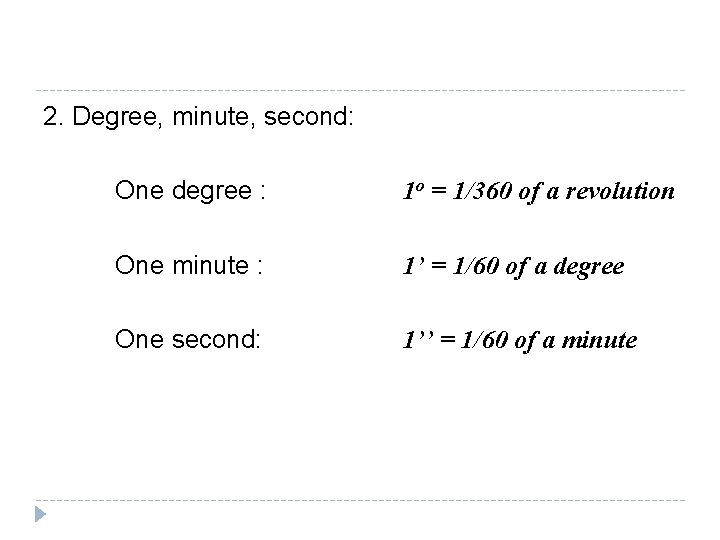
2. Degree, minute, second: One degree : 1 o = 1/360 of a revolution One minute : 1’ = 1/60 of a degree One second: 1’’ = 1/60 of a minute
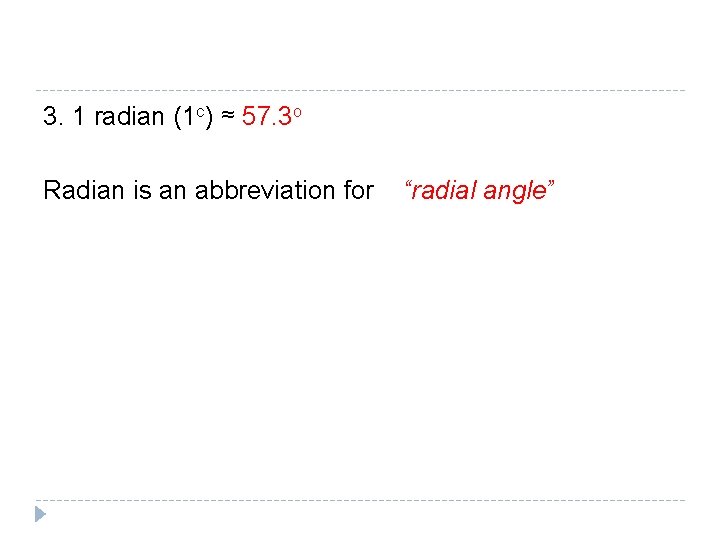
3. 1 radian (1 c) ≈ 57. 3 o Radian is an abbreviation for “radial angle”
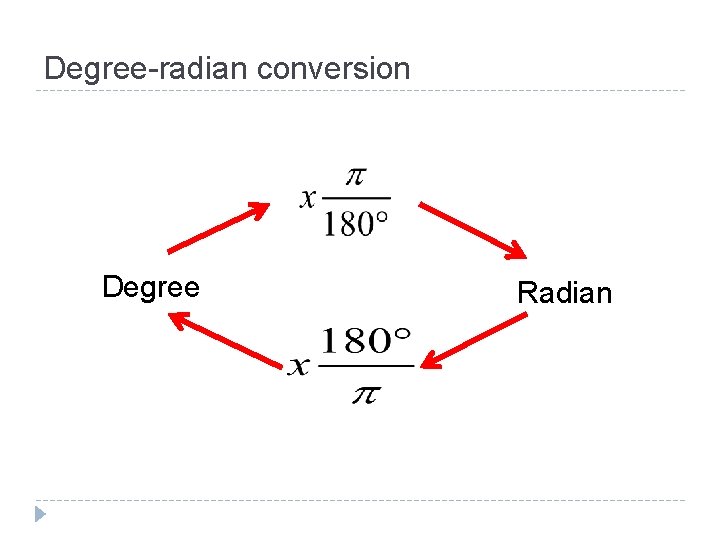
Degree-radian conversion Degree Radian
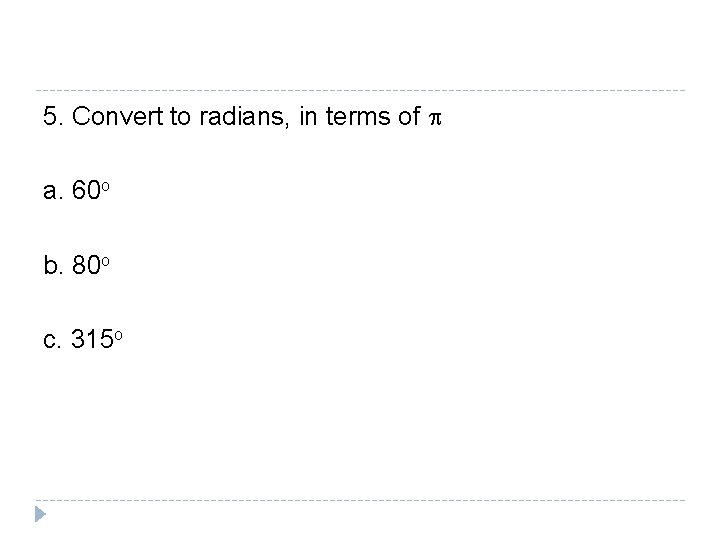
5. Convert to radians, in terms of p a. 60 o b. 80 o c. 315 o
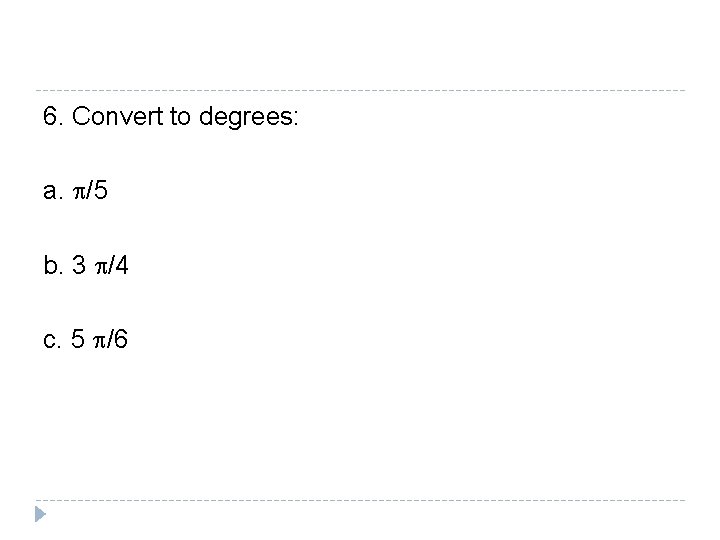
6. Convert to degrees: a. p/5 b. 3 p/4 c. 5 p/6
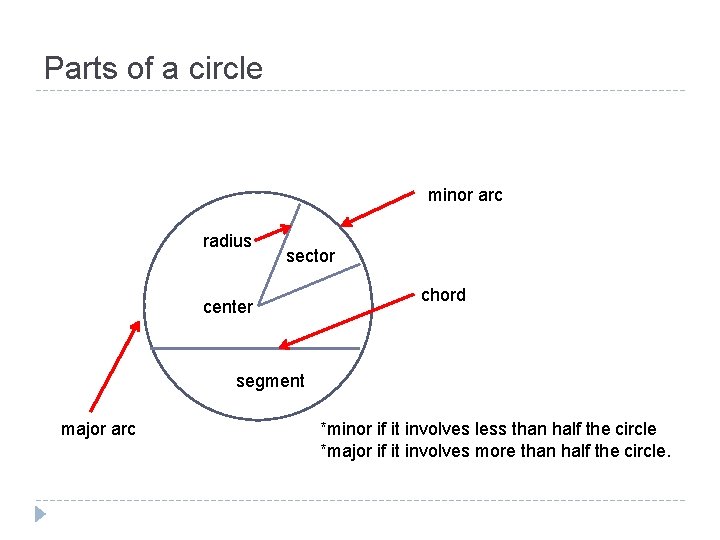
Parts of a circle minor arc radius sector chord center segment major arc *minor if it involves less than half the circle *major if it involves more than half the circle.
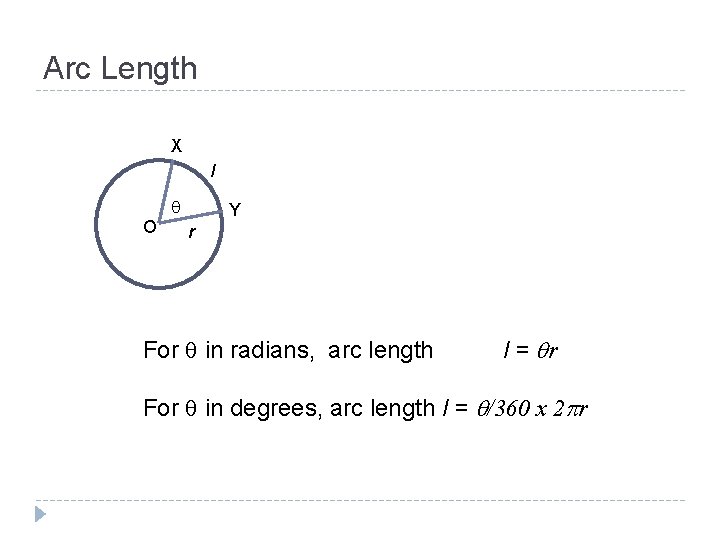
Arc Length X l q O Y r For q in radians, arc length l = qr For q in degrees, arc length l = q/360 x 2 pr
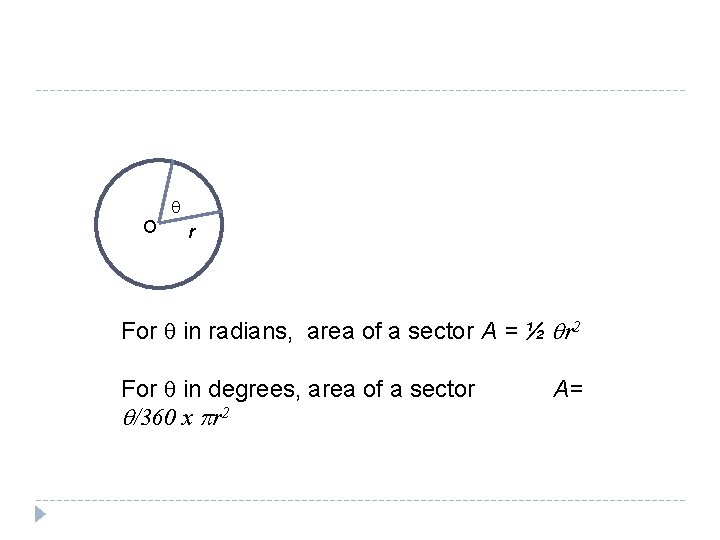
q O r For q in radians, area of a sector A = ½ qr 2 For q in degrees, area of a sector q/360 x pr 2 A=
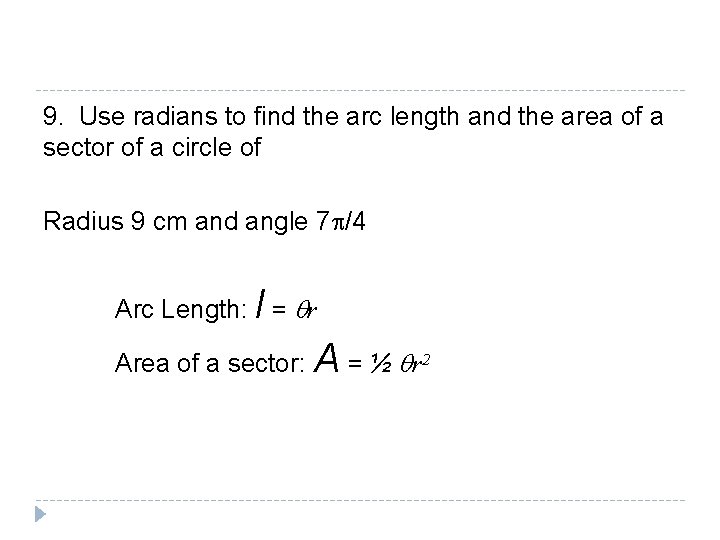
9. Use radians to find the arc length and the area of a sector of a circle of Radius 9 cm and angle 7 p/4 Arc Length: l = qr Area of a sector: A = ½ qr 2
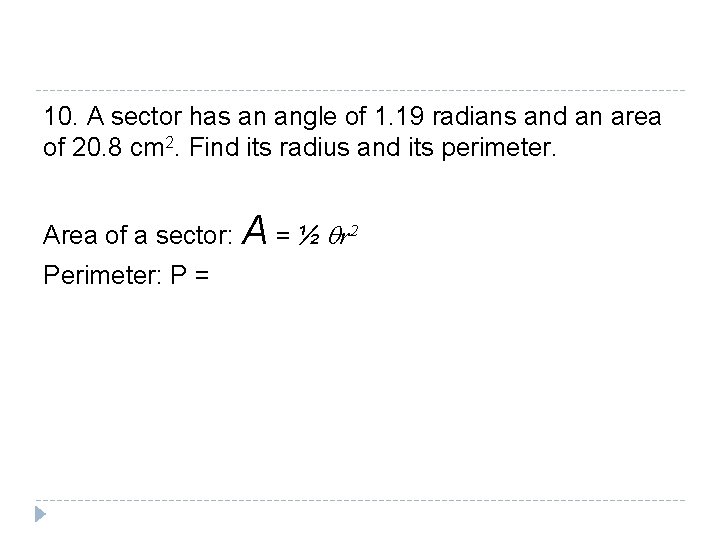
10. A sector has an angle of 1. 19 radians and an area of 20. 8 cm 2. Find its radius and its perimeter. Area of a sector: A = ½ qr 2 Perimeter: P =
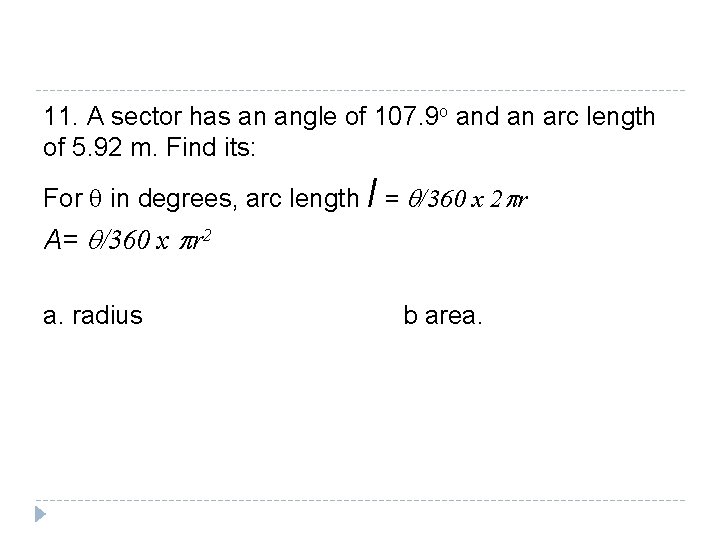
11. A sector has an angle of 107. 9 o and an arc length of 5. 92 m. Find its: For q in degrees, arc length l = q/360 x 2 pr A= q/360 x pr 2 a. radius b area.
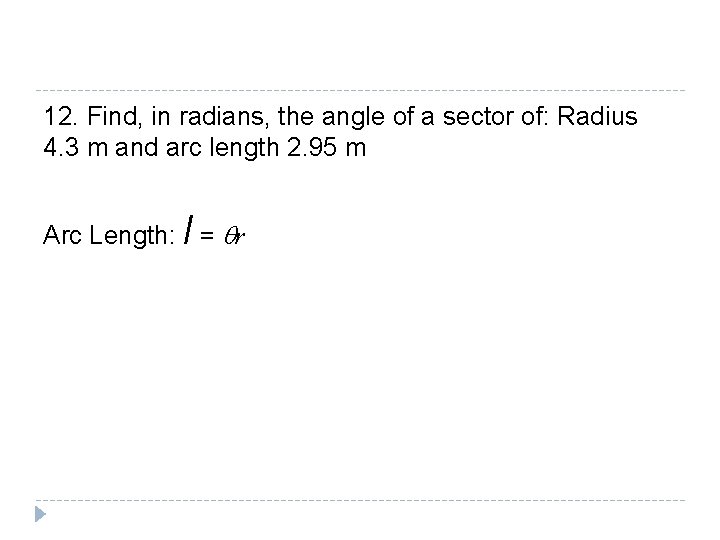
12. Find, in radians, the angle of a sector of: Radius 4. 3 m and arc length 2. 95 m Arc Length: l = qr
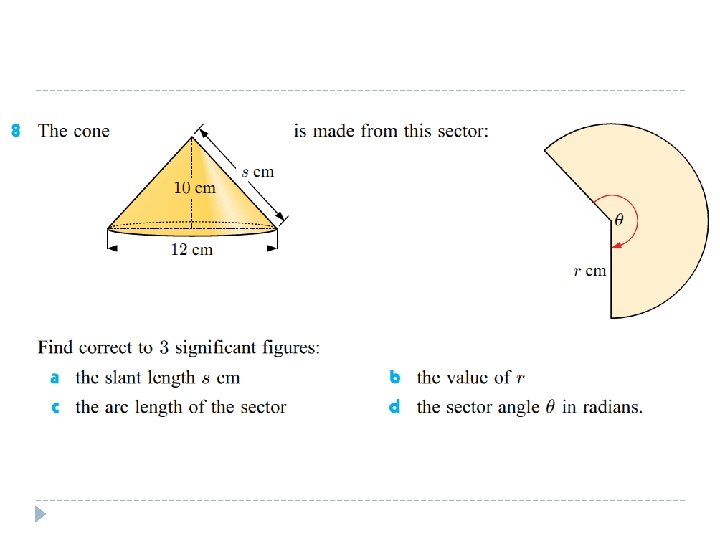
13. (number 8 in Exercise 8 B)
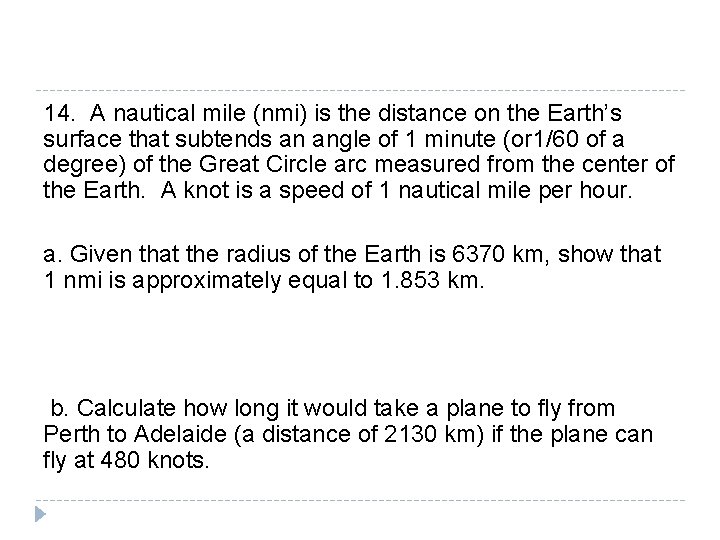
14. A nautical mile (nmi) is the distance on the Earth’s surface that subtends an angle of 1 minute (or 1/60 of a degree) of the Great Circle arc measured from the center of the Earth. A knot is a speed of 1 nautical mile per hour. a. Given that the radius of the Earth is 6370 km, show that 1 nmi is approximately equal to 1. 853 km. b. Calculate how long it would take a plane to fly from Perth to Adelaide (a distance of 2130 km) if the plane can fly at 480 knots.
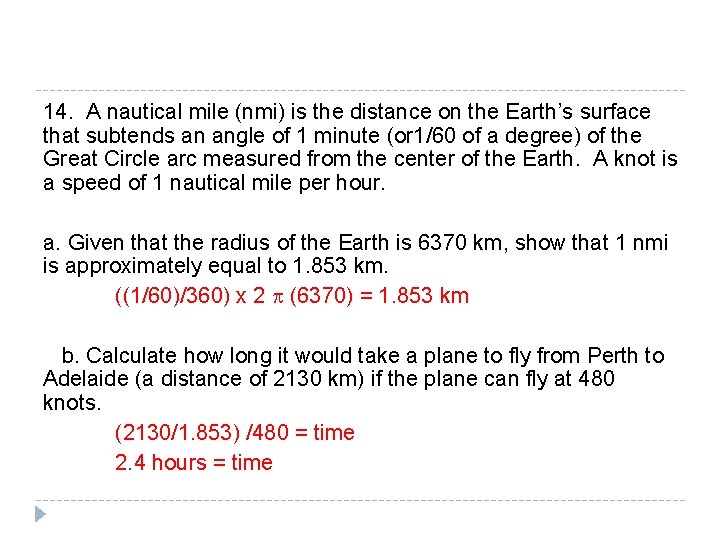
14. A nautical mile (nmi) is the distance on the Earth’s surface that subtends an angle of 1 minute (or 1/60 of a degree) of the Great Circle arc measured from the center of the Earth. A knot is a speed of 1 nautical mile per hour. a. Given that the radius of the Earth is 6370 km, show that 1 nmi is approximately equal to 1. 853 km. ((1/60)/360) x 2 p (6370) = 1. 853 km b. Calculate how long it would take a plane to fly from Perth to Adelaide (a distance of 2130 km) if the plane can fly at 480 knots. (2130/1. 853) /480 = time 2. 4 hours = time
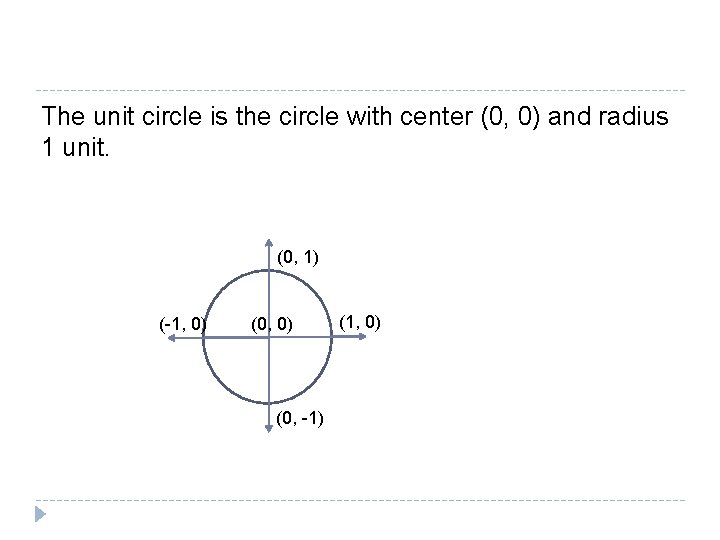
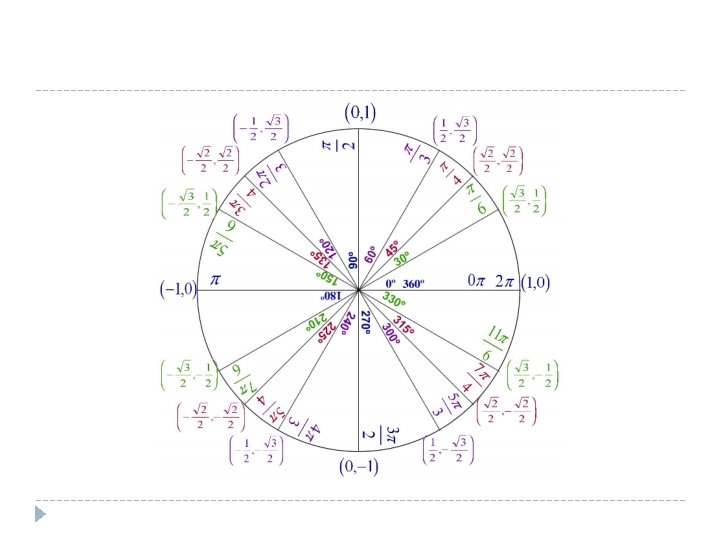
The unit circle is the circle with center (0, 0) and radius 1 unit. (0, 1) (-1, 0) (0, -1) (1, 0)
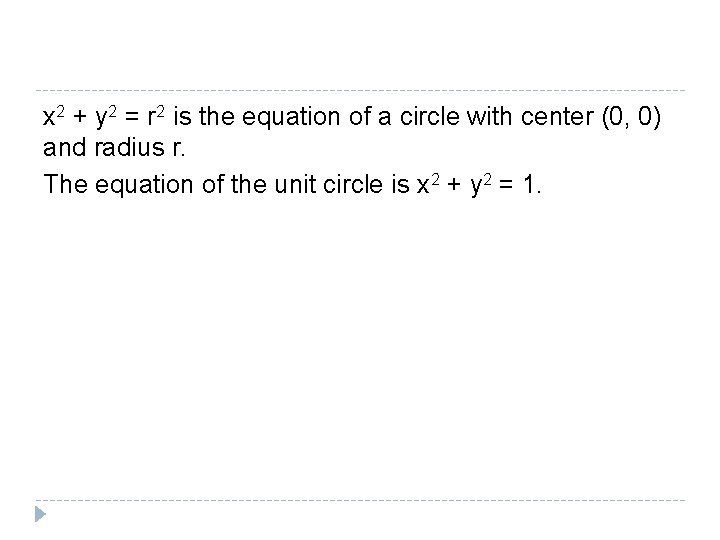
x 2 + y 2 = r 2 is the equation of a circle with center (0, 0) and radius r. The equation of the unit circle is x 2 + y 2 = 1.
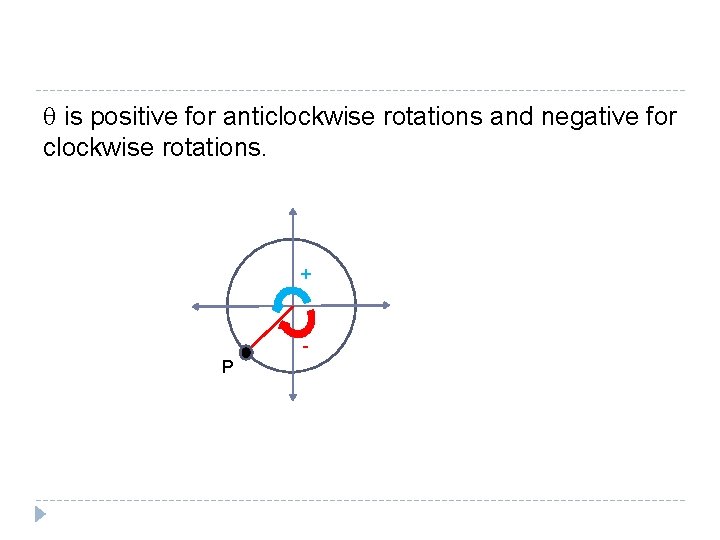
q is positive for anticlockwise rotations and negative for clockwise rotations. + P
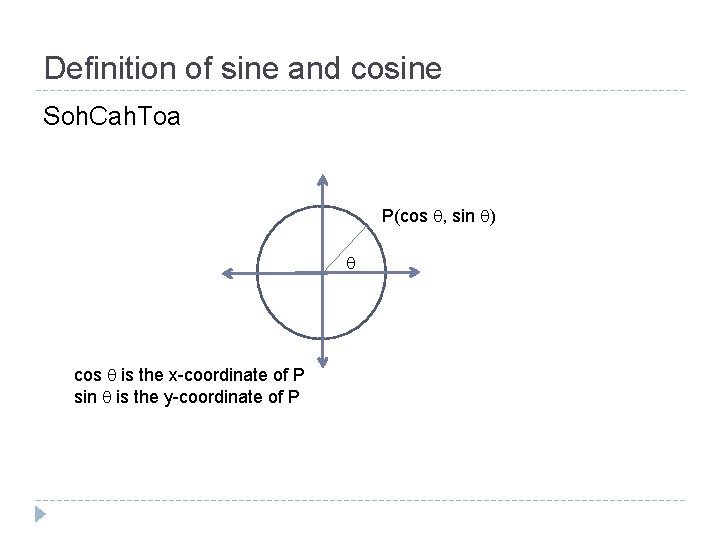
Definition of sine and cosine Soh. Cah. Toa P(cos q, sin q) q cos q is the x-coordinate of P sin q is the y-coordinate of P
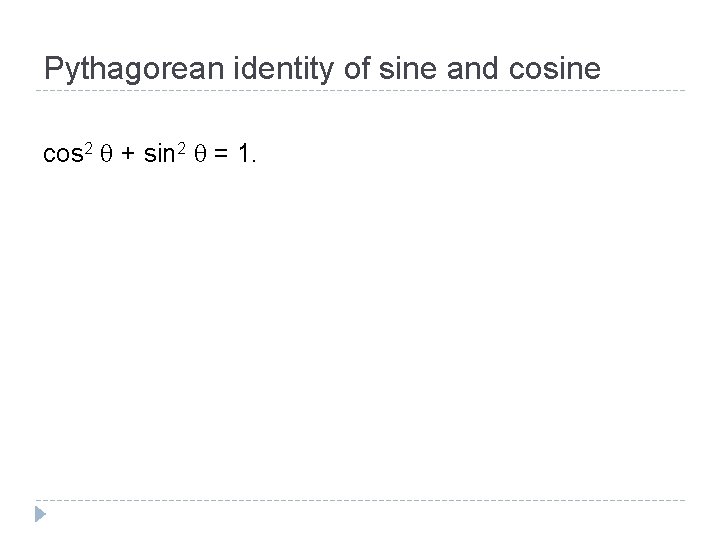
Pythagorean identity of sine and cosine cos 2 q + sin 2 q = 1.
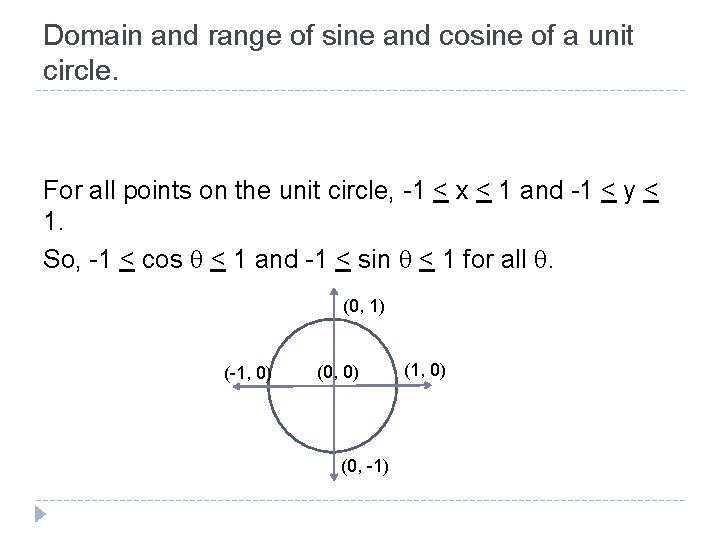
Domain and range of sine and cosine of a unit circle. For all points on the unit circle, -1 < x < 1 and -1 < y < 1. So, -1 < cos q < 1 and -1 < sin q < 1 for all q. (0, 1) (-1, 0) (0, -1) (1, 0)
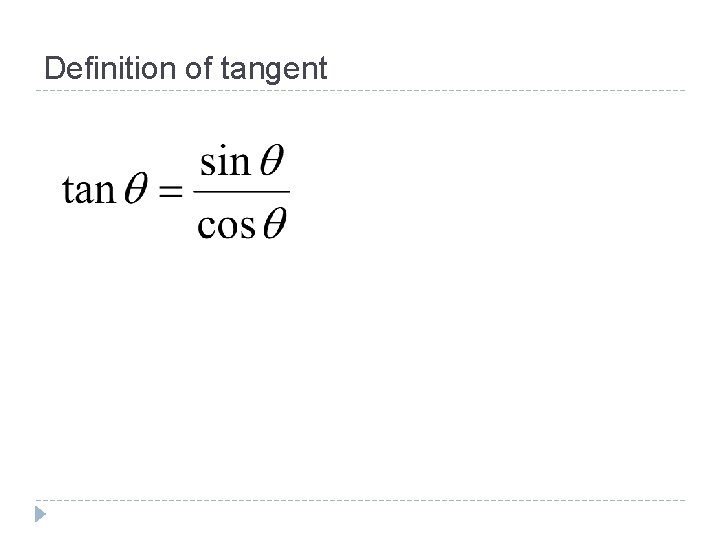
Definition of tangent
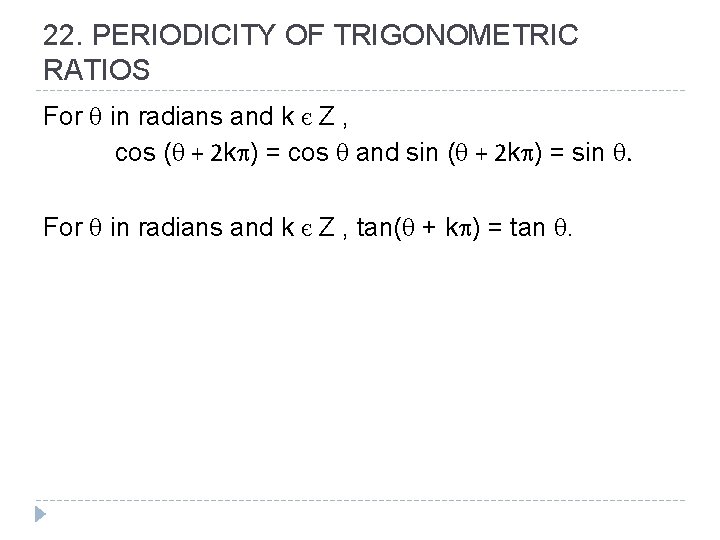
22. PERIODICITY OF TRIGONOMETRIC RATIOS For q in radians and k є Z , cos (q + 2 kp) = cos q and sin (q + 2 kp) = sin q. For q in radians and k є Z , tan(q + kp) = tan q.
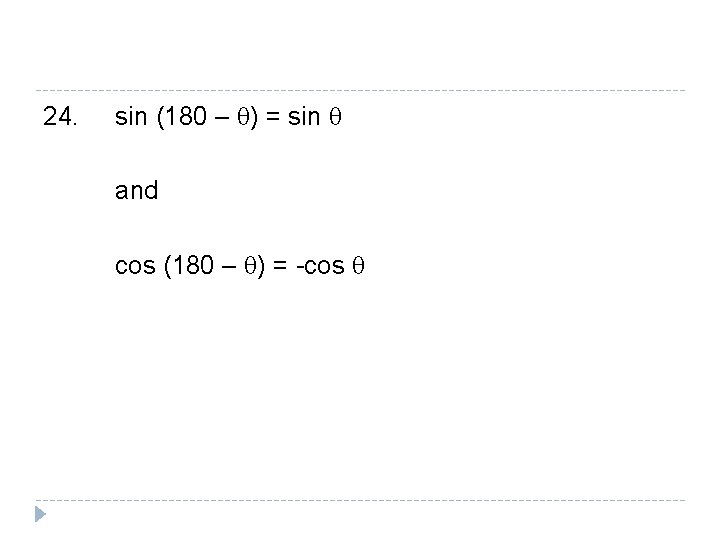
24. sin (180 – q) = sin q and cos (180 – q) = -cos q
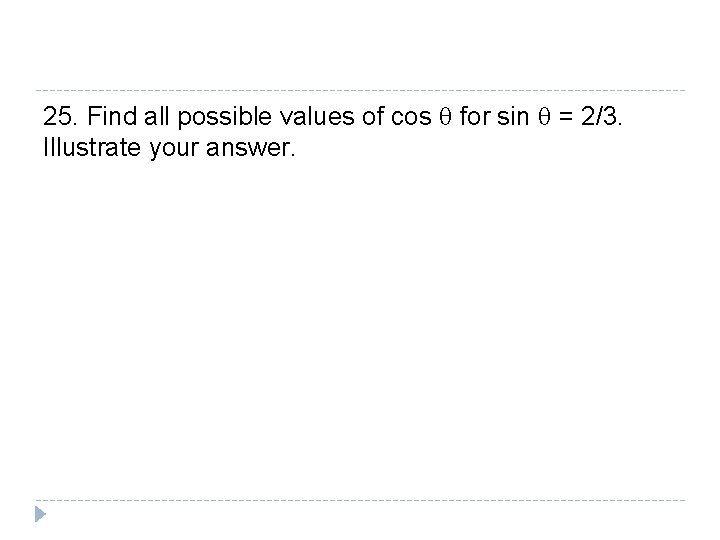
25. Find all possible values of cos q for sin q = 2/3. Illustrate your answer.
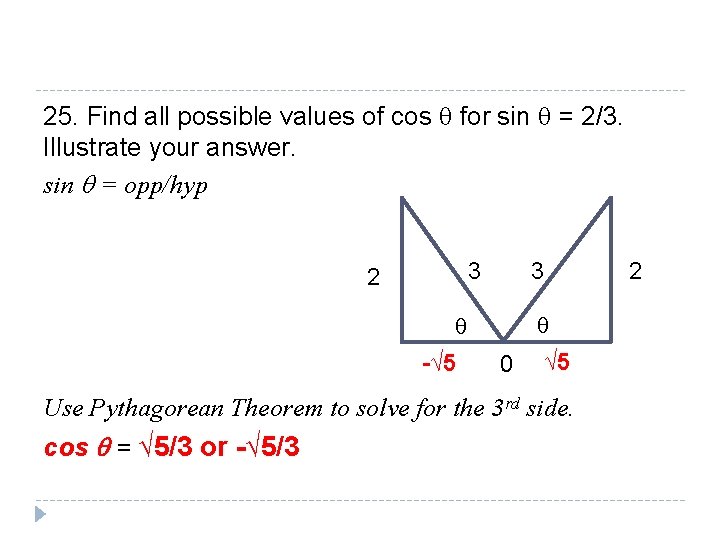
25. Find all possible values of cos q for sin q = 2/3. Illustrate your answer. sin q = opp/hyp 3 2 3 q q -√ 5 0 √ 5 Use Pythagorean Theorem to solve for the 3 rd side. cos q = √ 5/3 or -√ 5/3 2
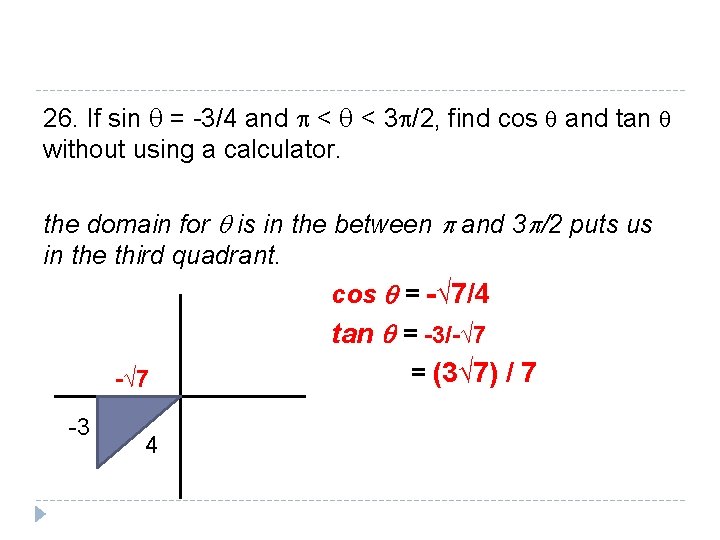
26. If sin q = -3/4 and p < q < 3 p/2, find cos q and tan q without using a calculator.
26. If sin q = -3/4 and p < q < 3 p/2, find cos q and tan q without using a calculator. the domain for q is in the between p and 3 p/2 puts us in the third quadrant. cos q = -√ 7/4 -√ 7 -3 4 tan q = -3/-√ 7 = (3√ 7) / 7
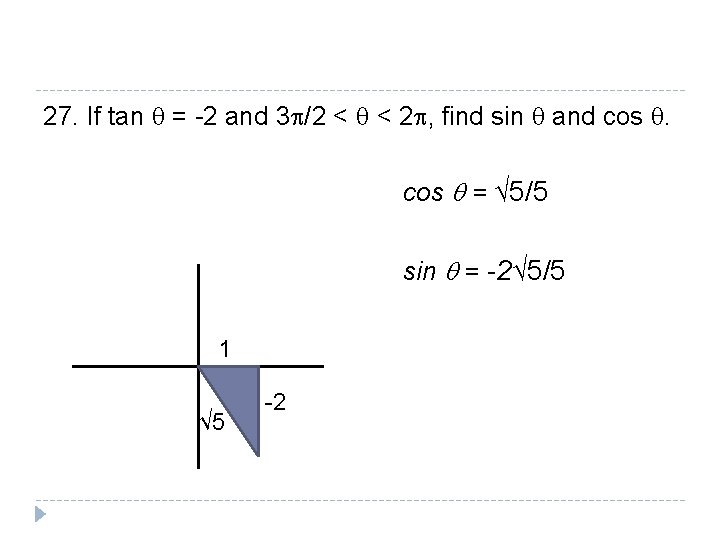
27. If tan q = -2 and 3 p/2 < q < 2 p, find sin q and cos q.
27. If tan q = -2 and 3 p/2 < q < 2 p, find sin q and cos q = √ 5/5 sin q = -2√ 5/5 1 √ 5 -2
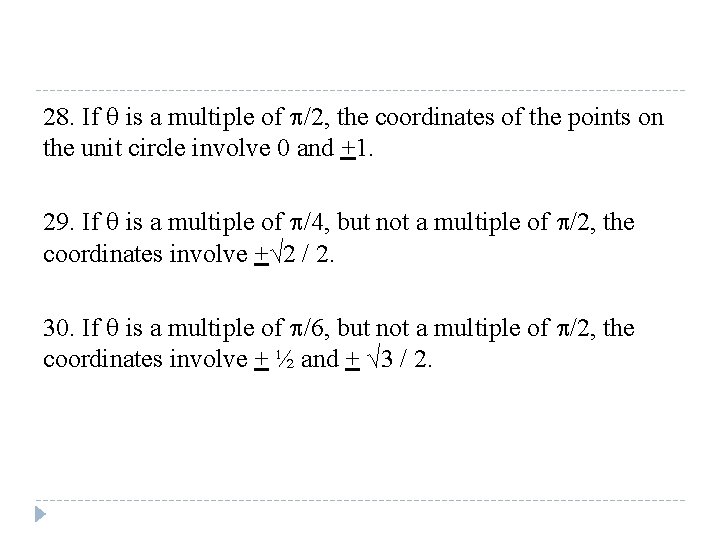
28. If q is a multiple of p/2, the coordinates of the points on the unit circle involve 0 and +1. 29. If q is a multiple of p/4, but not a multiple of p/2, the coordinates involve +√ 2 / 2. 30. If q is a multiple of p/6, but not a multiple of p/2, the coordinates involve + ½ and + √ 3 / 2.
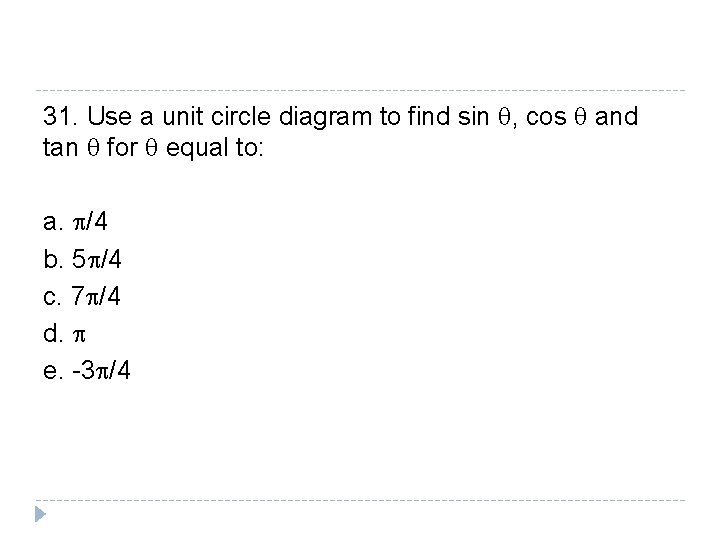
31. Use a unit circle diagram to find sin q, cos q and tan q for q equal to: a. p/4 b. 5 p/4 c. 7 p/4 d. p e. -3 p/4
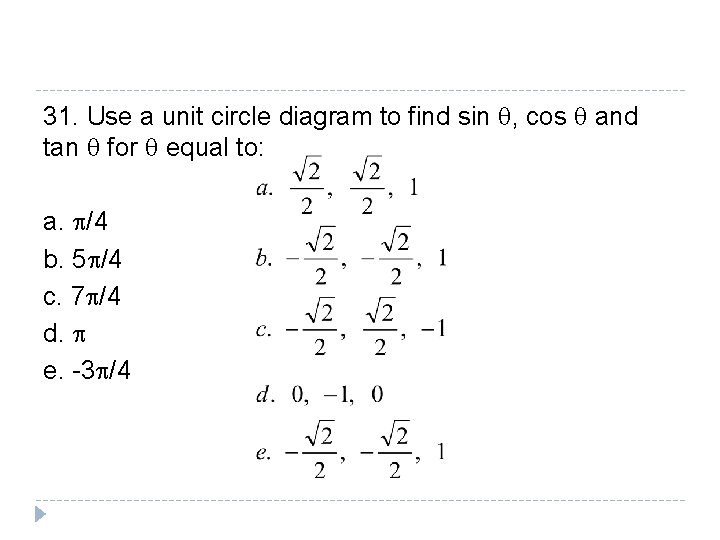
31. Use a unit circle diagram to find sin q, cos q and tan q for q equal to: a. p/4 b. 5 p/4 c. 7 p/4 d. p e. -3 p/4
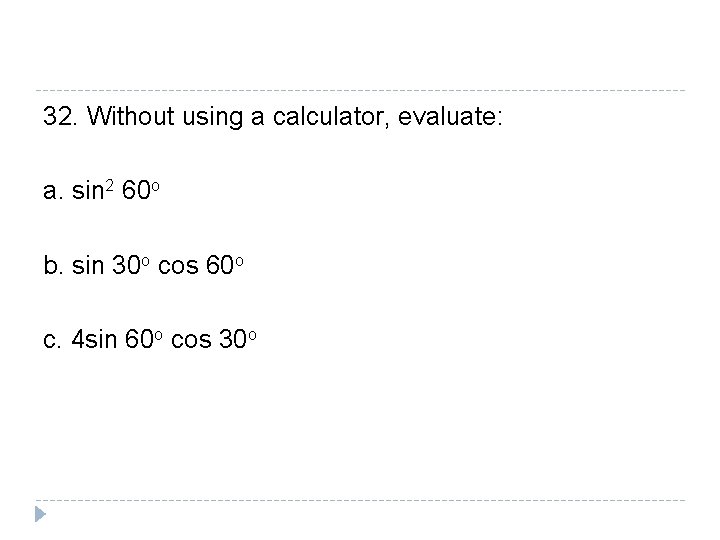
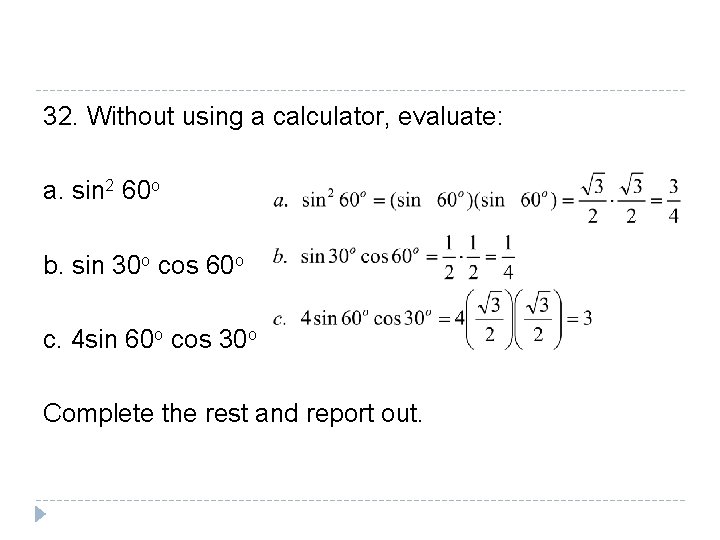
32. Without using a calculator, evaluate: a. sin 2 60 o b. sin 30 o cos 60 o c. 4 sin 60 o cos 30 o
32. Without using a calculator, evaluate: a. sin 2 60 o b. sin 30 o cos 60 o c. 4 sin 60 o cos 30 o Complete the rest and report out.
33. Equation of a straight line. If a straight line makes an angle of q with the positive x -axis then its gradient is m = tan q