
Chapter 8 Understanding Students with AttentionDeficit Hyperactivity Disorder

- Slides: 17
Chapter 8 Understanding Students with Attention-Deficit/ Hyperactivity Disorder Exceptional Lives: Special Education in Today’s School, 6 e ISBN: 0135027012 © 2010 Pearson Education, Inc. All rights reserved.
Chapter 8 Objectives At the end of this chapter you should be able to: n n Explain the three types of AD/HD: the predominantly inattentive type, the predominantly hyperactive-impulsive type, and the combined type. Articulate causes of ADHD Identify appropriate accommodations for students with AD/HD. Describe successful instructional practices for students with AD/HD. Exceptional Lives: Special Education in Today’s Schools, 6 e Ann Turnbull, Rud Turnbull, and Michael Wehmeyer ISBN: 0135027012 2 © 2010 Pearson Education, Inc. All Rights Reserved.
Defining Attention Deficit/ Hyperactivity Disorder n n n The condition must adversely impact the student’s academic performance to receive services Students usually receive services under “other health impairments” since there is no IDEA category for AD/HD APA definition n Persistent pattern of inattention and/or hyperactivity-impulsivity more frequent and severe than typical n Manifest before age 7, duration at least 6 months, present in 2 or more settings, not attributed to other disability Exceptional Lives: Special Education in Today’s Schools, 6 e Ann Turnbull, Rud Turnbull, and Michael Wehmeyer ISBN: 0135027012 3 © 2010 Pearson Education, Inc. All Rights Reserved.
Prevalence of AD/HD n n Approximately 3 to 8% of school-age children have AD/HD 4. 2% for preschoolers More boys than girls Latinos less likely to receive AD/HD diagnosis Exceptional Lives: Special Education in Today’s Schools, 6 e Ann Turnbull, Rud Turnbull, and Michael Wehmeyer ISBN: 0135027012 4 © 2010 Pearson Education, Inc. All Rights Reserved.
Three Subtypes of AD/HD n n n Predominantly inattentive type n Trouble paying attention, forgetful, easily distracted, selective attention n Students may appear lethargic, apathetic, or hypoactive (move or respond too slowly). n May be overlooked Predominantly hyperactive-impulsive type n Cannot seem to sit still, talk excessively, difficulty playing quietly n Few adolescents or adults have the HI type. Combined type n Combines features of inattention and hyperactivity n The majority of students with AD/HD are combined type Exceptional Lives: Special Education in Today’s Schools, 6 e Ann Turnbull, Rud Turnbull, and Michael Wehmeyer ISBN: 0135027012 5 © 2010 Pearson Education, Inc. All Rights Reserved.
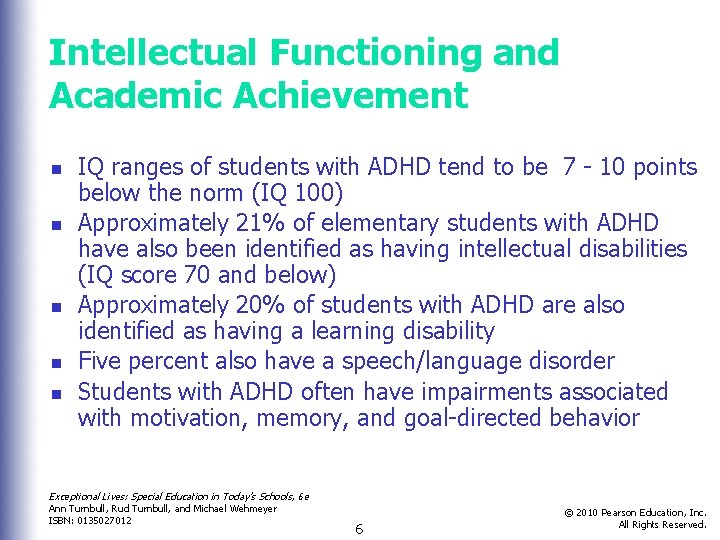
Intellectual Functioning and Academic Achievement n n n IQ ranges of students with ADHD tend to be 7 - 10 points below the norm (IQ 100) Approximately 21% of elementary students with ADHD have also been identified as having intellectual disabilities (IQ score 70 and below) Approximately 20% of students with ADHD are also identified as having a learning disability Five percent also have a speech/language disorder Students with ADHD often have impairments associated with motivation, memory, and goal-directed behavior Exceptional Lives: Special Education in Today’s Schools, 6 e Ann Turnbull, Rud Turnbull, and Michael Wehmeyer ISBN: 0135027012 6 © 2010 Pearson Education, Inc. All Rights Reserved.
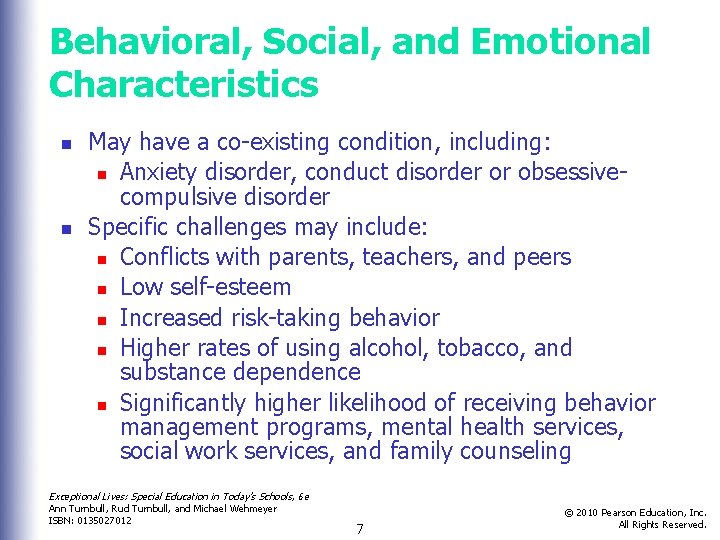
Behavioral, Social, and Emotional Characteristics n n May have a co-existing condition, including: n Anxiety disorder, conduct disorder or obsessivecompulsive disorder Specific challenges may include: n Conflicts with parents, teachers, and peers n Low self-esteem n Increased risk-taking behavior n Higher rates of using alcohol, tobacco, and substance dependence n Significantly higher likelihood of receiving behavior management programs, mental health services, social work services, and family counseling Exceptional Lives: Special Education in Today’s Schools, 6 e Ann Turnbull, Rud Turnbull, and Michael Wehmeyer ISBN: 0135027012 7 © 2010 Pearson Education, Inc. All Rights Reserved.
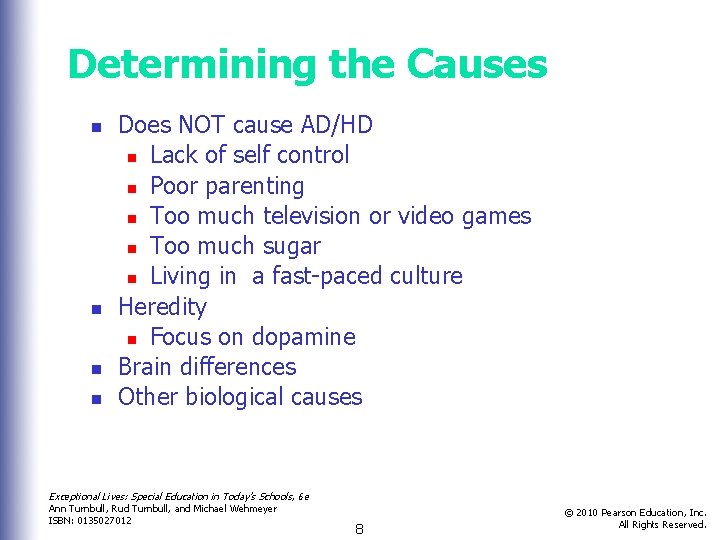
Determining the Causes n n Does NOT cause AD/HD n Lack of self control n Poor parenting n Too much television or video games n Too much sugar n Living in a fast-paced culture Heredity n Focus on dopamine Brain differences Other biological causes Exceptional Lives: Special Education in Today’s Schools, 6 e Ann Turnbull, Rud Turnbull, and Michael Wehmeyer ISBN: 0135027012 8 © 2010 Pearson Education, Inc. All Rights Reserved.
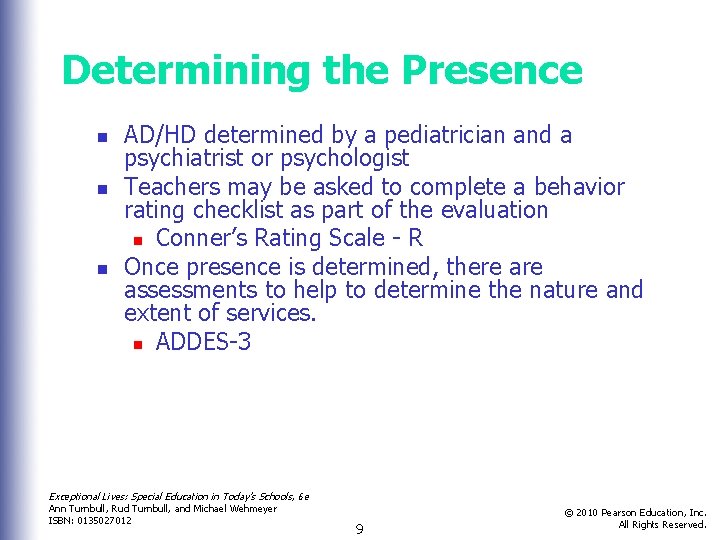
Determining the Presence n n n AD/HD determined by a pediatrician and a psychiatrist or psychologist Teachers may be asked to complete a behavior rating checklist as part of the evaluation n Conner’s Rating Scale - R Once presence is determined, there assessments to help to determine the nature and extent of services. n ADDES-3 Exceptional Lives: Special Education in Today’s Schools, 6 e Ann Turnbull, Rud Turnbull, and Michael Wehmeyer ISBN: 0135027012 9 © 2010 Pearson Education, Inc. All Rights Reserved.
Partnering for Special Education and Related Services n n Not every student with AD/HD qualifies for IDEA services n They may be able to receive services through Section 504 One role of the IEP or 504 team is to develop educational plans that may or may not be used in conjunction with medication n Team members should never suggest a child needs medication. Only a doctor can make that determination. n Teams also cannot make taking medication a requirement of attending school. Exceptional Lives: Special Education in Today’s Schools, 6 e Ann Turnbull, Rud Turnbull, and Michael Wehmeyer ISBN: 0135027012 10 © 2010 Pearson Education, Inc. All Rights Reserved.
Determining Supplementary Aids and Services n n n n Arrange the classroom in a consistent manner It is not always best to seat students with peers Seat the student in close proximity to the teacher Do not seat students with hyperactivity/impulsivity close to highly distracting areas Clearly post daily and weekly schedules Arrange the classroom to facilitate smooth transitions between classroom activities Minimize classroom clutter Exceptional Lives: Special Education in Today’s Schools, 6 e Ann Turnbull, Rud Turnbull, and Michael Wehmeyer ISBN: 0135027012 11 © 2010 Pearson Education, Inc. All Rights Reserved.
Planning for Universal Design for Learning n n Planning for Universal Design for Learning n Students need to learn organization and neatness n Goal setting can improve organization skills n Identify and define a goal n Develop a series of objectives or tasks n Specify actions necessary to achieve desired outcomes n Make goals challenging but obtainable Planning for Other Educational Needs n Teachers should play a role in monitoring children on medication for changes or side effects Exceptional Lives: Special Education in Today’s Schools, 6 e Ann Turnbull, Rud Turnbull, and Michael Wehmeyer ISBN: 0135027012 12 © 2010 Pearson Education, Inc. All Rights Reserved.
Early Childhood Students n Multidisciplinary Diagnostic and Training Program n Multimodal treatments n Medication n Parent Training n Classroom Behavioral Management Interventions Exceptional Lives: Special Education in Today’s Schools, 6 e Ann Turnbull, Rud Turnbull, and Michael Wehmeyer ISBN: 0135027012 13 © 2010 Pearson Education, Inc. All Rights Reserved.
Elementary and Middle School Students n Errorless learning n Presents discriminative stimuli and arranges the delivery of prompts in a learning situation in such a way as to ensure that the student gives only correct responses (or only a few incorrect responses) n Prompts can be physical, verbal, or visual n Premise is that learning that occurs without mistakes is stronger and lasts longer n Use “most to least” prompting, most intrusive at first, then, as task is mastered, prompts fade Exceptional Lives: Special Education in Today’s Schools, 6 e Ann Turnbull, Rud Turnbull, and Michael Wehmeyer ISBN: 0135027012 14 © 2010 Pearson Education, Inc. All Rights Reserved.
Secondary and Transition Students n Cognitive behavioral and self-control strategies n Teach the use of inner speech, “Self-talk” n The purpose of cognitive behavioral strategies is to modify behavior and thinking patterns n Possible benefits of this method are increased capacity to self-control and selfregulate behavior Exceptional Lives: Special Education in Today’s Schools, 6 e Ann Turnbull, Rud Turnbull, and Michael Wehmeyer ISBN: 0135027012 15 © 2010 Pearson Education, Inc. All Rights Reserved.
Measuring Students’ Progress n n Progress In the General Curriculum n Curriculum-based management n Goal Attainment Scaling (GAS) process Progress in Addressing Other Educational Needs n Monitor progress in areas such as social skills, self-control, medication management n T-Charts n Checklists Exceptional Lives: Special Education in Today’s Schools, 6 e Ann Turnbull, Rud Turnbull, and Michael Wehmeyer ISBN: 0135027012 16 © 2010 Pearson Education, Inc. All Rights Reserved.
Making Accommodations for Assessment n Issues include attention and concentration problems n May qualify to take extra breaks n May need multiple testing sessions n May request a reduced-distraction testing environment Exceptional Lives: Special Education in Today’s Schools, 6 e Ann Turnbull, Rud Turnbull, and Michael Wehmeyer ISBN: 0135027012 17 © 2010 Pearson Education, Inc. All Rights Reserved.