
Chapter 8 Transport Across Membranes Overcoming The Permeability
Chapter 8 Transport. Across. Membranes: Overcoming The Permeability Barrier 1. Cells And Transport Processes 2. Simple Diffusion 3. Facilitated diffusion 4. Active Transport 5. An Example of Active Transport 6. The Energetic of Transport
1. Cells and Transport Processes 1. Many cell molecules are involved in transport processes across membrane. § Ions: Na+, K+, Ca 2+ , CI-, and H+ § small organic and inorganic molecules: Sugars, amino acids, and nucleotides, oxygen, carbon dioxide, ethanol. § Macromolecules 2. Three different mechanisms. Simple diffusion: Unassisted net movement of a solute from a region where its concentration is higher to a region where its concentration is lower, such as small, nonpolar molecules (oxygen, carbon dioxide, water, ethanol) Facilitated diffusion: Membrane proteinmediated movement of a substance across a membrane – move down to an electrochemical gradient (without energy input). For example, glucose, Cl-, and HCO 3 -.

Active transport: Membrane proteinmediated movement of a substance across a membrane against a concentration or electrochemical gradient, which requires energy input. For example, H+, K+, Na+, and Ca+ 3. Erythrocyte plasma membrane provides examples of transport mechanisms. O 2, CO 2, H 2 O HCO 3 -, and Glucose. Na+, K+
Chapter 8 Transport. Across. Membranes: Overcoming The Permeability Barrier 1. Cells And Transport Processes 2. Simple Diffusion 3. Facilitated diffusion 4. Active Transport 5. An Example of Active Transport 6. The Energetic of Transport
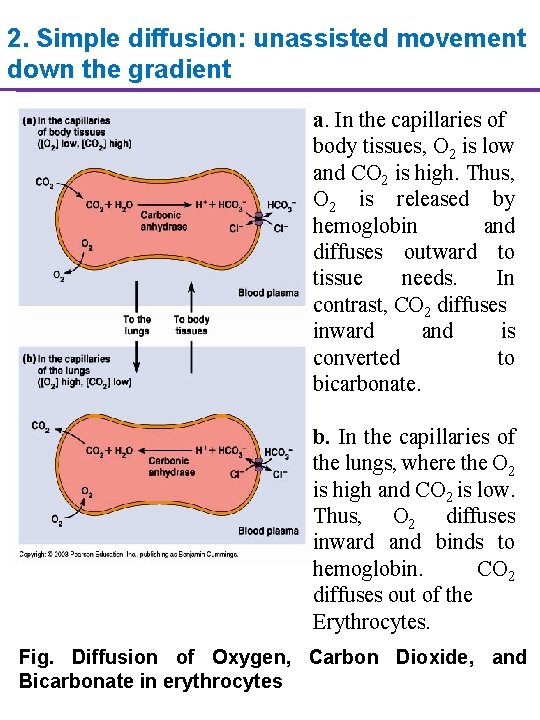
2. Simple diffusion: unassisted movement down the gradient a. In the capillaries of body tissues, O 2 is low and CO 2 is high. Thus, O 2 is released by hemoglobin and diffuses outward to tissue needs. In contrast, CO 2 diffuses inward and is converted to bicarbonate. b. In the capillaries of the lungs, where the O 2 is high and CO 2 is low. Thus, O 2 diffuses inward and binds to hemoglobin. CO 2 diffuses out of the Erythrocytes. Fig. Diffusion of Oxygen, Carbon Dioxide, and Bicarbonate in erythrocytes
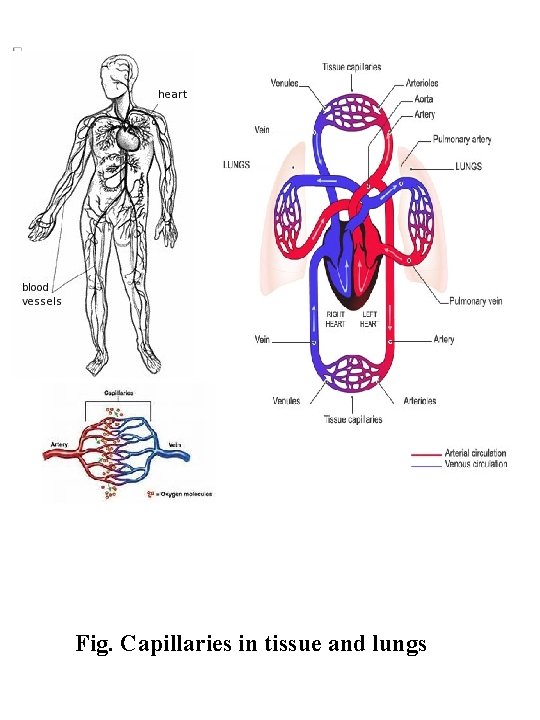
Fig. Capillaries in tissue and lungs
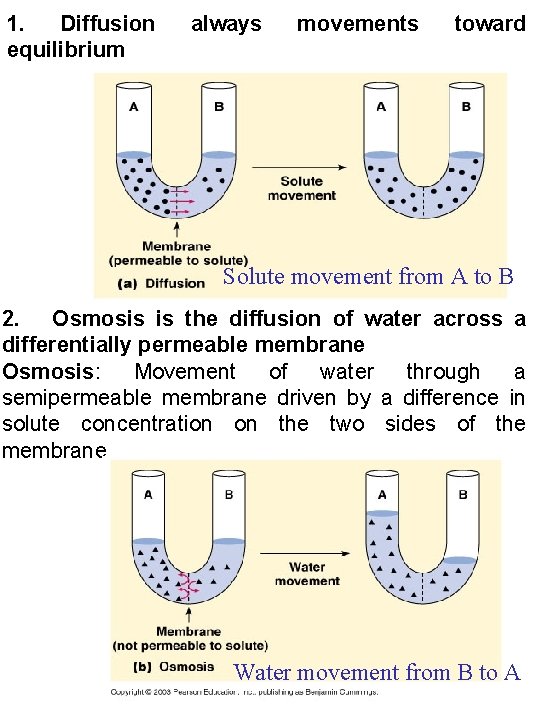
1. Diffusion equilibrium always movements toward Solute movement from A to B 2. Osmosis is the diffusion of water across a differentially permeable membrane Osmosis: Movement of water through a semipermeable membrane driven by a difference in solute concentration on the two sides of the membrane. Water movement from B to A

Isoosmotic solution: two solutions have equal (solute) concentration. Hyperosmotic solution: If two solutions have unequal osmotic concentrations, the solution with the higher concentration is hyperosmotic. Hypoosmotic solution: The solution with the lower concentration. In cells, a plasma membrane separates two aqueous solutions. The direction of the net diffusion of water across this membrane is determined by the osmotic concentrations of the solutions on either side.

3. Simple diffusion is limited to small, nonpolar molecules Factors affect simple diffusion: (Lipid bilayer is the primary permeability barrier of a membrane) Solute Size: Lipid bilayers are more permeable to smaller molecules (such as oxygen, carbon dioxide, and water) than to larger molecules Solute Polarity: In general, lipid bilayers are relatively permeable to nonpolar molecules and less permeable to polar molecules. . Solute Charge: In general, lipid bilayers are impermeable to plar substances and very impermeable to ions.

4. Rate of simple diffusion is directly proportional to the concentration gradient inward = p S Conclusion: simple diffusion is characterized by a linear relationship between the inward flux of the solute across the membrane and the concentration gradient of the solute, with no evidence of saturation at high concentrations.
Chapter 8 Transport. Across. Membranes: Overcoming The Permeability Barrier 1. Cells And Transport Processes 2. Simple Diffusion 3. Facilitated diffusion 4. Active Transport 5. An Example of Active Transport 6. The Energetic of Transport
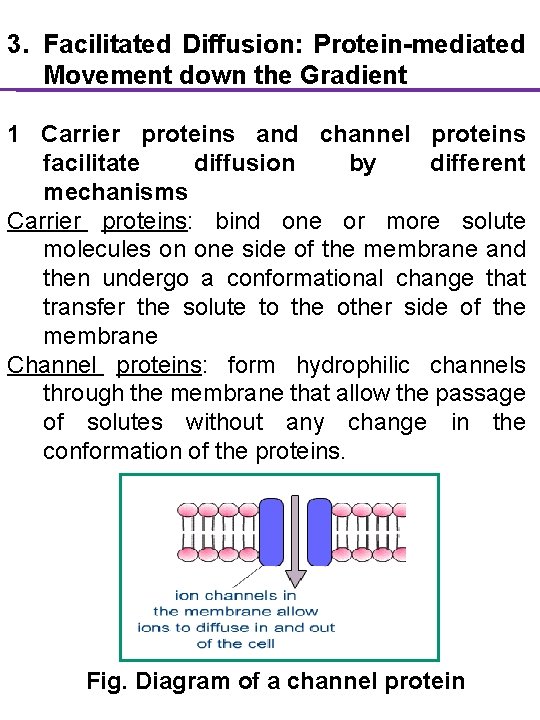
3. Facilitated Diffusion: Protein-mediated Movement down the Gradient 1 Carrier proteins and channel proteins facilitate diffusion by different mechanisms Carrier proteins: bind one or more solute molecules on one side of the membrane and then undergo a conformational change that transfer the solute to the other side of the membrane Channel proteins: form hydrophilic channels through the membrane that allow the passage of solutes without any change in the conformation of the proteins. Fig. Diagram of a channel protein

2. Carrier Proteins Alternate Between Two Conformational States. Alternating conformation model: Binding of a solute molecule or ion to the protein on one side of the membrane triggers a conformational change in the protein that opens the binding site to the other side of the membrane, thereby transferring the solute across the membrane.
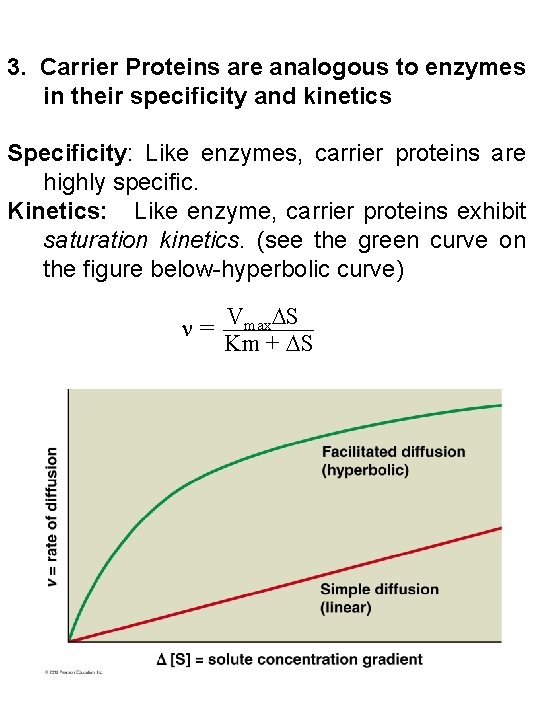
3. Carrier Proteins are analogous to enzymes in their specificity and kinetics Specificity: Like enzymes, carrier proteins are highly specific. Kinetics: Like enzyme, carrier proteins exhibit saturation kinetics. (see the green curve on the figure below-hyperbolic curve) = Vmax S Km + S
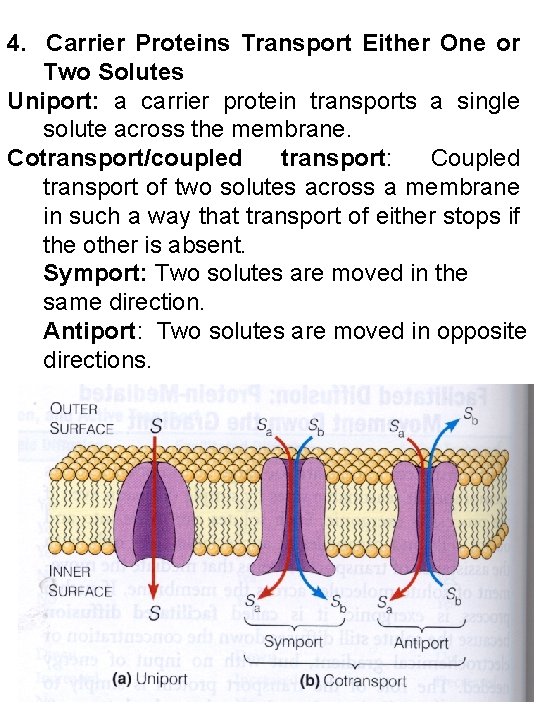
4. Carrier Proteins Transport Either One or Two Solutes Uniport: a carrier protein transports a single solute across the membrane. Cotransport/coupled transport: Coupled transport of two solutes across a membrane in such a way that transport of either stops if the other is absent. Symport: Two solutes are moved in the same direction. Antiport: Two solutes are moved in opposite directions.
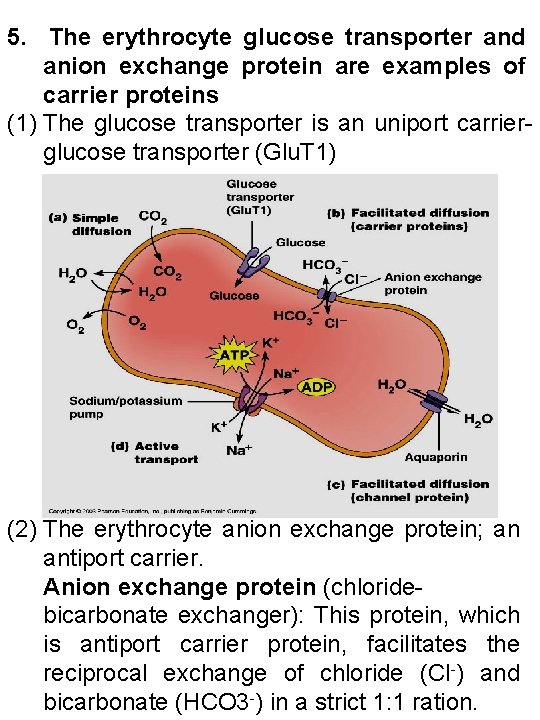
5. The erythrocyte glucose transporter and anion exchange protein are examples of carrier proteins (1) The glucose transporter is an uniport carrierglucose transporter (Glu. T 1) (2) The erythrocyte anion exchange protein; an antiport carrier. Anion exchange protein (chloridebicarbonate exchanger): This protein, which is antiport carrier protein, facilitates the reciprocal exchange of chloride (Cl-) and bicarbonate (HCO 3 -) in a strict 1: 1 ration.

6. Channel Proteins Facilitate Diffusion by Forming Hydrophilic Transmembrane Channels Channel proteins : form hydrophilic channels through the membrane that allow the passage of solutes without any change in the conformation of protein. (1) Ion channels: Allow rapid passage of specific ions. Na+, K+ Ca 2+, and CI-. Most ion channels are gated, which means that they can be opened and closed by conformational changes in the proteins. voltage-gated channels: responds to membrane potential ligand-gated channels: responds to binding of ligand mechanosensitive channels: respond to mechanical forces.
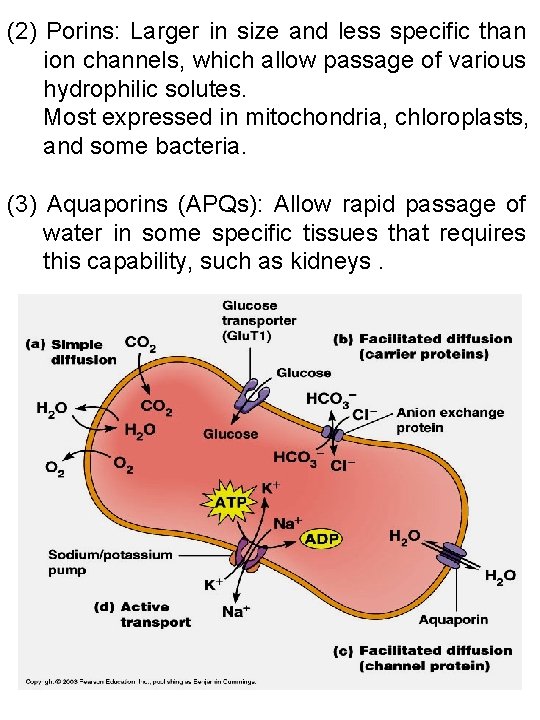
(2) Porins: Larger in size and less specific than ion channels, which allow passage of various hydrophilic solutes. Most expressed in mitochondria, chloroplasts, and some bacteria. (3) Aquaporins (APQs): Allow rapid passage of water in some specific tissues that requires this capability, such as kidneys.
Summary 1. Three different mechanisms are involved in the movement of solutes across membranes: simple diffusion, facilitated diffusion, and active transport. 3. Simple diffusion is unassisted movement down the gradient. This type diffusion is limited to small, nonpolar molecules, such as oxygen, ethanol, and CO 2. 4. Osmosis is the diffusion of water across a permeable membrane. Normally, cells are in isomostic water environment. Hyperosmotic and hypoosmotic (extracellular fluid) can cause a cell to shrink or swell, respectively. 5. Facilitated diffusion is dependent on either carrier proteins or channel proteins. Carrier proteins are analogous to enzymes in their specificity and kinetics. Channel proteins facilitates diffusion by forming hydrophilic transmembrane channels. There are three types of carrier proteins: uniport. symport, and antiport. Both symport and antiport called contransport. There also three types of the channel proteins: ion channels, porins, and aquaporins. Ion channels can further divided into voltage-gated channels, ligandgated channels, and mechanosensitive channels. 6. Porins are a little big and less specific than ion channels. As a result, porins allow passage of various hydrophilic solutes. 7. Aquaporins allow rapid passage of water in specific tissues that require this capability, such as kidneys.
- Slides: 19