
Chapter 8 Thermochemistry Chemical Energy Energy Energy capacity


- Slides: 40
Chapter 8 Thermochemistry: Chemical Energy
Energy • Energy – capacity to supply heat or do work Energy = Heat + Work E=q+w – 2 types of Energy • Potential Energy • Kinetic Energy
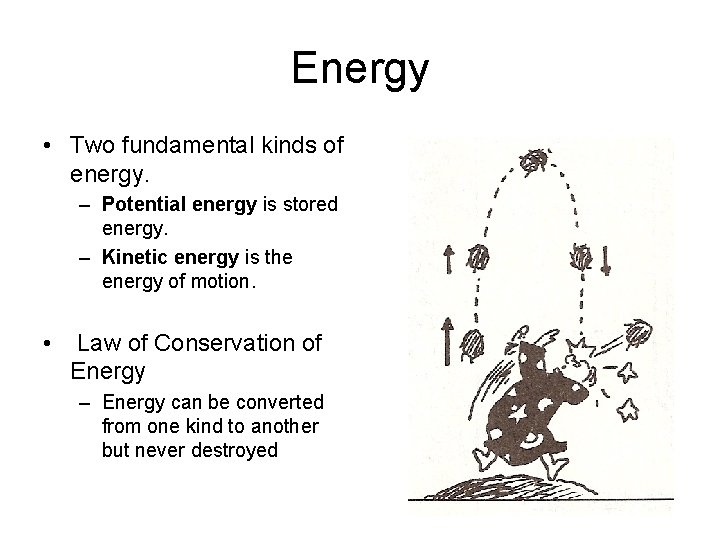
Energy • Two fundamental kinds of energy. – Potential energy is stored energy. – Kinetic energy is the energy of motion. • Law of Conservation of Energy – Energy can be converted from one kind to another but never destroyed
Energy • Units – SI Unit – Joule (J) – Additional units • Calorie (Cal) – food calorie • calorie (cal) – scientific calorie • Conversions – 1 cal = 4. 184 J – 1000 cal = 1 Cal
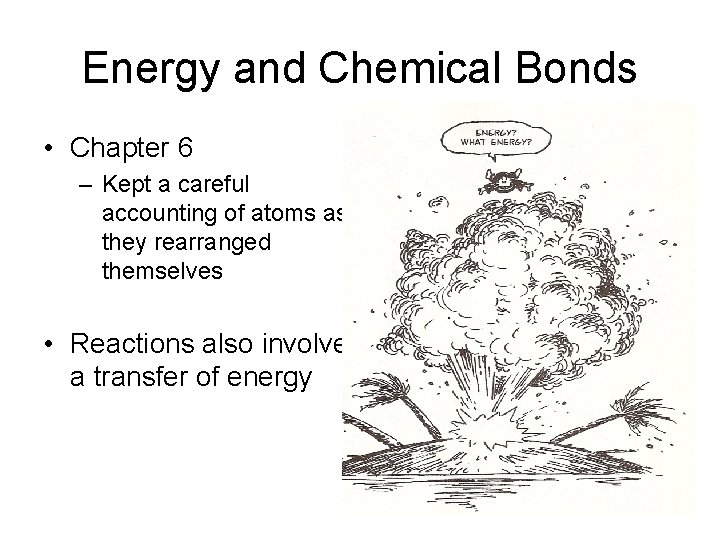
Energy and Chemical Bonds • Chapter 6 – Kept a careful accounting of atoms as they rearranged themselves • Reactions also involve a transfer of energy
Energy and Chemical Bonds • A chemical – Potential - attractive forces in an ionic compound or sharing of electrons covalent compound – Kinetic – (often in form of heat) occurs when bonds are broken and particles allowed to move – To determine the energy of a reaction it is necessary to keep track of the energy changes that occur during the reaction
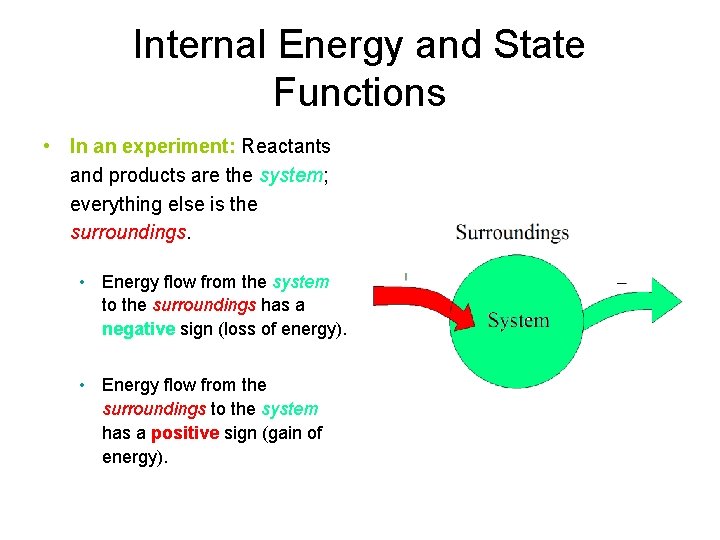
Internal Energy and State Functions • In an experiment: Reactants and products are the system; everything else is the surroundings. • Energy flow from the system to the surroundings has a negative sign (loss of energy). • Energy flow from the surroundings to the system has a positive sign (gain of energy).
Internal Energy and State Functions • Tracking energy changes – Energy changes are measured from the point of view of the system (Internal Energy - IE) • Change in Energy of the system – ΔE = Efinal - Einitial
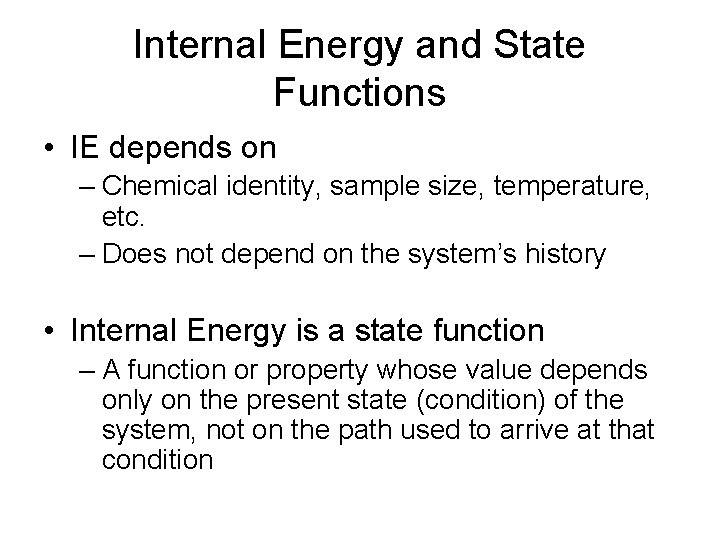
Internal Energy and State Functions • IE depends on – Chemical identity, sample size, temperature, etc. – Does not depend on the system’s history • Internal Energy is a state function – A function or property whose value depends only on the present state (condition) of the system, not on the path used to arrive at that condition
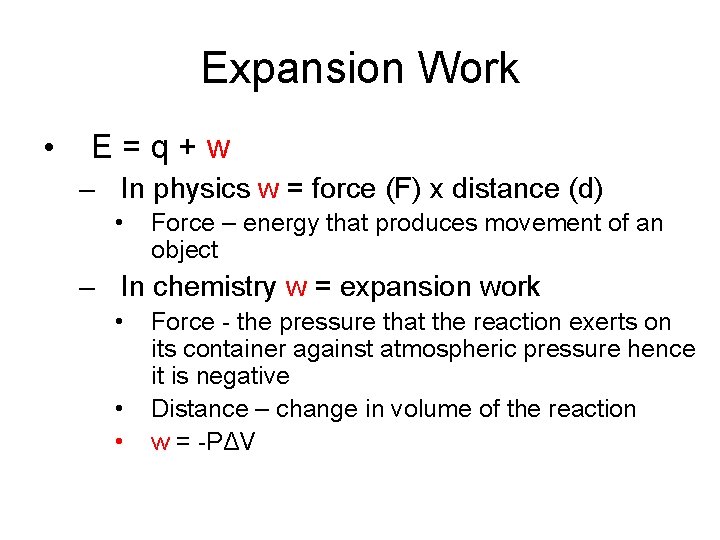
Expansion Work • E=q+w – In physics w = force (F) x distance (d) • Force – energy that produces movement of an object – In chemistry w = expansion work • • • Force - the pressure that the reaction exerts on its container against atmospheric pressure hence it is negative Distance – change in volume of the reaction w = -PΔV
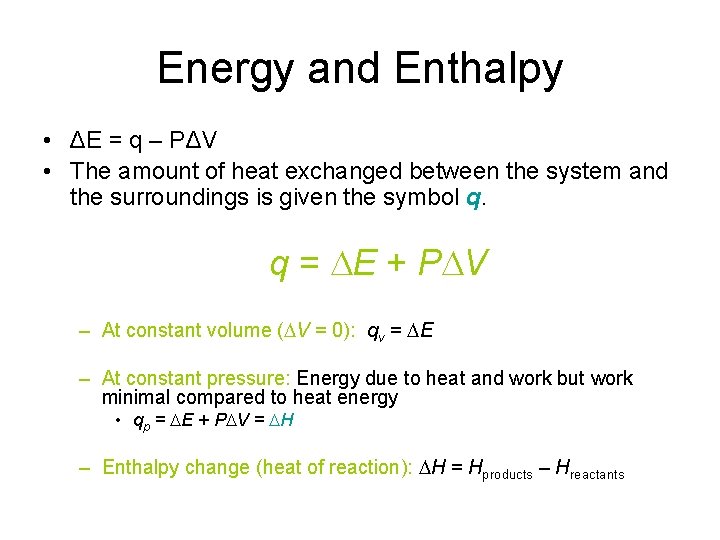
Energy and Enthalpy • ΔE = q – PΔV • The amount of heat exchanged between the system and the surroundings is given the symbol q. q = DE + PDV – At constant volume (DV = 0): qv = DE – At constant pressure: Energy due to heat and work but work minimal compared to heat energy • qp = DE + PDV = DH – Enthalpy change (heat of reaction): DH = Hproducts – Hreactants
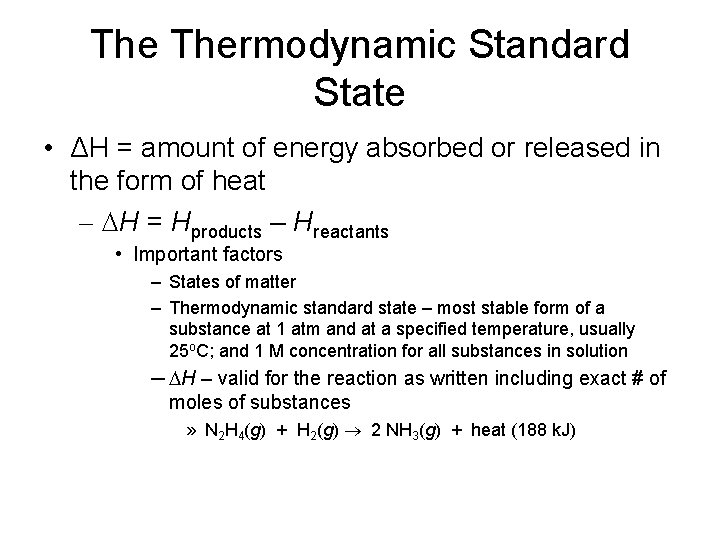
The Thermodynamic Standard State • ΔH = amount of energy absorbed or released in the form of heat – DH = Hproducts – Hreactants • Important factors – States of matter – Thermodynamic standard state – most stable form of a substance at 1 atm and at a specified temperature, usually 25 o. C; and 1 M concentration for all substances in solution ─ DH – valid for the reaction as written including exact # of moles of substances » N 2 H 4(g) + H 2(g) 2 NH 3(g) + heat (188 k. J)
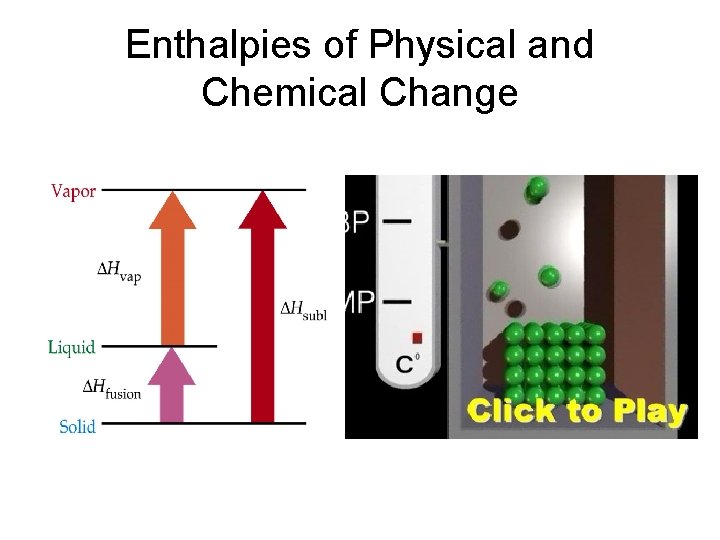
Enthalpies of Physical and Chemical Change
Enthalpies of Physical and Chemical Changes • Enthalpies of Chemical Change: Often called heats of reaction (DHreaction). – Endothermic: Heat flows into the system from the surroundings and DH has a positive sign. Unfavorable Process – Exothermic: Heat flows out of the system into the surroundings and DH has a negative sign. Favorable process
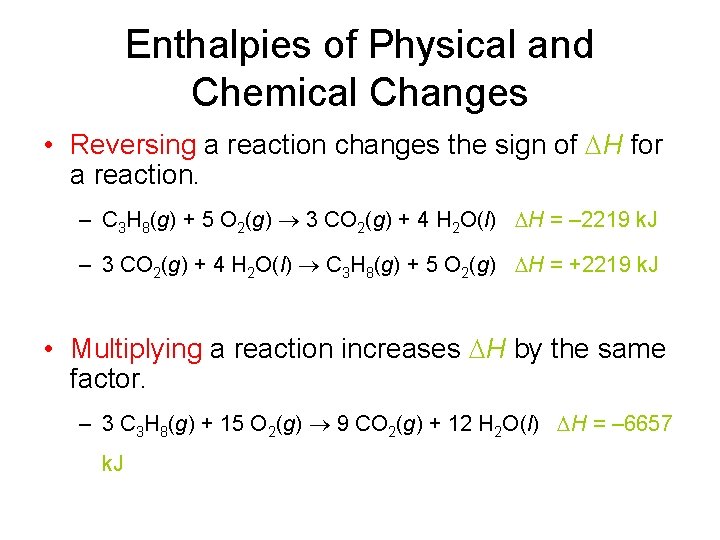
Enthalpies of Physical and Chemical Changes • Reversing a reaction changes the sign of DH for a reaction. – C 3 H 8(g) + 5 O 2(g) 3 CO 2(g) + 4 H 2 O(l) DH = – 2219 k. J – 3 CO 2(g) + 4 H 2 O(l) C 3 H 8(g) + 5 O 2(g) DH = +2219 k. J • Multiplying a reaction increases DH by the same factor. – 3 C 3 H 8(g) + 15 O 2(g) 9 CO 2(g) + 12 H 2 O(l) DH = – 6657 k. J
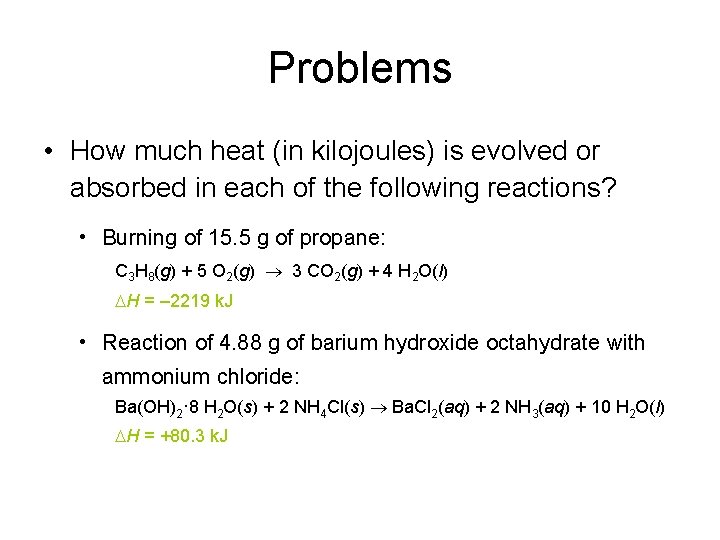
Problems • How much heat (in kilojoules) is evolved or absorbed in each of the following reactions? • Burning of 15. 5 g of propane: C 3 H 8(g) + 5 O 2(g) 3 CO 2(g) + 4 H 2 O(l) DH = – 2219 k. J • Reaction of 4. 88 g of barium hydroxide octahydrate with ammonium chloride: Ba(OH)2· 8 H 2 O(s) + 2 NH 4 Cl(s) Ba. Cl 2(aq) + 2 NH 3(aq) + 10 H 2 O(l) DH = +80. 3 k. J
Determination of Heats of Reaction • • Experimentally – calorimetry Hess’s Law Standard Heat’s of Formation Bond Dissociation Energies
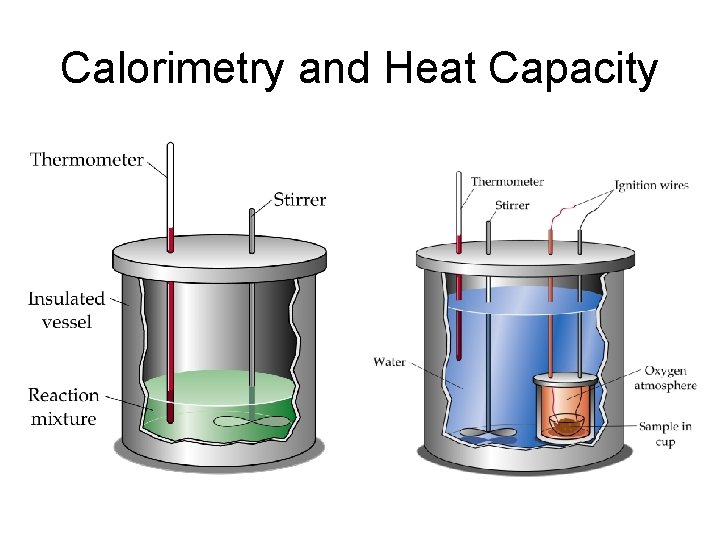
Calorimetry and Heat Capacity • Calorimetry is the science of measuring heat changes (q) for chemical reactions. There are two types of calorimeters: • Bomb Calorimetry: A bomb calorimeter measures the heat change at constant volume such that q = DE. • Constant Pressure Calorimetry: A constant pressure calorimeter measures the heat change at constant pressure such that q = DH.
Calorimetry and Heat Capacity
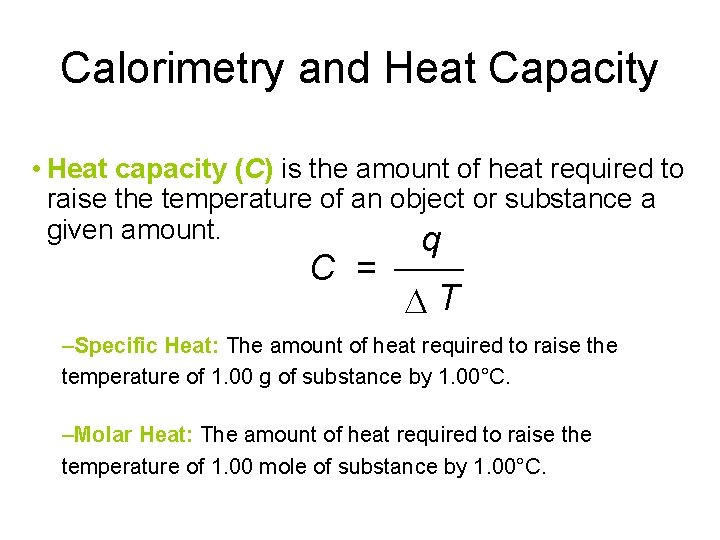
Calorimetry and Heat Capacity • Heat capacity (C) is the amount of heat required to raise the temperature of an object or substance a given amount. q C = DT –Specific Heat: The amount of heat required to raise the temperature of 1. 00 g of substance by 1. 00°C. –Molar Heat: The amount of heat required to raise the temperature of 1. 00 mole of substance by 1. 00°C.
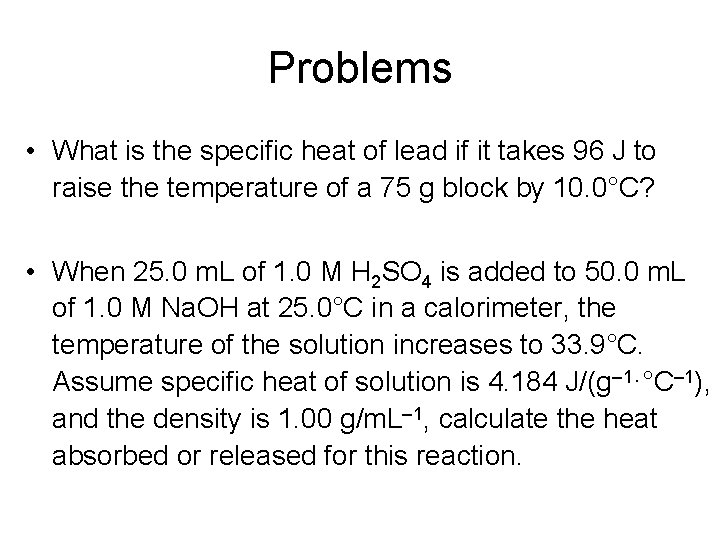
Problems • What is the specific heat of lead if it takes 96 J to raise the temperature of a 75 g block by 10. 0°C? • When 25. 0 m. L of 1. 0 M H 2 SO 4 is added to 50. 0 m. L of 1. 0 M Na. OH at 25. 0°C in a calorimeter, the temperature of the solution increases to 33. 9°C. Assume specific heat of solution is 4. 184 J/(g– 1·°C– 1), and the density is 1. 00 g/m. L– 1, calculate the heat absorbed or released for this reaction.
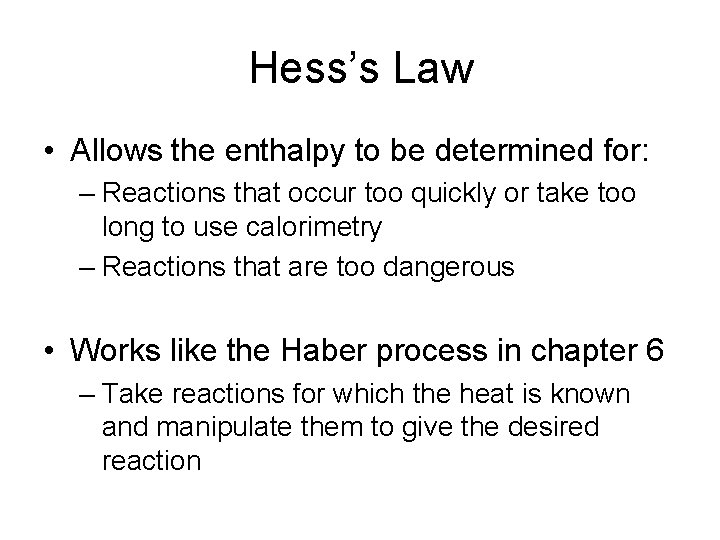
Hess’s Law • Allows the enthalpy to be determined for: – Reactions that occur too quickly or take too long to use calorimetry – Reactions that are too dangerous • Works like the Haber process in chapter 6 – Take reactions for which the heat is known and manipulate them to give the desired reaction
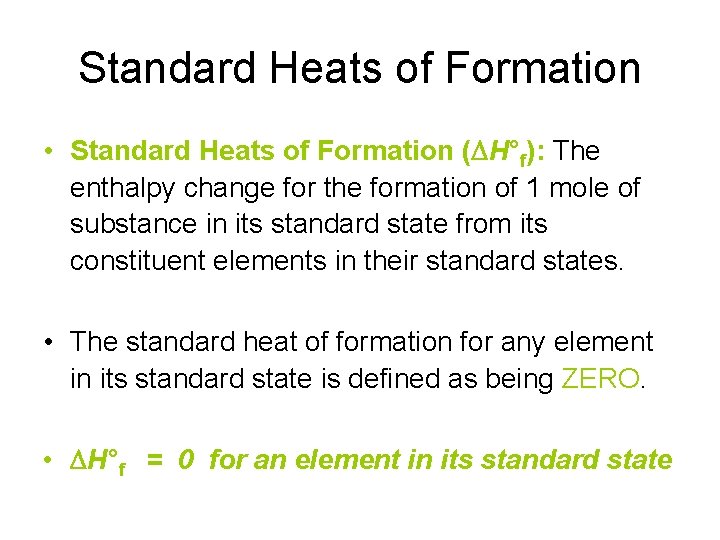
Standard Heats of Formation • Standard Heats of Formation (DH°f): The enthalpy change for the formation of 1 mole of substance in its standard state from its constituent elements in their standard states. • The standard heat of formation for any element in its standard state is defined as being ZERO. • DH°f = 0 for an element in its standard state
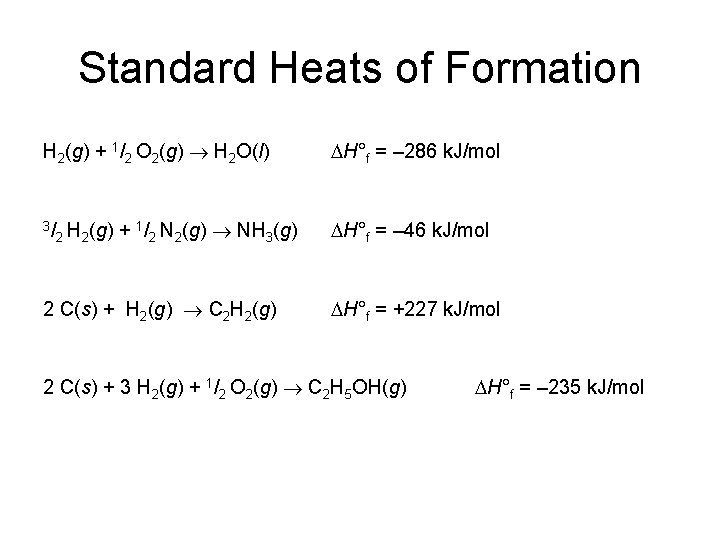
Standard Heats of Formation H 2(g) + 1/2 O 2(g) H 2 O(l) 3/ 2 H 2(g) + 1/2 N 2(g) NH 3(g) 2 C(s) + H 2(g) C 2 H 2(g) DH°f = – 286 k. J/mol DH°f = – 46 k. J/mol DH°f = +227 k. J/mol 2 C(s) + 3 H 2(g) + 1/2 O 2(g) C 2 H 5 OH(g) DH°f = – 235 k. J/mol
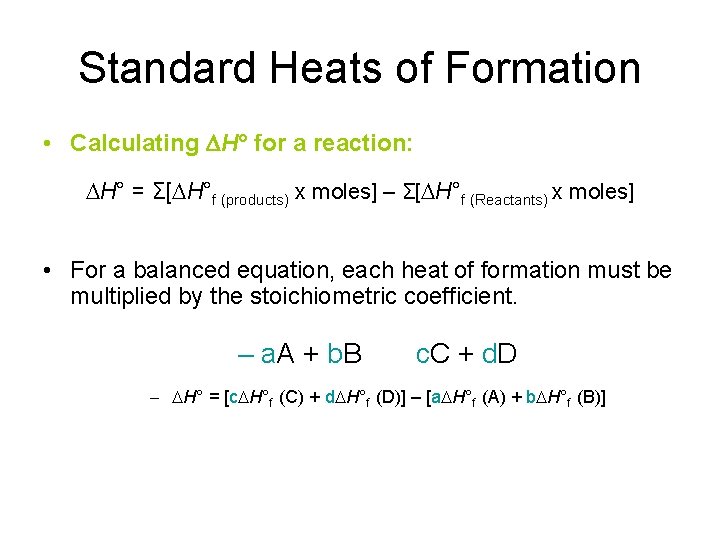
Standard Heats of Formation • Calculating DH° for a reaction: DH° = Σ[DH°f (products) x moles] – Σ[DH°f (Reactants) x moles] • For a balanced equation, each heat of formation must be multiplied by the stoichiometric coefficient. – a. A + b. B c. C + d. D – DH° = [c. DH°f (C) + d. DH°f (D)] – [a. DH°f (A) + b. DH°f (B)]
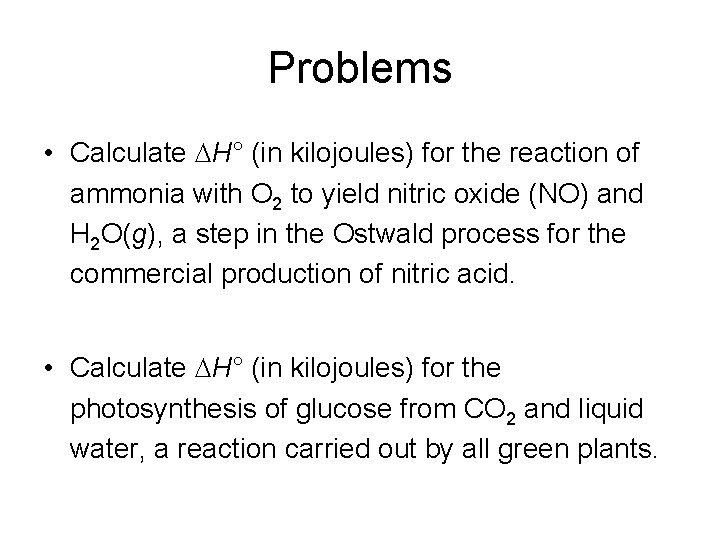
Problems • Calculate DH° (in kilojoules) for the reaction of ammonia with O 2 to yield nitric oxide (NO) and H 2 O(g), a step in the Ostwald process for the commercial production of nitric acid. • Calculate DH° (in kilojoules) for the photosynthesis of glucose from CO 2 and liquid water, a reaction carried out by all green plants.
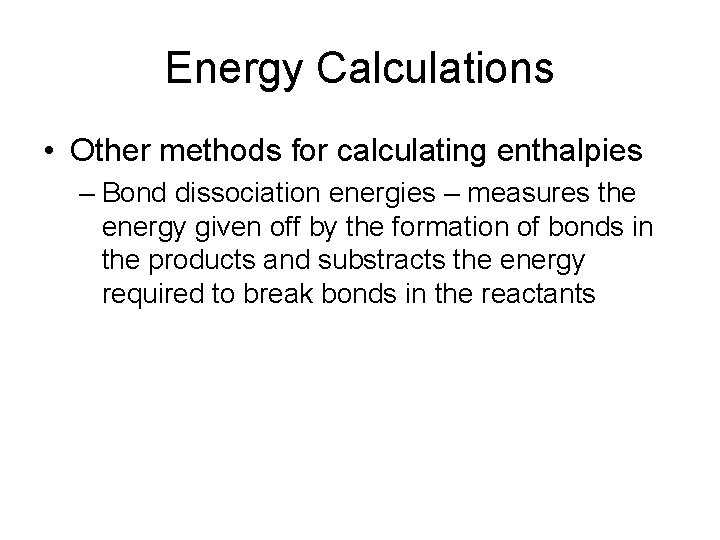
Energy Calculations • Other methods for calculating enthalpies – Bond dissociation energies – measures the energy given off by the formation of bonds in the products and substracts the energy required to break bonds in the reactants
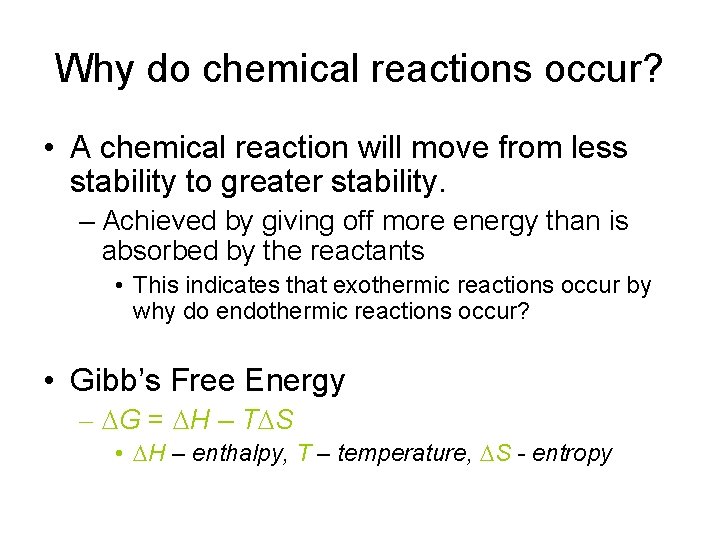
Why do chemical reactions occur? • A chemical reaction will move from less stability to greater stability. – Achieved by giving off more energy than is absorbed by the reactants • This indicates that exothermic reactions occur by why do endothermic reactions occur? • Gibb’s Free Energy – DG = DH – TDS • DH – enthalpy, T – temperature, DS - entropy
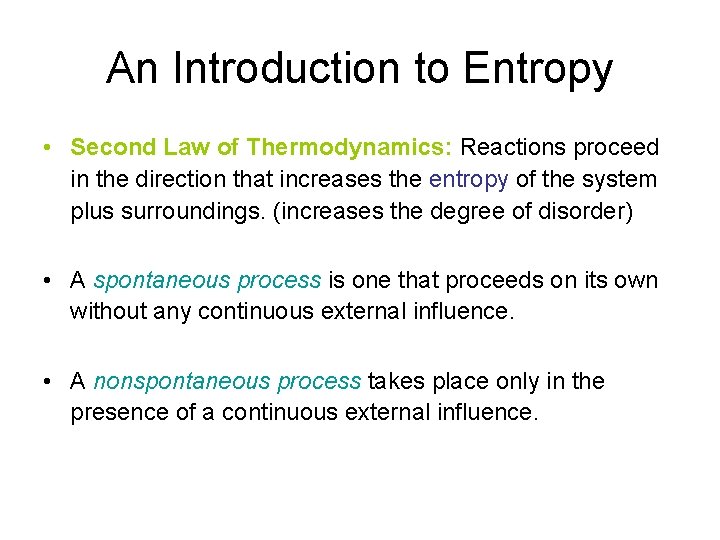
An Introduction to Entropy • Second Law of Thermodynamics: Reactions proceed in the direction that increases the entropy of the system plus surroundings. (increases the degree of disorder) • A spontaneous process is one that proceeds on its own without any continuous external influence. • A nonspontaneous process takes place only in the presence of a continuous external influence.
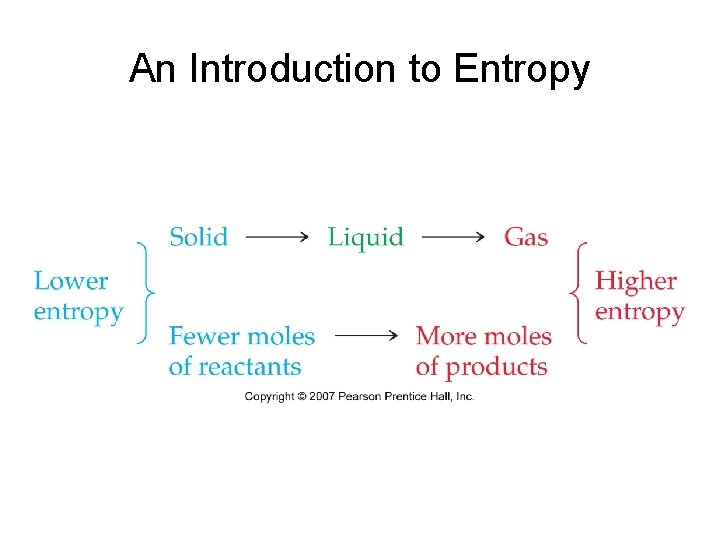
An Introduction to Entropy
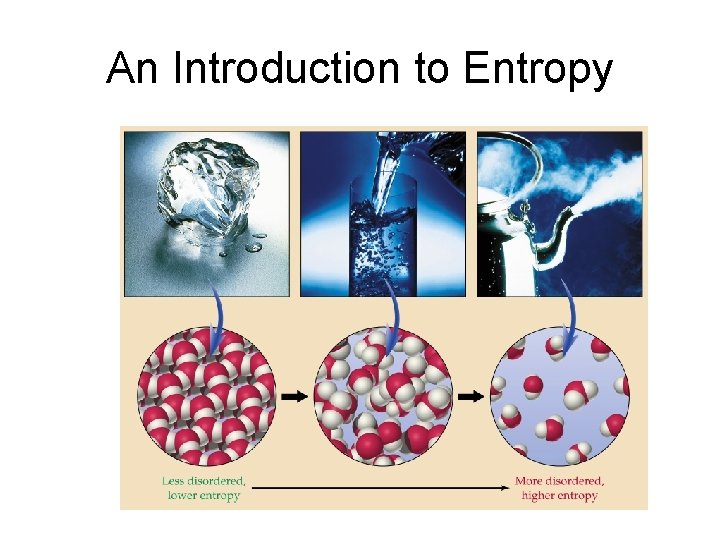
An Introduction to Entropy
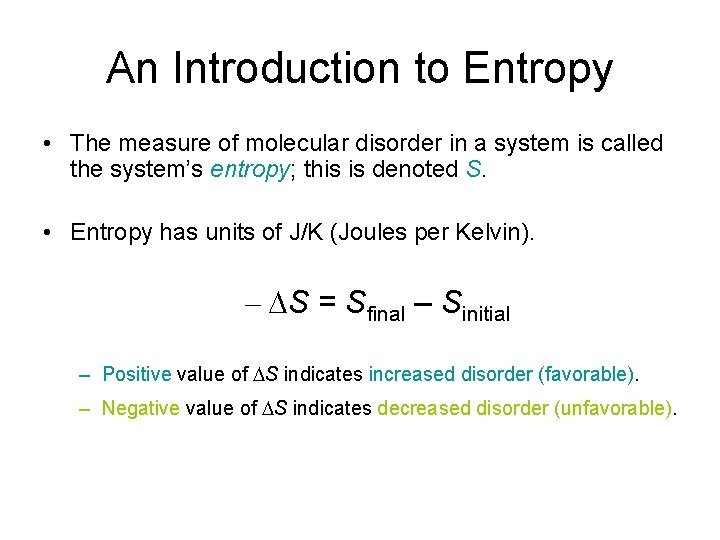
An Introduction to Entropy • The measure of molecular disorder in a system is called the system’s entropy; this is denoted S. • Entropy has units of J/K (Joules per Kelvin). – DS = Sfinal – Sinitial – Positive value of DS indicates increased disorder (favorable). – Negative value of DS indicates decreased disorder (unfavorable).
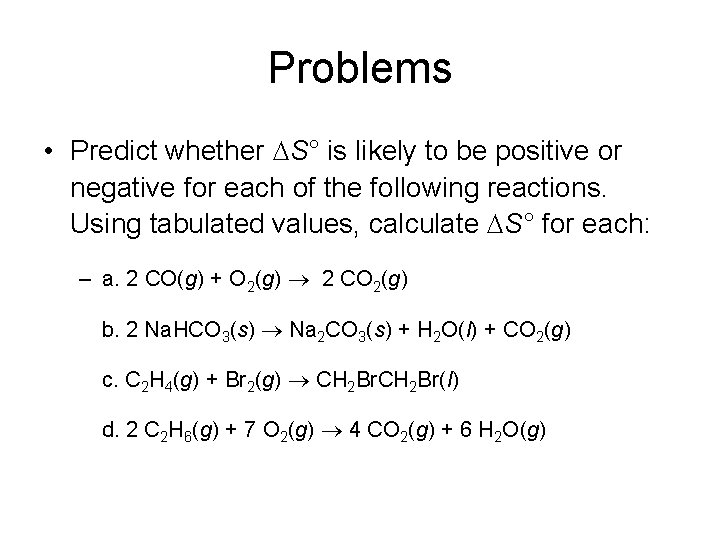
Problems • Predict whether DS° is likely to be positive or negative for each of the following reactions. Using tabulated values, calculate DS° for each: – a. 2 CO(g) + O 2(g) 2 CO 2(g) b. 2 Na. HCO 3(s) Na 2 CO 3(s) + H 2 O(l) + CO 2(g) c. C 2 H 4(g) + Br 2(g) CH 2 Br(l) d. 2 C 2 H 6(g) + 7 O 2(g) 4 CO 2(g) + 6 H 2 O(g)
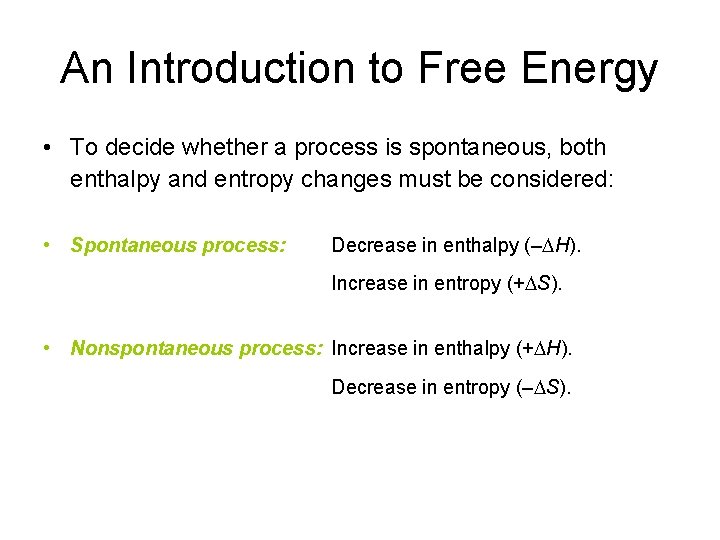
An Introduction to Free Energy • To decide whether a process is spontaneous, both enthalpy and entropy changes must be considered: • Spontaneous process: Decrease in enthalpy (–DH). Increase in entropy (+DS). • Nonspontaneous process: Increase in enthalpy (+DH). Decrease in entropy (–DS).
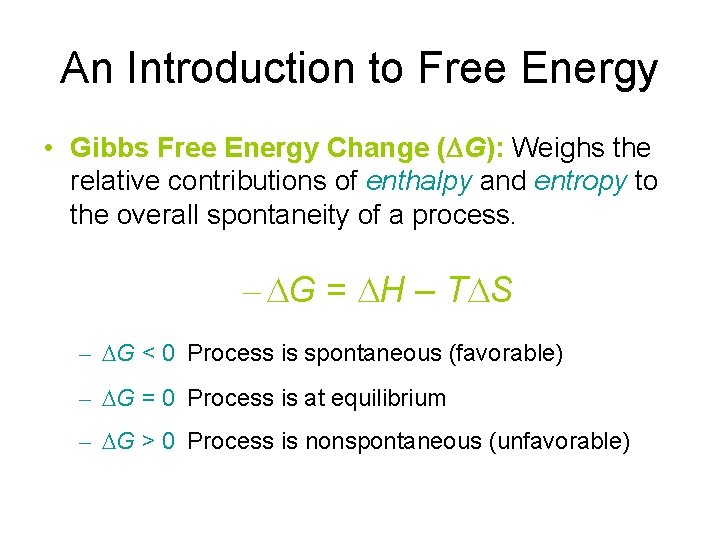
An Introduction to Free Energy • Gibbs Free Energy Change (DG): Weighs the relative contributions of enthalpy and entropy to the overall spontaneity of a process. – DG = DH – TDS – DG < 0 Process is spontaneous (favorable) – DG = 0 Process is at equilibrium – DG > 0 Process is nonspontaneous (unfavorable)
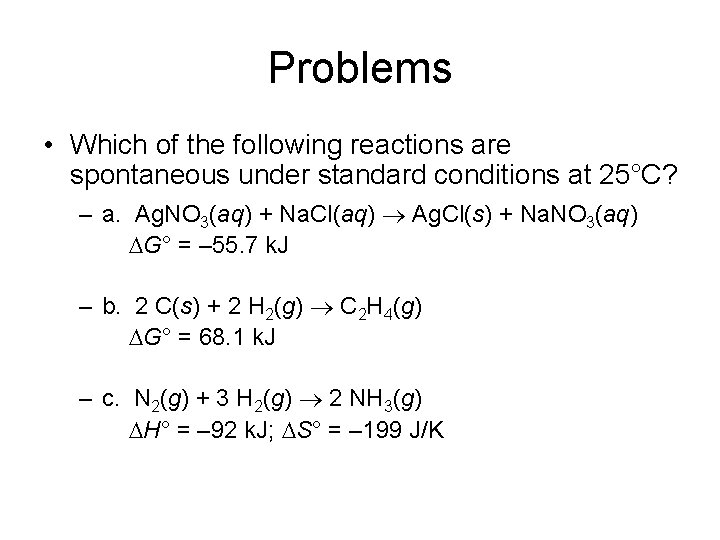
Problems • Which of the following reactions are spontaneous under standard conditions at 25°C? – a. Ag. NO 3(aq) + Na. Cl(aq) Ag. Cl(s) + Na. NO 3(aq) DG° = – 55. 7 k. J – b. 2 C(s) + 2 H 2(g) C 2 H 4(g) DG° = 68. 1 k. J – c. N 2(g) + 3 H 2(g) 2 NH 3(g) DH° = – 92 k. J; DS° = – 199 J/K
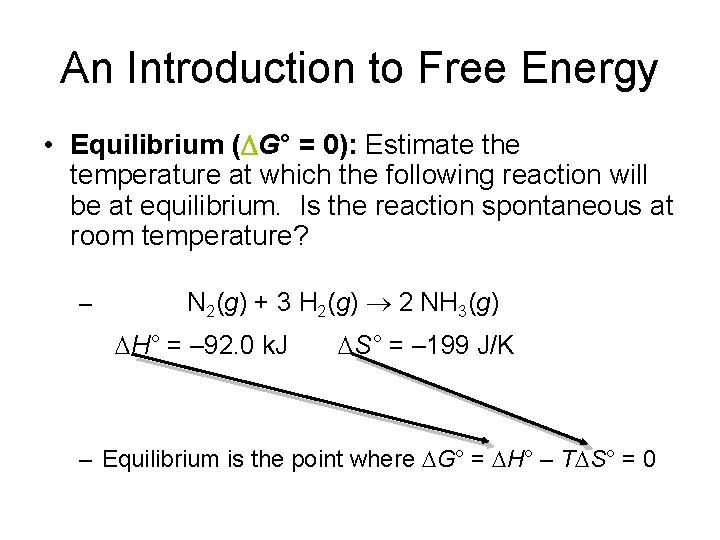
An Introduction to Free Energy • Equilibrium (DG° = 0): Estimate the temperature at which the following reaction will be at equilibrium. Is the reaction spontaneous at room temperature? – N 2(g) + 3 H 2(g) 2 NH 3(g) DH° = – 92. 0 k. J DS° = – 199 J/K – Equilibrium is the point where DG° = DH° – TDS° = 0
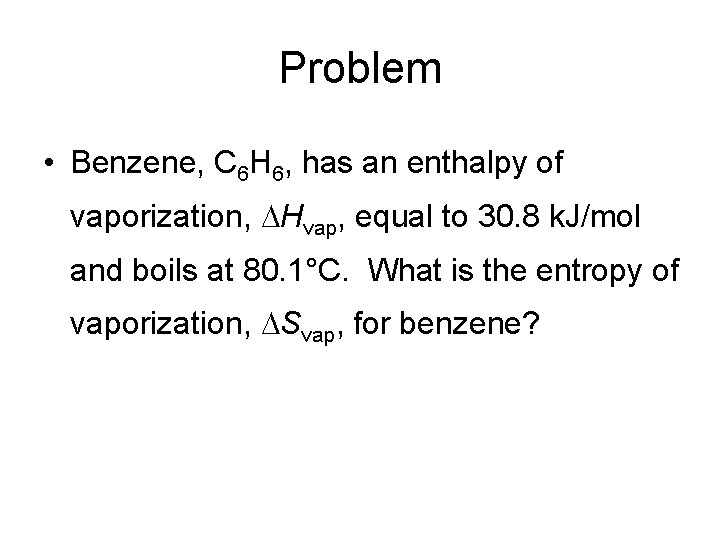
Problem • Benzene, C 6 H 6, has an enthalpy of vaporization, DHvap, equal to 30. 8 k. J/mol and boils at 80. 1°C. What is the entropy of vaporization, DSvap, for benzene?
Optional Homework • Text - 8. 28, 8. 32, 8. 50, 8. 52, 8. 56, 8. 58, 8. 66, 8. 70, 8. 74, 8. 82, 8. 88, 8. 90 • Chapter 8 Homework from website
Required Homework • Chapter 8 Assignment