
Chapter 8 Theory of NPCompleteness 1 n n
![Nondeterministic operations and functions [Horowitz 1998] n Choice(S) : arbitrarily chooses one of the](https://slidetodoc.com/presentation_image_h/ab46fa6d1d36dd5000b905f84bd8597b/image-16.jpg "Nondeterministic operations and functions [Horowitz 1998] n Choice(S) : arbitrarily chooses one of the")
- Slides: 65
Chapter 8 Theory of NP-Completeness 1
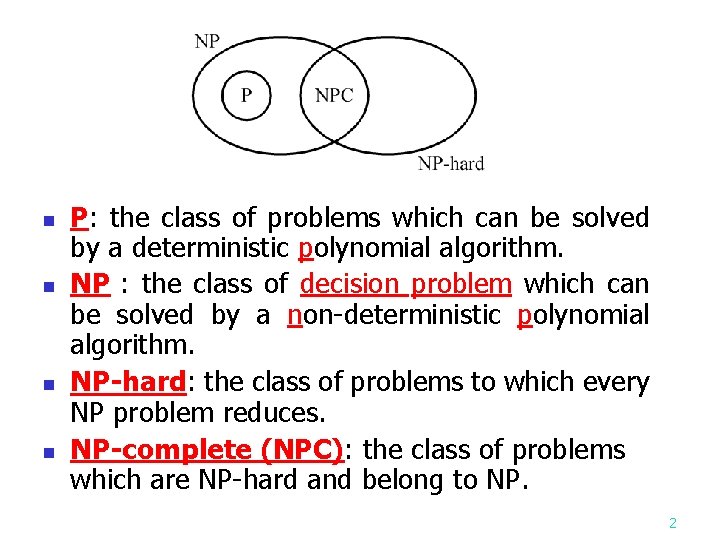
n n P: the class of problems which can be solved by a deterministic polynomial algorithm. NP : the class of decision problem which can be solved by a non-deterministic polynomial algorithm. NP-hard: the class of problems to which every NP problem reduces. NP-complete (NPC): the class of problems which are NP-hard and belong to NP. 2
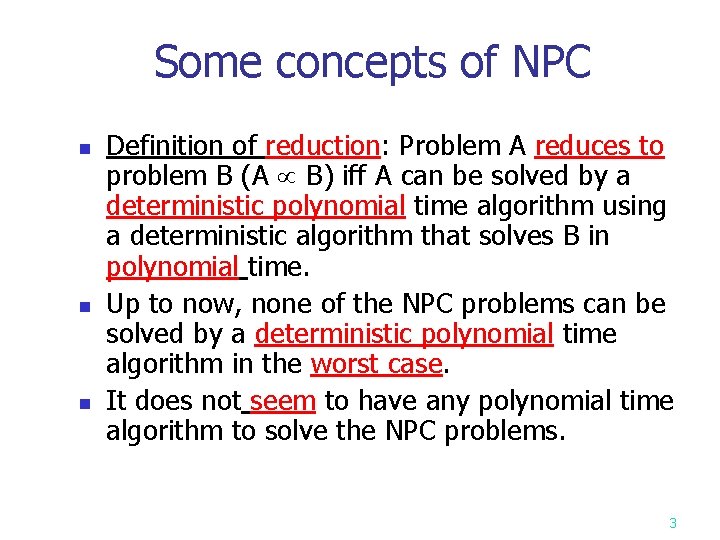
Some concepts of NPC n n n Definition of reduction: Problem A reduces to problem B (A B) iff A can be solved by a deterministic polynomial time algorithm using a deterministic algorithm that solves B in polynomial time. Up to now, none of the NPC problems can be solved by a deterministic polynomial time algorithm in the worst case. It does not seem to have any polynomial time algorithm to solve the NPC problems. 3
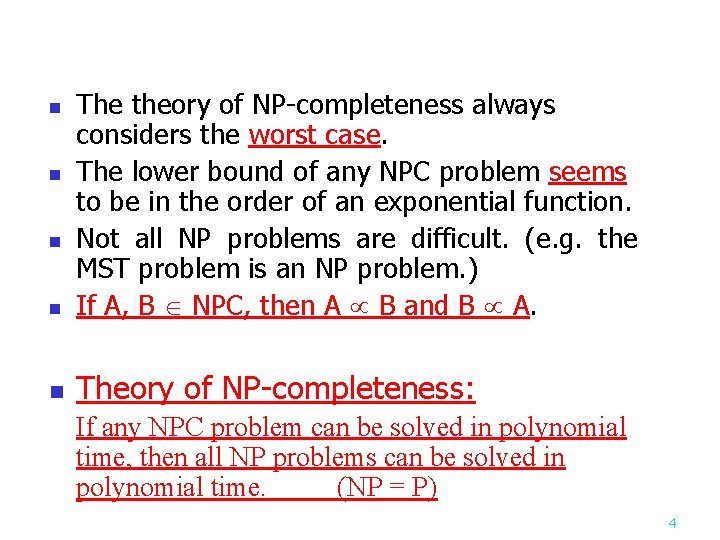
n The theory of NP-completeness always considers the worst case. The lower bound of any NPC problem seems to be in the order of an exponential function. Not all NP problems are difficult. (e. g. the MST problem is an NP problem. ) If A, B NPC, then A B and B A. n Theory of NP-completeness: n n n If any NPC problem can be solved in polynomial time, then all NP problems can be solved in polynomial time. (NP = P) 4
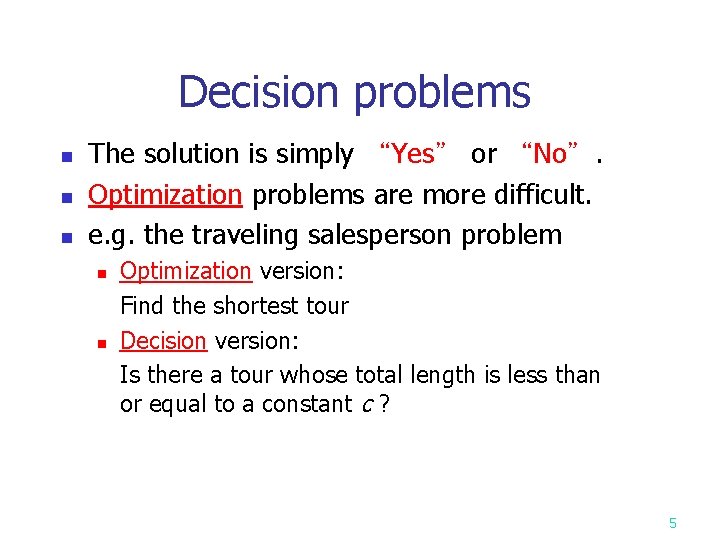
Decision problems n n n The solution is simply “Yes” or “No”. Optimization problems are more difficult. e. g. the traveling salesperson problem n n Optimization version: Find the shortest tour Decision version: Is there a tour whose total length is less than or equal to a constant c ? 5
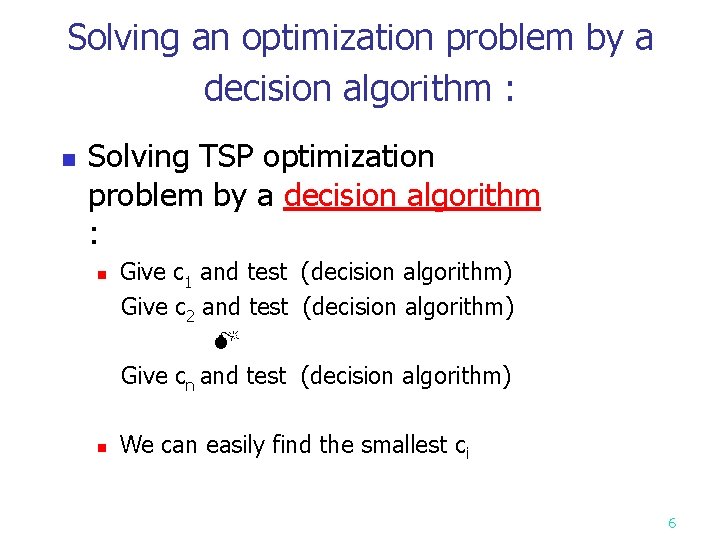
Solving an optimization problem by a decision algorithm : n Solving TSP optimization problem by a decision algorithm : Give c 1 and test (decision algorithm) Give c 2 and test (decision algorithm) Give cn and test (decision algorithm) n n We can easily find the smallest ci 6
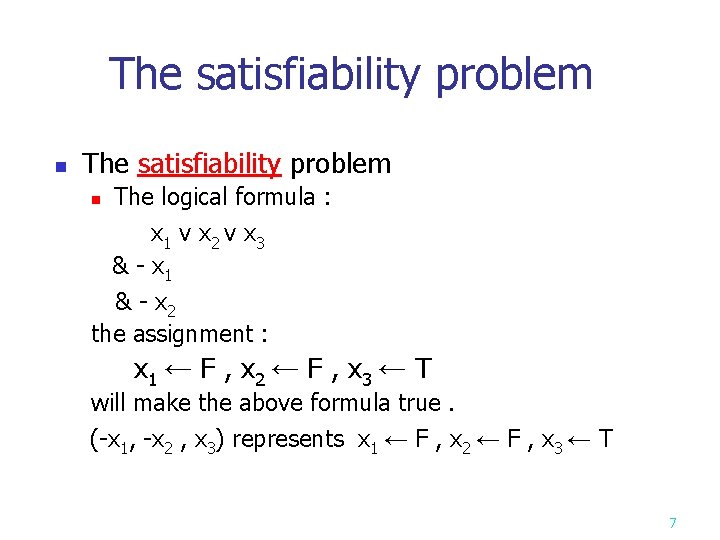
The satisfiability problem n The logical formula : x 1 v x 2 v x 3 & - x 1 & - x 2 the assignment : x 1 ← F , x 2 ← F , x 3 ← T will make the above formula true. (-x 1, -x 2 , x 3) represents x 1 ← F , x 2 ← F , x 3 ← T 7
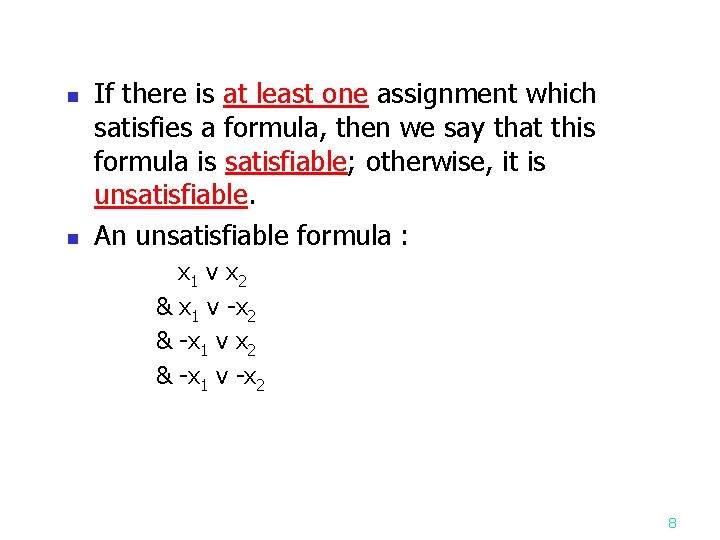
n n If there is at least one assignment which satisfies a formula, then we say that this formula is satisfiable; otherwise, it is unsatisfiable. An unsatisfiable formula : x 1 v x 2 & x 1 v -x 2 & -x 1 v -x 2 8
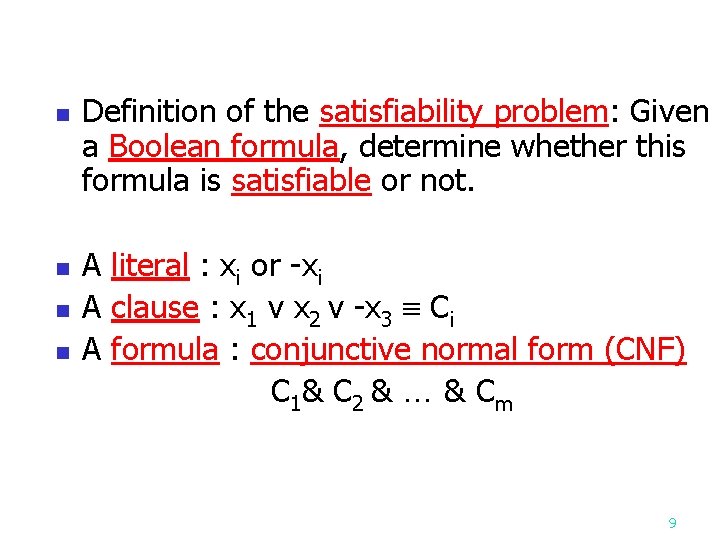
n Definition of the satisfiability problem: Given a Boolean formula, determine whether this formula is satisfiable or not. n n n A literal : xi or -xi A clause : x 1 v x 2 v -x 3 Ci A formula : conjunctive normal form (CNF) C 1& C 2 & … & Cm 9
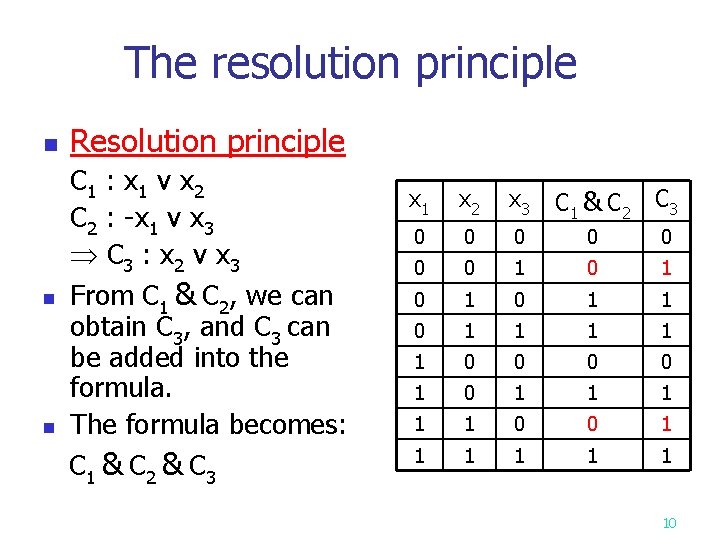
The resolution principle n Resolution principle C 1 : x 1 v x 2 C 2 : -x 1 v x 3 C 3 : x 2 v x 3 n From C 1 & C 2, we can obtain C 3, and C 3 can be added into the formula. n The formula becomes: C 1 & C 2 & C 3 x 1 x 2 x 3 C 1 & C 2 C 3 0 0 0 0 1 0 1 1 1 0 0 1 0 1 1 1 0 0 1 1 1 10
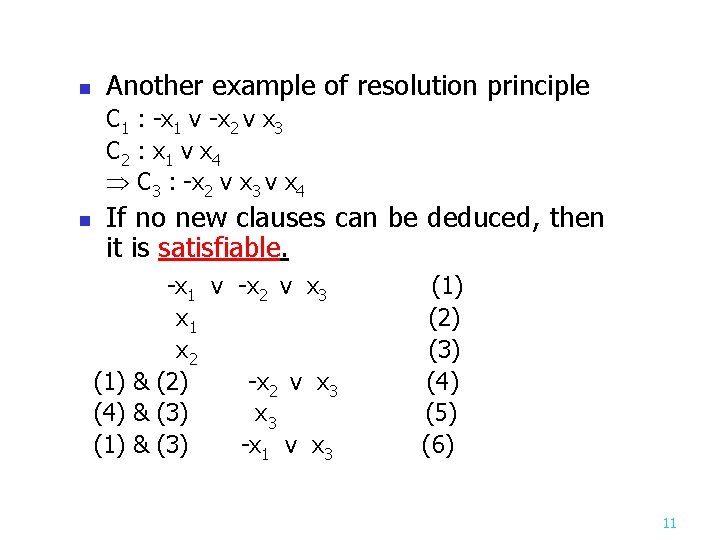
n Another example of resolution principle C 1 : -x 1 v -x 2 v x 3 C 2 : x 1 v x 4 C 3 : -x 2 v x 3 v x 4 If no new clauses can be deduced, then it is satisfiable. -x 1 v -x 2 v x 3 (1) n x 1 (2) x 2 (3) (1) & (2) -x 2 v x 3 (4) & (3) x 3 (5) (1) & (3) -x 1 v x 3 (6) 11
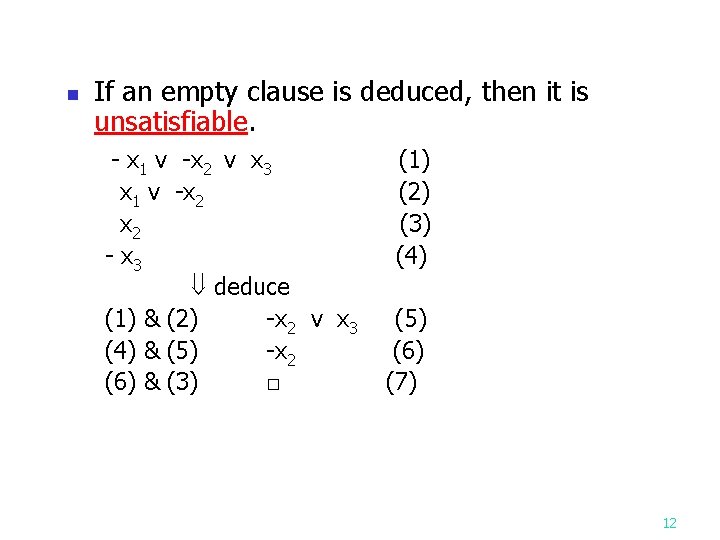
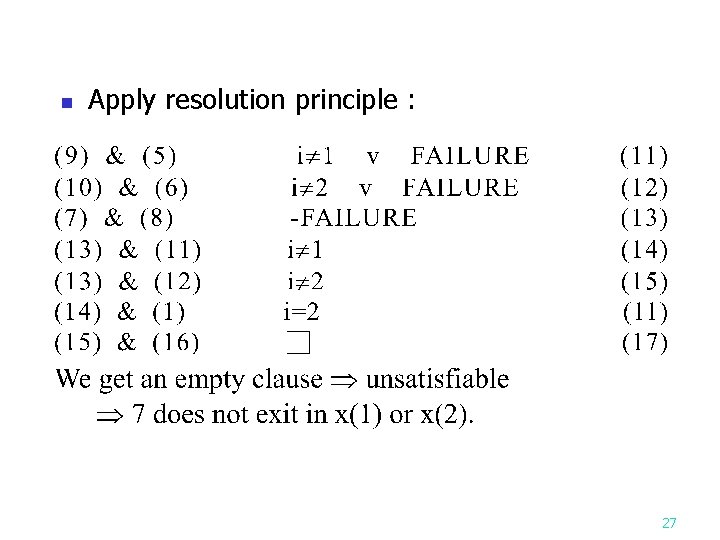
If an empty clause is deduced, then it is unsatisfiable. - x 1 v -x 2 v x 3 (1) n x 1 v -x 2 (2) x 2 (3) - x 3 (4) deduce (1) & (2) -x 2 v x 3 (5) (4) & (5) -x 2 (6) & (3) □ (7) 12
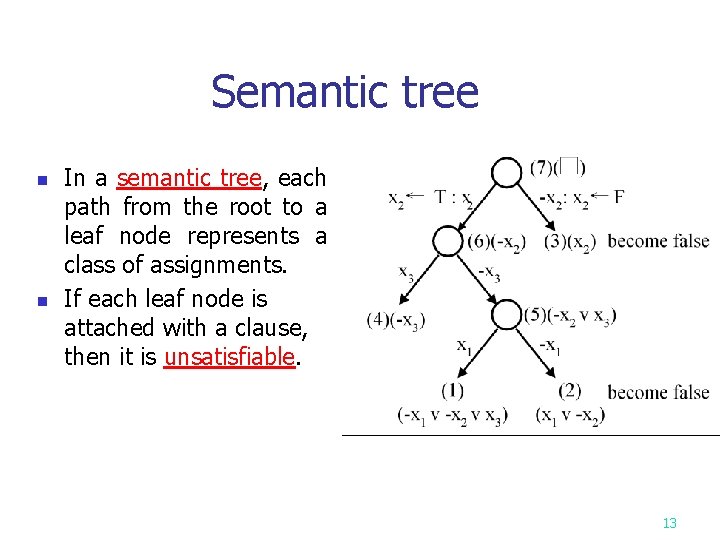
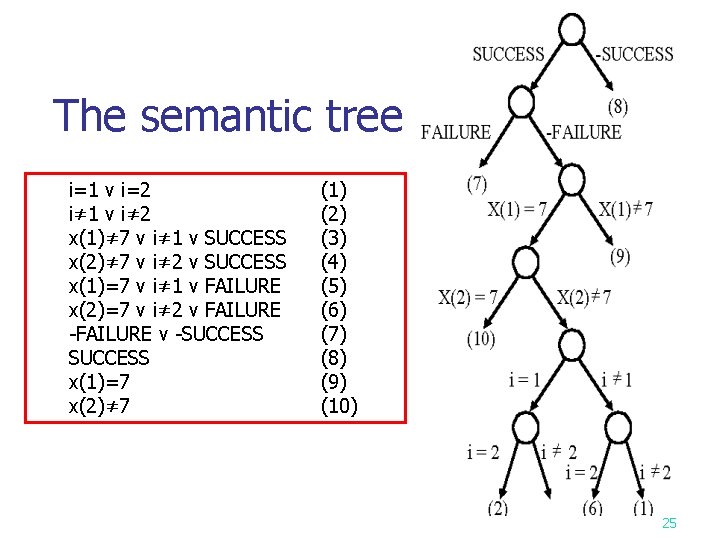
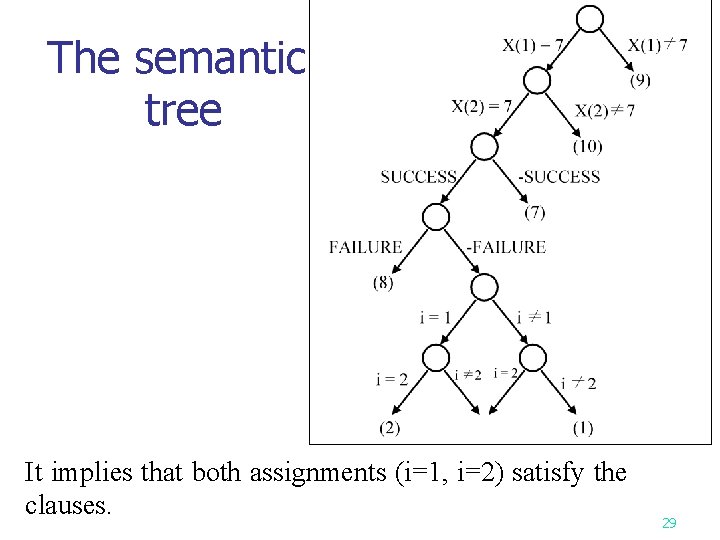
Semantic tree n n In a semantic tree, each path from the root to a leaf node represents a class of assignments. If each leaf node is attached with a clause, then it is unsatisfiable. 13
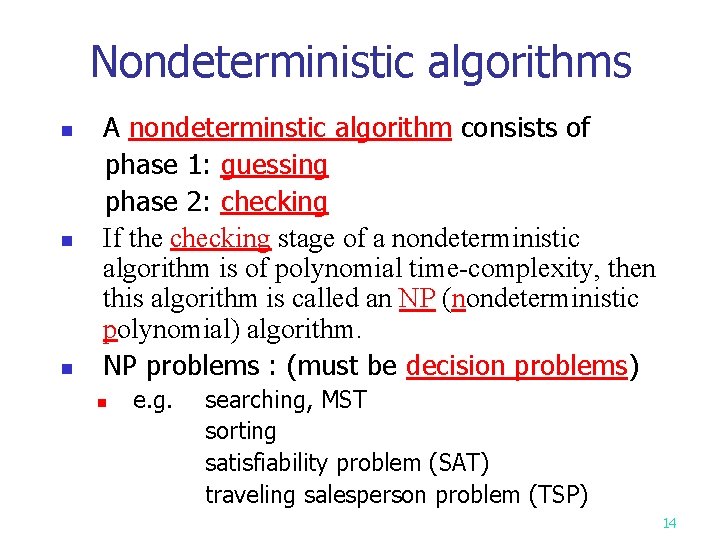
Nondeterministic algorithms A nondeterminstic algorithm consists of phase 1: guessing phase 2: checking n If the checking stage of a nondeterministic algorithm is of polynomial time-complexity, then this algorithm is called an NP (nondeterministic polynomial) algorithm. n NP problems : (must be decision problems) n n e. g. searching, MST sorting satisfiability problem (SAT) traveling salesperson problem (TSP) 14
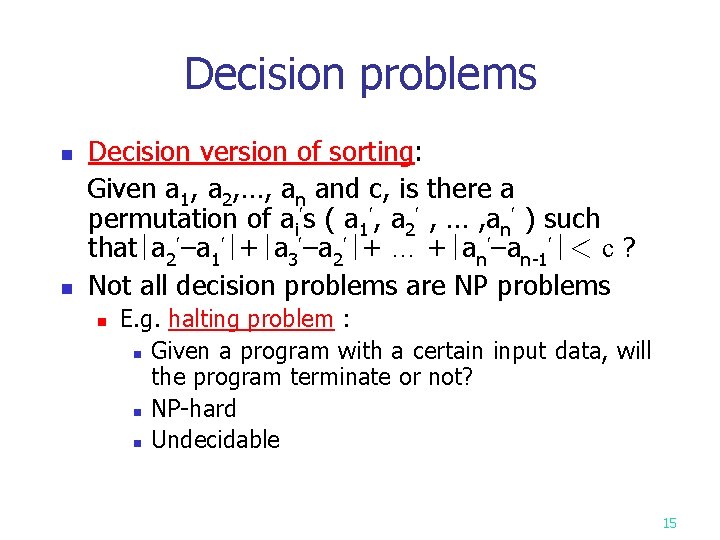
Decision problems Decision version of sorting: Given a 1, a 2, …, an and c, is there a permutation of ai s ( a 1 , a 2 , … , an ) such that∣a 2 –a 1 ∣+∣a 3 –a 2 ∣+ … +∣an –an-1 ∣< c ? n Not all decision problems are NP problems n n E. g. halting problem : n Given a program with a certain input data, will the program terminate or not? n NP-hard n Undecidable 15
Nondeterministic operations and functions [Horowitz 1998] n Choice(S) : arbitrarily chooses one of the elements in set S n Failure : an unsuccessful completion n Success : a successful completion n Nonderministic searching algorithm: j ← choice(1 : n) /* guessing */ if A(j) = x then success /* checking */ else failure 16
n n n A nondeterministic algorithm terminates unsuccessfully iff there does not exist a set of choices leading to a success signal. The time required for choice(1 : n) is O(1). A deterministic interpretation of a nondeterministic algorithm can be made by allowing unbounded parallelism in computation. 17
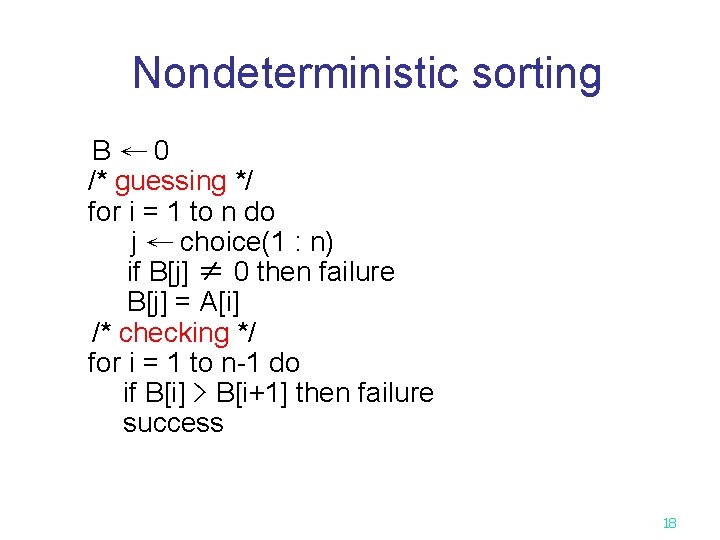
Nondeterministic sorting B← 0 /* guessing */ for i = 1 to n do j ← choice(1 : n) if B[j] ≠ 0 then failure B[j] = A[i] /* checking */ for i = 1 to n-1 do if B[i] > B[i+1] then failure success 18
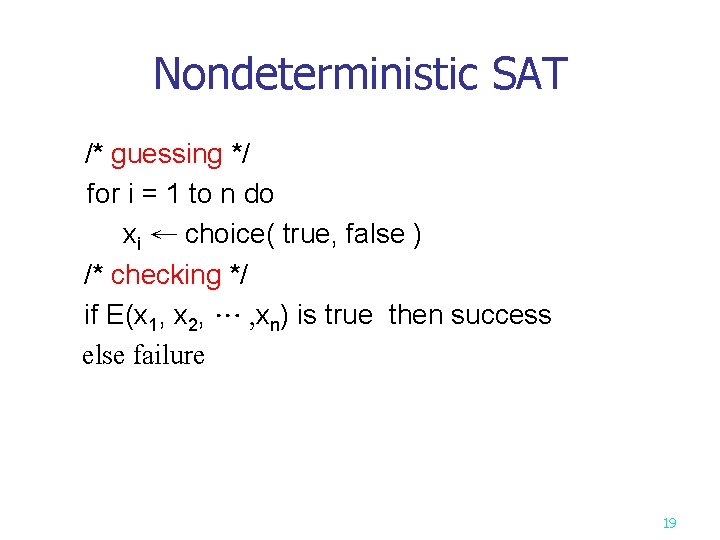
Nondeterministic SAT /* guessing */ for i = 1 to n do xi ← choice( true, false ) /* checking */ if E(x 1, x 2, … , xn) is true then success else failure 19
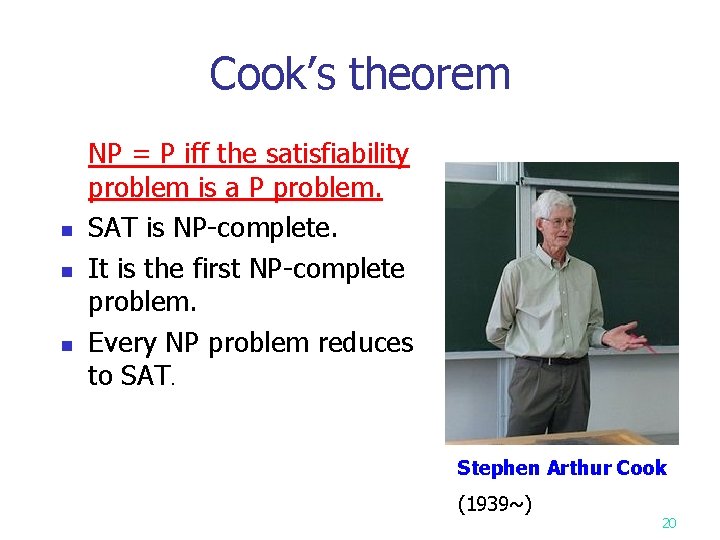
Cook’s theorem NP = P iff the satisfiability problem is a P problem. n SAT is NP-complete. n It is the first NP-complete problem. n Every NP problem reduces to SAT. Stephen Arthur Cook (1939~) 20
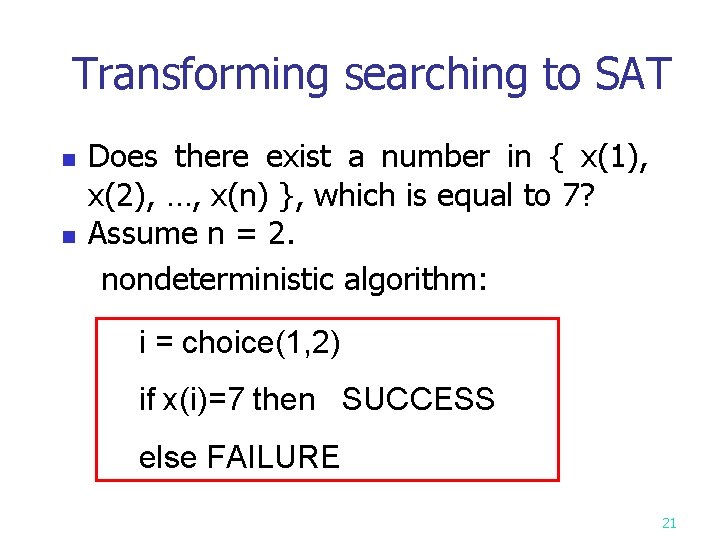
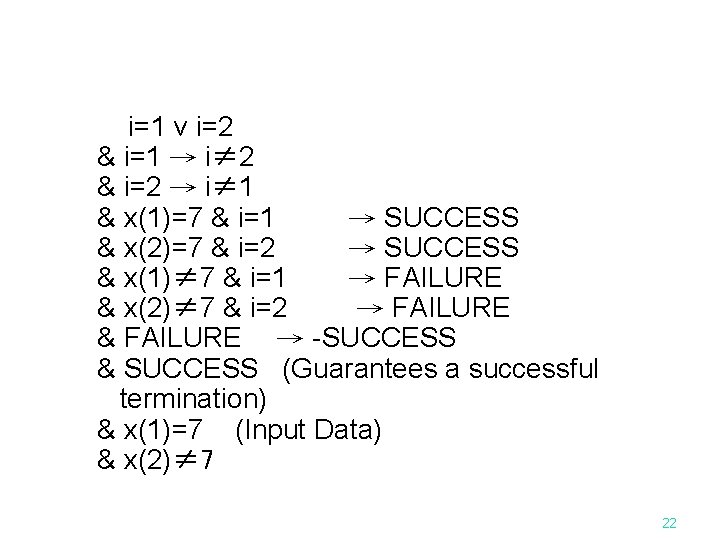
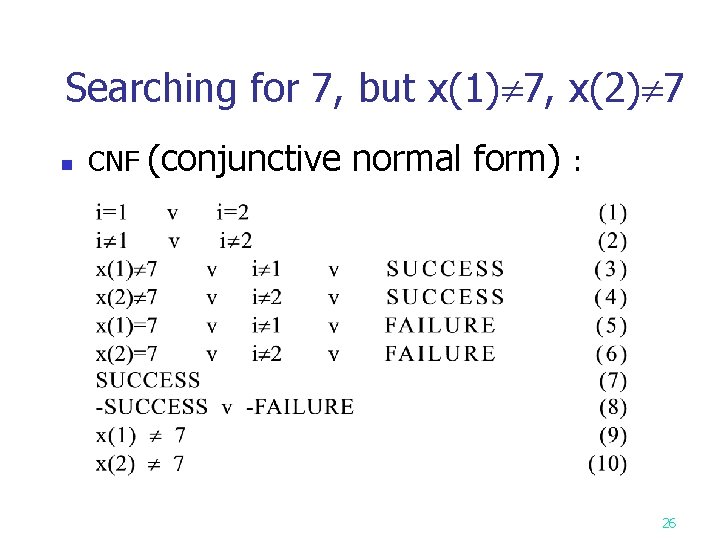
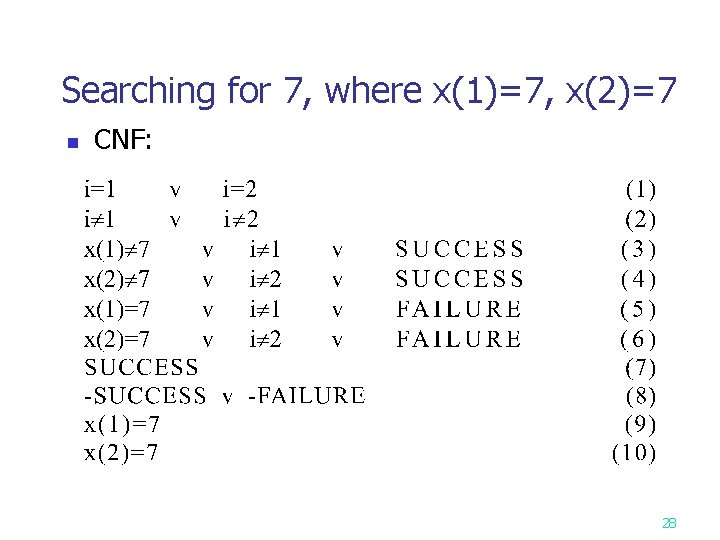
Transforming searching to SAT Does there exist a number in { x(1), x(2), …, x(n) }, which is equal to 7? n Assume n = 2. nondeterministic algorithm: n i = choice(1, 2) if x(i)=7 then SUCCESS else FAILURE 21
i=1 v i=2 & i=1 → i≠ 2 & i=2 → i≠ 1 & x(1)=7 & i=1 → SUCCESS & x(2)=7 & i=2 → SUCCESS & x(1)≠ 7 & i=1 → FAILURE & x(2)≠ 7 & i=2 → FAILURE & FAILURE → -SUCCESS & SUCCESS (Guarantees a successful termination) & x(1)=7 (Input Data) & x(2)≠ 7 22
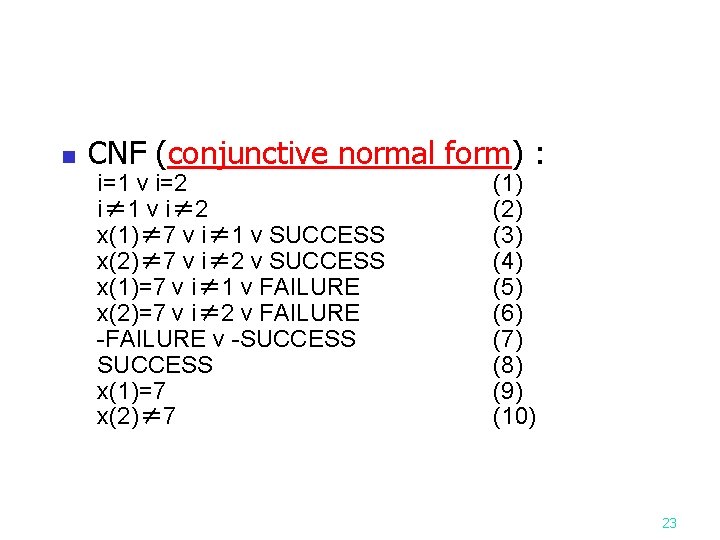
n CNF (conjunctive normal form) : i=1 v i=2 i≠ 1 v i≠ 2 x(1)≠ 7 v i≠ 1 v SUCCESS x(2)≠ 7 v i≠ 2 v SUCCESS x(1)=7 v i≠ 1 v FAILURE x(2)=7 v i≠ 2 v FAILURE -FAILURE v -SUCCESS x(1)=7 x(2)≠ 7 (1) (2) (3) (4) (5) (6) (7) (8) (9) (10) 23
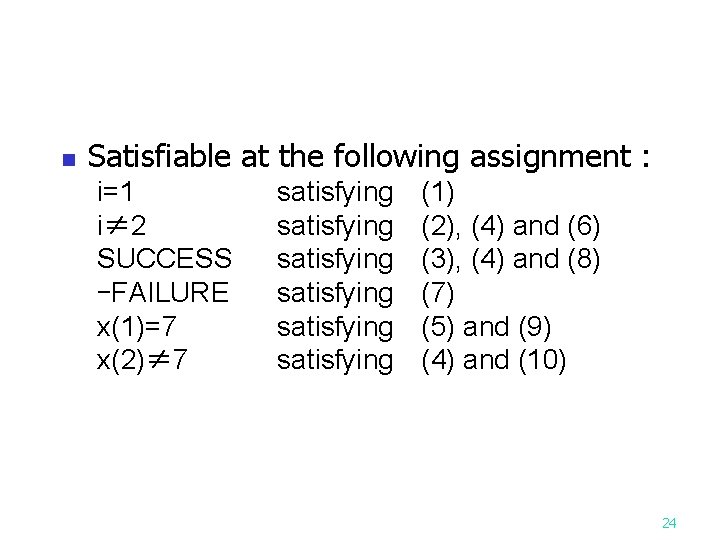
n Satisfiable at the following assignment : i=1 i≠ 2 SUCCESS -FAILURE x(1)=7 x(2)≠ 7 satisfying satisfying (1) (2), (4) and (6) (3), (4) and (8) (7) (5) and (9) (4) and (10) 24
The semantic tree i=1 v i=2 i≠ 1 v i≠ 2 x(1)≠ 7 v i≠ 1 v SUCCESS x(2)≠ 7 v i≠ 2 v SUCCESS x(1)=7 v i≠ 1 v FAILURE x(2)=7 v i≠ 2 v FAILURE -FAILURE v -SUCCESS x(1)=7 x(2)≠ 7 (1) (2) (3) (4) (5) (6) (7) (8) (9) (10) 25
Searching for 7, but x(1) 7, x(2) 7 n CNF (conjunctive normal form) : 26
n Apply resolution principle : 27
Searching for 7, where x(1)=7, x(2)=7 n CNF: 28
The semantic tree It implies that both assignments (i=1, i=2) satisfy the clauses. 29
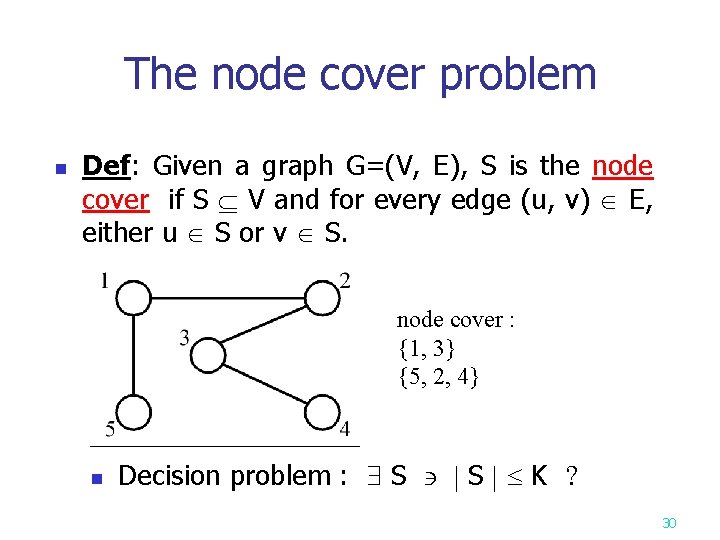
The node cover problem n Def: Given a graph G=(V, E), S is the node cover if S V and for every edge (u, v) E, either u S or v S. node cover : {1, 3} {5, 2, 4} n Decision problem : S S K 30
Transforming the node cover problem to SAT 31
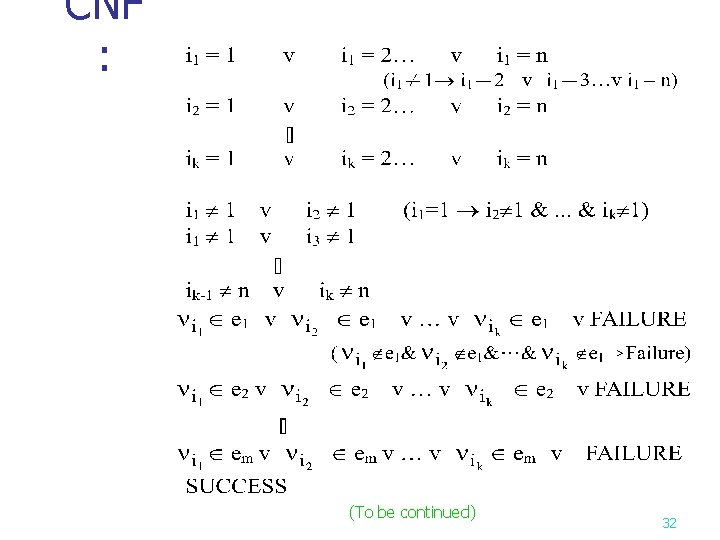
CNF : (To be continued) 32
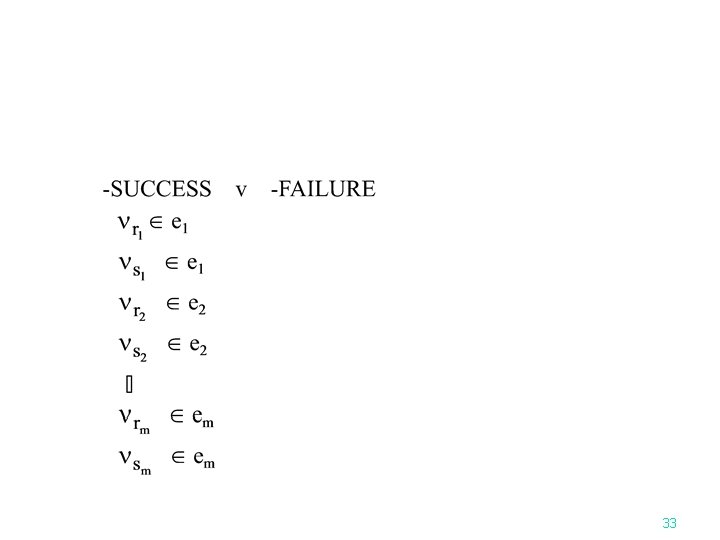
33
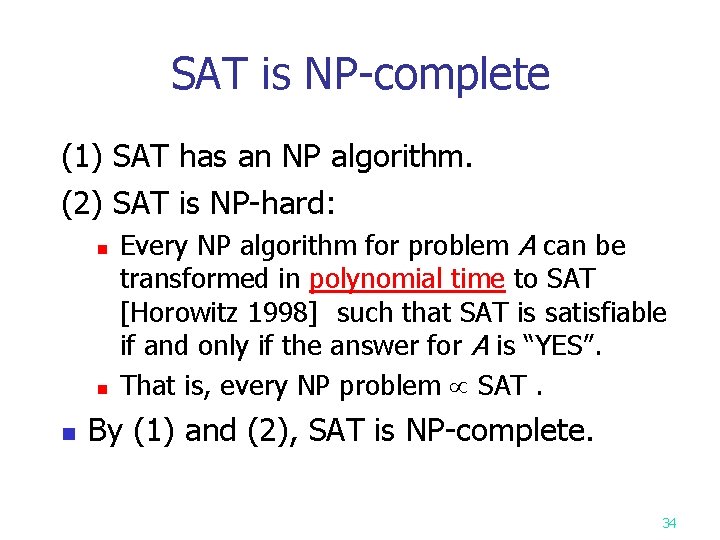
SAT is NP-complete (1) SAT has an NP algorithm. (2) SAT is NP-hard: n n n Every NP algorithm for problem A can be transformed in polynomial time to SAT [Horowitz 1998] such that SAT is satisfiable if and only if the answer for A is “YES”. That is, every NP problem SAT. By (1) and (2), SAT is NP-complete. 34
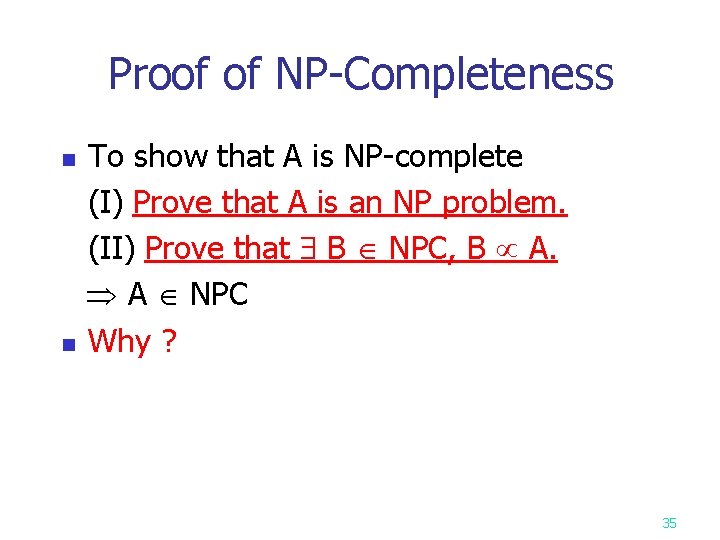
Proof of NP-Completeness n n To show that A is NP-complete (I) Prove that A is an NP problem. (II) Prove that B NPC, B A. A NPC Why ? 35
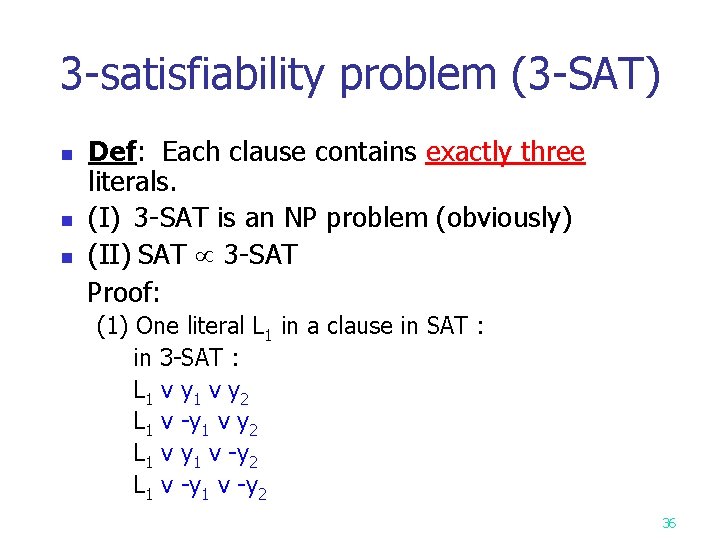
3 -satisfiability problem (3 -SAT) Def: Each clause contains exactly three literals. n (I) 3 -SAT is an NP problem (obviously) n (II) SAT 3 -SAT Proof: n (1) One literal L 1 in a clause in SAT : in 3 -SAT : L 1 v y 2 L 1 v -y 1 v y 2 L 1 v y 1 v -y 2 L 1 v -y 2 36
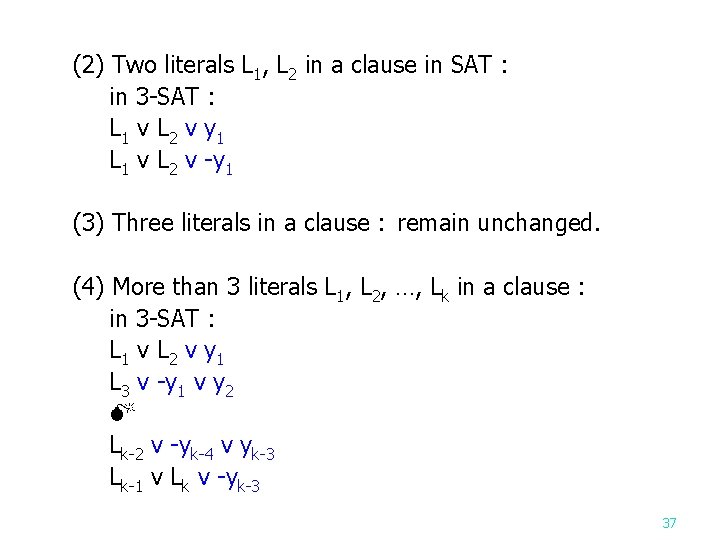
(2) Two literals L 1, L 2 in a clause in SAT : in 3 -SAT : L 1 v L 2 v y 1 L 1 v L 2 v -y 1 (3) Three literals in a clause : remain unchanged. (4) More than 3 literals L 1, L 2, …, Lk in a clause : in 3 -SAT : L 1 v L 2 v y 1 L 3 v -y 1 v y 2 Lk-2 v -yk-4 v yk-3 Lk-1 v Lk v -yk-3 37
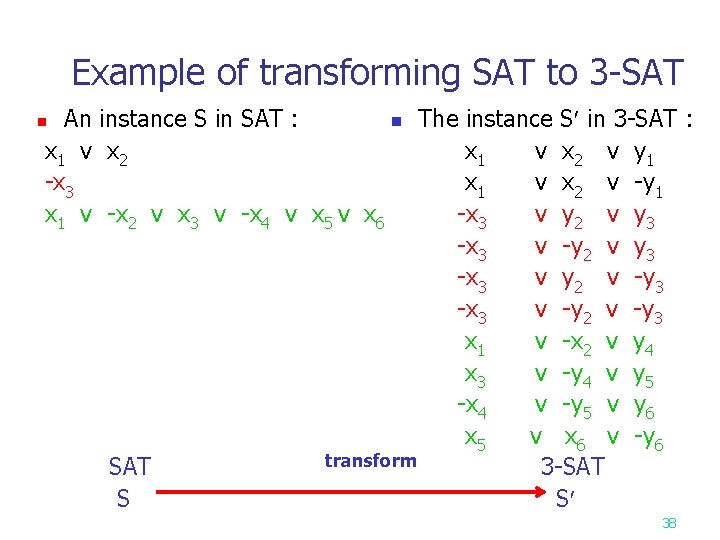
Example of transforming SAT to 3 -SAT n The instance S in 3 -SAT : An instance S in SAT : x 1 v x 2 x 1 v x 2 v y 1 -x 3 x 1 v x 2 v -y 1 x 1 v -x 2 v x 3 v -x 4 v x 5 v x 6 -x 3 v y 2 v y 3 -x 3 v -y 2 v y 3 -x 3 v y 2 v -y 3 -x 3 v -y 2 v -y 3 x 1 v -x 2 v y 4 x 3 v -y 4 v y 5 -x 4 v -y 5 v y 6 x 5 v x 6 v -y 6 transform SAT 3 -SAT S S n 38
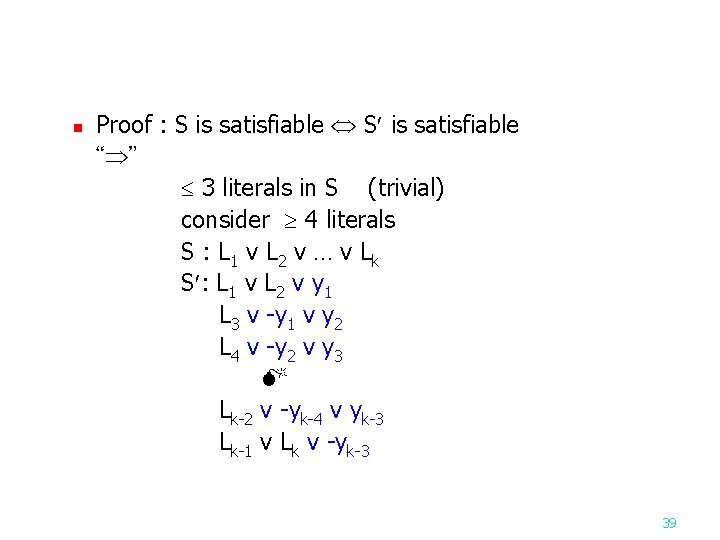
Proof : S is satisfiable “ ” 3 literals in S (trivial) consider 4 literals S : L 1 v L 2 v … v Lk S : L 1 v L 2 v y 1 L 3 v -y 1 v y 2 L 4 v -y 2 v y 3 Lk-2 v -yk-4 v yk-3 Lk-1 v Lk v -yk-3 n 39
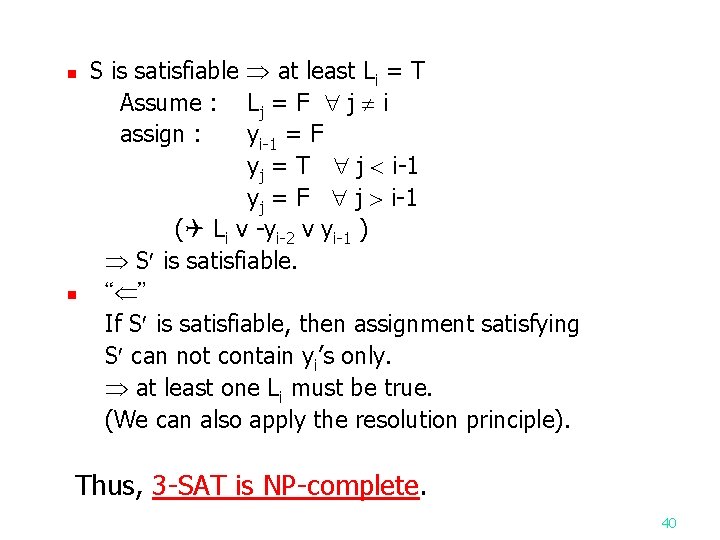
S is satisfiable at least Li = T Assume : Lj = F j i assign : yi-1 = F yj = T j i-1 yj = F j i-1 ( Li v -yi-2 v yi-1 ) S is satisfiable. n “ ” If S is satisfiable, then assignment satisfying S can not contain yi’s only. at least one Li must be true. (We can also apply the resolution principle). n Thus, 3 -SAT is NP-complete. 40
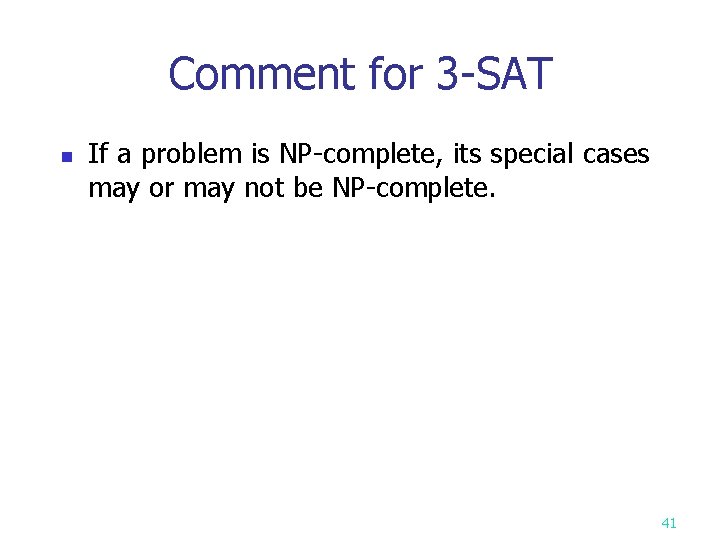
Comment for 3 -SAT n If a problem is NP-complete, its special cases may or may not be NP-complete. 41
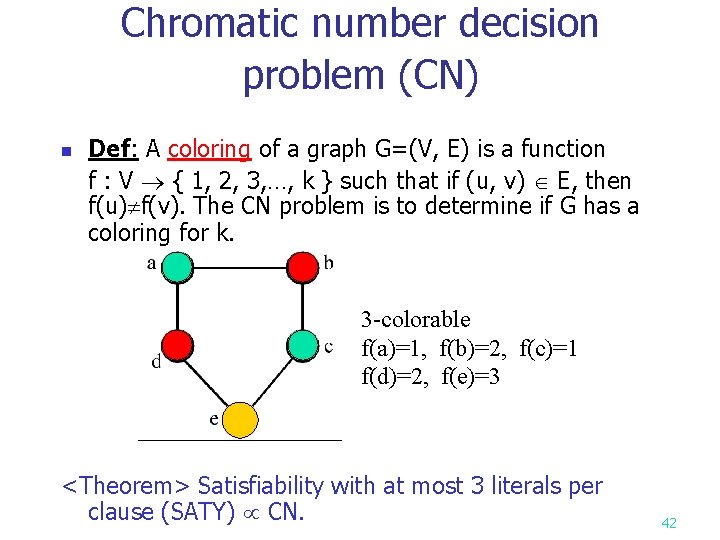
Chromatic number decision problem (CN) Def: A coloring of a graph G=(V, E) is a function f : V { 1, 2, 3, …, k } such that if (u, v) E, then f(u) f(v). The CN problem is to determine if G has a coloring for k. n 3 -colorable f(a)=1, f(b)=2, f(c)=1 f(d)=2, f(e)=3 <Theorem> Satisfiability with at most 3 literals per clause (SATY) CN. 42
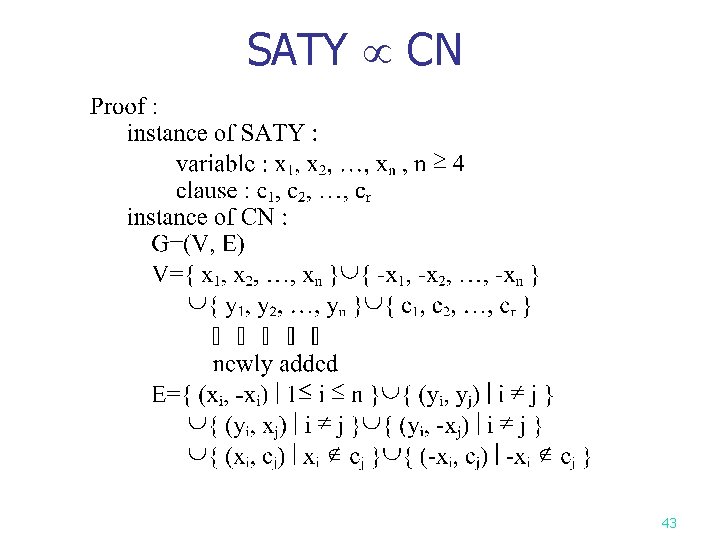
SATY CN 43
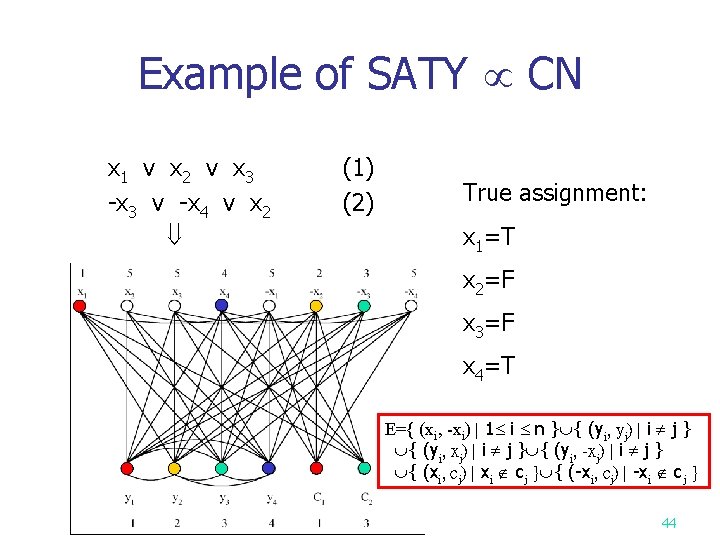
Example of SATY CN x 1 v x 2 v x 3 (1) -x 3 v -x 4 v x 2 (2) True assignment: x 1=T x 2=F x 3=F x 4=T E={ (xi, -xi) 1 i n } { (yi, yj) i j } { (yi, xj) i j } { (yi, -xj) i j } { (xi, cj) xi cj } { (-xi, cj) -xi cj } 44
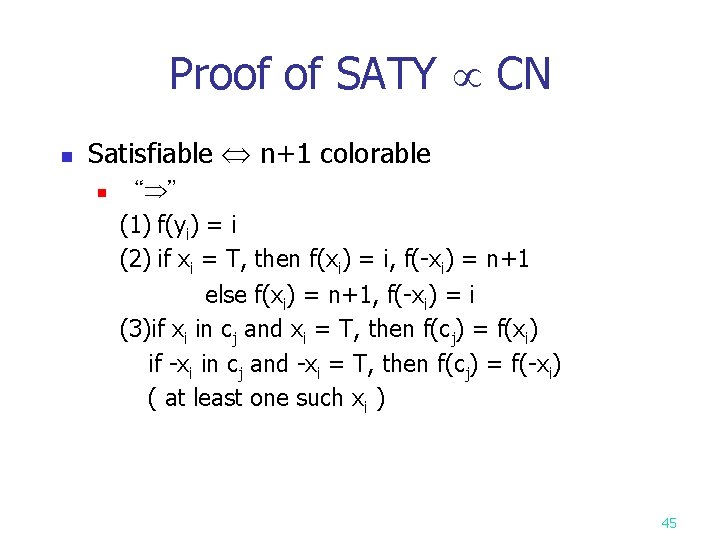
Proof of SATY CN n Satisfiable n+1 colorable n “ ” (1) f(yi) = i (2) if xi = T, then f(xi) = i, f(-xi) = n+1 else f(xi) = n+1, f(-xi) = i (3)if xi in cj and xi = T, then f(cj) = f(xi) if -xi in cj and -xi = T, then f(cj) = f(-xi) ( at least one such xi ) 45
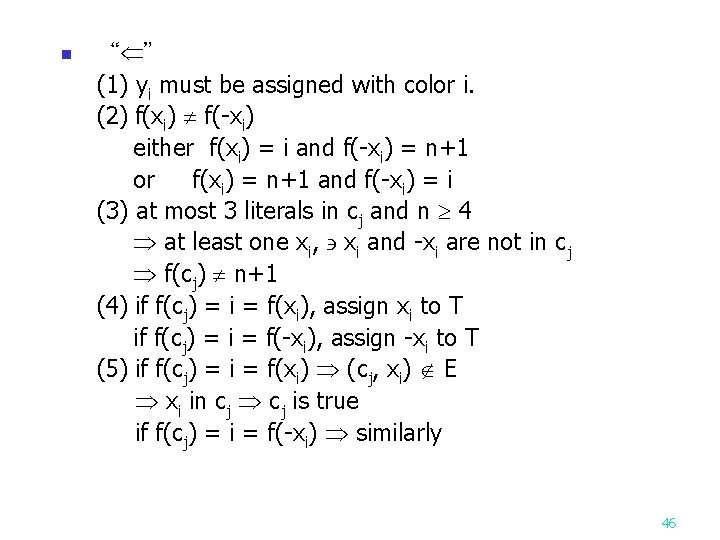
n “ ” (1) yi must be assigned with color i. (2) f(xi) f(-xi) either f(xi) = i and f(-xi) = n+1 or f(xi) = n+1 and f(-xi) = i (3) at most 3 literals in cj and n 4 at least one xi, xi and -xi are not in cj f(cj) n+1 (4) if f(cj) = i = f(xi), assign xi to T if f(cj) = i = f(-xi), assign -xi to T (5) if f(cj) = i = f(xi) (cj, xi) E xi in cj is true if f(cj) = i = f(-xi) similarly 46
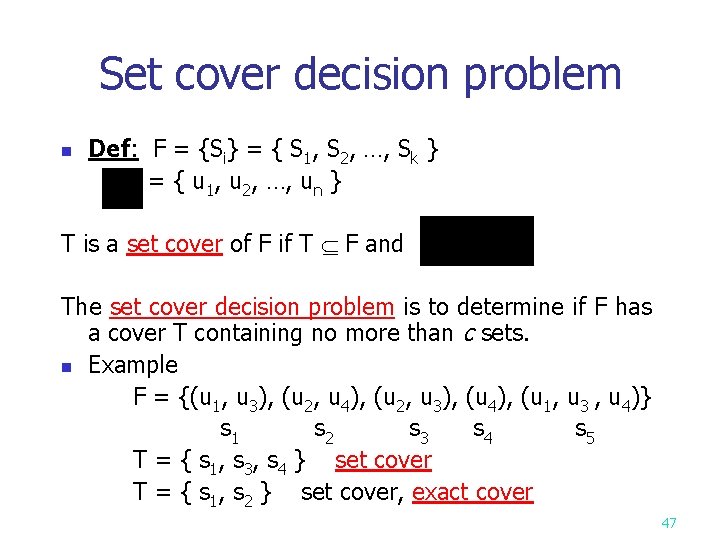
Set cover decision problem Def: F = {Si} = { S 1, S 2, …, Sk } = { u 1, u 2, …, un } T is a set cover of F if T F and The set cover decision problem is to determine if F has a cover T containing no more than c sets. n Example F = {(u 1, u 3), (u 2, u 4), (u 2, u 3), (u 4), (u 1, u 3 , u 4)} s 1 s 2 s 3 s 4 s 5 T = { s 1, s 3, s 4 } set cover T = { s 1, s 2 } set cover, exact cover n 47
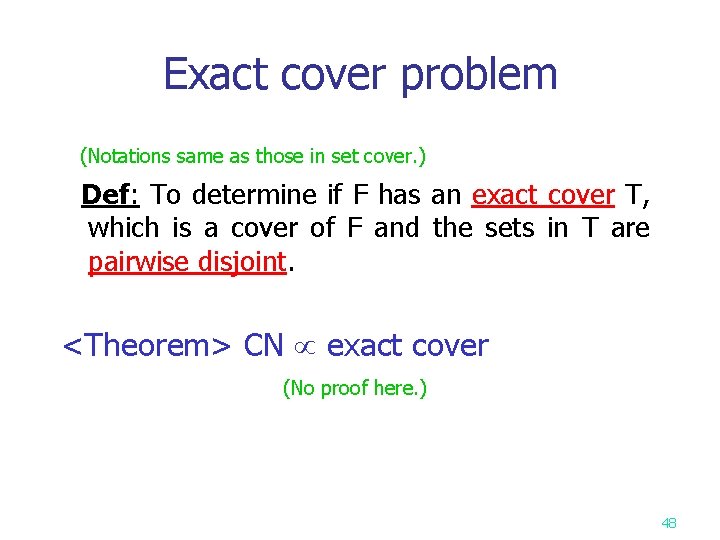
Exact cover problem (Notations same as those in set cover. ) Def: To determine if F has an exact cover T, which is a cover of F and the sets in T are pairwise disjoint. <Theorem> CN exact cover (No proof here. ) 48
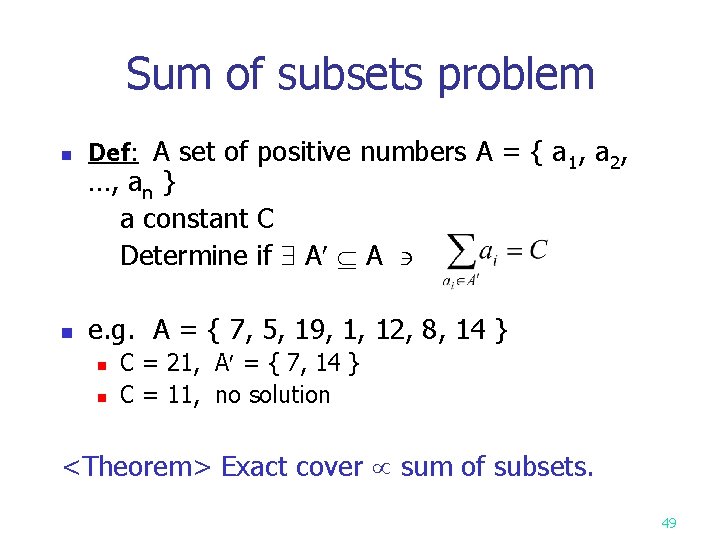
Sum of subsets problem n Def: A set of positive numbers A = { a 1, a 2, n e. g. A = { 7, 5, 19, 1, 12, 8, 14 } …, an } a constant C Determine if A A n n C = 21, A = { 7, 14 } C = 11, no solution <Theorem> Exact cover sum of subsets. 49
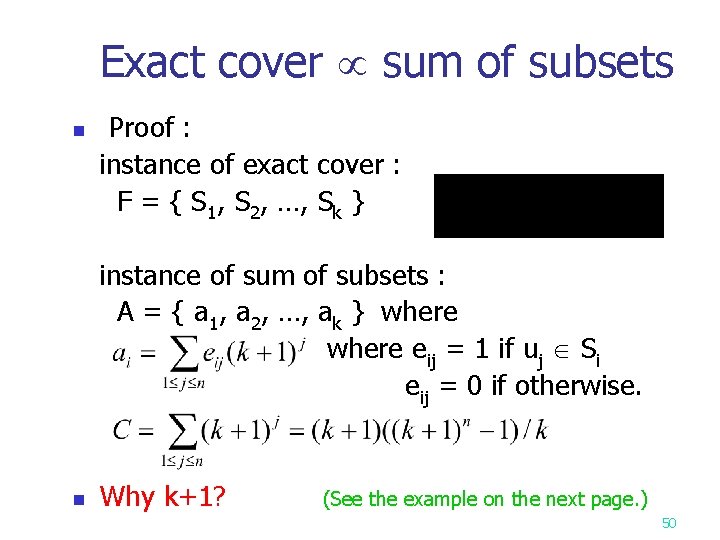
Exact cover sum of subsets Proof : instance of exact cover : F = { S 1, S 2, …, Sk } instance of sum of subsets : A = { a 1, a 2, …, ak } where where eij = 1 if uj Si eij = 0 if otherwise. n n Why k+1? (See the example on the next page. ) 50
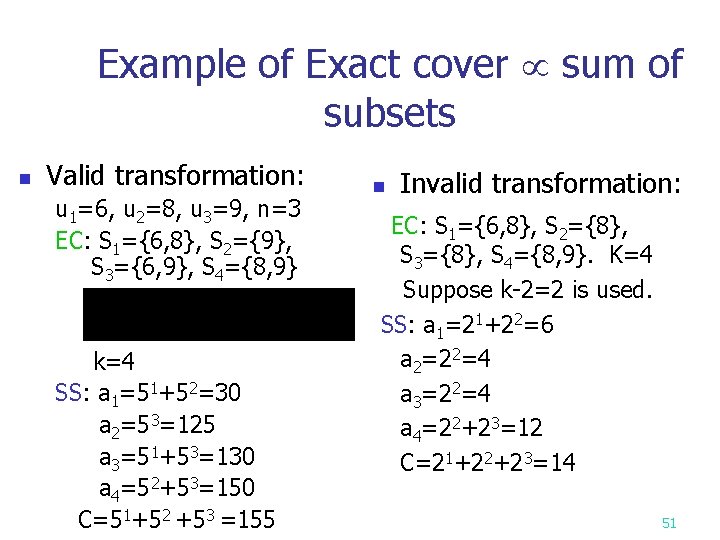
Example of Exact cover sum of subsets n Valid transformation: u 1=6, u 2=8, u 3=9, n=3 EC: S 1={6, 8}, S 2={9}, S 3={6, 9}, S 4={8, 9} k=4 SS: a 1=51+52=30 a 2=53=125 a 3=51+53=130 a 4=52+53=150 C=51+52 +53 =155 n Invalid transformation: EC: S 1={6, 8}, S 2={8}, S 3={8}, S 4={8, 9}. K=4 Suppose k-2=2 is used. SS: a 1=21+22=6 a 2=22=4 a 3=22=4 a 4=22+23=12 C=21+22+23=14 51
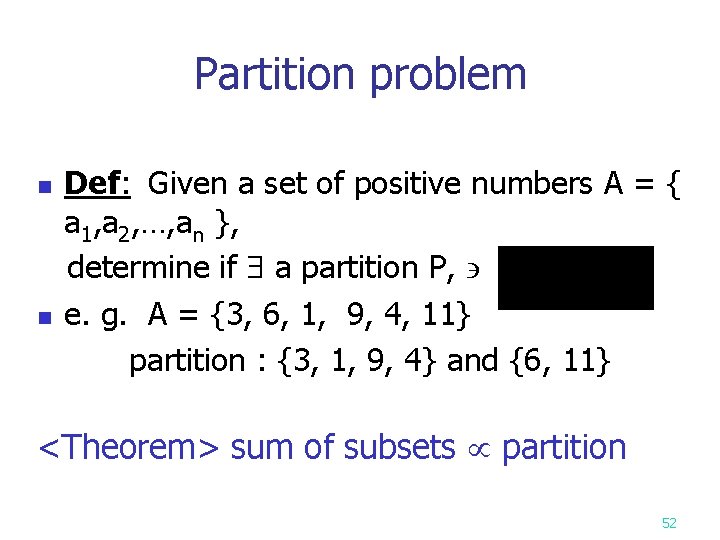
Partition problem Def: Given a set of positive numbers A = { a 1, a 2, …, an }, determine if a partition P, n e. g. A = {3, 6, 1, 9, 4, 11} partition : {3, 1, 9, 4} and {6, 11} n <Theorem> sum of subsets partition 52
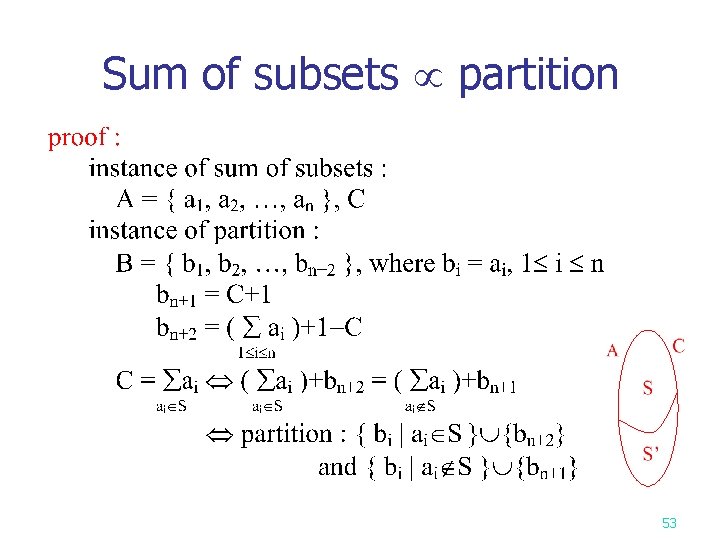
Sum of subsets partition 53
n Why bn+1 = C+1 ? why not bn+1 = C ? n To avoid bn+1 and bn+2 to be partitioned into the same subset. 54
Bin packing problem n Def: n items, each of size ci , ci > 0 n Each bin capacity : C Determine if we can assign the items into k bins, ci C , 1 j k. i binj <Theorem> partition bin packing. 55
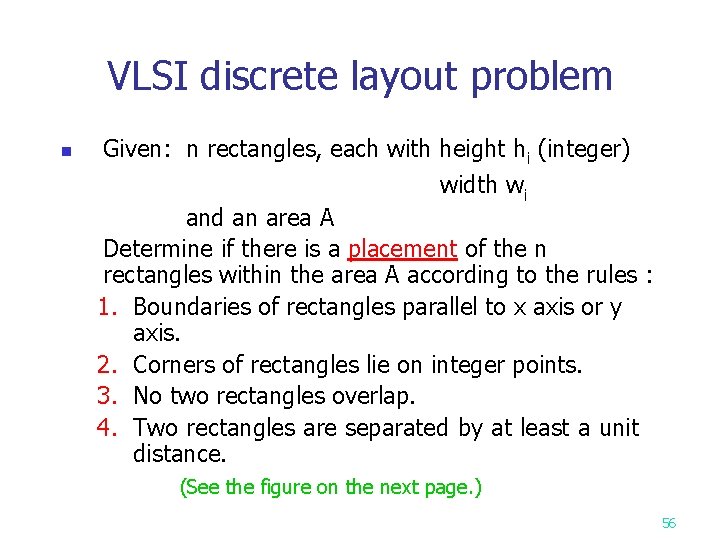
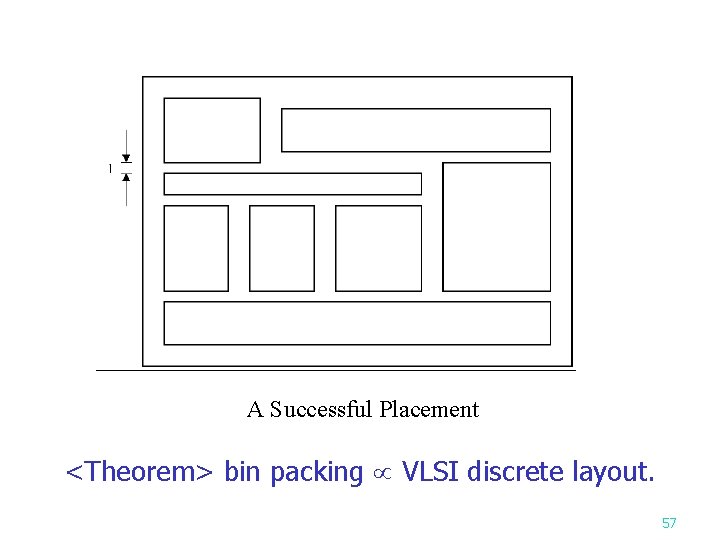
VLSI discrete layout problem n Given: n rectangles, each with height hi (integer) width wi and an area A Determine if there is a placement of the n rectangles within the area A according to the rules : 1. Boundaries of rectangles parallel to x axis or y axis. 2. Corners of rectangles lie on integer points. 3. No two rectangles overlap. 4. Two rectangles are separated by at least a unit distance. (See the figure on the next page. ) 56
A Successful Placement <Theorem> bin packing VLSI discrete layout. 57
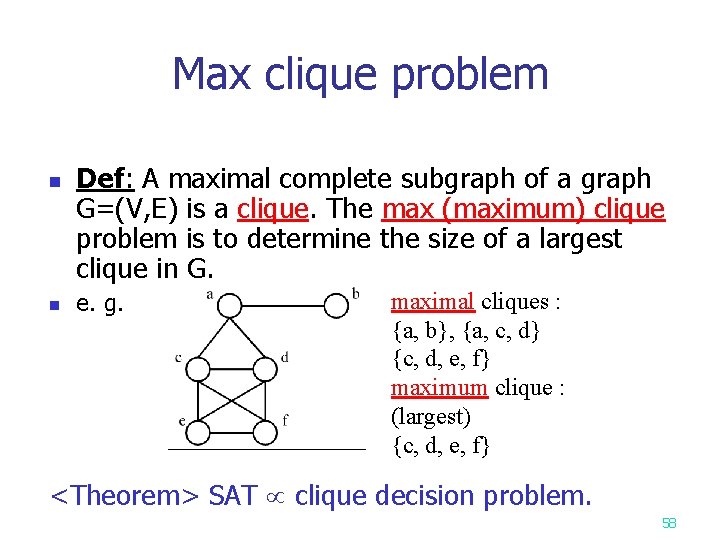
Max clique problem n n Def: A maximal complete subgraph of a graph G=(V, E) is a clique. The max (maximum) clique problem is to determine the size of a largest clique in G. e. g. maximal cliques : {a, b}, {a, c, d} {c, d, e, f} maximum clique : (largest) {c, d, e, f} <Theorem> SAT clique decision problem. 58
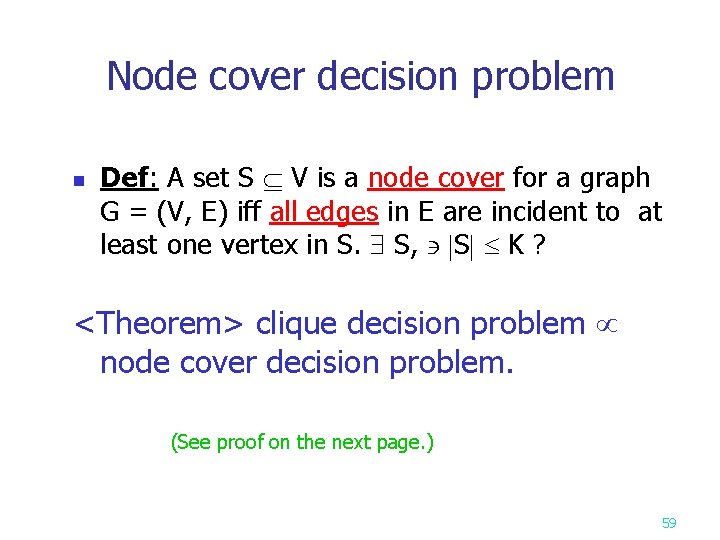
Node cover decision problem n Def: A set S V is a node cover for a graph G = (V, E) iff all edges in E are incident to at least one vertex in S. S, S K ? <Theorem> clique decision problem node cover decision problem. (See proof on the next page. ) 59
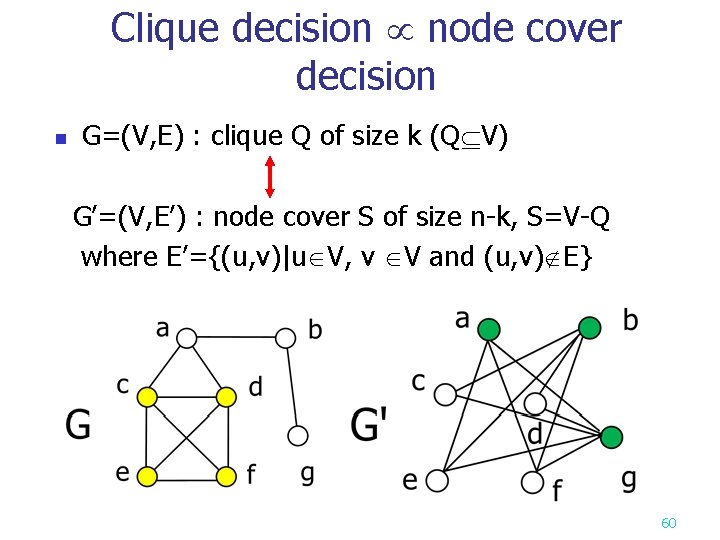
Clique decision node cover decision n G=(V, E) : clique Q of size k (Q V) G’=(V, E’) : node cover S of size n-k, S=V-Q where E’={(u, v)|u V, v V and (u, v) E} 60
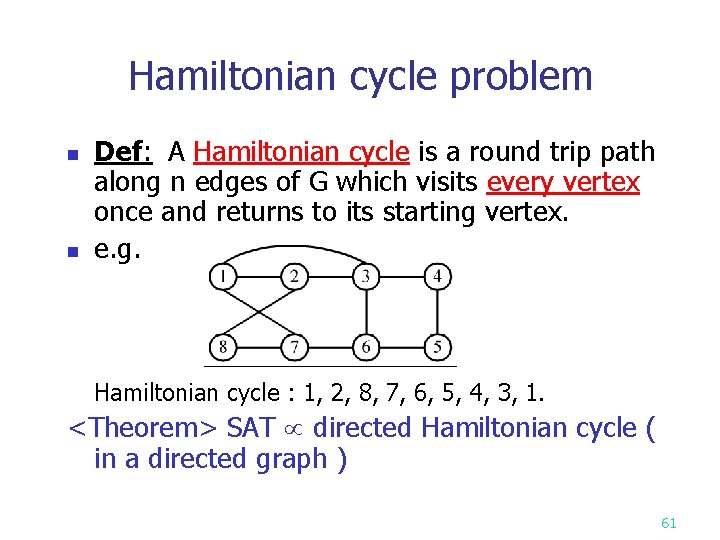
Hamiltonian cycle problem n n Def: A Hamiltonian cycle is a round trip path along n edges of G which visits every vertex once and returns to its starting vertex. e. g. Hamiltonian cycle : 1, 2, 8, 7, 6, 5, 4, 3, 1. <Theorem> SAT directed Hamiltonian cycle ( in a directed graph ) 61
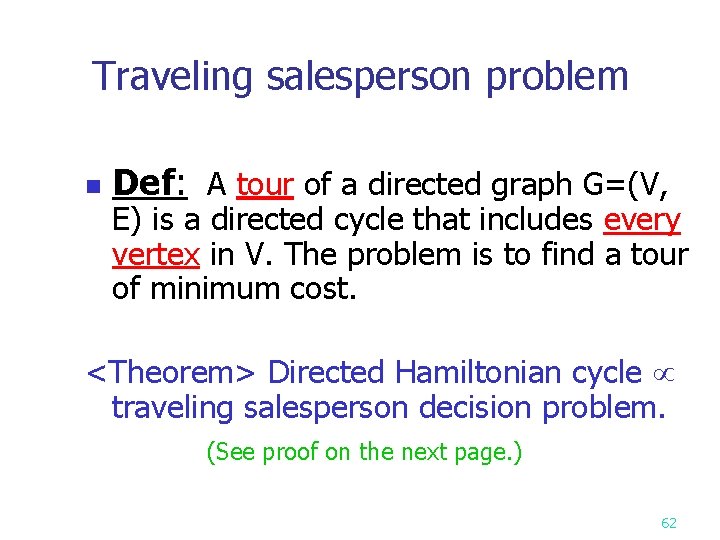
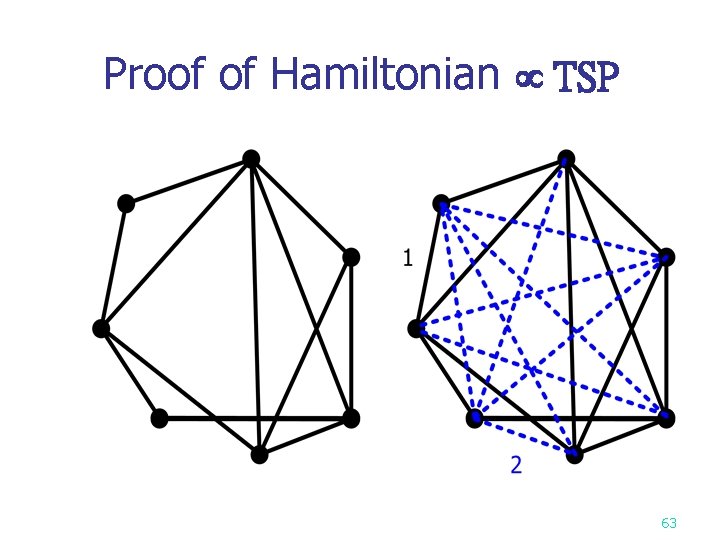
Traveling salesperson problem n Def: A tour of a directed graph G=(V, E) is a directed cycle that includes every vertex in V. The problem is to find a tour of minimum cost. <Theorem> Directed Hamiltonian cycle traveling salesperson decision problem. (See proof on the next page. ) 62
Proof of Hamiltonian TSP 63
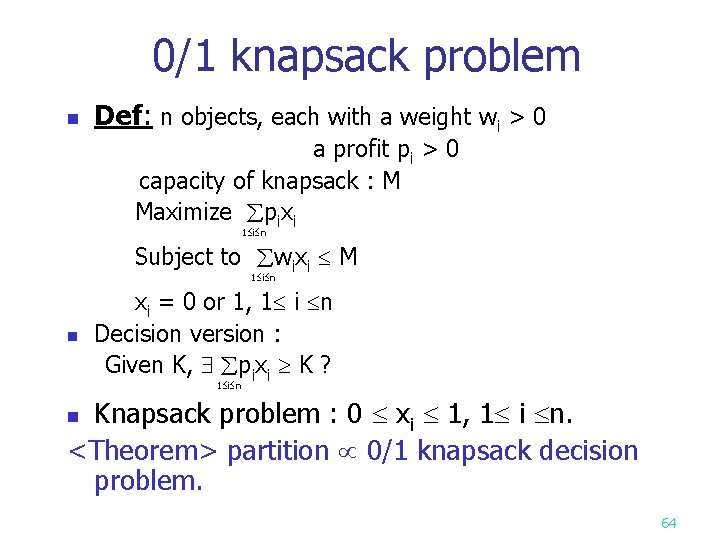
0/1 knapsack problem n Def: n objects, each with a weight wi > 0 a profit pi > 0 capacity of knapsack : M Maximize pixi 1 i n Subject to wixi M 1 i n xi = 0 or 1, 1 i n n Decision version : Given K, pixi K ? 1 i n Knapsack problem : 0 xi 1, 1 i n. <Theorem> partition 0/1 knapsack decision problem. n 64
n Refer to Sec. 11. 3, Sec. 11. 4 and its exercises of [Horowitz 1998] for the proofs of more NPcomplete problems. n [[Horowitz 1998] E. Howowitz, S. Sahni and S. Rajasekaran, Computer Algorithms, Computer Science Press, New York, 1998, 「台北圖書」代理, 02 -23625376 65