
CHAPTER 8 The Urban Labor Market Mc GrawHill
CHAPTER 8 The Urban Labor Market ©Mc. Graw-Hill Education. All rights reserved. Authorized only for instructor use in the classroom. No reproduction or further distribution permitted without the prior written consent of Mc. Graw-Hill Education.
Introduction • This chapter explores the workings of the urban labor market. – Who benefits from an increase in total employment? – How does tax policy affect total employment? – What are the economic effects of professional sports teams and megaevents such as the World Cup? ©Mc. Graw-Hill Education.
Urban Labor Supply and Demand The urban labor market model can be used to explore the market forces that determine equilibrium wages and total employment in a city. • For this chapter, use the following assumptions: – The metropolitan area is part of a larger regional economy in which households and firms are perfectly mobile between cities in the region. – The demand for labor comes from firms in the city, while the labor supply comes from households living in the city. ©Mc. Graw-Hill Education.
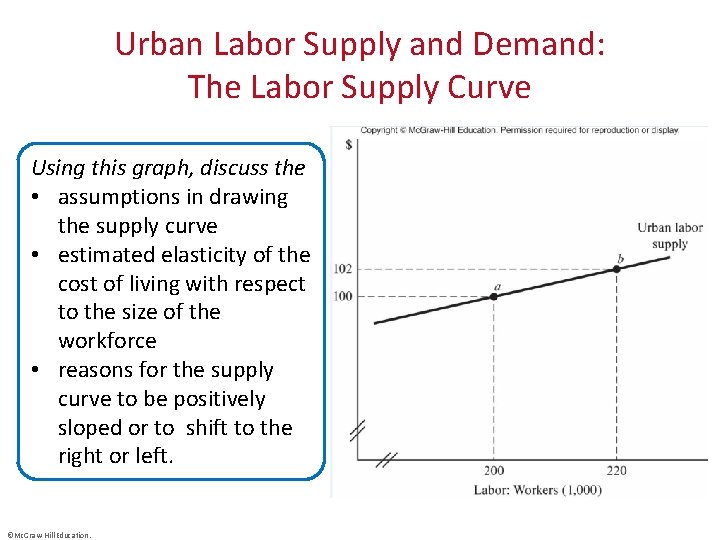
Urban Labor Supply and Demand: The Labor Supply Curve Using this graph, discuss the • assumptions in drawing the supply curve • estimated elasticity of the cost of living with respect to the size of the workforce • reasons for the supply curve to be positively sloped or to shift to the right or left. ©Mc. Graw-Hill Education.
Factors that Determine the Position of the Labor Supply Curve The position of the supply curve is determined by the following factors: • amenities • disamenities • residential taxes • residential public services. ©Mc. Graw-Hill Education.
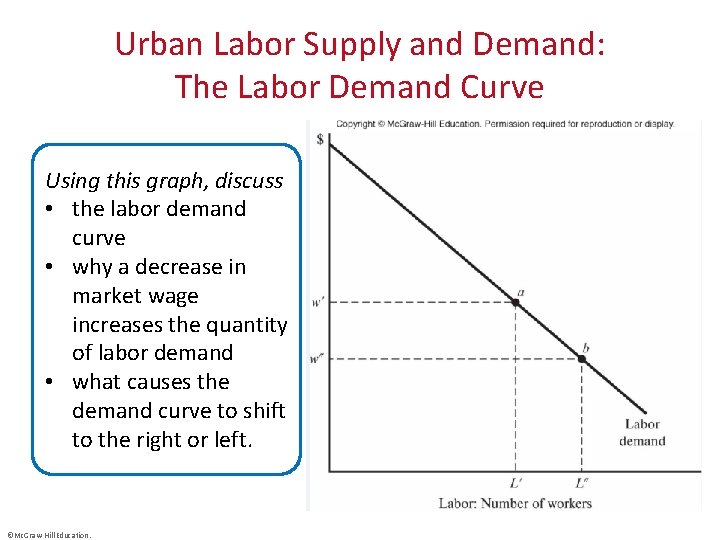
Urban Labor Supply and Demand: The Labor Demand Curve Using this graph, discuss • the labor demand curve • why a decrease in market wage increases the quantity of labor demand • what causes the demand curve to shift to the right or left. ©Mc. Graw-Hill Education.
Factors that Determine the Position of the Labor Demand Curve The position of the labor demand curve is determined by the: • demand for exports • labor productivity • business taxes • industrial public services • land-use policies. ©Mc. Graw-Hill Education.
The Employment Multiplier (1 of 3) Total employment in a city is the sum of export employment and local employment. Export Employment Local Employment People who produce goods and services that are sold to people services that are sold to local who live outside the city. residents are considered local workers. ©Mc. Graw-Hill Education.
The Employment Multiplier (2 of 3) The relationship between export employment and local employment is determined by the multiplier process. • The employment multiplier is defined as the change in total employment per unit change in export employment. • Employment multiplier = ΔTotal employment/ΔExport employment ©Mc. Graw-Hill Education.
The Employment Multiplier (3 of 3) Economists use two techniques to estimate employment multipliers. • The traditional alternative uses input-output analysis. • The modern alternative estimates multipliers based on actual experience. Discuss why the input-output approach is considered problematic. ©Mc. Graw-Hill Education.
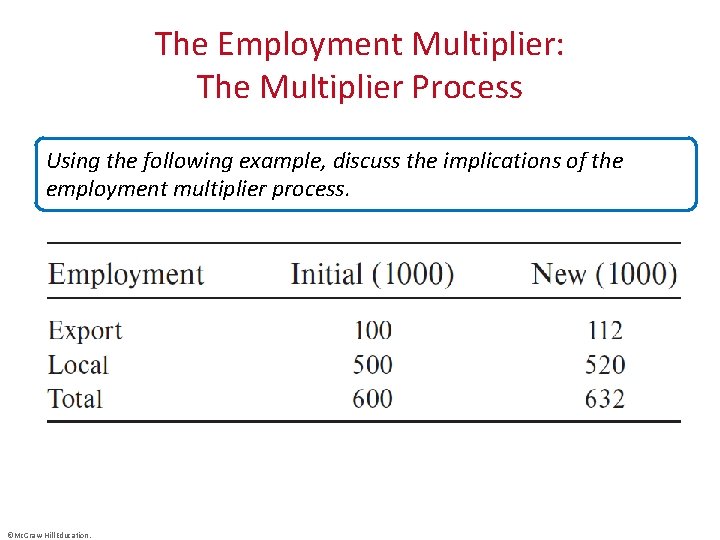
The Employment Multiplier: The Multiplier Process Using the following example, discuss the implications of the employment multiplier process. ©Mc. Graw-Hill Education.
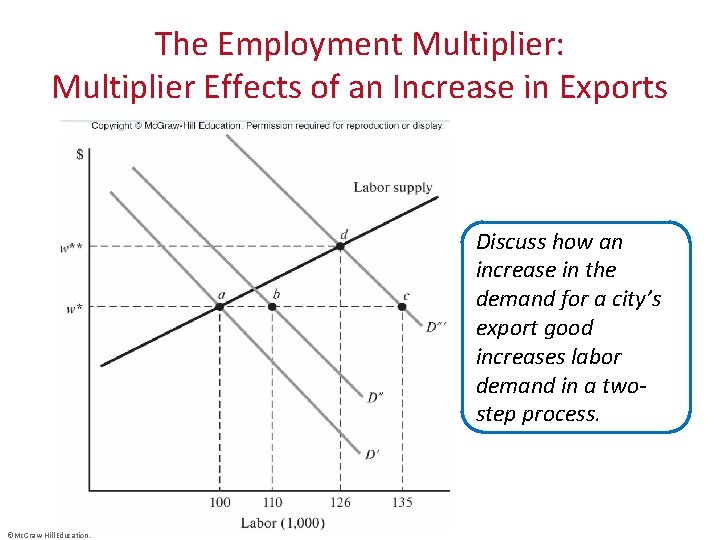
The Employment Multiplier: Multiplier Effects of an Increase in Exports Discuss how an increase in the demand for a city’s export good increases labor demand in a twostep process. ©Mc. Graw-Hill Education.
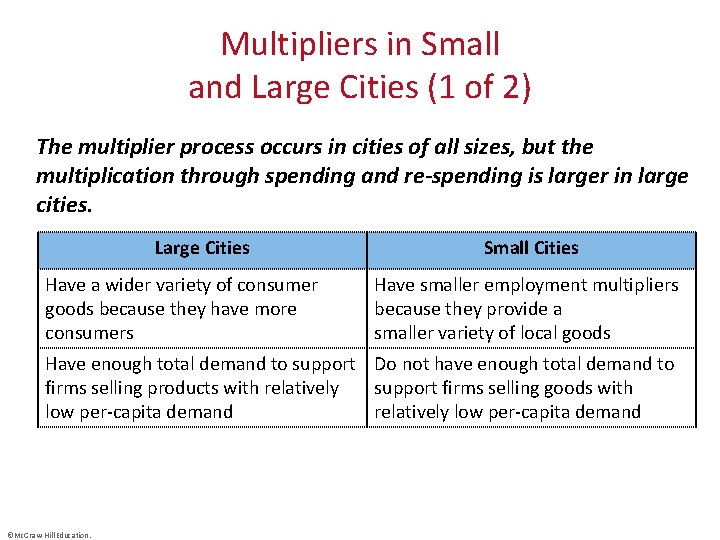
Multipliers in Small and Large Cities (1 of 2) The multiplier process occurs in cities of all sizes, but the multiplication through spending and re-spending is larger in large cities. Large Cities Have a wider variety of consumer goods because they have more consumers Small Cities Have smaller employment multipliers because they provide a smaller variety of local goods Have enough total demand to support Do not have enough total demand to firms selling products with relatively support firms selling goods with low per-capita demand relatively low per-capita demand ©Mc. Graw-Hill Education.
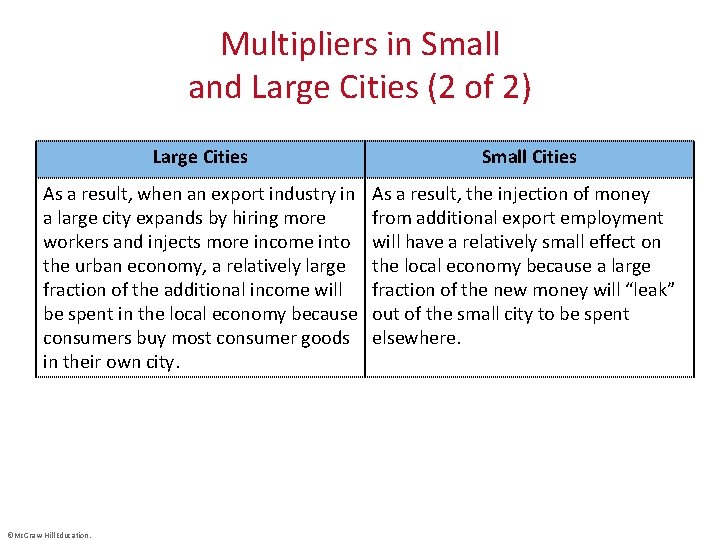
Multipliers in Small and Large Cities (2 of 2) Large Cities Small Cities As a result, when an export industry in a large city expands by hiring more workers and injects more income into the urban economy, a relatively large fraction of the additional income will be spent in the local economy because consumers buy most consumer goods in their own city. As a result, the injection of money from additional export employment will have a relatively small effect on the local economy because a large fraction of the new money will “leak” out of the small city to be spent elsewhere. ©Mc. Graw-Hill Education.
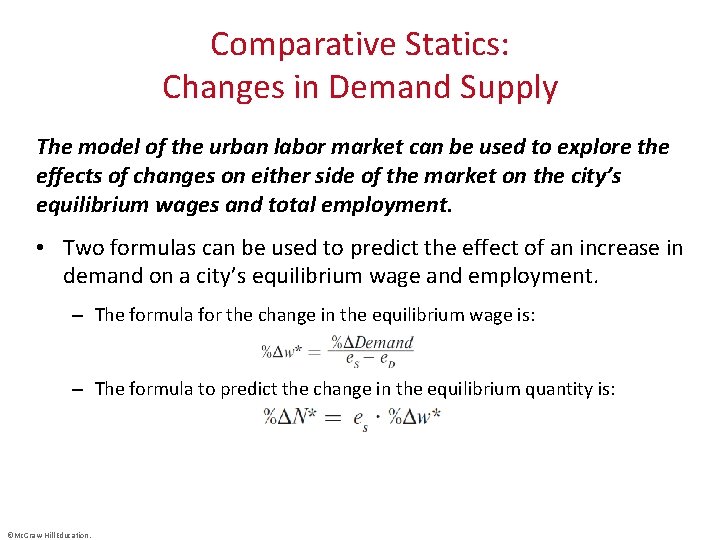
Comparative Statics: Changes in Demand Supply The model of the urban labor market can be used to explore the effects of changes on either side of the market on the city’s equilibrium wages and total employment. • Two formulas can be used to predict the effect of an increase in demand on a city’s equilibrium wage and employment. – The formula for the change in the equilibrium wage is: – The formula to predict the change in the equilibrium quantity is: ©Mc. Graw-Hill Education.
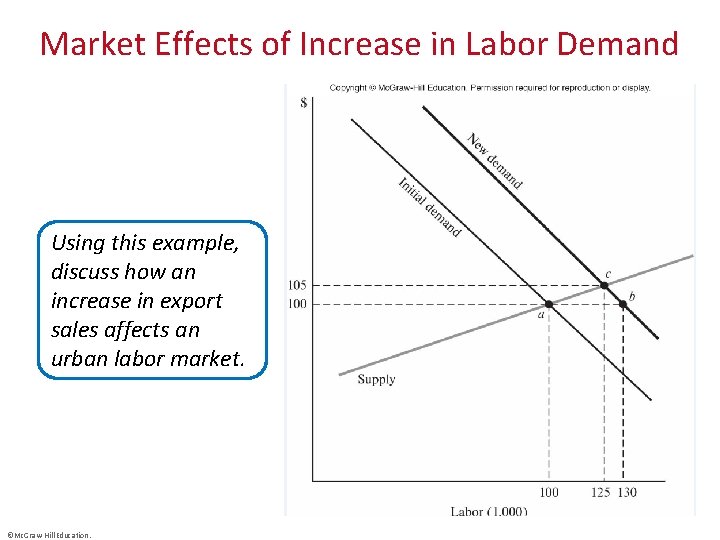
Market Effects of Increase in Labor Demand Using this example, discuss how an increase in export sales affects an urban labor market. ©Mc. Graw-Hill Education.
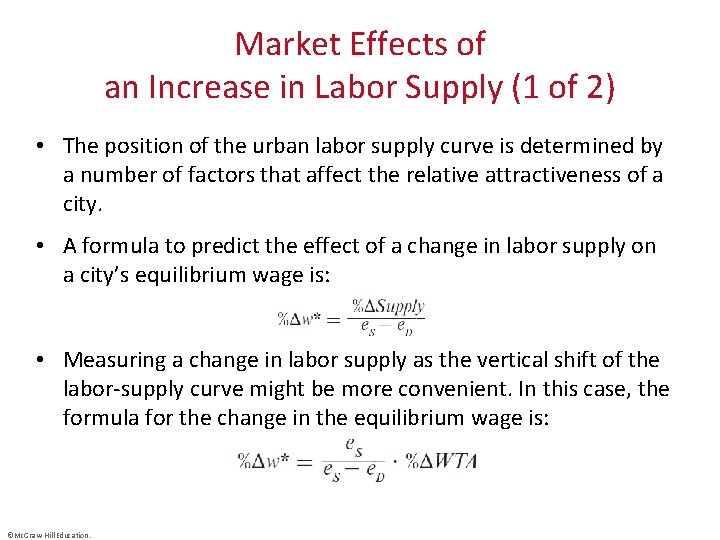
Market Effects of an Increase in Labor Supply (1 of 2) • The position of the urban labor supply curve is determined by a number of factors that affect the relative attractiveness of a city. • A formula to predict the effect of a change in labor supply on a city’s equilibrium wage is: • Measuring a change in labor supply as the vertical shift of the labor-supply curve might be more convenient. In this case, the formula for the change in the equilibrium wage is: ©Mc. Graw-Hill Education.
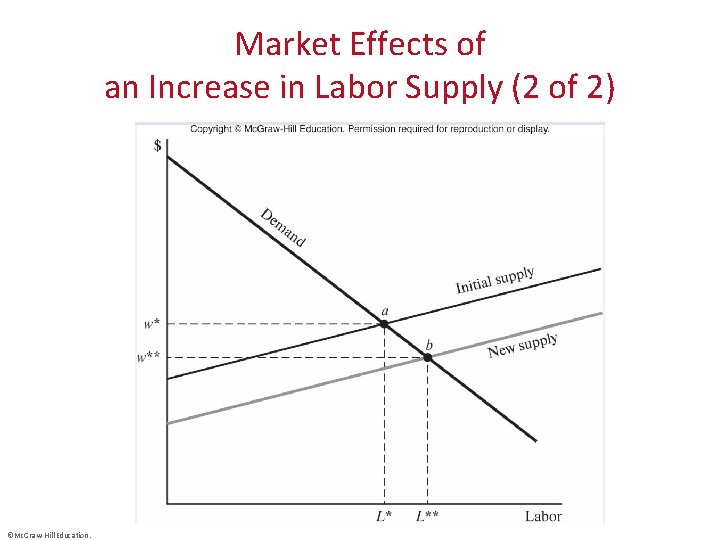
Market Effects of an Increase in Labor Supply (2 of 2) ©Mc. Graw-Hill Education.
Simultaneous Changes in Demand Supply What are the employment effects of local environmental policy? • Consider a city with two industries, a polluting steel industry and a clean industry. • A pollution tax affects both sides of the urban labor market: – decrease in labor demand – increase in labor supply Discuss how a pollution tax shifts both the supply curve and the demand curve. wage and employment. ©Mc. Graw-Hill Education.
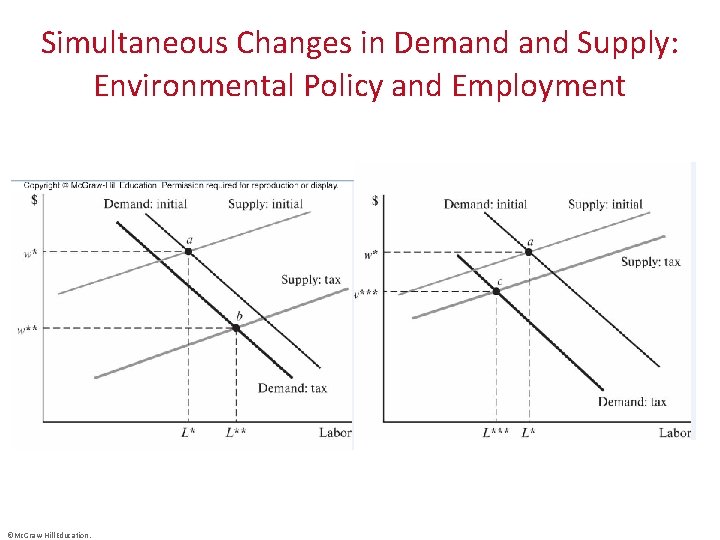
Simultaneous Changes in Demand Supply: Environmental Policy and Employment ©Mc. Graw-Hill Education.
Public Tax Policies: Firm Location Choices (1 of 2) Local governments can shift the demand curve for labor in a number of ways. Taxes can greatly affect a firm’s location decisions and urban employment. • Local taxes have a strong negative effect on employment growth. – A high-tax city will grow at a slower rate than a low-tax city, all else (such as public services) being equal. • There are two types of business location decisions: – interstate – intrastate. ©Mc. Graw-Hill Education.
Public Tax Policies: Firm Location Choices (2 of 2) The elasticity of business activity with respect to tax liabilities is defined as the percentage change in business activity divided by the percentage change in tax liabilities. • What is the elasticity of business activity in the context of interstate and intrastate location decisions? • Why is the elasticity for the intrastate decision larger? ©Mc. Graw-Hill Education.
Public Tax Policies: Tax Incentive Programs Many cities try to attract new firms by offering tax incentives such as relatively low tax rates over some period, sometimes known as tax holidays. • Discuss a typical tax-incentive package provided by state and local governments. • Discuss the effects of the Michigan Economic Growth Authority (MEGA) tax-incentive program. ©Mc. Graw-Hill Education.
Geographically Targeted Subsidies: Empowerment and Enterprise Zones Enterprise zones (within cities) are defined as areas where firms pay low taxes, receive subsidies for worker training, and are exempt from some local regulations. Discuss the benefits of enterprise zones. Empowerment zones are economically distressed areas. The firms that locate in these areas receive tax credits on wages paid to workers who live within the zone boundaries. Discuss the benefits of the Empowerment Zone (EZ) program funded by the federal government. ©Mc. Graw-Hill Education.
Sport Stadiums and Mega-Events Many cities subsidize the construction of facilities for professional sports, building stadiums that cost $200 million or more. • Discuss the employment effects of sport stadiums. • Discuss the economic effects of super bowl and other megaevents. ©Mc. Graw-Hill Education.
- Slides: 25