
Chapter 8 The t Test for Independent Means
- Slides: 11
Chapter 8 The t Test for Independent Means Part 1: Oct. 8, 2013
t Test for Independent Means • Comparing two samples – e. g. , experimental and control group – Scores are independent of each other • Focus on differences betw 2 samples, so comparison distribution is: – Distribution of differences between means
The Distribution of Differences Between Means • If null hyp is true, the 2 populations (where we get sample means) have equal means • If null is true, the mean of the distribution of differences = 0
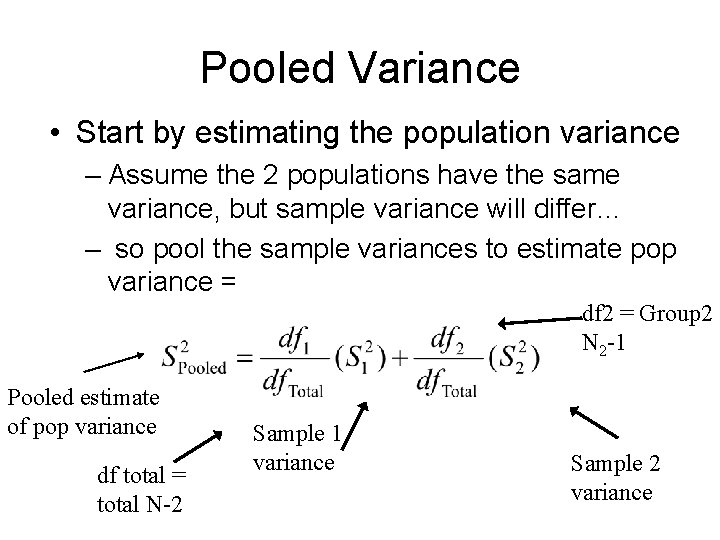
Pooled Variance • Start by estimating the population variance – Assume the 2 populations have the same variance, but sample variance will differ… – so pool the sample variances to estimate pop variance = df 2 = Group 2 N 2 -1 Pooled estimate of pop variance df total = total N-2 Sample 1 variance Sample 2 variance
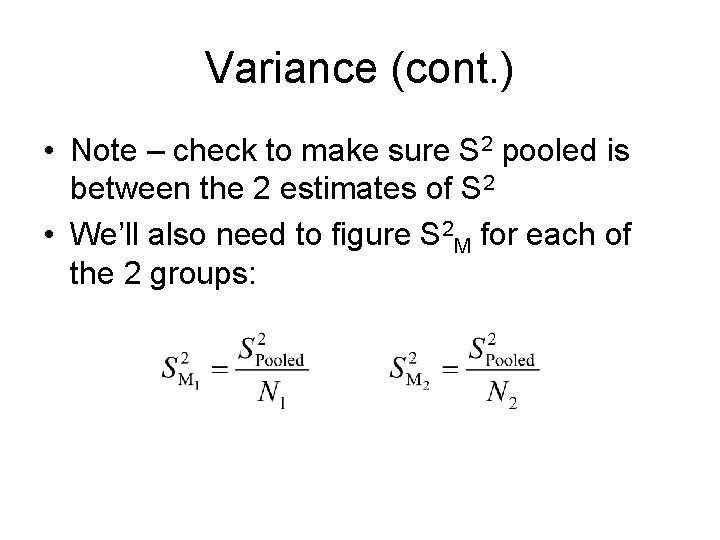
Variance (cont. ) • Note – check to make sure S 2 pooled is between the 2 estimates of S 2 • We’ll also need to figure S 2 M for each of the 2 groups:
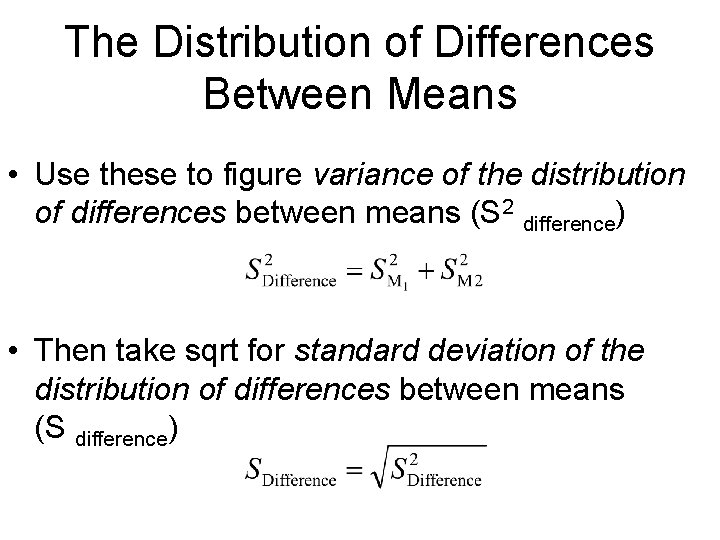
The Distribution of Differences Between Means • Use these to figure variance of the distribution of differences between means (S 2 difference) • Then take sqrt for standard deviation of the distribution of differences between means (S difference)
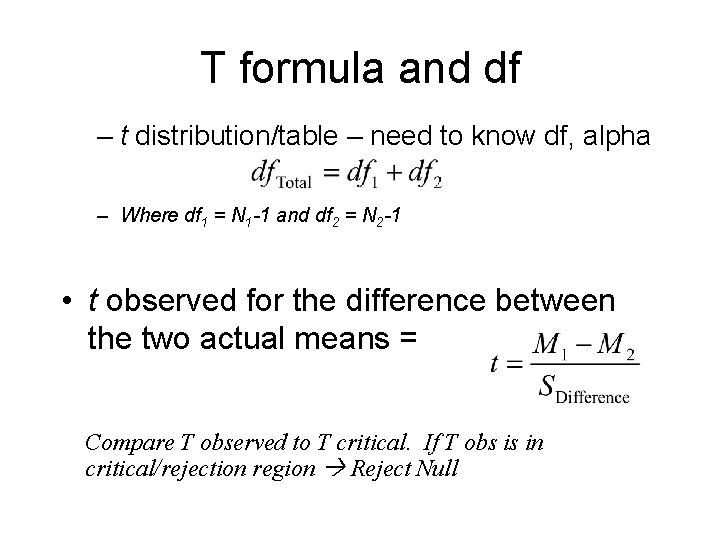
T formula and df – t distribution/table – need to know df, alpha – Where df 1 = N 1 -1 and df 2 = N 2 -1 • t observed for the difference between the two actual means = Compare T observed to T critical. If T obs is in critical/rejection region Reject Null
Example • Group 1 – watch TV news; Group 2 – radio news. – Is there a significant difference in knowledge based on news source? – Research Hyp? – Null Hyp?
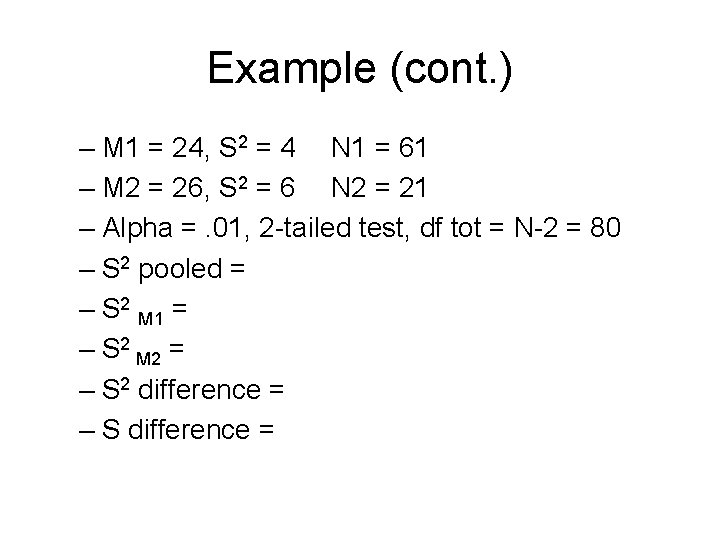
Example (cont. ) – M 1 = 24, S 2 = 4 N 1 = 61 – M 2 = 26, S 2 = 6 N 2 = 21 – Alpha =. 01, 2 -tailed test, df tot = N-2 = 80 – S 2 pooled = – S 2 M 1 = – S 2 M 2 = – S 2 difference = – S difference =
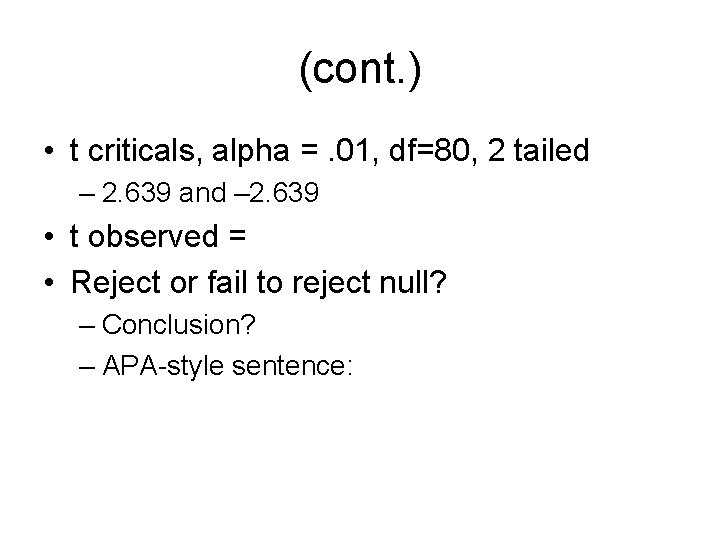
(cont. ) • t criticals, alpha =. 01, df=80, 2 tailed – 2. 639 and – 2. 639 • t observed = • Reject or fail to reject null? – Conclusion? – APA-style sentence:
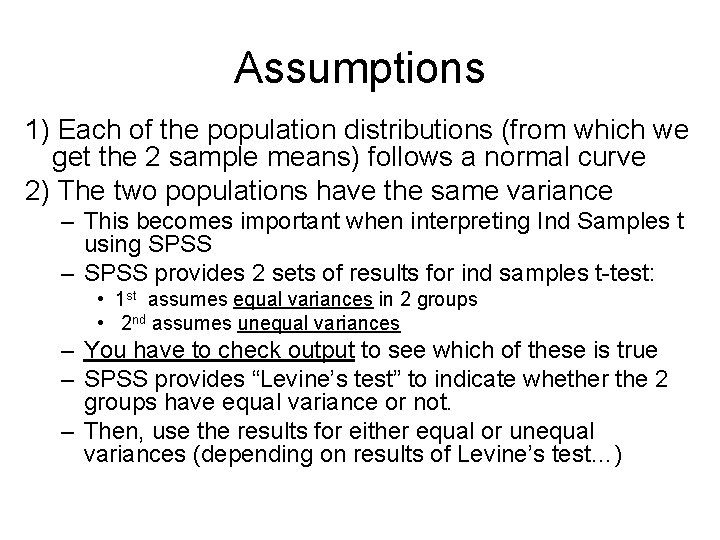
Assumptions 1) Each of the population distributions (from which we get the 2 sample means) follows a normal curve 2) The two populations have the same variance – This becomes important when interpreting Ind Samples t using SPSS – SPSS provides 2 sets of results for ind samples t-test: • 1 st assumes equal variances in 2 groups • 2 nd assumes unequal variances – You have to check output to see which of these is true – SPSS provides “Levine’s test” to indicate whether the 2 groups have equal variance or not. – Then, use the results for either equal or unequal variances (depending on results of Levine’s test…)