
CHAPTER 8 The Keynesian ShortRun Policy Model Demand
- Slides: 31
CHAPTER 8 The Keynesian Short-Run Policy Model: Demand. Side Policies © 2020 Mc. Graw-Hill Education. All rights reserved. Authorized only for instructor use in the classroom. No reproduction or further distribution permitted without the prior written consent of Mc. Graw-Hill Education.
Chapter Goals • Discuss the key insight of the AS/AD model and list both its assumptions and its components. • Describe the shape of the aggregate demand curve and what factors shift the curve. • Explain the shape of the short-run and long-run aggregate supply curves and what factors shift the curves. • Show the effects of shifts of the aggregate demand aggregate supply curves on the price level and output in both the short run and long run. • Discuss the limitations of the macro policy model. © 2020 Mc. Graw-Hill Education 2
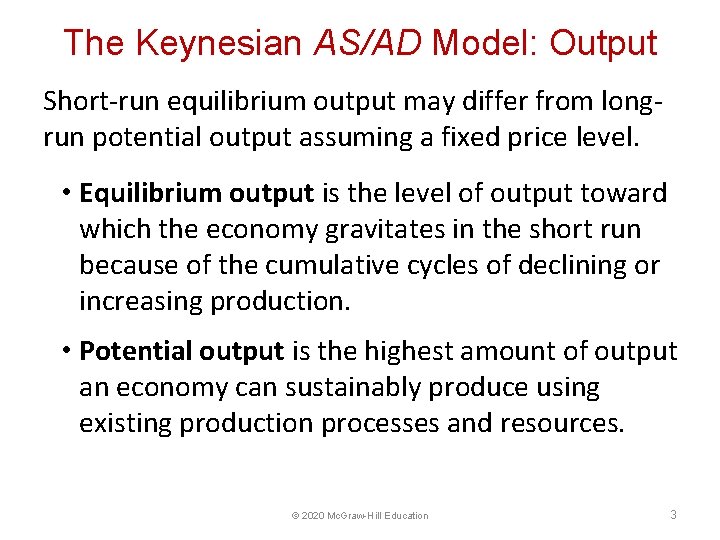
The Keynesian AS/AD Model: Output Short-run equilibrium output may differ from longrun potential output assuming a fixed price level. • Equilibrium output is the level of output toward which the economy gravitates in the short run because of the cumulative cycles of declining or increasing production. • Potential output is the highest amount of output an economy can sustainably produce using existing production processes and resources. © 2020 Mc. Graw-Hill Education 3
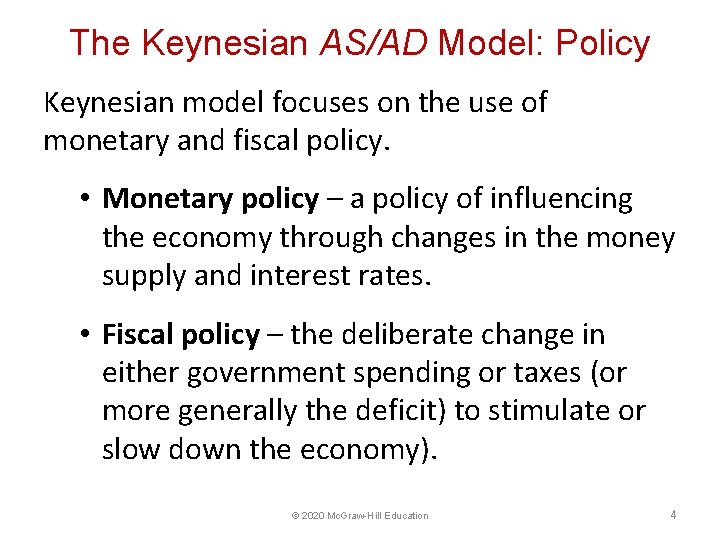
The Keynesian AS/AD Model: Policy Keynesian model focuses on the use of monetary and fiscal policy. • Monetary policy – a policy of influencing the economy through changes in the money supply and interest rates. • Fiscal policy – the deliberate change in either government spending or taxes (or more generally the deficit) to stimulate or slow down the economy). © 2020 Mc. Graw-Hill Education 4
Key Insight of the Keynesian AS/AD Model Paradox of thrift means an increase in saving may lead to a decrease in spending, output, causing a recession and lowering total saving. Keynesians believe the economy would need government’s help to prop up aggregate expenditures. Keynesian economists advocated an activist demand management policy. © 2020 Mc. Graw-Hill Education 5
The Components of the AS/AD Model Three important things about the AS/AD model: 1. It is a short-run model. 2. It is a pedagogical model. 3. It starts with aggregate relationships. The AS/AD model does provide a simple model that suggest a role for government in keeping feedback effects from spiraling an economy downward. © 2020 Mc. Graw-Hill Education 6
The AS/AD Model Consists of Three Curves 1. Aggregate Demand (AD) Curve: a curve that shows how a change in the price level will change aggregate expenditures on all goods and services in an economy. 2. Short-Run Aggregate Supply (SAS) Curve: a curve that specifies how a shift in the aggregate demand curve affects the price level and real output in the short run, other things constant. 3. Long-Run Aggregate Supply (LAS) Curve: a curve that shows the long-run relationship between output and the price level. © 2020 Mc. Graw-Hill Education 7
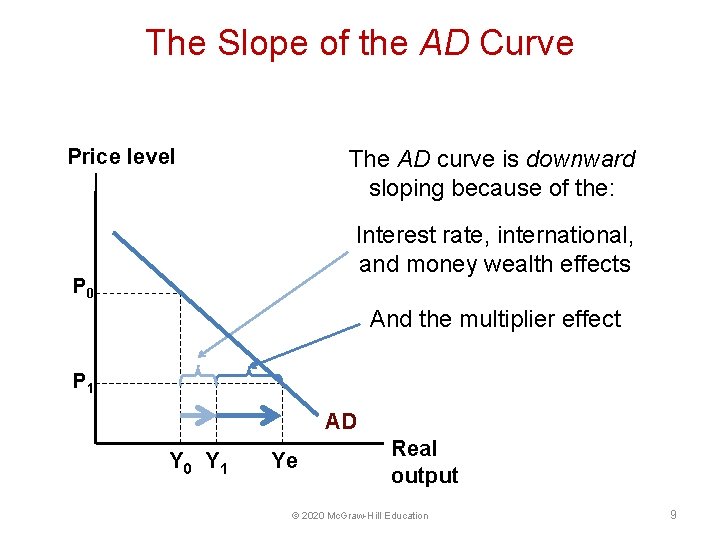
The AD Curve Is Downward Sloping Explanations that make the AD curve downward sloping: • Interest rate effect - the effect that a lower price level has on investment expenditures through the effect that a change in the price level has on interest rates. • International effect - as the price level falls (assuming the exchange rate does not change), net exports will rise. • Money wealth effect - a fall in the price level will make the holders of money richer, so they buy more. • Multiplier effect - the amplification of initial changes in expenditures. © 2020 Mc. Graw-Hill Education 8
The Slope of the AD Curve Price level The AD curve is downward sloping because of the: Interest rate, international, and money wealth effects P 0 And the multiplier effect P 1 AD Y 0 Y 1 Ye Real output © 2020 Mc. Graw-Hill Education 9
Dynamic Price-Level Adjustment Feedback Effects Dynamic effects exist that can overwhelm the standard AD shift factors. Especially important when aggregate demand is declining are: • Expectations of falling aggregate demand • Lower asset prices (declining nominal wealth) • Financial panics These forces counteract the standard shift factors. If strong enough, dynamic forces can cause aggregate demand to fall (shift to the left) when the price level falls. © 2020 Mc. Graw-Hill Education 10
Shifts in the AD Curve A shift in the AD curve means that at every price level, total expenditures have changed. Five important shift factors are: • Foreign income • Exchange rate fluctuations • Distribution of income • Expectations • Government policies © 2020 Mc. Graw-Hill Education 11
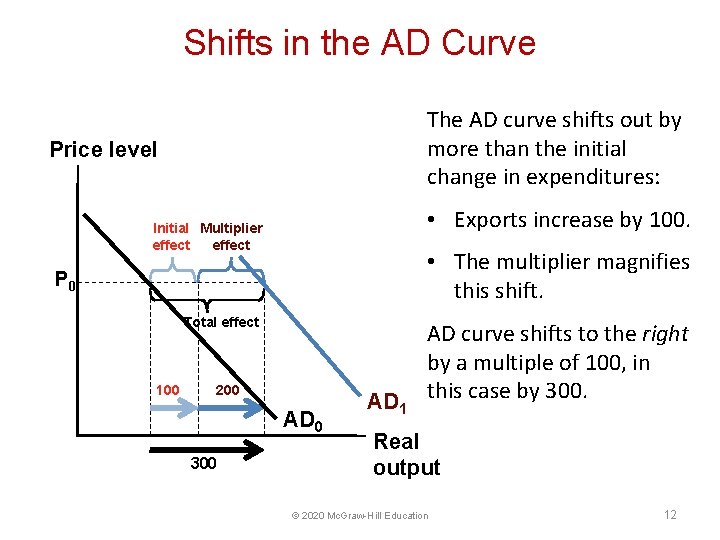
Shifts in the AD Curve The AD curve shifts out by more than the initial change in expenditures: Price level • Exports increase by 100. Initial Multiplier effect • The multiplier magnifies this shift. P 0 Total effect 100 200 AD 0 300 AD 1 AD curve shifts to the right by a multiple of 100, in this case by 300. Real output © 2020 Mc. Graw-Hill Education 12
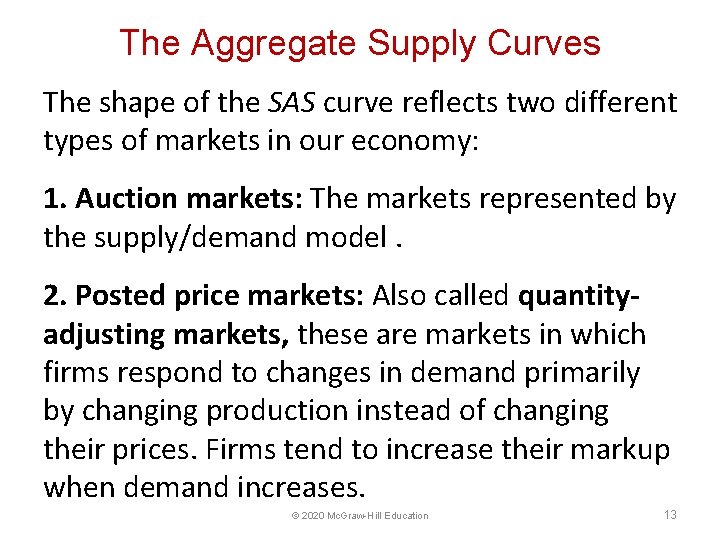
The Aggregate Supply Curves The shape of the SAS curve reflects two different types of markets in our economy: 1. Auction markets: The markets represented by the supply/demand model. 2. Posted price markets: Also called quantityadjusting markets, these are markets in which firms respond to changes in demand primarily by changing production instead of changing their prices. Firms tend to increase their markup when demand increases. © 2020 Mc. Graw-Hill Education 13
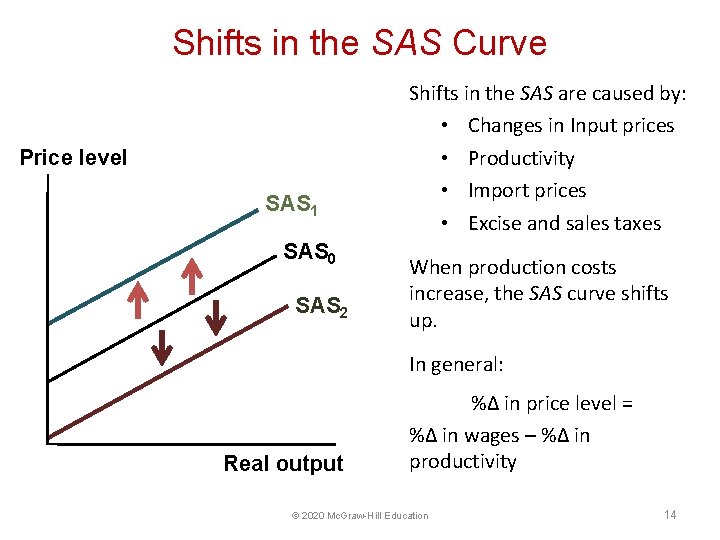
Shifts in the SAS Curve Price level SAS 1 SAS 0 SAS 2 Shifts in the SAS are caused by: • Changes in Input prices • Productivity • Import prices • Excise and sales taxes When production costs increase, the SAS curve shifts up. In general: Real output %Δ in price level = %Δ in wages – %Δ in productivity © 2020 Mc. Graw-Hill Education 14
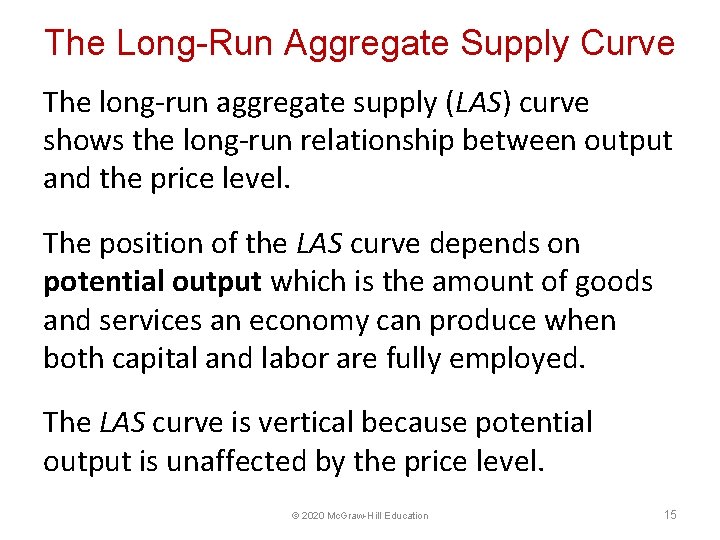
The Long-Run Aggregate Supply Curve The long-run aggregate supply (LAS) curve shows the long-run relationship between output and the price level. The position of the LAS curve depends on potential output which is the amount of goods and services an economy can produce when both capital and labor are fully employed. The LAS curve is vertical because potential output is unaffected by the price level. © 2020 Mc. Graw-Hill Education 15
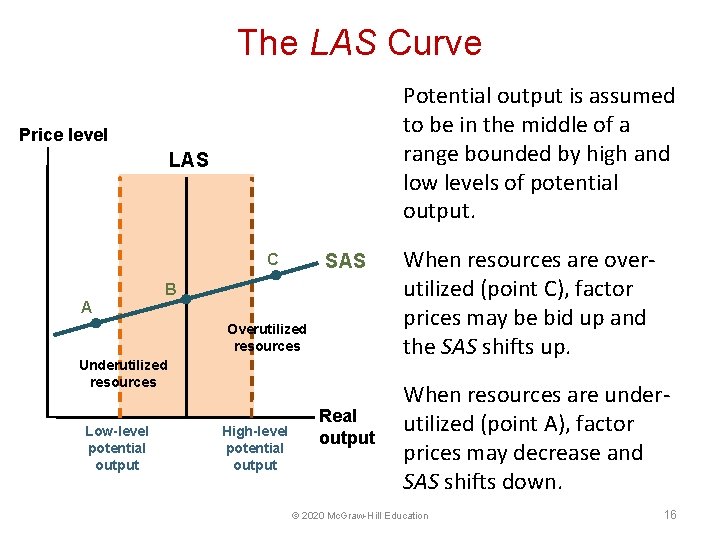
The LAS Curve Potential output is assumed to be in the middle of a range bounded by high and low levels of potential output. Price level LAS SAS C B A Overutilized resources Underutilized resources Low-level potential output High-level potential output Real output When resources are overutilized (point C), factor prices may be bid up and the SAS shifts up. When resources are underutilized (point A), factor prices may decrease and SAS shifts down. © 2020 Mc. Graw-Hill Education 16
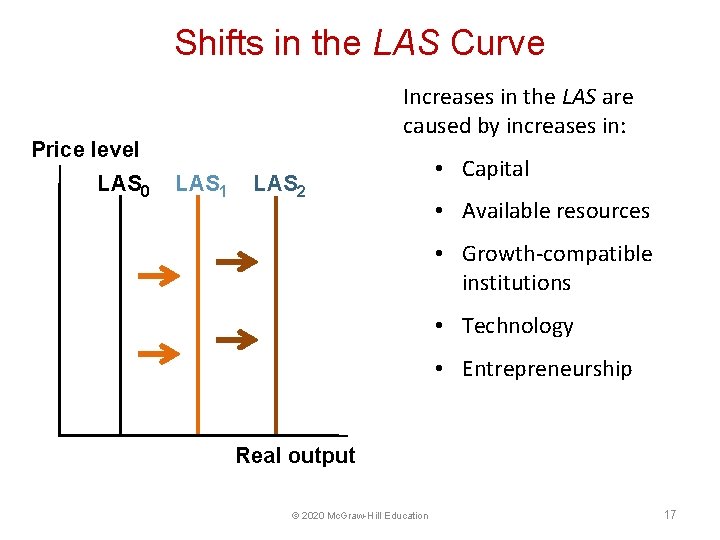
Shifts in the LAS Curve Increases in the LAS are caused by increases in: Price level LAS 0 LAS 1 LAS 2 • Capital • Available resources • Growth-compatible institutions • Technology • Entrepreneurship Real output © 2020 Mc. Graw-Hill Education 17
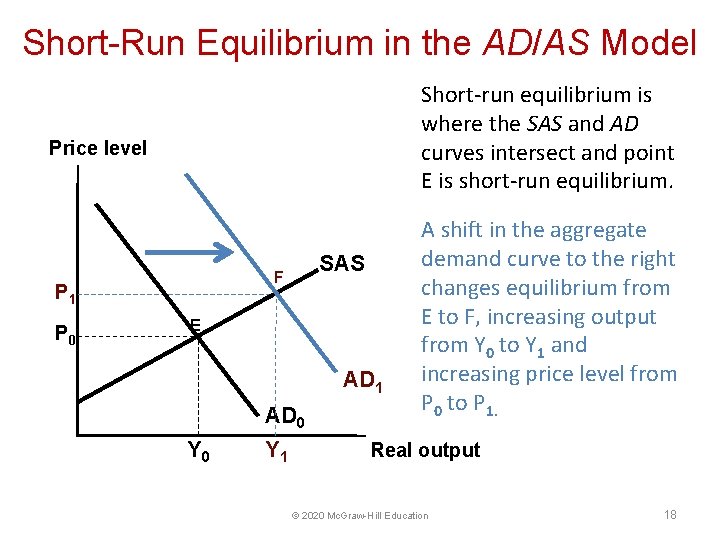
Short-Run Equilibrium in the AD/AS Model Short-run equilibrium is where the SAS and AD curves intersect and point E is short-run equilibrium. Price level P 1 P 0 SAS F E AD 1 AD 0 Y 1 A shift in the aggregate demand curve to the right changes equilibrium from E to F, increasing output from Y 0 to Y 1 and increasing price level from P 0 to P 1. Real output © 2020 Mc. Graw-Hill Education 18
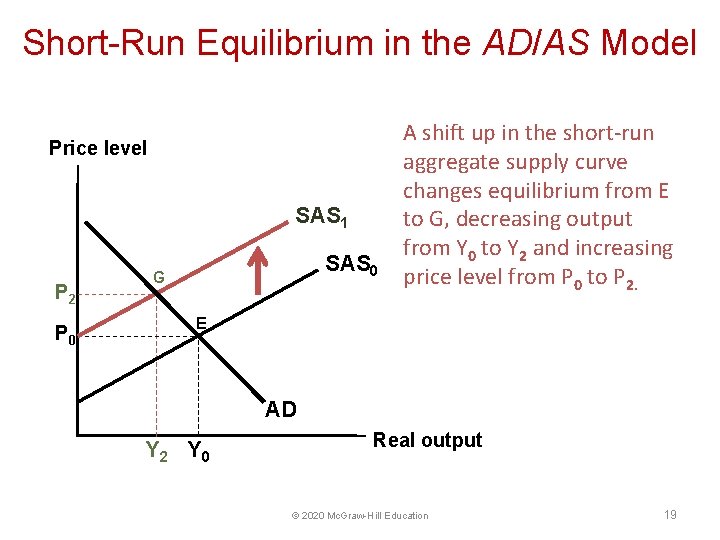
Short-Run Equilibrium in the AD/AS Model Price level SAS 1 P 2 P 0 SAS 0 G A shift up in the short-run aggregate supply curve changes equilibrium from E to G, decreasing output from Y 0 to Y 2 and increasing price level from P 0 to P 2. E AD Y 2 Y 0 Real output © 2020 Mc. Graw-Hill Education 19
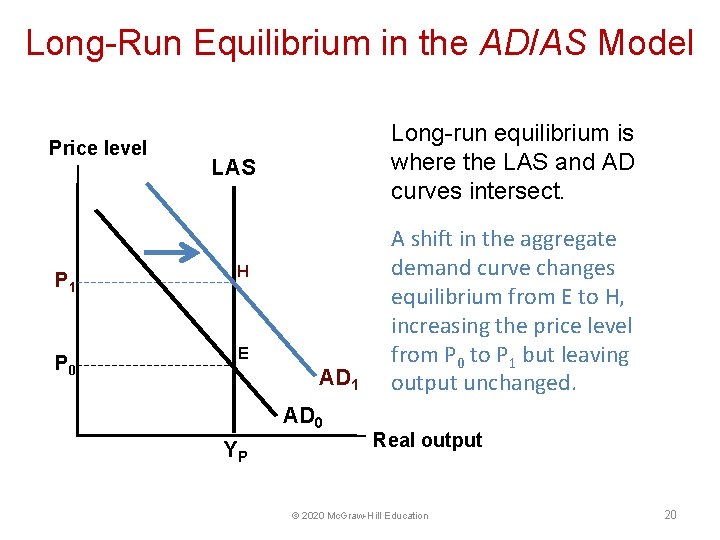
Long-Run Equilibrium in the AD/AS Model Price level Long-run equilibrium is where the LAS and AD curves intersect. LAS P 1 H P 0 E AD 1 AD 0 YP A shift in the aggregate demand curve changes equilibrium from E to H, increasing the price level from P 0 to P 1 but leaving output unchanged. Real output © 2020 Mc. Graw-Hill Education 20
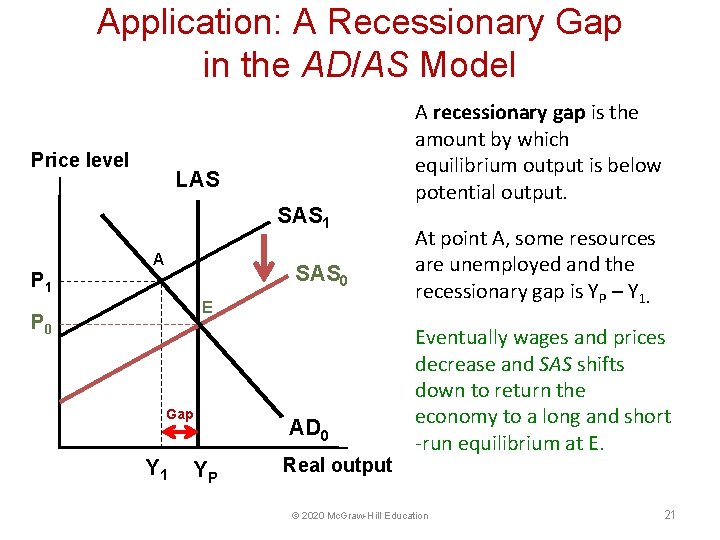
Application: A Recessionary Gap in the AD/AS Model Price level LAS SAS 1 A SAS 0 P 1 E P 0 Gap Y 1 YP AD 0 Real output A recessionary gap is the amount by which equilibrium output is below potential output. At point A, some resources are unemployed and the recessionary gap is YP – Y 1. Eventually wages and prices decrease and SAS shifts down to return the economy to a long and short -run equilibrium at E. © 2020 Mc. Graw-Hill Education 21
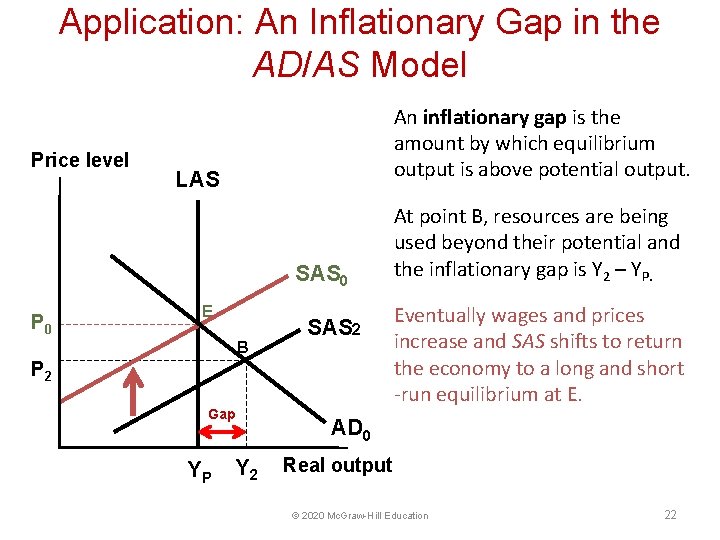
Application: An Inflationary Gap in the AD/AS Model Price level An inflationary gap is the amount by which equilibrium output is above potential output. LAS SAS 0 P 0 E B SAS 2 P 2 Gap YP Y 2 At point B, resources are being used beyond their potential and the inflationary gap is Y 2 – YP. Eventually wages and prices increase and SAS shifts to return the economy to a long and short -run equilibrium at E. AD 0 Real output © 2020 Mc. Graw-Hill Education 22
Aggregate Demand Policy A primary reason for government policy makers’ interest in the AS/AD model is that monetary or fiscal policy shifts the AD curve. • Monetary policy involves the Federal Reserve Bank changing the money supply and interest rates. • Fiscal policy is the deliberate change in either government spending or taxes to stimulate or slow down the economy. © 2020 Mc. Graw-Hill Education 23
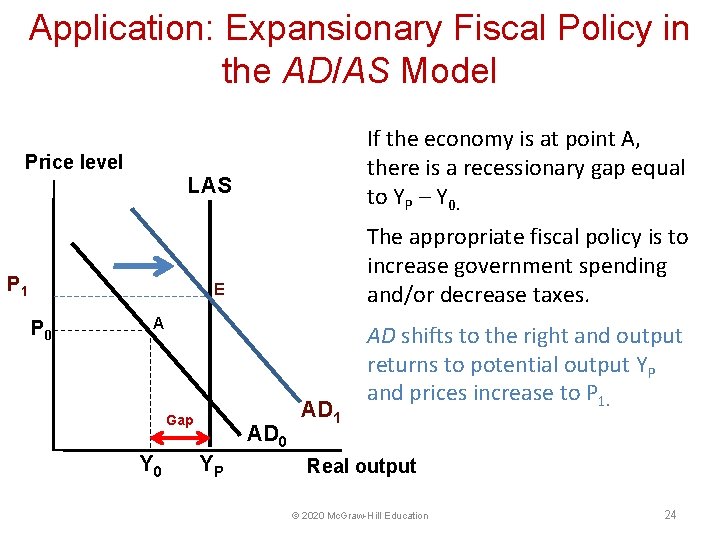
Application: Expansionary Fiscal Policy in the AD/AS Model Price level If the economy is at point A, there is a recessionary gap equal to YP – Y 0. LAS P 1 The appropriate fiscal policy is to increase government spending and/or decrease taxes. E P 0 A Gap Y 0 AD 0 YP AD 1 AD shifts to the right and output returns to potential output YP and prices increase to P 1. Real output © 2020 Mc. Graw-Hill Education 24
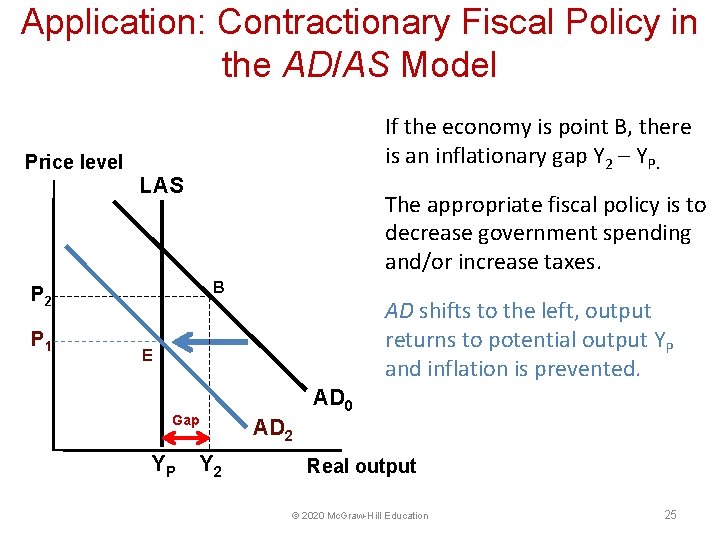
Application: Contractionary Fiscal Policy in the AD/AS Model Price level If the economy is point B, there is an inflationary gap Y 2 – YP. LAS The appropriate fiscal policy is to decrease government spending and/or increase taxes. B P 2 P 1 AD shifts to the left, output returns to potential output YP and inflation is prevented. E Gap YP Y 2 AD 0 AD 2 Real output © 2020 Mc. Graw-Hill Education 25
Limitations of the AS/AD Model • The AS/AD model assumes away many possible feedback effects that can significantly affect the macroeconomy and lead to quite different conclusions. • Implementing fiscal policy through changing taxes and government spending is a slow legislative process. • There is no guarantee that government will do what economists say is necessary. © 2020 Mc. Graw-Hill Education 26
Limitations of the AS/AD Model • Potential output (the level of output that the economy is capable of producing without generating inflation) is difficult to estimate. • We do have ways to get a rough idea of where it is. • There are many other possible interrelationships in the economy that the model does not take into account. • The aggregate economy can become dynamically unstable, so a shock can set in motion changes that will not automatically be self-correcting. © 2020 Mc. Graw-Hill Education 27
Limitations of the AS/AD Model There are two ways to think about the effectiveness of fiscal policy: in the model and in reality. The effectiveness of fiscal policy depends on the government’s ability to perceive and to react appropriately to a problem. Countercyclical fiscal policy is fiscal policy in which the government offsets any change in aggregate expenditures that would create a business cycle. Fine-tuning is used to describe such fiscal policy designed to keep the economy always at its target or potential level of income. © 2020 Mc. Graw-Hill Education 28
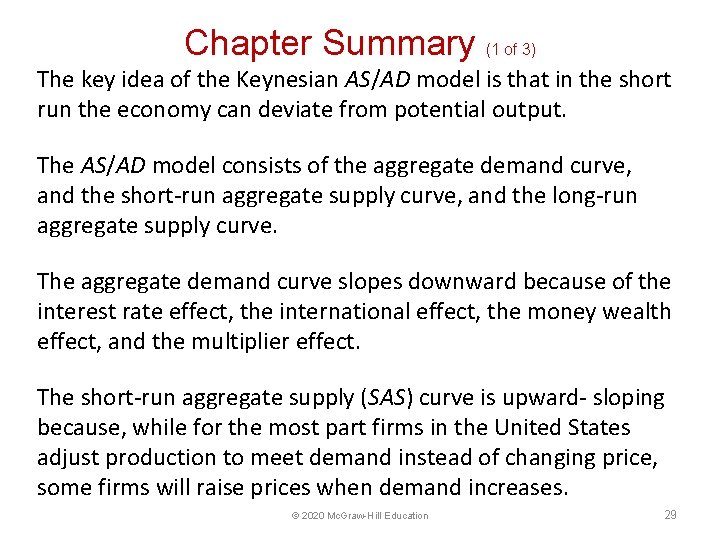
Chapter Summary (1 of 3) The key idea of the Keynesian AS/AD model is that in the short run the economy can deviate from potential output. The AS/AD model consists of the aggregate demand curve, and the short-run aggregate supply curve, and the long-run aggregate supply curve. The aggregate demand curve slopes downward because of the interest rate effect, the international effect, the money wealth effect, and the multiplier effect. The short-run aggregate supply (SAS) curve is upward- sloping because, while for the most part firms in the United States adjust production to meet demand instead of changing price, some firms will raise prices when demand increases. © 2020 Mc. Graw-Hill Education 29
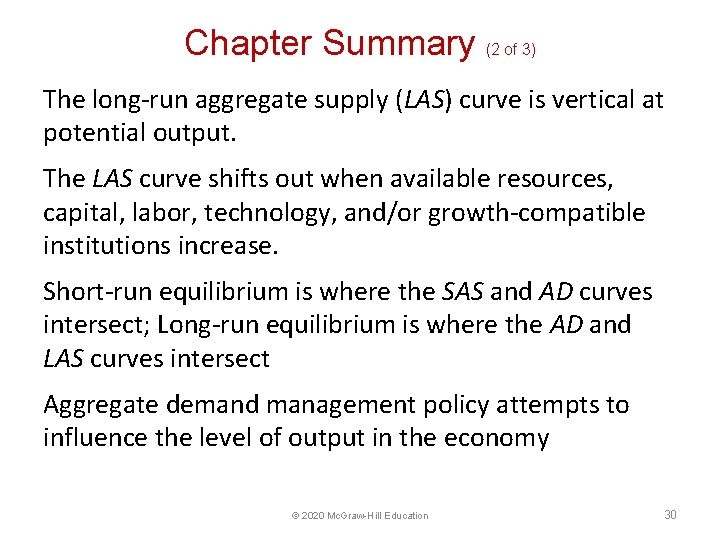
Chapter Summary (2 of 3) The long-run aggregate supply (LAS) curve is vertical at potential output. The LAS curve shifts out when available resources, capital, labor, technology, and/or growth-compatible institutions increase. Short-run equilibrium is where the SAS and AD curves intersect; Long-run equilibrium is where the AD and LAS curves intersect Aggregate demand management policy attempts to influence the level of output in the economy © 2020 Mc. Graw-Hill Education 30
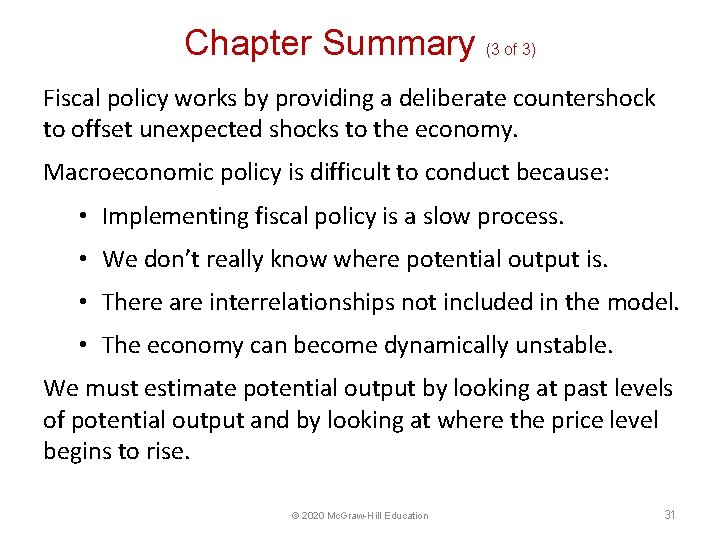
Chapter Summary (3 of 3) Fiscal policy works by providing a deliberate countershock to offset unexpected shocks to the economy. Macroeconomic policy is difficult to conduct because: • Implementing fiscal policy is a slow process. • We don’t really know where potential output is. • There are interrelationships not included in the model. • The economy can become dynamically unstable. We must estimate potential output by looking at past levels of potential output and by looking at where the price level begins to rise. © 2020 Mc. Graw-Hill Education 31