
Chapter 8 The Clinical Interview The Interviewer 1
- Slides: 38
Chapter 8 The Clinical Interview
The Interviewer (1 of 7) General Skills • Interviewer should acquire general skills as foundation for conducting interviews • Requirements – Quieting themselves – Being self-aware – Developing positive working relationships with clients Pomerantz, Clinical Psychology © SAGE Publishing, 2020. 2
The Interviewer (2 of 7) Specific Behaviors: Eye Contact • Eye contact – Facilitates and communicates listening – Makes client feels heard – Requires interviewer to have cultural knowledge and sensitivity Pomerantz, Clinical Psychology © SAGE Publishing, 2020. 3
The Interviewer (3 of 7) Specific Behaviors: Body Language • Culture shapes connotations of body language • General rules for interviewer – Face the client – Appear attentive – Minimize restlessness – Display appropriate facial expressions Pomerantz, Clinical Psychology © SAGE Publishing, 2020. 4
The Interviewer (4 of 7) Specific Behaviors: Vocal Qualities – Skilled interviewers – Use pitch, tone, volume, and fluctuation – Attend closely to the vocal qualities of clients Pomerantz, Clinical Psychology © SAGE Publishing, 2020. 5
The Interviewer (5 of 7) Specific Behaviors: Verbal Tracking • Effective interviewers monitor the client’s train of thought by – Repeating key words and phrases – Weaving clients’ language into their own – Shifting topics smoothly Pomerantz, Clinical Psychology © SAGE Publishing, 2020. 6
The Interviewer (6 of 7) Specific Behaviors: Referring to the Client by the Proper Name • Inappropriate addressing can jeopardize the client’s sense of comfort with interviewer • Mistakes – Using nicknames or shortening names – Omitting essential “middle” name – Addressing client by first name Pomerantz, Clinical Psychology © SAGE Publishing, 2020. 7
The Interviewer (7 of 7) Specific Behaviors: Observing Client Behaviors • Important decisions can be informed by behavioral observations of client • Observing behaviors allows psychologist to consider nonverbal components Pomerantz, Clinical Psychology © SAGE Publishing, 2020. 8
Components of the Interview (1 of 13) Rapport • Strong sense of rapport brings sense of connect with interviewer • To establish good rapport with clients – Make an effort to put the client at ease – Acknowledge unique, unusual situation of clinical interview – Enhance rapport by following client’s lead Pomerantz, Clinical Psychology © SAGE Publishing, 2020. 9
Components of the Interview (2 of 13) Technique: Directive Versus Nondirective Styles • Directive questioning approach – Tends to be targeted toward specific pieces of information – Client responses are typically brief – Provides crucial data that clients may not otherwise choose to discuss – Can sacrifice rapport in favor of information Pomerantz, Clinical Psychology © SAGE Publishing, 2020. 10
Components of the Interview (3 of 13) Technique: Directive Versus Nondirective Styles • Nondirective questioning approach – Client may choose to spend time on some topics – Can provide crucial information that interviewers may not otherwise know to inquire about – Can fall short in terms of gathering specific information Pomerantz, Clinical Psychology © SAGE Publishing, 2020. 11
Components of the Interview (4 of 13) Technique: Directive Versus Nondirective Styles • Best strategy involves balance and versatility – Using only a directive approach could sacrifice rapport in favor of information – Using only a nondirective approach can facilitate rapport but fall short of gathering specific information Pomerantz, Clinical Psychology © SAGE Publishing, 2020. 12
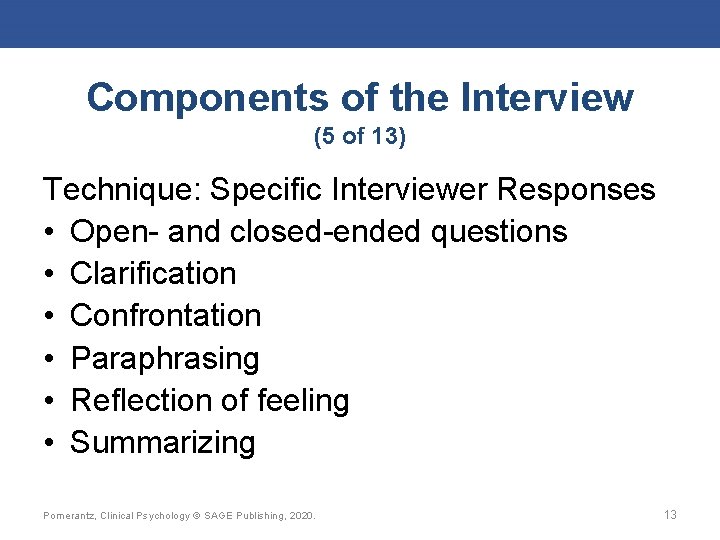
Components of the Interview (5 of 13) Technique: Specific Interviewer Responses • Open- and closed-ended questions • Clarification • Confrontation • Paraphrasing • Reflection of feeling • Summarizing Pomerantz, Clinical Psychology © SAGE Publishing, 2020. 13
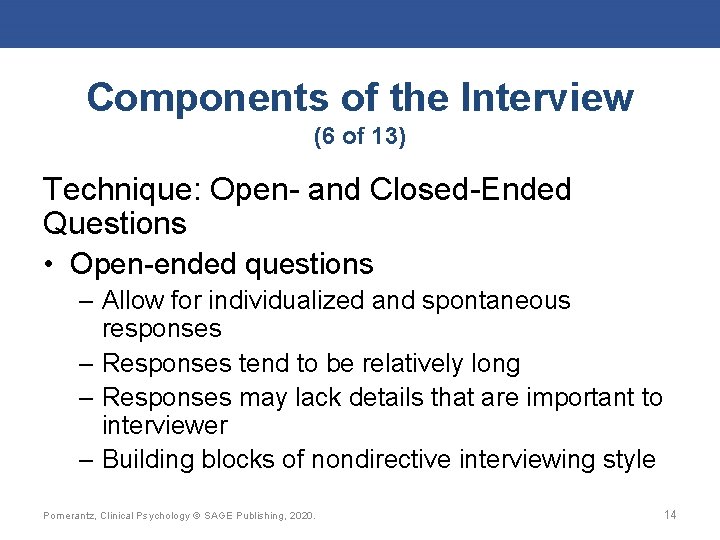
Components of the Interview (6 of 13) Technique: Open- and Closed-Ended Questions • Open-ended questions – Allow for individualized and spontaneous responses – Responses tend to be relatively long – Responses may lack details that are important to interviewer – Building blocks of nondirective interviewing style Pomerantz, Clinical Psychology © SAGE Publishing, 2020. 14
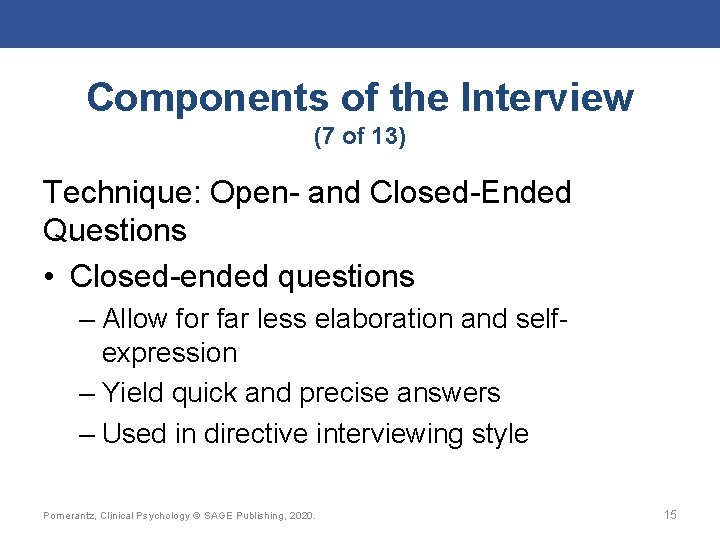
Components of the Interview (7 of 13) Technique: Open- and Closed-Ended Questions • Closed-ended questions – Allow for far less elaboration and selfexpression – Yield quick and precise answers – Used in directive interviewing style Pomerantz, Clinical Psychology © SAGE Publishing, 2020. 15
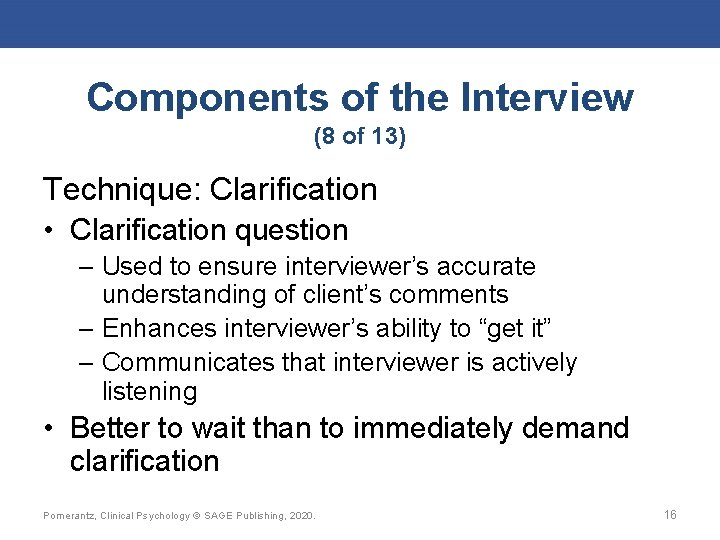
Components of the Interview (8 of 13) Technique: Clarification • Clarification question – Used to ensure interviewer’s accurate understanding of client’s comments – Enhances interviewer’s ability to “get it” – Communicates that interviewer is actively listening • Better to wait than to immediately demand clarification Pomerantz, Clinical Psychology © SAGE Publishing, 2020. 16
Components of the Interview (9 of 13) Technique: Confrontation • Similar to clarifications, but focuses on contradictory information supplied • Used when discrepancies or inconsistencies are noticed in client’s comments Pomerantz, Clinical Psychology © SAGE Publishing, 2020. 17
Components of the Interview (10 of 13) Technique: Paraphrasing • Used to assure clients of being accurately heard • Restates content of clients’ comments using similar language • Maintains conversation, doesn’t break new ground Pomerantz, Clinical Psychology © SAGE Publishing, 2020. 18
Components of the Interview (11 of 13) Technique: Reflection of Feeling • Echoes client’s emotions • Intended to make clients feel that their emotions are recognized • Involves interviewer’s inference about emotions underlying client’s words Pomerantz, Clinical Psychology © SAGE Publishing, 2020. 19
Components of the Interview (12 of 13) Technique: Summarizing • Ties together various topics of discussion • Connects statements made at different points • Identifies themes that have recurred during the interview • Lets clients know that they have been understood in a comprehensive, integrative way Pomerantz, Clinical Psychology © SAGE Publishing, 2020. 20
Components of the Interview (13 of 13) Conclusions • Depends on interview type, setting, client’s problem, etc. • Provides initial conceptualization of client’s problem • May consist of specific diagnosis • May involve recommendations Pomerantz, Clinical Psychology © SAGE Publishing, 2020. 21
Pragmatics of the Interview (1 of 4) Note Taking • Documents the interview • More reliable than interviewer’s memory • Could be a distraction to client • Distracts from noticing important client behaviors • Effect of taking notes highly dependent on situation Pomerantz, Clinical Psychology © SAGE Publishing, 2020. 22
Pragmatics of the Interview (2 of 4) Audio and Video Recordings • Recording interview requires client’s written permission • Could hinder openness and willingness to disclose information • Client appreciates explanation of rationale for recording Pomerantz, Clinical Psychology © SAGE Publishing, 2020. 23
Pragmatics of the Interview (3 of 4) The Interview Room • Types – Traditional, psychoanalytic arrangement – Interviewer and client sitting face-to-face – Interviewer and client in chairs at an angle between 90° and 180° • Setting should facilitate fundamental goals of interview • Should steer clear of overtly personal items Pomerantz, Clinical Psychology © SAGE Publishing, 2020. 24
Pragmatics of the Interview (4 of 4) Confidentiality • Many assume that sessions are absolutely confidential – Some situations require psychologist to break confidentiality • Some assume that related others have access to interview records hence, disclose very little • Interviewers should explain policies regarding confidentiality Pomerantz, Clinical Psychology © SAGE Publishing, 2020. 25
Types of Interviews (1 of 10) • Form of interview depends on – Setting – Client’s presenting problem – Issues the interview is intended to address • Types – Intake interviews – Diagnostic interviews – Mental status exams – Crisis interviews Pomerantz, Clinical Psychology © SAGE Publishing, 2020. 26
Types of Interviews (2 of 10) Intake Interviews • Determine – Whether client needs treatment – What form of treatment is needed • Involve detailed questioning about presenting complaint Pomerantz, Clinical Psychology © SAGE Publishing, 2020. 27
Types of Interviews (3 of 10) Diagnostic Interviews • Assign DSM diagnoses to client’s problems • Include questions that relate to criteria of DSM disorders Pomerantz, Clinical Psychology © SAGE Publishing, 2020. 28
Types of Interviews (4 of 10) Diagnostic Interviews: Structured Interviews Versus Unstructured Interviews • Advantages of structured interview – Produces diagnosis based explicitly on DSM criteria – Empirically sound – Standardized, and typically uncomplicated Pomerantz, Clinical Psychology © SAGE Publishing, 2020. 29
Types of Interviews (5 of 10) Diagnostic Interviews: Structured Interviews Versus Unstructured Interviews • Disadvantages of structured interview – Rigidity inhibits rapport and client’s opportunity to elaborate or explain – Does not allow for inquiries not related to DSM diagnostic categories – Requires a more comprehensive list of questions, which lengthens the interview Pomerantz, Clinical Psychology © SAGE Publishing, 2020. 30
Types of Interviews (6 of 10) Diagnostic Interviews: Structured Interviews Versus Unstructured Interviews • In unstructured interviews, interviewers – Improvise – Determine questions on the spot to seek relevant information Pomerantz, Clinical Psychology © SAGE Publishing, 2020. 31
Types of Interviews (7 of 10) Diagnostic Interviews: Structured Interviews Versus Unstructured Interviews • SCID – List of questions that ask about specific symptoms of disorders listed in DSM – Most SCID questions designed to elicit yes/no answers – Modular • Semistructured interview Pomerantz, Clinical Psychology © SAGE Publishing, 2020. 32
Types of Interviews (8 of 10) Mental Status Exam • Employed most often in medical settings • Intended for brief, flexible administration requiring no manual or other materials • Captures psychological and cognitive processes of an individual “right now” Pomerantz, Clinical Psychology © SAGE Publishing, 2020. 33
Types of Interviews (9 of 10) Mental Status Exam • Lacks standardization – Different questions within same category • Some main categories – Appearance, behavior, mood, and speech – Orientation, memory, etc. Pomerantz, Clinical Psychology © SAGE Publishing, 2020. 34
Types of Interviews (10 of 10) Crisis Interviews • Assesses problems demanding urgent attention like suicide, etc. • Provides immediate and effective intervention • Key components – Quickly establishing rapport – Expressing empathy Pomerantz, Clinical Psychology © SAGE Publishing, 2020. 35
Cultural Components (1 of 3) Appreciating the Cultural Context • Interviewer should be culturally competent • Variability among individuals within cultural groups • Consideration of religion as a component of culture Pomerantz, Clinical Psychology © SAGE Publishing, 2020. 36
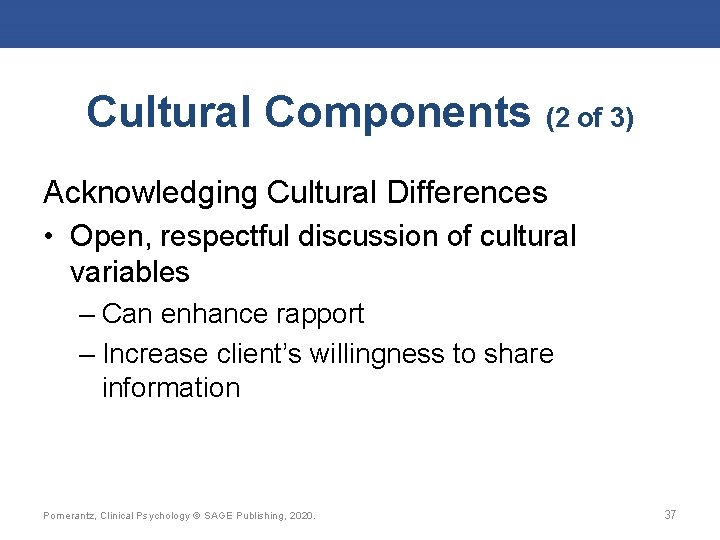
Cultural Components (2 of 3) Acknowledging Cultural Differences • Open, respectful discussion of cultural variables – Can enhance rapport – Increase client’s willingness to share information Pomerantz, Clinical Psychology © SAGE Publishing, 2020. 37
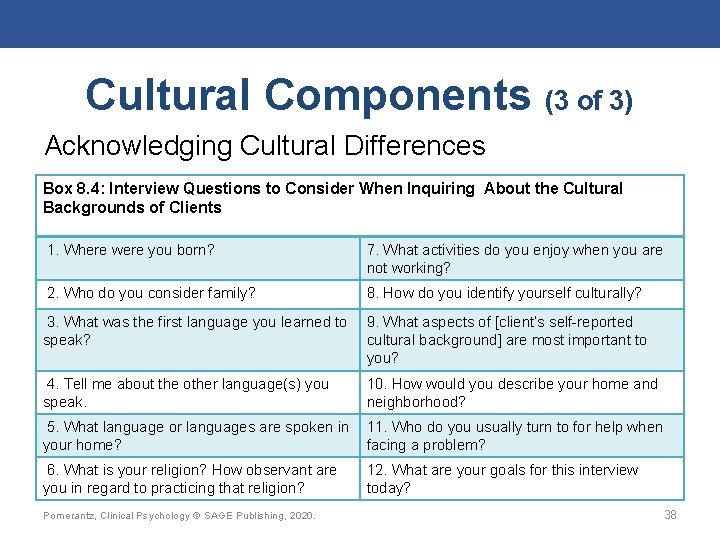
Cultural Components (3 of 3) Acknowledging Cultural Differences Box 8. 4: Interview Questions to Consider When Inquiring About the Cultural Backgrounds of Clients 1. Where were you born? 7. What activities do you enjoy when you are not working? 2. Who do you consider family? 8. How do you identify yourself culturally? 3. What was the first language you learned to speak? 9. What aspects of [client’s self-reported cultural background] are most important to you? 4. Tell me about the other language(s) you speak. 10. How would you describe your home and neighborhood? 5. What language or languages are spoken in your home? 11. Who do you usually turn to for help when facing a problem? 6. What is your religion? How observant are you in regard to practicing that religion? 12. What are your goals for this interview today? Pomerantz, Clinical Psychology © SAGE Publishing, 2020. 38