
Chapter 8 The Cellular Basis of Reproduction and
Chapter 8 The Cellular Basis of Reproduction and Inheritance Power. Point Lectures Campbell Biology: Concepts & Connections, Eighth Edition REECE • TAYLOR • SIMON • DICKEY • HOGAN © 2015 Pearson Education, Inc. Lecture by Edward J. Zalisko
Answer in Notebooks #1. Why do cells divide, why don’t they just get bigger? © 2015 Pearson Education, Inc.
CELL DIVISION AND REPRODUCTION © 2015 Pearson Education, Inc.
8. 1 Cell division plays many important roles in the lives of organisms • The ability of organisms to reproduce their own kind is a key characteristic of life. © 2015 Pearson Education, Inc.
8. 1 Cell division plays many important roles in the lives of organisms • Cell division • 2 “daughter” cells - genetically identical to each other and original “parent” cell • Duplication of chromosomes -structures that contain most of the cell’s DNA • Sorts new sets of chromosomes into the resulting pair of daughter cells. © 2015 Pearson Education, Inc.
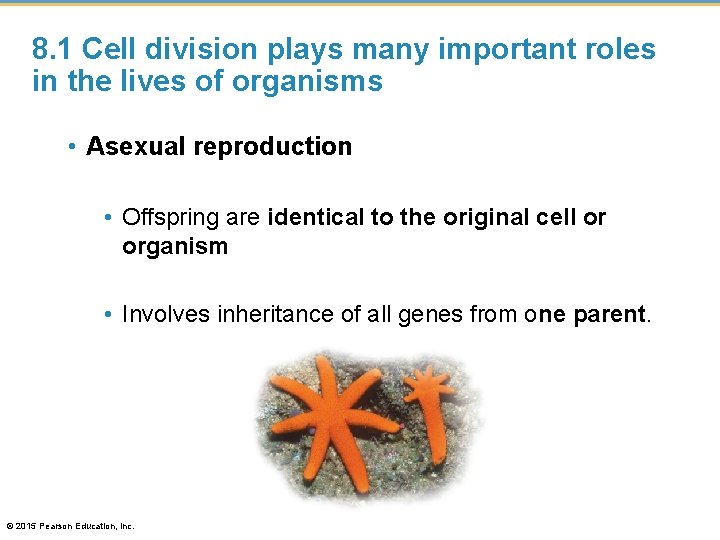
8. 1 Cell division plays many important roles in the lives of organisms • Asexual reproduction • Offspring are identical to the original cell or organism • Involves inheritance of all genes from one parent. © 2015 Pearson Education, Inc.
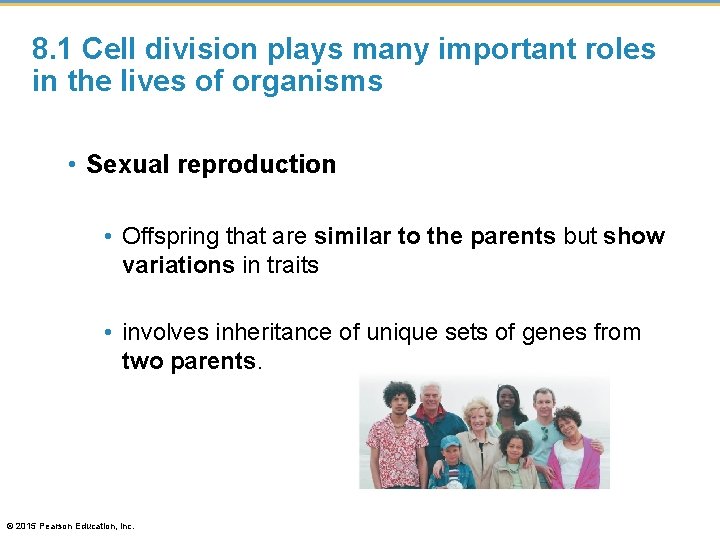
8. 1 Cell division plays many important roles in the lives of organisms • Sexual reproduction • Offspring that are similar to the parents but show variations in traits • involves inheritance of unique sets of genes from two parents. © 2015 Pearson Education, Inc.
Answer in Notebooks #2. Differentiate between Asexual and Sexual Reproduction. © 2015 Pearson Education, Inc.
8. 1 Cell division plays many important roles in the lives of organisms • Cell division is used for • reproduction of single-celled organisms • growth of multicellular organisms from a fertilized egg into an adult • repair and replacement of cells • production of sperm and eggs © 2015 Pearson Education, Inc.

8. 2 Prokaryotes reproduce by binary fission • Prokaryotes (single-celled bacteria and archaea) reproduce by binary fission (“dividing in half”) • The chromosome of a prokaryote is typically • a single circular DNA molecule associated with proteins and • much smaller than those of eukaryotes. © 2015 Pearson Education, Inc.

8. 2 Prokaryotes reproduce by binary fission • Binary fission of a prokaryote occurs in three stages: 1. duplication of the chromosome and separation of the copies 2. continued elongation of the cell and movement of the copies 3. division into two daughter cells. © 2015 Pearson Education, Inc.
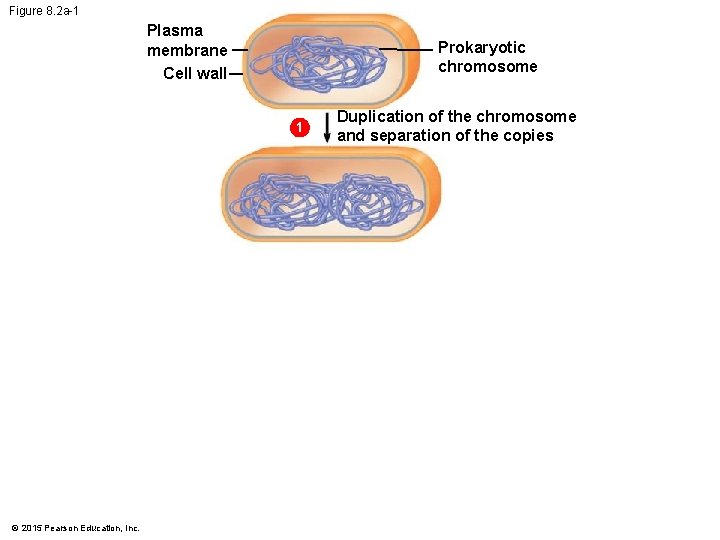
Figure 8. 2 a-1 Plasma membrane Cell wall Prokaryotic chromosome 1 © 2015 Pearson Education, Inc. Duplication of the chromosome and separation of the copies
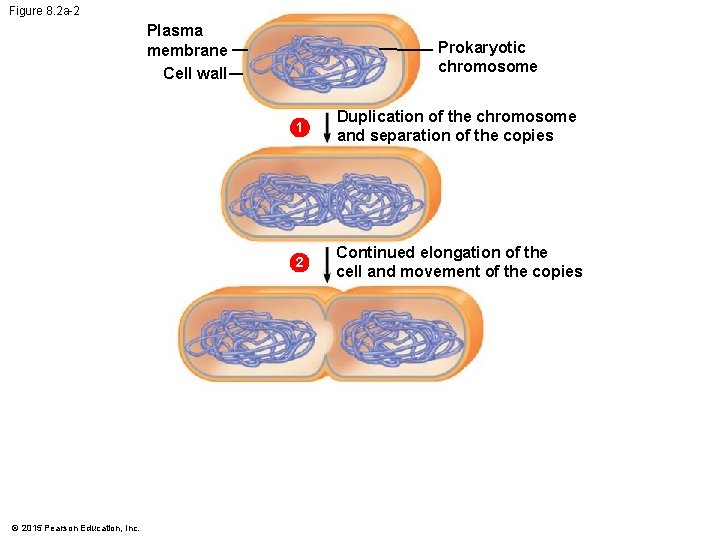
Figure 8. 2 a-2 Plasma membrane Cell wall © 2015 Pearson Education, Inc. Prokaryotic chromosome 1 Duplication of the chromosome and separation of the copies 2 Continued elongation of the cell and movement of the copies
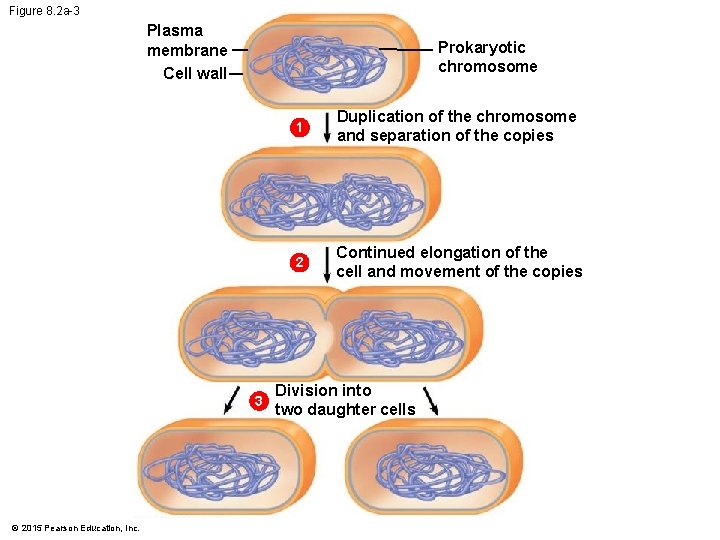
Figure 8. 2 a-3 Plasma membrane Cell wall Prokaryotic chromosome 3 © 2015 Pearson Education, Inc. 1 Duplication of the chromosome and separation of the copies 2 Continued elongation of the cell and movement of the copies Division into two daughter cells
Answer in Notebooks: #3. Briefly describe or illustrate the process of binary fission. #4. What type of organisms reproduce by using binary fission?
THE EUKARYOTIC CELL CYCLE AND MITOSIS © 2015 Pearson Education, Inc.
8. 3 The large, complex chromosomes of eukaryotes duplicate with each cell division • Eukaryotic cells • are more complex and larger than prokaryotic cells • have more genes • store most of their genes on multiple chromosomes within the nucleus • Each eukaryotic species has a characteristic number of chromosomes in each cell nucleus. © 2015 Pearson Education, Inc.
8. 3 The large, complex chromosomes of eukaryotes duplicate with each cell division • Eukaryotic chromosomes are composed of chromatin consisting of • one long DNA molecule • proteins that help maintain the chromosome structure and control the activity of its genes. © 2015 Pearson Education, Inc.
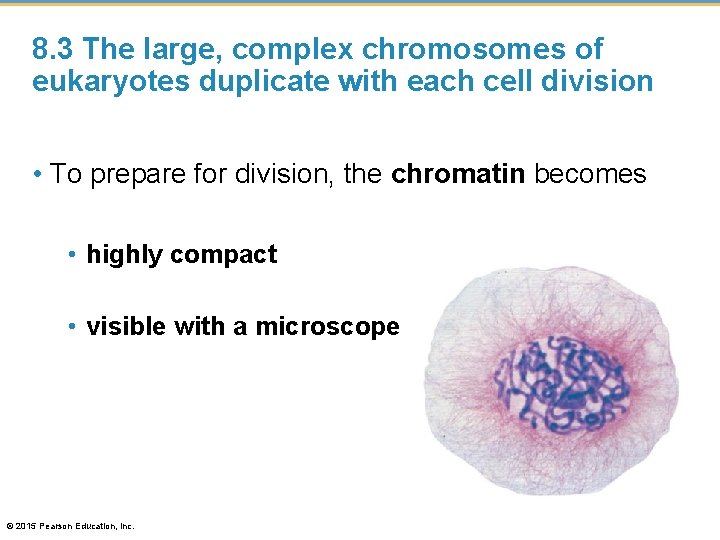
8. 3 The large, complex chromosomes of eukaryotes duplicate with each cell division • To prepare for division, the chromatin becomes • highly compact • visible with a microscope © 2015 Pearson Education, Inc.
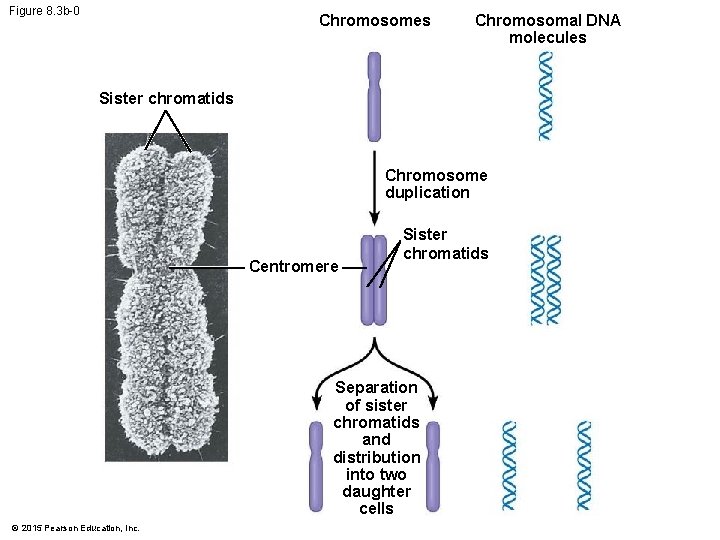
Figure 8. 3 b-0 Chromosomes Chromosomal DNA molecules Sister chromatids Chromosome duplication Centromere Sister chromatids Separation of sister chromatids and distribution into two daughter cells © 2015 Pearson Education, Inc.
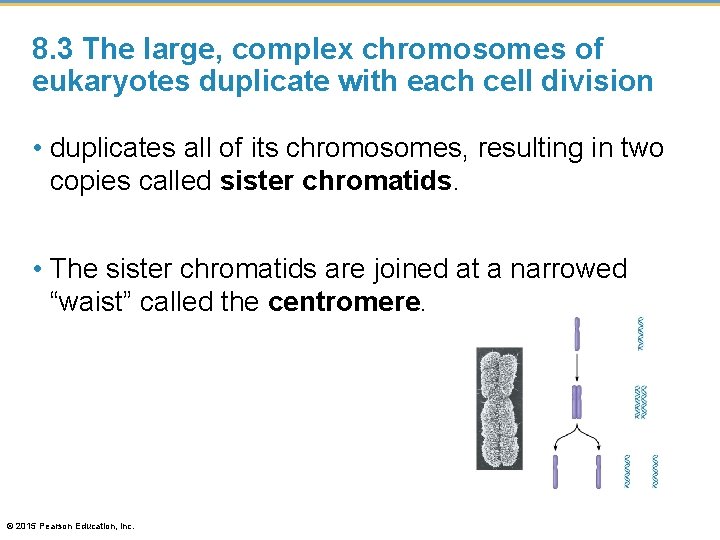
8. 3 The large, complex chromosomes of eukaryotes duplicate with each cell division • duplicates all of its chromosomes, resulting in two copies called sister chromatids. • The sister chromatids are joined at a narrowed “waist” called the centromere. © 2015 Pearson Education, Inc.
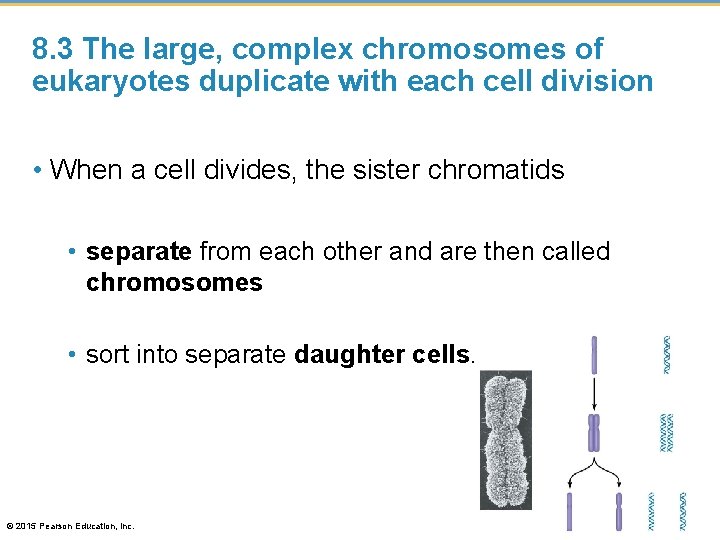
8. 3 The large, complex chromosomes of eukaryotes duplicate with each cell division • When a cell divides, the sister chromatids • separate from each other and are then called chromosomes • sort into separate daughter cells. © 2015 Pearson Education, Inc.
Answer in Notebooks #5. Define the following terms: Chromatin: Sister Chromatid: Chromosome: © 2015 Pearson Education, Inc.
8. 4 The cell cycle includes growing and division phases • The cell cycle is an ordered sequence of events that extends from the time a cell is first formed from a dividing parent cell until its own division. © 2015 Pearson Education, Inc.
8. 4 The cell cycle includes growing and division phases • The cell cycle consists of two stages, characterized as follows: 1. Interphase: duplication of cell contents • G 1—growth, increase in cytoplasm • S—duplication of chromosomes • G 2—growth, preparation for division © 2015 Pearson Education, Inc.
8. 4 The cell cycle includes growing and division phases • The cell cycle consists of two stages, characterized as follows: 2. Mitotic phase: division • Mitosis—division of the nucleus • Cytokinesis—division of cytoplasm © 2015 Pearson Education, Inc.
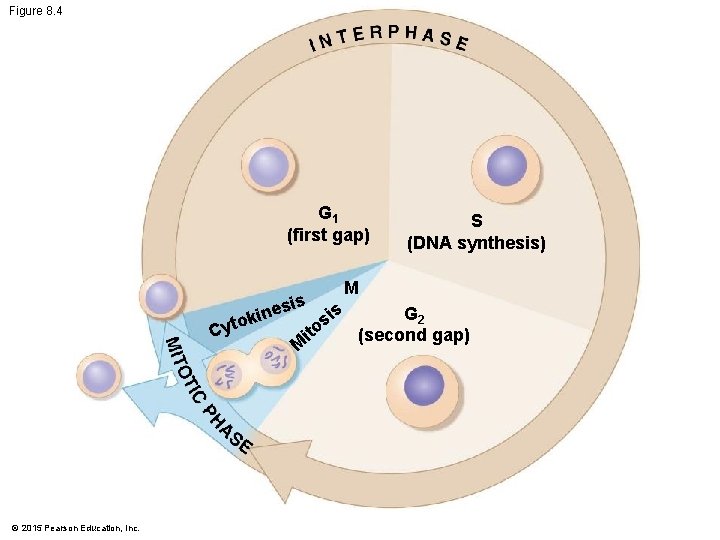
Figure 8. 4 G 1 (first gap) M S (DNA synthesis) sis is e G 2 n i k s o t Cy (second gap) ito M © 2015 Pearson Education, Inc.
Answer in Notebooks: #6. In which phase does a cell spend most of its time?
8. 5 Cell division is a continuum of dynamic changes • Mitosis progresses through a series of stages: • prophase • prometaphase • metaphase • anaphase • telophase • Cytokinesis often overlaps telophase. © 2015 Pearson Education, Inc.
8. 5 Cell division is a continuum of dynamic changes • A mitotic spindle • is required to divide the chromosomes • guides the separation of the two sets of daughter chromosomes • is composed of microtubules and associated proteins. © 2015 Pearson Education, Inc.
8. 5 Cell division is a continuum of dynamic changes • Spindle microtubules emerge from two centrosomes, microtubule-organizing regions in the cytoplasm of eukaryotic cells. © 2015 Pearson Education, Inc.
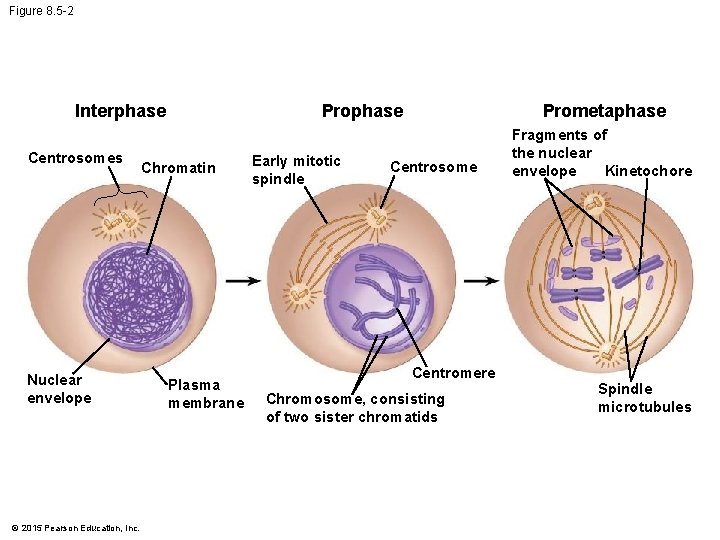
Figure 8. 5 -2 Prophase Interphase Centrosomes Nuclear envelope © 2015 Pearson Education, Inc. Chromatin Plasma membrane Early mitotic spindle Prometaphase Centrosome Centromere Chromosome, consisting of two sister chromatids Fragments of the nuclear Kinetochore envelope Spindle microtubules
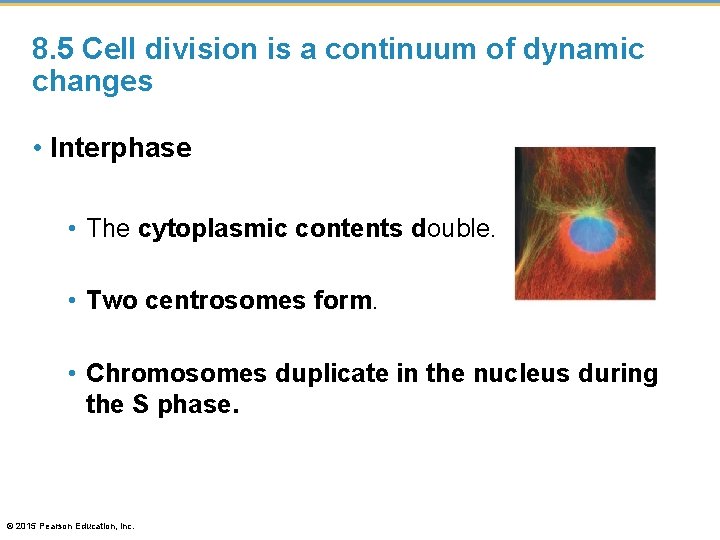
8. 5 Cell division is a continuum of dynamic changes • Interphase • The cytoplasmic contents double. • Two centrosomes form. • Chromosomes duplicate in the nucleus during the S phase. © 2015 Pearson Education, Inc.
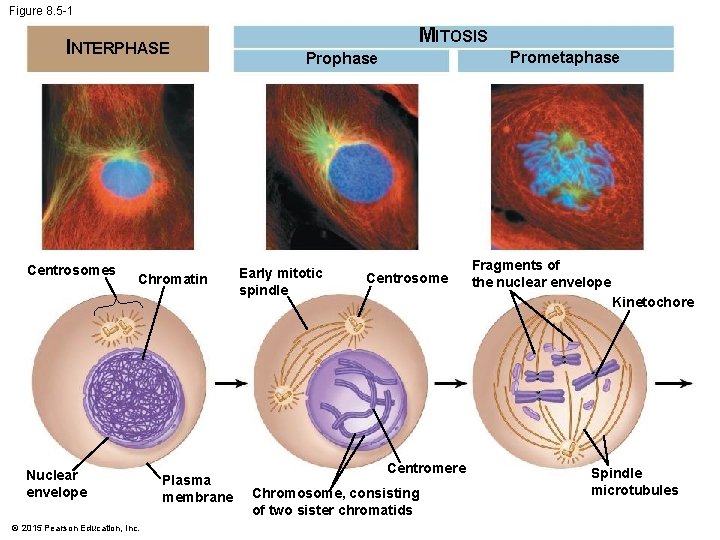
Figure 8. 5 -1 INTERPHASE Centrosomes Chromatin Nuclear envelope © 2015 Pearson Education, Inc. Plasma membrane MITOSIS Prometaphase Prophase Early mitotic spindle Centrosome Fragments of the nuclear envelope Kinetochore Centromere Chromosome, consisting of two sister chromatids Spindle microtubules
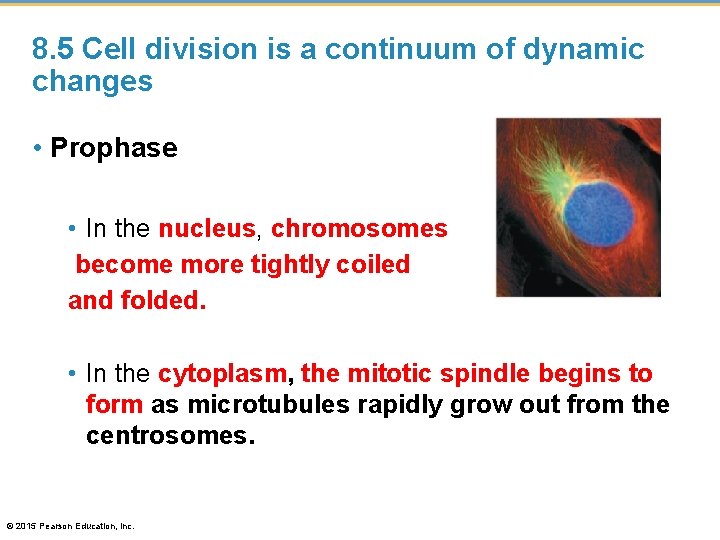
8. 5 Cell division is a continuum of dynamic changes • Prophase • In the nucleus, chromosomes become more tightly coiled and folded. • In the cytoplasm, the mitotic spindle begins to form as microtubules rapidly grow out from the centrosomes. © 2015 Pearson Education, Inc.
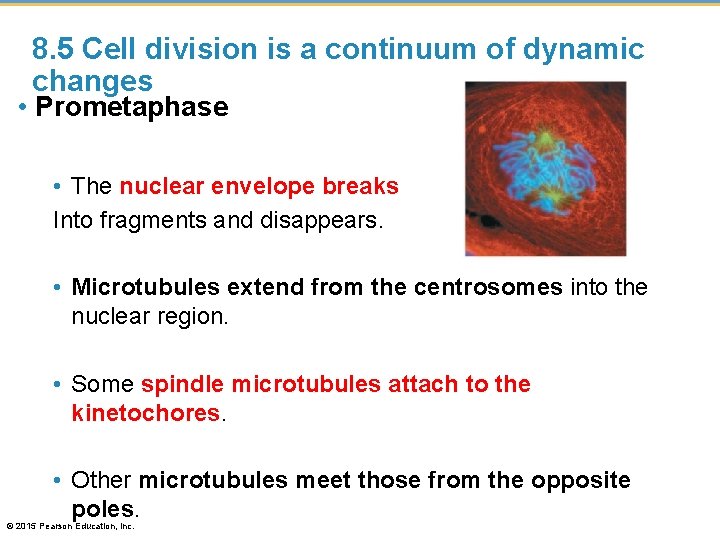
8. 5 Cell division is a continuum of dynamic changes • Prometaphase • The nuclear envelope breaks Into fragments and disappears. • Microtubules extend from the centrosomes into the nuclear region. • Some spindle microtubules attach to the kinetochores. • Other microtubules meet those from the opposite poles. © 2015 Pearson Education, Inc.
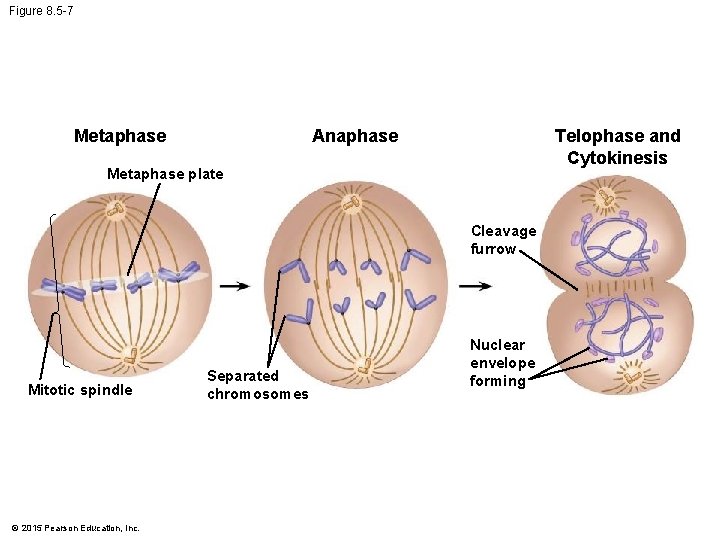
Figure 8. 5 -7 Anaphase Metaphase Telophase and Cytokinesis Metaphase plate Cleavage furrow Mitotic spindle © 2015 Pearson Education, Inc. Separated chromosomes Nuclear envelope forming
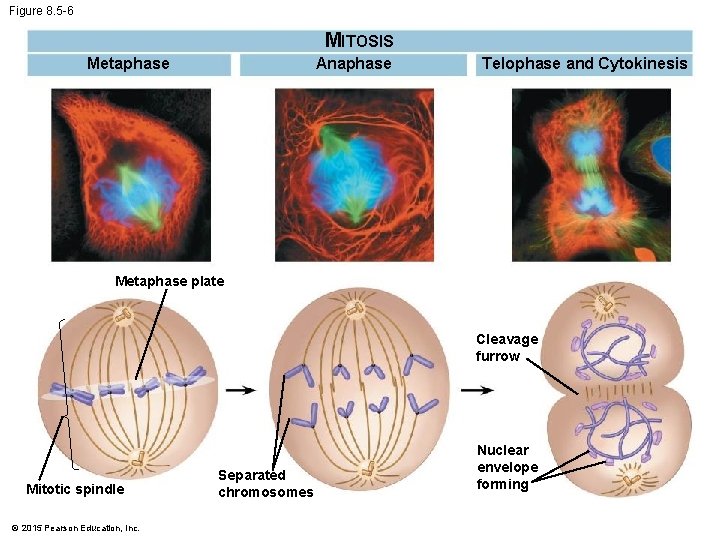
Figure 8. 5 -6 MITOSIS Metaphase Anaphase Telophase and Cytokinesis Metaphase plate Cleavage furrow Mitotic spindle © 2015 Pearson Education, Inc. Separated chromosomes Nuclear envelope forming
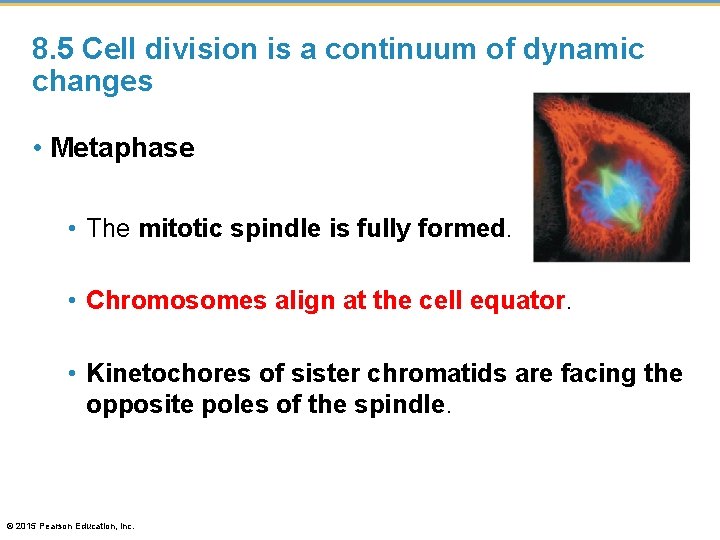
8. 5 Cell division is a continuum of dynamic changes • Metaphase • The mitotic spindle is fully formed. • Chromosomes align at the cell equator. • Kinetochores of sister chromatids are facing the opposite poles of the spindle. © 2015 Pearson Education, Inc.
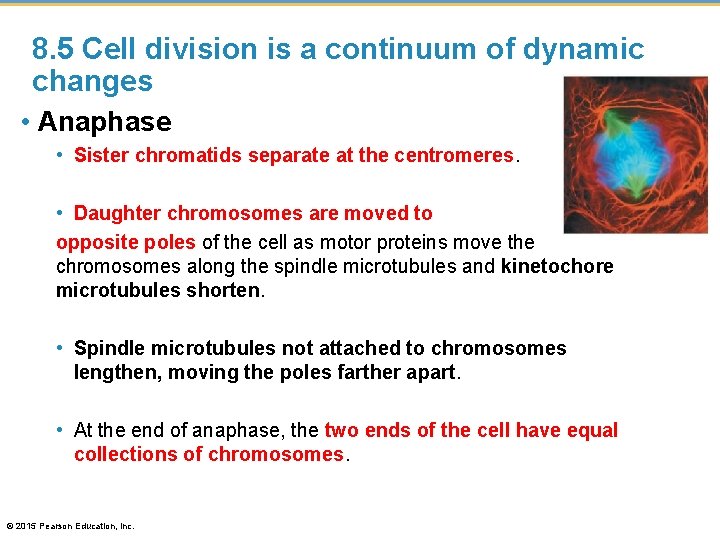
8. 5 Cell division is a continuum of dynamic changes • Anaphase • Sister chromatids separate at the centromeres. • Daughter chromosomes are moved to opposite poles of the cell as motor proteins move the chromosomes along the spindle microtubules and kinetochore microtubules shorten. • Spindle microtubules not attached to chromosomes lengthen, moving the poles farther apart. • At the end of anaphase, the two ends of the cell have equal collections of chromosomes. © 2015 Pearson Education, Inc.
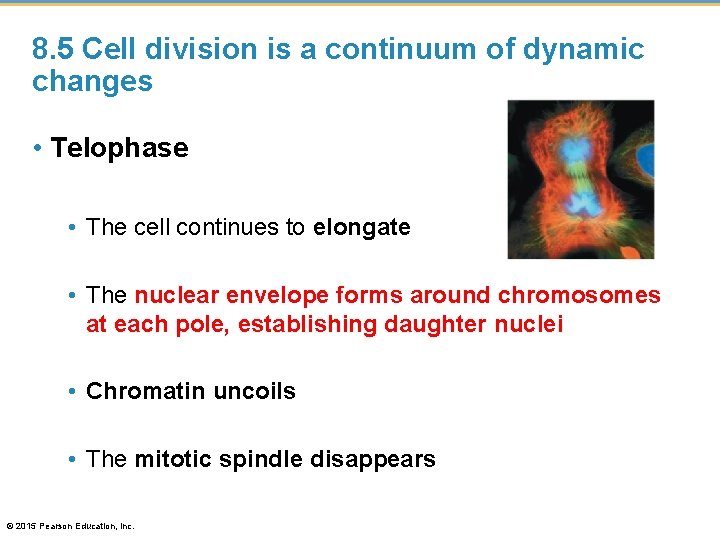
8. 5 Cell division is a continuum of dynamic changes • Telophase • The cell continues to elongate • The nuclear envelope forms around chromosomes at each pole, establishing daughter nuclei • Chromatin uncoils • The mitotic spindle disappears © 2015 Pearson Education, Inc.
8. 5 Cell division is a continuum of dynamic changes • During cytokinesis, the cytoplasm is divided into separate cells. • Cytokinesis usually occurs simultaneously with telophase. © 2015 Pearson Education, Inc.
Answer in Notebooks: #7. Draw and Briefly Explain the 4 stages of Mitosis. © 2015 Pearson Education, Inc.
- Slides: 43