
Chapter 8 The Articular System Joints 1 Introduction

- Slides: 35
Chapter 8 The Articular System Joints 1
Introduction • Articulation: union between two or more bones • Can be mobile or immobile • Examples – skull bones – Knee or elbow joint 2
The Classification of Joints: Structure and Function 3
Introduction • Joints are classified into three major groups based on: – Degree of movement allowed (function) – Type of material holding bones together (structure) – 1 -synarthroses( joints that do not allow movements) – 2 - Amphiarthroses(joints that allow only slight movement. – 3 - Diarthroses or synovial joints( Freely moving joints or articulations) 4
Movements at Synovial Joints 5
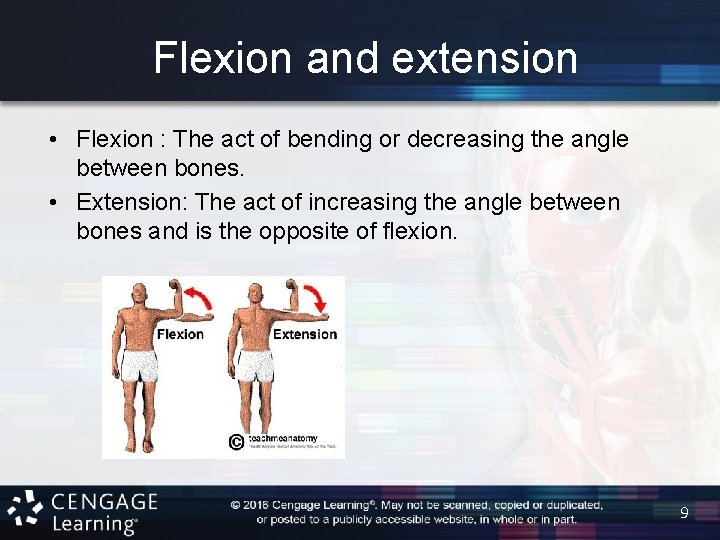
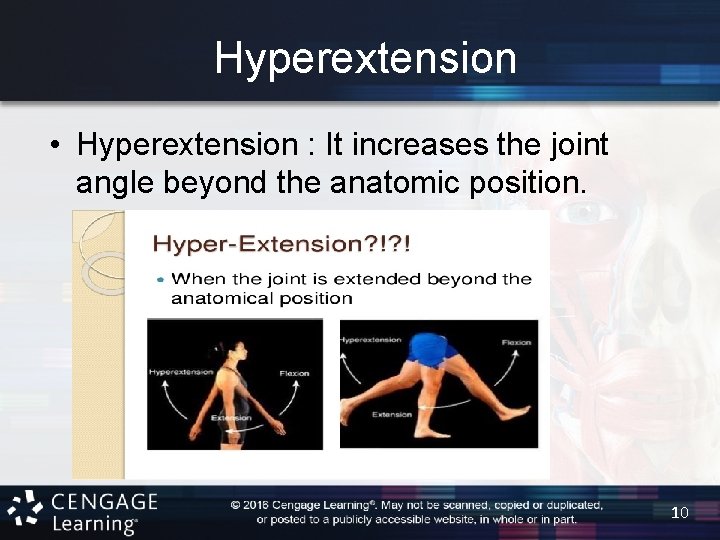
Movements at Synovial Joints (cont’d. ) • Flexion/extension – Hyperextension: abnormal extension • • Dorsiflexion/plantar flexion Abduction/adduction Rotation Circumduction 6
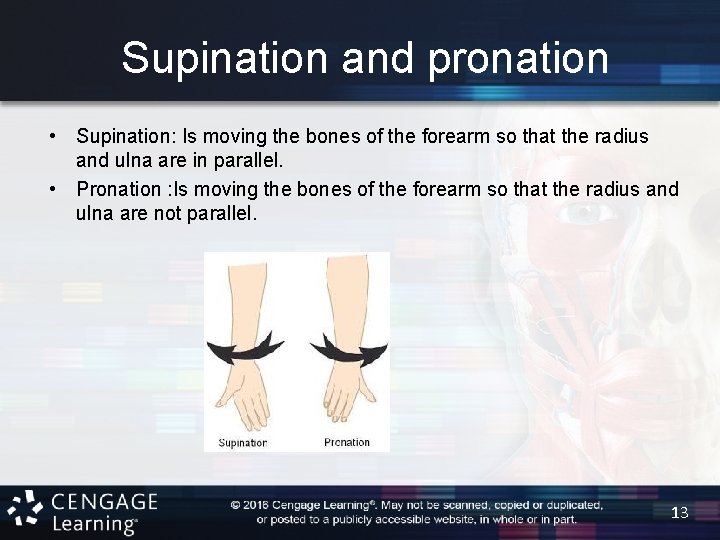
Movements at Synovial Joints (cont’d. ) • • Supination/pronation Eversion/inversion Protraction/retraction Opposition/reposition 7
8
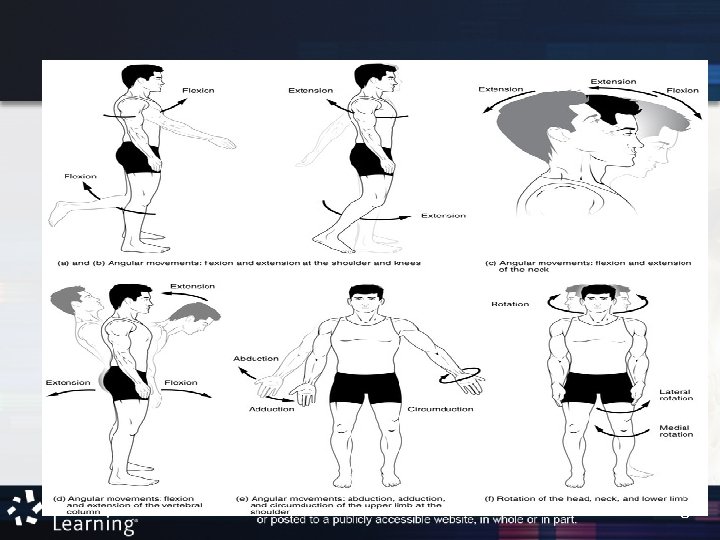
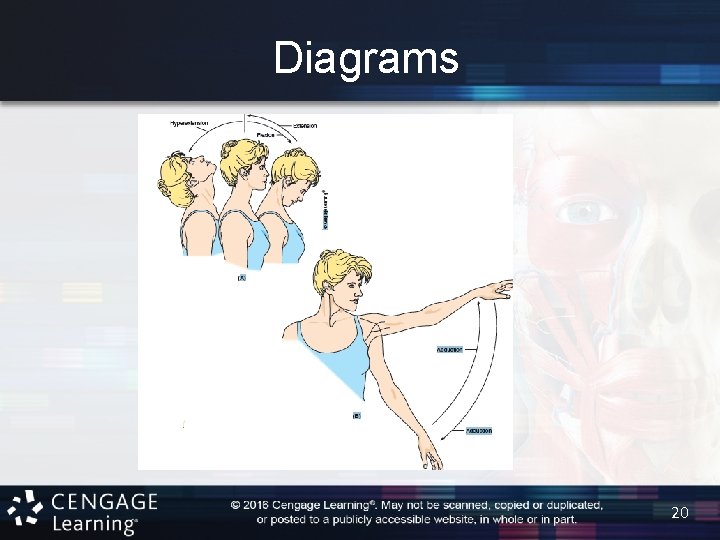
Flexion and extension • Flexion : The act of bending or decreasing the angle between bones. • Extension: The act of increasing the angle between bones and is the opposite of flexion. 9
Hyperextension • Hyperextension : It increases the joint angle beyond the anatomic position. 10
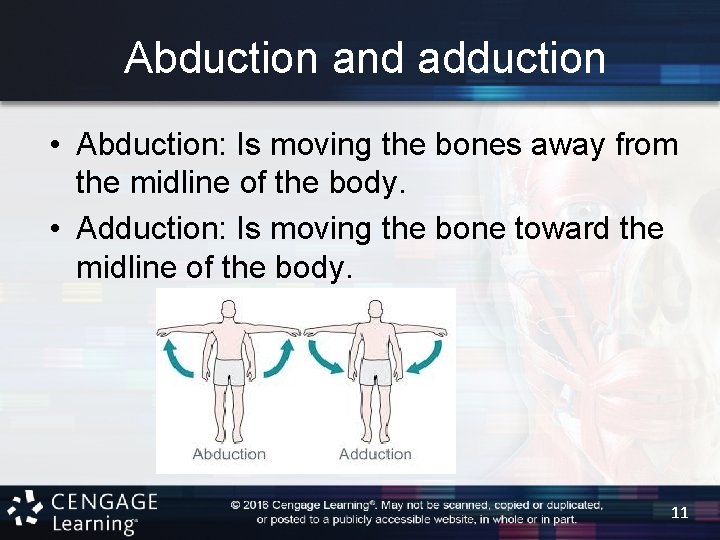
Abduction and adduction • Abduction: Is moving the bones away from the midline of the body. • Adduction: Is moving the bone toward the midline of the body. 11
Rotation and circumduction • Rotation: Is the act of moving the bone around a central axis. • Circumduction: Is moving the bone in such a way that the end of the bone describe the circle in the air and the sides of the bone describe a cone in the air. 12
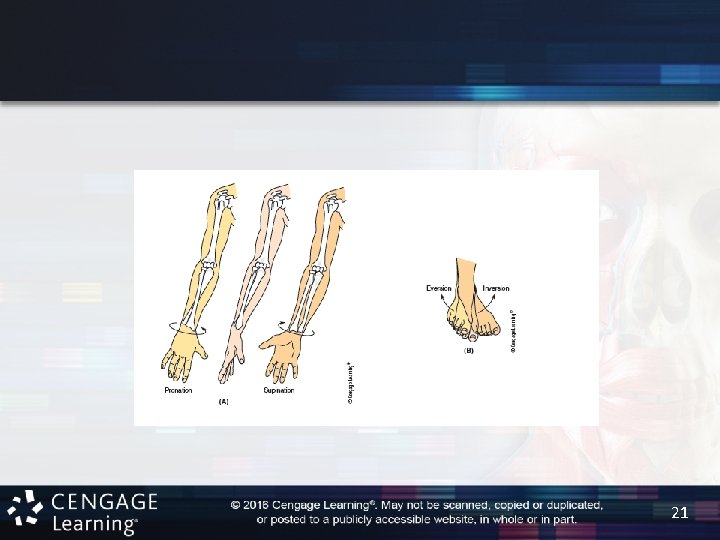
Supination and pronation • Supination: Is moving the bones of the forearm so that the radius and ulna are in parallel. • Pronation : Is moving the bones of the forearm so that the radius and ulna are not parallel. 13
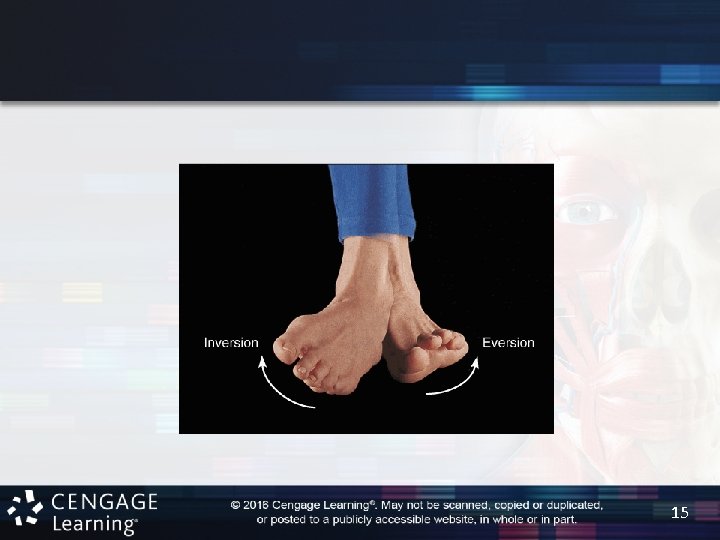
Eversion and inversion • Eversion : Is the moving the sole of the foot outward at the ankle. • Inversion: Is moving the sole of the foot inward at the ankle. 14
15
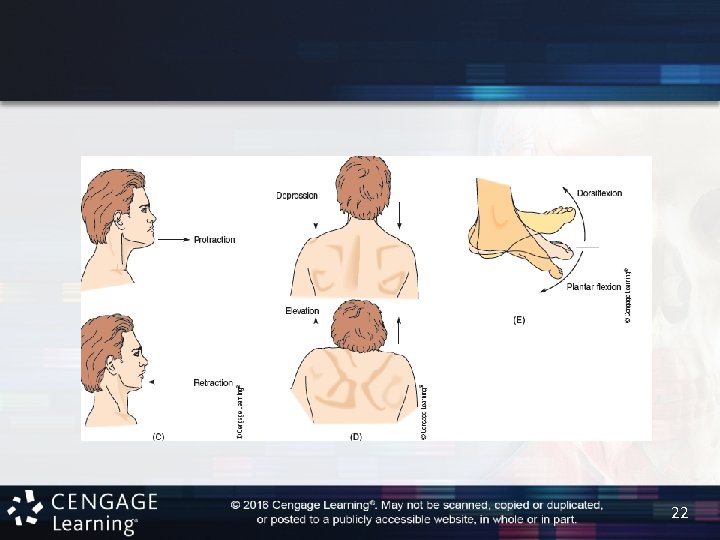
Other movements • Protraction : Is moving a part of the body forward on a plane parallel to the ground. • Retraction : Is moving a part of the body backward on a plane parallel to the ground. • Elevation : Is raising a part of the body. • Depression : Is lowering a part of the body. 16
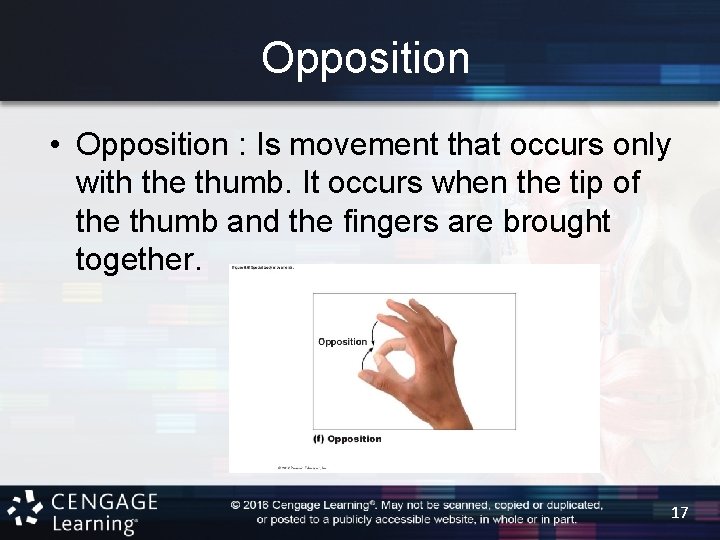
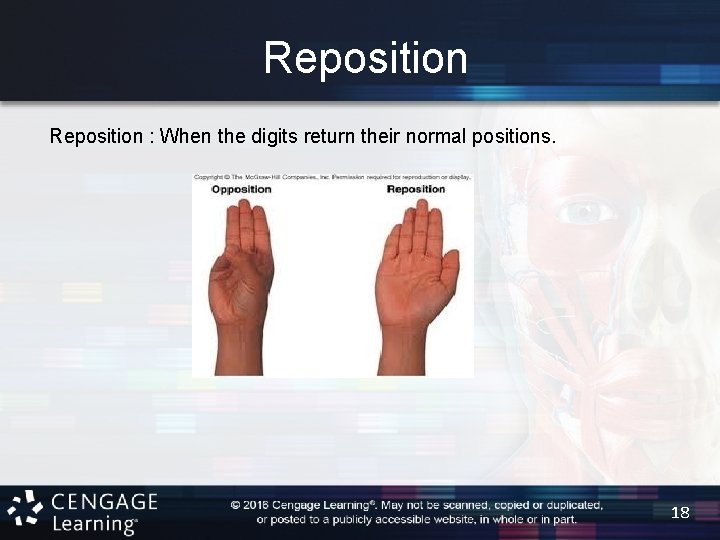
Opposition • Opposition : Is movement that occurs only with the thumb. It occurs when the tip of the thumb and the fingers are brought together. 17
Reposition : When the digits return their normal positions. 18
Dorsiflexion and plantar flexion • Dorsiflexion : Is raising the foot up at the ankle joint. • Plantar flexion: Is pushing the foot down at the ankle joints, actions we do when walking. 19
Diagrams 20
21
22
The Six Types of Diarthroses or Synovial Joints 23
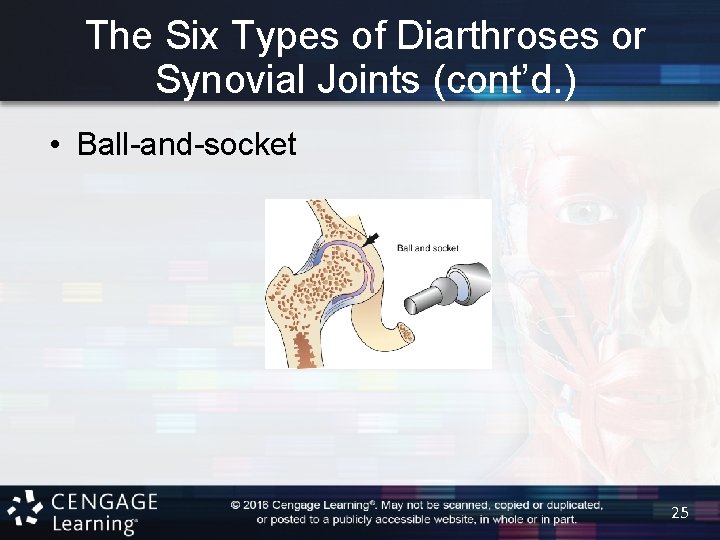
The Six Types of Diarthroses or Synovial Joints (cont’d. ) • Ball-and-socket – Widest range of movement • Movement can occur in all planes and directions – Shoulder – Hip 24
The Six Types of Diarthroses or Synovial Joints (cont’d. ) • Ball-and-socket 25
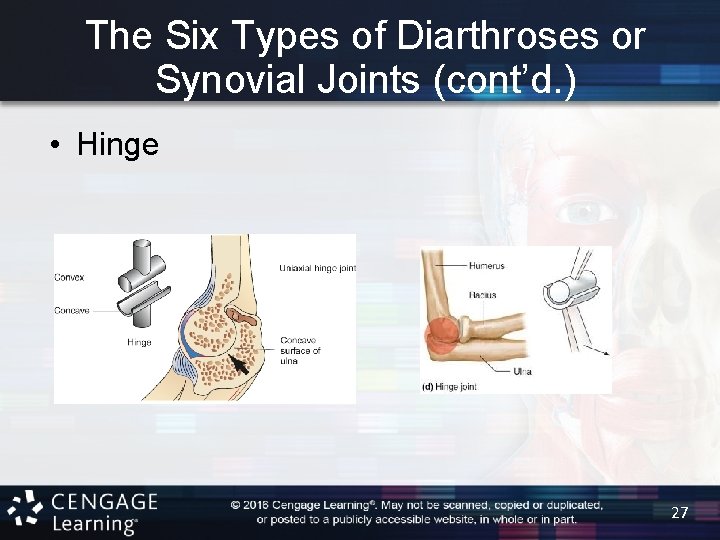
The Six Types of Diarthroses or Synovial Joints (cont’d. ) • Hinge – Convex surface fits into concave surface – Flexion and extension only – Knee – Elbow – Hinge joints are formed between two or more bones where the bones can only move along one axis to flex or extend. 26
The Six Types of Diarthroses or Synovial Joints (cont’d. ) • Hinge 27
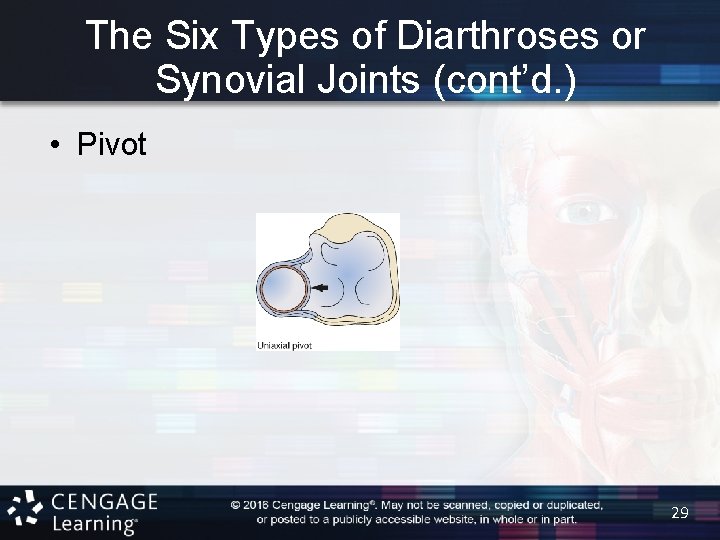
The Six Types of Diarthroses or Synovial Joints (cont’d. ) • Pivot – Rotation in one plane – Atlas and axis (cervical spine) – Rotation of the head 28
The Six Types of Diarthroses or Synovial Joints (cont’d. ) • Pivot 29
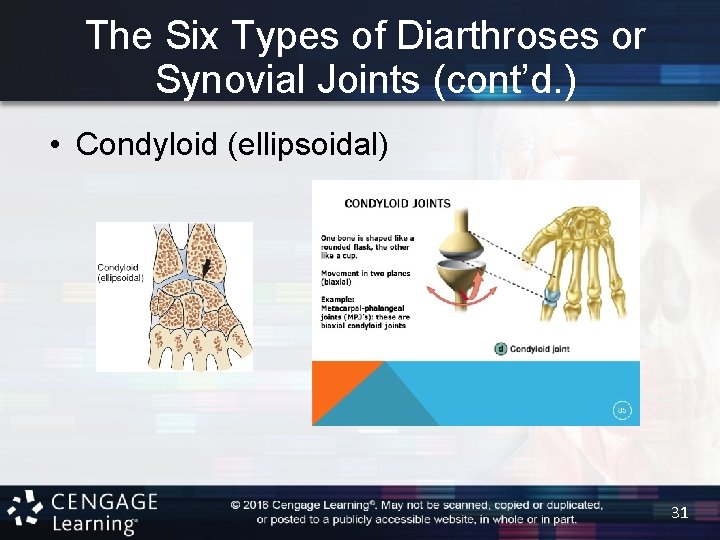
The Six Types of Diarthroses or Synovial Joints (cont’d. ) • Condyloid (ellipsoidal) – Oval-shaped condyle fits into elliptical cavity – Motion in two planes at right angles – Radius and carpal bones – This permits movement in two planes, allowing flexion, extension, adduction, abduction, and circumduction. 30
The Six Types of Diarthroses or Synovial Joints (cont’d. ) • Condyloid (ellipsoidal) 31
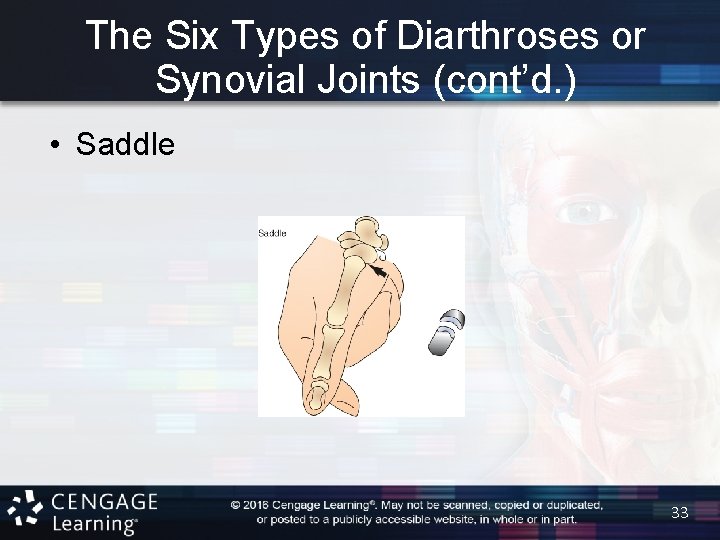
The Six Types of Diarthroses or Synovial Joints (cont’d. ) • Saddle – Motion in two planes at right angles – Permits opposition of the thumb – Saddle joints provide stability to the bones while providing more flexibility than a hinge or gliding joint. 32
The Six Types of Diarthroses or Synovial Joints (cont’d. ) • Saddle 33
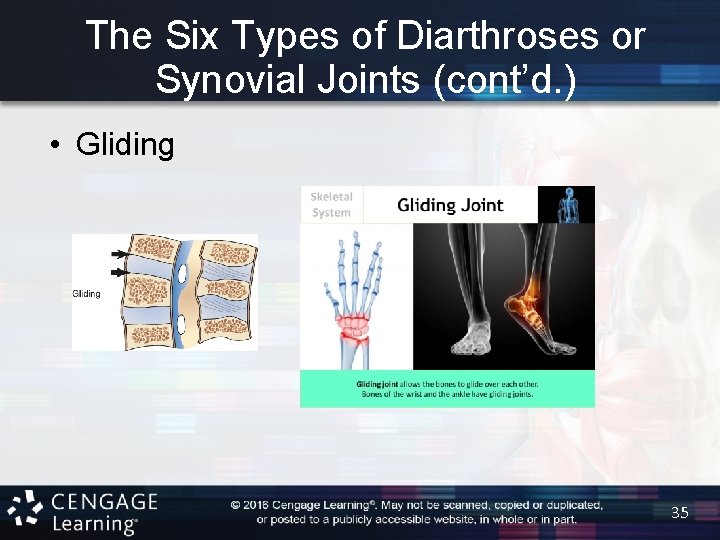
The Six Types of Diarthroses or Synovial Joints (cont’d. ) • A gliding joint, also known as a plane joint or planar joint, formed between bones that meet at flat or nearly flat articular surfaces. Gliding joints allow the bones to glide past one another in any direction along the plane of thejoint – up and down, left and right, and diagonally. – Gliding motion – Intervertebral joints in spine 34
The Six Types of Diarthroses or Synovial Joints (cont’d. ) • Gliding 35