
Chapter 8 The Art of Directing Directors l
- Slides: 15
Chapter 8 The Art of Directing
Directors l l l l Turn the script into a production Coordinate the efforts of a team of collaborators Represent the intentions of the playwright and the expectations of the audience Inspire the actors to perform their best Create an environment in which each member of theatre ensemble can excel Offer creative solutions to questions and problems Demonstrate strong communication skills
Directing: A History The word director comes from the Greek didaskalos, or teacher l Middle Ages pageants and the conducteur des secrets l The playwright as director (i. e. Moliere) l The actor-manager of the 19 th century l
George II, the Duke of Saxe. Meiningen (1826 -1914) l First director in the modern sense l Long rehearsal periods l Attention to detail in acting l Advocated historical accuracy in the scenography l Keen ability to stage large ensemble scenes
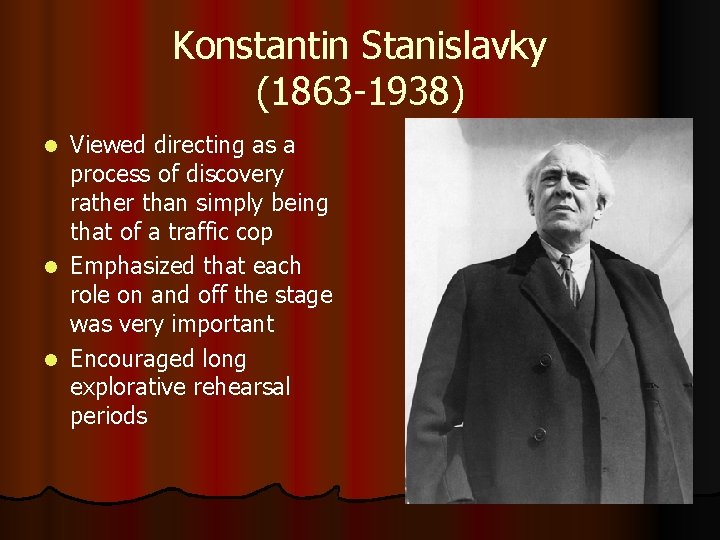
Konstantin Stanislavky (1863 -1938) Viewed directing as a process of discovery rather than simply being that of a traffic cop l Emphasized that each role on and off the stage was very important l Encouraged long explorative rehearsal periods l
The Directing Process In the Beginning l Script analysis l l Explore the world of the play in terms of character, language and environment Dramaturg l Assists the director in researching and thinking about the play, the playwrights, the audience and questions of style
The Directing Process Structural Analysis l Theme l Characters l Language l Environment l Plot l French l Beats scenes
The Directing Process Concept to Casting l Production Concept The primary metaphor, symbol, or concept that is essential to the production of this play l Production meetings serve to bring the production team a central point in the collaborative process l l Casting l l l Cast to type Cast against type Gender-neutral casting Cross-gender casting Color-blind casting
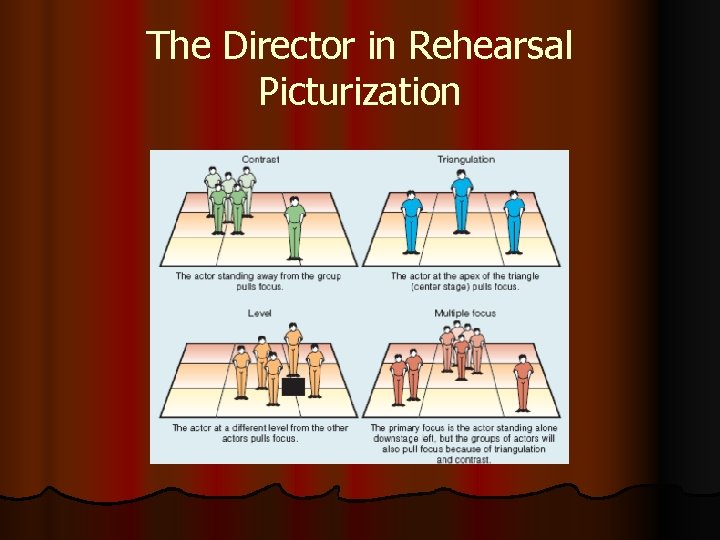
The Director in Rehearsal Focus l Shared focus l Stealing focus or upstaging l Profile l Stage areas l Triangulation
The Director in Rehearsal Picturization
The Director Collaborates with Others Assistant director l Stage manager l Assistant stage manager l Movement coach l Fight director l Vocal or dialect coach l Music director l Choreographer l Assistant choreographer l Dance director l
Types of Directors: Interpretive l Interpretive directors attempt to translate the play as they think the playwright would want it to be. l “The dramatist expresses himself mainly through words, the director through action …” l Harold Clurman, American director
Types of Directors: Creative l Creative Directors create “concept productions” based on their unique ideas or interpretations of a play script l “The theatre of the future will be a theatre of visions … an art which says less yet shows more … art which springs from movement, movement which is the very symbol of life. ” l Gordon Craig, scenographer
Types of Directors: Contemporary Trends Ensemble Directors, designers and actors work with playwrights in the development of a play from its very conception
Peter Brook Director of the International Centre… “I know of one acid test in theatre … When the performance is over, what remains? … It is the play’s central image that remains, its silhouette, … this shape will be the essence of what it has to say. ”