
Chapter 8 Team dynamics Learning Objectives 8 1
Chapter 8 Team dynamics
Learning Objectives 8. 1 Explain why employees join informal groups, and discuss the benefits and limitations of teams 8. 2 Outline the team effectiveness model and discuss how task characteristics, team size and team composition influence team effectiveness 8. 3 Discuss how the four team processes—team development, norms, cohesion and trust—influence team effectiveness 8. 4 Discuss the characteristics and factors required for the success of self-directed teams and virtual teams 8. 5 Identify four constraints on team decision making and discuss the advantages and disadvantages of four structures aimed at improving team decision making Copyright © 2013 Mc. Graw-Hill Australia Pty Ltd Mc. Shane, Olekalns, Travaglione, Organisational Behaviour, 4 e 8 -2
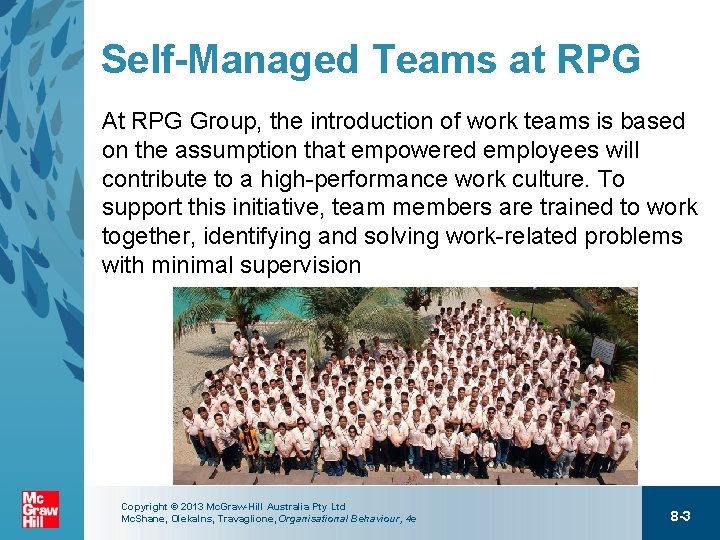
Self-Managed Teams at RPG At RPG Group, the introduction of work teams is based on the assumption that empowered employees will contribute to a high-performance work culture. To support this initiative, team members are trained to work together, identifying and solving work-related problems with minimal supervision Copyright © 2013 Mc. Graw-Hill Australia Pty Ltd Mc. Shane, Olekalns, Travaglione, Organisational Behaviour, 4 e 8 -3
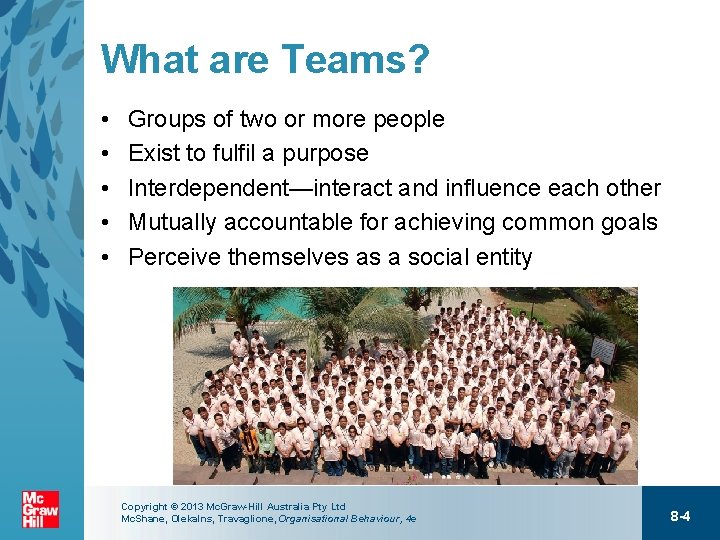
What are Teams? • • • Groups of two or more people Exist to fulfil a purpose Interdependent—interact and influence each other Mutually accountable for achieving common goals Perceive themselves as a social entity Copyright © 2013 Mc. Graw-Hill Australia Pty Ltd Mc. Shane, Olekalns, Travaglione, Organisational Behaviour, 4 e 8 -4
Many Types of Teams • Departmental teams • Production/service/ leadership teams • Self-directed teams • Advisory teams • Task force (project) teams • Skunkworks • Virtual teams • Communities of practice Copyright © 2013 Mc. Graw-Hill Australia Pty Ltd Mc. Shane, Olekalns, Travaglione, Organisational Behaviour, 4 e 8 -5
Informal Groups • Groups that exist primarily for the benefit of their members • Reasons why informal groups exist: – Innate drive to bond – Social identity—we define ourselves by group memberships – Goal accomplishment – Emotional support Copyright © 2013 Mc. Graw-Hill Australia Pty Ltd Mc. Shane, Olekalns, Travaglione, Organisational Behaviour, 4 e 8 -6
Advantages/Disadvantages of Teams • Advantages – Make better decisions, products and services – Better information sharing – Increase employee motivation and engagement § Fulfils drive to bond § Closer scrutiny by team members § Team members are benchmarks of comparison • Disadvantages – Individuals better/faster on some tasks – Process losses—cost of developing and maintaining teams – Social loafing Copyright © 2013 Mc. Graw-Hill Australia Pty Ltd Mc. Shane, Olekalns, Travaglione, Organisational Behaviour, 4 e 8 -7
How to Minimise Social Loafing • Make individual performance more visible – Form smaller teams – Specialise tasks – Measure individual performance • Increase employee motivation – Increase job enrichment – Select motivated employees Copyright © 2013 Mc. Graw-Hill Australia Pty Ltd Mc. Shane, Olekalns, Travaglione, Organisational Behaviour, 4 e 8 -8
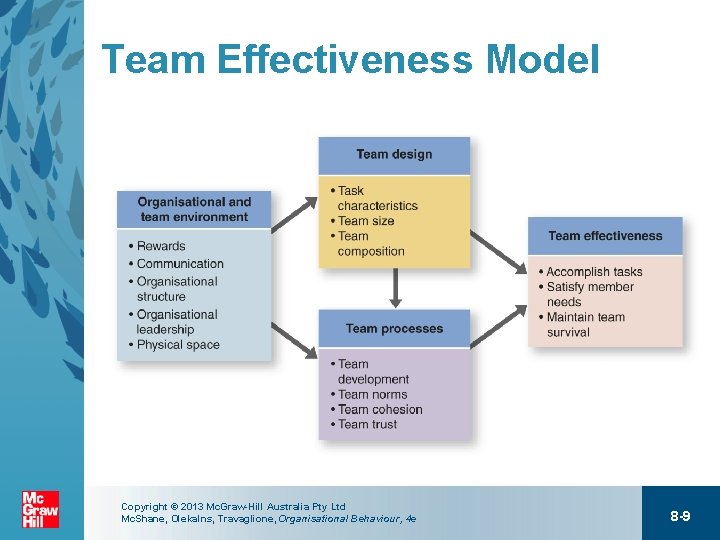
Team Effectiveness Model Copyright © 2013 Mc. Graw-Hill Australia Pty Ltd Mc. Shane, Olekalns, Travaglione, Organisational Behaviour, 4 e 8 -9
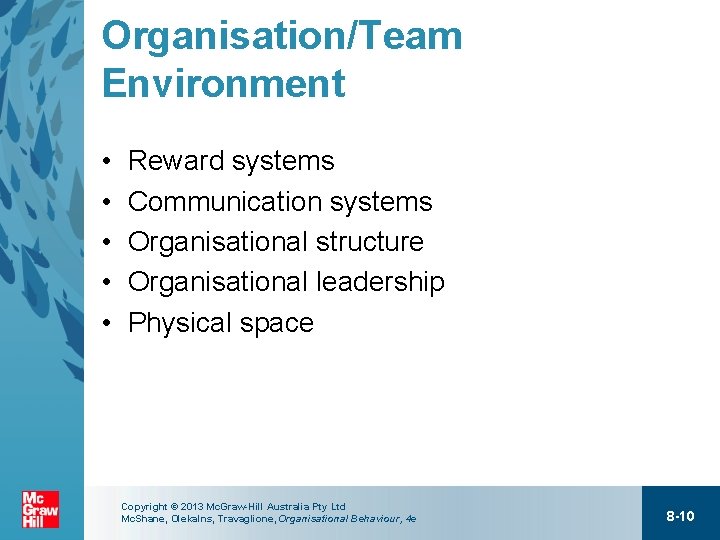
Organisation/Team Environment • • • Reward systems Communication systems Organisational structure Organisational leadership Physical space Copyright © 2013 Mc. Graw-Hill Australia Pty Ltd Mc. Shane, Olekalns, Travaglione, Organisational Behaviour, 4 e 8 -10
Team’s Task Characteristics • Teams work better when tasks are clear and easy to implement – Learn roles faster, easier to become cohesive – Ill-defined tasks require members with diverse backgrounds and more time to coordinate • Teams preferred with higher task interdependence – Extent that employees need to share materials, information or expertise to perform their jobs Copyright © 2013 Mc. Graw-Hill Australia Pty Ltd Mc. Shane, Olekalns, Travaglione, Organisational Behaviour, 4 e 8 -11
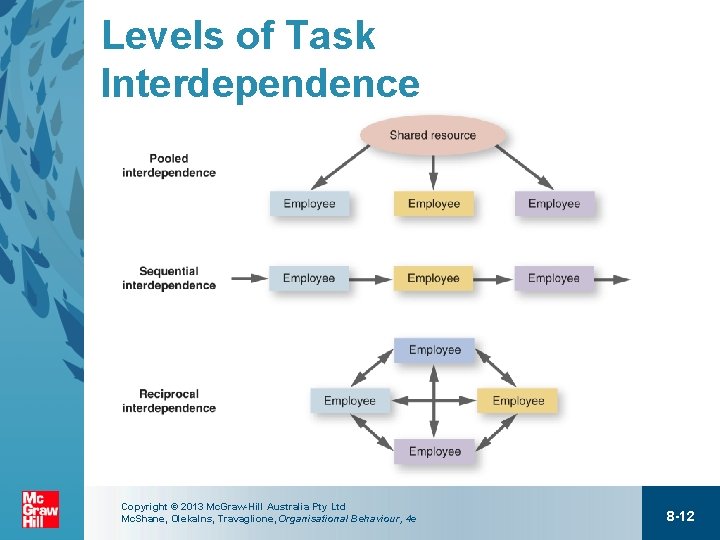
Levels of Task Interdependence Copyright © 2013 Mc. Graw-Hill Australia Pty Ltd Mc. Shane, Olekalns, Travaglione, Organisational Behaviour, 4 e 8 -12
Team Size • Smaller teams are better because they: – Need less time to coordinate roles and resolve differences – Require less time to develop more member involvement, thus higher commitment • But the team must be large enough to accomplish the task Copyright © 2013 Mc. Graw-Hill Australia Pty Ltd Mc. Shane, Olekalns, Travaglione, Organisational Behaviour, 4 e 8 -13
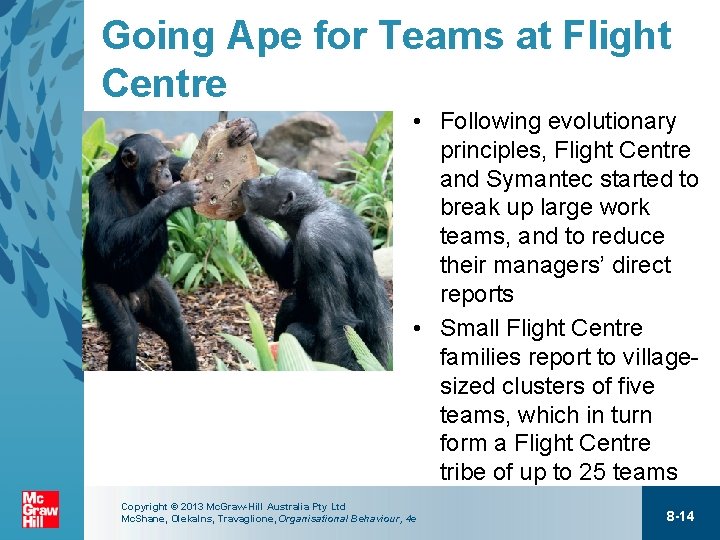
Going Ape for Teams at Flight Centre <<Insert Ape Image p. 258>> • Following evolutionary principles, Flight Centre and Symantec started to break up large work teams, and to reduce their managers’ direct reports • Small Flight Centre families report to villagesized clusters of five teams, which in turn form a Flight Centre tribe of up to 25 teams Copyright © 2013 Mc. Graw-Hill Australia Pty Ltd Mc. Shane, Olekalns, Travaglione, Organisational Behaviour, 4 e 8 -14
Team Composition • Effective team members must be willing and able to work on the team • Effective team members possess specific competencies (5 Cs) Copyright © 2013 Mc. Graw-Hill Australia Pty Ltd Mc. Shane, Olekalns, Travaglione, Organisational Behaviour, 4 e 8 -15

Five Cs of Team-member Competencies Copyright © 2013 Mc. Graw-Hill Australia Pty Ltd Mc. Shane, Olekalns, Travaglione, Organisational Behaviour, 4 e 8 -16
Team Composition: Diversity • Team members have diverse knowledge, skills, perspectives, values, etc. • Advantages – View problems and possible solutions from different perspectives – Broader knowledge base – Better representation of team’s constituents • Disadvantages – Take longer to become a high-performing team – More susceptible to ‘fault lines’ – Increased risk of dysfunctional conflict Copyright © 2013 Mc. Graw-Hill Australia Pty Ltd Mc. Shane, Olekalns, Travaglione, Organisational Behaviour, 4 e 8 -17
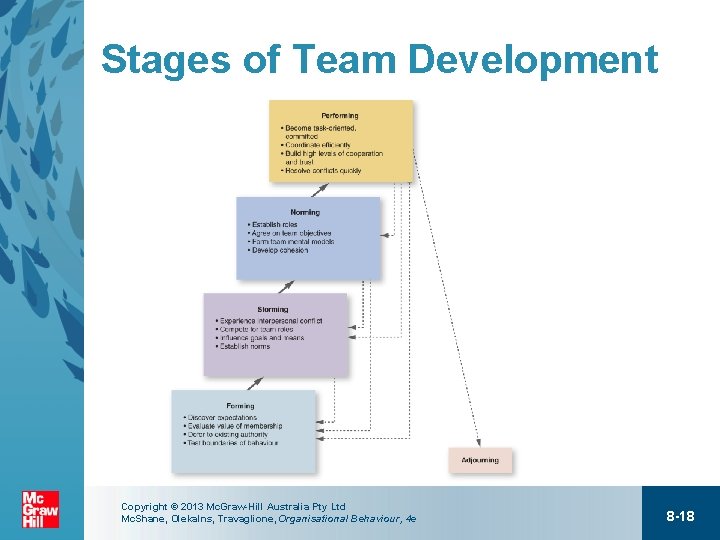
Stages of Team Development Copyright © 2013 Mc. Graw-Hill Australia Pty Ltd Mc. Shane, Olekalns, Travaglione, Organisational Behaviour, 4 e 8 -18
Team Development as Membership and Competence • Two central processes in team development: • Team membership formation – Transition from ‘them’ to ‘us’ – Team becomes part of person’s social identity • Team competence development – Forming routines with others – Forming shared mental models Copyright © 2013 Mc. Graw-Hill Australia Pty Ltd Mc. Shane, Olekalns, Travaglione, Organisational Behaviour, 4 e 8 -19
Team Roles • A set of behaviours that people are expected to perform • Some formally assigned; others informally • Informal role assignment occurs during team development and is related to personal characteristics Copyright © 2013 Mc. Graw-Hill Australia Pty Ltd Mc. Shane, Olekalns, Travaglione, Organisational Behaviour, 4 e 8 -20
Team Building • Formal activities intended to improve the team’s development and functioning • Types of team building – – Clarify team’s performance goals Improve team’s problem-solving skills Improve role definitions Improve relations Copyright © 2013 Mc. Graw-Hill Australia Pty Ltd Mc. Shane, Olekalns, Travaglione, Organisational Behaviour, 4 e 8 -21
Team Norms • Informal rules and shared expectations that the team establishes to regulate member behaviours • Norms develop through: – Initial team experiences – Critical events in team’s history – Experience and values members bring to the team Copyright © 2013 Mc. Graw-Hill Australia Pty Ltd Mc. Shane, Olekalns, Travaglione, Organisational Behaviour, 4 e 8 -22
Team Cohesion • The degree of attraction people feel toward the team and their motivation to remain members • Both cognitive and emotional process • Related to the team member’s social identity Copyright © 2013 Mc. Graw-Hill Australia Pty Ltd Mc. Shane, Olekalns, Travaglione, Organisational Behaviour, 4 e 8 -23
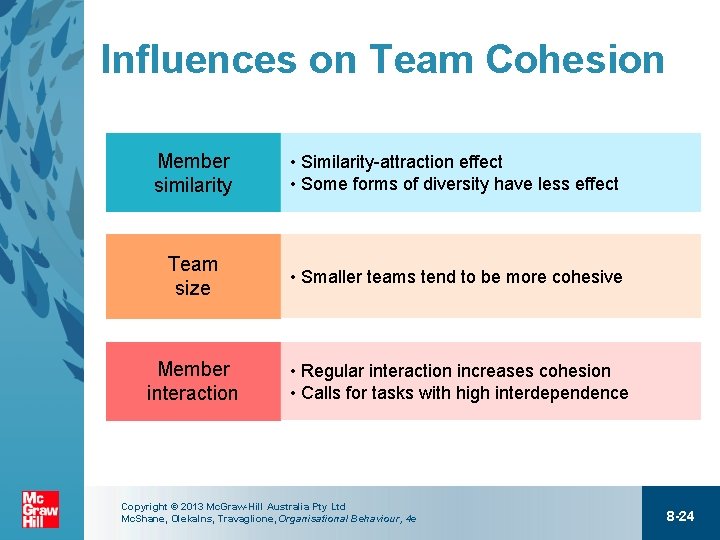
Influences on Team Cohesion Member similarity • Similarity-attraction effect • Some forms of diversity have less effect Team size • Smaller teams tend to be more cohesive Member interaction • Regular interaction increases cohesion • Calls for tasks with high interdependence Copyright © 2013 Mc. Graw-Hill Australia Pty Ltd Mc. Shane, Olekalns, Travaglione, Organisational Behaviour, 4 e 8 -24
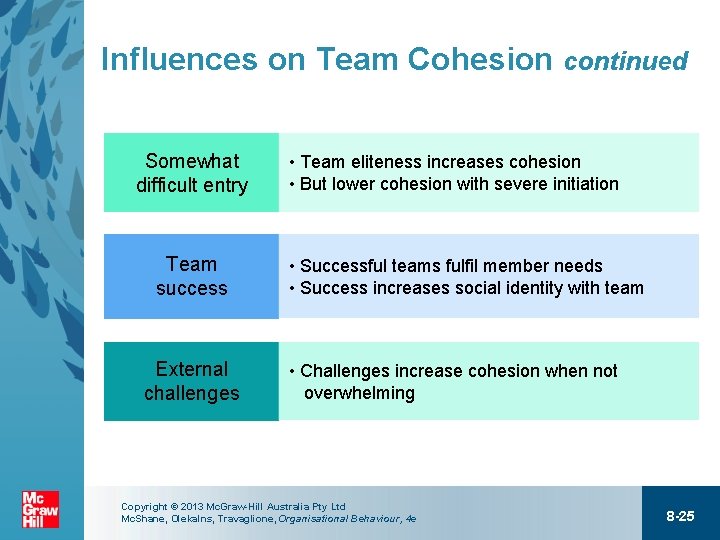
Influences on Team Cohesion continued Somewhat difficult entry Team success External challenges • Team eliteness increases cohesion • But lower cohesion with severe initiation • Successful teams fulfil member needs • Success increases social identity with team • Challenges increase cohesion when not overwhelming Copyright © 2013 Mc. Graw-Hill Australia Pty Ltd Mc. Shane, Olekalns, Travaglione, Organisational Behaviour, 4 e 8 -25
Team Cohesion Outcomes • • • Motivated to remain members Willing to share information Strong interpersonal bonds Resolve conflict effectively Better interpersonal relationships Better performance (if norms aligned) Copyright © 2013 Mc. Graw-Hill Australia Pty Ltd Mc. Shane, Olekalns, Travaglione, Organisational Behaviour, 4 e 8 -26
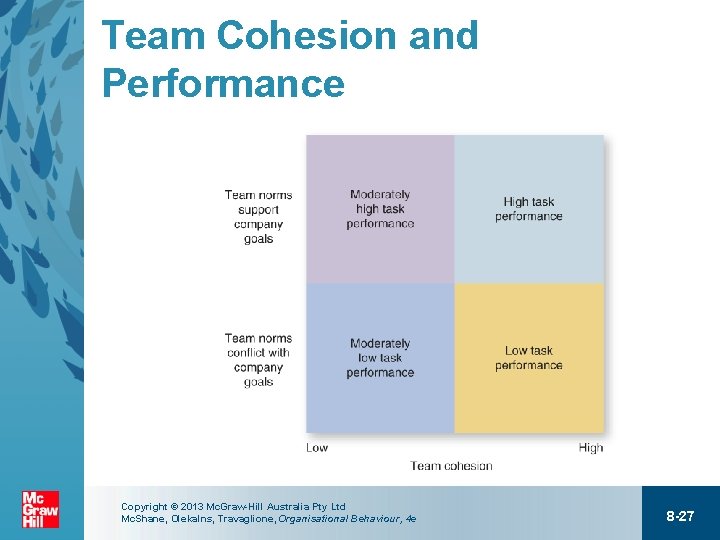
Team Cohesion and Performance Copyright © 2013 Mc. Graw-Hill Australia Pty Ltd Mc. Shane, Olekalns, Travaglione, Organisational Behaviour, 4 e 8 -27
Trust Defined • Positive expectations one person has of another person in situations involving risk Copyright © 2013 Mc. Graw-Hill Australia Pty Ltd Mc. Shane, Olekalns, Travaglione, Organisational Behaviour, 4 e 8 -28
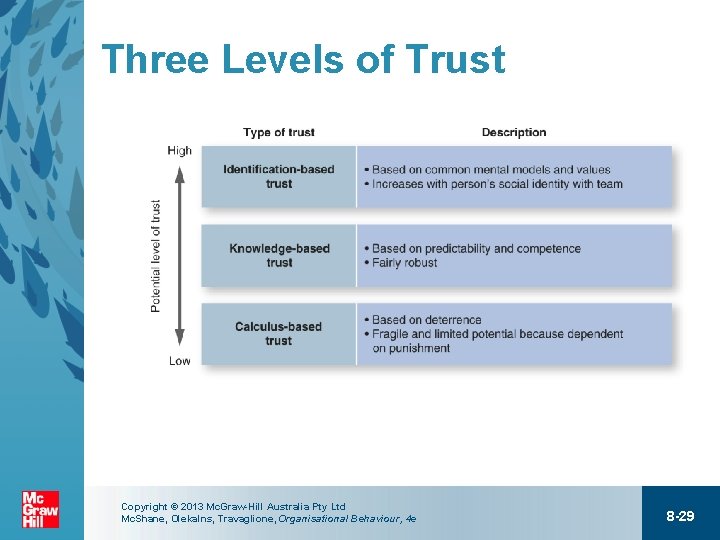
Three Levels of Trust Copyright © 2013 Mc. Graw-Hill Australia Pty Ltd Mc. Shane, Olekalns, Travaglione, Organisational Behaviour, 4 e 8 -29
Self-Directed Teams • SDTs are cross-functional work groups organised around work processes • They complete an entire piece of work requiring several interdependent tasks • They have substantial autonomy over the execution of those tasks Copyright © 2013 Mc. Graw-Hill Australia Pty Ltd Mc. Shane, Olekalns, Travaglione, Organisational Behaviour, 4 e 8 -30
Self-Directed Team Success Factors • • • Responsible for entire work process High interdependence within the team Low interdependence with other teams Autonomy to organise and coordinate work Work site and technology support team communication/coordination Copyright © 2013 Mc. Graw-Hill Australia Pty Ltd Mc. Shane, Olekalns, Travaglione, Organisational Behaviour, 4 e 8 -31
Multicultural teams • Teams built from employees around the globe • Can be affected by cultural differences: – Norms (about power, communicating and decision making) – Values – Local versus global perspectives Copyright © 2013 Mc. Graw-Hill Australia Pty Ltd Mc. Shane, Olekalns, Travaglione, Organisational Behaviour, 4 e 8 -32
Managing Multicultural Teams • Managers of multicultural teams can make one of three kinds of interventions: – Encourage adaptation – Implement a structural intervention – Direct manager intervention Copyright © 2013 Mc. Graw-Hill Australia Pty Ltd Mc. Shane, Olekalns, Travaglione, Organisational Behaviour, 4 e 8 -33
Virtual Teams • Teams whose members operate across space, time and organisational boundaries and are linked through information technologies to achieve organisational tasks – Increasingly possible because of: § Information technologies § Knowledge-based work – Increasingly necessary because of: § Organisational learning § Globalisation Copyright © 2013 Mc. Graw-Hill Australia Pty Ltd Mc. Shane, Olekalns, Travaglione, Organisational Behaviour, 4 e 8 -34
Virtual Team Success Factors • Member characteristics – Technology savvy – Self-leadership skills – Emotional intelligence • Flexible use of communication technologies • Opportunities to meet face-to-face Copyright © 2013 Mc. Graw-Hill Australia Pty Ltd Mc. Shane, Olekalns, Travaglione, Organisational Behaviour, 4 e 8 -35
Team Decision-Making Constraints • Time constraints – Time to organise/coordinate – Production blocking • Evaluation apprehension – Belief that others are silently evaluating you • Peer pressure to conform – Suppressing opinions that oppose team norms • Groupthink – Tendency in highly cohesive teams to value consensus at the price of decision quality – Concept losing favour—consider more specific features Copyright © 2013 Mc. Graw-Hill Australia Pty Ltd Mc. Shane, Olekalns, Travaglione, Organisational Behaviour, 4 e 8 -36
General Guidelines for Team Decisions • Team norms should encourage critical thinking • Sufficient team diversity • Ensure neither leader nor any member dominates • Maintain optimal team size • Introduce effective team structures Copyright © 2013 Mc. Graw-Hill Australia Pty Ltd Mc. Shane, Olekalns, Travaglione, Organisational Behaviour, 4 e 8 -37
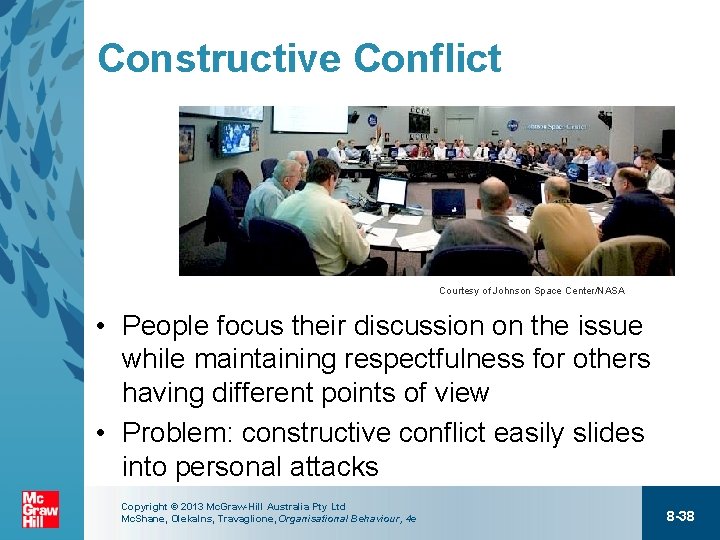
Constructive Conflict Courtesy of Johnson Space Center/NASA • People focus their discussion on the issue while maintaining respectfulness for others having different points of view • Problem: constructive conflict easily slides into personal attacks Copyright © 2013 Mc. Graw-Hill Australia Pty Ltd Mc. Shane, Olekalns, Travaglione, Organisational Behaviour, 4 e 8 -38
Rules of Brainstorming • • Speak freely Don’t criticise Provide as many ideas as possible Build on others’ ideas Copyright © 2013 Mc. Graw-Hill Australia Pty Ltd Mc. Shane, Olekalns, Travaglione, Organisational Behaviour, 4 e 8 -39
Evaluating Brainstorming • Strengths – Produces more creative ideas – Less evaluation apprehension when team supports a learning orientation – Strengthens decision acceptance and team cohesiveness – Sharing positive emotions encourages creativity • Weaknesses – Production blocking still exists – Evaluation apprehension exists in many groups Copyright © 2013 Mc. Graw-Hill Australia Pty Ltd Mc. Shane, Olekalns, Travaglione, Organisational Behaviour, 4 e 8 -40
Electronic Brainstorming • Relies on networked computers to submit and share creative ideas • Strengths—more creative ideas, minimal production blocking, evaluation apprehension or conformity problems • Limitations—too structured and technologybound Copyright © 2013 Mc. Graw-Hill Australia Pty Ltd Mc. Shane, Olekalns, Travaglione, Organisational Behaviour, 4 e 8 -41
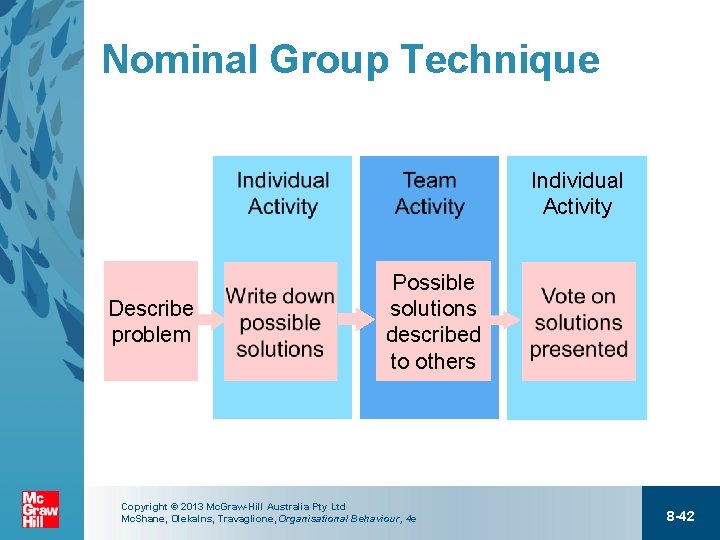
Nominal Group Technique Individual Activity Describe problem Possible solutions described to others Copyright © 2013 Mc. Graw-Hill Australia Pty Ltd Mc. Shane, Olekalns, Travaglione, Organisational Behaviour, 4 e 8 -42
Summary • People have a drive to bond. As such, they join informal groups and work in teams • A team is effective when able to achieve its objectives, fulfil the needs of its members and maintain its survival • The model of team effectiveness considers the team and organisational environment, team design and team processes • Different team types (SDTs, virtual or multicultural) have different challenges and conditions for success Copyright © 2013 Mc. Graw-Hill Australia Pty Ltd Mc. Shane, Olekalns, Travaglione, Organisational Behaviour, 4 e 8 -43
- Slides: 43