
Chapter 8 Survey Research Power Point presentation to
- Slides: 21
Chapter 8 Survey Research Power. Point presentation to accompany Research Design Explained 6 th edition; © 2007 Mark Mitchell & Janina Jolley
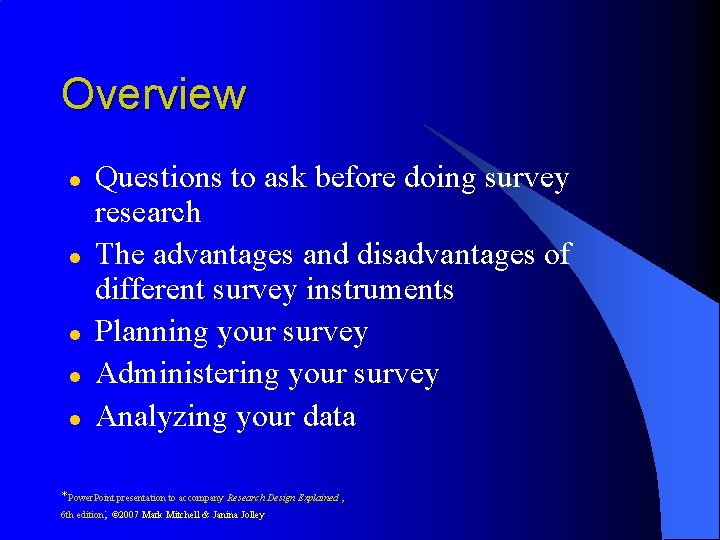
Overview l l l Questions to ask before doing survey research The advantages and disadvantages of different survey instruments Planning your survey Administering your survey Analyzing your data *Power. Point presentation to accompany Research Design Explained , 6 th edition; © 2007 Mark Mitchell & Janina Jolley
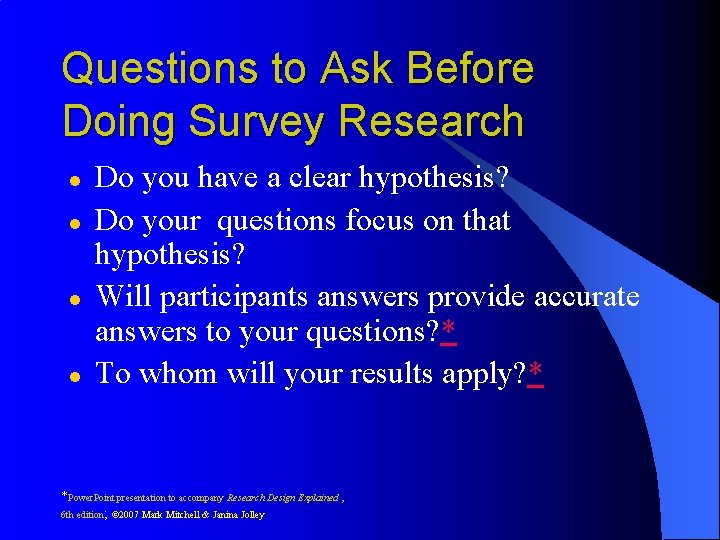
Questions to Ask Before Doing Survey Research l l Do you have a clear hypothesis? Do your questions focus on that hypothesis? Will participants answers provide accurate answers to your questions? * To whom will your results apply? * *Power. Point presentation to accompany Research Design Explained , 6 th edition; © 2007 Mark Mitchell & Janina Jolley
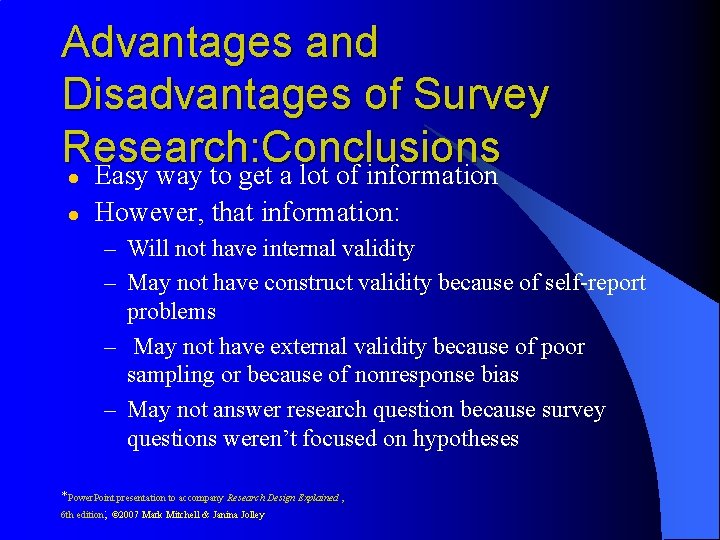
Advantages and Disadvantages of Survey Research: Conclusions Easy way to get a lot of information l l However, that information: – Will not have internal validity – May not have construct validity because of self-report problems – May not have external validity because of poor sampling or because of nonresponse bias – May not answer research question because survey questions weren’t focused on hypotheses *Power. Point presentation to accompany Research Design Explained , 6 th edition; © 2007 Mark Mitchell & Janina Jolley
The Advantages and Disadvantages of Different Survey Instruments l l Written Instruments * Interviews* *Power. Point presentation to accompany Research Design Explained , 6 th edition; © 2007 Mark Mitchell & Janina Jolley
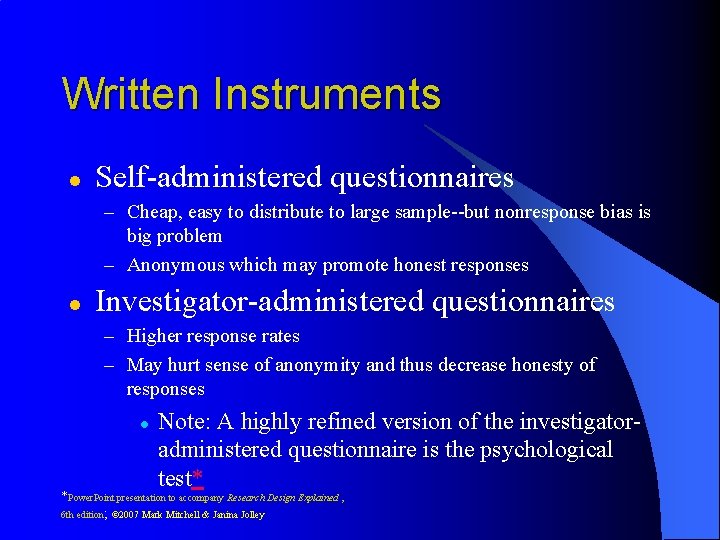
Written Instruments l Self-administered questionnaires – Cheap, easy to distribute to large sample--but nonresponse bias is big problem – Anonymous which may promote honest responses l Investigator-administered questionnaires – Higher response rates – May hurt sense of anonymity and thus decrease honesty of responses l Note: A highly refined version of the investigatoradministered questionnaire is the psychological test* *Power. Point presentation to accompany Research Design Explained , 6 th edition; © 2007 Mark Mitchell & Janina Jolley
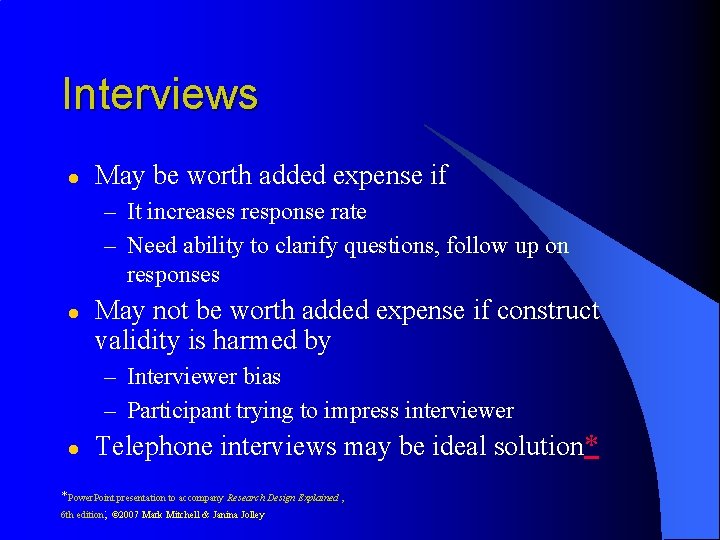
Interviews l May be worth added expense if – It increases response rate – Need ability to clarify questions, follow up on responses l May not be worth added expense if construct validity is harmed by – Interviewer bias – Participant trying to impress interviewer l Telephone interviews may be ideal solution* *Power. Point presentation to accompany Research Design Explained , 6 th edition; © 2007 Mark Mitchell & Janina Jolley
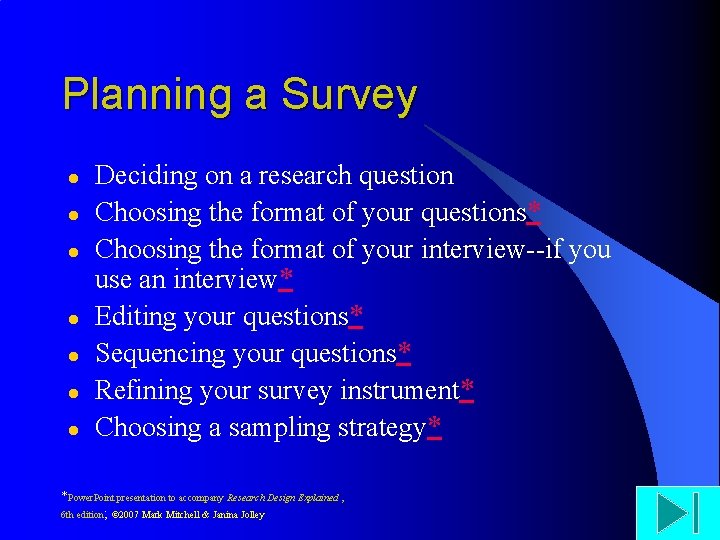
Planning a Survey l l l l Deciding on a research question Choosing the format of your questions* Choosing the format of your interview--if you use an interview* Editing your questions* Sequencing your questions* Refining your survey instrument* Choosing a sampling strategy* *Power. Point presentation to accompany Research Design Explained , 6 th edition; © 2007 Mark Mitchell & Janina Jolley
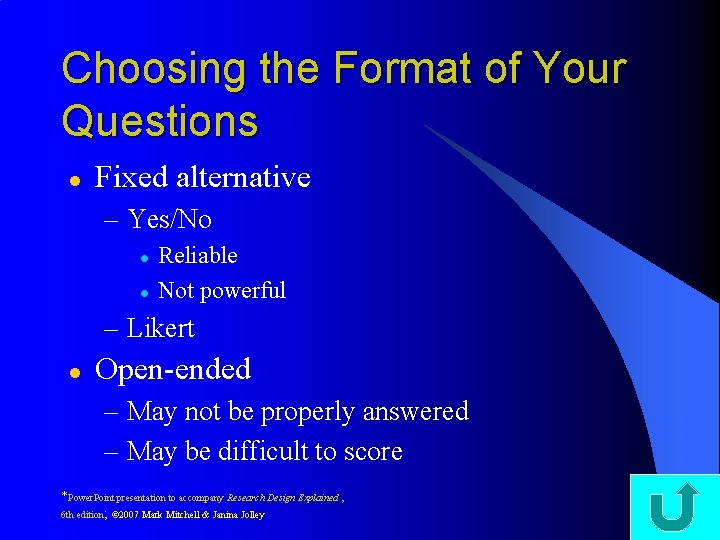
Choosing the Format of Your Questions l Fixed alternative – Yes/No l l Reliable Not powerful – Likert l Open-ended – May not be properly answered – May be difficult to score *Power. Point presentation to accompany Research Design Explained , 6 th edition; © 2007 Mark Mitchell & Janina Jolley
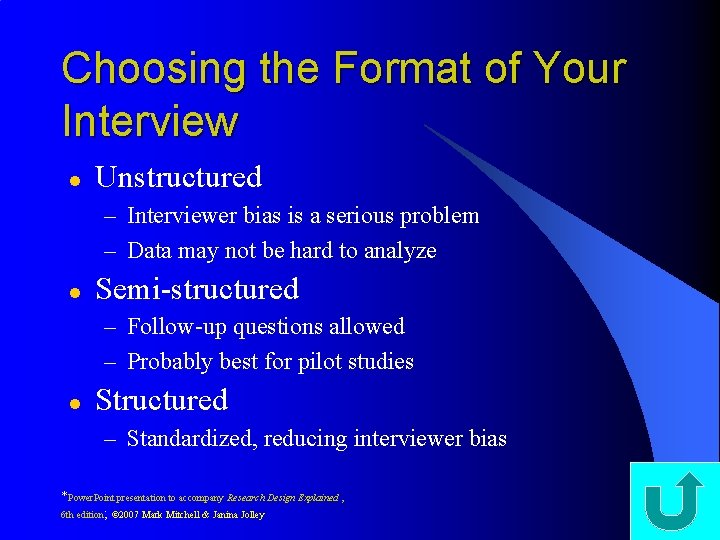
Choosing the Format of Your Interview l Unstructured – Interviewer bias is a serious problem – Data may not be hard to analyze l Semi-structured – Follow-up questions allowed – Probably best for pilot studies l Structured – Standardized, reducing interviewer bias *Power. Point presentation to accompany Research Design Explained , 6 th edition; © 2007 Mark Mitchell & Janina Jolley
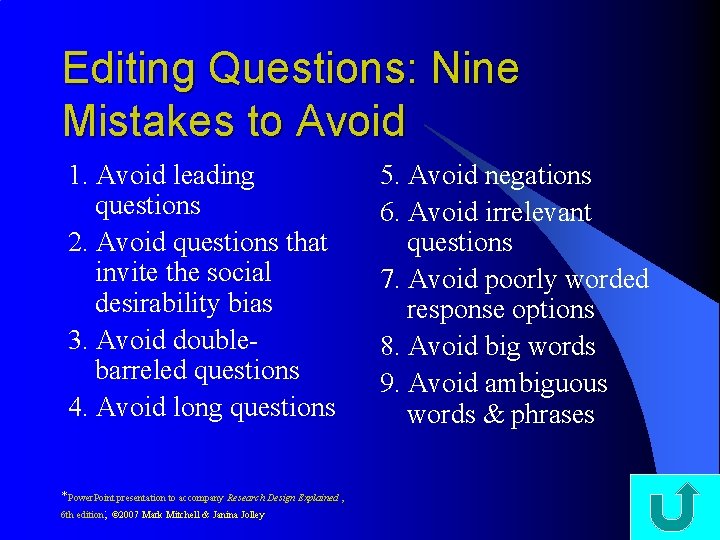
Editing Questions: Nine Mistakes to Avoid 1. Avoid leading questions 2. Avoid questions that invite the social desirability bias 3. Avoid doublebarreled questions 4. Avoid long questions *Power. Point presentation to accompany Research Design Explained , 6 th edition; © 2007 Mark Mitchell & Janina Jolley 5. Avoid negations 6. Avoid irrelevant questions 7. Avoid poorly worded response options 8. Avoid big words 9. Avoid ambiguous words & phrases
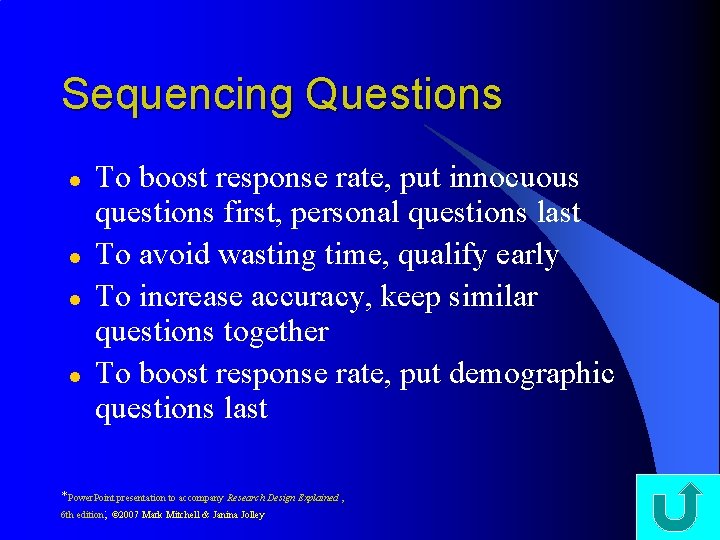
Sequencing Questions l l To boost response rate, put innocuous questions first, personal questions last To avoid wasting time, qualify early To increase accuracy, keep similar questions together To boost response rate, put demographic questions last *Power. Point presentation to accompany Research Design Explained , 6 th edition; © 2007 Mark Mitchell & Janina Jolley
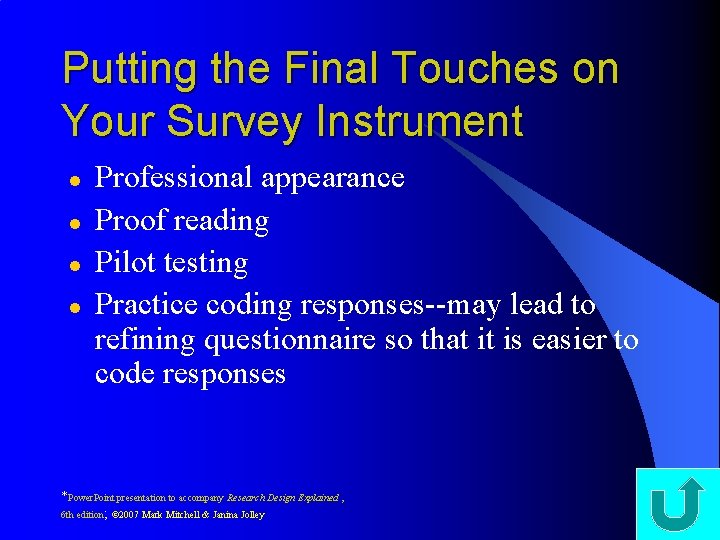
Putting the Final Touches on Your Survey Instrument l l Professional appearance Proof reading Pilot testing Practice coding responses--may lead to refining questionnaire so that it is easier to code responses *Power. Point presentation to accompany Research Design Explained , 6 th edition; © 2007 Mark Mitchell & Janina Jolley
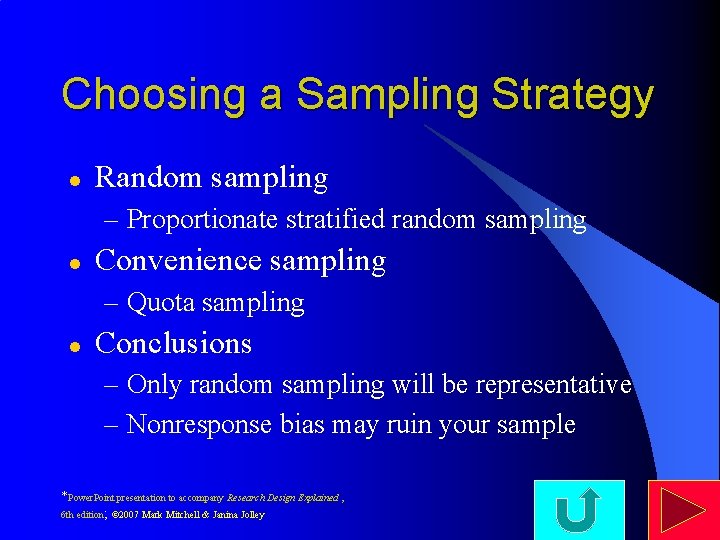
Choosing a Sampling Strategy l Random sampling – Proportionate stratified random sampling l Convenience sampling – Quota sampling l Conclusions – Only random sampling will be representative – Nonresponse bias may ruin your sample *Power. Point presentation to accompany Research Design Explained , 6 th edition; © 2007 Mark Mitchell & Janina Jolley
Administering the Survey l l Informed consent Clear instructions Debriefing Confidentiality *Power. Point presentation to accompany Research Design Explained , 6 th edition; © 2007 Mark Mitchell & Janina Jolley
Analyzing Survey Data l l Summarizing data Inferential statistics *Power. Point presentation to accompany Research Design Explained , 6 th edition; © 2007 Mark Mitchell & Janina Jolley
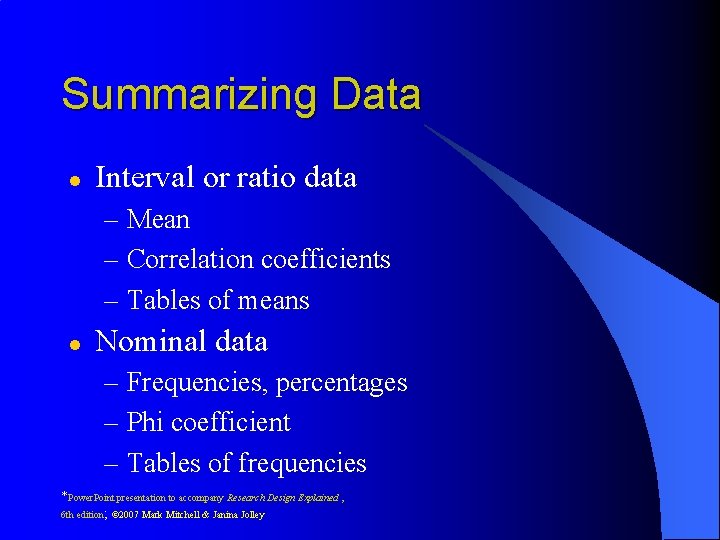
Summarizing Data l Interval or ratio data – Mean – Correlation coefficients – Tables of means l Nominal data – Frequencies, percentages – Phi coefficient – Tables of frequencies *Power. Point presentation to accompany Research Design Explained , 6 th edition; © 2007 Mark Mitchell & Janina Jolley
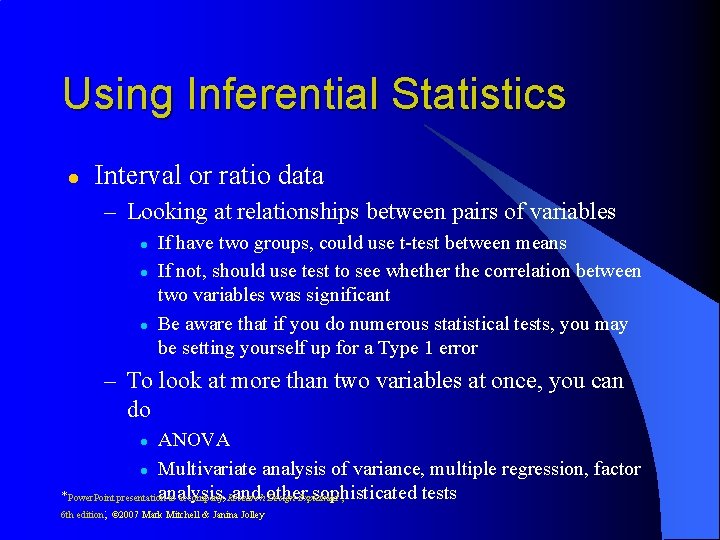
Using Inferential Statistics l Interval or ratio data – Looking at relationships between pairs of variables l l l If have two groups, could use t-test between means If not, should use test to see whether the correlation between two variables was significant Be aware that if you do numerous statistical tests, you may be setting yourself up for a Type 1 error – To look at more than two variables at once, you can do ANOVA l Multivariate analysis of variance, multiple regression, factor analysis, and other sophisticated tests *Power. Point presentation to accompany Research Design Explained , l 6 th edition; © 2007 Mark Mitchell & Janina Jolley
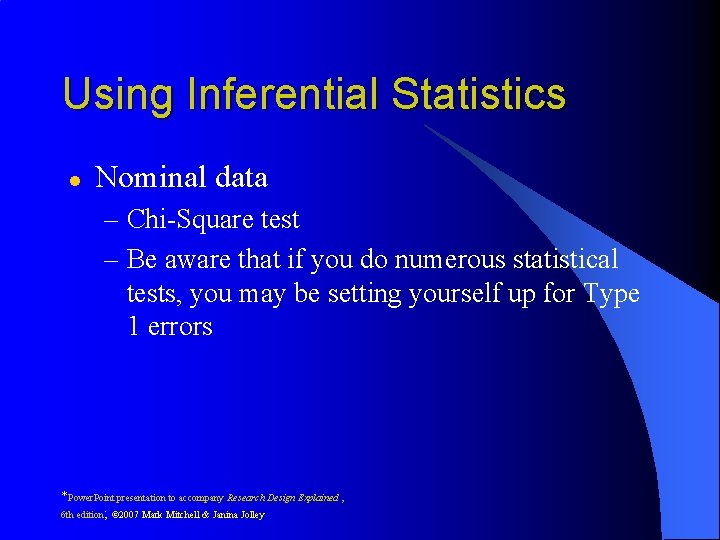
Using Inferential Statistics l Nominal data – Chi-Square test – Be aware that if you do numerous statistical tests, you may be setting yourself up for Type 1 errors *Power. Point presentation to accompany Research Design Explained , 6 th edition; © 2007 Mark Mitchell & Janina Jolley
Concluding Remarks l l l Survey research is the most used research method Survey research is the most misused research method You know how to use rather than abuse survey research *Power. Point presentation to accompany Research Design Explained , 6 th edition; © 2007 Mark Mitchell & Janina Jolley
The End *Power. Point presentation to accompany Research Design Explained , 6 th edition; © 2007 Mark Mitchell & Janina Jolley