
Chapter 8 StatementLevel Control Structures 30 January 2022
- Slides: 25
Chapter 8: Statement-Level Control Structures 30 January 2022 Prof. Abdelaziz Khamis 1
n Selection Statements q q n Two-Way Selection Statements Multiple-Selection Statements Iterative Statements q q Counter-Controlled Loops Logically-Controlled Loops 30 January 2022 Prof. Abdelaziz Khamis 2
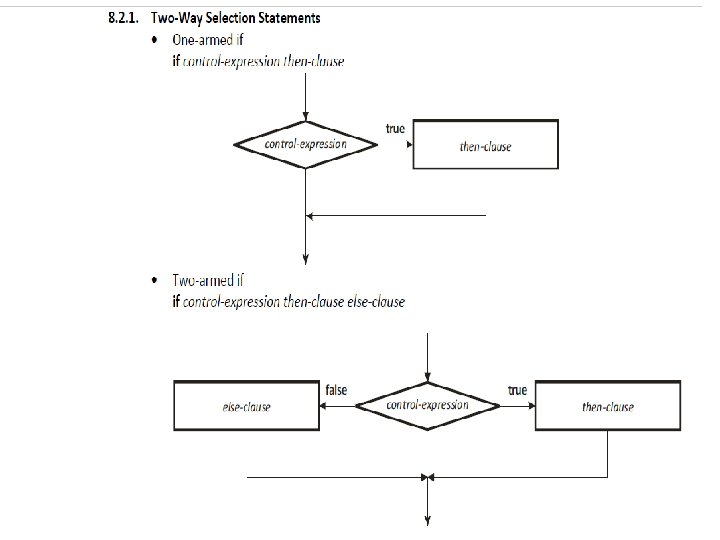
Selection Statements n A selection statement provides the means of choosing between two or more execution paths in a program. Two-Way Selection Statements n Although the two-way selection statements of current imperative languages are quite similar, there are some variations in their designs. n The general form of a two-way selector is as follows: if control-expression then clause else clause 30 January 2022 Prof. Abdelaziz Khamis 3
30 January 2022 4
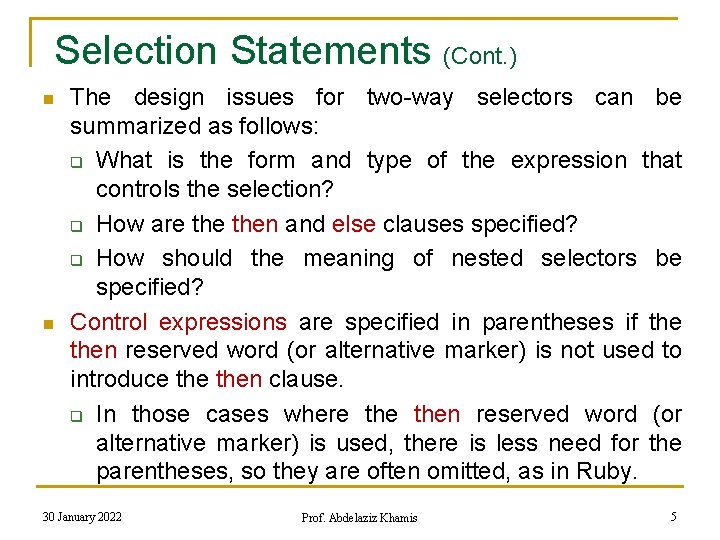
Selection Statements (Cont. ) n n The design issues for two-way selectors can be summarized as follows: q What is the form and type of the expression that controls the selection? q How are then and else clauses specified? q How should the meaning of nested selectors be specified? Control expressions are specified in parentheses if then reserved word (or alternative marker) is not used to introduce then clause. q In those cases where then reserved word (or alternative marker) is used, there is less need for the parentheses, so they are often omitted, as in Ruby. 30 January 2022 Prof. Abdelaziz Khamis 5
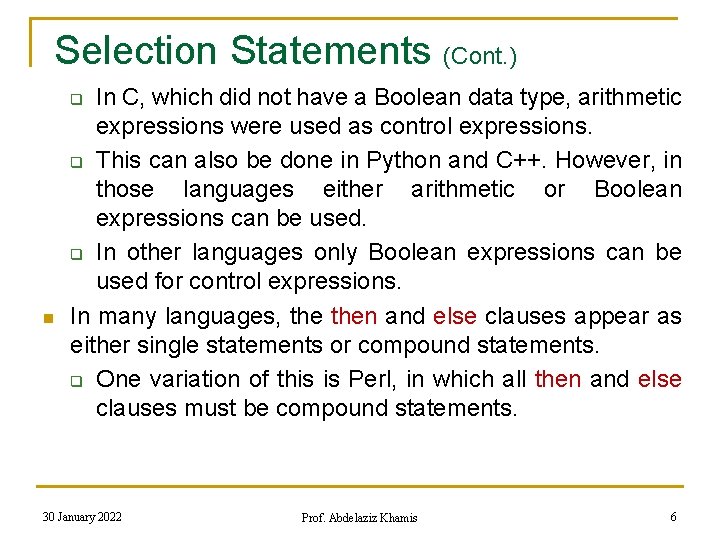
Selection Statements (Cont. ) In C, which did not have a Boolean data type, arithmetic expressions were used as control expressions. q This can also be done in Python and C++. However, in those languages either arithmetic or Boolean expressions can be used. q In other languages only Boolean expressions can be used for control expressions. In many languages, then and else clauses appear as either single statements or compound statements. q One variation of this is Perl, in which all then and else clauses must be compound statements. q n 30 January 2022 Prof. Abdelaziz Khamis 6
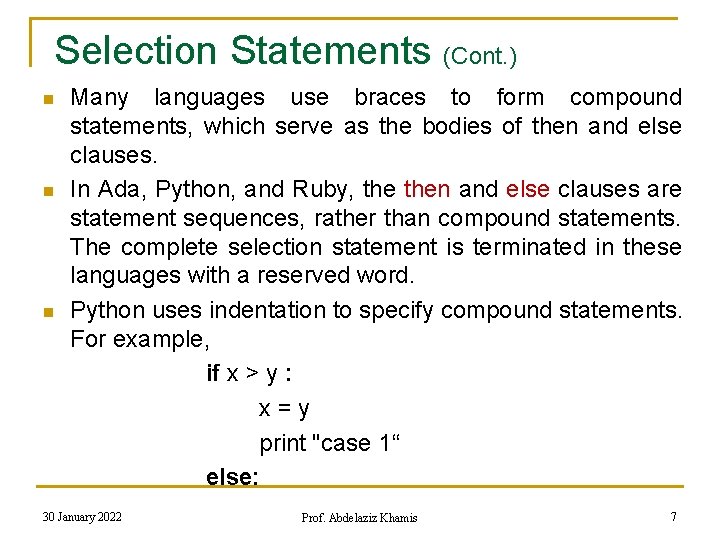
Selection Statements (Cont. ) n n n Many languages use braces to form compound statements, which serve as the bodies of then and else clauses. In Ada, Python, and Ruby, then and else clauses are statement sequences, rather than compound statements. The complete selection statement is terminated in these languages with a reserved word. Python uses indentation to specify compound statements. For example, if x > y : x=y print "case 1“ else: 30 January 2022 Prof. Abdelaziz Khamis 7
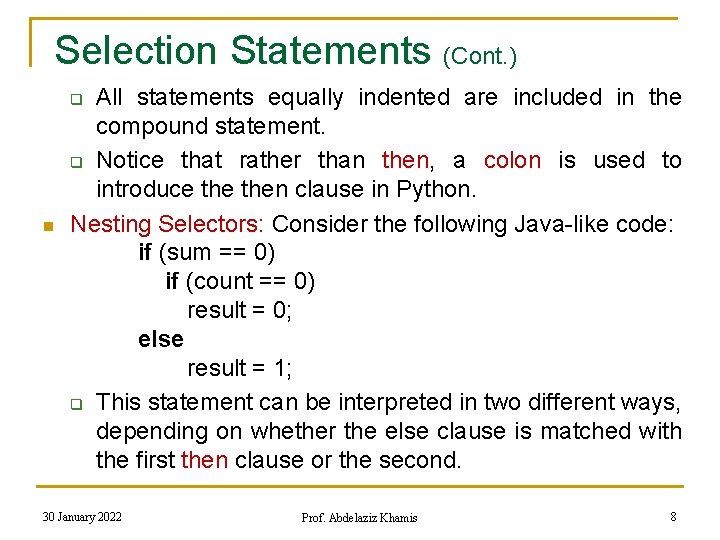
Selection Statements (Cont. ) All statements equally indented are included in the compound statement. q Notice that rather than then, a colon is used to introduce then clause in Python. Nesting Selectors: Consider the following Java-like code: if (sum == 0) if (count == 0) result = 0; else result = 1; q This statement can be interpreted in two different ways, depending on whether the else clause is matched with the first then clause or the second. q n 30 January 2022 Prof. Abdelaziz Khamis 8
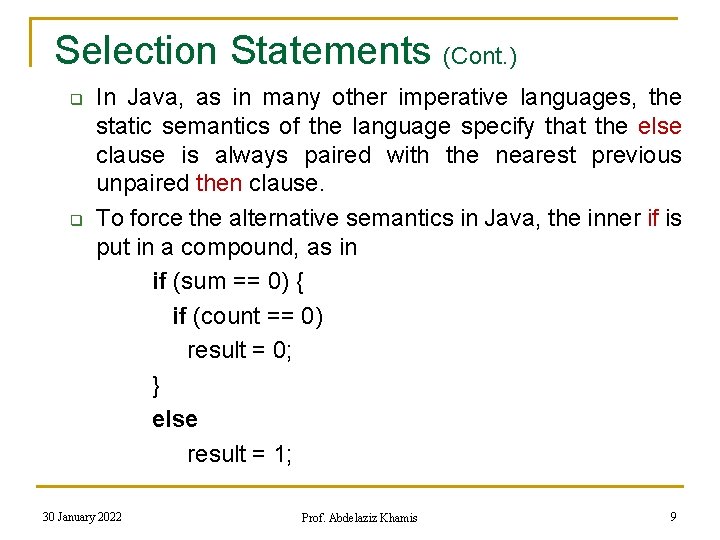
Selection Statements (Cont. ) q q In Java, as in many other imperative languages, the static semantics of the language specify that the else clause is always paired with the nearest previous unpaired then clause. To force the alternative semantics in Java, the inner if is put in a compound, as in if (sum == 0) { if (count == 0) result = 0; } else result = 1; 30 January 2022 Prof. Abdelaziz Khamis 9
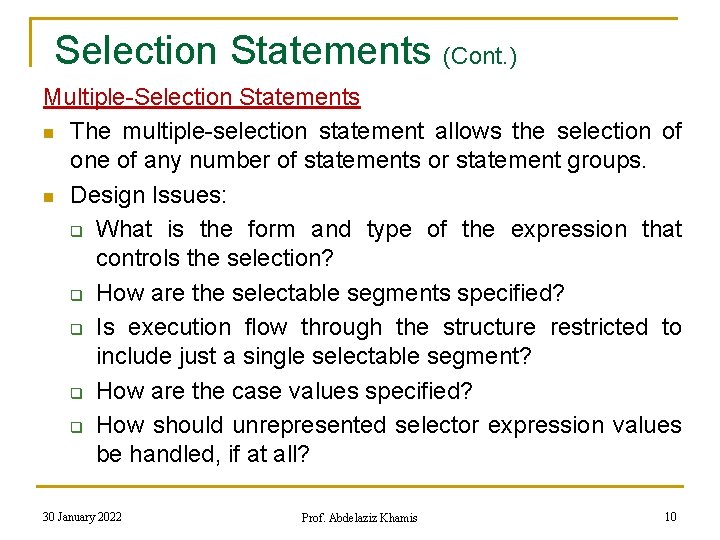
Selection Statements (Cont. ) Multiple-Selection Statements n The multiple-selection statement allows the selection of one of any number of statements or statement groups. n Design Issues: q What is the form and type of the expression that controls the selection? q How are the selectable segments specified? q Is execution flow through the structure restricted to include just a single selectable segment? q How are the case values specified? q How should unrepresented selector expression values be handled, if at all? 30 January 2022 Prof. Abdelaziz Khamis 10
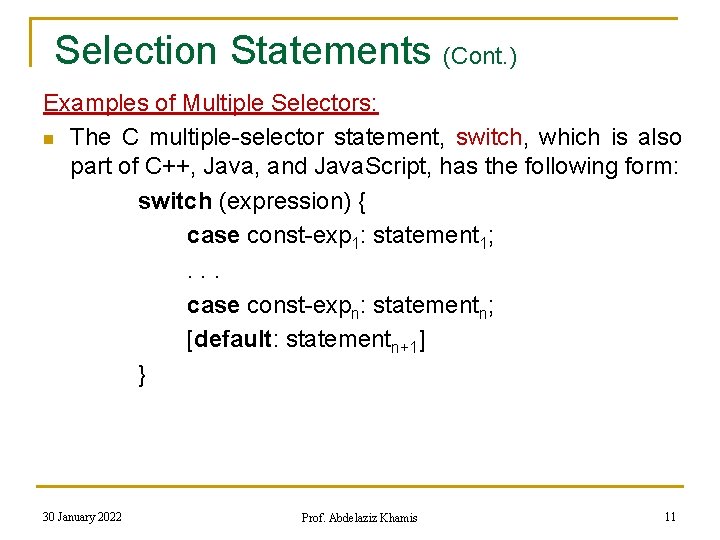
Selection Statements (Cont. ) Examples of Multiple Selectors: n The C multiple-selector statement, switch, which is also part of C++, Java, and Java. Script, has the following form: switch (expression) { case const-exp 1: statement 1; . . . case const-expn: statementn; [default: statementn+1] } 30 January 2022 Prof. Abdelaziz Khamis 11
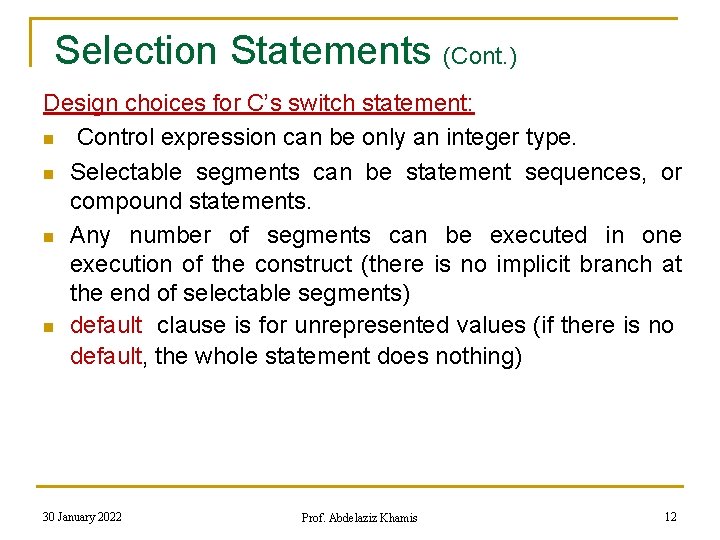
Selection Statements (Cont. ) Design choices for C’s switch statement: n Control expression can be only an integer type. n Selectable segments can be statement sequences, or compound statements. n Any number of segments can be executed in one execution of the construct (there is no implicit branch at the end of selectable segments) n default clause is for unrepresented values (if there is no default, the whole statement does nothing) 30 January 2022 Prof. Abdelaziz Khamis 12
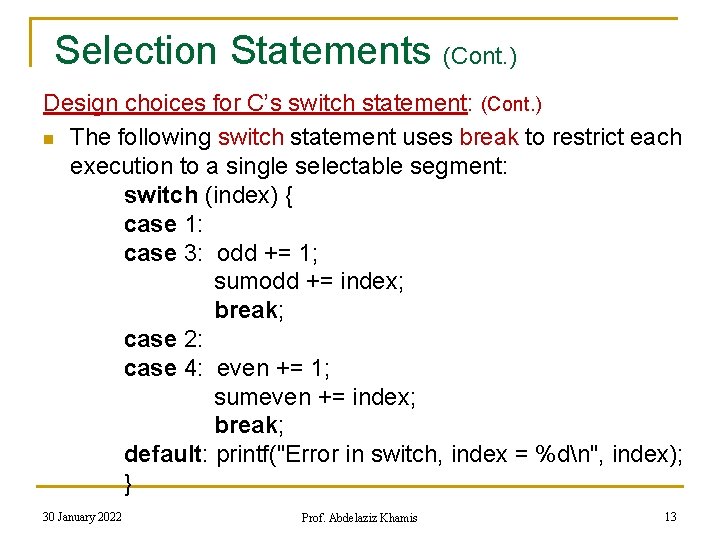
Selection Statements (Cont. ) Design choices for C’s switch statement: (Cont. ) n The following switch statement uses break to restrict each execution to a single selectable segment: switch (index) { case 1: case 3: odd += 1; sumodd += index; break; case 2: case 4: even += 1; sumeven += index; break; default: printf("Error in switch, index = %dn", index); } 30 January 2022 Prof. Abdelaziz Khamis 13
Selection Statements (Cont. ) Design choices for C’s switch statement: (Cont. ) n Occasionally, it is convenient to allow control to flow from one selectable code segment to another. n For example, in the example above, the segments for the case values 1 and 2 are empty, allowing control to flow to the segments for 3 and 4, respectively. n This is the reason why there are no implicit branches in the switch statement. n The reliability problem with this design arises when the mistaken absence of a break statement in a segment allows control to flow to the next segment incorrectly. 30 January 2022 Prof. Abdelaziz Khamis 14
Iterative Statements n n The repeated execution of a statement or compound statement is accomplished either by iteration or recursion. An iterative statement is one that causes a statement or collection of statements to be executed zero, one, or more times. An iterative statement is often called a loop. Several categories of iteration control statements have been developed. The primary categories are defined by how designers answered two basic design questions: 1. How is iteration controlled? 2. Where should the control mechanism appear in the loop statement? 30 January 2022 Prof. Abdelaziz Khamis 15
Iterative Statements (Cont. ) n n The primary possibilities for iteration control are logical, counting, or a combination of the two. The main choices for the location of the control mechanism are the top or the bottom of the loop. q Top and bottom here are logical, rather than physical, denotations. q The issue is not the physical placement of the control mechanism; rather, it is whether the mechanism is executed and affects control before or after execution of the statement’s body. q The body of an iterative statement is the collection of statements whose execution is controlled by the control mechanism. 30 January 2022 Prof. Abdelaziz Khamis 16
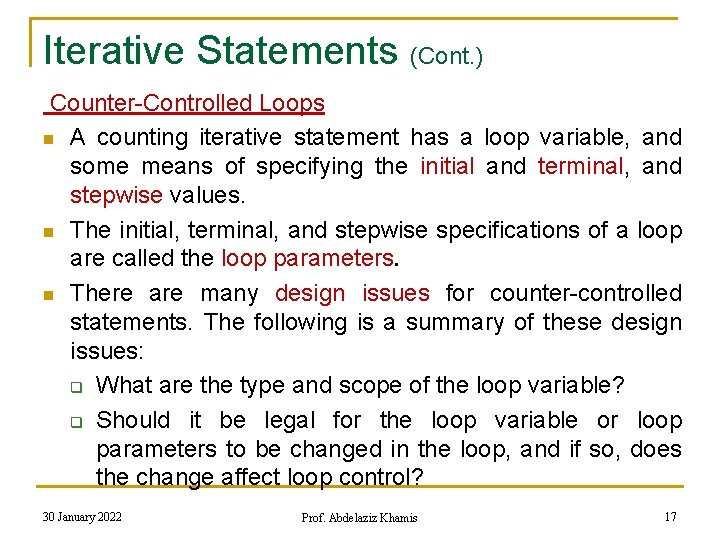
Iterative Statements (Cont. ) Counter-Controlled Loops n A counting iterative statement has a loop variable, and some means of specifying the initial and terminal, and stepwise values. n The initial, terminal, and stepwise specifications of a loop are called the loop parameters. n There are many design issues for counter-controlled statements. The following is a summary of these design issues: q What are the type and scope of the loop variable? q Should it be legal for the loop variable or loop parameters to be changed in the loop, and if so, does the change affect loop control? 30 January 2022 Prof. Abdelaziz Khamis 17
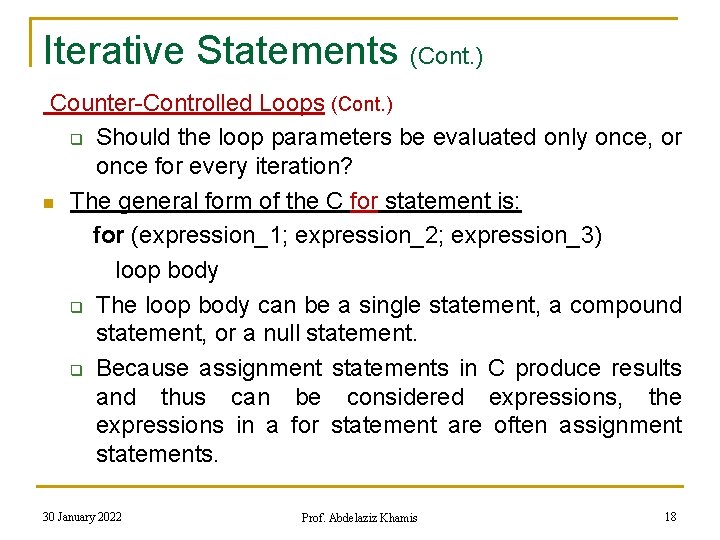
Iterative Statements (Cont. ) Counter-Controlled Loops (Cont. ) q Should the loop parameters be evaluated only once, or once for every iteration? n The general form of the C for statement is: for (expression_1; expression_2; expression_3) loop body q The loop body can be a single statement, a compound statement, or a null statement. q Because assignment statements in C produce results and thus can be considered expressions, the expressions in a for statement are often assignment statements. 30 January 2022 Prof. Abdelaziz Khamis 18
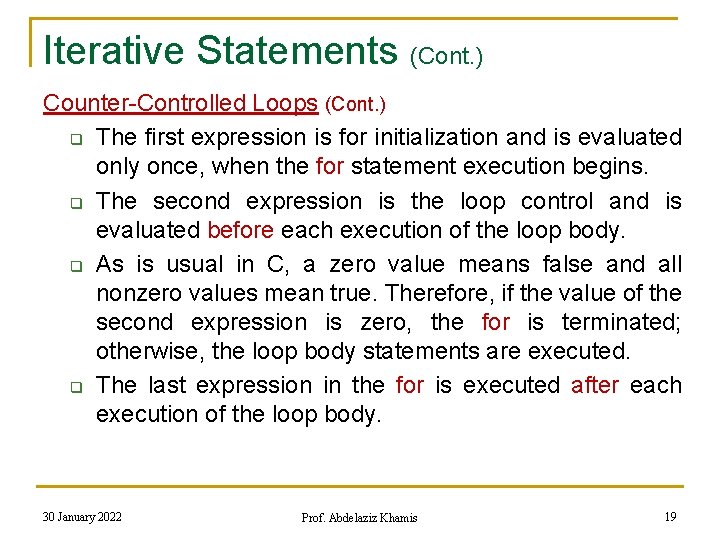
Iterative Statements (Cont. ) Counter-Controlled Loops (Cont. ) q The first expression is for initialization and is evaluated only once, when the for statement execution begins. q The second expression is the loop control and is evaluated before each execution of the loop body. q As is usual in C, a zero value means false and all nonzero values mean true. Therefore, if the value of the second expression is zero, the for is terminated; otherwise, the loop body statements are executed. q The last expression in the for is executed after each execution of the loop body. 30 January 2022 Prof. Abdelaziz Khamis 19
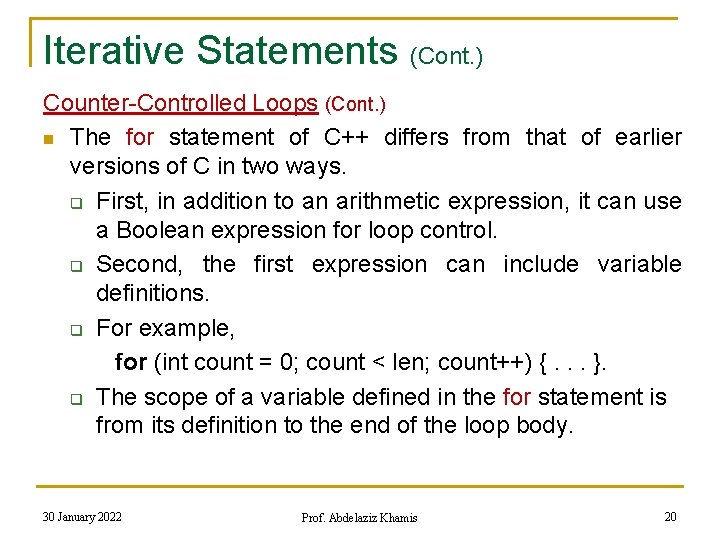
Iterative Statements (Cont. ) Counter-Controlled Loops (Cont. ) n The for statement of C++ differs from that of earlier versions of C in two ways. q First, in addition to an arithmetic expression, it can use a Boolean expression for loop control. q Second, the first expression can include variable definitions. q For example, for (int count = 0; count < len; count++) {. . . }. q The scope of a variable defined in the for statement is from its definition to the end of the loop body. 30 January 2022 Prof. Abdelaziz Khamis 20
Iterative Statements (Cont. ) Counter-Controlled Loops (Cont. ) n The for statement of Java and C# is like that of C++, except that the loop control expression is restricted to boolean. n n In all of the C-based languages, the last two loop parameters are evaluated with every iteration. Furthermore, variables that appear in the loop parameter expression can be changed in the loop body. 30 January 2022 Prof. Abdelaziz Khamis 21
Iterative Statements (Cont. ) Logically-Controlled Loops n In many cases, collections of statements must be repeatedly executed, but the repetition control is based on a Boolean expression rather than a counter. q For these situations, a logically controlled loop is convenient. n Logically controlled loops are more general than countercontrolled loops. q Every counting loop can be built with a logical loop, but the reverse is not true. n Because they are much simpler than counter-controlled loops, logically controlled loops have fewer design issues. 30 January 2022 Prof. Abdelaziz Khamis 22
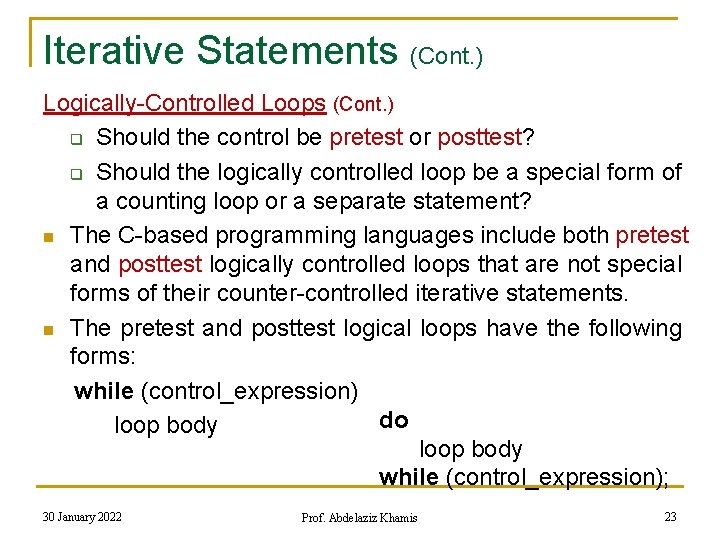
Iterative Statements (Cont. ) Logically-Controlled Loops (Cont. ) q Should the control be pretest or posttest? q Should the logically controlled loop be a special form of a counting loop or a separate statement? n The C-based programming languages include both pretest and posttest logically controlled loops that are not special forms of their counter-controlled iterative statements. n The pretest and posttest logical loops have the following forms: while (control_expression) do loop body while (control_expression); 30 January 2022 Prof. Abdelaziz Khamis 23
Iterative Statements (Cont. ) Logically-Controlled Loops (Cont. ) n In the pretest version of a logical loop (while), the statement or statement segment is executed as long as the expression evaluates to true. n In the posttest version (do), the loop body is executed until the expression evaluates to false. n The only real difference between the do and the while is that the do always causes the loop body to be executed at least once. n Java’s while and do statements are similar to those of C and C++, except the control expression must be boolean type. 30 January 2022 Prof. Abdelaziz Khamis 24
Unconditional Branching • Transfers execution control to a specified place in the program • Represented one of the most heated debates in 1960’s and 1970’s • Major concern: Readability • Some languages do not support goto statement (e. g. , Java) • C# offers goto statement (can be used in switch statements) Guarded Commands • Designed by Dijkstra • Purpose: to support a new programming methodology that supported verification (correctness) during development • Basis for two linguistic mechanisms for concurrent programming (in CSP and Ada) 30 January 2022 Prof. Abdelaziz Khamis 25