
Chapter 8 Sports Promotion Marketing Principles Learning Targets
- Slides: 26
Chapter 8: Sports Promotion Marketing Principles
Learning Targets: I can…. ● define event marketing. ● explain promotion and the promotional mix in sports marketing. ● identify the roles of advertising and sales promotion in sports marketing. ● describe the use of technology in promotion. ● identify the roles of public relations and personal selling in sports marketing. ● identify the types and steps of selling.
Section 8 -1: Planning the Promotion
Discussion Starter What do you think of when you hear the word event?
I. Event Marketing- all activities associated with the sale, distribution, and promotion of a sports event. Discussion Question: Think about the last event you went to, what are some of the things that stood out to you at the event that you feel was a part of their marketing strategy.
II. Promotion in Sports Marketing 3 Functions of Promotion: 1. Generate Sales: a. all sports events are business ventures and therefore must product revenue to cover expenses. 2. Attract a targeted audience: a. target the fans of the sport and the potential customers of the products being promoted by the sponsors. (What are some events you can think of that has sponsor/sport that targets a certain audience? 3. Help create a positive image a. Wheaties teams up with the American College of Sport Medicine. “Breakfast of Champions"
III. Promotional Mix- any combination of advertising sales, promotion, publicity, and personal selling. Ex: Russell Athletics “Are you Russell Athletics material? ”
IV. Promotional Budget 3 Ways to Determine a Promotional Budget 1. Percentage of Sales a. using a set percentage or portion of last year’s sales or the coming year’s sales to decide on the funds for the promotional budget. 2. Competitive Parity a. Looking for industry trends on how much to spend. “Parity” means having equality or similarity. 3. Objective-an-Task Method a. set objectives for promotion and decide what promotional activities are necessary to reach those objectives.
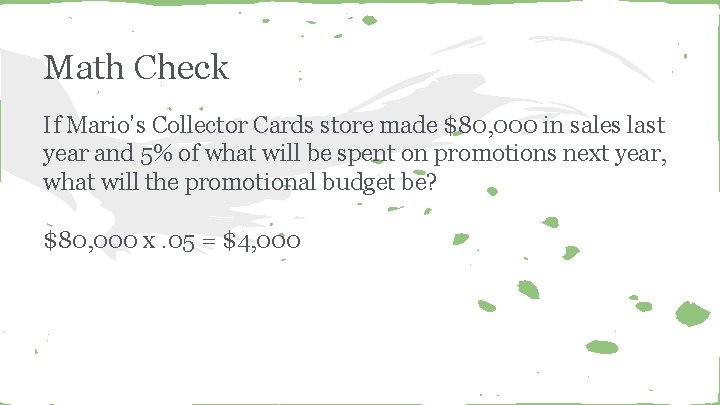
Math Check If Mario’s Collector Cards store made $80, 000 in sales last year and 5% of what will be spent on promotions next year, what will the promotional budget be? $80, 000 x. 05 = $4, 000
Section 8 -2: Advertising and Sales Promotion
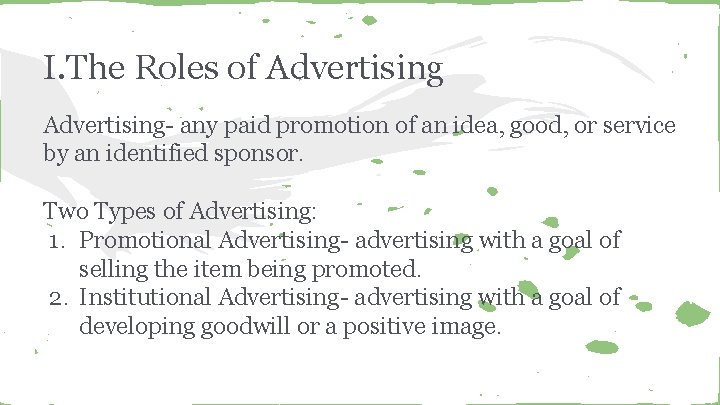
I. The Roles of Advertising- any paid promotion of an idea, good, or service by an identified sponsor. Two Types of Advertising: 1. Promotional Advertising- advertising with a goal of selling the item being promoted. 2. Institutional Advertising- advertising with a goal of developing goodwill or a positive image.
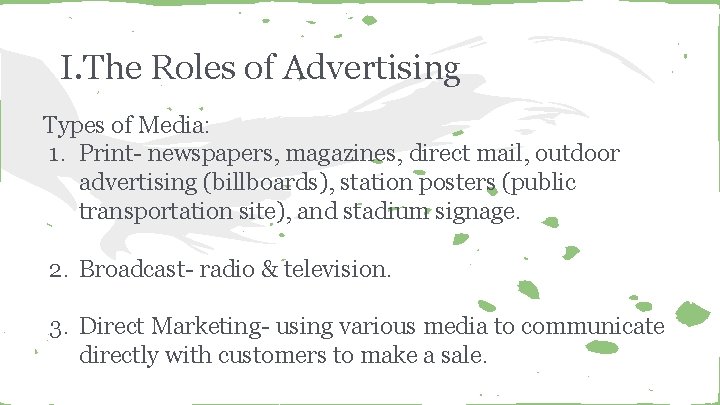
I. The Roles of Advertising Types of Media: 1. Print- newspapers, magazines, direct mail, outdoor advertising (billboards), station posters (public transportation site), and stadium signage. 2. Broadcast- radio & television. 3. Direct Marketing- using various media to communicate directly with customers to make a sale.
I. The Roles of Advertising Types of media continued…. 4. Online Advertising- purchase banner ads on websites. ● Advantage: number of “hits” ● Disadvantage: not all members of the target market can be reached.
II. Sales Promotion- a short-term incentive to get customers interested in buying a product. (advertisement or personal sales pitch) Target Customers (get the customers excited and interested in buying the product. )
II. Sales Promotion ● Coupons- offers some type of price reduction or free merchandise, must be redeemed at the retail store. o Newspapers or magazines. ● Rebates- offer some type of price reduction or free merchandise, must be sent to the manufacturer to be redeemed. o Contact Lenses ● Samples- distributed through newspaper, mail, or in person. o perfume/cologne samples in magazine. Chick-Fil-A chicken nugget samples at the food court in a mall.
II. Sales Promotions ● Premiums- items given away with a purchase of merchandise. o Clinique makeup- purchase a certain dollar amount of makeup and receive the bonus makeup bag with samples. ● Contests- radio gives you a chance to win tickets in trivia contest. Must participate to win. ● Sweepstakes- only need to sign up. o Free vacation giveaway (restaurant, hotel, store) Promotional events at sports arenas/ballparks; contests, reduced tick prices, other incentives.
Section 8 -3: Public Relations and Personal Selling
I. Public Relations- activities that promote image and communications a company had with its employees, customers, investors, and the public at large. Publicity- the free mention of a product or company in the media. (differs from advertising because a company does not pay for the exposure it gets in the media. ) ● ● Advantage- how the public may view what they see and hear in the media. Must be objective and believable. Disadvantage- company’s lack of control over it. May not all be positive about the company. Bad publicity gives bad image.
I. Public Relations The Role of Media in Public Relations: ● Rely on media to get the news out. ● Up to media to decide what news will be used. o Example: something extraordinary occurs, such as an airplane crash, the media will give coverage to that event as top priority over other news originally scheduled for release that day.
I. Public Relations Press Kit & Press Release 1. Press Kit- consists of promotional materials that can be used by the media, such as fact sheets, background information, press releases, and videotapes. 2. Press Release- newsworthy article that provides basic information to answer questions about a subject, such as who, what, where, when, and why. a. Example- when a baseball player gets traded, a press release is sent to the media from the baseball franchise.
II. Personal Selling- direct communication by a salesperson to potential customers either in person or by telephone. ● Inexpensive goods, may not be necessary because advertising and other forms of promotion may have already sold customers on products. ● Expensive goods, face-to-face contact might be needed to educate the customer on the product. ● Face-to-face selling is important because it allows two way communication between the buyer and the seller.
II. Personal Selling Types of Selling: 1. Order Taking- does not involve much sales ability because consumers generally know what they want and simply ask for it. (salesperson working in a souvenir shop at a sporting event. 2. Order Getting- professional sales person who knows how to follow the steps of sale, then follows up after a sale has been completed. (sports agent)
II. Personal Selling Before selling begins, salesperson prepares with two strategies: 1. Prospecting- looking at potential customers, or leads. a. trade shows and advertising. 2. Preapproach- learning about the products and the potential customers. a. agents put together a sales presentation to highlight the features and benefits of the athlete they are represnting.
II. Personal Selling Steps in the Selling Process: 1. Approach a. face-to-face meeting with the potential customer. 2. Determine Needs a. b. c. looking, listening, and asking questions to determine needs. determine the needs as soon as possible and throughout the sales process. learn to read facial expressions.
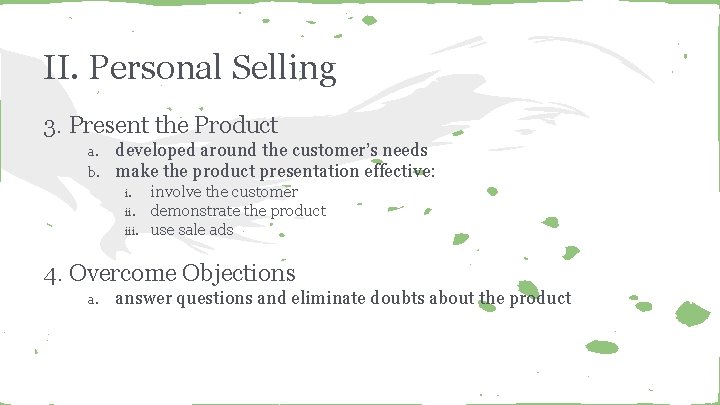
II. Personal Selling 3. Present the Product a. b. developed around the customer’s needs make the product presentation effective: i. iii. involve the customer demonstrate the product use sale ads 4. Overcome Objections a. answer questions and eliminate doubts about the product
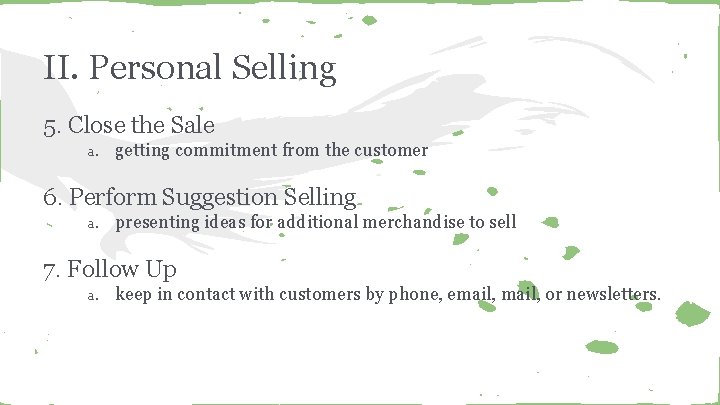
II. Personal Selling 5. Close the Sale a. getting commitment from the customer 6. Perform Suggestion Selling a. presenting ideas for additional merchandise to sell 7. Follow Up a. keep in contact with customers by phone, email, or newsletters.