
Chapter 8 Securitization and the Credit Crisis of
- Slides: 13
Chapter 8 Securitization and the Credit Crisis of 2007 1
Securitization • Traditionally banks have funded loans with deposits • Securitization is a way that loans can increase much faster than deposits 2
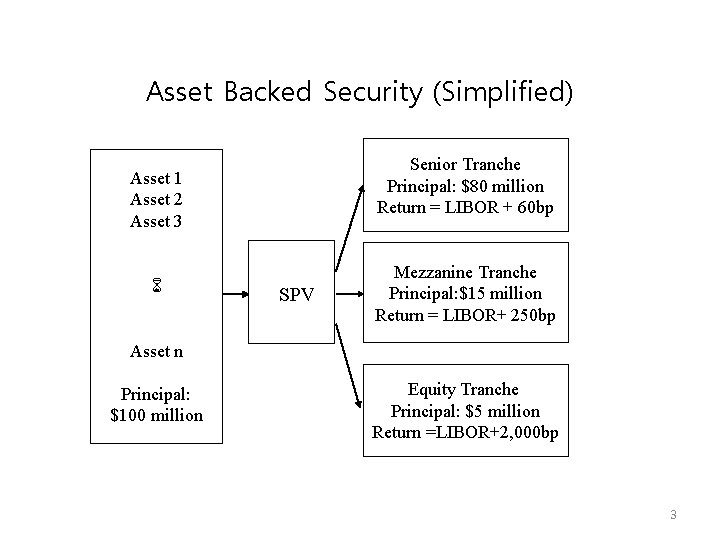
Asset Backed Security (Simplified) Senior Tranche Principal: $80 million Return = LIBOR + 60 bp Asset 1 Asset 2 Asset 3 SPV Mezzanine Tranche Principal: $15 million Return = LIBOR+ 250 bp Asset n Principal: $100 million Equity Tranche Principal: $5 million Return =LIBOR+2, 000 bp 3
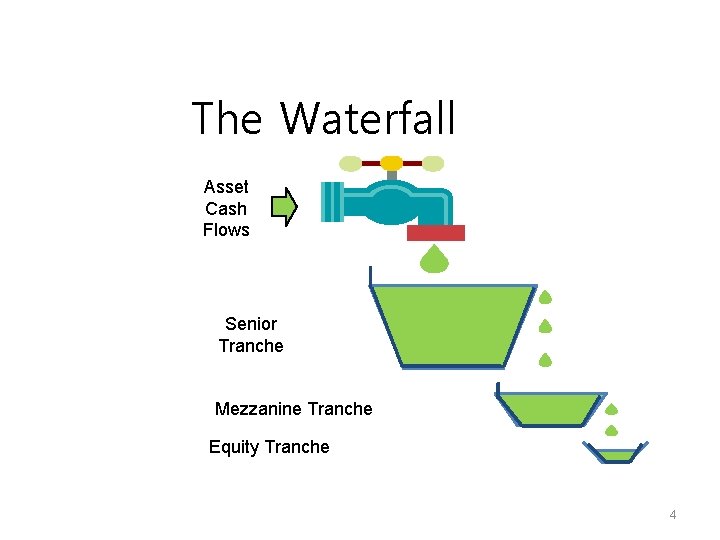
The Waterfall Asset Cash Flows Senior Tranche Mezzanine Tranche Equity Tranche 4
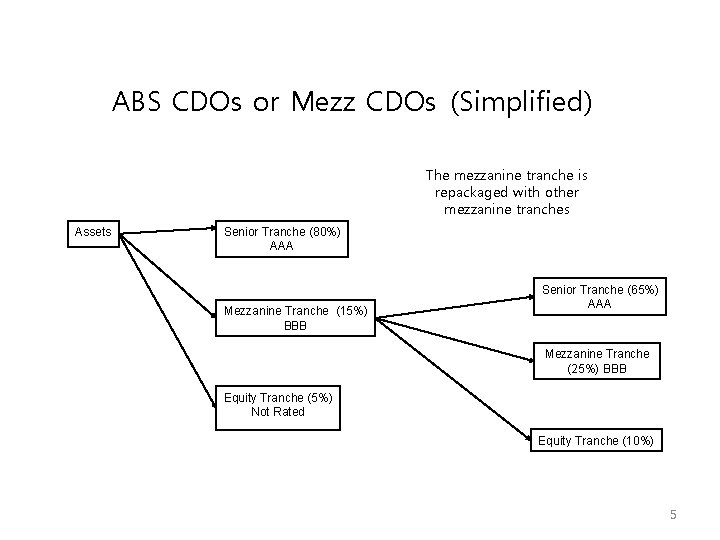
ABS CDOs or Mezz CDOs (Simplified) The mezzanine tranche is repackaged with other mezzanine tranches Assets Senior Tranche (80%) AAA Mezzanine Tranche (15%) BBB Senior Tranche (65%) AAA Mezzanine Tranche (25%) BBB Equity Tranche (5%) Not Rated Equity Tranche (10%) 5
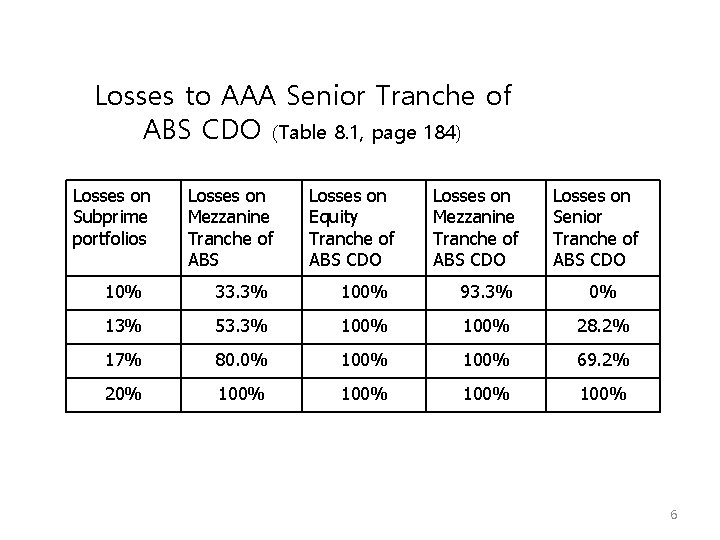
Losses to AAA Senior Tranche of ABS CDO (Table 8. 1, page 184) Losses on Subprime portfolios Losses on Mezzanine Tranche of ABS Losses on Equity Tranche of ABS CDO Losses on Mezzanine Tranche of ABS CDO Losses on Senior Tranche of ABS CDO 10% 33. 3% 100% 93. 3% 0% 13% 53. 3% 100% 28. 2% 17% 80. 0% 100% 69. 2% 20% 100% 6
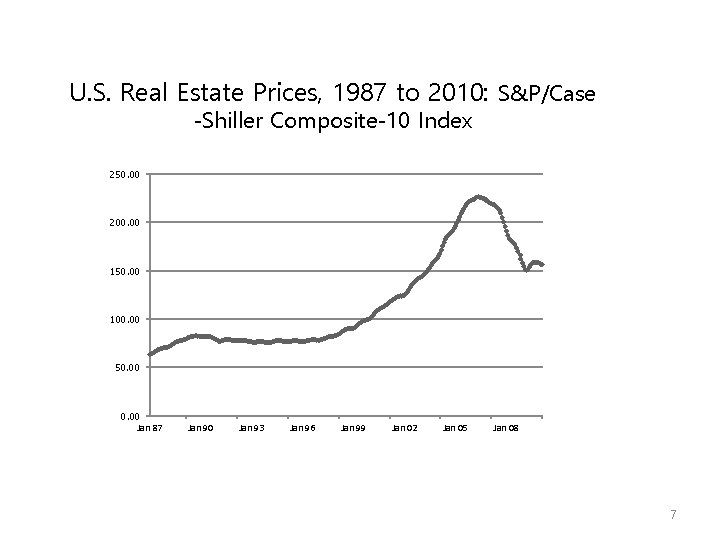
U. S. Real Estate Prices, 1987 to 2010: S&P/Case -Shiller Composite-10 Index 250. 00 200. 00 150. 00 100. 00 50. 00 Jan 87 Jan 90 Jan 93 Jan 96 Jan 99 Jan 02 Jan 05 Jan 08 7
What happened… • Starting in 2000, mortgage originators in the US relaxed their lending standards and created large numbers of subprime first mortgages. • This, combined with very low interest rates, increased the demand for real estate and prices rose. • To continue to attract first time buyers and keep prices increasing they relaxed lending standards further • Features of the market: 100% mortgages, ARMs, teaser rates, NINJAs, liar loans, non-recourse borrowing • Mortgages were packaged in financial products and sold to investors 8
What happened. . . • Banks found it profitable to invest in the AAA rated tranches because the promised return was significantly higher than the cost of funds and capital requirements were low • In 2007 the bubble burst. Some borrowers could not afford their payments when the teaser rates ended. Others had negative equity and recognized that it was optimal for them to exercise their put options. • Foreclosures increased supply and caused U. S. real estate prices to fall. Products, created from the mortgages, that were previously thought to be safe began to be viewed as risky • There was a “flight to quality” and credit spreads increased to very high levels • Many banks incurred huge losses 9
What Many Market Participants Did Not Realize • Default correlation goes up in stressed market conditions • The BBB tranches used to create ABS CDOs were typically about 1% wide and had “all or nothing” loss distributions. • This is quite different from the loss distribution for a BBB bond from a BBB bond 10
Regulatory Arbitrage • The regulatory capital banks were required to keep for the tranches created from mortgages was less than that for the mortgages themselves 11
Incentives • The crisis highlighted the dysfunctional incentives of – Mortgage originators (Their prime interest was in in originating mortgages that could be securitized) – Valuers (They were under pressure to provide high valuations so that the loan-to-value ratios looked good) – Traders (They were focused on the next end-of year bonus and not worried about any longer term problems in the market) 12
The Aftermath… • A huge amount of new regulation including: – Banks required to hold more capital – Banks required to satisfy liquidity ratios – More emphasis on stress testing and the use of historical data from stressed market conditions – Clearing houses for OTC derivatives – Taxes on bonuses (UK) – Limits to proprietary trading 13