
Chapter 8 Section 7 8 7 Complex Numbers
Chapter 8 Section 7
8. 7 Complex Numbers Objectives 1 • Simplify numbers of the form 2 • Recognize subsets of the complex numbers. 3 • Add and subtract complex numbers. 4 • Multiply complex numbers. 5 • Divide complex numbers. 6 • Find powers of i. Copyright © 2012, 2008, 2004 Pearson Education, Inc. where b > 0.
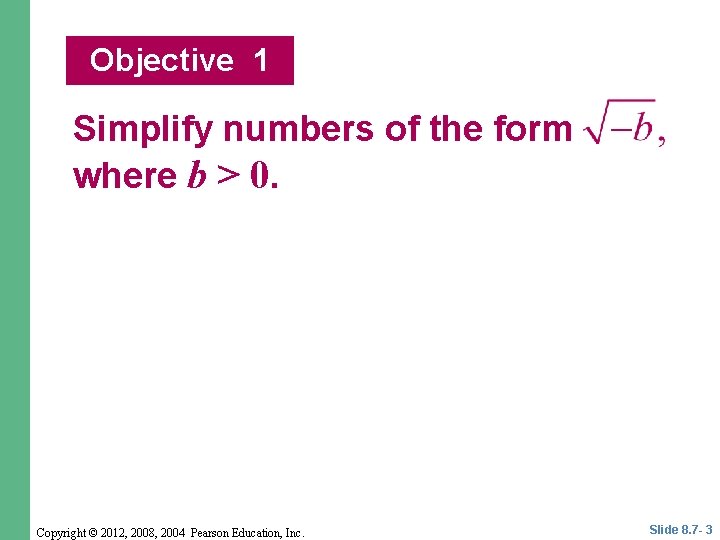
Objective 1 Simplify numbers of the form where b > 0. Copyright © 2012, 2008, 2004 Pearson Education, Inc. Slide 8. 7 - 3
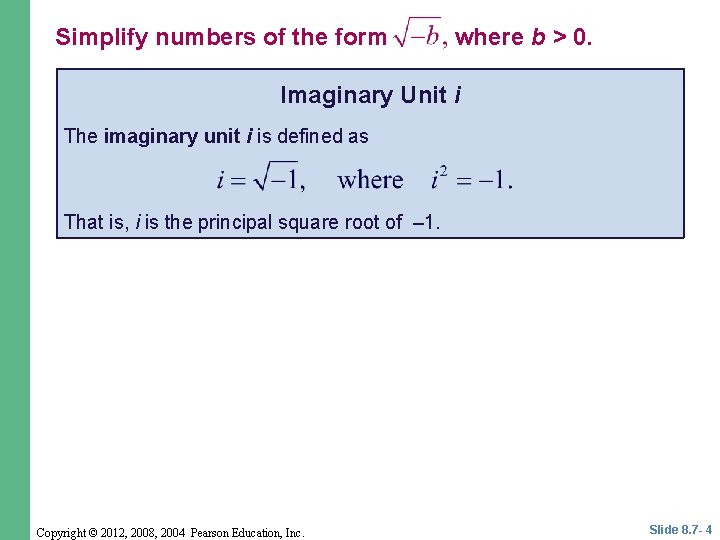
Simplify numbers of the form where b > 0. Imaginary Unit i The imaginary unit i is defined as That is, i is the principal square root of – 1. Copyright © 2012, 2008, 2004 Pearson Education, Inc. Slide 8. 7 - 4
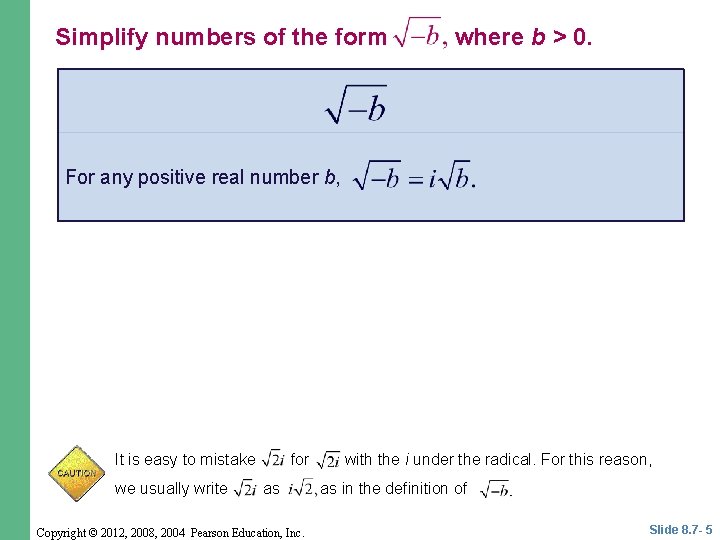
Simplify numbers of the form where b > 0. For any positive real number b, It is easy to mistake we usually write for as Copyright © 2012, 2008, 2004 Pearson Education, Inc. with the i under the radical. For this reason, as in the definition of Slide 8. 7 - 5
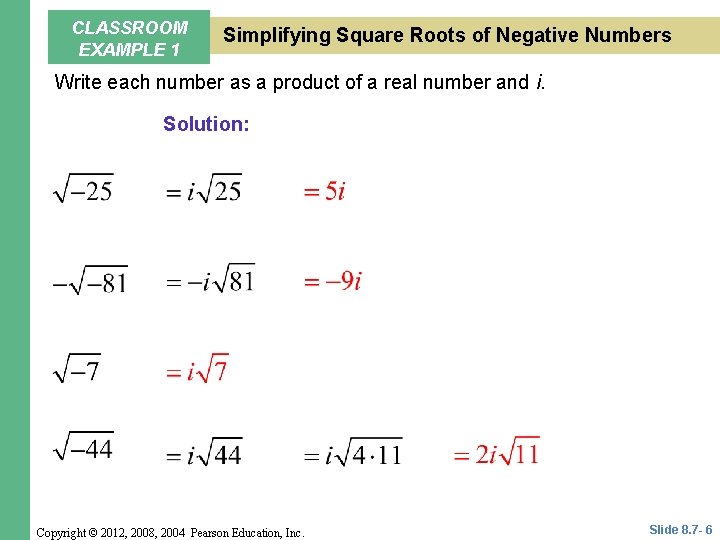
CLASSROOM EXAMPLE 1 Simplifying Square Roots of Negative Numbers Write each number as a product of a real number and i. Solution: Copyright © 2012, 2008, 2004 Pearson Education, Inc. Slide 8. 7 - 6
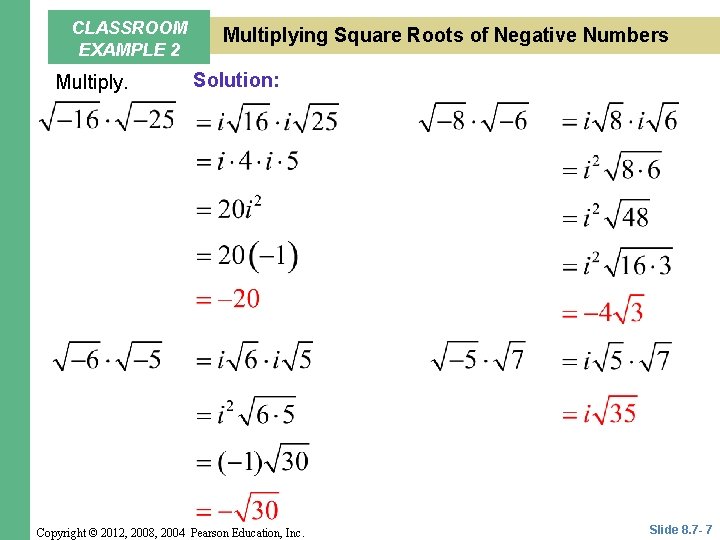
CLASSROOM EXAMPLE 2 Multiplying Square Roots of Negative Numbers Solution: Copyright © 2012, 2008, 2004 Pearson Education, Inc. Slide 8. 7 - 7
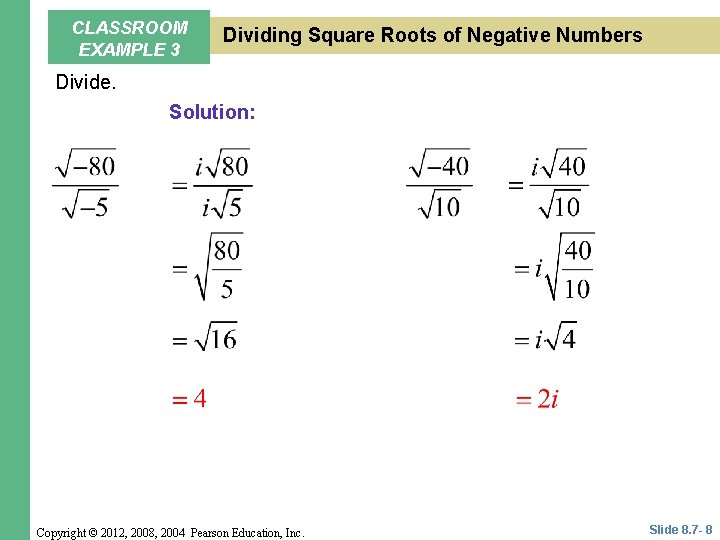
CLASSROOM EXAMPLE 3 Dividing Square Roots of Negative Numbers Divide. Solution: Copyright © 2012, 2008, 2004 Pearson Education, Inc. Slide 8. 7 - 8
Objective 2 Recognize subsets of the complex numbers. Copyright © 2012, 2008, 2004 Pearson Education, Inc. Slide 8. 7 - 9
Recognize subsets of the complex numbers. Complex Number If a and b are real numbers, then any number of the form a + bi is called a complex number. In the complex number a + bi, the number a is called the real part and b is called the imaginary part. Copyright © 2012, 2008, 2004 Pearson Education, Inc. Slide 8. 7 - 10
Recognize subsets of the complex numbers. For a complex number a + bi, if b = 0, then a + bi = a, which is a real number. Thus, the set of real numbers is a subset of the set of complex numbers. If a = 0 and b ≠ 0, the complex number is said to be a pure imaginary number. For example, 3 i is a pure imaginary number. A number such as 7 + 2 i is a nonreal complex number. A complex number written in the form a + bi is in standard form. Copyright © 2012, 2008, 2004 Pearson Education, Inc. Slide 8. 7 - 11
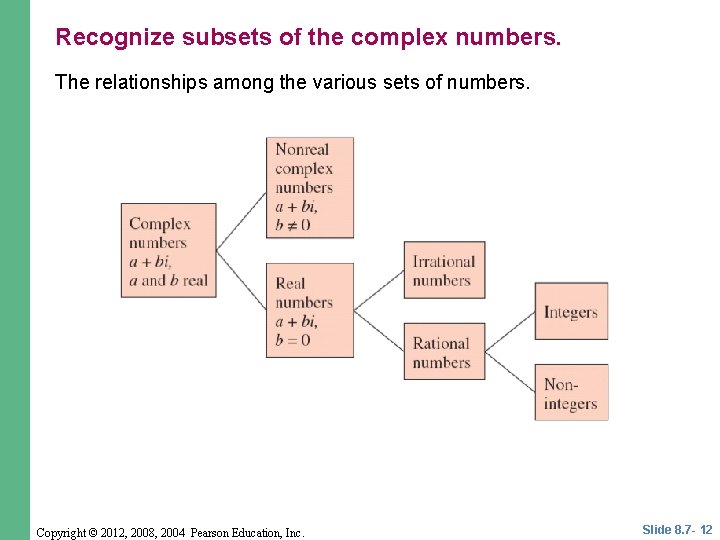
Recognize subsets of the complex numbers. The relationships among the various sets of numbers. Copyright © 2012, 2008, 2004 Pearson Education, Inc. Slide 8. 7 - 12
Objective 3 Add and subtract complex numbers. Copyright © 2012, 2008, 2004 Pearson Education, Inc. Slide 8. 7 - 13
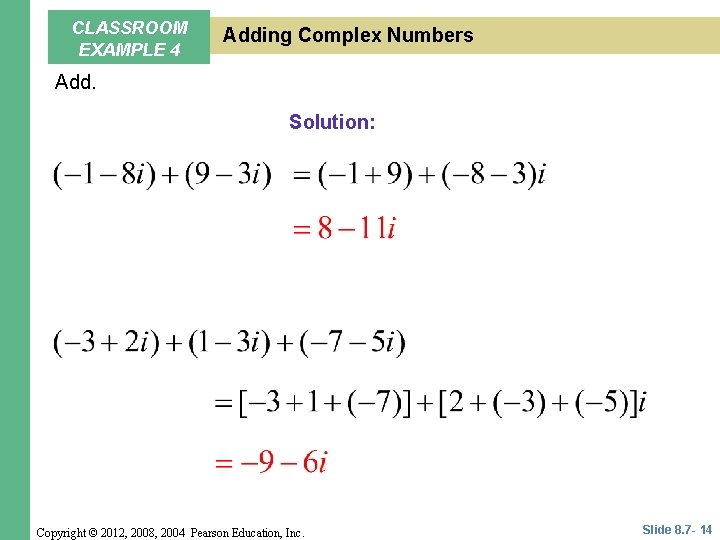
CLASSROOM EXAMPLE 4 Adding Complex Numbers Add. Solution: Copyright © 2012, 2008, 2004 Pearson Education, Inc. Slide 8. 7 - 14

CLASSROOM EXAMPLE 5 Subtracting Complex Numbers Subtract. Solution: Copyright © 2012, 2008, 2004 Pearson Education, Inc. Slide 8. 7 - 15
Objective 4 Multiply complex numbers. Copyright © 2012, 2008, 2004 Pearson Education, Inc. Slide 8. 7 - 16
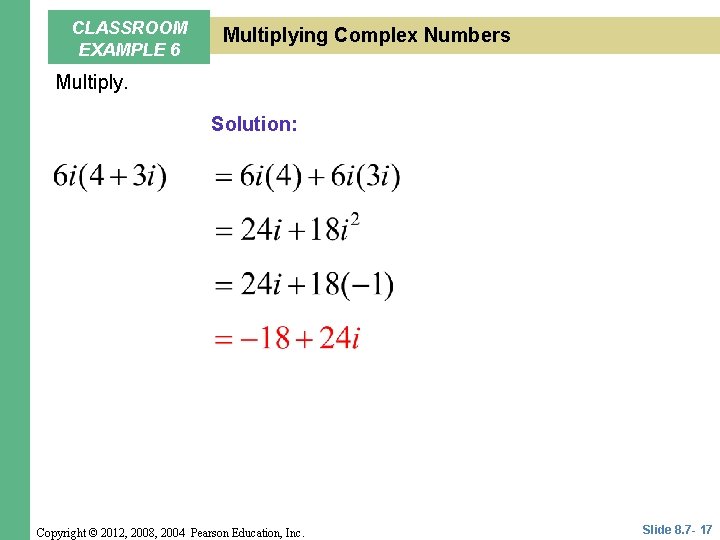
CLASSROOM EXAMPLE 6 Multiplying Complex Numbers Multiply. Solution: Copyright © 2012, 2008, 2004 Pearson Education, Inc. Slide 8. 7 - 17
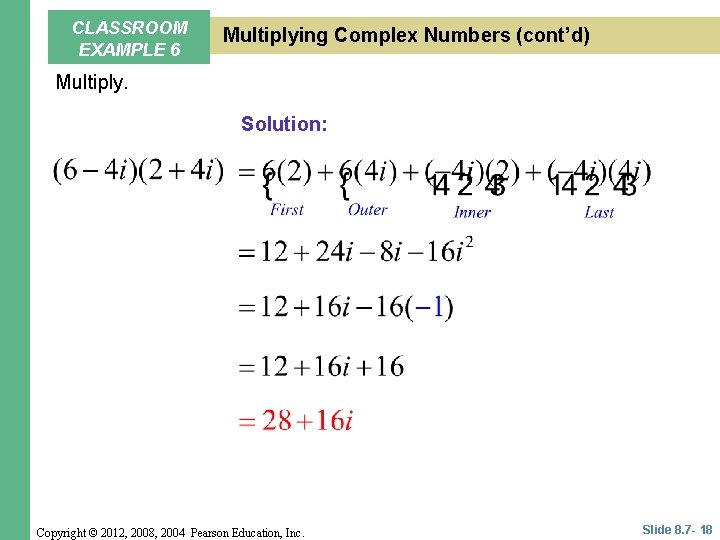
CLASSROOM EXAMPLE 6 Multiplying Complex Numbers (cont’d) Multiply. Solution: Copyright © 2012, 2008, 2004 Pearson Education, Inc. Slide 8. 7 - 18
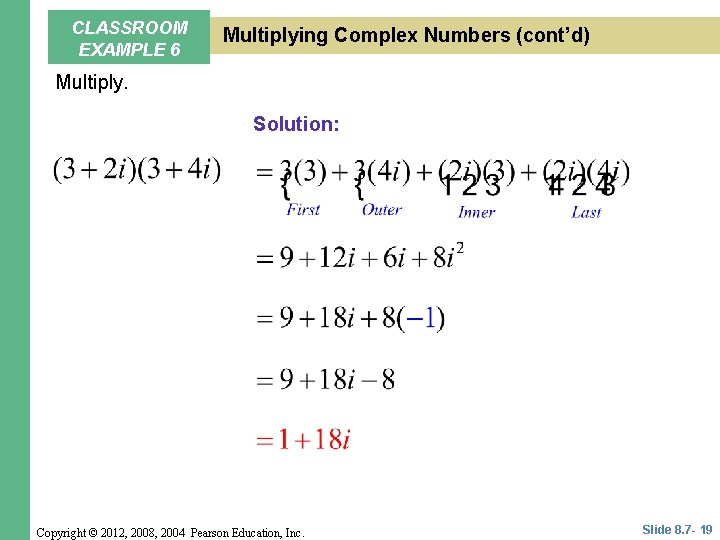
CLASSROOM EXAMPLE 6 Multiplying Complex Numbers (cont’d) Multiply. Solution: Copyright © 2012, 2008, 2004 Pearson Education, Inc. Slide 8. 7 - 19
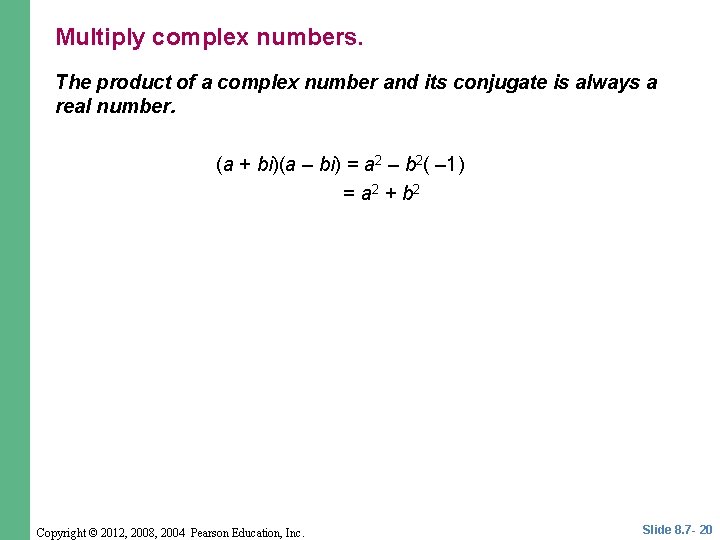
Multiply complex numbers. The product of a complex number and its conjugate is always a real number. (a + bi)(a – bi) = a 2 – b 2( – 1) = a 2 + b 2 Copyright © 2012, 2008, 2004 Pearson Education, Inc. Slide 8. 7 - 20
Objective 5 Divide complex numbers. Copyright © 2012, 2008, 2004 Pearson Education, Inc. Slide 8. 7 - 21
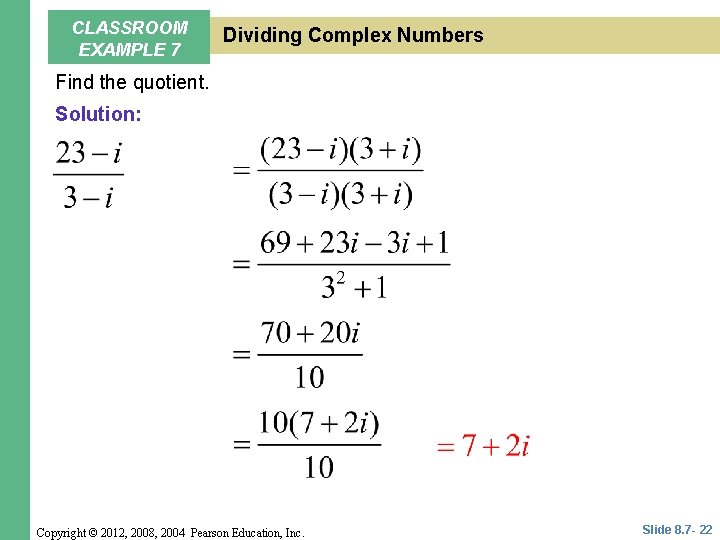
CLASSROOM EXAMPLE 7 Dividing Complex Numbers Find the quotient. Solution: Copyright © 2012, 2008, 2004 Pearson Education, Inc. Slide 8. 7 - 22
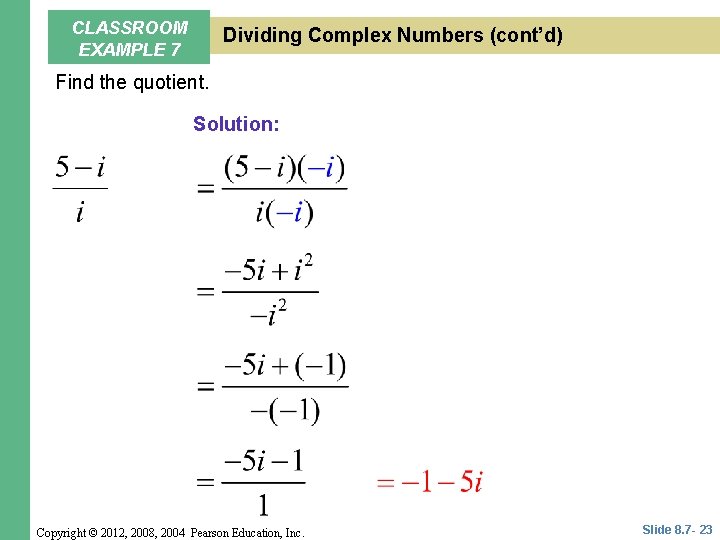
CLASSROOM EXAMPLE 7 Dividing Complex Numbers (cont’d) Find the quotient. Solution: Copyright © 2012, 2008, 2004 Pearson Education, Inc. Slide 8. 7 - 23
Objective 6 Find powers of i. Copyright © 2012, 2008, 2004 Pearson Education, Inc. Slide 8. 7 - 24
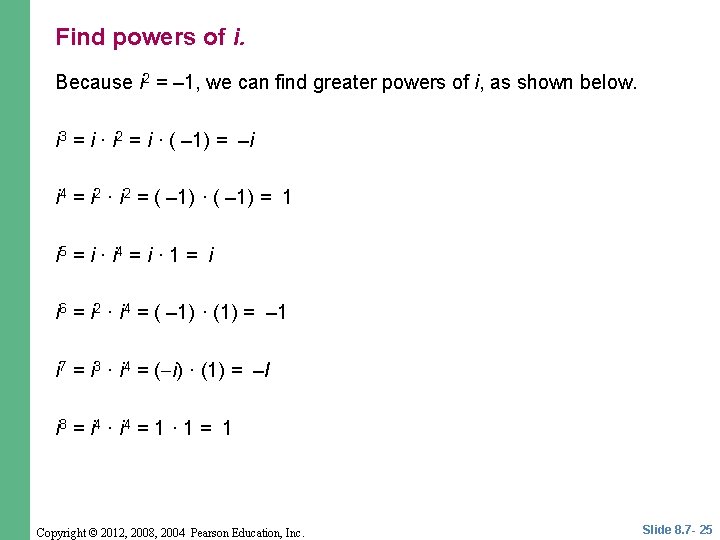
Find powers of i. Because i 2 = – 1, we can find greater powers of i, as shown below. i 3 = i · i 2 = i · ( – 1) = –i i 4 = i 2 · i 2 = ( – 1) · ( – 1) = 1 i 5 = i · i 4 = i · 1 = i i 6 = i 2 · i 4 = ( – 1) · (1) = – 1 i 7 = i 3 · i 4 = ( i) · (1) = –I i 8 = i 4 · i 4 = 1 · 1 = 1 Copyright © 2012, 2008, 2004 Pearson Education, Inc. Slide 8. 7 - 25
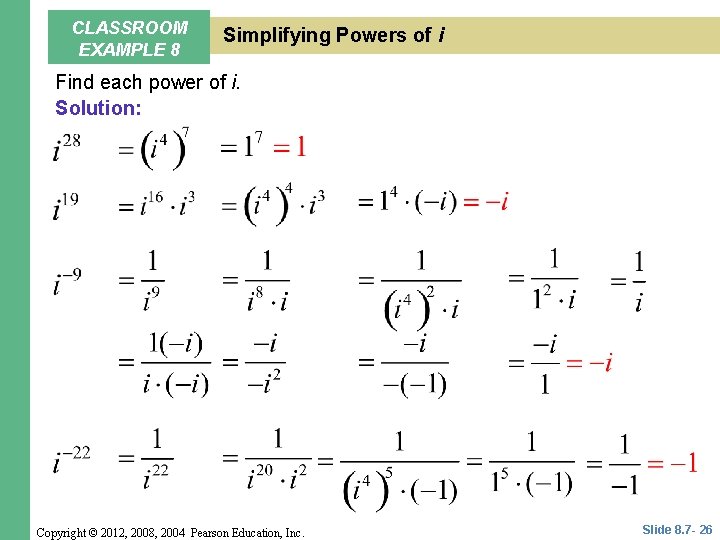
CLASSROOM EXAMPLE 8 Simplifying Powers of i Find each power of i. Solution: Copyright © 2012, 2008, 2004 Pearson Education, Inc. Slide 8. 7 - 26
- Slides: 26