
Chapter 8 Section 3 Corporation Def a legal




- Slides: 31
Chapter 8 Section 3
Corporation • Def: a legal entity owned by individual stockholders, each of whom faces limited liability for the firms debts. • A corporation is the most complex type of a business organization. • Some corporate enterprises span the globe.
Stock. • Def: a share of ownership in a corporation • Stockholders own shares of stock which represent their portion of ownership in the corporation. • In other words if you own stock in a corporation you are part-owner of that corporation. • If a corporation issues 1, 000 shares of stock, and you purchase 1 share, you own 1/1000 th of the company. • But a corporation is defined as an “entity” because it has a legal identity separate from its owner(s)
• Incorporation: forming a corporation
Closely held corporation • Def: corporation that issues stock to only a few people often family members. • Stocks are sold through the company itself and are not seen in stock news sources. • They are also known as privately held corporations.
Publicly held corporations • Def: a corporation that sells stock on the open market. • You must purchase publicly held stock through a broker • Stocks are bought and sold at financial markets called stock exchanges, such as New York Stock exchange.
• While the exact organization varies from firm to firm, all corporations have the same basic structure. • Every corporation has a board of directors, which are elected by the corporations owners. • The board of directors are the people in the corporation who make all of the major decisions. • Corporate officers hire managers and employees who work in various departments.
Multinational corporations • Def: large corporation that produces and sells its goods and services throughout the world. • They operate in more than one country at a time. • Most of the time they have a headquarters in one country and branches in the other. • They obey laws and pay taxes in each country they operate in.
Advantages of incorporation include: – Limited liability for owners – Transferable ownership – Ability to attract capital – Long life for the corporation
• Dividends: the portion of corporate profits paid out to stockholders • Corporations only account for about 20% of all U. S. businesses, but sell about 90% of the products.
• The primary reason that entrepreneurs choose to incorporate is to gain the benefit of limited liability. • Individual investors do not carry responsibility for the corporations actions. • They can only lose the amount of money they have in the invested in the business. • Corporations usually also provide stockholders with more flexibility than other ownership forms.
Multinational corporations (cont. ) • They accounted for more than $3 trillion of worldwide assets. • Many multinational corporations have operating budgets that are bigger than the government’s budgets of some countries.
Advantages of multinational • They create jobs and products around the world. • They spread new technology • They show new production methods across the globe. • They help the poorer nations gain better living standards for their people.
Disadvantages of multinationals • End up influencing the culture and the politics in the country. • Poorer countries already have low wages and poor working conditions. • Even though there are disadvantages people think that these type of corporations will become increasingly important in the world economy in the next couple years.
By size of Receipts
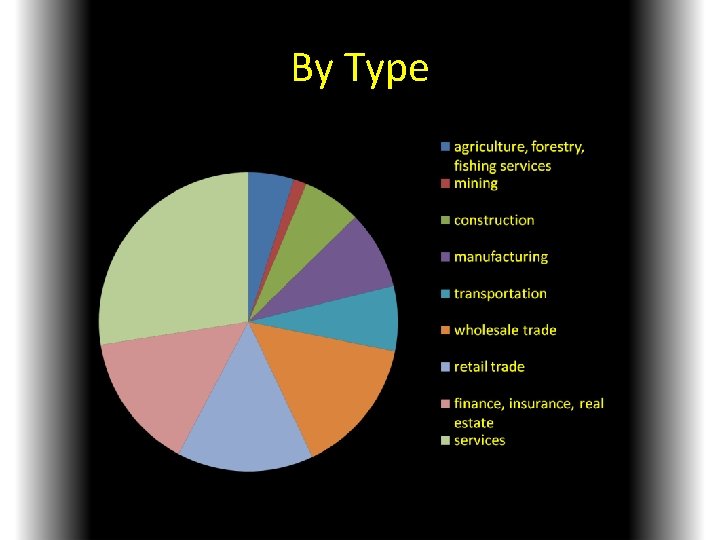
By Type
• Corporations face more regulations than other businesses
• Corporations usually merge, or combine the firm with another company • The three kinds of mergers are horizontal, vertical, conglomerates • Each of these corporate combinations can lead to larger, more efficient firms • Often larger firms can produce and sell their products for lower prices.
Horizontal mergers • Def: joins two or more firms competing in the same market with the same good or service. • They sometimes come together if the new firm will be more efficient then the other one. • The federal government watches all horizontal mergers very carefully.
Vertical mergers • Def: joins two or more firms involved in different stages of producing the same good or service. • These help firms operate more efficiently than they would without them. • They sometimes vertically combined with a firm out of fear.
Conglomerates • Def: business combination merging more than three businesses that make unrelated products • This kind of merging doesn’t decrease the competition in the economy • The government supports this kind of merging.
Question #1 • how does a corporation differ from a sole proprietorship or partnership?
Question #2 • what is the difference between a closely held corporation and a publicly held corporation?
Question #3 • what information is required in a certificate of incorporation?
Question #4 • What is a stock?
Question #5 • Why must stockholders pay taxes on dividends?
Question #6 • what is a merger? How do horizontal mergers, vertical mergers, and conglomerates differ?
Question #7 • Why are some corporations called multinational corporations?
Question #8 • Why do you think most big businesses organize as corporation?
Question #9 • How might a corporation benefit by being multinational?
Question #10 • You want to incorporate your family business. Will your form a closely held corporation or a publicly held corporation? Explain.