
Chapter 8 Section 2 Types of Chemical Reactions
- Slides: 31
Chapter 8 Section 2 Types of Chemical Reactions Preview • • Lesson Starter Objectives Synthesis Reactions Decomposition Reactions Single-Displacement Reactions Double-Displacement Reactions Combustion Reactions
Chapter 8 Section 2 Types of Chemical Reactions Lesson Starter • So many chemical reactions can occur or are occurring that it would be impossible to predict their products if it was not possible to place many of them into categories. • Synthesis reactions are one class of reactions in which substances combine to form a new compound.
Chapter 8 Section 2 Types of Chemical Reactions Objectives • Define and give general equations for synthesis, decomposition, single-displacement, and doubledisplacement reactions. • Classify a reaction as a synthesis, decomposition, single-displacement, double-displacement, or combustion reaction. • List three kinds of synthesis reactions and six kinds of decomposition reactions.
Chapter 8 Section 2 Types of Chemical Reactions Objectives, continued • List four kinds of single-displacement reactions and three kinds of double-displacement reactions. • Predict the products of simple reactions given the reactants.
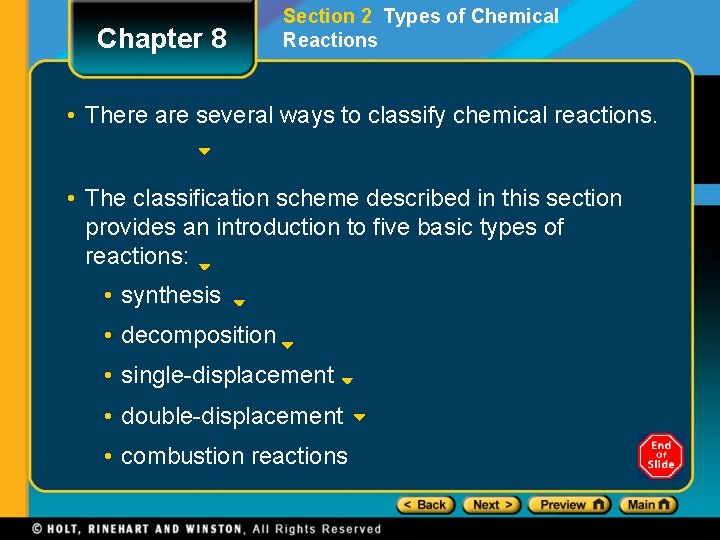
Chapter 8 Section 2 Types of Chemical Reactions • There are several ways to classify chemical reactions. • The classification scheme described in this section provides an introduction to five basic types of reactions: • synthesis • decomposition • single-displacement • double-displacement • combustion reactions
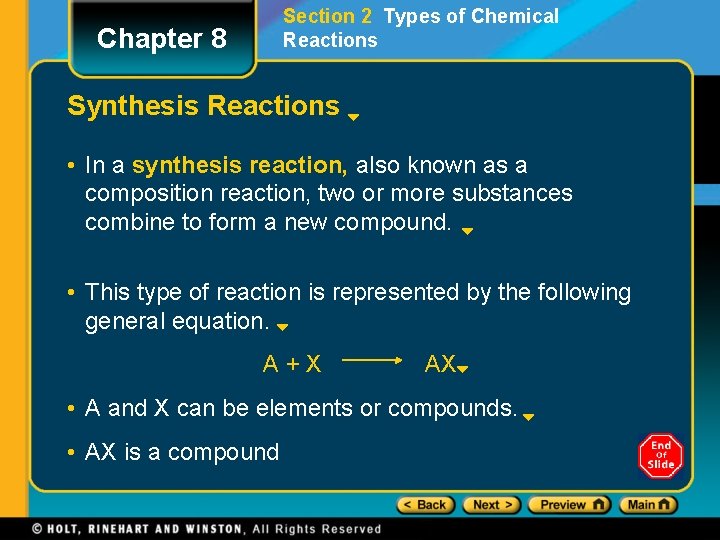
Section 2 Types of Chemical Reactions Chapter 8 Synthesis Reactions • In a synthesis reaction, also known as a composition reaction, two or more substances combine to form a new compound. • This type of reaction is represented by the following general equation. A+X AX • A and X can be elements or compounds. • AX is a compound
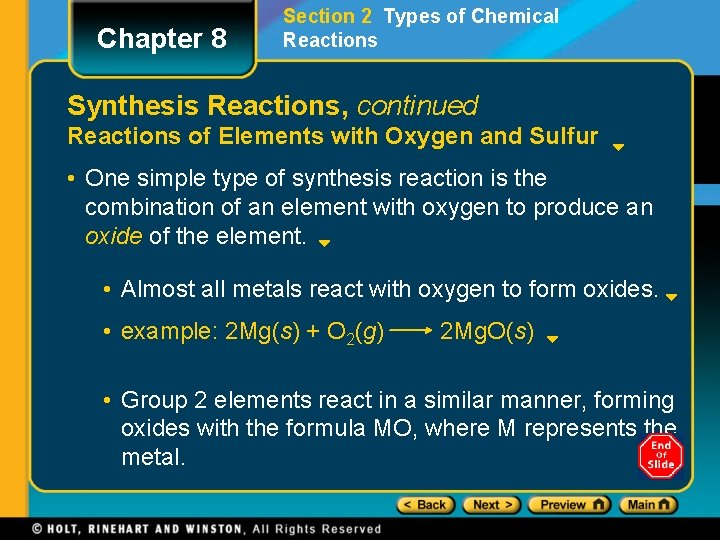
Chapter 8 Section 2 Types of Chemical Reactions Synthesis Reactions, continued Reactions of Elements with Oxygen and Sulfur • One simple type of synthesis reaction is the combination of an element with oxygen to produce an oxide of the element. • Almost all metals react with oxygen to form oxides. • example: 2 Mg(s) + O 2(g) 2 Mg. O(s) • Group 2 elements react in a similar manner, forming oxides with the formula MO, where M represents the metal.
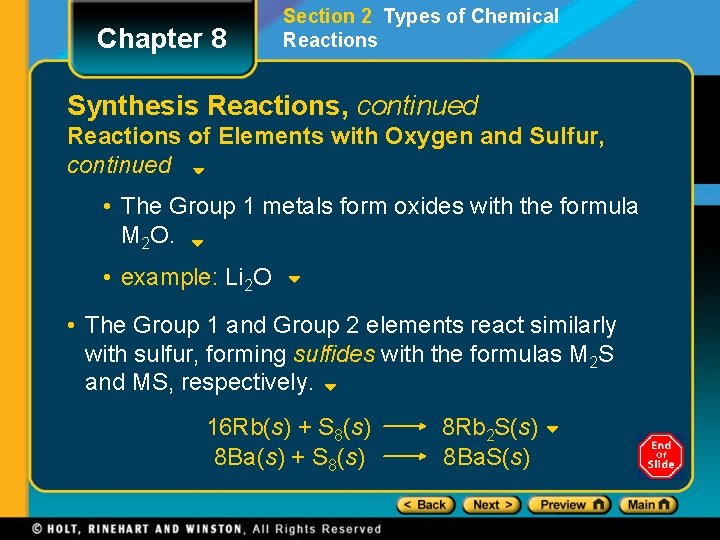
Chapter 8 Section 2 Types of Chemical Reactions Synthesis Reactions, continued Reactions of Elements with Oxygen and Sulfur, continued • The Group 1 metals form oxides with the formula M 2 O. • example: Li 2 O • The Group 1 and Group 2 elements react similarly with sulfur, forming sulfides with the formulas M 2 S and MS, respectively. 16 Rb(s) + S 8(s) 8 Ba(s) + S 8(s) 8 Rb 2 S(s) 8 Ba. S(s)
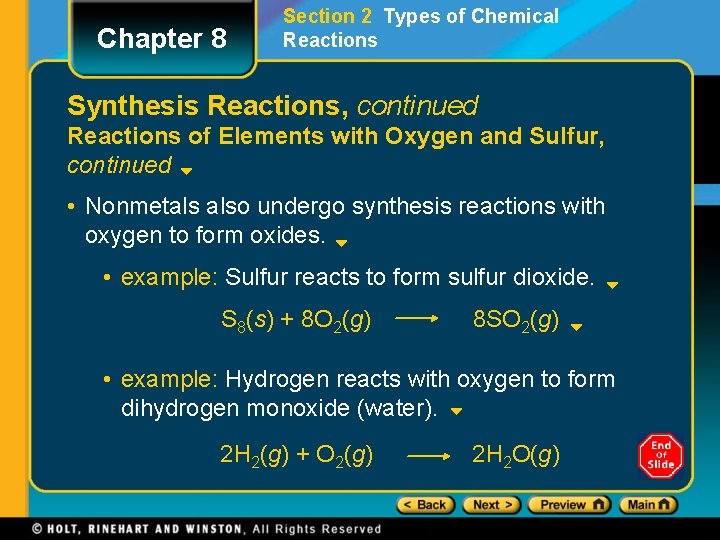
Chapter 8 Section 2 Types of Chemical Reactions Synthesis Reactions, continued Reactions of Elements with Oxygen and Sulfur, continued • Nonmetals also undergo synthesis reactions with oxygen to form oxides. • example: Sulfur reacts to form sulfur dioxide. S 8(s) + 8 O 2(g) 8 SO 2(g) • example: Hydrogen reacts with oxygen to form dihydrogen monoxide (water). 2 H 2(g) + O 2(g) 2 H 2 O(g)
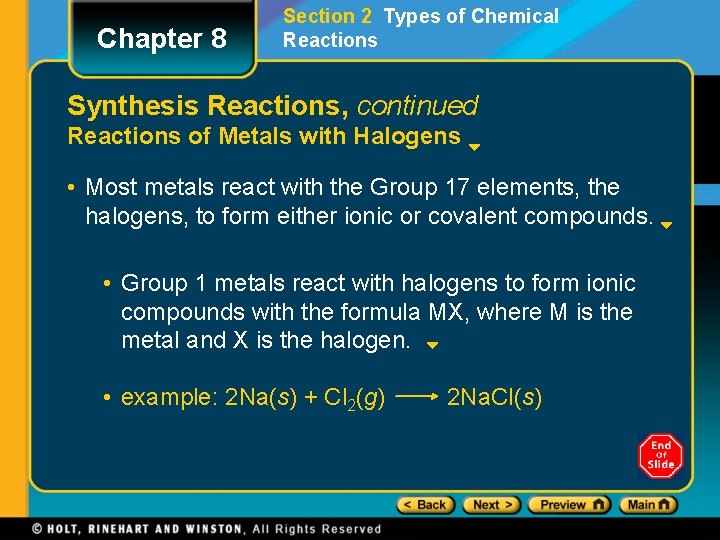
Chapter 8 Section 2 Types of Chemical Reactions Synthesis Reactions, continued Reactions of Metals with Halogens • Most metals react with the Group 17 elements, the halogens, to form either ionic or covalent compounds. • Group 1 metals react with halogens to form ionic compounds with the formula MX, where M is the metal and X is the halogen. • example: 2 Na(s) + Cl 2(g) 2 Na. Cl(s)
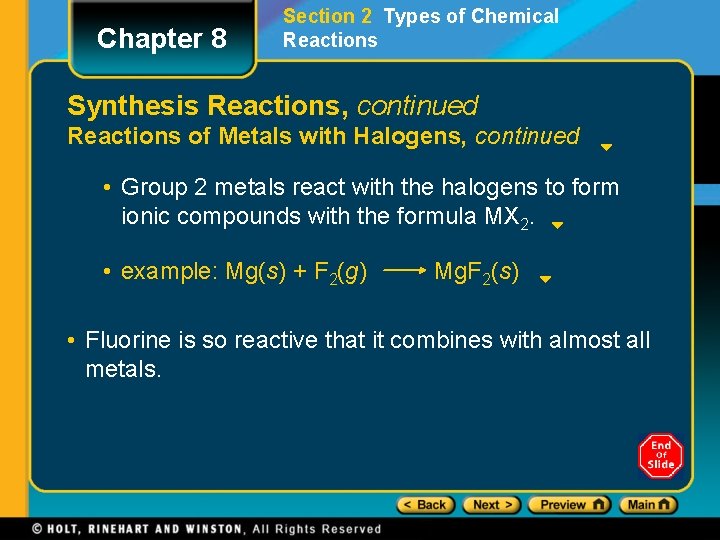
Chapter 8 Section 2 Types of Chemical Reactions Synthesis Reactions, continued Reactions of Metals with Halogens, continued • Group 2 metals react with the halogens to form ionic compounds with the formula MX 2. • example: Mg(s) + F 2(g) Mg. F 2(s) • Fluorine is so reactive that it combines with almost all metals.
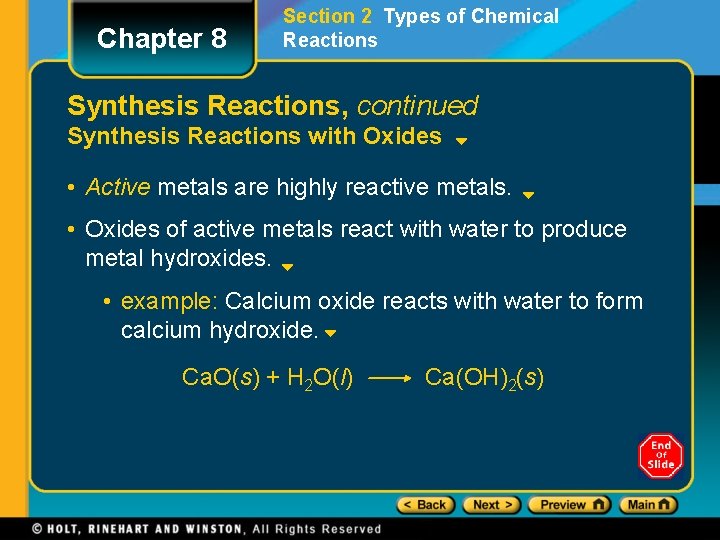
Chapter 8 Section 2 Types of Chemical Reactions Synthesis Reactions, continued Synthesis Reactions with Oxides • Active metals are highly reactive metals. • Oxides of active metals react with water to produce metal hydroxides. • example: Calcium oxide reacts with water to form calcium hydroxide. Ca. O(s) + H 2 O(l) Ca(OH)2(s)
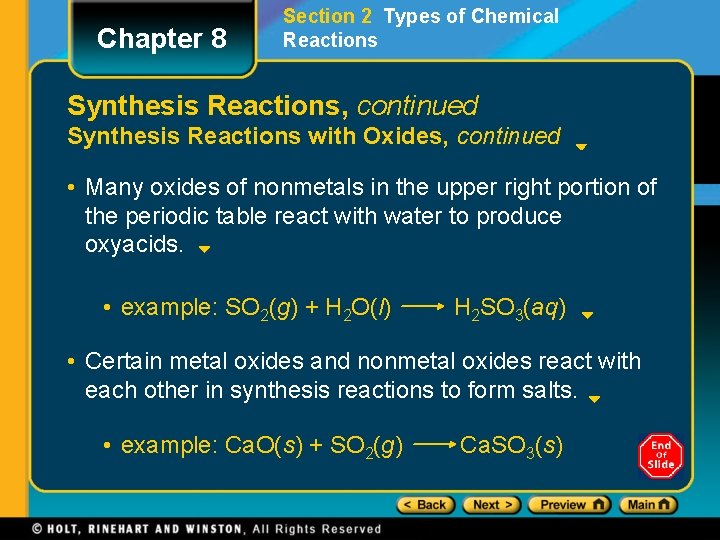
Chapter 8 Section 2 Types of Chemical Reactions Synthesis Reactions, continued Synthesis Reactions with Oxides, continued • Many oxides of nonmetals in the upper right portion of the periodic table react with water to produce oxyacids. • example: SO 2(g) + H 2 O(l) H 2 SO 3(aq) • Certain metal oxides and nonmetal oxides react with each other in synthesis reactions to form salts. • example: Ca. O(s) + SO 2(g) Ca. SO 3(s)
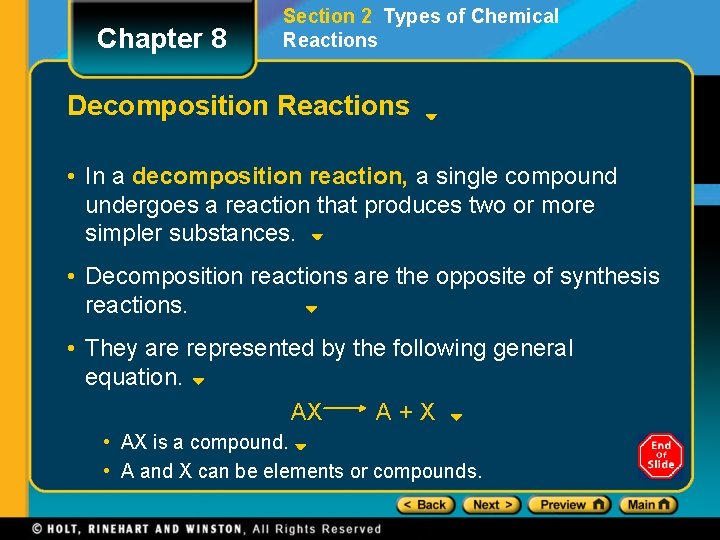
Chapter 8 Section 2 Types of Chemical Reactions Decomposition Reactions • In a decomposition reaction, a single compound undergoes a reaction that produces two or more simpler substances. • Decomposition reactions are the opposite of synthesis reactions. • They are represented by the following general equation. AX A+X • AX is a compound. • A and X can be elements or compounds.
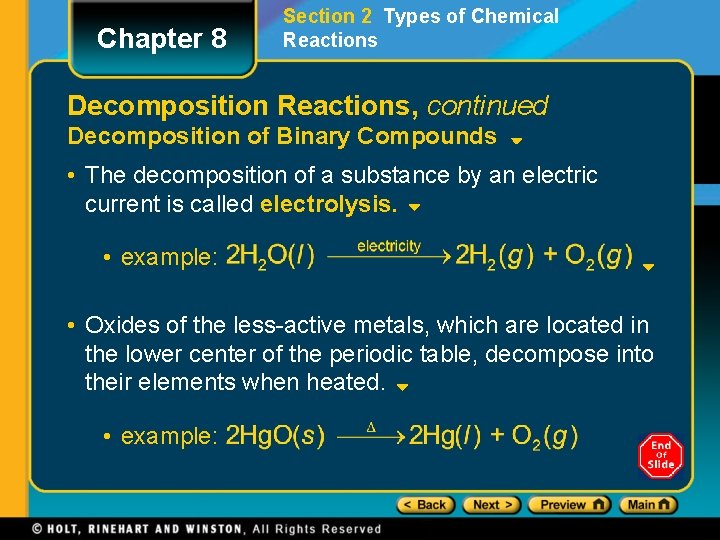
Chapter 8 Section 2 Types of Chemical Reactions Decomposition Reactions, continued Decomposition of Binary Compounds • The decomposition of a substance by an electric current is called electrolysis. • example: • Oxides of the less-active metals, which are located in the lower center of the periodic table, decompose into their elements when heated. • example:
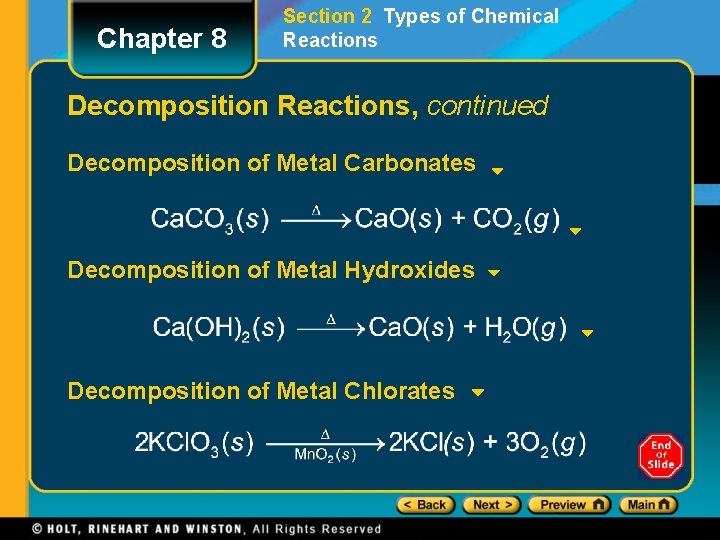
Chapter 8 Section 2 Types of Chemical Reactions Decomposition Reactions, continued Decomposition of Metal Carbonates Decomposition of Metal Hydroxides Decomposition of Metal Chlorates
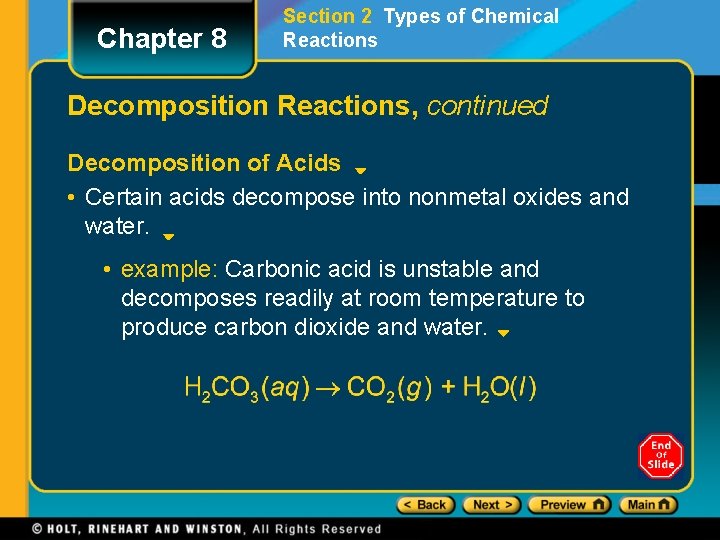
Chapter 8 Section 2 Types of Chemical Reactions Decomposition Reactions, continued Decomposition of Acids • Certain acids decompose into nonmetal oxides and water. • example: Carbonic acid is unstable and decomposes readily at room temperature to produce carbon dioxide and water.
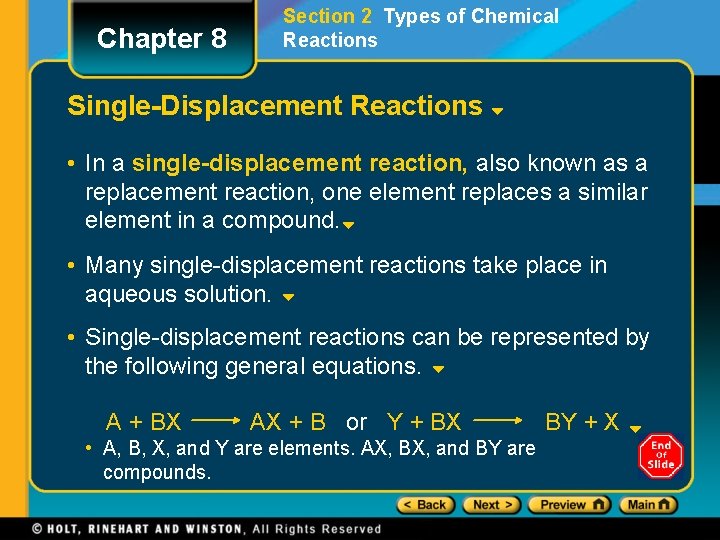
Chapter 8 Section 2 Types of Chemical Reactions Single-Displacement Reactions • In a single-displacement reaction, also known as a replacement reaction, one element replaces a similar element in a compound. • Many single-displacement reactions take place in aqueous solution. • Single-displacement reactions can be represented by the following general equations. A + BX AX + B or Y + BX • A, B, X, and Y are elements. AX, BX, and BY are compounds. BY + X
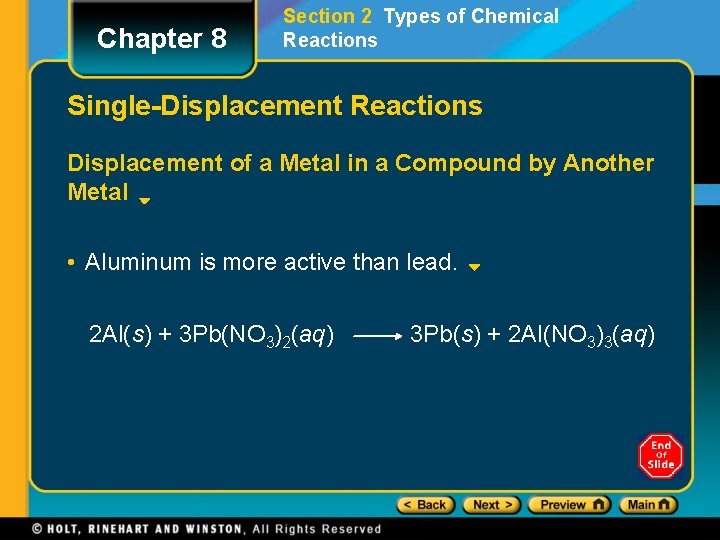
Chapter 8 Section 2 Types of Chemical Reactions Single-Displacement Reactions Displacement of a Metal in a Compound by Another Metal • Aluminum is more active than lead. 2 Al(s) + 3 Pb(NO 3)2(aq) 3 Pb(s) + 2 Al(NO 3)3(aq)
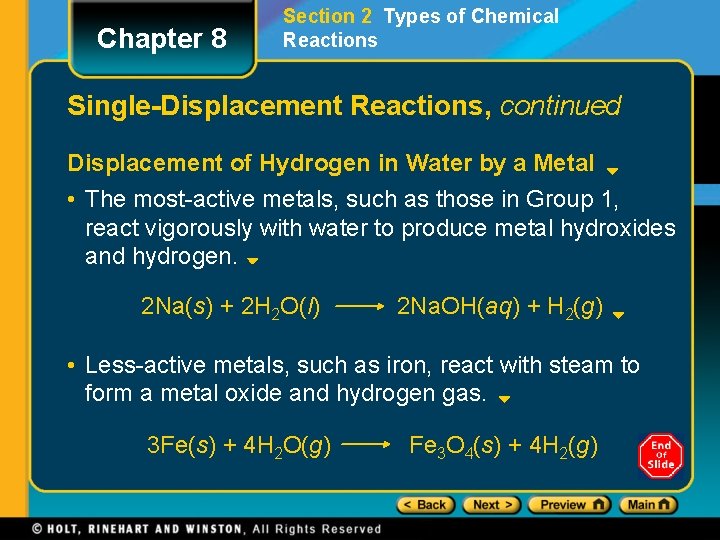
Chapter 8 Section 2 Types of Chemical Reactions Single-Displacement Reactions, continued Displacement of Hydrogen in Water by a Metal • The most-active metals, such as those in Group 1, react vigorously with water to produce metal hydroxides and hydrogen. 2 Na(s) + 2 H 2 O(l) 2 Na. OH(aq) + H 2(g) • Less-active metals, such as iron, react with steam to form a metal oxide and hydrogen gas. 3 Fe(s) + 4 H 2 O(g) Fe 3 O 4(s) + 4 H 2(g)
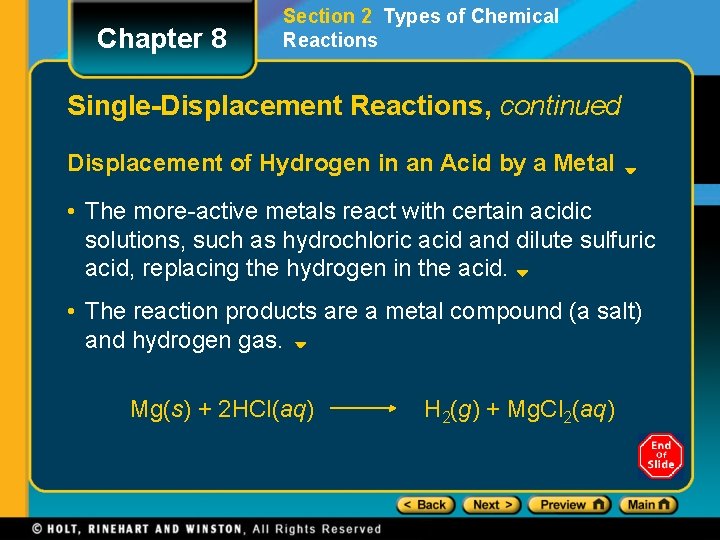
Chapter 8 Section 2 Types of Chemical Reactions Single-Displacement Reactions, continued Displacement of Hydrogen in an Acid by a Metal • The more-active metals react with certain acidic solutions, such as hydrochloric acid and dilute sulfuric acid, replacing the hydrogen in the acid. • The reaction products are a metal compound (a salt) and hydrogen gas. Mg(s) + 2 HCl(aq) H 2(g) + Mg. Cl 2(aq)
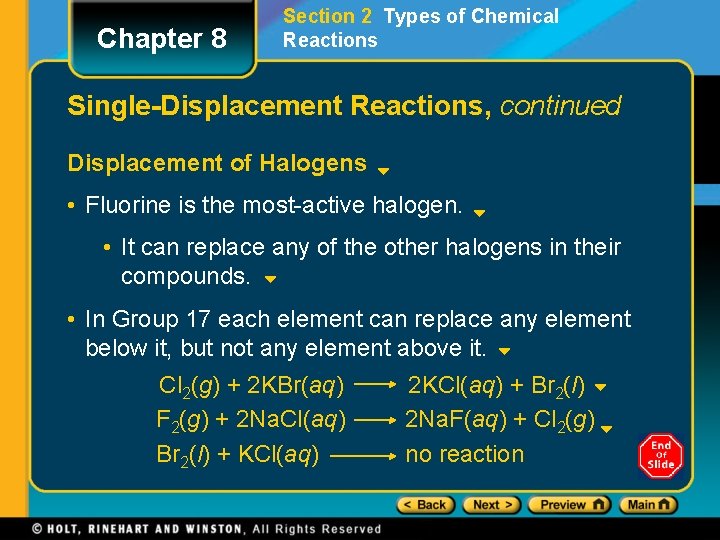
Chapter 8 Section 2 Types of Chemical Reactions Single-Displacement Reactions, continued Displacement of Halogens • Fluorine is the most-active halogen. • It can replace any of the other halogens in their compounds. • In Group 17 each element can replace any element below it, but not any element above it. Cl 2(g) + 2 KBr(aq) F 2(g) + 2 Na. Cl(aq) Br 2(l) + KCl(aq) 2 KCl(aq) + Br 2(l) 2 Na. F(aq) + Cl 2(g) no reaction
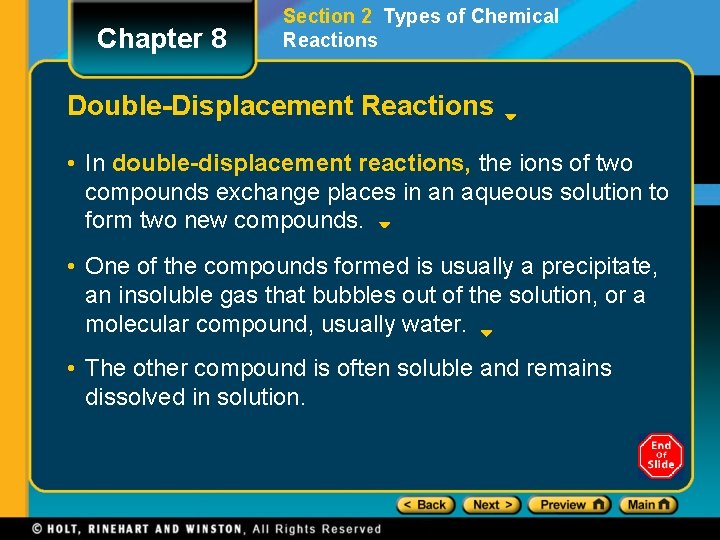
Chapter 8 Section 2 Types of Chemical Reactions Double-Displacement Reactions • In double-displacement reactions, the ions of two compounds exchange places in an aqueous solution to form two new compounds. • One of the compounds formed is usually a precipitate, an insoluble gas that bubbles out of the solution, or a molecular compound, usually water. • The other compound is often soluble and remains dissolved in solution.
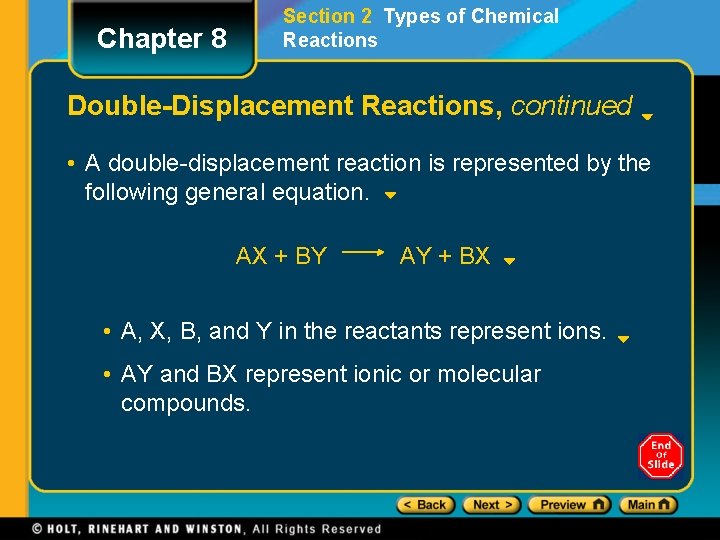
Chapter 8 Section 2 Types of Chemical Reactions Double-Displacement Reactions, continued • A double-displacement reaction is represented by the following general equation. AX + BY AY + BX • A, X, B, and Y in the reactants represent ions. • AY and BX represent ionic or molecular compounds.
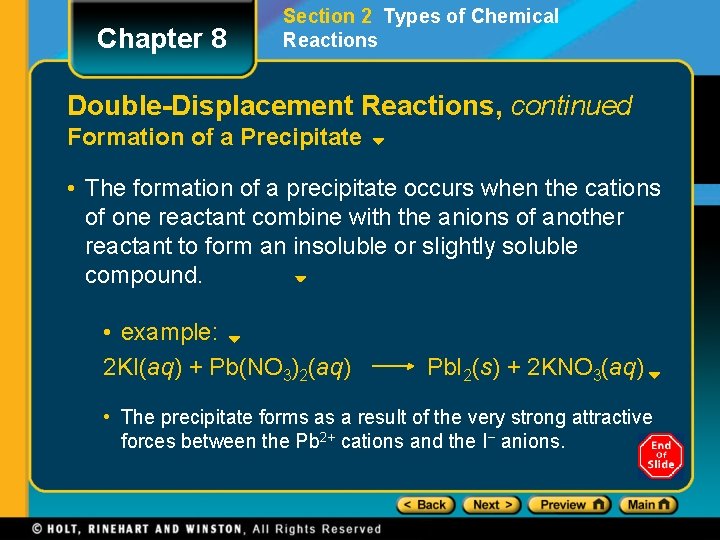
Chapter 8 Section 2 Types of Chemical Reactions Double-Displacement Reactions, continued Formation of a Precipitate • The formation of a precipitate occurs when the cations of one reactant combine with the anions of another reactant to form an insoluble or slightly soluble compound. • example: 2 KI(aq) + Pb(NO 3)2(aq) Pb. I 2(s) + 2 KNO 3(aq) • The precipitate forms as a result of the very strong attractive forces between the Pb 2+ cations and the I− anions.
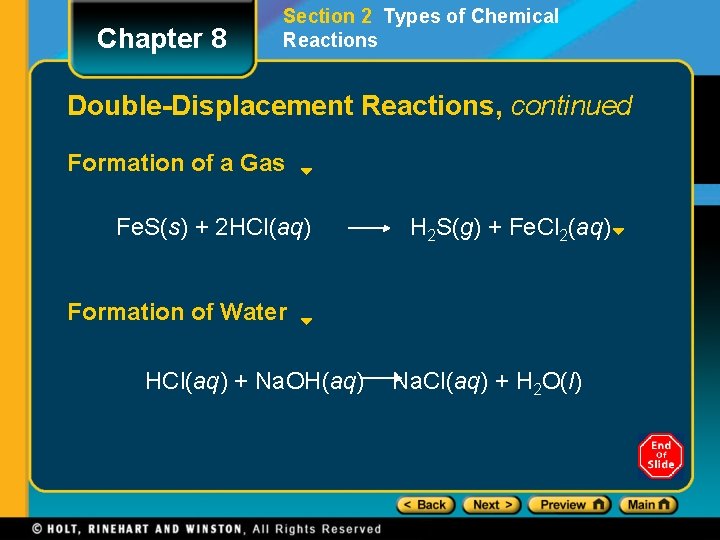
Chapter 8 Section 2 Types of Chemical Reactions Double-Displacement Reactions, continued Formation of a Gas Fe. S(s) + 2 HCl(aq) H 2 S(g) + Fe. Cl 2(aq) Formation of Water HCl(aq) + Na. OH(aq) Na. Cl(aq) + H 2 O(l)
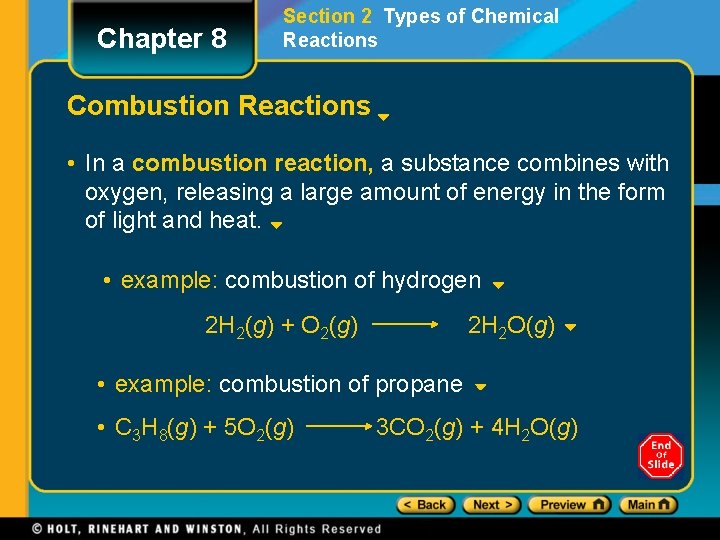
Chapter 8 Section 2 Types of Chemical Reactions Combustion Reactions • In a combustion reaction, a substance combines with oxygen, releasing a large amount of energy in the form of light and heat. • example: combustion of hydrogen 2 H 2(g) + O 2(g) 2 H 2 O(g) • example: combustion of propane • C 3 H 8(g) + 5 O 2(g) 3 CO 2(g) + 4 H 2 O(g)
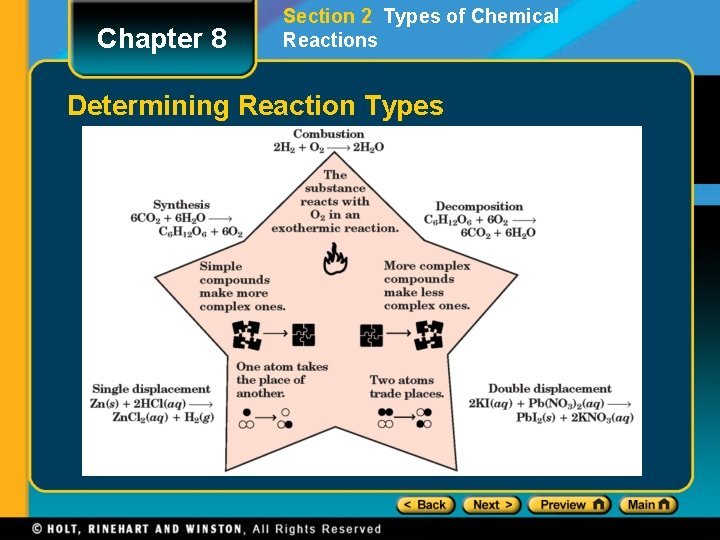
Chapter 8 Section 2 Types of Chemical Reactions Determining Reaction Types
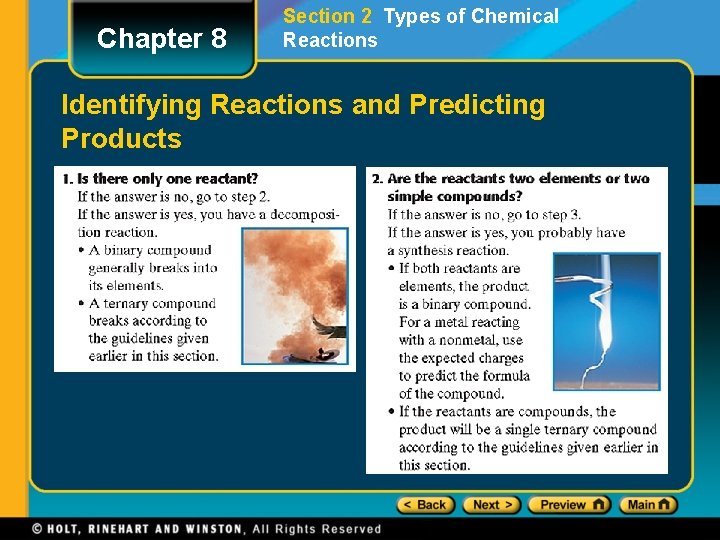
Chapter 8 Section 2 Types of Chemical Reactions Identifying Reactions and Predicting Products
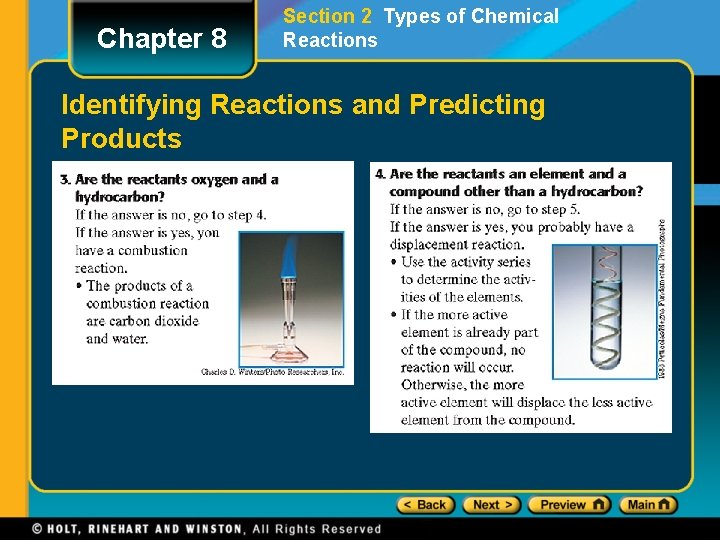
Chapter 8 Section 2 Types of Chemical Reactions Identifying Reactions and Predicting Products
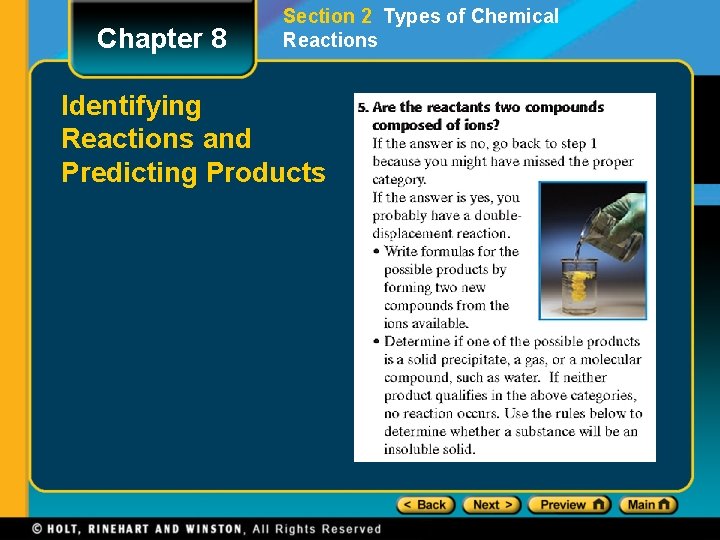
Chapter 8 Section 2 Types of Chemical Reactions Identifying Reactions and Predicting Products