
Chapter 8 Section 2 1 2 3 Chapter








- Slides: 33
Chapter 8 Section 2 1
2
3
Chapter 8 Section 3 Nationalism 4
I. Nationalism: A Force for Unity A. Two Views of Nationalism – 1. Nationalists use their common bond to build nation-states – 2. Rulers eventually use nationalism to unify their subjects 5
3. Three different types of nationalist movements: – a) unification merges culturally similar lands – b) separation splits off culturally distinct groups – c) state-building binds separate cultures into one 6
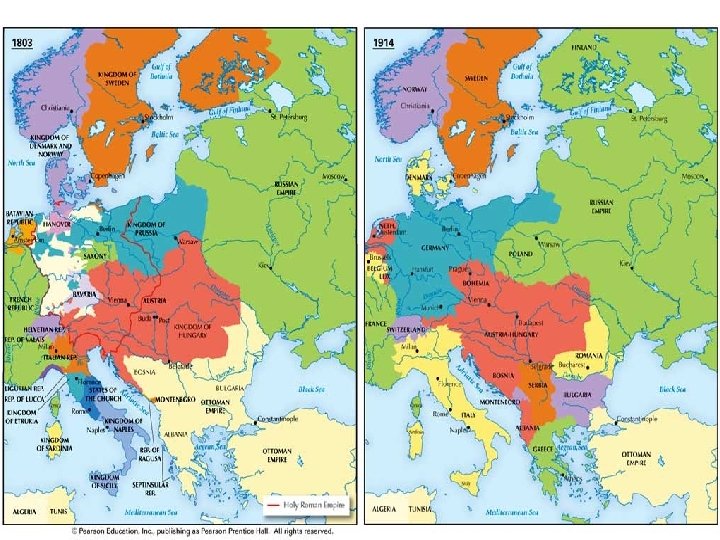
II. Nationalism Shakes Aging Empires • A. The Breakup of the Austrian Empire – 1. Austria includes people from many ethnic groups – 2. 1866 defeat forces emperor to split empire into Austria and Hungary • a) still ruled by emperor 7
8
B. The Russian Empire Crumbles 1. After 370 years, Russian Czars begin losing control over empire 2. Russification – a) forcing other peoples to adopt Russian culture b) policy further disunited Russia, strengthens ethnic nationalism 9
C. The Ottoman Empire Weakens 1. Internal tensions among ethnic groups weakens empire 2. Rulers grant citizenship to all groups, outraging Turks 10
III. Case Study: Italy A. Cavor Unites Italy – 1. Italy forms territory from crumbling empires – 2. 1815 -1848 Italians want independence from foreign rulers 11
B. Cavour Leads Italian Unification 1. Camillo di Cavour • a) prime minister of kingdom of Sardinia in 1852 2. Gets French help to win control of Austrian-controlled Italian land 12
13
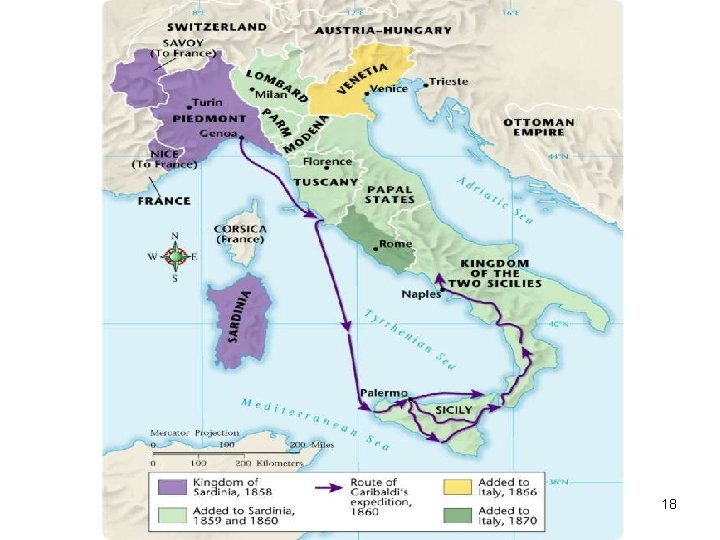
C. Garibaldi Brings Unity • 1. Giuseppe Garibaldi – a) leads nationalists who conquer southern Italy • (1) Red Shirts 14
• 2. Cavour convinces Garibaldi to unite southern Italy and Sardinia • 3. Garibaldi steps aside, allowing king of Sardinia to rule • 4. Control of Venetia, Papal States finally unites Italy 15
5. 1861, Victor Emmanuel II was crowned King of Italy 16
17
18
3 The Struggle for Italy CAVOUR Prime minister who believed in Realpolitik. Wanted to end Austrian power in Italy and annex its provinces of Lombardy and Venetia. Led Sardinia to provoke a war with Austria. With help from France, Sardinia defeated Austria and annexed Lombardy. GARIBALDI Long-time nationalist leader who wanted to create an Italian republic. Captured Sicily and Naples and turned them over to Victor Emmanuel. Shortly afterward, Victor Emmanuel II was crowned king of Italy. 19
IV. Case Study: Germany 20
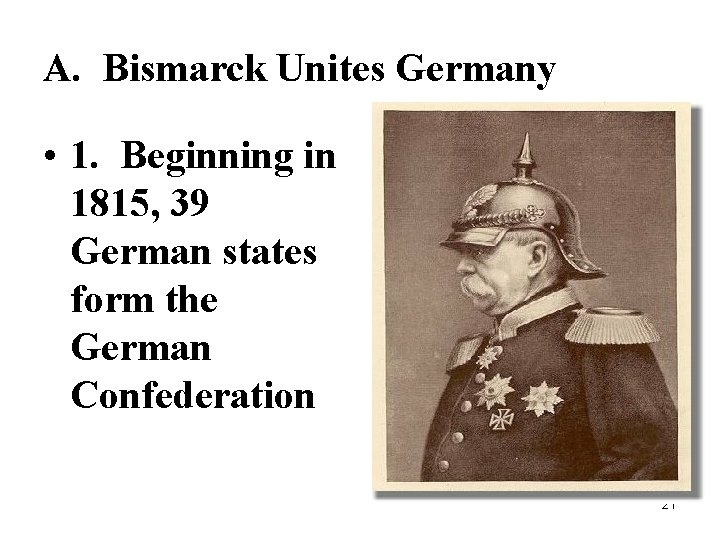
A. Bismarck Unites Germany • 1. Beginning in 1815, 39 German states form the German Confederation 21
B. Prussia Leads German Unification • 1. Prussia has advantages that help it unify Germany – a) mainly German population – b) powerful army – c) creation of liberal constitution 22
C. Bismarck Takes Control • 1. Junkers – – a) conservative wealthy landowners – b) support Prussian Wilhelm I 23
• 2. Junker realpolitik master Otto von Bismarck becomes prime minister • 3. Realpolitik – power politics without room for idealism • 4. Bismarck defies Prussian parliament 24
D. Prussia Expands • 1. Prussia and Austria fight Denmark, gain two provinces • 2. Quick victory makes other German nations respect Prussia 25
E. Seven Weeks’ war • 1. Bismarck creates border dispute with Austria to provoke war • 2. Prussia seizes Austrian territory, northern German 26
• 3. Eastern and western parts of Prussian kingdom joined for first time 27
F. The Franco-Prussian War • 1. Bismarck provokes war with France to unite all Germans 28
• 2. Wilhelm is crowned Kaiser – emperor of a united Germany – at Versailles 29
• 3. Bismarck creates a Germany united under Prussian dominance 30
31
G. Balance is Lost 1. In 1815, the Congress of Vienna established five powers in Europe – 1. Austria – 2. Prussia – 3. Britain – 4. France – 5. Russia 32
2. By 1871, Britain and Prussia (now Germany) have gained much power 3. Austria and Russia are weaker militarily and economically 33