
Chapter 8 Section 1 Work and Power Bellringer
Chapter 8 Section 1 Work and Power Bellringer What specific kind of work is being done in each activity below? Select the activities that require the least amount of work. • carrying heavy books home • reading a 300 -page novel • skiing for 1 hour • lifting a 45 kg mass • holding a steel beam in place for 3 hours • jacking up a car Chapter menu Resources Copyright © by Holt, Rinehart and Winston. All rights reserved.
Chapter 8 Section 1 Work and Power Objectives • Determine when work is being done on an object. • Calculate the amount of work done on an object. • Explain the difference between work and power. Chapter menu Resources Copyright © by Holt, Rinehart and Winston. All rights reserved.
Chapter 8 Section 1 Work and Power What Is Work? • Work is the transfer of energy to an object by using a force that causes the object to move in the direction of the force. • Transfer of Energy One way you can tell that work is being done is that energy is transferred. Chapter menu Resources Copyright © by Holt, Rinehart and Winston. All rights reserved.
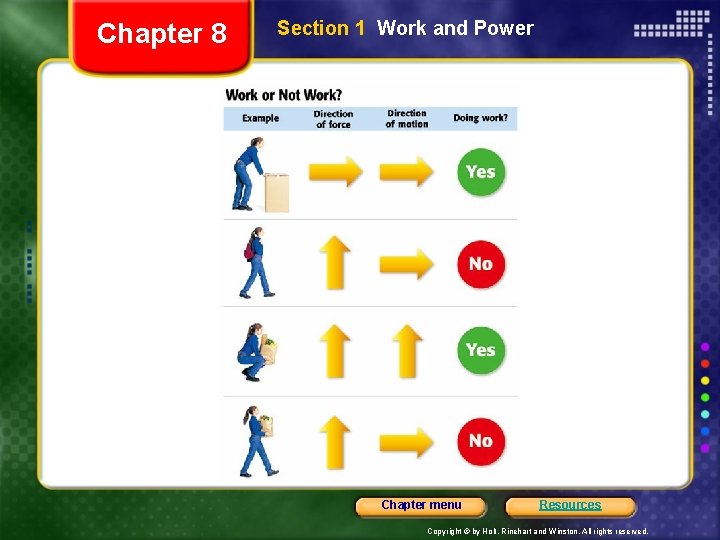
Chapter 8 Section 1 Work and Power What Is Work? , continued • Difference Between Force and Work Applying a force doesn’t always result in work being done. • Force and Motion in the Same Direction For work to be done on an object, the object must move in the same direction as the force. Chapter menu Resources Copyright © by Holt, Rinehart and Winston. All rights reserved.
Chapter 8 Section 1 Work and Power Chapter menu Resources Copyright © by Holt, Rinehart and Winston. All rights reserved.
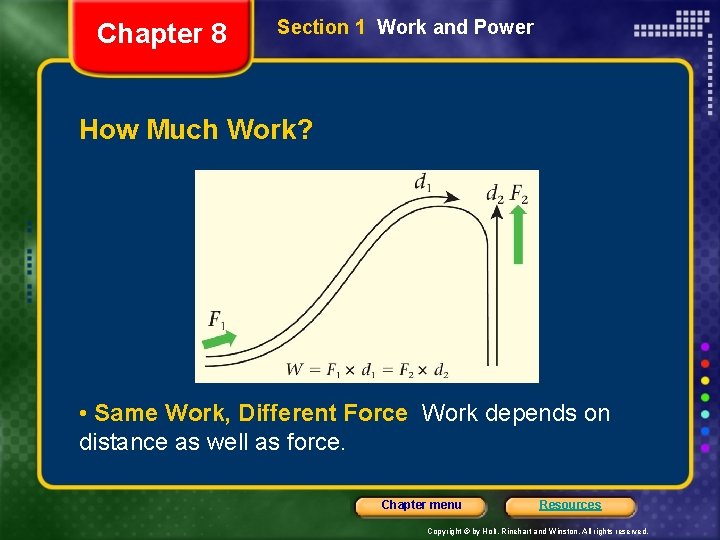
Chapter 8 Section 1 Work and Power How Much Work? • Same Work, Different Force Work depends on distance as well as force. Chapter menu Resources Copyright © by Holt, Rinehart and Winston. All rights reserved.

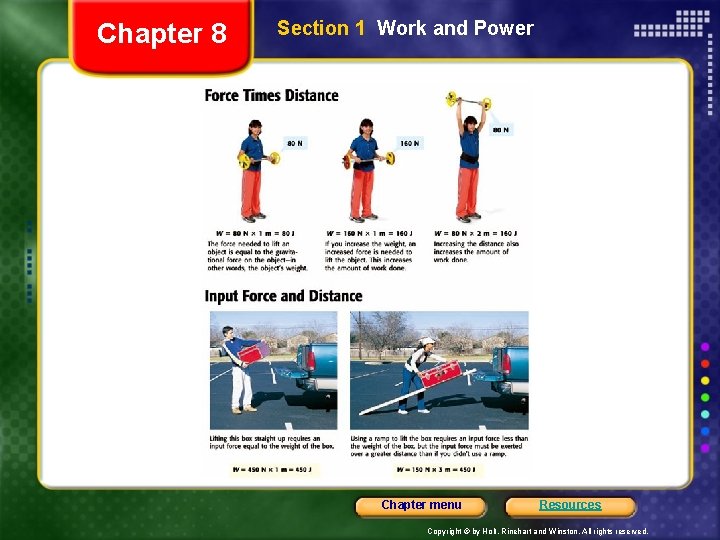
Chapter 8 Section 1 Work and Power How Much Work? , continued • Calculating Work The amount of work (W) done in moving an object can be calculated by multiplying the force (F) applied to the object by the distance (d) through which the force is applied: W F d • The unit used to express work is the newton-meter (N m), which is more simply called the joule. Chapter menu Resources Copyright © by Holt, Rinehart and Winston. All rights reserved.
Chapter 8 Section 1 Work and Power Chapter menu Resources Copyright © by Holt, Rinehart and Winston. All rights reserved.
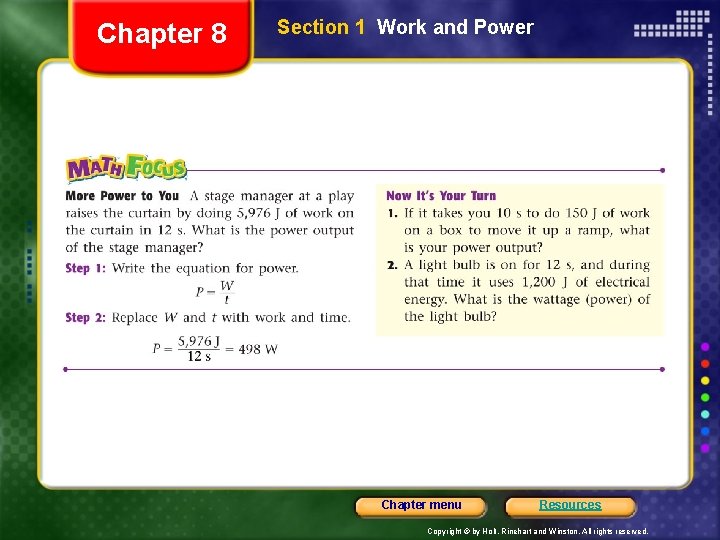
Chapter 8 Section 1 Work and Power: How Fast Work Is Done • Calculating Power is the rate at which energy is transferred. To calculate power (P), you divide the amount of work done (W) by the time (t) it takes to do that work: W P t • The unit used to express power is joules per second (J/s), also called the watt. One watt (W) is equal to 1 J/s. Chapter menu Resources Copyright © by Holt, Rinehart and Winston. All rights reserved.
Chapter 8 Section 1 Work and Power Chapter menu Resources Copyright © by Holt, Rinehart and Winston. All rights reserved.
Chapter 8 Section 1 Work and Power: How Fast Work Is Done, continued • Increasing Power It may take you longer to sand a wooden shelf by hand than by using an electric sander, but the amount of energy needed is the same either way. Only the power output is lower when you sand the shelf by hand. Chapter menu Resources Copyright © by Holt, Rinehart and Winston. All rights reserved.
- Slides: 11