
Chapter 8 Secondary Storage Mc GrawHillIrwin Copyright 2008
- Slides: 29
Chapter 8 Secondary Storage Mc. Graw-Hill/Irwin Copyright © 2008 by The Mc. Graw-Hill Companies, Inc. All rights reserved.
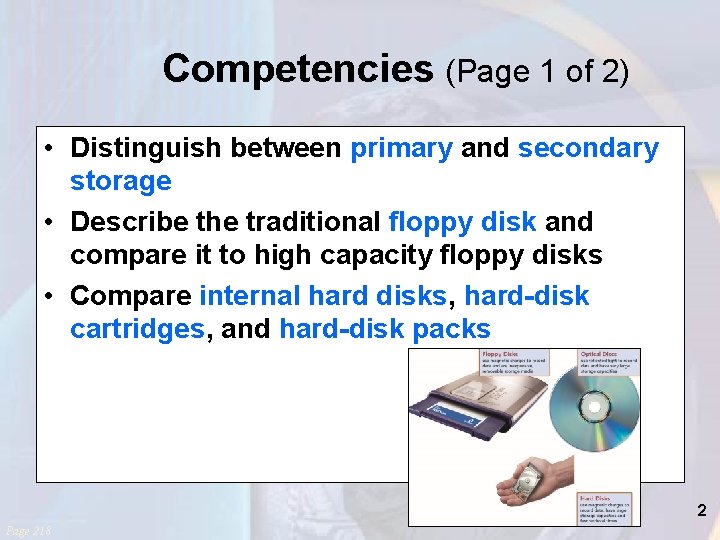
Competencies (Page 1 of 2) • Distinguish between primary and secondary storage • Describe the traditional floppy disk and compare it to high capacity floppy disks • Compare internal hard disks, hard-disk cartridges, and hard-disk packs 2 Page 218
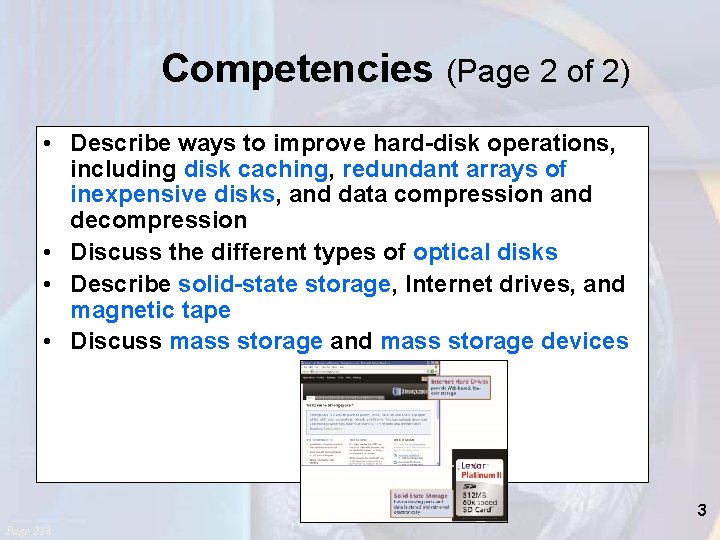
Competencies (Page 2 of 2) • Describe ways to improve hard-disk operations, including disk caching, redundant arrays of inexpensive disks, and data compression and decompression • Discuss the different types of optical disks • Describe solid-state storage, Internet drives, and magnetic tape • Discuss mass storage and mass storage devices 3 Page 218
Introduction Data storage has expanded from text and numeric files to include digital music files, photographic files, video files, and much more. These new types of files require secondary storage devices with much greater capacity than floppy disks. In this chapter, you will learn about the many types of secondary storage devices including their capabilities and limitations. 4 Page 219
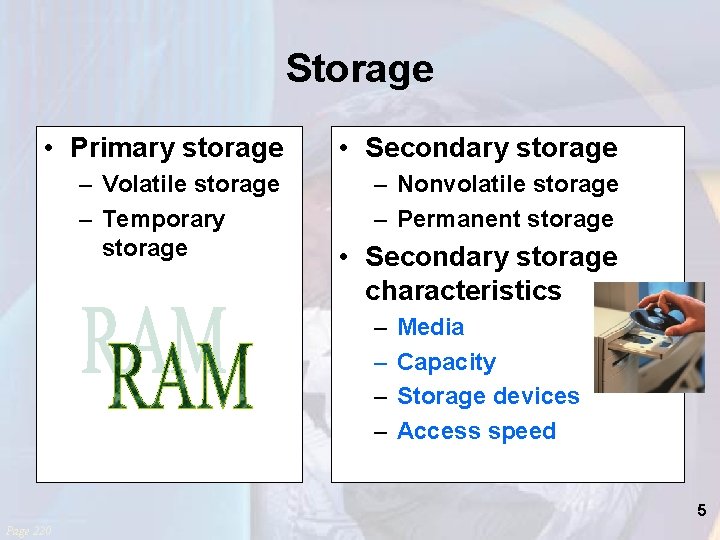
Storage • Primary storage • Secondary storage – Volatile storage – Temporary storage – Nonvolatile storage – Permanent storage • Secondary storage characteristics – – Media Capacity Storage devices Access speed 5 Page 220
Secondary Storage Devices • Most desktop microcomputer systems have floppy disks, hard disks, and optical disk drives • Are used to save, back up, and transport data files and programs 6 Page 220
Floppy Disks • Portable or removable storage media • Typically used to store and transfer small word processing, spreadsheet, and other types of files • Floppy disk drives (FDD) – Store data and programs – Retrieves data by reading electromagnetic charges – Also called flexible disks and floppies 7 Page 220
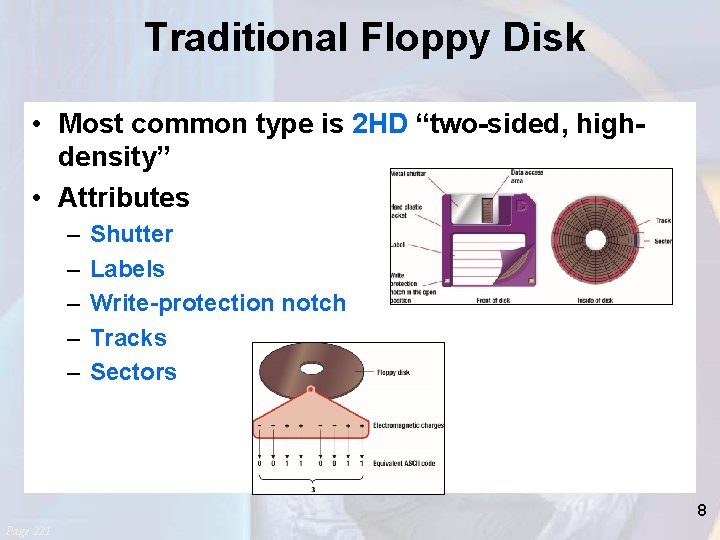
Traditional Floppy Disk • Most common type is 2 HD “two-sided, highdensity” • Attributes – – – Shutter Labels Write-protection notch Tracks Sectors 8 Page 221
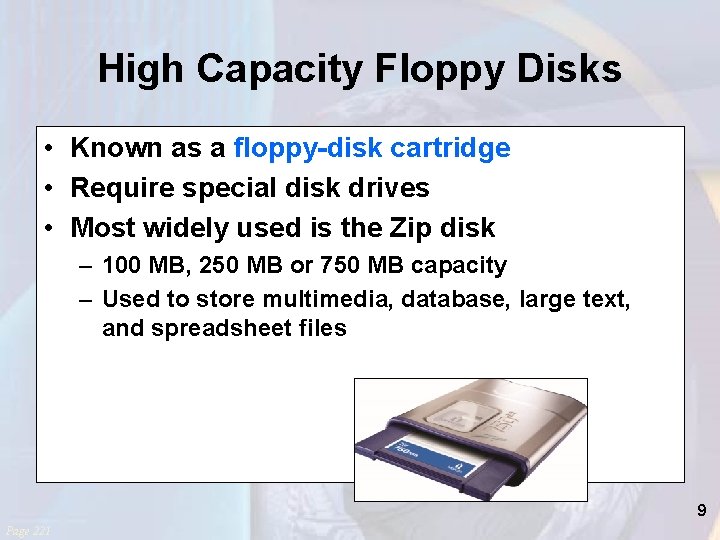
High Capacity Floppy Disks • Known as a floppy-disk cartridge • Require special disk drives • Most widely used is the Zip disk – 100 MB, 250 MB or 750 MB capacity – Used to store multimedia, database, large text, and spreadsheet files 9 Page 221
Hard Disks • • • Use thicker, metallic platters for storage Faster than a floppy diskette Large capacity Sensitive instruments There are three types of hard disks: – Internal Hard Disk – Hard-disk cartridge – Hard-disk pack • Performance Enhancements 10 Page 221
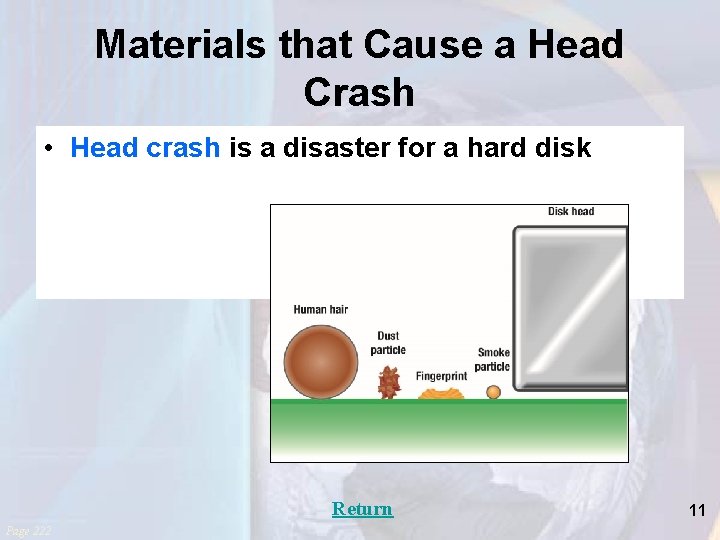
Materials that Cause a Head Crash • Head crash is a disaster for a hard disk Return Page 222 11
Internal Hard Disk • Located inside system unit • Designated as the C drive • Advantages over floppies – Capacity – Access speed Return Page 222 12
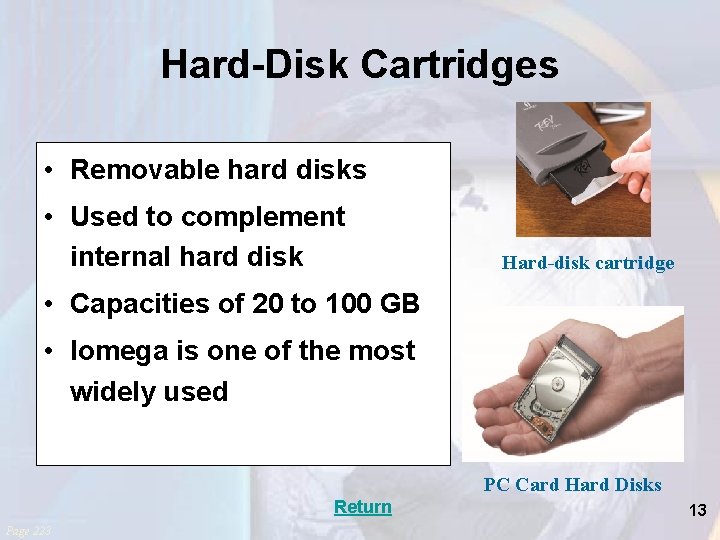
Hard-Disk Cartridges • Removable hard disks • Used to complement internal hard disk Hard-disk cartridge • Capacities of 20 to 100 GB • Iomega is one of the most widely used PC Card Hard Disks Return Page 223 13
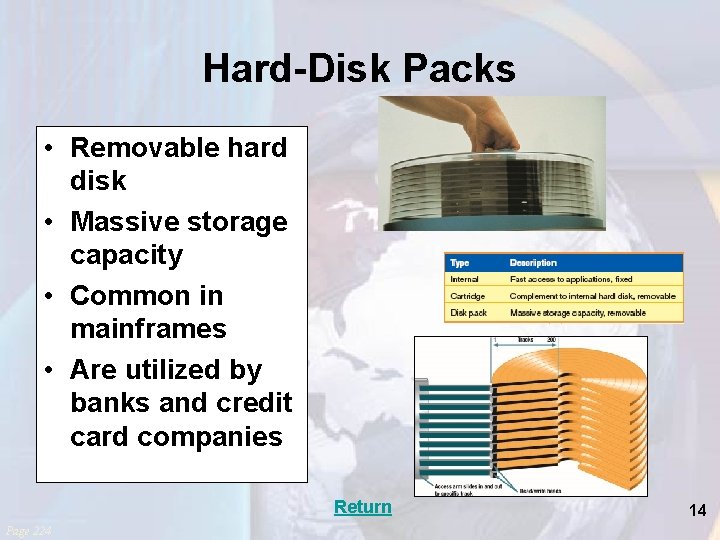
Hard-Disk Packs • Removable hard disk • Massive storage capacity • Common in mainframes • Are utilized by banks and credit card companies Return Page 224 14
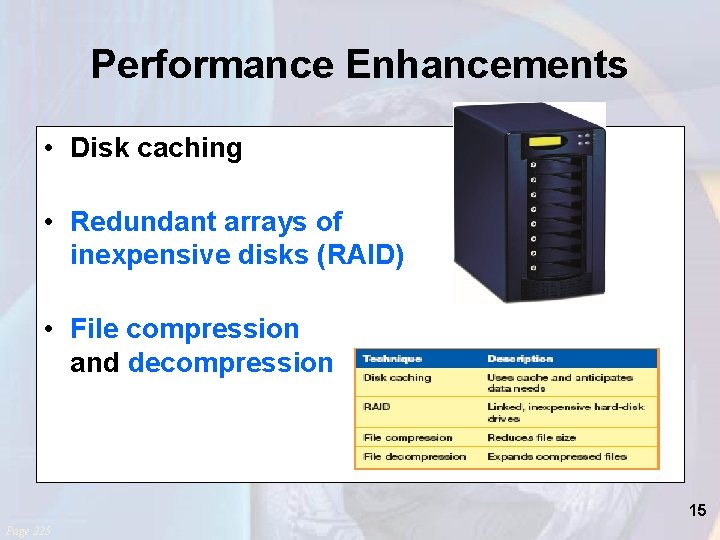
Performance Enhancements • Disk caching • Redundant arrays of inexpensive disks (RAID) • File compression and decompression 15 Page 225
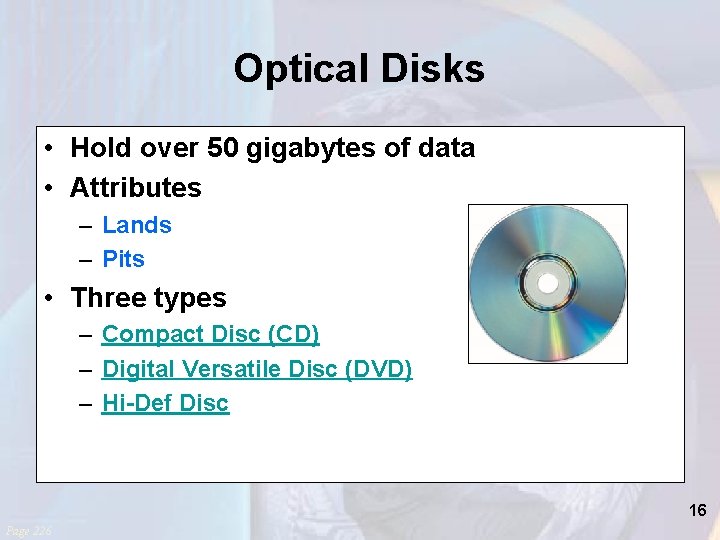
Optical Disks • Hold over 50 gigabytes of data • Attributes – Lands – Pits • Three types – Compact Disc (CD) – Digital Versatile Disc (DVD) – Hi-Def Disc 16 Page 226
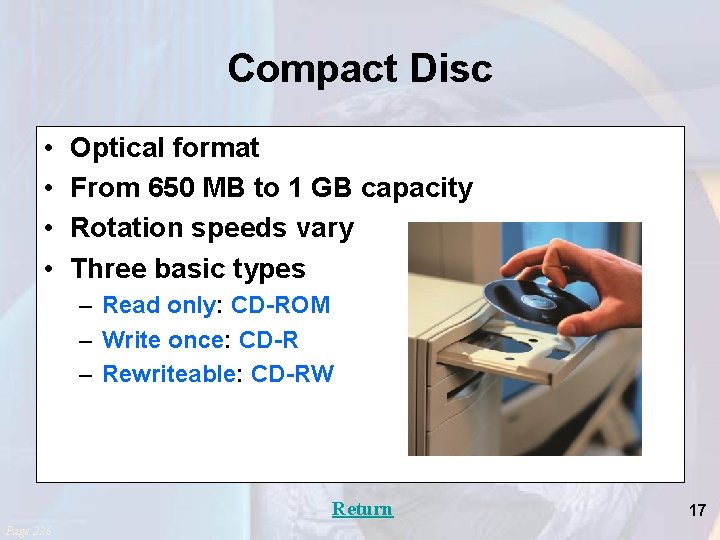
Compact Disc • • Optical format From 650 MB to 1 GB capacity Rotation speeds vary Three basic types – Read only: CD-ROM – Write once: CD-R – Rewriteable: CD-RW Return Page 226 17
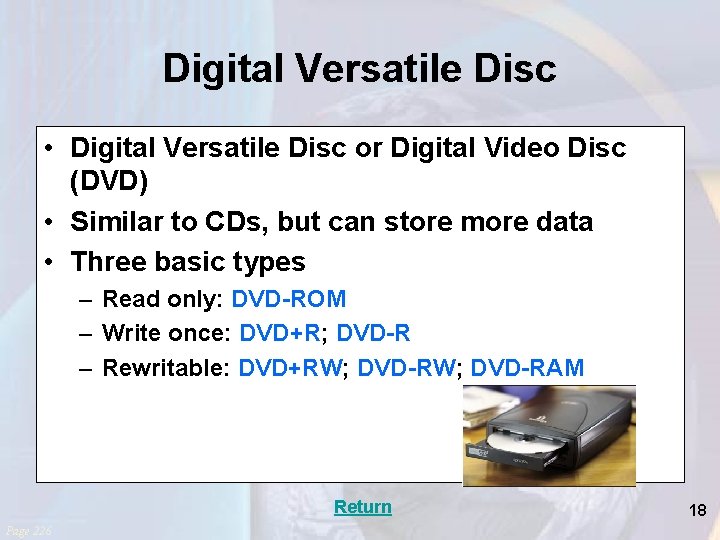
Digital Versatile Disc • Digital Versatile Disc or Digital Video Disc (DVD) • Similar to CDs, but can store more data • Three basic types – Read only: DVD-ROM – Write once: DVD+R; DVD-R – Rewritable: DVD+RW; DVD-RAM Return Page 226 18
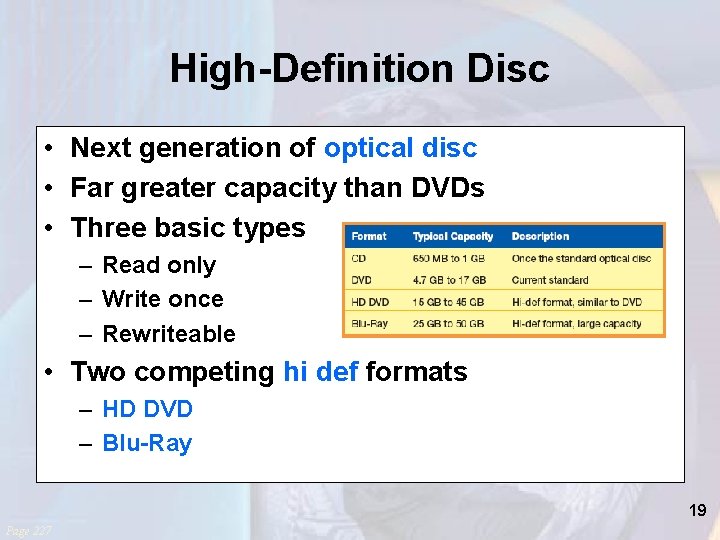
High-Definition Disc • Next generation of optical disc • Far greater capacity than DVDs • Three basic types – Read only – Write once – Rewriteable • Two competing hi def formats – HD DVD – Blu-Ray 19 Page 227
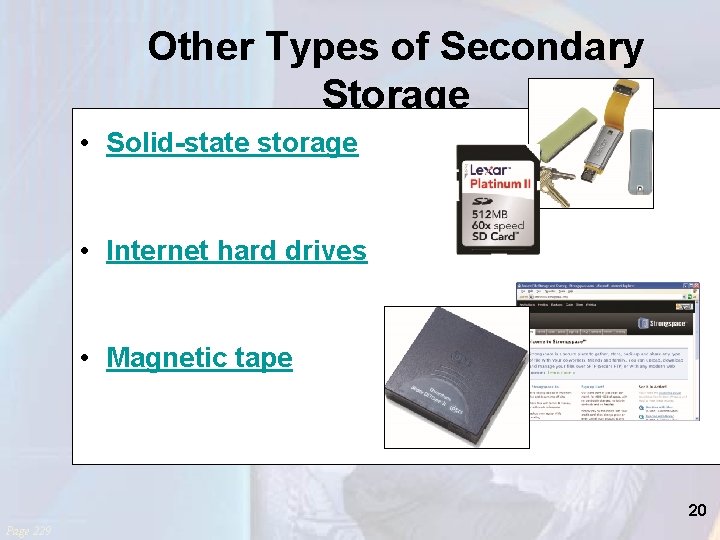
Other Types of Secondary Storage • Solid-state storage • Internet hard drives • Magnetic tape 20 Page 229
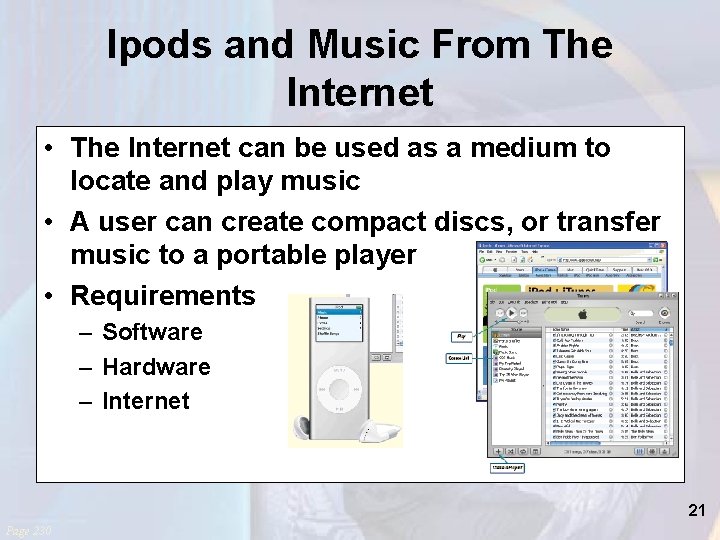
Ipods and Music From The Internet • The Internet can be used as a medium to locate and play music • A user can create compact discs, or transfer music to a portable player • Requirements – Software – Hardware – Internet 21 Page 230
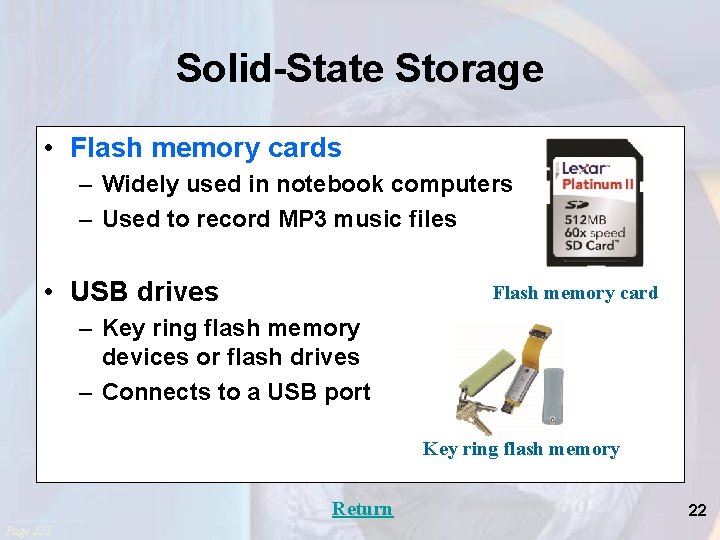
Solid-State Storage • Flash memory cards – Widely used in notebook computers – Used to record MP 3 music files • USB drives Flash memory card – Key ring flash memory devices or flash drives – Connects to a USB port Key ring flash memory Return Page 232 22
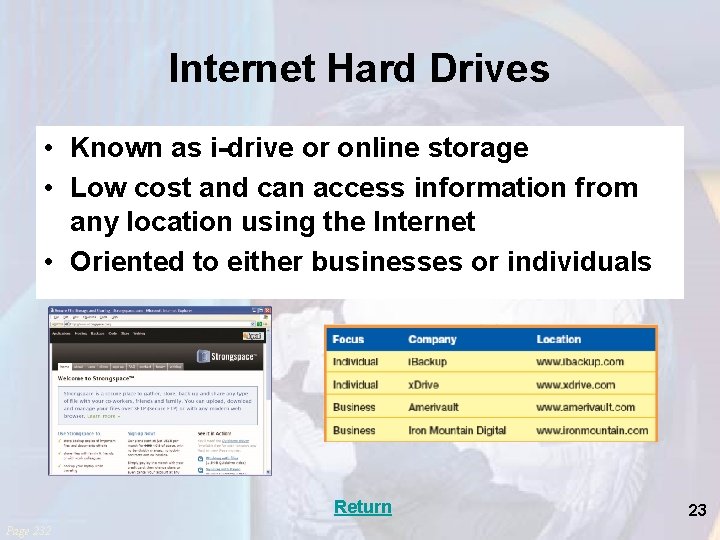
Internet Hard Drives • Known as i-drive or online storage • Low cost and can access information from any location using the Internet • Oriented to either businesses or individuals Return Page 232 23
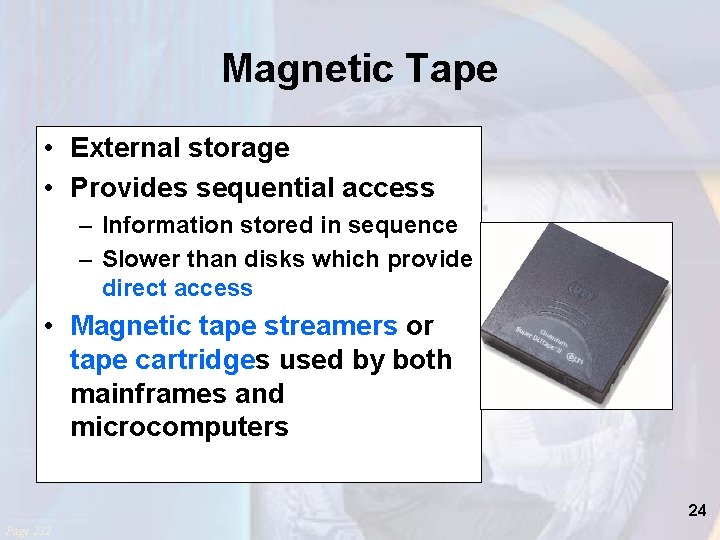
Magnetic Tape • External storage • Provides sequential access – Information stored in sequence – Slower than disks which provide direct access • Magnetic tape streamers or tape cartridges used by both mainframes and microcomputers 24 Page 232
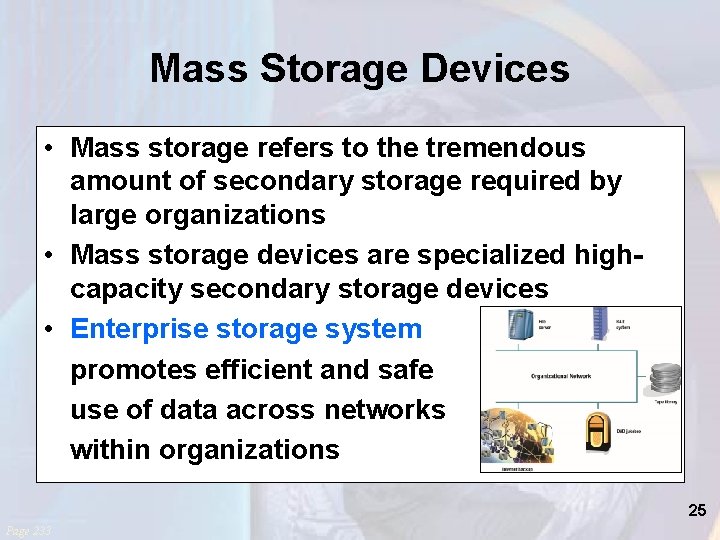
Mass Storage Devices • Mass storage refers to the tremendous amount of secondary storage required by large organizations • Mass storage devices are specialized highcapacity secondary storage devices • Enterprise storage system promotes efficient and safe use of data across networks within organizations 25 Page 233
Careers In IT • Software engineers analyze users’ needs and create application software • General employer requirements – Bachelors degree in computer science – Extensive knowledge of computers and technology – Good communication and analytical skills • Software engineers can expect to earn an annual salary of $53 K to $88 K 26 Page 234
A Look to the Future Your Entire Life Recorded on a Single Disk • Future secondary storage disks could eventually store one terabyte • Experiments with three dimensional storing • Video of an entire life • Technology is being used to rapidly scan photos and videos 27 Page 235
Discussion Questions (Page 1 of 2) • Discuss the traditional and high-capacity floppy disks. • What are three types of hard disks? Describe three ways to improve hard disk performance. • What are the two most common optical disk formats? What is hi def? Describe the basic types for each format. 28 Page 242
Discussion Questions (Page 2 of 2) • Discuss solid-state storage, Internet hard drives, and magnetic tape. What are the advantages and disadvantages of each? • Discuss mass storage, enterprise storage systems, and mass storage devices. 29 Page 242