
Chapter 8 RMON Network Management Principles and Practice






- Slides: 20
Chapter 8 RMON Network Management: Principles and Practice © Mani Subramanian 2000 8 -1
Chapter 8 RMON Components • RMON Probe • Data gatherer - a physical device • Data analyzer • Processor that analyzes data Notes • RMON Remote Network Monitoring • Standards-based network management protocol • Allows network information to be gathered at a single workstation • Defines additional MIBs to provide a richer set of data about network usage Network Management: Principles and Practice © Mani Subramanian 2000 8 -2
Chapter 8 Network with RMONs Notes Nots • Note that RMON is embedded monitoring remote FDDI LAN • Analysis done in NMS Network Management: Principles and Practice © Mani Subramanian 2000 8 -3
Chapter 8 RMON Benefits • Monitors and analyzes locally and relays data; Less load on the network • Needs no direct visibility by NMS • More reliable information • Permits monitoring on a more frequent basis and hence faster fault diagnosis • Increases productivity for administrators Network Management: Principles and Practice © Mani Subramanian 2000 8 -4
Chapter 8 RMON MIB Notes • RMON 1: Ethernet RMON groups (rmon 1 - rmon 9) • RMON 1: Extension: Token ring extension (rmon 10) • RMON 2: Higher layers (3 -7) groups (rmon 11 - rmon 20) Network Management: Principles and Practice © Mani Subramanian 2000 8 -5
Chapter 8 Row Creation & Deletion • Entry. Status data type introduced in RMON • Entry. Status (similar to Row. Status in SNMPv 2) used to create and delete conceptual row. • Only 4 states in RMON compared to 6 in SNMPv 2 Network Management: Principles and Practice © Mani Subramanian 2000 8 -6
Chapter 8 RMON Groups and Functions Notes • Probe gathers data • Functions • Statistics on Ethernet, token ring, and hosts / conversations • Filter group filters data prior to capture of data • Generation of alarms and events Network Management: Principles and Practice © Mani Subramanian 2000 8 -7
Chapter 8 RMON 1 MIB Groups & Tables Notes • Ten groups divided into three categories • Statistics groups (rmon 1, 2, 4, 5, 6, and 10)) • Event reporting groups (rmon 3 and 9) • Filter and packet capture groups(romon 7 and 8) • Groups with “ 2” in the name are enhancements with RMON 2 Network Management: Principles and Practice © Mani Subramanian 2000 8 -8
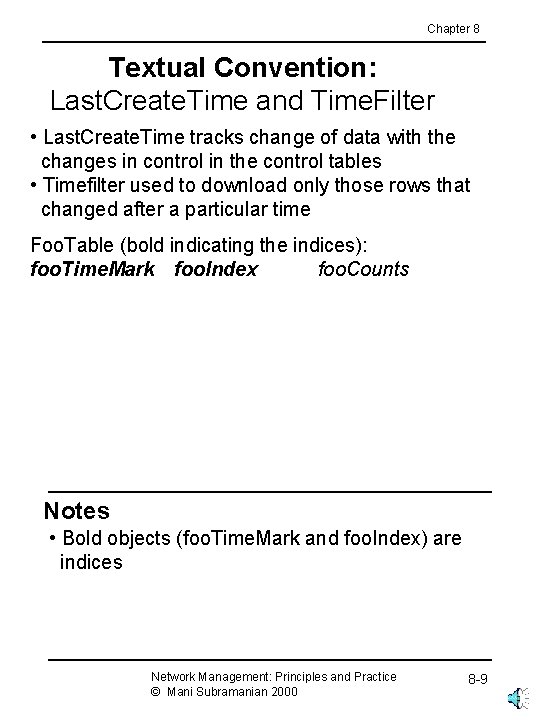
Chapter 8 Textual Convention: Last. Create. Time and Time. Filter • Last. Create. Time tracks change of data with the changes in control in the control tables • Timefilter used to download only those rows that changed after a particular time Foo. Table (bold indicating the indices): foo. Time. Mark foo. Index foo. Counts Notes • Bold objects (foo. Time. Mark and foo. Index) are indices Network Management: Principles and Practice © Mani Subramanian 2000 8 -9
Chapter 8 Control and Data Tables Notes • Control table used to set the instances of data rows in the data table • Values of data index and control index are the same Network Management: Principles and Practice © Mani Subramanian 2000 8 -10
Chapter 8 Matrix Control and SD Tables Notes • matrix. SDTable is the source-destination table • control. Data. Source identifies the source of the data • control. Table. Size identifies entries associated with the data source • control. Owner is creator of the entry Network Management: Principles and Practice © Mani Subramanian 2000 8 -11
Chapter 8 Host Top N Group Example Network Management: Principles and Practice © Mani Subramanian 2000 8 -12
Chapter 8 Filter Group Notes • Filter group used to capture packets defined by logical expressions • Channel is a stream of data captured based on a logical expression • Filter table allows packets to be filtered with an arbitrary filter expression • A row in the channel table associated with multiple rows in the filter table Network Management: Principles and Practice © Mani Subramanian 2000 8 -13
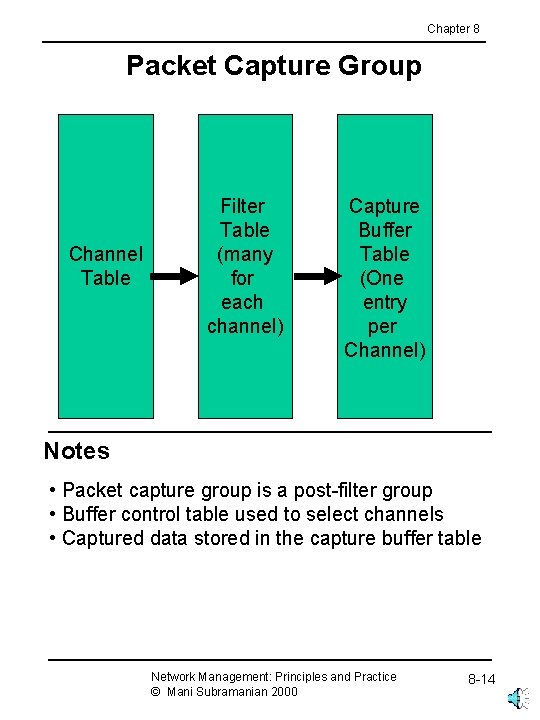
Chapter 8 Packet Capture Group Channel Table Filter Table (many for each channel) Capture Buffer Table (One entry per Channel) Notes • Packet capture group is a post-filter group • Buffer control table used to select channels • Captured data stored in the capture buffer table Network Management: Principles and Practice © Mani Subramanian 2000 8 -14
Chapter 8 RMON TR Extension Groups Notes • Two statistics groups and associated history groups • MAC layer (Statistics group) collects TR parameters • Promiscuous Statistics group collects packets promiscuously on sizes and types of packets • Three groups associated with the stations • Routing group gathers on routing Network Management: Principles and Practice © Mani Subramanian 2000 8 -15
Chapter 8 RMON 2 • Applicable to Layers 3 and above • Functions similar to RMON 1 • Enhancement to RMON 1 • Defined conformance and compliance Network Management: Principles and Practice © Mani Subramanian 2000 8 -16
Chapter 8 RMON 2 MIB Network Management: Principles and Practice © Mani Subramanian 2000 8 -17
Chapter 8 ATM RMON Notes • ATM Forum extended RMON to ATM • Switch extensions and ATM RMON define objects at the base layer • ATM protocol IDs for RMON 2 define additional objects at the higher levels • ATM devices require cell-based measurements and statistics • Probe should be able to handle high speed Network Management: Principles and Practice © Mani Subramanian 2000 8 -18
Chapter 8 A Case Study • A study at Georgia Tech on Internet traffic • Objectives • Traffic growth and trend • Traffic patterns • Network comprising Ethernet and FDDI LANs • Tools used • HP Netmetrix protocol analyzer • Special high-speed TCP dump tool for FDDI LAN • RMON groups utilized • Host top-n • Matrix group • Filter group • Packet capture group (for application level protocols) Network Management: Principles and Practice © Mani Subramanian 2000 8 -21
Chapter 8 Case Study Results Network Management: Principles and Practice © Mani Subramanian 2000 8 -22