
Chapter 8 Risk and Return Capital Market Theory


- Slides: 69
Chapter 8 Risk and Return: Capital Market Theory Copyright © 2011 Pearson Prentice Hall. All rights reserved.
Slide Contents • Learning Objectives • Principles Used in This Chapter 1. Portfolio Returns and Portfolio Risk 2. Systematic Risk and the Market Portfolio 3. The Security Market Line and the CAPM • Key Terms Copyright © 2011 Pearson Prentice Hall. All rights reserved. 8 -2
Learning Objectives 1. Calculate the expected rate of return and volatility for a portfolio of investments and describe how diversification affects the returns to a portfolio of investments. 2. Understand the concept of systematic risk for an individual investment and calculate portfolio systematic risk (beta). Copyright © 2011 Pearson Prentice Hall. All rights reserved. 8 -3
Learning Objectives (cont. ) 3. Estimate an investor’s required rate of return using capital asset pricing model. Copyright © 2011 Pearson Prentice Hall. All rights reserved. 8 -4
Principles Used in This Chapter • Principle 2: There is a Risk-Return Tradeoff. – We extend our risk return analysis to consider portfolios of risky investments and the beneficial effects of portfolio diversification on risk. – In addition, we will learn more about what types of risk are associated with both higher and lower expected rates of return. Copyright © 2011 Pearson Prentice Hall. All rights reserved. 8 -5
8. 1 Portfolio Returns and Portfolio Risk Copyright © 2011 Pearson Prentice Hall. All rights reserved.
Portfolio Returns and Portfolio Risk • With appropriate diversification, we can lower the risk of the portfolio without lowering the portfolio’s expected rate of return. • Some risk can be eliminated by diversification, and those risks that can be eliminated are not necessarily rewarded in the financial marketplace. Copyright © 2011 Pearson Prentice Hall. All rights reserved. 8 -7
Calculating the Expected Return of a Portfolio • To calculate a portfolio’s expected rate of return, we weight each individual investment’s expected rate of return using the fraction of the portfolio that is invested in each investment. Copyright © 2011 Pearson Prentice Hall. All rights reserved. 8 -8
Calculating the Expected Return of a Portfolio (cont. ) • Example 8. 1 : If you invest 25%of your money in the stock of Citi bank (C) with an expected rate of return of -32% and 75% of your money in the stock of Apple (AAPL) with an expected rate of return of 120%, what will be the expected rate of return on this portfolio? Copyright © 2011 Pearson Prentice Hall. All rights reserved. 8 -9
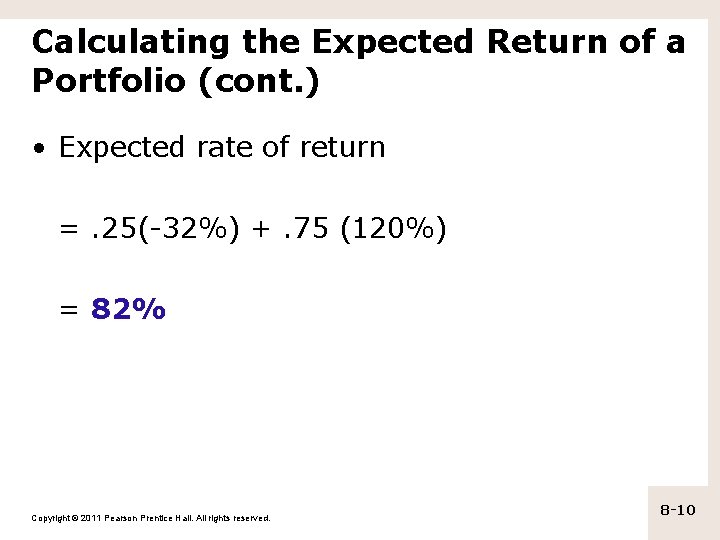
Calculating the Expected Return of a Portfolio (cont. ) • Expected rate of return =. 25(-32%) +. 75 (120%) = 82% Copyright © 2011 Pearson Prentice Hall. All rights reserved. 8 -10
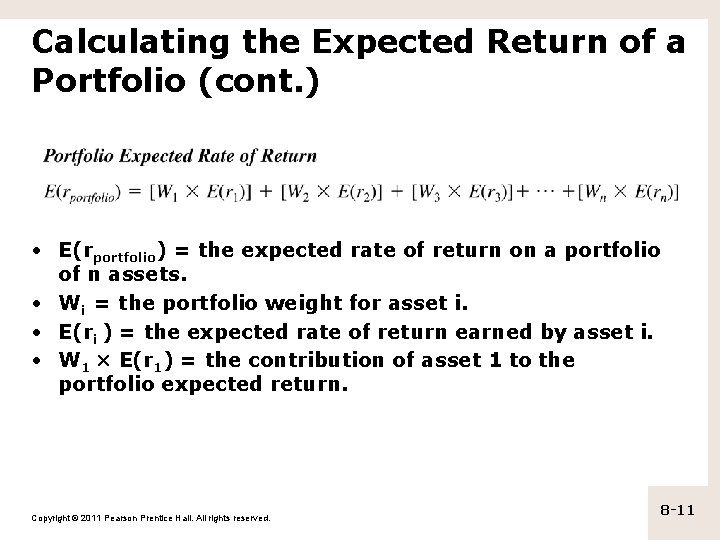
Calculating the Expected Return of a Portfolio (cont. ) • E(rportfolio) = the expected rate of return on a portfolio of n assets. • Wi = the portfolio weight for asset i. • E(ri ) = the expected rate of return earned by asset i. • W 1 × E(r 1) = the contribution of asset 1 to the portfolio expected return. Copyright © 2011 Pearson Prentice Hall. All rights reserved. 8 -11
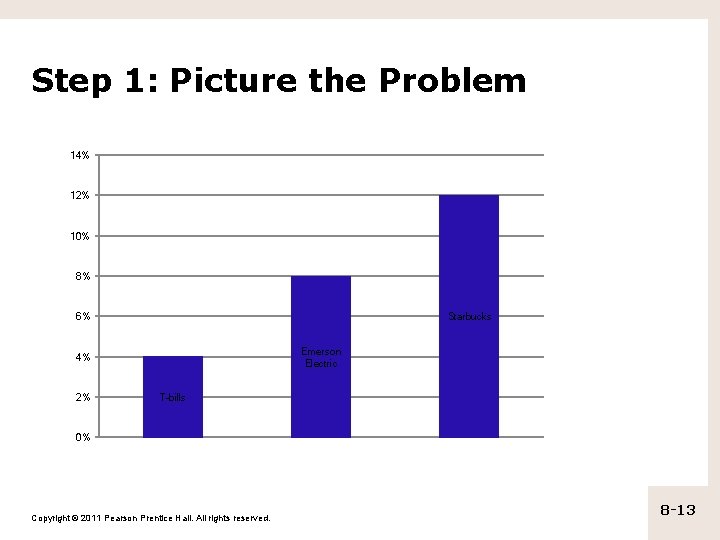
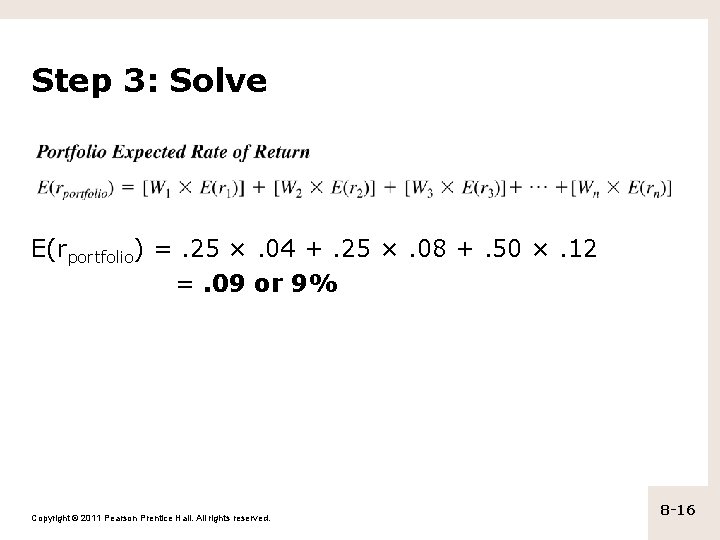
Checkpoint 8. 1: Check Yourself Evaluate the expected return for Penny’s portfolio where she places 1/4 th of her money in Treasury bills, half in Starbucks stock, and the remainder in Emerson Electric stock. Copyright © 2011 Pearson Prentice Hall. All rights reserved. 8 -12
Step 1: Picture the Problem 14% 12% 10% 8% 6% Starbucks Emerson Electric 4% 2% T-bills 0% Copyright © 2011 Pearson Prentice Hall. All rights reserved. 8 -13
Step 1: Picture the Problem (cont. ) • The figure in the previous slide shows the expected rates of return for the three stocks in the portfolio. • Starbucks has the highest expected return at 12% and Treasury bills have the lowest expected return at 4%. Copyright © 2011 Pearson Prentice Hall. All rights reserved. 8 -14
Step 2: Decide on a Solution Strategy • The portfolio expected rate of return is simply a weighted average of the expected rates of return of the investments in the portfolio. • We can use equation 8 -1 to calculate the expected rate of return for Penny’s portfolio. Copyright © 2011 Pearson Prentice Hall. All rights reserved. 8 -15
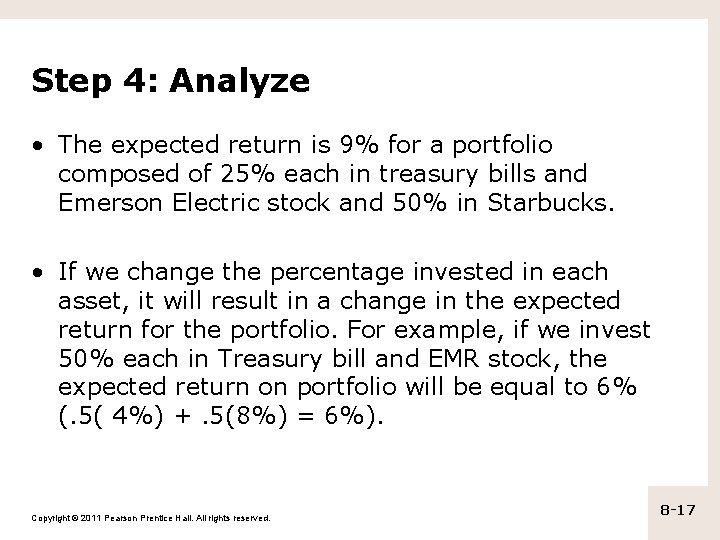
Step 3: Solve E(rportfolio) =. 25 ×. 04 +. 25 ×. 08 +. 50 ×. 12 =. 09 or 9% Copyright © 2011 Pearson Prentice Hall. All rights reserved. 8 -16
Step 4: Analyze • The expected return is 9% for a portfolio composed of 25% each in treasury bills and Emerson Electric stock and 50% in Starbucks. • If we change the percentage invested in each asset, it will result in a change in the expected return for the portfolio. For example, if we invest 50% each in Treasury bill and EMR stock, the expected return on portfolio will be equal to 6% (. 5( 4%) +. 5(8%) = 6%). Copyright © 2011 Pearson Prentice Hall. All rights reserved. 8 -17
Evaluating Portfolio Risk • Unlike expected return, standard deviation is not generally equal to the a weighted average of the standard deviations of the returns of investments held in the portfolio. • This is because of diversification effects. Copyright © 2011 Pearson Prentice Hall. All rights reserved. 8 -18
Portfolio Diversification • The effect of reducing risks by including a large number of investments in a portfolio is called diversification. • As a consequence of diversification, the standard deviation of the returns of a portfolio is typically less than the average of the standard deviation of the returns of each of the individual investments. Copyright © 2011 Pearson Prentice Hall. All rights reserved. 8 -19
Portfolio Diversification (cont. ) • The diversification gains achieved by adding more investments will depend on the degree of correlation among the investments. • The degree of correlation is measured by using the correlation coefficient. Copyright © 2011 Pearson Prentice Hall. All rights reserved. 8 -20
Portfolio Diversification (cont. ) • The correlation coefficient can range from 1. 0 (perfect negative correlation), meaning two variables move in perfectly opposite directions to +1. 0 (perfect positive correlation), which means the two assets move exactly together. • A correlation coefficient of 0 means that there is no relationship between the returns earned by the two assets. Copyright © 2011 Pearson Prentice Hall. All rights reserved. 8 -21
Portfolio Diversification (cont. ) • As long as the investment returns are not perfectly positively correlated, there will be diversification benefits. • However, the diversification benefits will be greater when the correlations are low or positive. • The returns on most investment assets tend to be positively correlated. Copyright © 2011 Pearson Prentice Hall. All rights reserved. 8 -22
Diversification Lessons 1. A portfolio can be less risky than the average risk of its individual investments in the portfolio. 2. The key to reducing risk through diversification is to combine investments whose returns do not move together. Copyright © 2011 Pearson Prentice Hall. All rights reserved. 8 -23
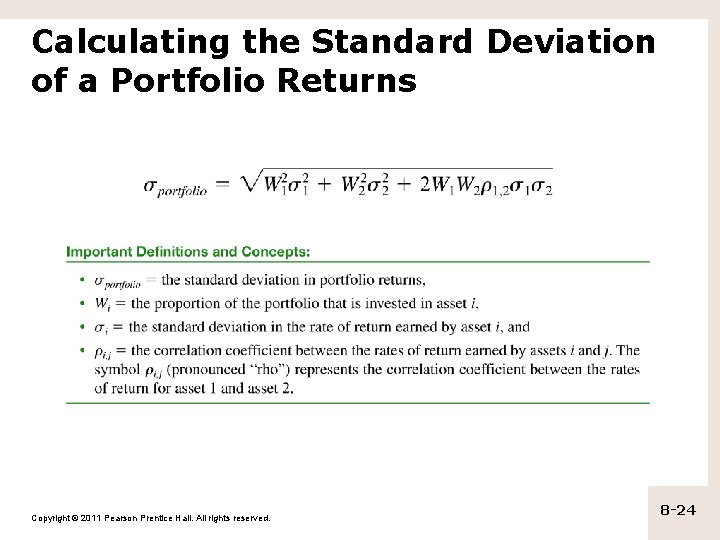
Calculating the Standard Deviation of a Portfolio Returns Copyright © 2011 Pearson Prentice Hall. All rights reserved. 8 -24
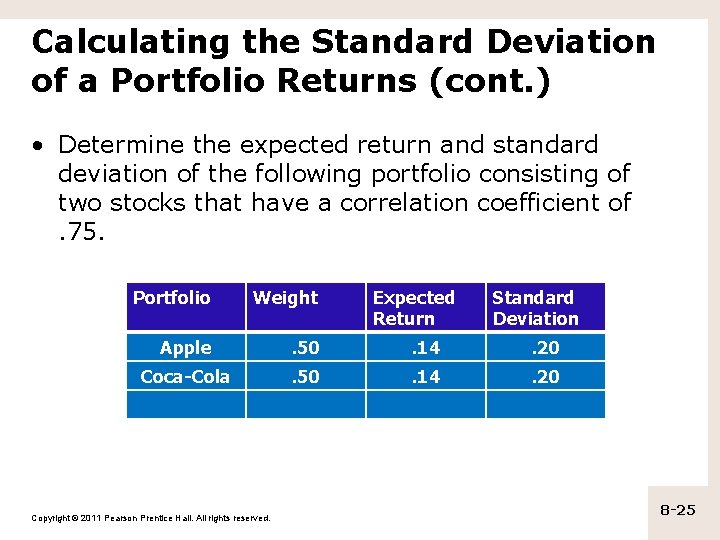
Calculating the Standard Deviation of a Portfolio Returns (cont. ) • Determine the expected return and standard deviation of the following portfolio consisting of two stocks that have a correlation coefficient of. 75. Portfolio Weight Apple . 50 . 14 . 20 Coca-Cola . 50 . 14 . 20 Copyright © 2011 Pearson Prentice Hall. All rights reserved. Expected Return Standard Deviation 8 -25
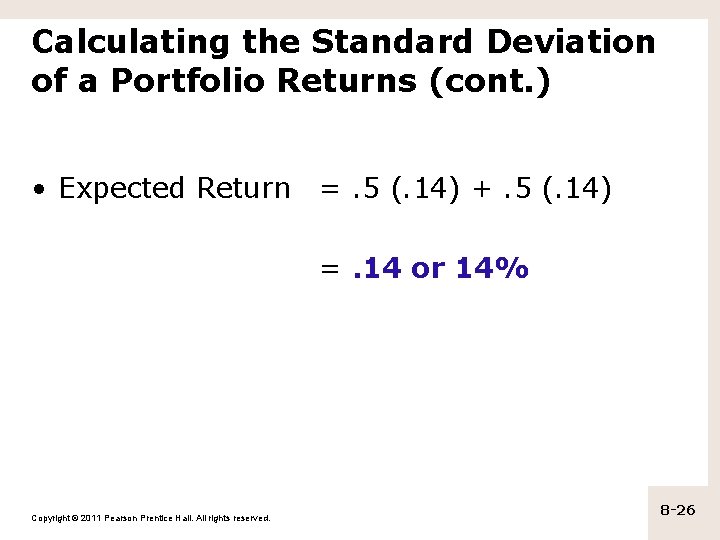
Calculating the Standard Deviation of a Portfolio Returns (cont. ) • Expected Return =. 5 (. 14) +. 5 (. 14) =. 14 or 14% Copyright © 2011 Pearson Prentice Hall. All rights reserved. 8 -26
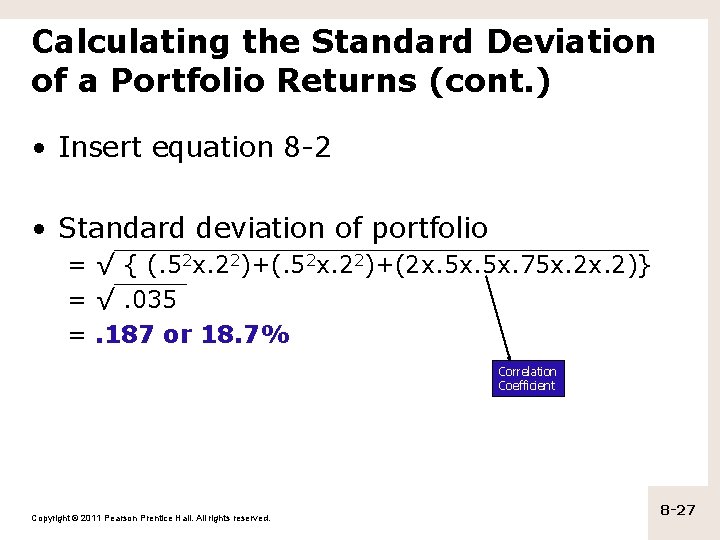
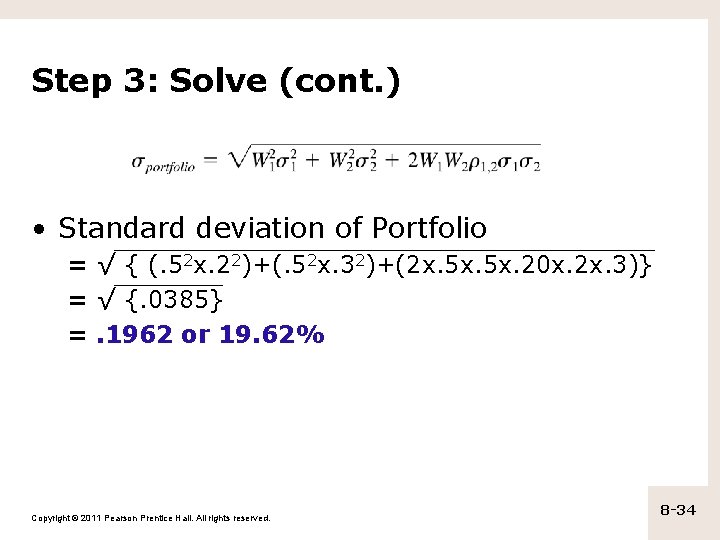
Calculating the Standard Deviation of a Portfolio Returns (cont. ) • Insert equation 8 -2 • Standard deviation of portfolio = √ { (. 52 x. 22)+(2 x. 5 x. 75 x. 2)} = √. 035 =. 187 or 18. 7% Correlation Coefficient Copyright © 2011 Pearson Prentice Hall. All rights reserved. 8 -27
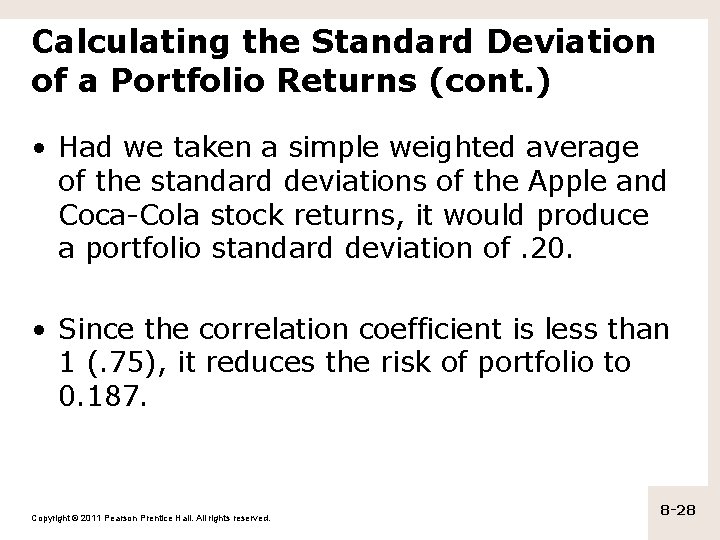
Calculating the Standard Deviation of a Portfolio Returns (cont. ) • Had we taken a simple weighted average of the standard deviations of the Apple and Coca-Cola stock returns, it would produce a portfolio standard deviation of. 20. • Since the correlation coefficient is less than 1 (. 75), it reduces the risk of portfolio to 0. 187. Copyright © 2011 Pearson Prentice Hall. All rights reserved. 8 -28
Checkpoint 8. 2: Check Yourself Evaluate the expected return and standard deviation of the portfolio where the correlation is assumed to be. 20 and Sarah still places half of her money in each of the funds. Copyright © 2011 Pearson Prentice Hall. All rights reserved. 8 -29
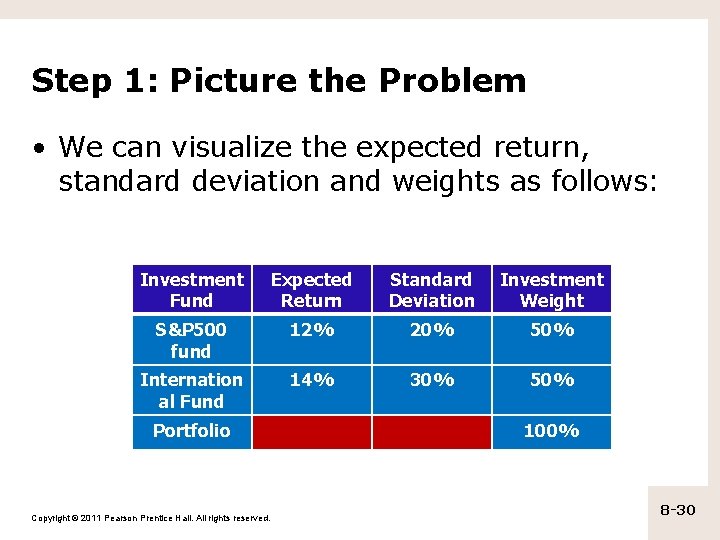
Step 1: Picture the Problem • We can visualize the expected return, standard deviation and weights as follows: Investment Fund Expected Return Standard Deviation Investment Weight S&P 500 fund 12% 20% 50% Internation al Fund 14% 30% 50% Portfolio Copyright © 2011 Pearson Prentice Hall. All rights reserved. 100% 8 -30
Step 1: Picture the Problem (cont. ) • Sarah needs to determine the answers to place in the empty squares. Copyright © 2011 Pearson Prentice Hall. All rights reserved. 8 -31
Step 2: Decide on a Solution Strategy • The portfolio expected return is a simple weighted average of the expected rates of return of the two investments given by equation 8 -1. • The standard deviation of the portfolio can be calculated using equation 8 -2. We are given the correlation to be equal to. 20. Copyright © 2011 Pearson Prentice Hall. All rights reserved. 8 -32
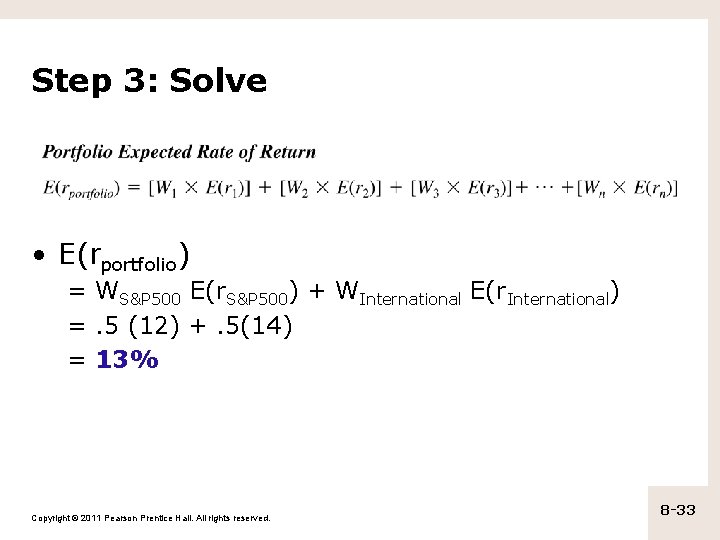
Step 3: Solve • E(rportfolio) = WS&P 500 E(r. S&P 500) + WInternational E(r. International) =. 5 (12) +. 5(14) = 13% Copyright © 2011 Pearson Prentice Hall. All rights reserved. 8 -33
Step 3: Solve (cont. ) • Standard deviation of Portfolio = √ { (. 52 x. 22)+(. 52 x. 32)+(2 x. 5 x. 20 x. 2 x. 3)} = √ {. 0385} =. 1962 or 19. 62% Copyright © 2011 Pearson Prentice Hall. All rights reserved. 8 -34
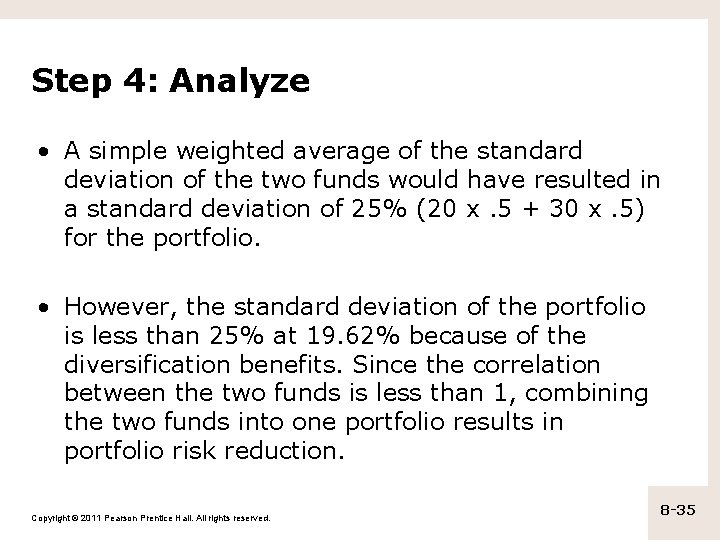
Step 4: Analyze • A simple weighted average of the standard deviation of the two funds would have resulted in a standard deviation of 25% (20 x. 5 + 30 x. 5) for the portfolio. • However, the standard deviation of the portfolio is less than 25% at 19. 62% because of the diversification benefits. Since the correlation between the two funds is less than 1, combining the two funds into one portfolio results in portfolio risk reduction. Copyright © 2011 Pearson Prentice Hall. All rights reserved. 8 -35
8. 2 Systematic Risk and the Market Portfolio Copyright © 2011 Pearson Prentice Hall. All rights reserved.
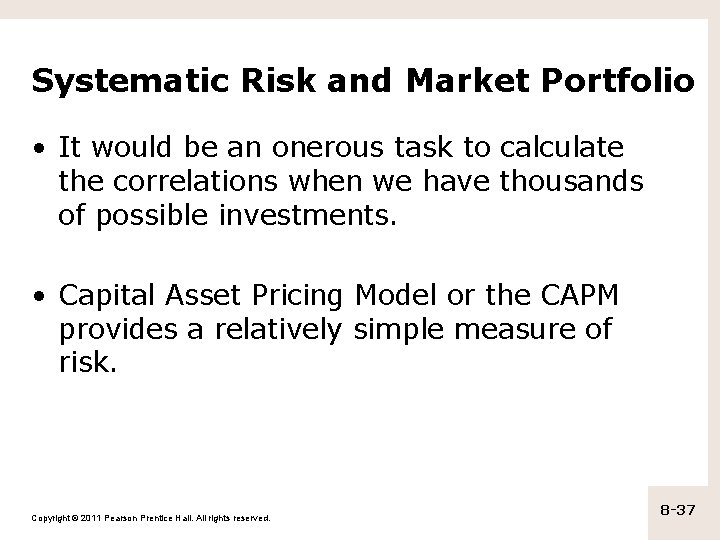
Systematic Risk and Market Portfolio • It would be an onerous task to calculate the correlations when we have thousands of possible investments. • Capital Asset Pricing Model or the CAPM provides a relatively simple measure of risk. Copyright © 2011 Pearson Prentice Hall. All rights reserved. 8 -37
Systematic Risk and Market Portfolio (cont. ) • CAPM assumes that investors chose to hold the optimally diversified portfolio that includes all risky investments. This optimally diversified portfolio that includes all of the economy’s assets is referred to as the market portfolio. Copyright © 2011 Pearson Prentice Hall. All rights reserved. 8 -38
Systematic Risk and Market Portfolio (cont. ) • According to the CAPM, the relevant risk of an investment relates to how the investment contributes to the risk of this market portfolio. Copyright © 2011 Pearson Prentice Hall. All rights reserved. 8 -39
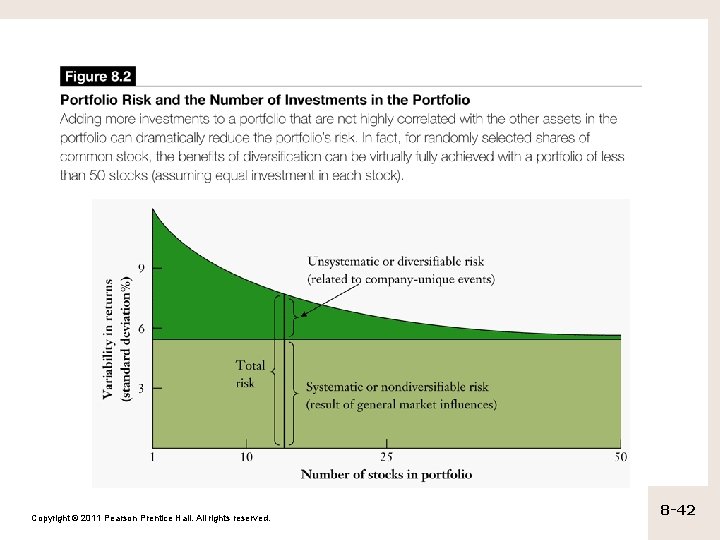
Systematic Risk and Market Portfolio (cont. ) • To understand how an investment contributes to the risk of the portfolio, we categorize the risks of the individual investments into two categories: – Systematic risk, and – Unsystematic risk Copyright © 2011 Pearson Prentice Hall. All rights reserved. 8 -40
Systematic Risk and Market Portfolio (cont. ) • The systematic risk component measures the contribution of the investment to the risk of the market. For example: War, hike in corporate tax rate. • The unsystematic risk is the element of risk that does not contribute to the risk of the market. This component is diversified away when the investment is combined with other investments. For example: Product recall, labor strike, change of management. Copyright © 2011 Pearson Prentice Hall. All rights reserved. 8 -41
Copyright © 2011 Pearson Prentice Hall. All rights reserved. 8 -42
Diversification and Unsystematic Risk • Figure 8 -2 illustrates that as the number of securities in a portfolio increases, the contribution of the unsystematic or diversifiable risk to the standard deviation of the portfolio declines. Copyright © 2011 Pearson Prentice Hall. All rights reserved. 8 -43
Diversification and Systematic Risk • Figure 8 -2 illustrates that systematic or non-diversifiable risk is not reduced even as we increase the number of stocks in the portfolio. • Systematic sources of risk (such as inflation, war, interest rates) are common to most investments resulting in a perfect positive correlation and no diversification benefit. Copyright © 2011 Pearson Prentice Hall. All rights reserved. 8 -44
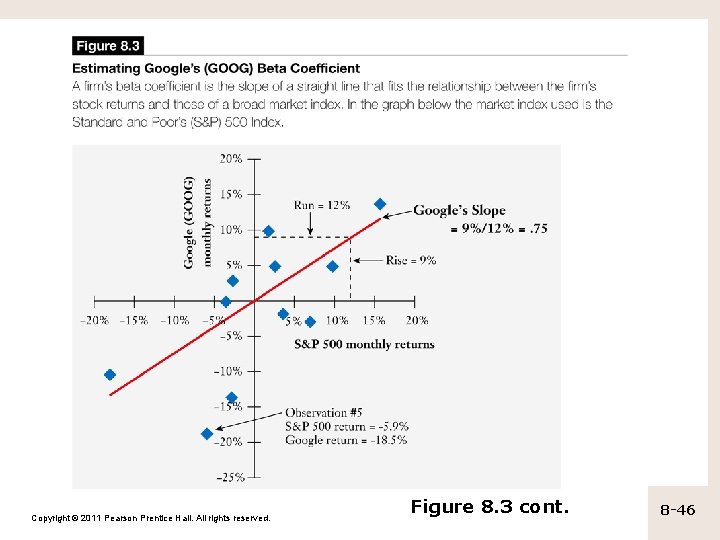
Systematic Risk and Beta • Systematic risk is measured by beta coefficient, which estimates the extent to which a particular investment’s returns vary with the returns on the market portfolio. • In practice, it is estimated as the slope of a straight line (see figure 8 -3) Copyright © 2011 Pearson Prentice Hall. All rights reserved. 8 -45
Copyright © 2011 Pearson Prentice Hall. All rights reserved. Figure 8. 3 cont. 8 -46
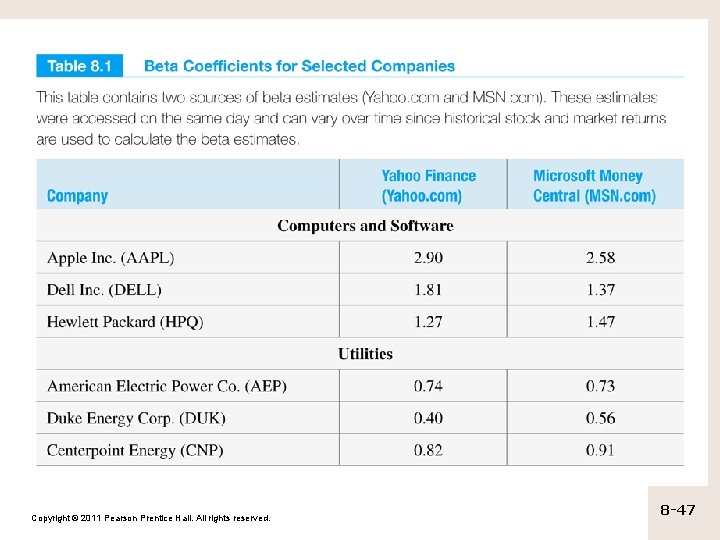
Copyright © 2011 Pearson Prentice Hall. All rights reserved. 8 -47
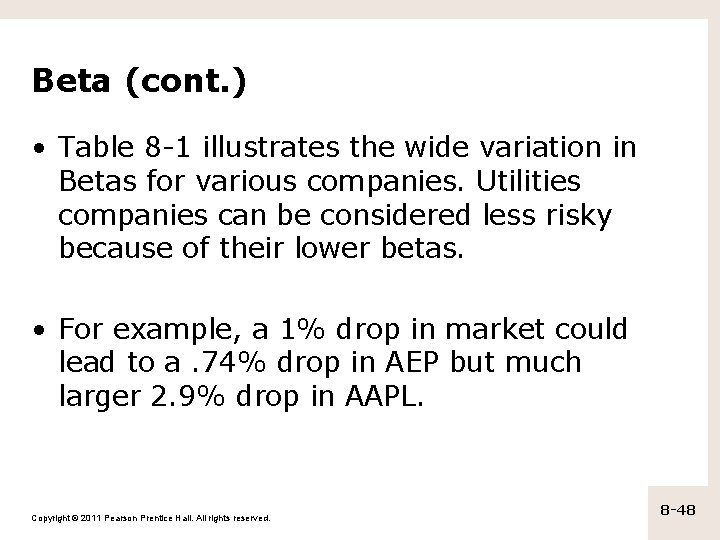
Beta (cont. ) • Table 8 -1 illustrates the wide variation in Betas for various companies. Utilities companies can be considered less risky because of their lower betas. • For example, a 1% drop in market could lead to a. 74% drop in AEP but much larger 2. 9% drop in AAPL. Copyright © 2011 Pearson Prentice Hall. All rights reserved. 8 -48
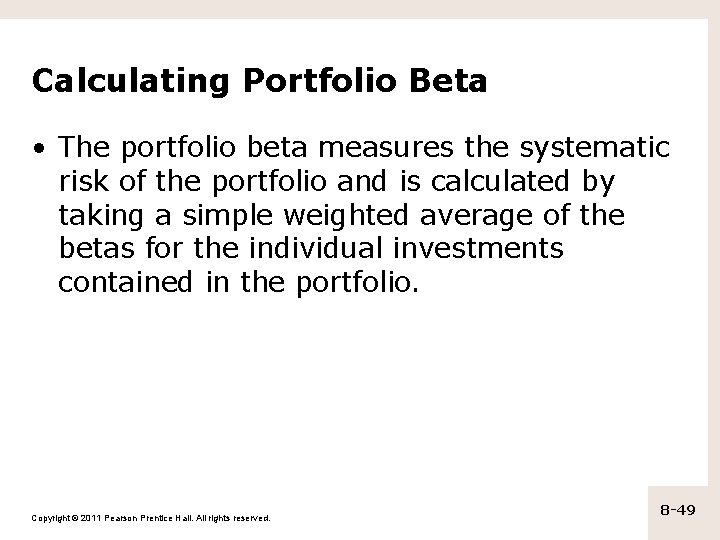
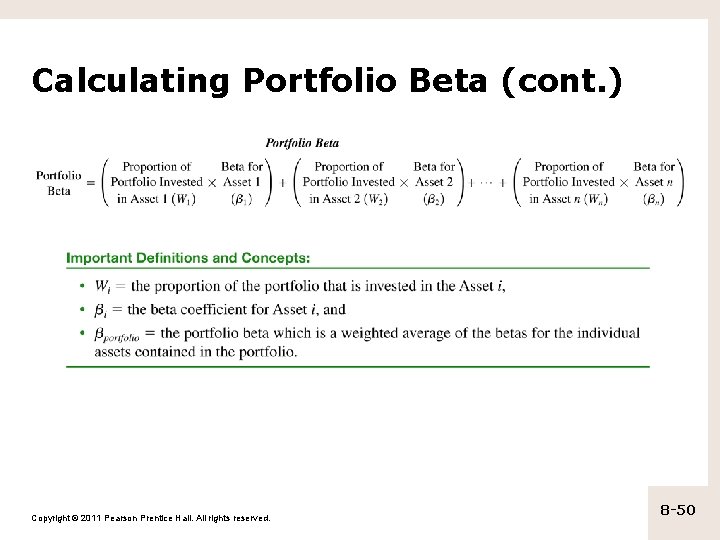
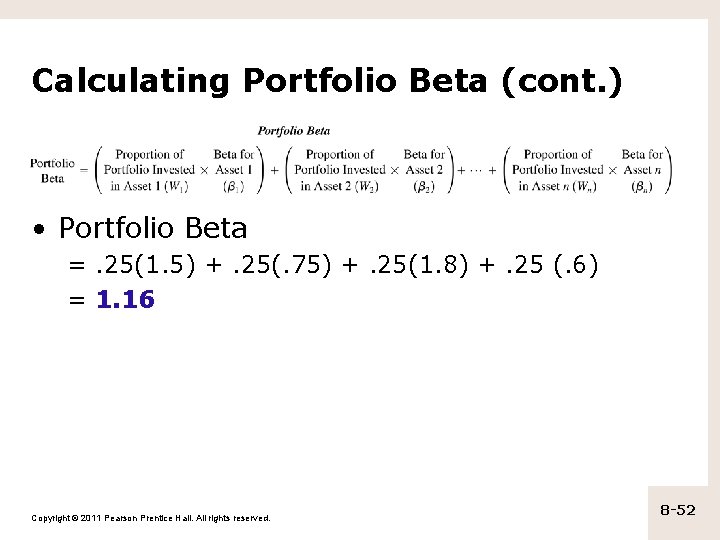
Calculating Portfolio Beta • The portfolio beta measures the systematic risk of the portfolio and is calculated by taking a simple weighted average of the betas for the individual investments contained in the portfolio. Copyright © 2011 Pearson Prentice Hall. All rights reserved. 8 -49
Calculating Portfolio Beta (cont. ) Copyright © 2011 Pearson Prentice Hall. All rights reserved. 8 -50
Calculating Portfolio Beta (cont. ) • Example 8. 2 Consider a portfolio that is comprised of four investments with betas equal to 1. 5, . 75, 1. 8 and. 60. If you invest equal amount in each investment, what will be the beta for the portfolio? Copyright © 2011 Pearson Prentice Hall. All rights reserved. 8 -51
Calculating Portfolio Beta (cont. ) • Portfolio Beta =. 25(1. 5) +. 25(. 75) +. 25(1. 8) +. 25 (. 6) = 1. 16 Copyright © 2011 Pearson Prentice Hall. All rights reserved. 8 -52
8. 3 The Security Market Line and the CAPM Copyright © 2011 Pearson Prentice Hall. All rights reserved.
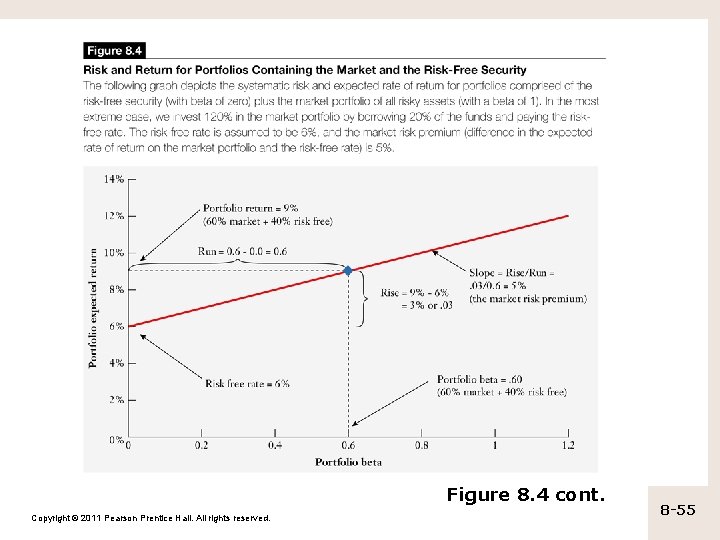
The Security Market Line and the CAPM • CAPM also describes how the betas relate to the expected rates of return that investors require on their investments. • The key insight of CAPM is that investors will require a higher rate of return on investments with higher betas. Copyright © 2011 Pearson Prentice Hall. All rights reserved. 8 -54
Figure 8. 4 cont. Copyright © 2011 Pearson Prentice Hall. All rights reserved. 8 -55
The Security Market Line and the CAPM (cont. ) • The straight line relationship between the betas and expected returns in Figure 8 -4 is called the security market line (SML), and its slope is often referred to as the reward to risk ratio. • SML is a graphical representation of the CAPM. Copyright © 2011 Pearson Prentice Hall. All rights reserved. 8 -56
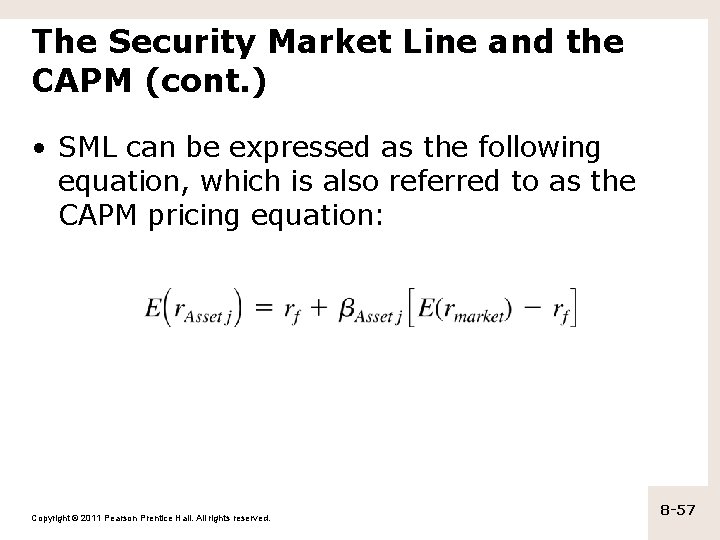
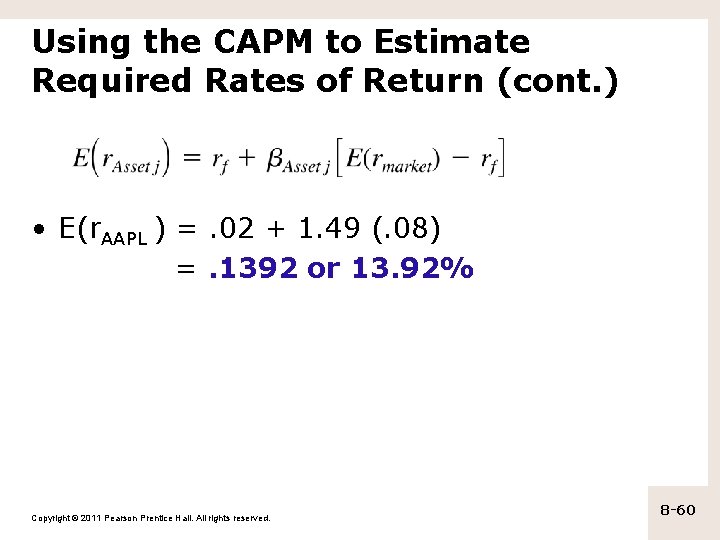
The Security Market Line and the CAPM (cont. ) • SML can be expressed as the following equation, which is also referred to as the CAPM pricing equation: Copyright © 2011 Pearson Prentice Hall. All rights reserved. 8 -57
The Security Market Line and the CAPM (cont. ) • Equation 8 -6 implies that higher the systematic risk of an investment, other things remaining the same, the higher will be the expected rate of return an investor would require to invest in the asset. • This is consistent with Principle 2: There is a Risk-Return Tradeoff. Copyright © 2011 Pearson Prentice Hall. All rights reserved. 8 -58
Using the CAPM to Estimate Required Rates of Return • Example 8. 2 What will be the expected rate of return on AAPL stock with a beta of 1. 49 if the risk-free rate of interest is 2% and if the market risk premium, which is the difference between expected return on the market portfolio and the risk-free rate of return is estimated to be 8%? Copyright © 2011 Pearson Prentice Hall. All rights reserved. 8 -59
Using the CAPM to Estimate Required Rates of Return (cont. ) • E(r. AAPL ) =. 02 + 1. 49 (. 08) =. 1392 or 13. 92% Copyright © 2011 Pearson Prentice Hall. All rights reserved. 8 -60
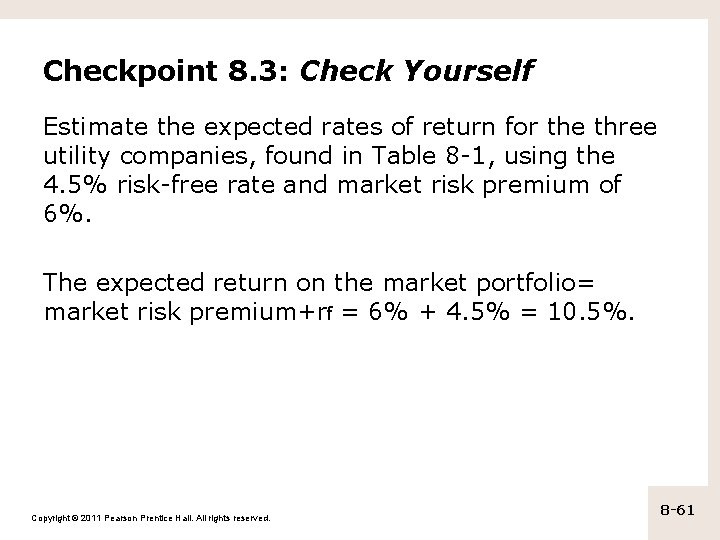
Checkpoint 8. 3: Check Yourself Estimate the expected rates of return for the three utility companies, found in Table 8 -1, using the 4. 5% risk-free rate and market risk premium of 6%. The expected return on the market portfolio= market risk premium+rf = 6% + 4. 5% = 10. 5%. Copyright © 2011 Pearson Prentice Hall. All rights reserved. 8 -61
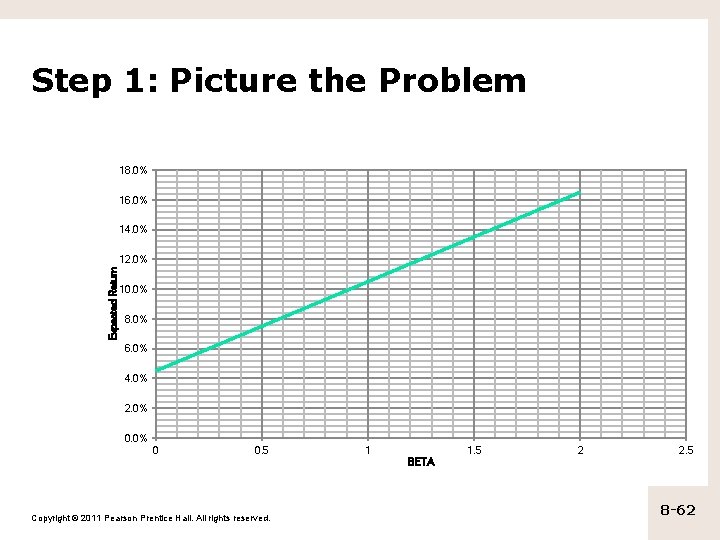
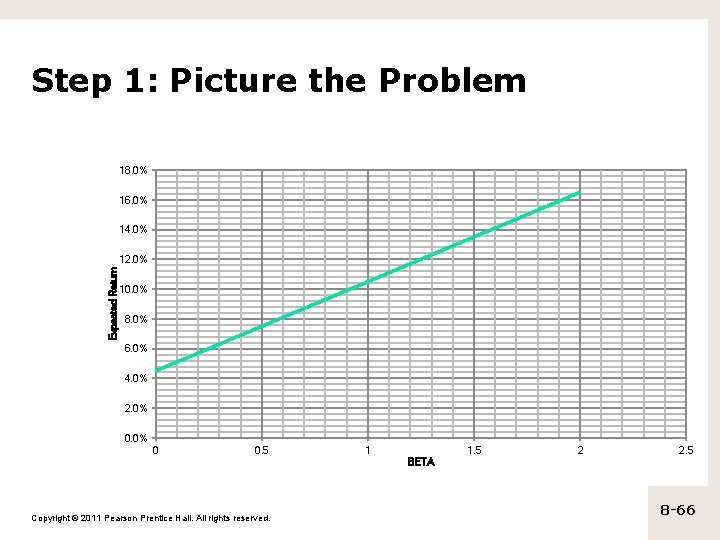
Step 1: Picture the Problem 18. 0% 16. 0% 14. 0% Expected Return 12. 0% 10. 0% 8. 0% 6. 0% 4. 0% 2. 0% 0 0. 5 1 1. 5 2 2. 5 BETA Copyright © 2011 Pearson Prentice Hall. All rights reserved. 8 -62
Step 1: Picture the Problem • The graph shows that as beta increases, the expected return also increases. • When beta = 0, the expected return is equal to the risk free rate of 4. 5%. Copyright © 2011 Pearson Prentice Hall. All rights reserved. 8 -63
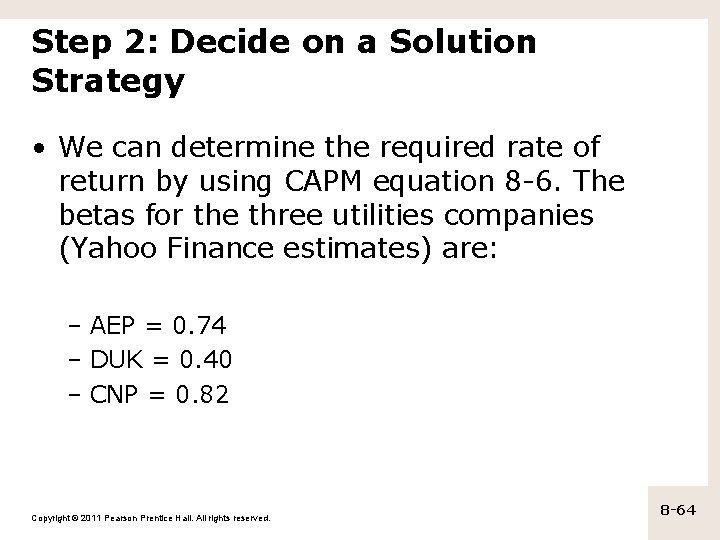
Step 2: Decide on a Solution Strategy • We can determine the required rate of return by using CAPM equation 8 -6. The betas for the three utilities companies (Yahoo Finance estimates) are: – AEP = 0. 74 – DUK = 0. 40 – CNP = 0. 82 Copyright © 2011 Pearson Prentice Hall. All rights reserved. 8 -64
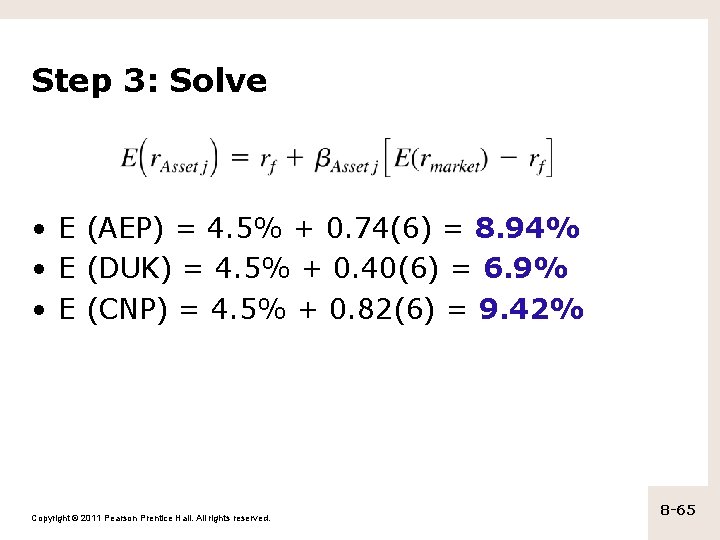
Step 3: Solve • E (AEP) = 4. 5% + 0. 74(6) = 8. 94% • E (DUK) = 4. 5% + 0. 40(6) = 6. 9% • E (CNP) = 4. 5% + 0. 82(6) = 9. 42% Copyright © 2011 Pearson Prentice Hall. All rights reserved. 8 -65
Step 1: Picture the Problem 18. 0% 16. 0% 14. 0% Expected Return 12. 0% 10. 0% 8. 0% 6. 0% 4. 0% 2. 0% 0 0. 5 1 1. 5 2 2. 5 BETA Copyright © 2011 Pearson Prentice Hall. All rights reserved. 8 -66
Step 4: Analyze • The expected rates of return on the stocks vary depending on their beta. • Higher the beta, higher is the expected return. Copyright © 2011 Pearson Prentice Hall. All rights reserved. 8 -67
Key Terms • • Beta coefficient Capital asset pricing model (CAPM) Correlation coefficient Diversification Diversifiable risk Market portfolio Market risk premium Copyright © 2011 Pearson Prentice Hall. All rights reserved. 8 -68
Key Terms (cont. ) • • • Non-diversifiable risk Portfolio beta Security market line Systematic risk Unsystematic risk Copyright © 2011 Pearson Prentice Hall. All rights reserved. 8 -69