
Chapter 8 Risk and Rates of Return Essentials


- Slides: 27
Chapter 8 Risk and Rates of Return Essentials of Managerial Finance by S. Besley & E. Brigham Slide 1 of 27
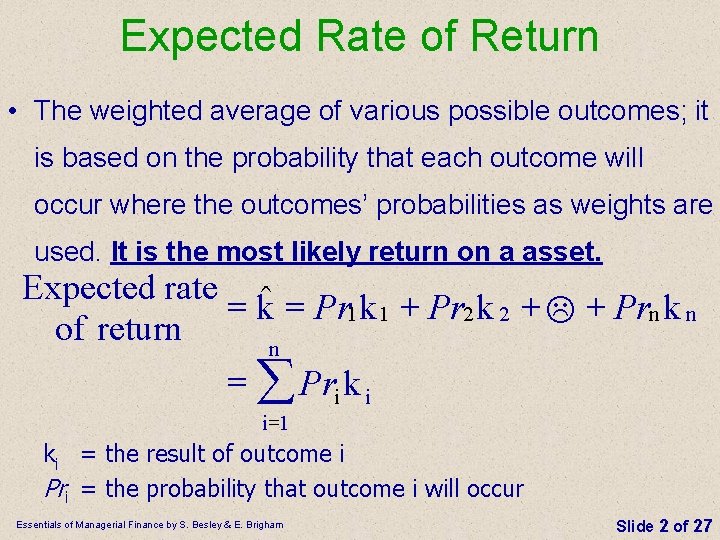
Expected Rate of Return • The weighted average of various possible outcomes; it is based on the probability that each outcome will occur where the outcomes’ probabilities as weights are used. It is the most likely return on a asset. Expected rate = = k Pr 1 k 1 + Pr 2 k 2 + L + Prn k n of return n = å Pri k i i =1 ki = the result of outcome i Pri = the probability that outcome i will occur Essentials of Managerial Finance by S. Besley & E. Brigham Slide 2 of 27
Expected Rate of Return - Example Essentials of Managerial Finance by S. Besley & E. Brigham Slide 3 of 27
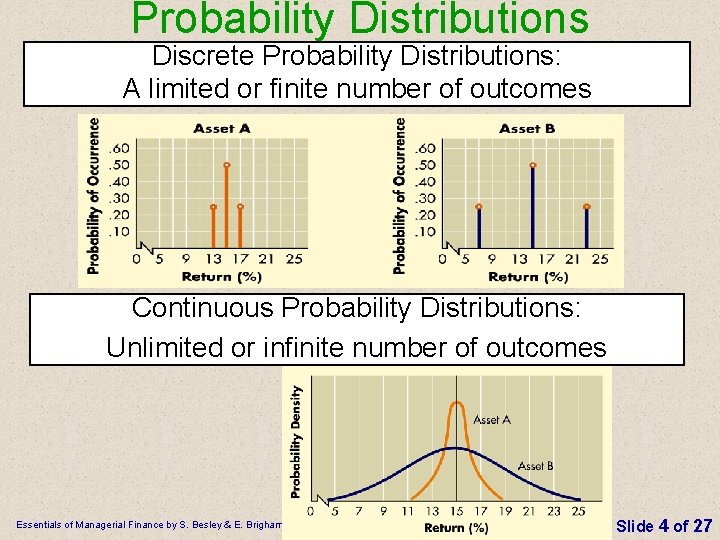
Probability Distributions Discrete Probability Distributions: A limited or finite number of outcomes Continuous Probability Distributions: Unlimited or infinite number of outcomes Essentials of Managerial Finance by S. Besley & E. Brigham Slide 4 of 27
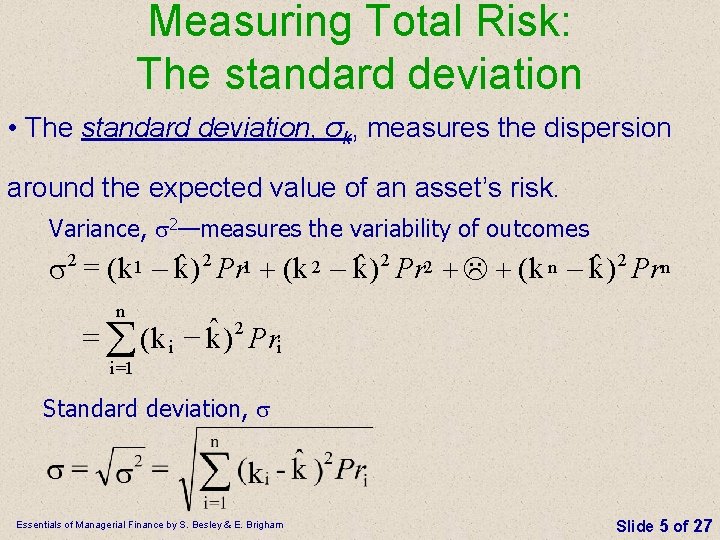
Measuring Total Risk: The standard deviation • The standard deviation, σk, measures the dispersion around the expected value of an asset’s risk. Variance, 2—measures the variability of outcomes 2 = (k 1 - k ) 2 Pr 1 + (k 2 - k ) 2 Pr 2 + L + (k n - k ) 2 Prn n = å (k i - k ) 2 Pri i =1 Standard deviation, Essentials of Managerial Finance by S. Besley & E. Brigham Slide 5 of 27
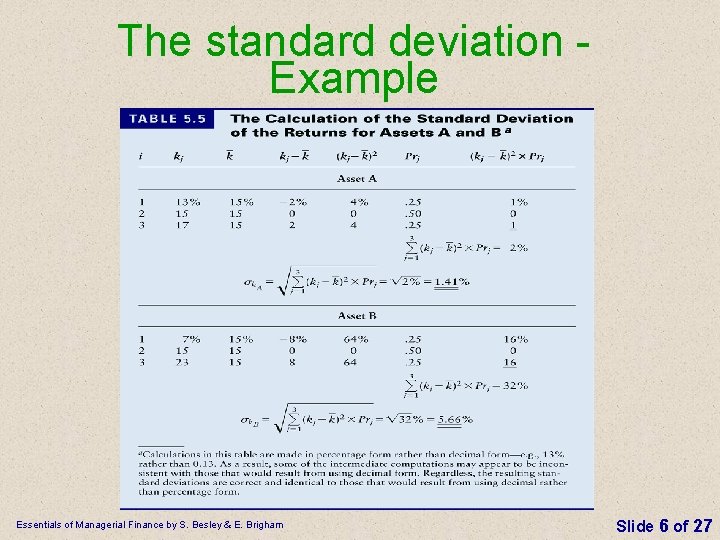
The standard deviation Example Essentials of Managerial Finance by S. Besley & E. Brigham Slide 6 of 27
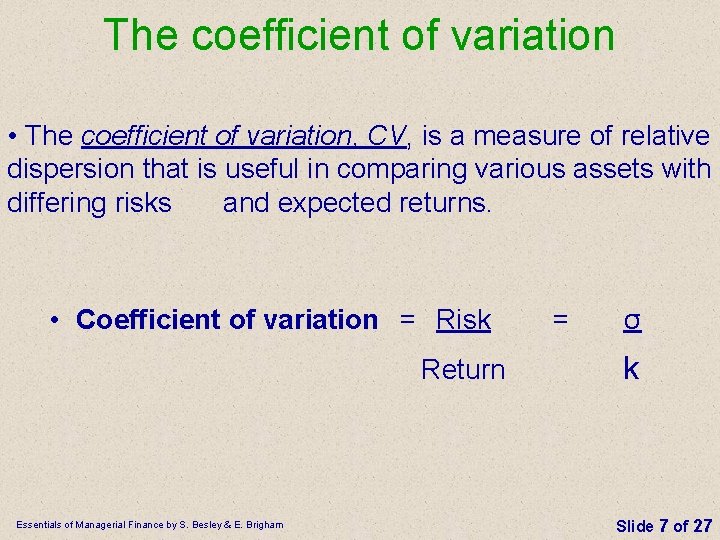
The coefficient of variation • The coefficient of variation, CV, is a measure of relative dispersion that is useful in comparing various assets with differing risks and expected returns. • Coefficient of variation = Risk Return Essentials of Managerial Finance by S. Besley & E. Brigham = σ k Slide 7 of 27
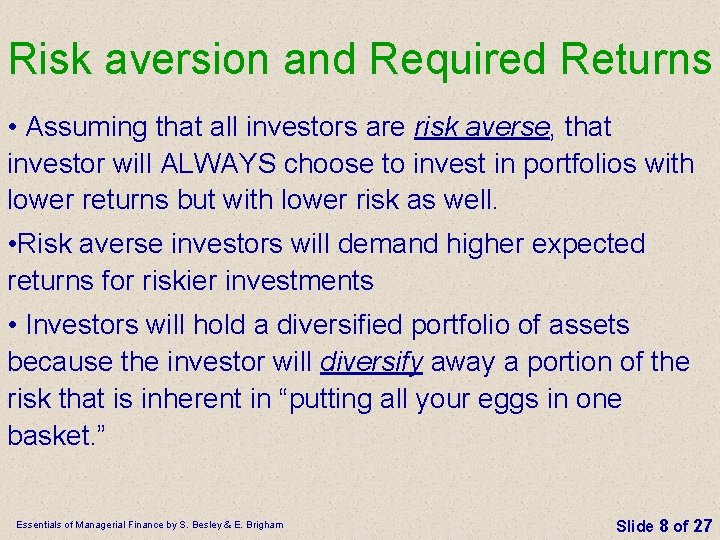
Risk aversion and Required Returns • Assuming that all investors are risk averse, that investor will ALWAYS choose to invest in portfolios with lower returns but with lower risk as well. • Risk averse investors will demand higher expected returns for riskier investments • Investors will hold a diversified portfolio of assets because the investor will diversify away a portion of the risk that is inherent in “putting all your eggs in one basket. ” Essentials of Managerial Finance by S. Besley & E. Brigham Slide 8 of 27
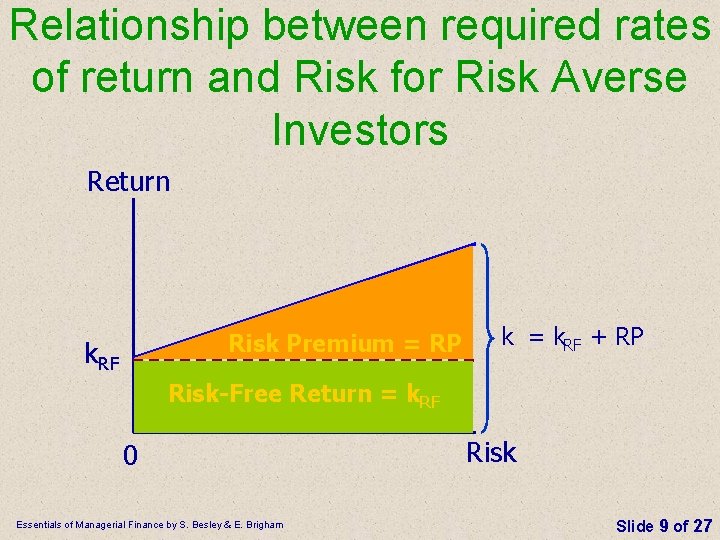
Relationship between required rates of return and Risk for Risk Averse Investors Return Risk Premium = RP k. RF k = k. RF + RP Risk-Free Return = k. RF 0 Essentials of Managerial Finance by S. Besley & E. Brigham Risk Slide 9 of 27
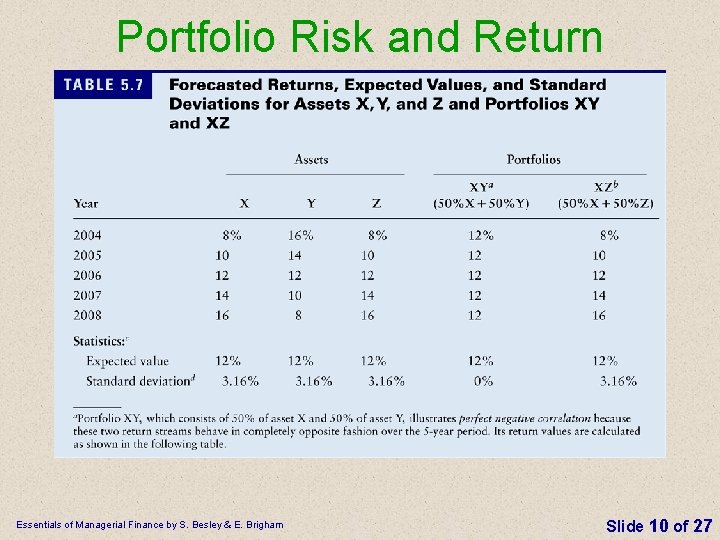
Portfolio Risk and Return Essentials of Managerial Finance by S. Besley & E. Brigham Slide 10 of 27
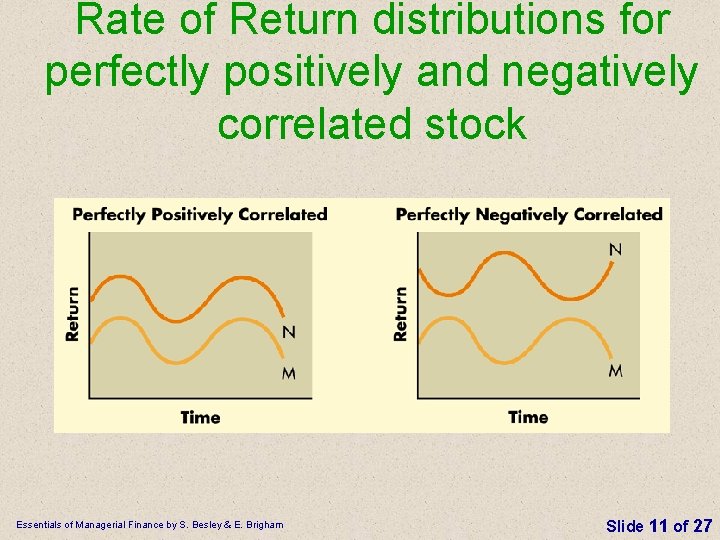
Rate of Return distributions for perfectly positively and negatively correlated stock Essentials of Managerial Finance by S. Besley & E. Brigham Slide 11 of 27
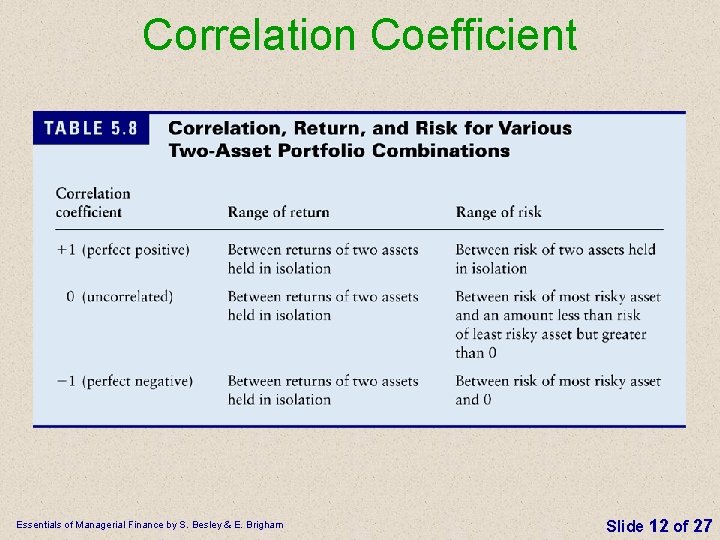
Correlation Coefficient Essentials of Managerial Finance by S. Besley & E. Brigham Slide 12 of 27
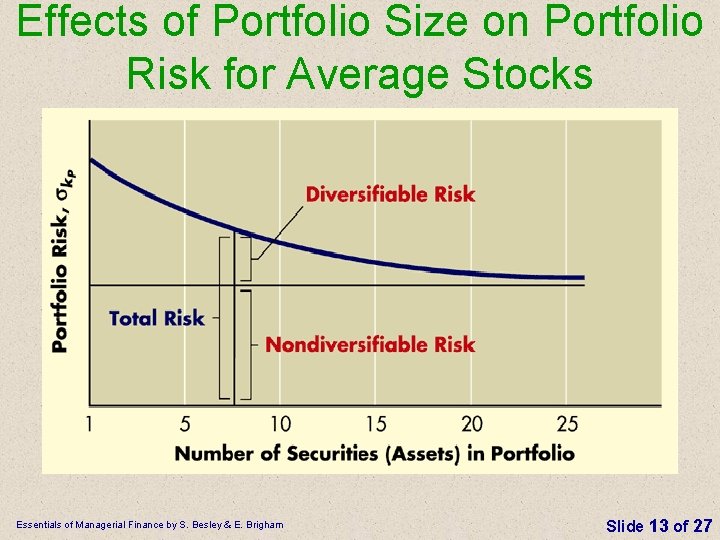
Effects of Portfolio Size on Portfolio Risk for Average Stocks Essentials of Managerial Finance by S. Besley & E. Brigham Slide 13 of 27
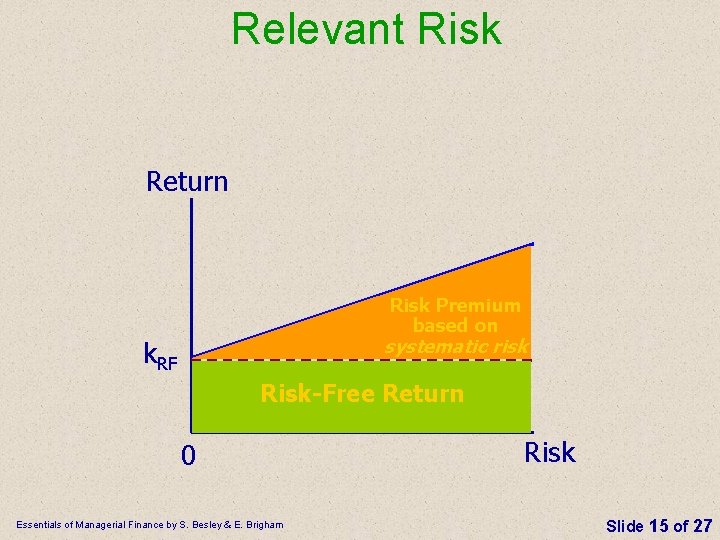
Relevant – Irrelevant Risk • Relevant risk is the risk that cannot be reduced or diversified away (systematic, or market risk) • “Irrelevant” risk is the portion of total risk can be reduced through diversification (firm-specific, or unsystematic risk) Essentials of Managerial Finance by S. Besley & E. Brigham Slide 14 of 27
Relevant Risk Return Risk Premium based on systematic risk k. RF Risk-Free Return 0 Essentials of Managerial Finance by S. Besley & E. Brigham Risk Slide 15 of 27
The Capital Asset Pricing Model (CAPM) The CAPM is a model developed to determine the required rate of return for an investment that considers the fact that some of the total risk associated with the investment can be diversified away; in essence, the model suggests that the risk premium associated with an investment should only be based on the risk that cannot be diversified away rather than the total risk; investors should not be rewarded for not diversifying—that is, they should not be paid for taking on risk that can be eliminated through diversification. Essentials of Managerial Finance by S. Besley & E. Brigham Slide 16 of 27
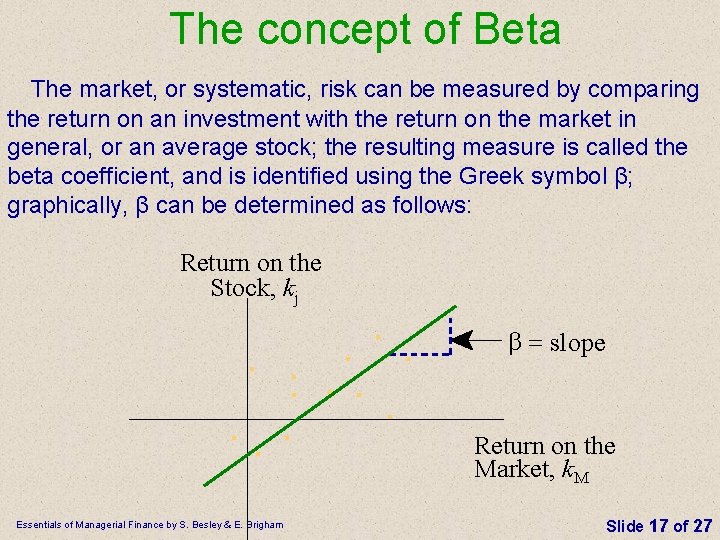
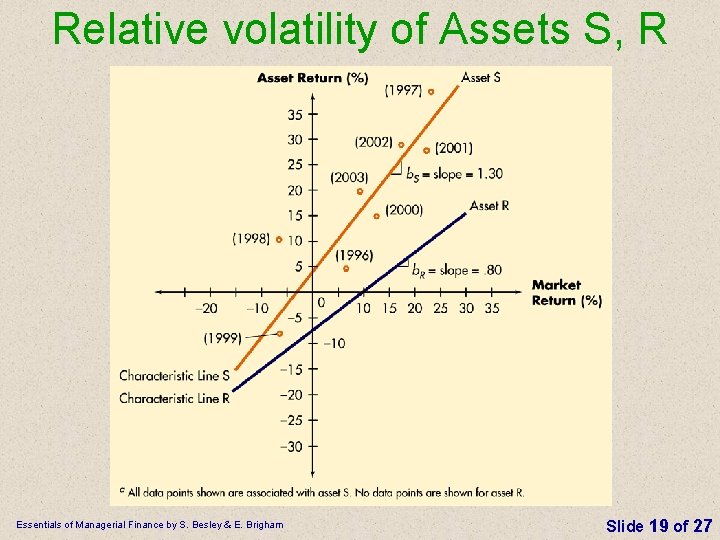
The concept of Beta The market, or systematic, risk can be measured by comparing the return on an investment with the return on the market in general, or an average stock; the resulting measure is called the beta coefficient, and is identified using the Greek symbol β; graphically, β can be determined as follows: Return on the Stock, kj . . . Essentials of Managerial Finance by S. Besley & E. Brigham . = slope Return on the Market, k. M Slide 17 of 27
The concept of Beta The beta coefficient shows how the returns associated an investment move with respect to the returns associated the market; because the market is very well diversified, its returns should be affected by systematic risk only—unsystematic risk should be completely diversified away in a portfolio that contains all investments in the market; thus, the beta coefficient is a measure of systematic risk because it gives an indication of the degree of movement in returns associated with an investment relative to the market, which contains only systematic risk; for example, an investment with β = 2. 0 generally is considered twice as risky as the market, such that the risk premium associated with the investment should be twice the risk premium on the market. Slide 18 of 27 Essentials of Managerial Finance by S. Besley & E. Brigham
Relative volatility of Assets S, R Essentials of Managerial Finance by S. Besley & E. Brigham Slide 19 of 27
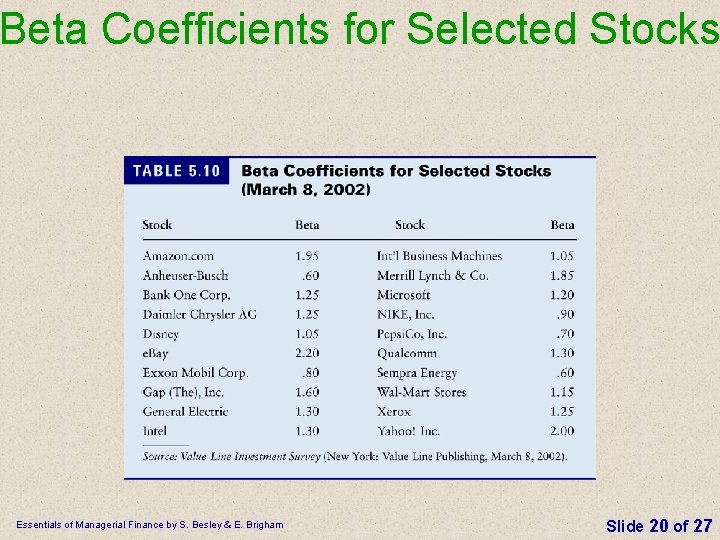
Beta Coefficients for Selected Stocks Essentials of Managerial Finance by S. Besley & E. Brigham Slide 20 of 27
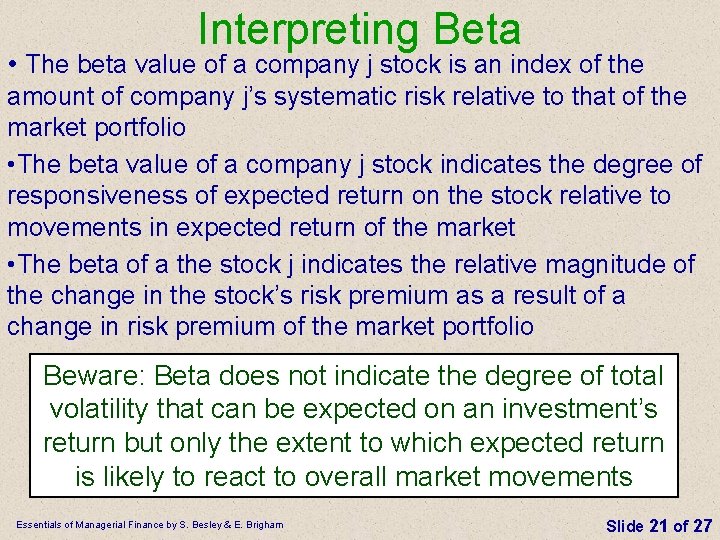
Interpreting Beta • The beta value of a company j stock is an index of the amount of company j’s systematic risk relative to that of the market portfolio • The beta value of a company j stock indicates the degree of responsiveness of expected return on the stock relative to movements in expected return of the market • The beta of a the stock j indicates the relative magnitude of the change in the stock’s risk premium as a result of a change in risk premium of the market portfolio Beware: Beta does not indicate the degree of total volatility that can be expected on an investment’s return but only the extent to which expected return is likely to react to overall market movements Essentials of Managerial Finance by S. Besley & E. Brigham Slide 21 of 27
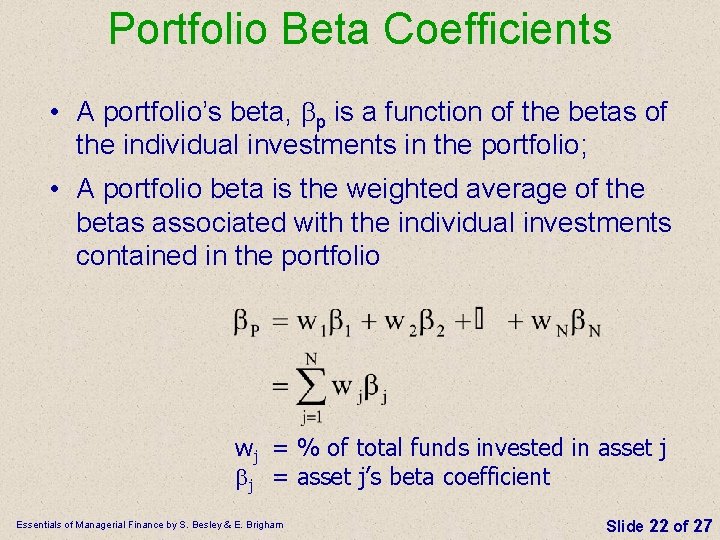
Portfolio Beta Coefficients • A portfolio’s beta, p is a function of the betas of the individual investments in the portfolio; • A portfolio beta is the weighted average of the betas associated with the individual investments contained in the portfolio wj = % of total funds invested in asset j j = asset j’s beta coefficient Essentials of Managerial Finance by S. Besley & E. Brigham Slide 22 of 27
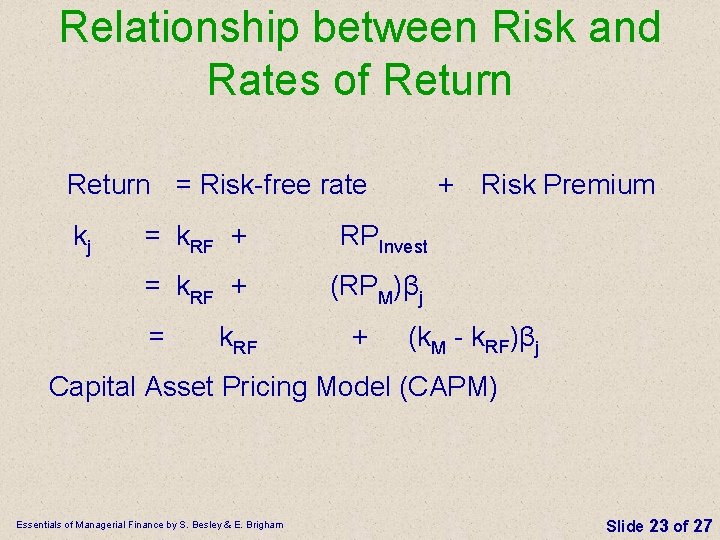
Relationship between Risk and Rates of Return = Risk-free rate kj + Risk Premium = k. RF + RPInvest = k. RF + (RPM)βj = k. RF + (k. M - k. RF)βj Capital Asset Pricing Model (CAPM) Essentials of Managerial Finance by S. Besley & E. Brigham Slide 23 of 27
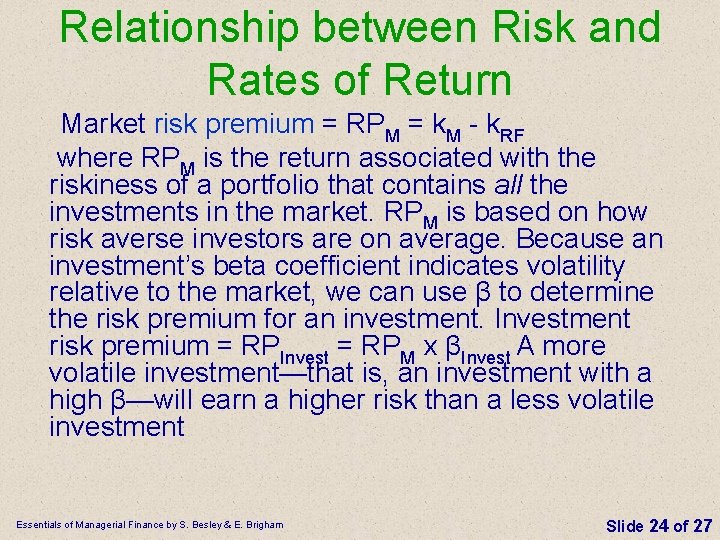
Relationship between Risk and Rates of Return Market risk premium = RPM = k. M - k. RF where RPM is the return associated with the riskiness of a portfolio that contains all the investments in the market. RPM is based on how risk averse investors are on average. Because an investment’s beta coefficient indicates volatility relative to the market, we can use β to determine the risk premium for an investment. Investment risk premium = RPInvest = RPM x βInvest A more volatile investment—that is, an investment with a high β—will earn a higher risk than a less volatile investment Essentials of Managerial Finance by S. Besley & E. Brigham Slide 24 of 27
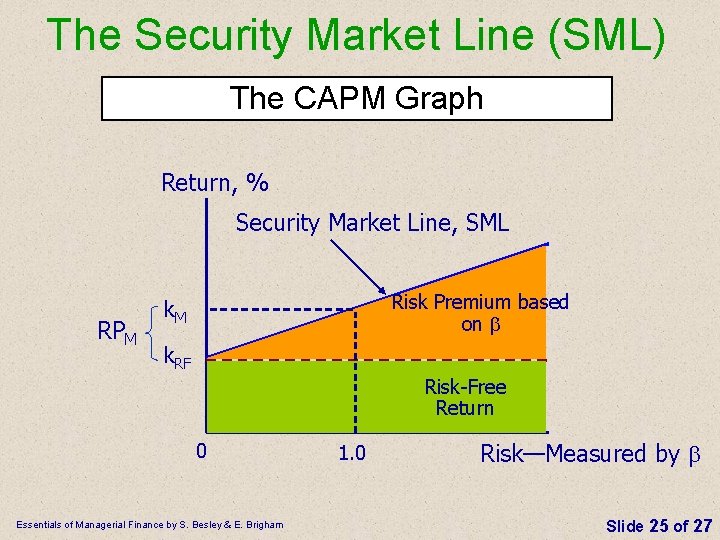
The Security Market Line (SML) The CAPM Graph Return, % Security Market Line, SML RPM Risk Premium based on k. M k. RF Risk-Free Return 0 Essentials of Managerial Finance by S. Besley & E. Brigham 1. 0 Risk—Measured by Slide 25 of 27
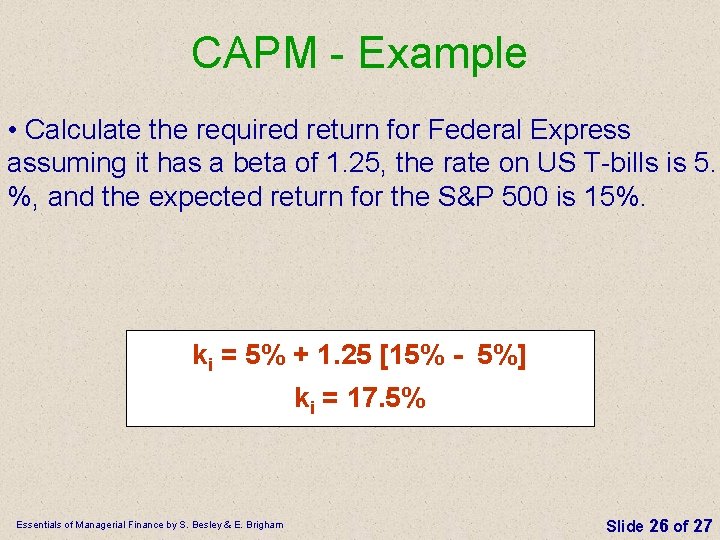
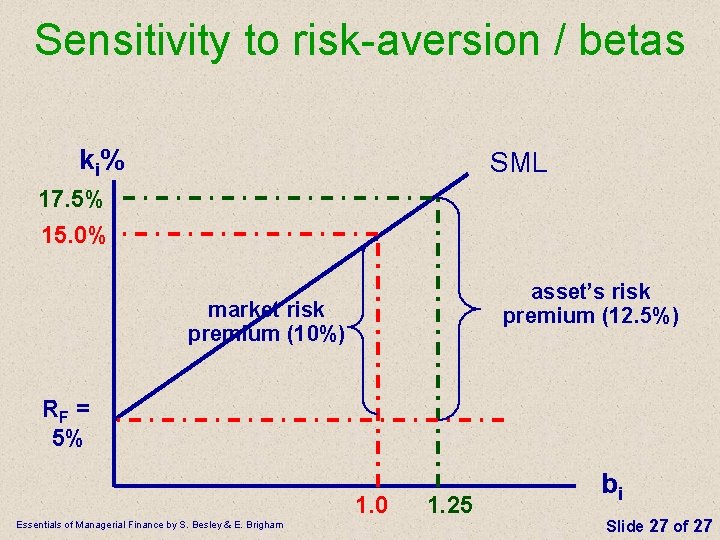
CAPM - Example • Calculate the required return for Federal Express assuming it has a beta of 1. 25, the rate on US T-bills is 5. %, and the expected return for the S&P 500 is 15%. ki = 5% + 1. 25 [15% - 5%] ki = 17. 5% Essentials of Managerial Finance by S. Besley & E. Brigham Slide 26 of 27
Sensitivity to risk-aversion / betas ki % SML 17. 5% 15. 0% asset’s risk premium (12. 5%) market risk premium (10%) RF = 5% 1. 0 Essentials of Managerial Finance by S. Besley & E. Brigham 1. 25 bi Slide 27 of 27