
Chapter 8 Resources Economics The Case of Labour
Chapter 8 Resources Economics: The Case of Labour Economics
Labour as a Resource Market • How do firms decide between inputs (land, labour, entrepreneurship and capital)? • Relative price of inputs provides the answer • Labour market supplies the labour input
Demand for Labour • Derived Demand based on consumer demand for good or service being produced • The greater the demand for a good or service, the greater the demand for the labour producing it • Second factor is productivity – how much each worker can produce in a given time period
Marginal Revenue Product of Labour • aka MRPL • Related to the marginal product – the additional product created by adding a unit of labour • MRPL is the additional revenue generated from the marginal product • In Perfect Competition MRPL = Price x Marginal Product
Marginal Revenue Product of Labour • MRPL is the Demand Curve for Labour for any firm • MRPL decreases because of diminishing returns • How many workers to hire? • Answer: continue to hire workers until MRPL is less than the wage rate (price of labour)
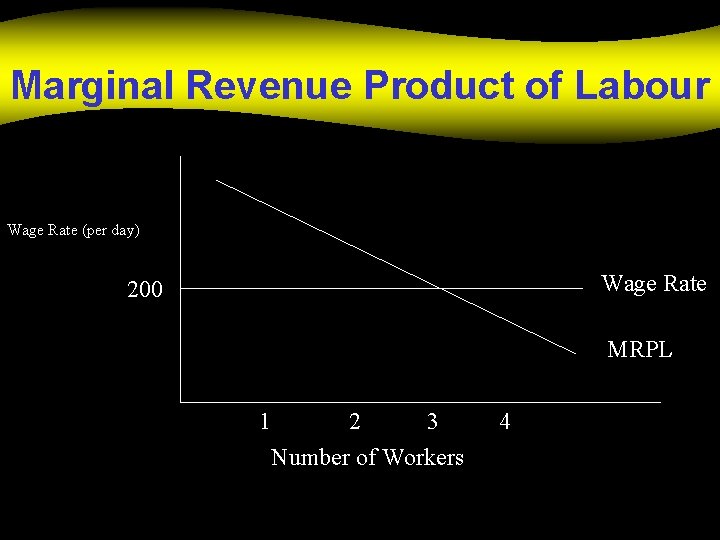
Marginal Revenue Product of Labour Wage Rate (per day) Wage Rate 200 MRPL 1 2 3 Number of Workers 4
Factors Shifting the Labour Demand Curve • Change in the demand for the product – if more popular more workers needed • Change in the price of other productive resources – technology may mean fewer workers needed • Change in worker productivity – enhances need for workers
Supply of Labour • The Market Labour Supply Curve shows all workers willing to offer their services at every wage rate • Opportunity Cost affects number of workers • Specific skills necessary (e. g doctor) • Geographic location – urban areas offer more workers
Factors Shifting Labour Supply Curve • Changes in income tax rates – an increase shifts curve to the left • Changes in size and composition of population – aging workforce? ? • Changes in household technology – more time for work • Changes in attitude – more women in workforce
Wage Determination & Trends • In equilibrium no shortages or surpluses • High skilled labour earns higher wage rate than low skill • Education means higher income! • Trends include knowledge, computer literacy and retraining • Read info on pages 178, 179
Labour Unions • Organization of workers promoting interests of its members through collective bargaining – collective agreement • Trade unions represent an occupation • Industrial unions represent an industry e. g. Unifor (formally CAW) • Public Sector Unions – gov’t employees
Labour Unions • Negotiate wages, benefits, working conditions • Open Shop – membership voluntary • Closed Shop – mandatory • Union Shop – membership over time • Rand Formula – all workers pay union dues whether members or not
Labour Unions • Negotiations may fail… if so: • Conciliation/mediation means third party enters • Voluntary Arbitration mean both sides agree to decision • Compulsory Arbitration means no choice! • Job actions include strikes, lockouts, work to rule and rotating strike, encouraging boycott • Higher wages are an impact
- Slides: 13