
Chapter 8 Relational Database Design Database System Concepts
Chapter 8: Relational Database Design Database System Concepts, 6 th Ed. ©Silberschatz, Korth and Sudarshan See www. db-book. com for conditions on re-use
Chapter 8: Relational Database Design n Features of Good Relational Design n Atomic Domains and First Normal Form n Decomposition Using Functional Dependencies n Functional Dependency Theory n Algorithms for Functional Dependencies n Database-Design Process n Modeling Temporal Database System Concepts - 6 th Edition 8. 2 ©Silberschatz, Korth and Sudarshan

Combine Schemas? n Suppose we combine instructor and department into inst_dept l (No connection to relationship set inst_dept) n Result is possible repetition of information Database System Concepts - 6 th Edition 8. 3 ©Silberschatz, Korth and Sudarshan
A Combined Schema Without Repetition n Consider combining relations l sec_class(sec_id, building, room_number) and l section(course_id, sec_id, semester, year) into one relation l section(course_id, sec_id, semester, year, building, room_number) n No repetition in this case Database System Concepts - 6 th Edition 8. 4 ©Silberschatz, Korth and Sudarshan

What About Smaller Schemas? n Suppose we had started with inst_dept. How would we know to split up (decompose) it into instructor and department? n Write a rule “if there were a schema (dept_name, building, budget), then dept_name would be a candidate key” n Denote as a functional dependency: dept_name building, budget n In inst_dept, because dept_name is not a candidate key, the building and budget of a department may have to be repeated. l This indicates the need to decompose inst_dept Database System Concepts - 6 th Edition 8. 5 ©Silberschatz, Korth and Sudarshan
Lossy Decomposition n Not all decompositions are good. Suppose we decompose employee(ID, name, street, city, salary) into employee 1 (ID, name) employee 2 (name, street, city, salary) n The next slide shows how we lose information -- we cannot reconstruct the original employee relation -- and so, this is a lossy decomposition. Database System Concepts - 6 th Edition 8. 6 ©Silberschatz, Korth and Sudarshan
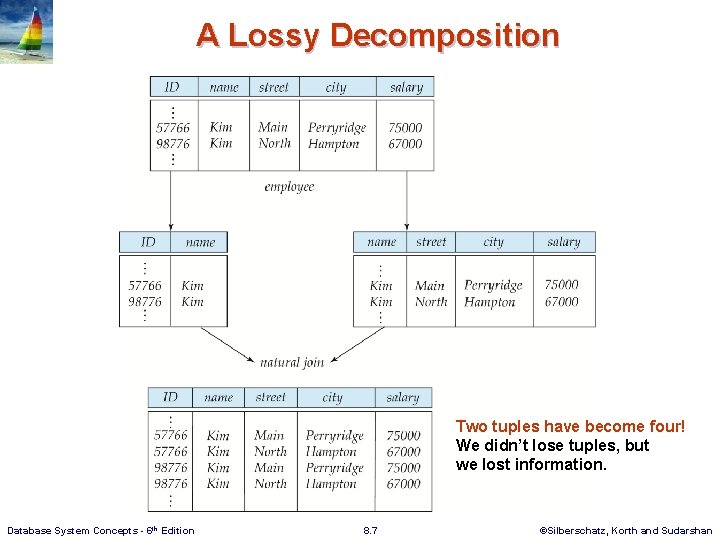
A Lossy Decomposition Two tuples have become four! We didn’t lose tuples, but we lost information. Database System Concepts - 6 th Edition 8. 7 ©Silberschatz, Korth and Sudarshan
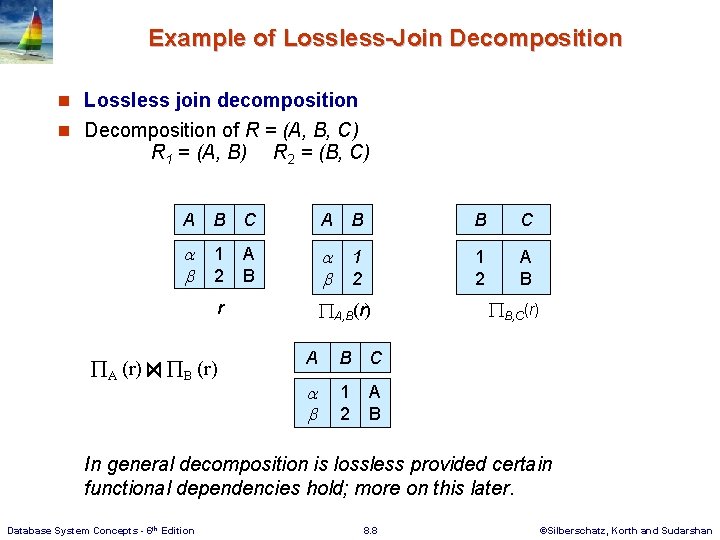
Example of Lossless-Join Decomposition n Lossless join decomposition n Decomposition of R = (A, B, C) R 1 = (A, B) R 2 = (B, C) A B C A B B C 1 2 1 2 A B A, B(r) r A (r) B (r) A B C 1 2 B, C(r) A B In general decomposition is lossless provided certain functional dependencies hold; more on this later. Database System Concepts - 6 th Edition 8. 8 ©Silberschatz, Korth and Sudarshan
First Normal Form n Domain is atomic if its elements are considered to be indivisible units l Examples of non-atomic domains: 4 Set of names, composite attributes 4 Identification numbers like CS 101 that can be broken up into parts n A relational schema R is in first normal form if the domains of all attributes of R are atomic n Non-atomic values complicate storage and encourage redundant (repeated) storage of data l Example: Set of accounts stored with each customer, and set of owners stored with each account l We assume all relations are in first normal form (and revisit this in Chapter 22: Object Based Databases) Database System Concepts - 6 th Edition 8. 9 ©Silberschatz, Korth and Sudarshan
First Normal Form (Cont’d) n Atomicity is actually a property of how the elements of the domain are used. l Example: Strings would normally be considered indivisible l Suppose that students are given roll numbers which are strings of the form CS 0012 or EE 1127 l If the first two characters are extracted to find the department, the domain of roll numbers is not atomic. l Doing so is a bad idea: leads to encoding of information in application program rather than in the database. Database System Concepts - 6 th Edition 8. 10 ©Silberschatz, Korth and Sudarshan
Goal — Devise a Theory for the Following n Decide whether a particular relation R is in “good” form. n In the case that a relation R is not in “good” form, decompose it into a set of relations {R 1, R 2, . . . , Rn} such that l each relation is in good form l the decomposition is a lossless-join decomposition n Our theory is based on: l functional dependencies l multivalued dependencies (see book for details) Database System Concepts - 6 th Edition 8. 11 ©Silberschatz, Korth and Sudarshan
Functional Dependencies n Constraints on the set of legal relations. n Require that the value for a certain set of attributes determines uniquely the value for another set of attributes. n A functional dependency is a generalization of the notion of a key. Database System Concepts - 6 th Edition 8. 12 ©Silberschatz, Korth and Sudarshan
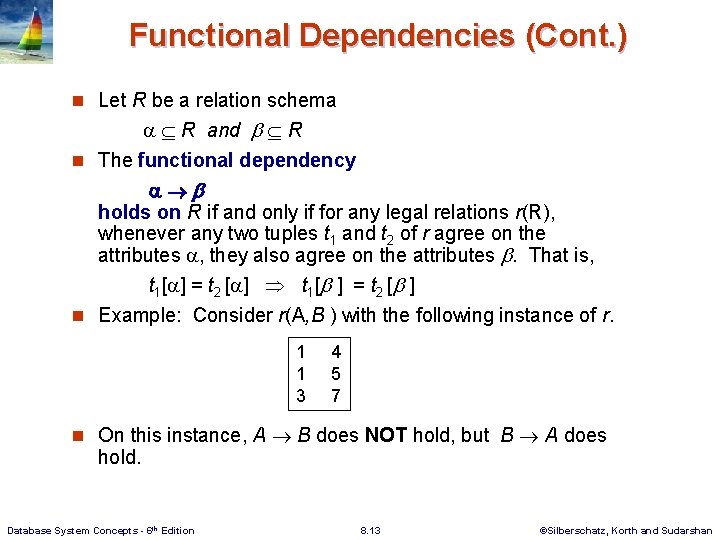
Functional Dependencies (Cont. ) n Let R be a relation schema R and R n The functional dependency holds on R if and only if for any legal relations r(R), whenever any two tuples t 1 and t 2 of r agree on the attributes , they also agree on the attributes . That is, t 1[ ] = t 2 [ ] n Example: Consider r(A, B ) with the following instance of r. 1 1 3 4 5 7 n On this instance, A B does NOT hold, but B A does hold. Database System Concepts - 6 th Edition 8. 13 ©Silberschatz, Korth and Sudarshan
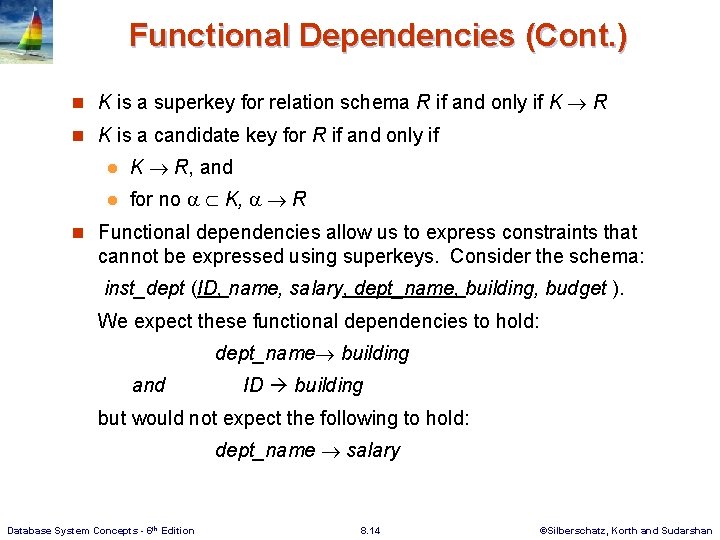
Functional Dependencies (Cont. ) n K is a superkey for relation schema R if and only if K R n K is a candidate key for R if and only if l K R, and l for no K, R n Functional dependencies allow us to express constraints that cannot be expressed using superkeys. Consider the schema: inst_dept (ID, name, salary, dept_name, building, budget ). We expect these functional dependencies to hold: dept_name building and ID building but would not expect the following to hold: dept_name salary Database System Concepts - 6 th Edition 8. 14 ©Silberschatz, Korth and Sudarshan
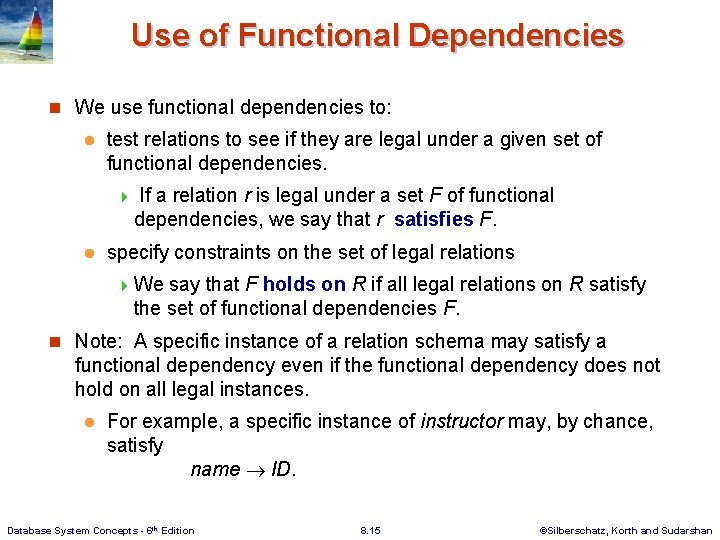
Use of Functional Dependencies n We use functional dependencies to: l test relations to see if they are legal under a given set of functional dependencies. 4 l If a relation r is legal under a set F of functional dependencies, we say that r satisfies F. specify constraints on the set of legal relations 4 We say that F holds on R if all legal relations on R satisfy the set of functional dependencies F. n Note: A specific instance of a relation schema may satisfy a functional dependency even if the functional dependency does not hold on all legal instances. l For example, a specific instance of instructor may, by chance, satisfy name ID. Database System Concepts - 6 th Edition 8. 15 ©Silberschatz, Korth and Sudarshan
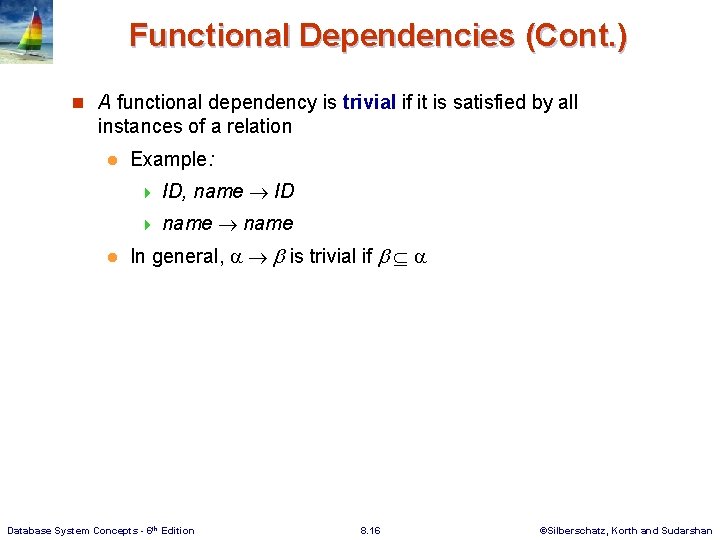
Functional Dependencies (Cont. ) n A functional dependency is trivial if it is satisfied by all instances of a relation l l Example: 4 ID, name ID 4 name In general, is trivial if Database System Concepts - 6 th Edition 8. 16 ©Silberschatz, Korth and Sudarshan
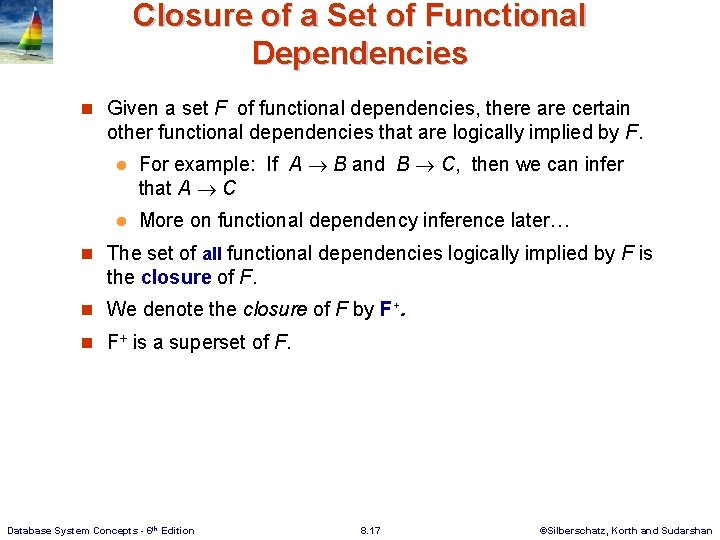
Closure of a Set of Functional Dependencies n Given a set F of functional dependencies, there are certain other functional dependencies that are logically implied by F. l For example: If A B and B C, then we can infer that A C l More on functional dependency inference later… n The set of all functional dependencies logically implied by F is the closure of F. n We denote the closure of F by F+. n F+ is a superset of F. Database System Concepts - 6 th Edition 8. 17 ©Silberschatz, Korth and Sudarshan
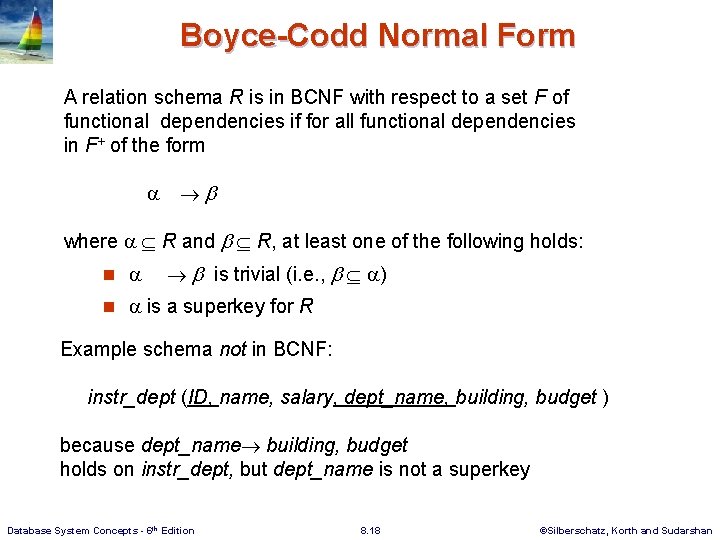
Boyce-Codd Normal Form A relation schema R is in BCNF with respect to a set F of functional dependencies if for all functional dependencies in F+ of the form where R and R, at least one of the following holds: n is trivial (i. e. , ) n is a superkey for R Example schema not in BCNF: instr_dept (ID, name, salary, dept_name, building, budget ) because dept_name building, budget holds on instr_dept, but dept_name is not a superkey Database System Concepts - 6 th Edition 8. 18 ©Silberschatz, Korth and Sudarshan
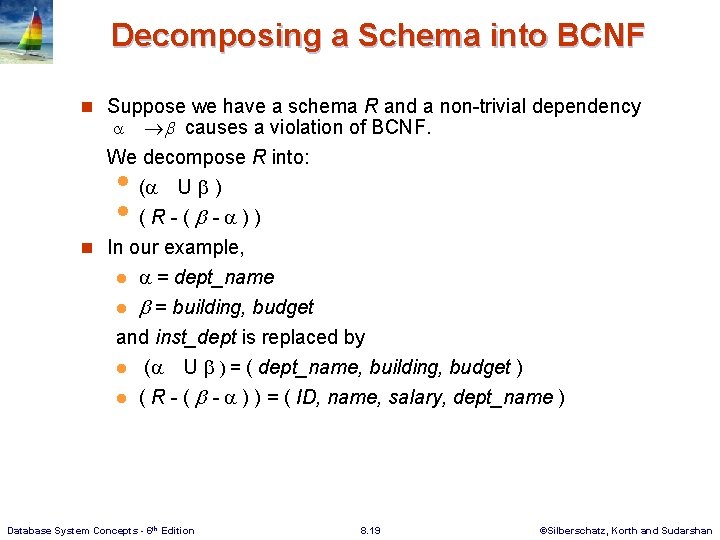
Decomposing a Schema into BCNF n Suppose we have a schema R and a non-trivial dependency causes a violation of BCNF. We decompose R into: ( U ) • • (R-( - )) n In our example, = dept_name l = building, budget and inst_dept is replaced by l ( U ) = ( dept_name, building, budget ) l l ( R - ( - ) ) = ( ID, name, salary, dept_name ) Database System Concepts - 6 th Edition 8. 19 ©Silberschatz, Korth and Sudarshan
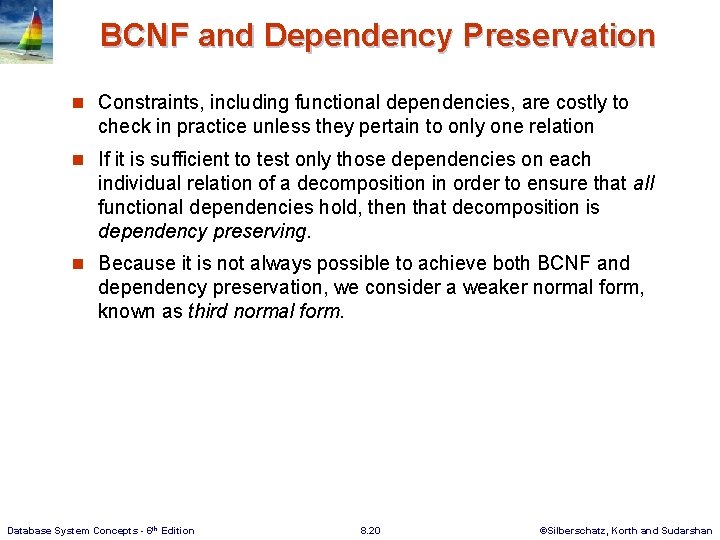
BCNF and Dependency Preservation n Constraints, including functional dependencies, are costly to check in practice unless they pertain to only one relation n If it is sufficient to test only those dependencies on each individual relation of a decomposition in order to ensure that all functional dependencies hold, then that decomposition is dependency preserving. n Because it is not always possible to achieve both BCNF and dependency preservation, we consider a weaker normal form, known as third normal form. Database System Concepts - 6 th Edition 8. 20 ©Silberschatz, Korth and Sudarshan
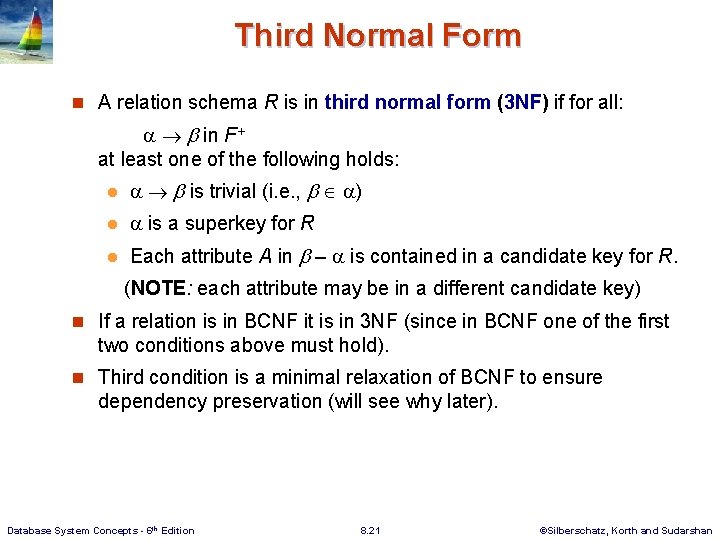
Third Normal Form n A relation schema R is in third normal form (3 NF) if for all: in F+ at least one of the following holds: l is trivial (i. e. , ) l is a superkey for R l Each attribute A in – is contained in a candidate key for R. (NOTE: each attribute may be in a different candidate key) n If a relation is in BCNF it is in 3 NF (since in BCNF one of the first two conditions above must hold). n Third condition is a minimal relaxation of BCNF to ensure dependency preservation (will see why later). Database System Concepts - 6 th Edition 8. 21 ©Silberschatz, Korth and Sudarshan
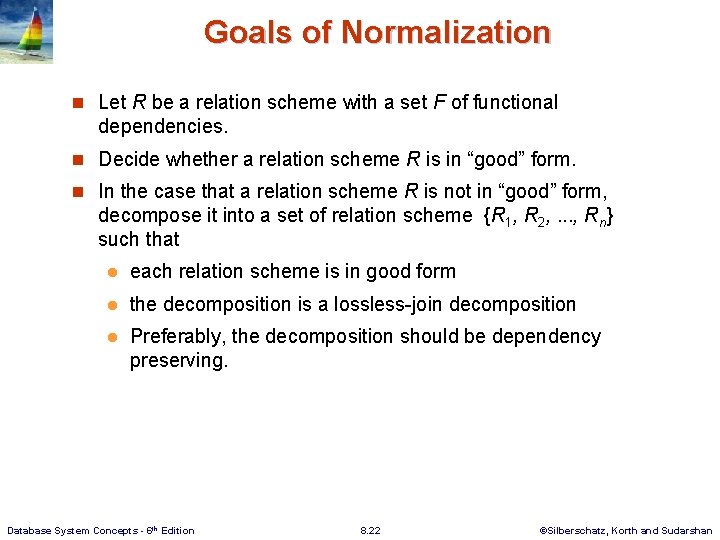
Goals of Normalization n Let R be a relation scheme with a set F of functional dependencies. n Decide whether a relation scheme R is in “good” form. n In the case that a relation scheme R is not in “good” form, decompose it into a set of relation scheme {R 1, R 2, . . . , Rn} such that l each relation scheme is in good form l the decomposition is a lossless-join decomposition l Preferably, the decomposition should be dependency preserving. Database System Concepts - 6 th Edition 8. 22 ©Silberschatz, Korth and Sudarshan
Functional-Dependency Theory n We now consider the formal theory that tells us which functional dependencies are implied logically by a given set of functional dependencies. n We then develop algorithms to generate lossless decompositions into BCNF and 3 NF n We then develop algorithms to test if a decomposition is dependency-preserving Database System Concepts - 6 th Edition 8. 23 ©Silberschatz, Korth and Sudarshan
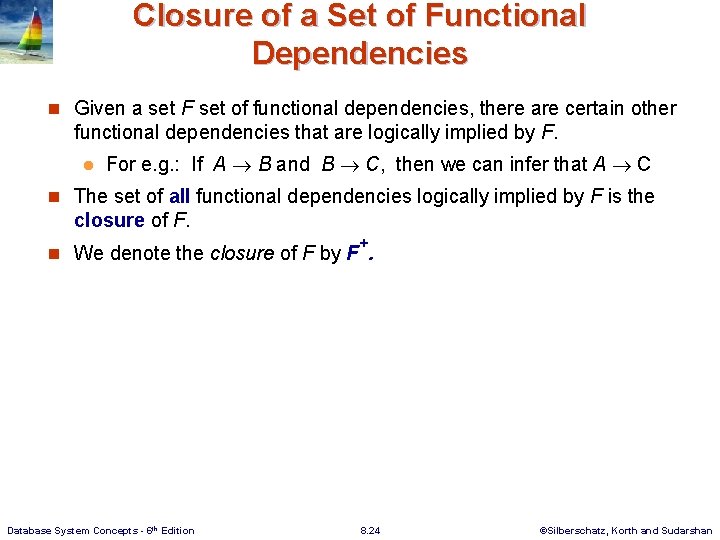
Closure of a Set of Functional Dependencies n Given a set F set of functional dependencies, there are certain other functional dependencies that are logically implied by F. l For e. g. : If A B and B C, then we can infer that A C n The set of all functional dependencies logically implied by F is the closure of F. + n We denote the closure of F by F. Database System Concepts - 6 th Edition 8. 24 ©Silberschatz, Korth and Sudarshan
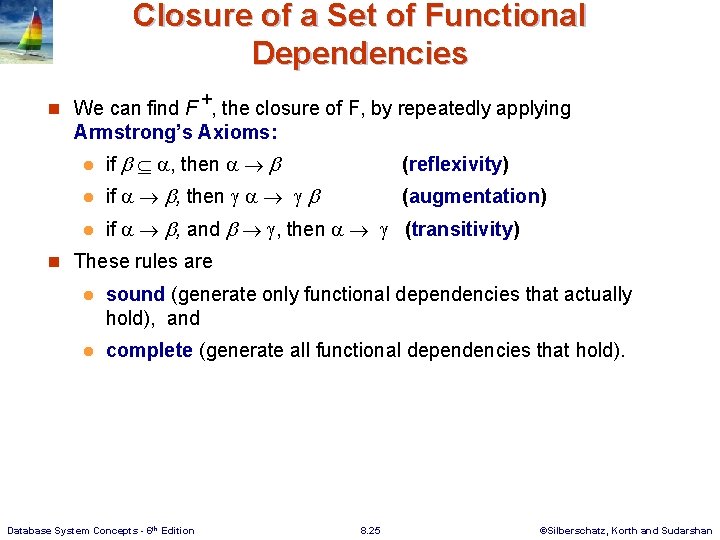
Closure of a Set of Functional Dependencies n We can find F +, the closure of F, by repeatedly applying Armstrong’s Axioms: l if , then (reflexivity) l if , then (augmentation) l if , and , then (transitivity) n These rules are l sound (generate only functional dependencies that actually hold), and l complete (generate all functional dependencies that hold). Database System Concepts - 6 th Edition 8. 25 ©Silberschatz, Korth and Sudarshan
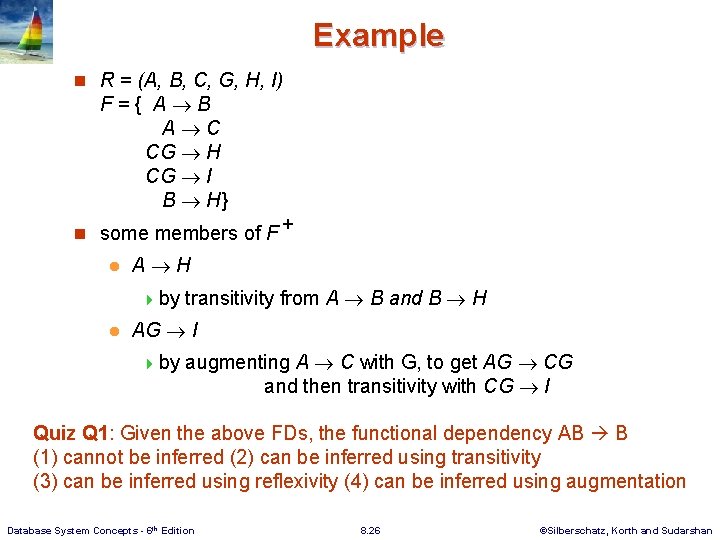
Example n R = (A, B, C, G, H, I) F={ A B A C CG H CG I B H} n some members of F + l A H 4 by l transitivity from A B and B H AG I 4 by augmenting A C with G, to get AG CG and then transitivity with CG I Quiz Q 1: Given the above FDs, the functional dependency AB B (1) cannot be inferred (2) can be inferred using transitivity (3) can be inferred using reflexivity (4) can be inferred using augmentation Database System Concepts - 6 th Edition 8. 26 ©Silberschatz, Korth and Sudarshan
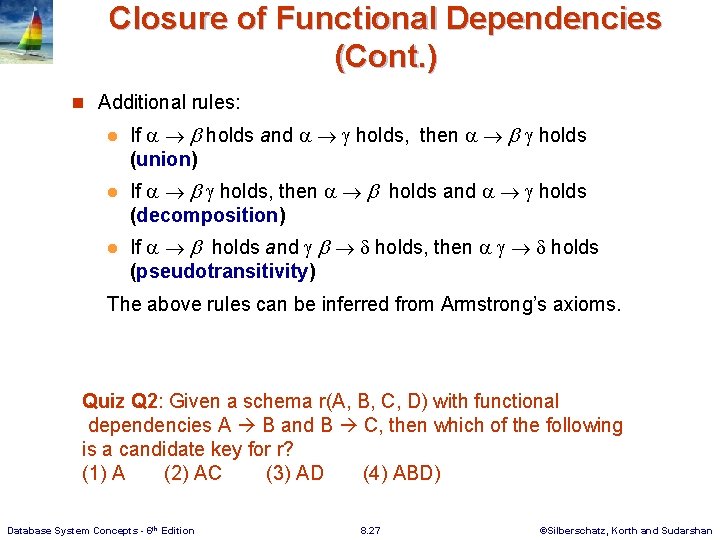
Closure of Functional Dependencies (Cont. ) n Additional rules: l If holds and holds, then holds (union) l If holds, then holds and holds (decomposition) l If holds and holds, then holds (pseudotransitivity) The above rules can be inferred from Armstrong’s axioms. Quiz Q 2: Given a schema r(A, B, C, D) with functional dependencies A B and B C, then which of the following is a candidate key for r? (1) A (2) AC (3) AD (4) ABD) Database System Concepts - 6 th Edition 8. 27 ©Silberschatz, Korth and Sudarshan
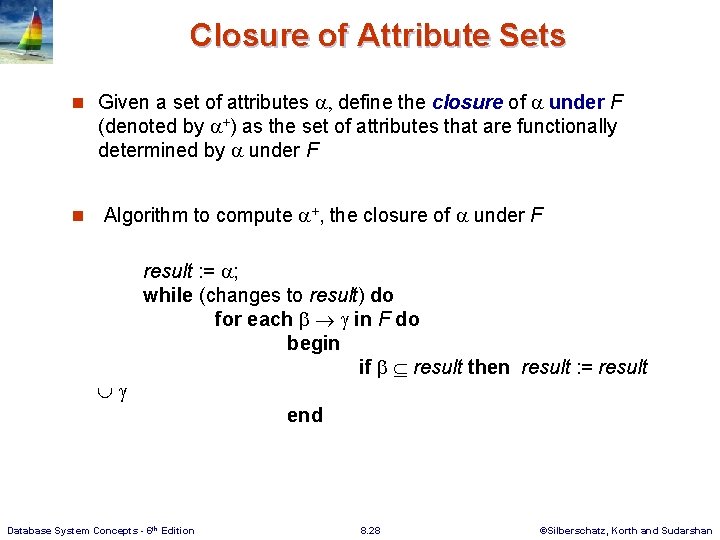
Closure of Attribute Sets n Given a set of attributes , define the closure of under F (denoted by +) as the set of attributes that are functionally determined by under F n Algorithm to compute +, the closure of under F result : = ; while (changes to result) do for each in F do begin if result then result : = result end Database System Concepts - 6 th Edition 8. 28 ©Silberschatz, Korth and Sudarshan
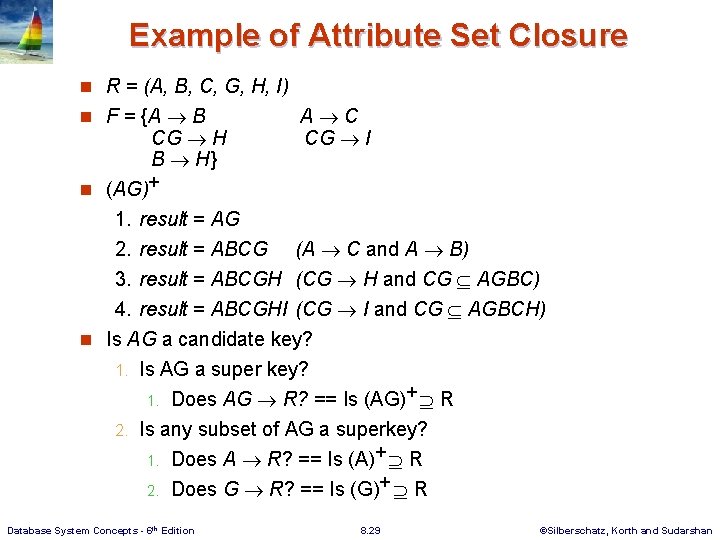
Example of Attribute Set Closure n R = (A, B, C, G, H, I) n F = {A B CG H B H} A C CG I n (AG)+ 1. result = AG 2. result = ABCG (A C and A B) 3. result = ABCGH (CG H and CG AGBC) 4. result = ABCGHI (CG I and CG AGBCH) n Is AG a candidate key? 1. Is AG a super key? + 1. Does AG R? == Is (AG) R 2. Is any subset of AG a superkey? + 1. Does A R? == Is (A) R + 2. Does G R? == Is (G) R Database System Concepts - 6 th Edition 8. 29 ©Silberschatz, Korth and Sudarshan
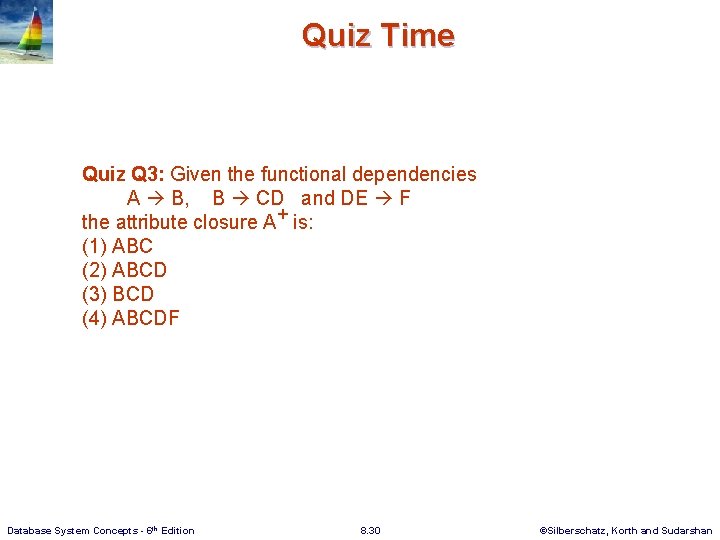
Quiz Time Quiz Q 3: Given the functional dependencies A B, B CD and DE F the attribute closure A+ is: (1) ABC (2) ABCD (3) BCD (4) ABCDF Database System Concepts - 6 th Edition 8. 30 ©Silberschatz, Korth and Sudarshan
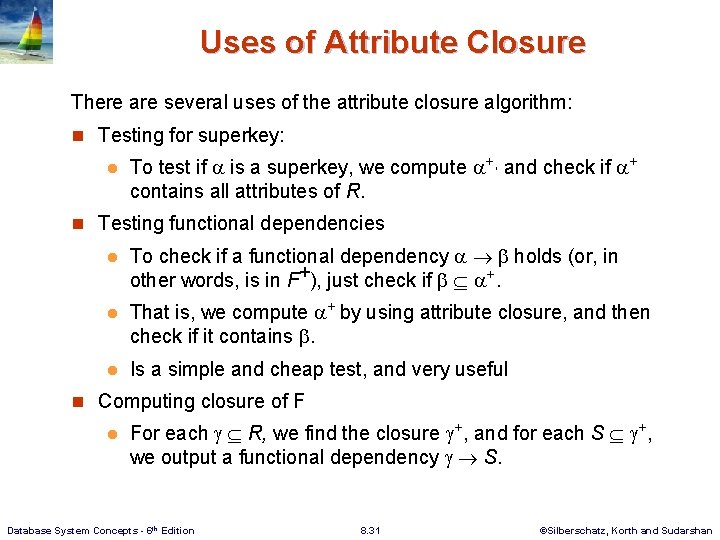
Uses of Attribute Closure There are several uses of the attribute closure algorithm: n Testing for superkey: l To test if is a superkey, we compute +, and check if + contains all attributes of R. n Testing functional dependencies l To check if a functional dependency holds (or, in other words, is in F+), just check if +. l That is, we compute + by using attribute closure, and then check if it contains . l Is a simple and cheap test, and very useful n Computing closure of F l For each R, we find the closure +, and for each S +, we output a functional dependency S. Database System Concepts - 6 th Edition 8. 31 ©Silberschatz, Korth and Sudarshan
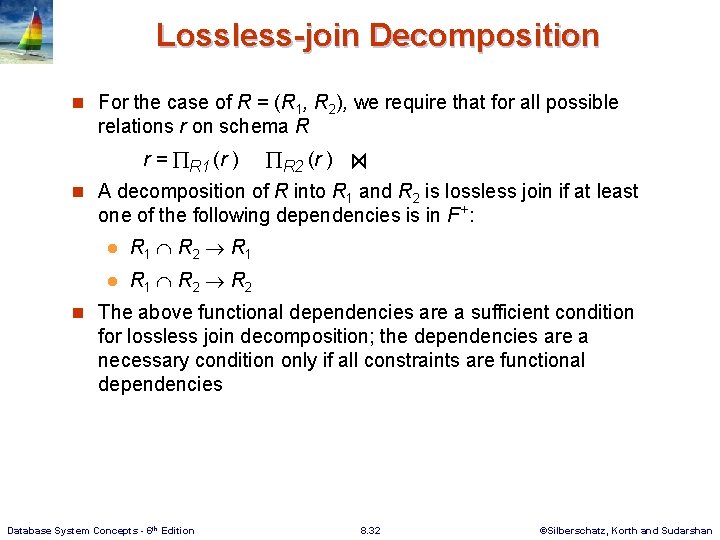
Lossless-join Decomposition n For the case of R = (R 1, R 2), we require that for all possible relations r on schema R r = R 1 (r ) R 2 (r ) n A decomposition of R into R 1 and R 2 is lossless join if at least one of the following dependencies is in F+: l R 1 R 2 R 1 l R 1 R 2 n The above functional dependencies are a sufficient condition for lossless join decomposition; the dependencies are a necessary condition only if all constraints are functional dependencies Database System Concepts - 6 th Edition 8. 32 ©Silberschatz, Korth and Sudarshan
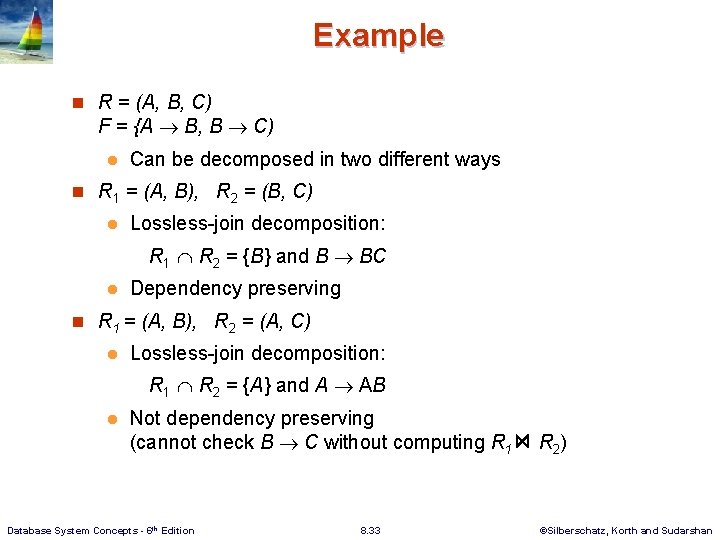
Example n R = (A, B, C) F = {A B, B C) l Can be decomposed in two different ways n R 1 = (A, B), R 2 = (B, C) l Lossless-join decomposition: R 1 R 2 = {B} and B BC l Dependency preserving n R 1 = (A, B), R 2 = (A, C) l Lossless-join decomposition: R 1 R 2 = {A} and A AB l Not dependency preserving (cannot check B C without computing R 1 Database System Concepts - 6 th Edition 8. 33 R 2 ) ©Silberschatz, Korth and Sudarshan
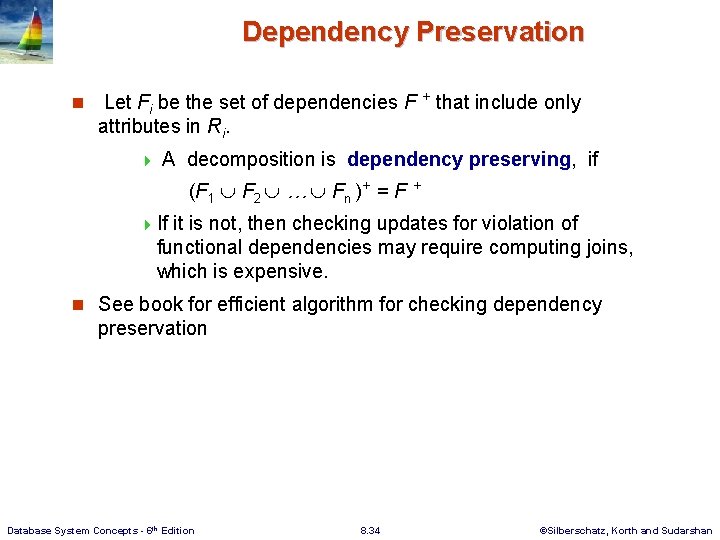
Dependency Preservation n Let Fi be the set of dependencies F + that include only attributes in Ri. 4 A decomposition is dependency preserving, if (F 1 F 2 … Fn )+ = F + 4 If it is not, then checking updates for violation of functional dependencies may require computing joins, which is expensive. n See book for efficient algorithm for checking dependency preservation Database System Concepts - 6 th Edition 8. 34 ©Silberschatz, Korth and Sudarshan
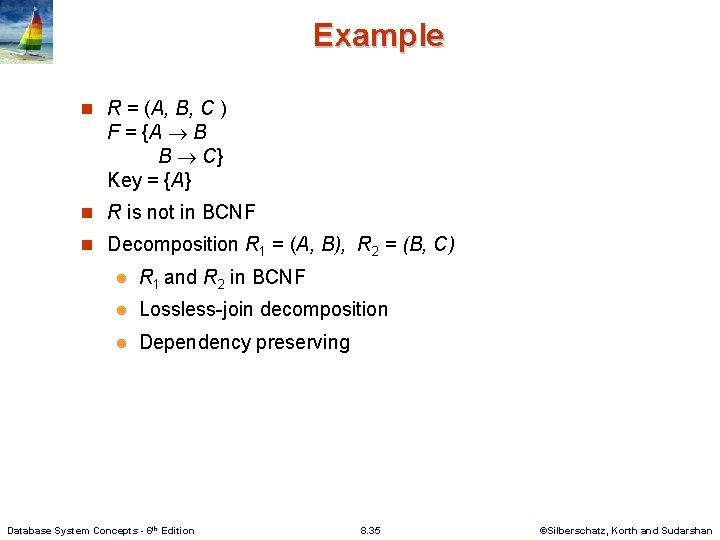
Example n R = (A, B, C ) F = {A B B C} Key = {A} n R is not in BCNF n Decomposition R 1 = (A, B), R 2 = (B, C) l R 1 and R 2 in BCNF l Lossless-join decomposition l Dependency preserving Database System Concepts - 6 th Edition 8. 35 ©Silberschatz, Korth and Sudarshan
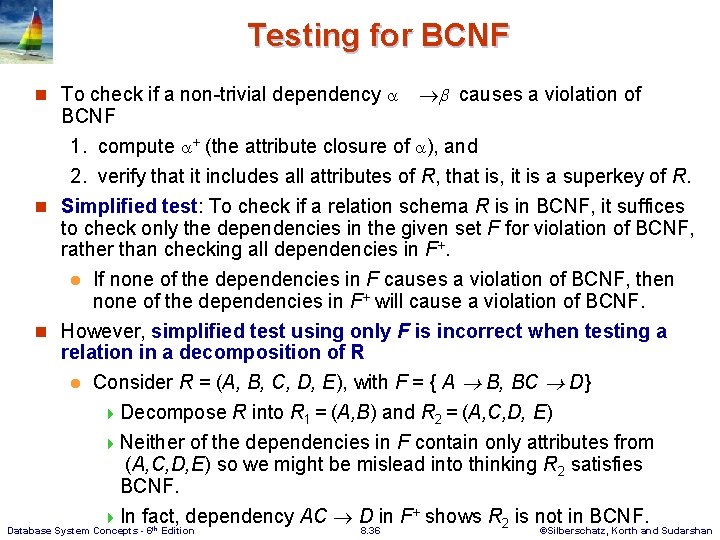
Testing for BCNF n To check if a non-trivial dependency causes a violation of BCNF 1. compute + (the attribute closure of ), and 2. verify that it includes all attributes of R, that is, it is a superkey of R. n Simplified test: To check if a relation schema R is in BCNF, it suffices to check only the dependencies in the given set F for violation of BCNF, rather than checking all dependencies in F+. l If none of the dependencies in F causes a violation of BCNF, then none of the dependencies in F+ will cause a violation of BCNF. n However, simplified test using only F is incorrect when testing a relation in a decomposition of R l Consider R = (A, B, C, D, E), with F = { A B, BC D} 4 Decompose R into R 1 = (A, B) and R 2 = (A, C, D, E) 4 Neither of the dependencies in F contain only attributes from (A, C, D, E) so we might be mislead into thinking R 2 satisfies BCNF. 4 In fact, dependency AC D in F+ shows R 2 is not in BCNF. Database System Concepts - 6 th Edition 8. 36 ©Silberschatz, Korth and Sudarshan
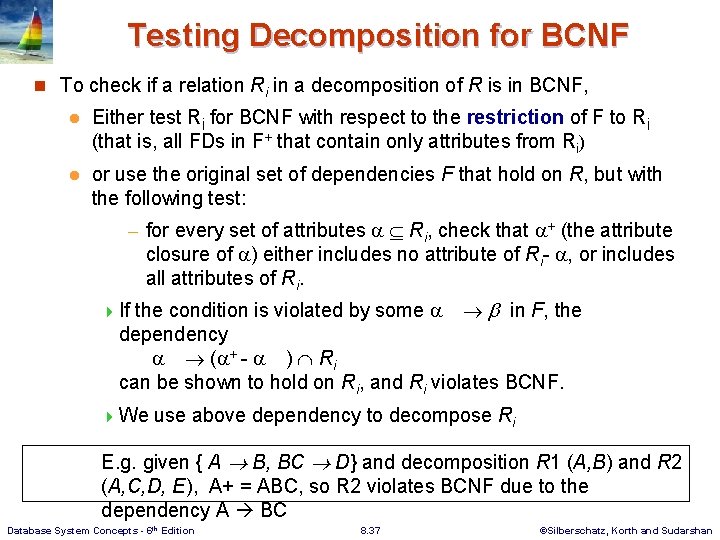
Testing Decomposition for BCNF n To check if a relation Ri in a decomposition of R is in BCNF, l Either test Ri for BCNF with respect to the restriction of F to Ri (that is, all FDs in F+ that contain only attributes from Ri) l or use the original set of dependencies F that hold on R, but with the following test: – for every set of attributes Ri, check that + (the attribute closure of ) either includes no attribute of Ri- , or includes all attributes of Ri. the condition is violated by some in F, the dependency ( + - ) Ri can be shown to hold on Ri, and Ri violates BCNF. 4 If 4 We use above dependency to decompose Ri E. g. given { A B, BC D} and decomposition R 1 (A, B) and R 2 (A, C, D, E), A+ = ABC, so R 2 violates BCNF due to the dependency A BC Database System Concepts - 6 th Edition 8. 37 ©Silberschatz, Korth and Sudarshan
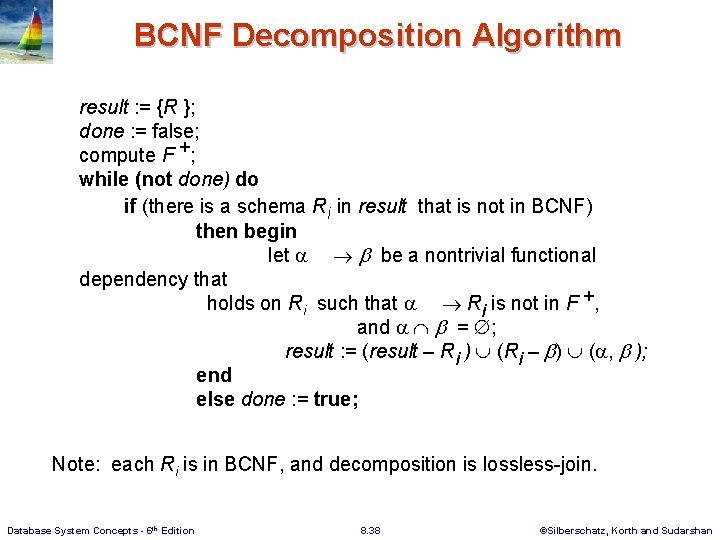
BCNF Decomposition Algorithm result : = {R }; done : = false; compute F +; while (not done) do if (there is a schema Ri in result that is not in BCNF) then begin let be a nontrivial functional dependency that holds on Ri such that Ri is not in F +, and = ; result : = (result – Ri ) (Ri – ) ( , ); end else done : = true; Note: each Ri is in BCNF, and decomposition is lossless-join. Database System Concepts - 6 th Edition 8. 38 ©Silberschatz, Korth and Sudarshan
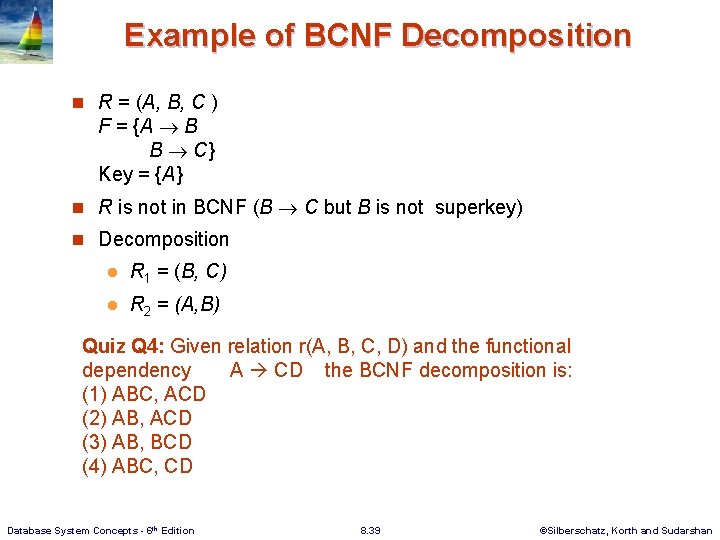
Example of BCNF Decomposition n R = (A, B, C ) F = {A B B C} Key = {A} n R is not in BCNF (B C but B is not superkey) n Decomposition l R 1 = (B, C) l R 2 = (A, B) Quiz Q 4: Given relation r(A, B, C, D) and the functional dependency A CD the BCNF decomposition is: (1) ABC, ACD (2) AB, ACD (3) AB, BCD (4) ABC, CD Database System Concepts - 6 th Edition 8. 39 ©Silberschatz, Korth and Sudarshan
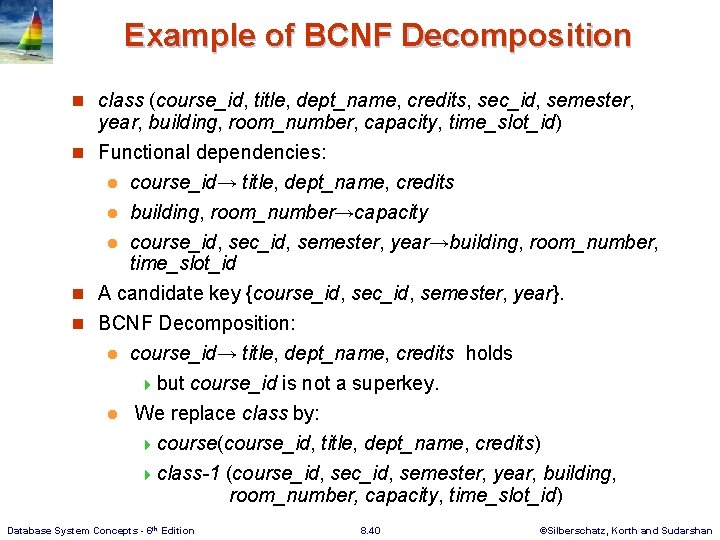
Example of BCNF Decomposition n class (course_id, title, dept_name, credits, sec_id, semester, year, building, room_number, capacity, time_slot_id) n Functional dependencies: l course_id→ title, dept_name, credits l building, room_number→capacity l course_id, sec_id, semester, year→building, room_number, time_slot_id n A candidate key {course_id, sec_id, semester, year}. n BCNF Decomposition: l course_id→ title, dept_name, credits holds 4 but course_id is not a superkey. l We replace class by: 4 course(course_id, title, dept_name, credits) 4 class-1 (course_id, sec_id, semester, year, building, room_number, capacity, time_slot_id) Database System Concepts - 6 th Edition 8. 40 ©Silberschatz, Korth and Sudarshan
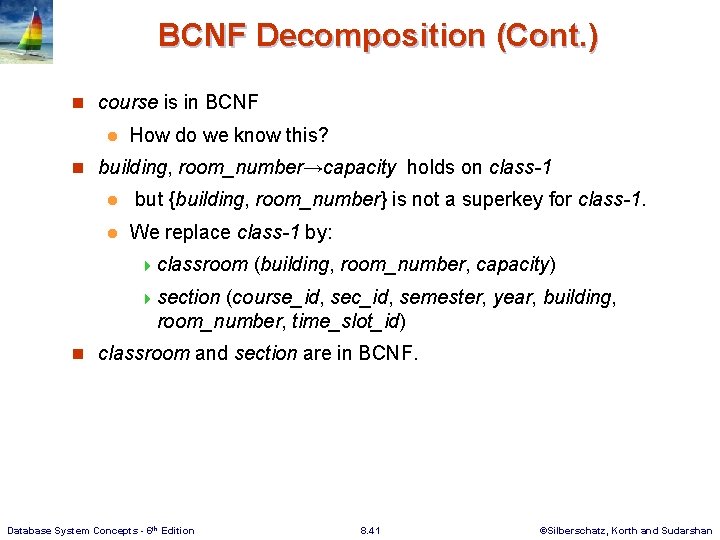
BCNF Decomposition (Cont. ) n course is in BCNF l How do we know this? n building, room_number→capacity holds on class-1 l l but {building, room_number} is not a superkey for class-1. We replace class-1 by: 4 classroom (building, room_number, capacity) 4 section (course_id, sec_id, semester, year, building, room_number, time_slot_id) n classroom and section are in BCNF. Database System Concepts - 6 th Edition 8. 41 ©Silberschatz, Korth and Sudarshan
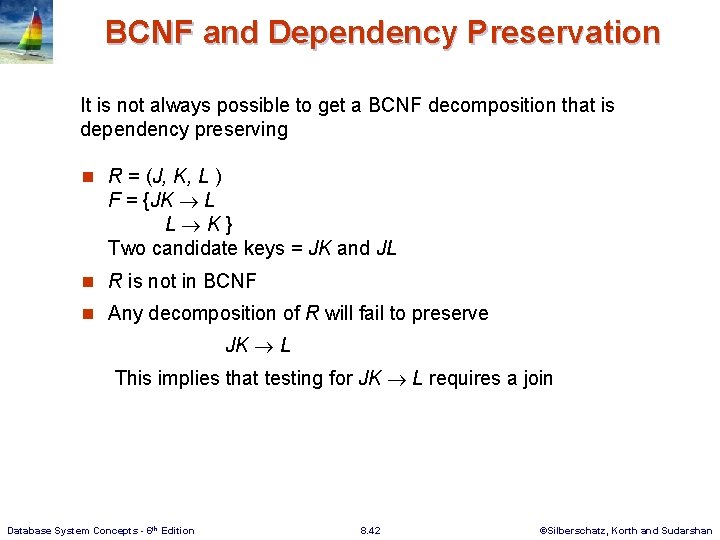
BCNF and Dependency Preservation It is not always possible to get a BCNF decomposition that is dependency preserving n R = (J, K, L ) F = {JK L L K} Two candidate keys = JK and JL n R is not in BCNF n Any decomposition of R will fail to preserve JK L This implies that testing for JK L requires a join Database System Concepts - 6 th Edition 8. 42 ©Silberschatz, Korth and Sudarshan
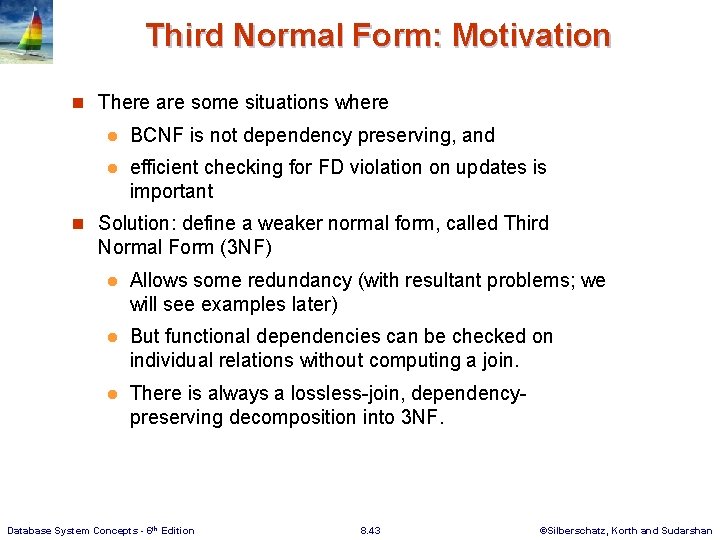
Third Normal Form: Motivation n There are some situations where l BCNF is not dependency preserving, and l efficient checking for FD violation on updates is important n Solution: define a weaker normal form, called Third Normal Form (3 NF) l Allows some redundancy (with resultant problems; we will see examples later) l But functional dependencies can be checked on individual relations without computing a join. l There is always a lossless-join, dependencypreserving decomposition into 3 NF. Database System Concepts - 6 th Edition 8. 43 ©Silberschatz, Korth and Sudarshan
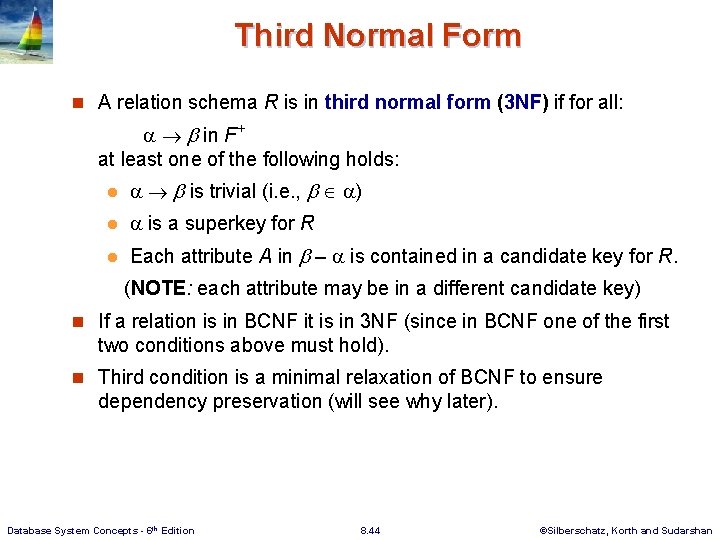
Third Normal Form n A relation schema R is in third normal form (3 NF) if for all: in F+ at least one of the following holds: l is trivial (i. e. , ) l is a superkey for R l Each attribute A in – is contained in a candidate key for R. (NOTE: each attribute may be in a different candidate key) n If a relation is in BCNF it is in 3 NF (since in BCNF one of the first two conditions above must hold). n Third condition is a minimal relaxation of BCNF to ensure dependency preservation (will see why later). Database System Concepts - 6 th Edition 8. 44 ©Silberschatz, Korth and Sudarshan
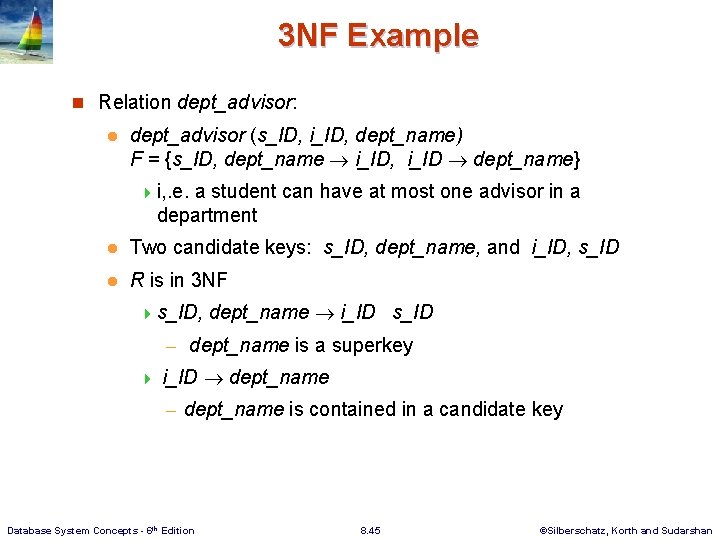
3 NF Example n Relation dept_advisor: l dept_advisor (s_ID, i_ID, dept_name) F = {s_ID, dept_name i_ID, i_ID dept_name} 4 i, . e. a student can have at most one advisor in a department l Two candidate keys: s_ID, dept_name, and i_ID, s_ID l R is in 3 NF 4 s_ID, dept_name i_ID s_ID – dept_name is a superkey 4 i_ID dept_name – dept_name is contained in a candidate key Database System Concepts - 6 th Edition 8. 45 ©Silberschatz, Korth and Sudarshan
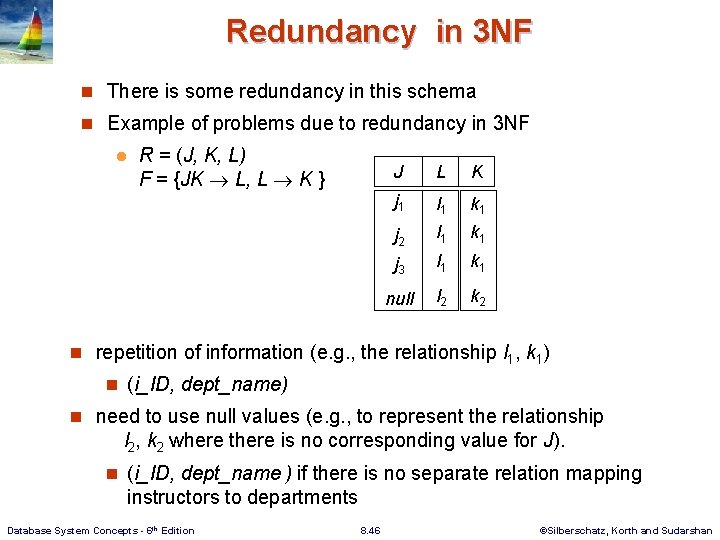
Redundancy in 3 NF n There is some redundancy in this schema n Example of problems due to redundancy in 3 NF l R = (J, K, L) F = {JK L, L K } J L K j 1 l 1 k 1 j 2 l 1 k 1 j 3 l 1 k 1 null l 2 k 2 n repetition of information (e. g. , the relationship l 1, k 1) n (i_ID, dept_name) n need to use null values (e. g. , to represent the relationship l 2, k 2 where there is no corresponding value for J). n (i_ID, dept_name ) if there is no separate relation mapping instructors to departments Database System Concepts - 6 th Edition 8. 46 ©Silberschatz, Korth and Sudarshan
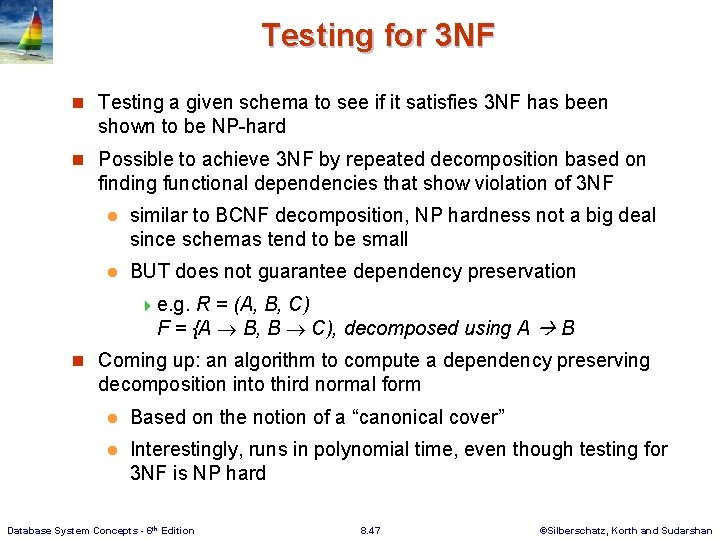
Testing for 3 NF n Testing a given schema to see if it satisfies 3 NF has been shown to be NP-hard n Possible to achieve 3 NF by repeated decomposition based on finding functional dependencies that show violation of 3 NF l similar to BCNF decomposition, NP hardness not a big deal since schemas tend to be small l BUT does not guarantee dependency preservation 4 e. g. R = (A, B, C) F = {A B, B C), decomposed using A B n Coming up: an algorithm to compute a dependency preserving decomposition into third normal form l Based on the notion of a “canonical cover” l Interestingly, runs in polynomial time, even though testing for 3 NF is NP hard Database System Concepts - 6 th Edition 8. 47 ©Silberschatz, Korth and Sudarshan
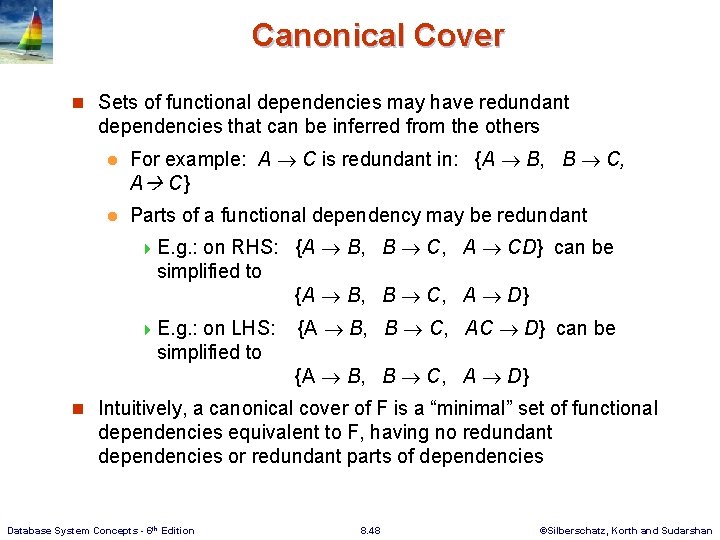
Canonical Cover n Sets of functional dependencies may have redundant dependencies that can be inferred from the others l For example: A C is redundant in: {A B, B C, A C} l Parts of a functional dependency may be redundant on RHS: {A B, B C, A CD} can be simplified to {A B, B C, A D} 4 E. g. : on LHS: simplified to {A B, B C, AC D} can be {A B, B C, A D} n Intuitively, a canonical cover of F is a “minimal” set of functional dependencies equivalent to F, having no redundant dependencies or redundant parts of dependencies Database System Concepts - 6 th Edition 8. 48 ©Silberschatz, Korth and Sudarshan
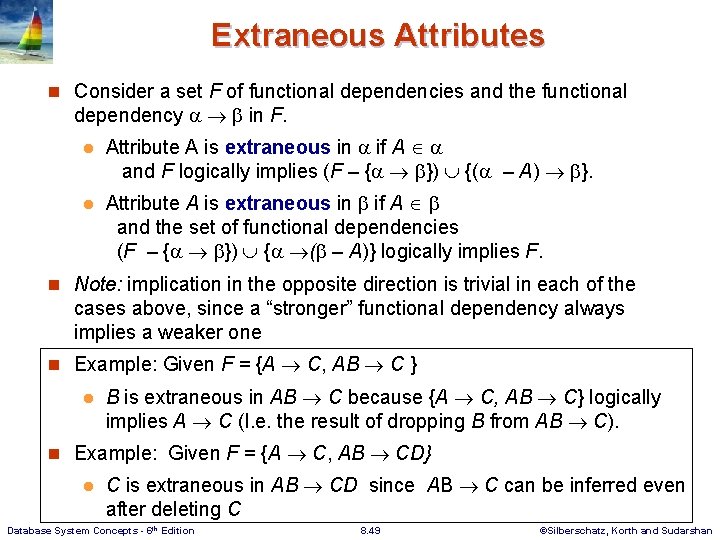
Extraneous Attributes n Consider a set F of functional dependencies and the functional dependency in F. l Attribute A is extraneous in if A and F logically implies (F – { }) {( – A) }. l Attribute A is extraneous in if A and the set of functional dependencies (F – { }) { ( – A)} logically implies F. n Note: implication in the opposite direction is trivial in each of the cases above, since a “stronger” functional dependency always implies a weaker one n Example: Given F = {A C, AB C } l B is extraneous in AB C because {A C, AB C} logically implies A C (I. e. the result of dropping B from AB C). n Example: Given F = {A C, AB CD} l C is extraneous in AB CD since AB C can be inferred even after deleting C Database System Concepts - 6 th Edition 8. 49 ©Silberschatz, Korth and Sudarshan
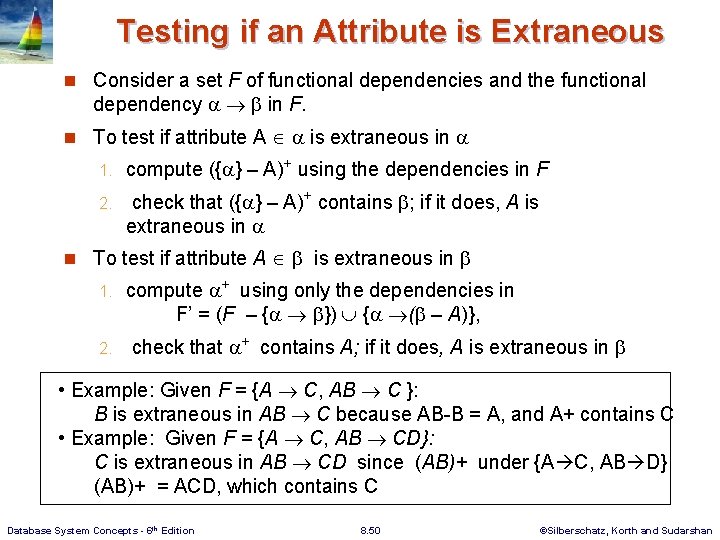
Testing if an Attribute is Extraneous n Consider a set F of functional dependencies and the functional dependency in F. n To test if attribute A is extraneous in 1. compute ({ } – A)+ using the dependencies in F 2. check that ({ } – A)+ contains ; if it does, A is extraneous in n To test if attribute A is extraneous in 1. 2. compute + using only the dependencies in F’ = (F – { }) { ( – A)}, check that + contains A; if it does, A is extraneous in • Example: Given F = {A C, AB C }: B is extraneous in AB C because AB-B = A, and A+ contains C • Example: Given F = {A C, AB CD}: C is extraneous in AB CD since (AB)+ under {A C, AB D} (AB)+ = ACD, which contains C Database System Concepts - 6 th Edition 8. 50 ©Silberschatz, Korth and Sudarshan
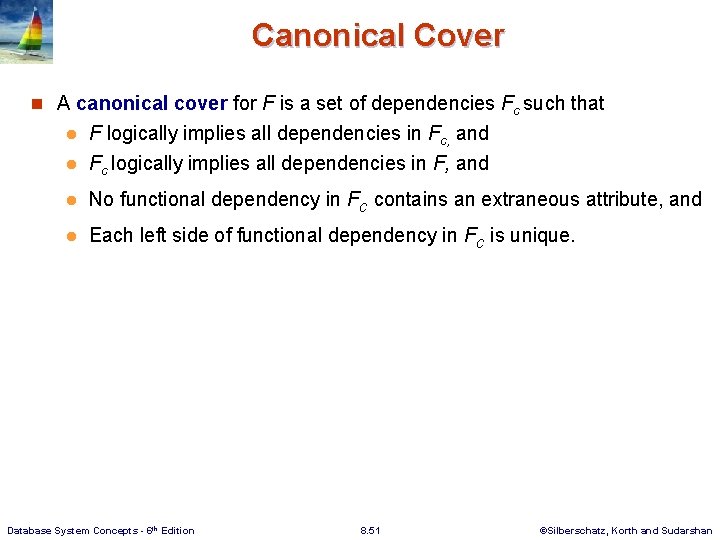
Canonical Cover n A canonical cover for F is a set of dependencies Fc such that F logically implies all dependencies in Fc, and l Fc logically implies all dependencies in F, and l l No functional dependency in Fc contains an extraneous attribute, and l Each left side of functional dependency in Fc is unique. Database System Concepts - 6 th Edition 8. 51 ©Silberschatz, Korth and Sudarshan
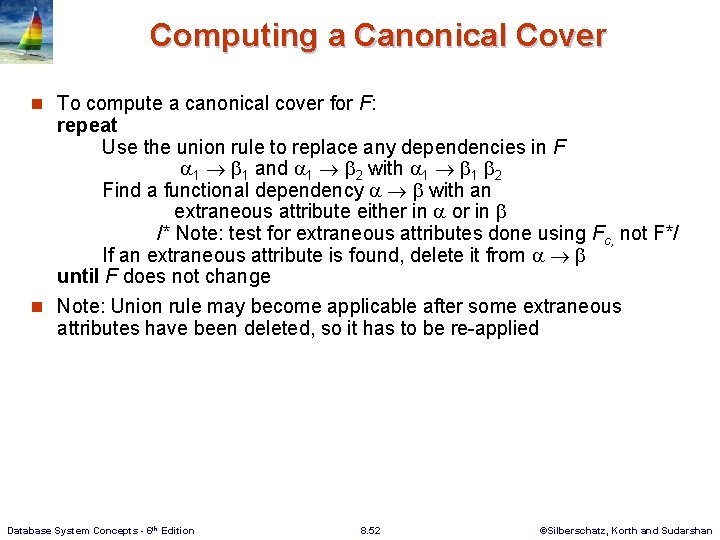
Computing a Canonical Cover n To compute a canonical cover for F: repeat Use the union rule to replace any dependencies in F 1 1 and 1 2 with 1 1 2 Find a functional dependency with an extraneous attribute either in or in /* Note: test for extraneous attributes done using Fc, not F*/ If an extraneous attribute is found, delete it from until F does not change n Note: Union rule may become applicable after some extraneous attributes have been deleted, so it has to be re-applied Database System Concepts - 6 th Edition 8. 52 ©Silberschatz, Korth and Sudarshan
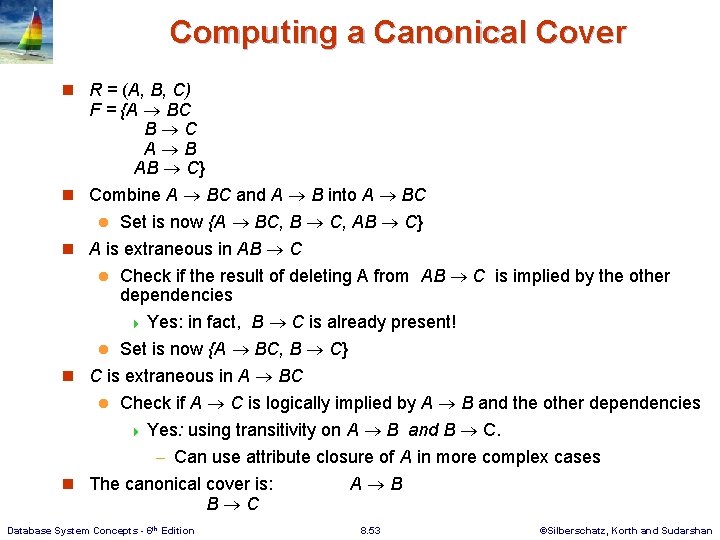
Computing a Canonical Cover n R = (A, B, C) F = {A BC B C A B AB C} n Combine A BC and A B into A BC Set is now {A BC, B C, AB C} n A is extraneous in AB C l Check if the result of deleting A from AB C is implied by the other dependencies 4 Yes: in fact, B C is already present! l Set is now {A BC, B C} n C is extraneous in A BC l Check if A C is logically implied by A B and the other dependencies 4 Yes: using transitivity on A B and B C. – Can use attribute closure of A in more complex cases n The canonical cover is: A B B C l Database System Concepts - 6 th Edition 8. 53 ©Silberschatz, Korth and Sudarshan
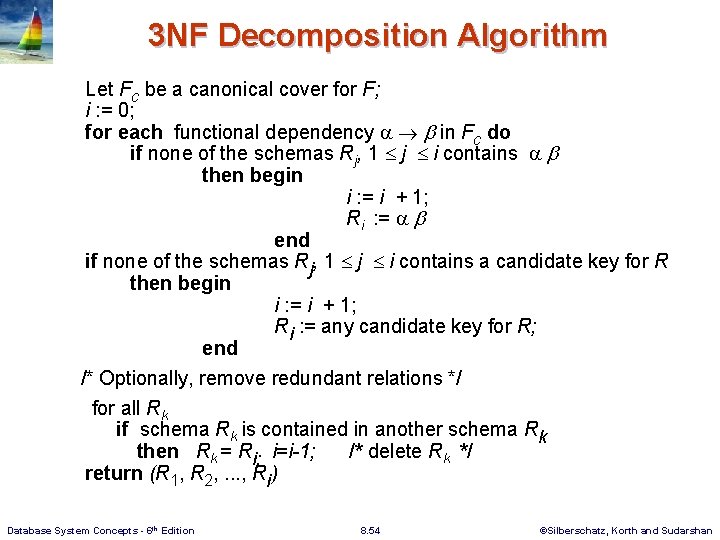
3 NF Decomposition Algorithm Let Fc be a canonical cover for F; i : = 0; for each functional dependency in Fc do if none of the schemas Rj, 1 j i contains then begin i : = i + 1; Ri : = end if none of the schemas Rj, 1 j i contains a candidate key for R then begin i : = i + 1; Ri : = any candidate key for R; end /* Optionally, remove redundant relations */ for all Rk if schema Rk is contained in another schema Rk then Rk = Ri; i=i-1; /* delete Rk */ return (R 1, R 2, . . . , Ri) Database System Concepts - 6 th Edition 8. 54 ©Silberschatz, Korth and Sudarshan
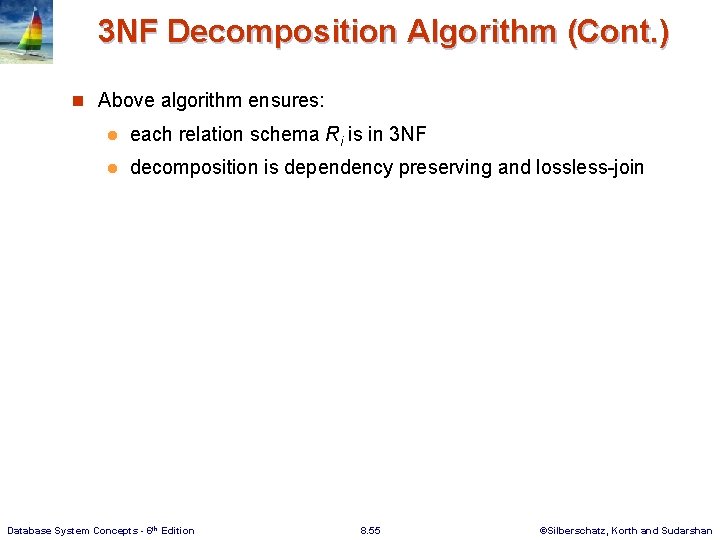
3 NF Decomposition Algorithm (Cont. ) n Above algorithm ensures: l each relation schema Ri is in 3 NF l decomposition is dependency preserving and lossless-join Database System Concepts - 6 th Edition 8. 55 ©Silberschatz, Korth and Sudarshan
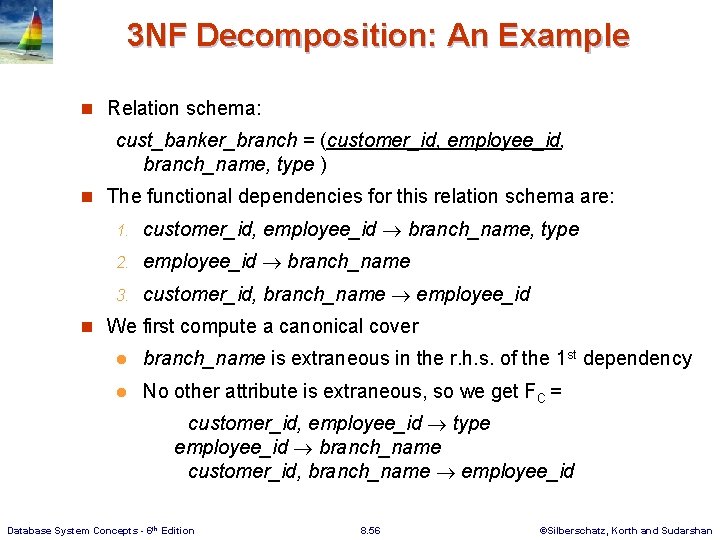
3 NF Decomposition: An Example n Relation schema: cust_banker_branch = (customer_id, employee_id, branch_name, type ) n The functional dependencies for this relation schema are: 1. customer_id, employee_id branch_name, type 2. employee_id branch_name 3. customer_id, branch_name employee_id n We first compute a canonical cover l branch_name is extraneous in the r. h. s. of the 1 st dependency l No other attribute is extraneous, so we get FC = customer_id, employee_id type employee_id branch_name customer_id, branch_name employee_id Database System Concepts - 6 th Edition 8. 56 ©Silberschatz, Korth and Sudarshan
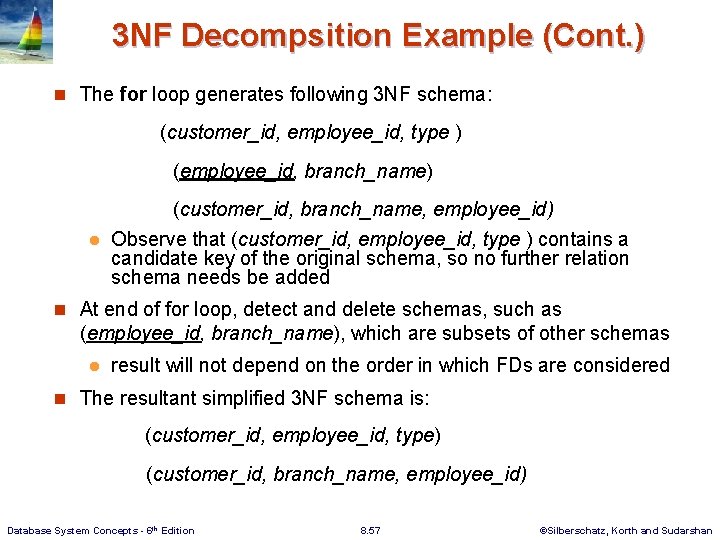
3 NF Decompsition Example (Cont. ) n The for loop generates following 3 NF schema: (customer_id, employee_id, type ) (employee_id, branch_name) (customer_id, branch_name, employee_id) l Observe that (customer_id, employee_id, type ) contains a candidate key of the original schema, so no further relation schema needs be added n At end of for loop, detect and delete schemas, such as (employee_id, branch_name), which are subsets of other schemas l result will not depend on the order in which FDs are considered n The resultant simplified 3 NF schema is: (customer_id, employee_id, type) (customer_id, branch_name, employee_id) Database System Concepts - 6 th Edition 8. 57 ©Silberschatz, Korth and Sudarshan
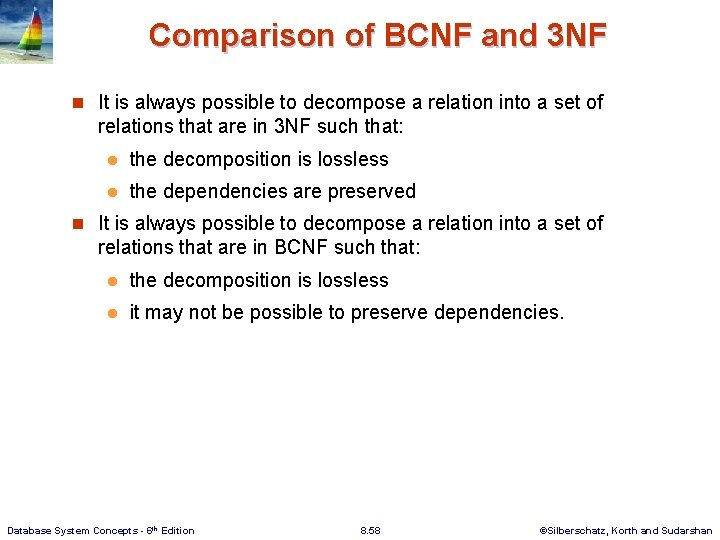
Comparison of BCNF and 3 NF n It is always possible to decompose a relation into a set of relations that are in 3 NF such that: l the decomposition is lossless l the dependencies are preserved n It is always possible to decompose a relation into a set of relations that are in BCNF such that: l the decomposition is lossless l it may not be possible to preserve dependencies. Database System Concepts - 6 th Edition 8. 58 ©Silberschatz, Korth and Sudarshan
Design Goals n Goal for a relational database design is: l BCNF. l Lossless join. l Dependency preservation. n If we cannot achieve this, we accept one of l Lack of dependency preservation l Redundancy due to use of 3 NF n Interestingly, SQL does not provide a direct way of specifying functional dependencies other than superkeys. Can specify FDs using assertions, but they are expensive to test, (and currently not supported by any of the widely used databases!) n Even if we had a dependency preserving decomposition, using SQL we would not be able to efficiently test a functional dependency whose left hand side is not a key. Database System Concepts - 6 th Edition 8. 59 ©Silberschatz, Korth and Sudarshan
Multivalued Dependencies n Suppose we record names of children, and phone numbers for instructors: l inst_child(ID, child_name) l inst_phone(ID, phone_number) n If we were to combine these schemas to get l inst_info(ID, child_name, phone_number) l Example data: (99999, David, 512 -555 -1234) (99999, David, 512 -555 -4321) (99999, William, 512 -555 -1234) (99999, William, 512 -555 -4321) n This relation is in BCNF l Why? n Even though phone number is not uniquely determined by ID, the connection between ID and phone number is independent of all other attributes (child_name in this case) Database System Concepts - 6 th Edition 8. 60 ©Silberschatz, Korth and Sudarshan
Multivalued Dependencies n See book for details on l Modeling above redundancy via multivalued dependencies 4 In above example ID multivalue determines phone number 4 written as: ID phone_number Normalization using multivalued dependencies, to get fourth normal form (4 NF) n Idea: use functional dependencies and multivalued dependencies to decompose schema l Database System Concepts - 6 th Edition 8. 61 ©Silberschatz, Korth and Sudarshan
Database Design Process Database System Concepts, 6 th Ed. ©Silberschatz, Korth and Sudarshan See www. db-book. com for conditions on re-use
Overall Database Design Process n We have assumed schema R is given l R could have been generated when converting E-R diagram to a set of tables. l R could have been a single relation containing all attributes that are of interest (called universal relation). l Normalization breaks R into smaller relations. l R could have been the result of some ad hoc design of relations, which we then test/convert to normal form. Database System Concepts - 6 th Edition 8. 63 ©Silberschatz, Korth and Sudarshan
ER Model and Normalization n When an E-R diagram is carefully designed, identifying all entities correctly, the tables generated from the E-R diagram should not need further normalization. n However, in a real (imperfect) design, there can be functional dependencies from non-key attributes of an entity to other attributes of the entity l Example: an employee entity with attributes department_name and building, and a functional dependency department_name building l Good design would have made department an entity n Functional dependencies from non-key attributes of a relationship set possible, but rare --- most relationships are binary Database System Concepts - 6 th Edition 8. 64 ©Silberschatz, Korth and Sudarshan
Modeling Temporal Data n Temporal data have an association time interval during which the data are valid. n A snapshot is the value of the data at a particular point in time n Several proposals to extend ER model by adding valid time to l attributes, e. g. address of an instructor at different points in time l entities, e. g. time duration when a student entity exists l relationships, e. g. time during which an instructor was associated with a student as an advisor. n But no accepted standard n Adding a temporal component results in functional dependencies like ID street, city not to hold, because the address varies over time t n A temporal functional dependency X Y holds on schema R if the functional dependency X Y holds on all snapshots for all legal instances r (R ) Database System Concepts - 6 th Edition 8. 65 ©Silberschatz, Korth and Sudarshan
Modeling Temporal Data (Cont. ) n In practice, database designers may add start and end time attributes to relations l E. g. course(course_id, course_title) is replaced by course(course_id, course_title, start, end) 4 Constraint: no two tuples can have overlapping valid times – Hard to enforce efficiently n Foreign key references may be to current version of data, or to data at a point in time l E. g. student transcript should refer to course information at the time the course was taken Database System Concepts - 6 th Edition 8. 66 ©Silberschatz, Korth and Sudarshan
End of Chapter Database System Concepts, 6 th Ed. ©Silberschatz, Korth and Sudarshan See www. db-book. com for conditions on re-use
- Slides: 67