
Chapter 8 Receivables Learning Objectives 1 Define and
Chapter 8 Receivables
Learning Objectives 1. Define and explain common types of receivables and journalize sales on credit, credit card sales, and debit card sales 2. Apply the direct write-off method for uncollectibles © 2016 Pearson Education, Inc. 8 -2
Learning Objectives 3. Apply the allowance method for uncollectibles and estimate bad debts expense based on the percent-of-sales, percent-of -receivables, and aging-ofreceivables methods © 2016 Pearson Education, Inc. 8 -3
Learning Objectives 4. Account for notes receivable including computing interest and recording honored and dishonored notes 5. Use the acid-test ratio, accounts receivable turnover ratio, and days’ sales in receivables to evaluate business performance © 2016 Pearson Education, Inc. 8 -4
Learning Objective 1 Define and explain common types of receivables and journalize sales on credit, credit card sales, and debit card sales © 2016 Pearson Education, Inc. 8 -5
What Are Common Types of Receivables, and How Are Credit Sales Recorded? • A receivable occurs when a business sells goods or services to another party on account (on credit). • A receivable is a monetary claim against a business or an individual. – A receivable is a right to receive cash in the future from a current transaction. – A creditor is the party who receives a receivable. – A debtor is the party to a credit transaction who is obligated to pay later. © 2016 Pearson Education, Inc. 8 -6
Accounts Receivable • Accounts receivable, also called trade receivables, represents the right to receive cash in the future from customers for goods or services performed. – Generally collected within 30 to 60 days – Reported as a current asset on the balance sheet © 2016 Pearson Education, Inc. 9 -7
Notes Receivable • Notes receivable usually have longer terms than accounts receivable. • Notes receivable are sometimes called promissory notes. • A note receivable represents a promise to pay a fixed amount of principle plus interest by a certain due date. • The maturity date is the date on which a note receivable is due. © 2016 Pearson Education, Inc. 8 -8
Other Receivables • Any other type of receivable is considered other receivables. • Receivables are classified as either current or long-term, depending on whether they will be received in one year or less. • Examples include: • Dividends receivable • Interest receivable • Taxes receivable © 2016 Pearson Education, Inc. 8 -9
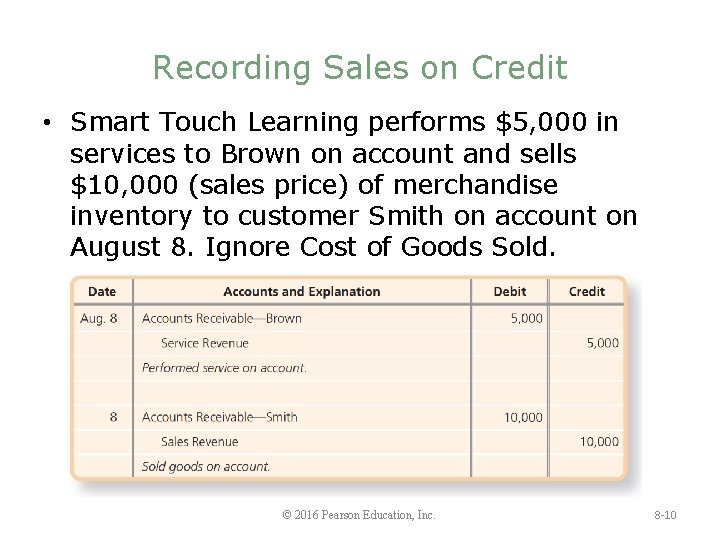
Recording Sales on Credit • Smart Touch Learning performs $5, 000 in services to Brown on account and sells $10, 000 (sales price) of merchandise inventory to customer Smith on account on August 8. Ignore Cost of Goods Sold. © 2016 Pearson Education, Inc. 8 -10
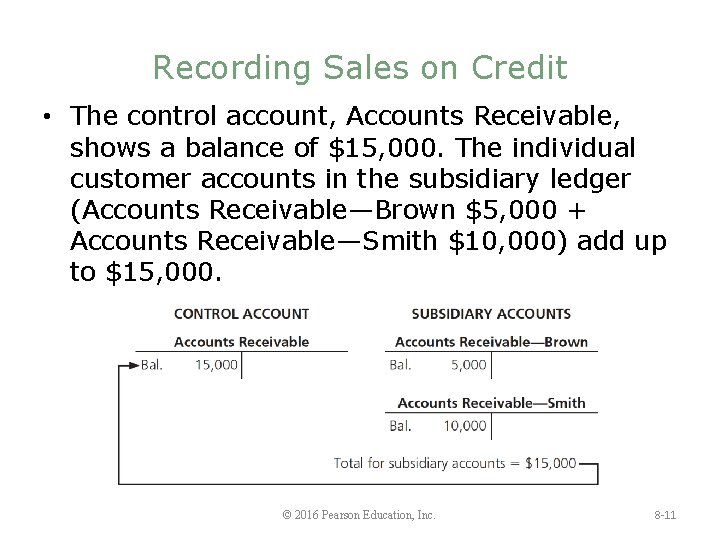
Recording Sales on Credit • The control account, Accounts Receivable, shows a balance of $15, 000. The individual customer accounts in the subsidiary ledger (Accounts Receivable—Brown $5, 000 + Accounts Receivable—Smith $10, 000) add up to $15, 000. © 2016 Pearson Education, Inc. 8 -11
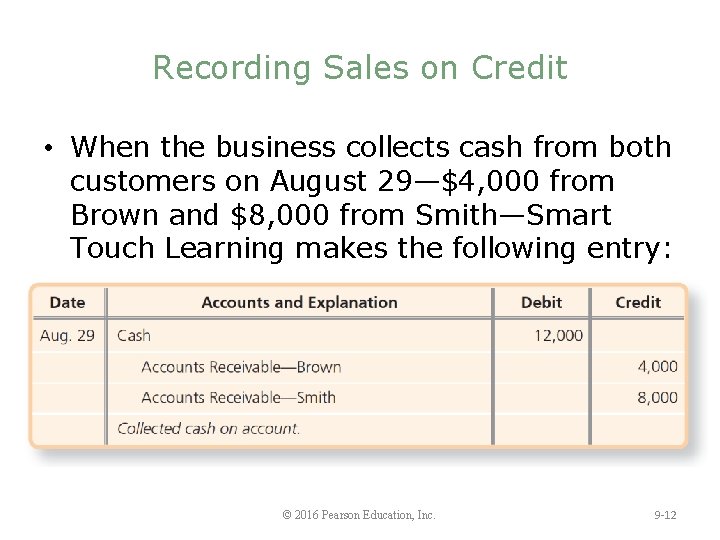
Recording Sales on Credit • When the business collects cash from both customers on August 29—$4, 000 from Brown and $8, 000 from Smith—Smart Touch Learning makes the following entry: © 2016 Pearson Education, Inc. 9 -12
Recording Credit Card and Debit Card Sales • Credit and debit card sales are recorded the same as cash sales. • A fee is usually charged by the card company. • There are two methods for recording credit card sales: – Net method – Gross method © 2016 Pearson Education, Inc. 8 -13
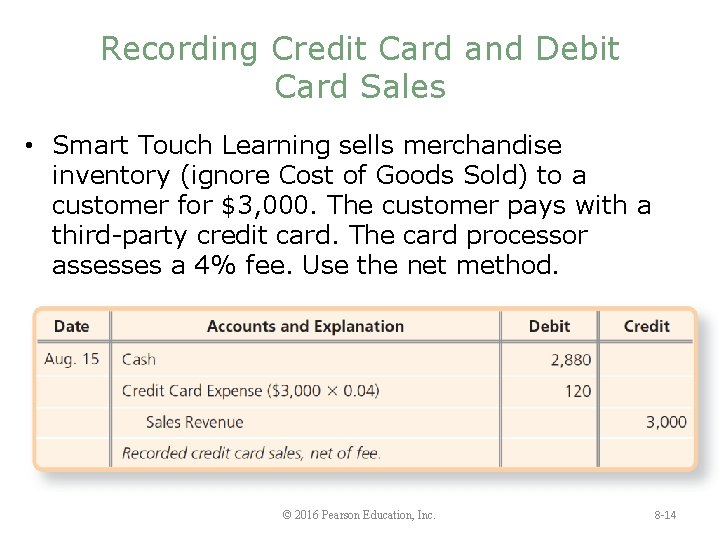
Recording Credit Card and Debit Card Sales • Smart Touch Learning sells merchandise inventory (ignore Cost of Goods Sold) to a customer for $3, 000. The customer pays with a third-party credit card. The card processor assesses a 4% fee. Use the net method. © 2016 Pearson Education, Inc. 8 -14
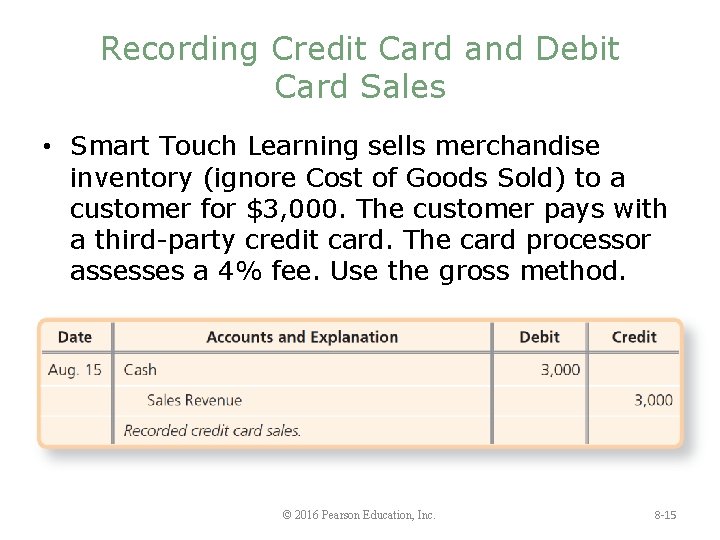
Recording Credit Card and Debit Card Sales • Smart Touch Learning sells merchandise inventory (ignore Cost of Goods Sold) to a customer for $3, 000. The customer pays with a third-party credit card. The card processor assesses a 4% fee. Use the gross method. © 2016 Pearson Education, Inc. 8 -15
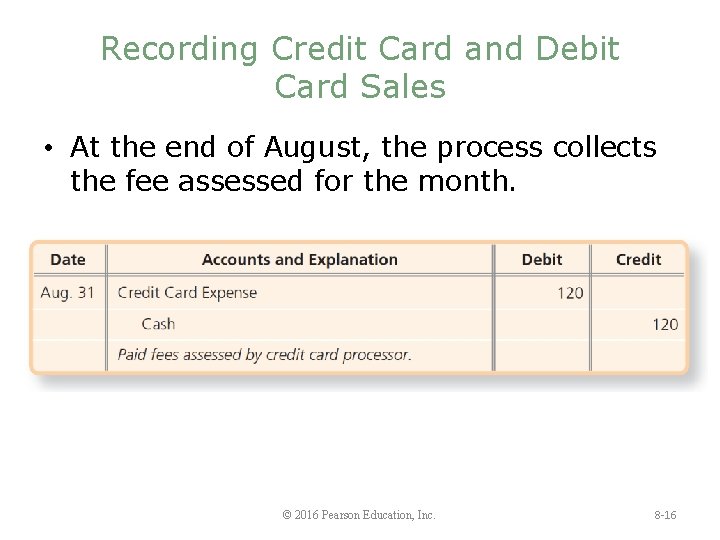
Recording Credit Card and Debit Card Sales • At the end of August, the process collects the fee assessed for the month. © 2016 Pearson Education, Inc. 8 -16
Learning Objective 2 Apply the direct write-off method for uncollectibles © 2016 Pearson Education, Inc. 8 -17
How Are Uncollectibles Accounted for When Using the Direct Write-Off Method? • Bad debts expense arises from failure to collect from some customers who purchase on account. • There are two methods of accounting for uncollectible receivables: – Direct write-off method – Allowance method (required by GAAP) © 2016 Pearson Education, Inc. 8 -18
Recording and Writing Off Uncollectible Accounts—Direct Write-off Method • The direct write-off method of accounting for uncollectible receivables is primarily used by small, nonpublic companies. – Accounts receivable are written off when the business determines that it will never collect from a specific customer. – Bad debts expense is recorded. © 2016 Pearson Education, Inc. 8 -19
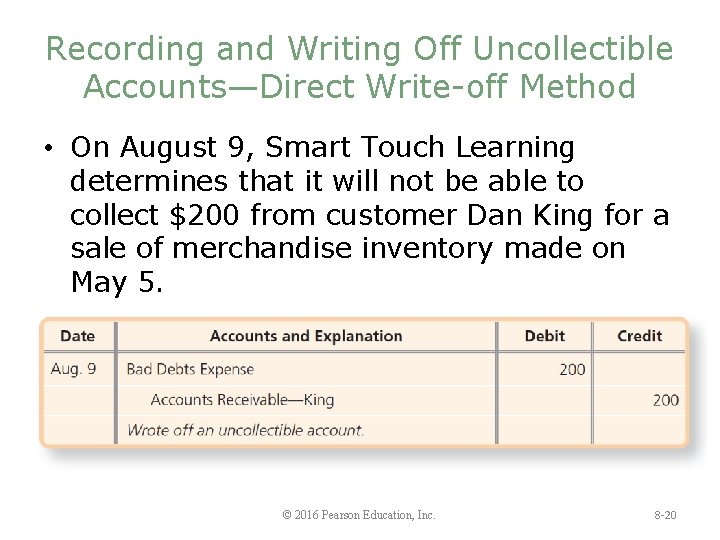
Recording and Writing Off Uncollectible Accounts—Direct Write-off Method • On August 9, Smart Touch Learning determines that it will not be able to collect $200 from customer Dan King for a sale of merchandise inventory made on May 5. © 2016 Pearson Education, Inc. 8 -20
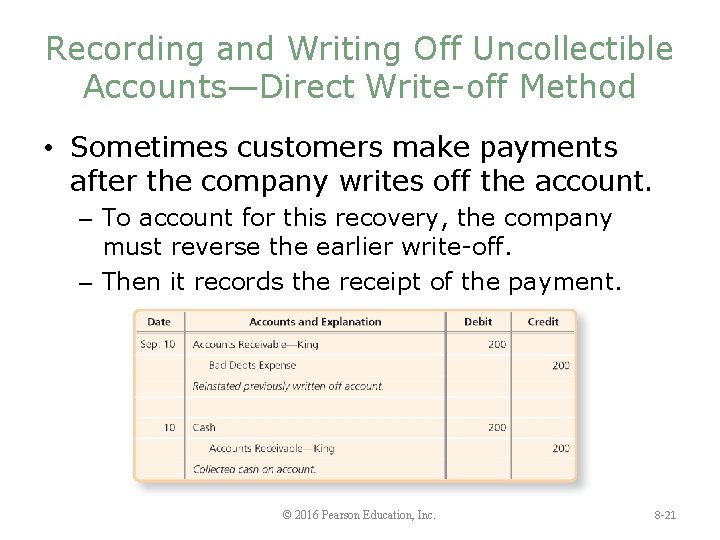
Recording and Writing Off Uncollectible Accounts—Direct Write-off Method • Sometimes customers make payments after the company writes off the account. – To account for this recovery, the company must reverse the earlier write-off. – Then it records the receipt of the payment. © 2016 Pearson Education, Inc. 8 -21
Learning Objective 3 Apply the allowance method for uncollectibles and estimate bad debts expense based on the percent-ofsales, percent-of-receivables, and aging-of-receivables methods © 2016 Pearson Education, Inc. 8 -22
How Are Uncollectibles Accounted for When Using the Allowance Method? • Most companies use the allowance method to measure bad debts. – The allowance method is based on the matching principle. – It records bad debts in the same period as the sales revenue. • A contra asset account called Allowance for Bad Debts reduces the Accounts Receivable to the net realizable value. © 2016 Pearson Education, Inc. 8 -23
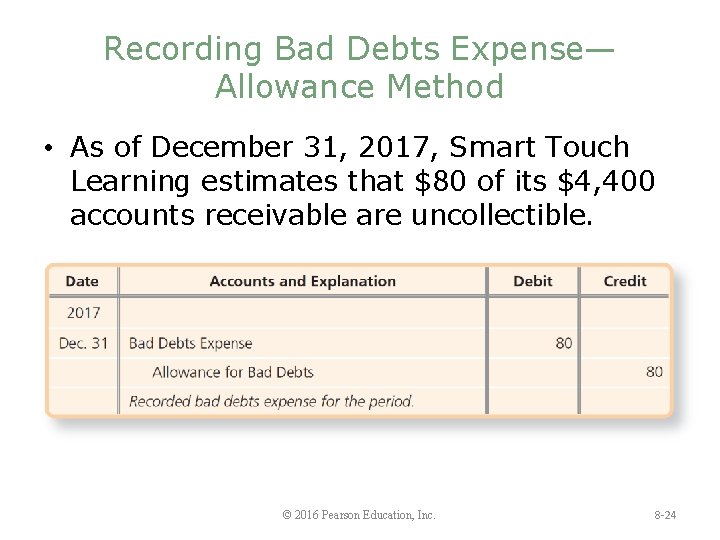
Recording Bad Debts Expense— Allowance Method • As of December 31, 2017, Smart Touch Learning estimates that $80 of its $4, 400 accounts receivable are uncollectible. © 2016 Pearson Education, Inc. 8 -24
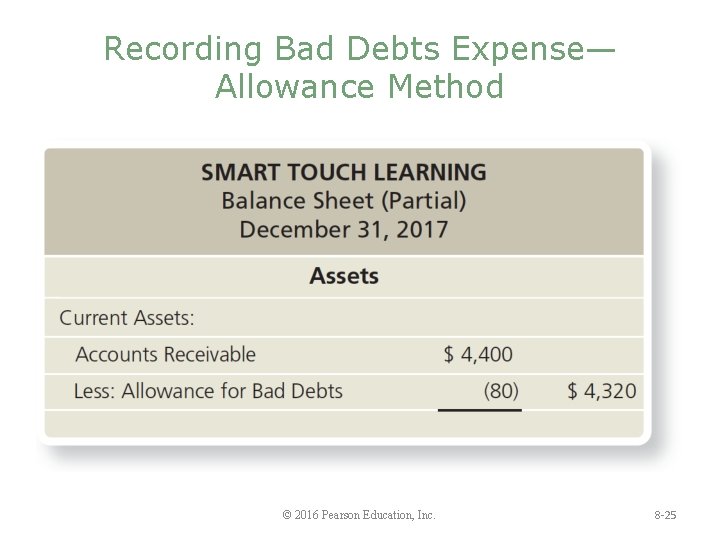
Recording Bad Debts Expense— Allowance Method © 2016 Pearson Education, Inc. 8 -25
Writing Off Uncollectible Accounts— Allowance Method • An allowance is established for the estimated uncollectible accounts. • Instead of recording a debit to Bad Debts Expense, the company records a debit to Allowance for Bad Debts. • The entry to write off an account under the allowance method has no effect on net income at the time of entry. © 2016 Pearson Education, Inc. 8 -26
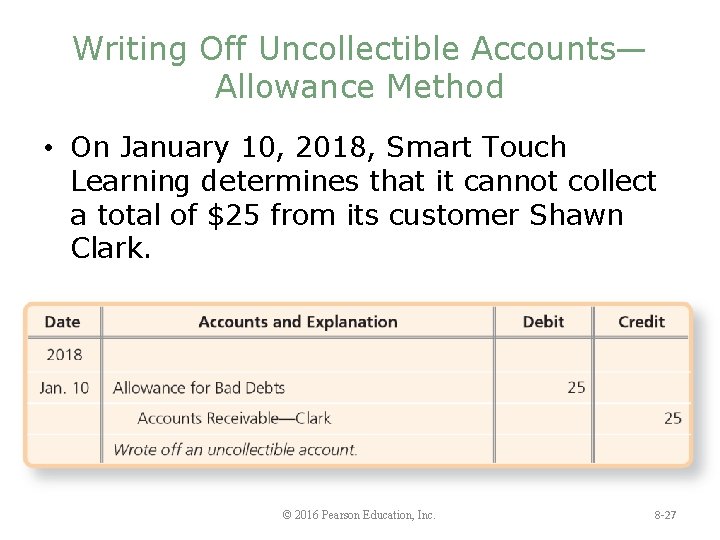
Writing Off Uncollectible Accounts— Allowance Method • On January 10, 2018, Smart Touch Learning determines that it cannot collect a total of $25 from its customer Shawn Clark. © 2016 Pearson Education, Inc. 8 -27
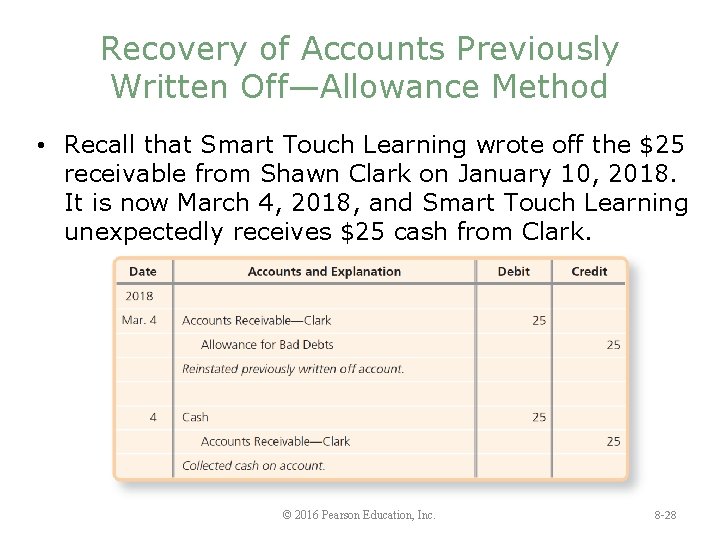
Recovery of Accounts Previously Written Off—Allowance Method • Recall that Smart Touch Learning wrote off the $25 receivable from Shawn Clark on January 10, 2018. It is now March 4, 2018, and Smart Touch Learning unexpectedly receives $25 cash from Clark. © 2016 Pearson Education, Inc. 8 -28
Estimating and Recording Bad Debts Expense—Allowance Method • Companies estimate bad debts expense based upon: • Past experience • The industry in which they operate • Other variables • There are three methods to estimate uncollectibles using the allowance method: – Percent-of-sales – Percent-of-receivables – Aging-of-receivables © 2016 Pearson Education, Inc. 8 -29
Percent-of-Sales Method • The percent-of-sales method computes bad debts expense as a percentage of net credit sales. • Some companies use all sales, not just credit sales. • This method is also called the incomestatement approach. © 2016 Pearson Education, Inc. 8 -30
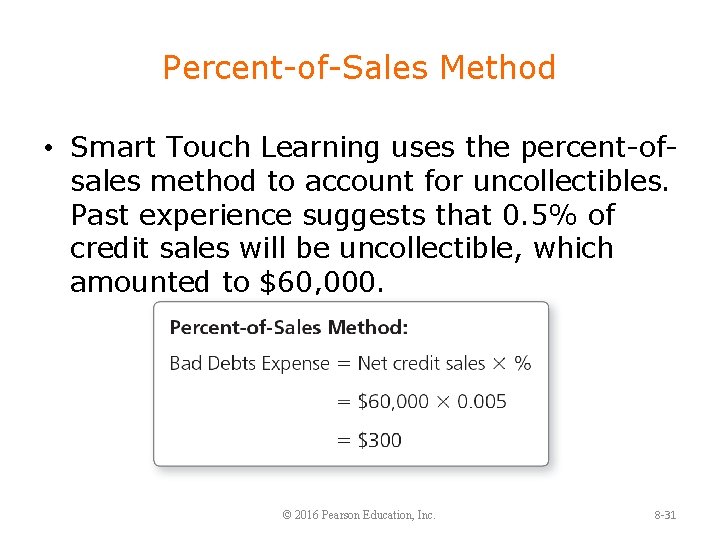
Percent-of-Sales Method • Smart Touch Learning uses the percent-ofsales method to account for uncollectibles. Past experience suggests that 0. 5% of credit sales will be uncollectible, which amounted to $60, 000. © 2016 Pearson Education, Inc. 8 -31
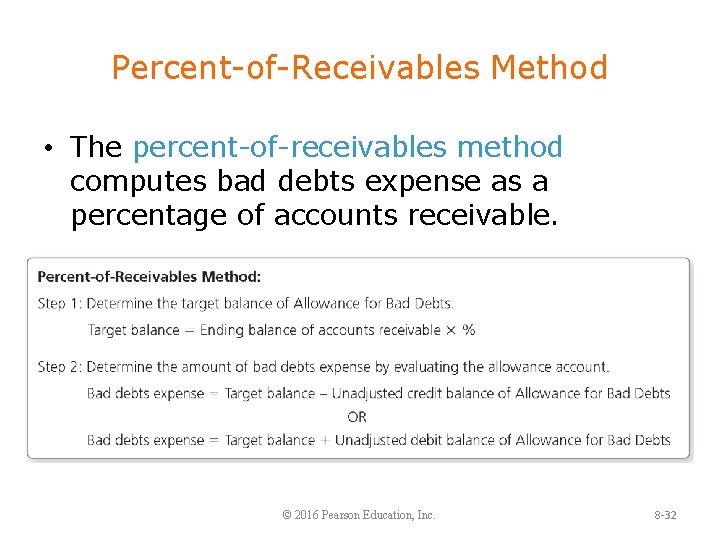
Percent-of-Receivables Method • The percent-of-receivables method computes bad debts expense as a percentage of accounts receivable. © 2016 Pearson Education, Inc. 8 -32
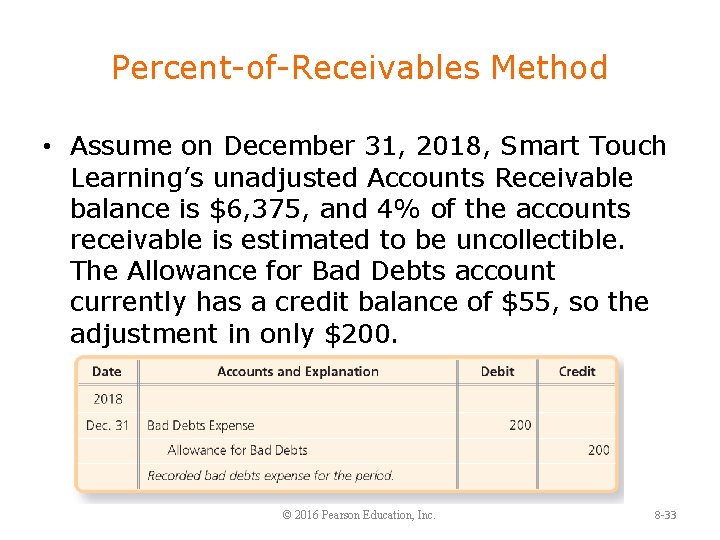
Percent-of-Receivables Method • Assume on December 31, 2018, Smart Touch Learning’s unadjusted Accounts Receivable balance is $6, 375, and 4% of the accounts receivable is estimated to be uncollectible. The Allowance for Bad Debts account currently has a credit balance of $55, so the adjustment in only $200. © 2016 Pearson Education, Inc. 8 -33
Aging-of-Receivables Method • The aging-of-receivables method is similar to the percent-of-receivables method. • In the aging method, businesses group individual accounts based on how long the receivable has been outstanding. • Different percentages are applied to each category. © 2016 Pearson Education, Inc. 8 -34
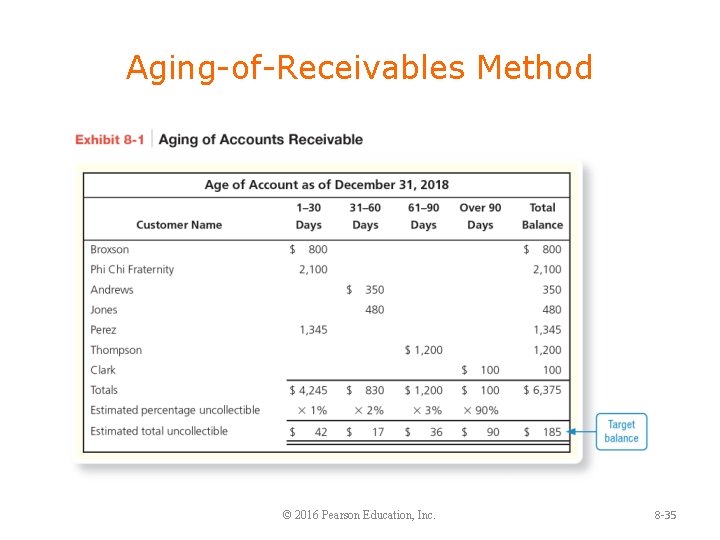
Aging-of-Receivables Method © 2016 Pearson Education, Inc. 8 -35
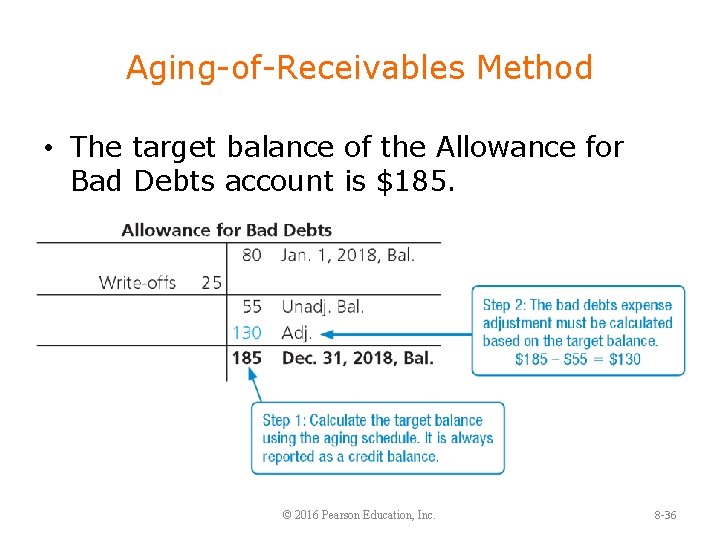
Aging-of-Receivables Method • The target balance of the Allowance for Bad Debts account is $185. © 2016 Pearson Education, Inc. 8 -36
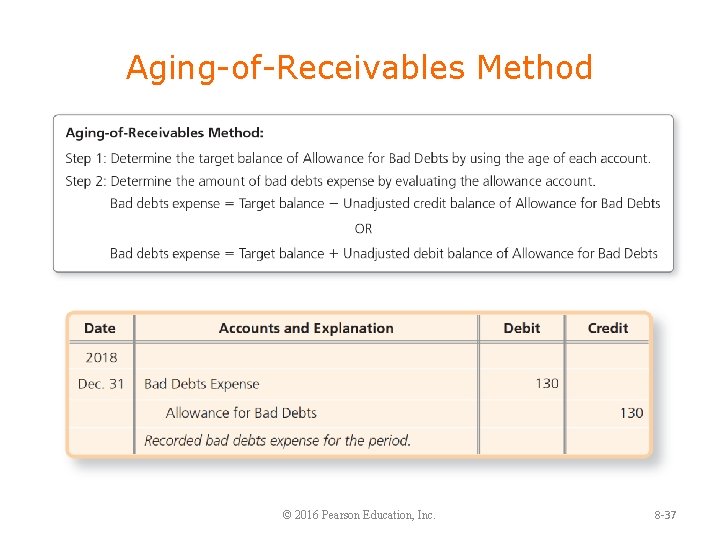
Aging-of-Receivables Method © 2016 Pearson Education, Inc. 8 -37
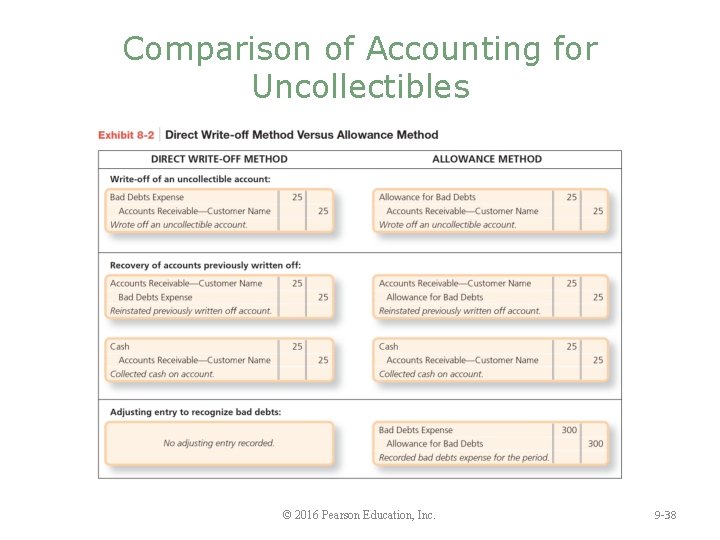
Comparison of Accounting for Uncollectibles © 2016 Pearson Education, Inc. 9 -38
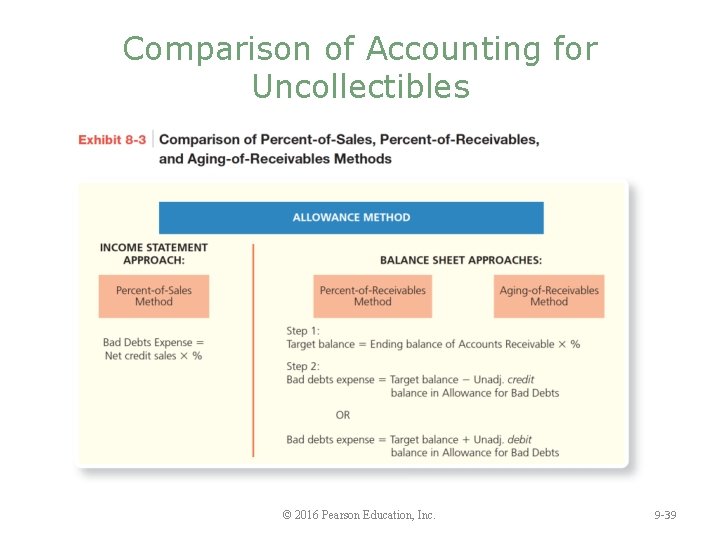
Comparison of Accounting for Uncollectibles © 2016 Pearson Education, Inc. 9 -39
Learning Objective 4 Account for notes receivable including computing interest and recording honored and dishonored notes © 2016 Pearson Education, Inc. 8 -40
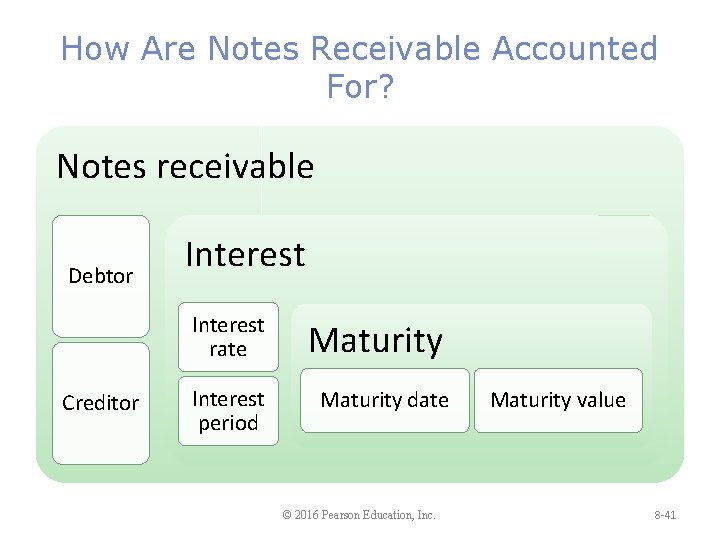
How Are Notes Receivable Accounted For? Notes receivable Debtor Creditor Interest rate Maturity Interest period Maturity date © 2016 Pearson Education, Inc. Maturity value 8 -41
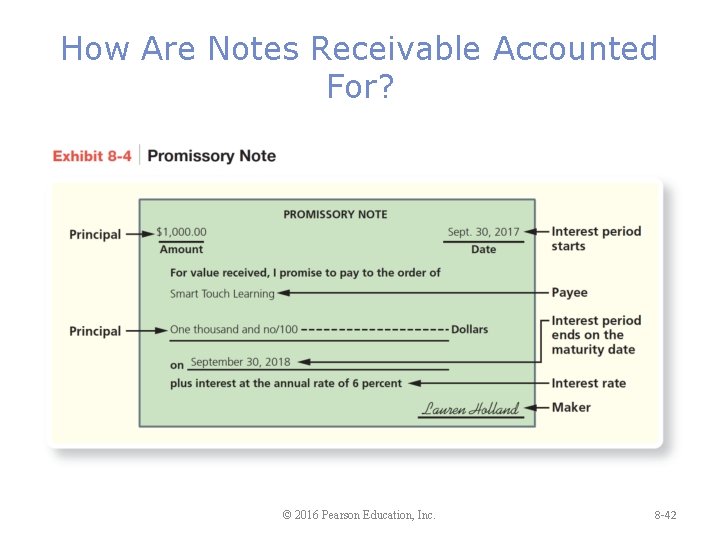
How Are Notes Receivable Accounted For? © 2016 Pearson Education, Inc. 8 -42
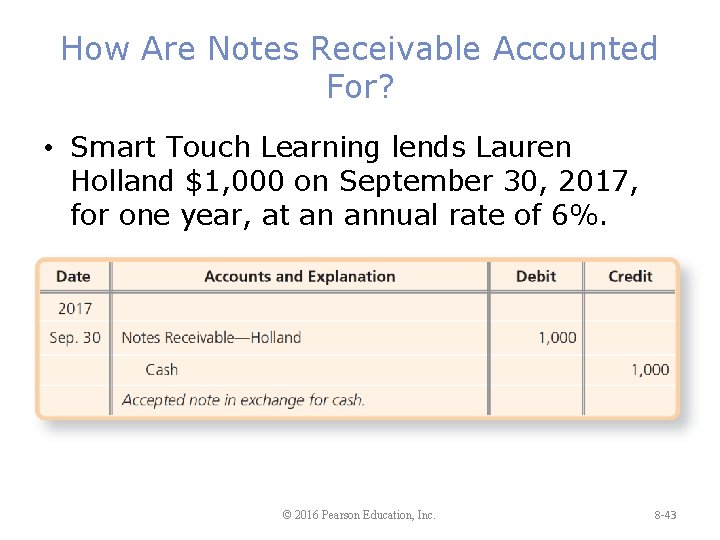
How Are Notes Receivable Accounted For? • Smart Touch Learning lends Lauren Holland $1, 000 on September 30, 2017, for one year, at an annual rate of 6%. © 2016 Pearson Education, Inc. 8 -43
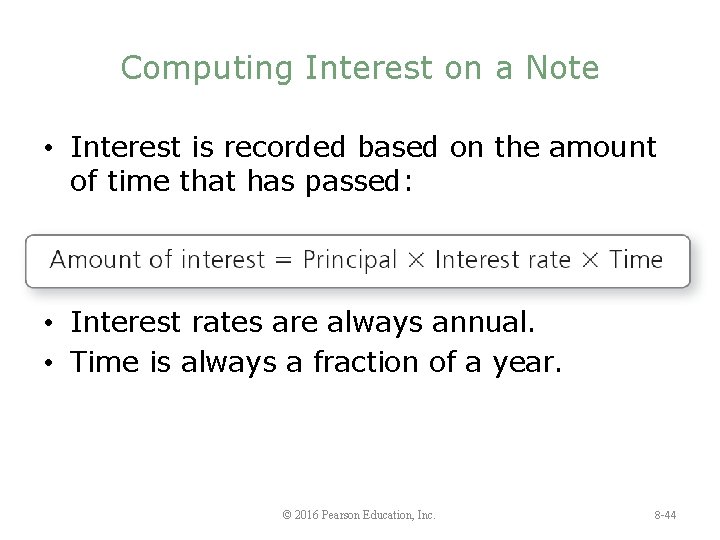
Computing Interest on a Note • Interest is recorded based on the amount of time that has passed: • Interest rates are always annual. • Time is always a fraction of a year. © 2016 Pearson Education, Inc. 8 -44
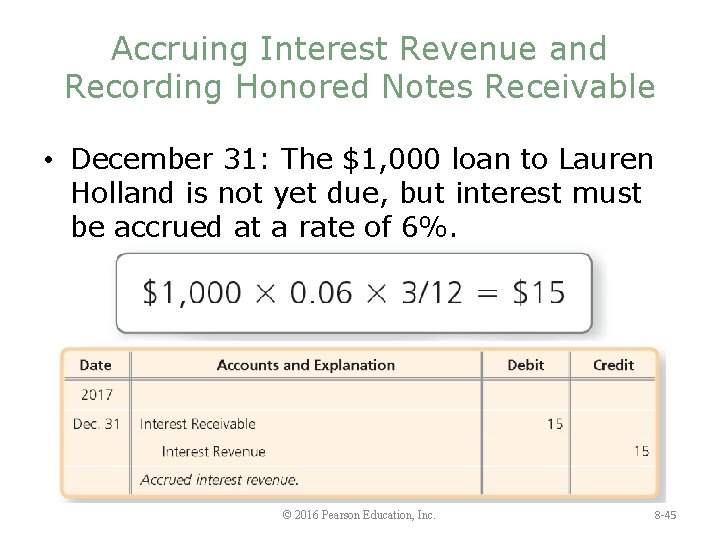
Accruing Interest Revenue and Recording Honored Notes Receivable • December 31: The $1, 000 loan to Lauren Holland is not yet due, but interest must be accrued at a rate of 6%. © 2016 Pearson Education, Inc. 8 -45
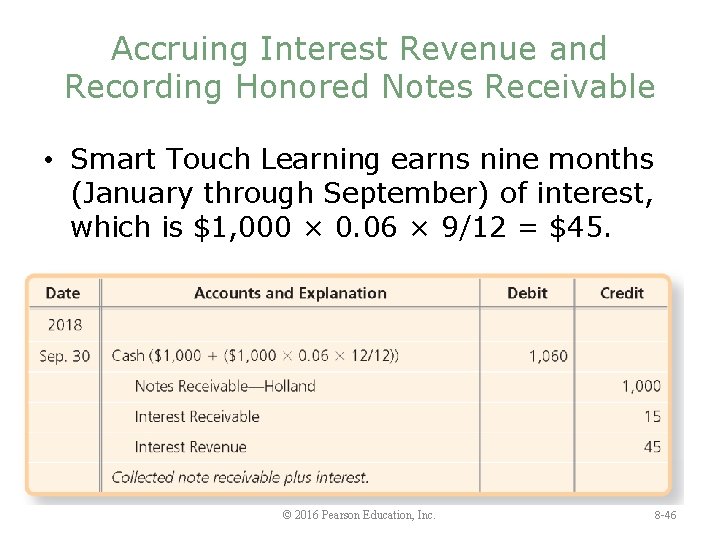
Accruing Interest Revenue and Recording Honored Notes Receivable • Smart Touch Learning earns nine months (January through September) of interest, which is $1, 000 × 0. 06 × 9/12 = $45. © 2016 Pearson Education, Inc. 8 -46
Recording Dishonored Notes Receivable • When a maker dishonors a note, the dishonored note and the unpaid interest are transferred to Accounts Receivable. • Later, the Accounts Receivable can be written off under the direct write-off method or the allowance method. © 2016 Pearson Education, Inc. 8 -47
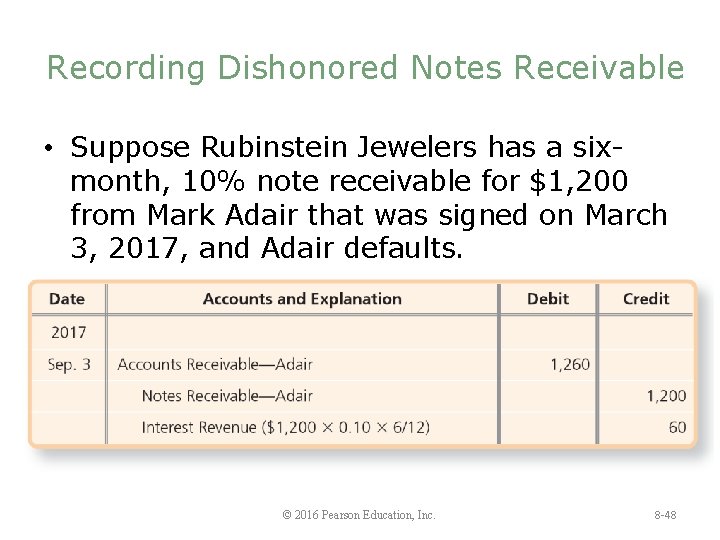
Recording Dishonored Notes Receivable • Suppose Rubinstein Jewelers has a sixmonth, 10% note receivable for $1, 200 from Mark Adair that was signed on March 3, 2017, and Adair defaults. © 2016 Pearson Education, Inc. 8 -48
Learning Objective 5 Use the acid-test ratio, accounts receivable turnover ratio, and days’ sales in receivables to evaluate business performance © 2016 Pearson Education, Inc. 8 -49
How Do We Use the Acid-Test Ratio, Accounts Receivable Turnover Ratio, and Days’ Sales in Receivables to Evaluate Business Performance? • Balance-sheet data are useful because they show the relationships among assets, liabilities, and revenues. • Ratios for analysis: – Acid-test ratio – Accounts receivable turnover ratio – Days’ sales in receivables © 2016 Pearson Education, Inc. 9 -50
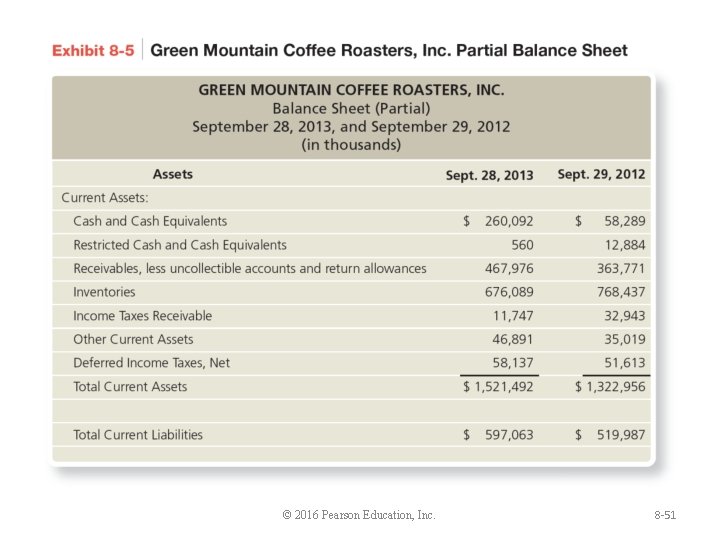
© 2016 Pearson Education, Inc. 8 -51
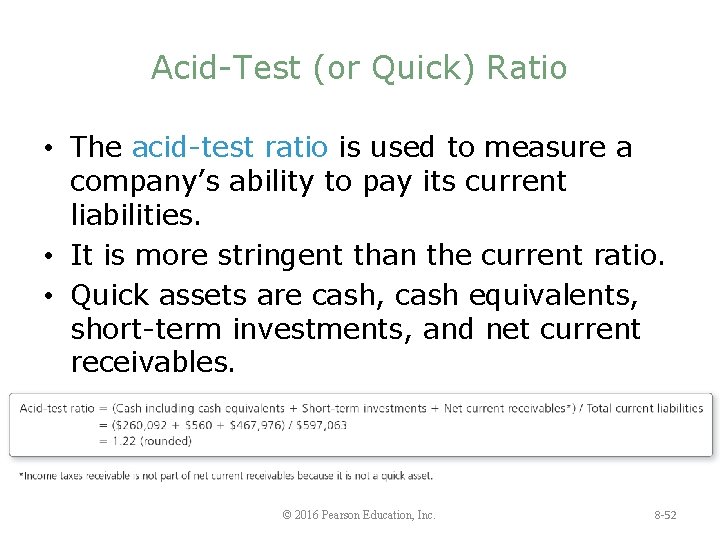
Acid-Test (or Quick) Ratio • The acid-test ratio is used to measure a company’s ability to pay its current liabilities. • It is more stringent than the current ratio. • Quick assets are cash, cash equivalents, short-term investments, and net current receivables. © 2016 Pearson Education, Inc. 8 -52
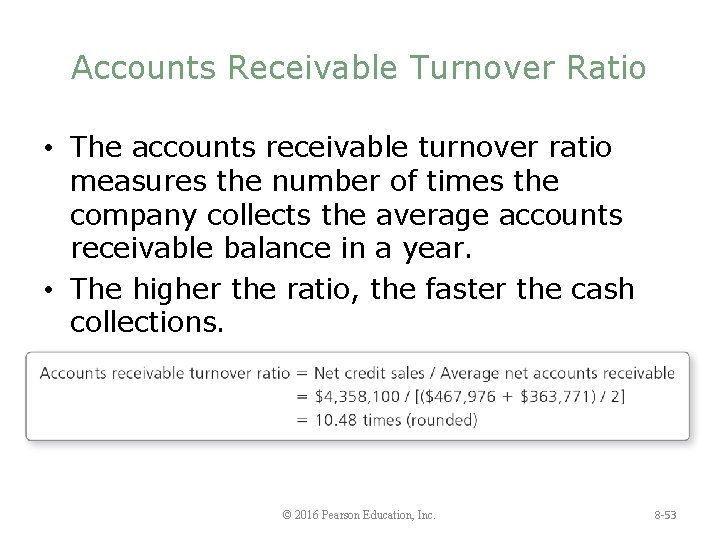
Accounts Receivable Turnover Ratio • The accounts receivable turnover ratio measures the number of times the company collects the average accounts receivable balance in a year. • The higher the ratio, the faster the cash collections. © 2016 Pearson Education, Inc. 8 -53

Days’ Sales in Receivables • Days’ sales in receivables indicates how many days it takes to collect the average level of accounts receivable. It is also called the collection period. © 2016 Pearson Education, Inc. 8 -54
© 2016 Pearson Education, Inc. 8 -55
- Slides: 55