
Chapter 8 Reactions 5 Indicators of a Chemical

- Slides: 43
Chapter 8: Reactions
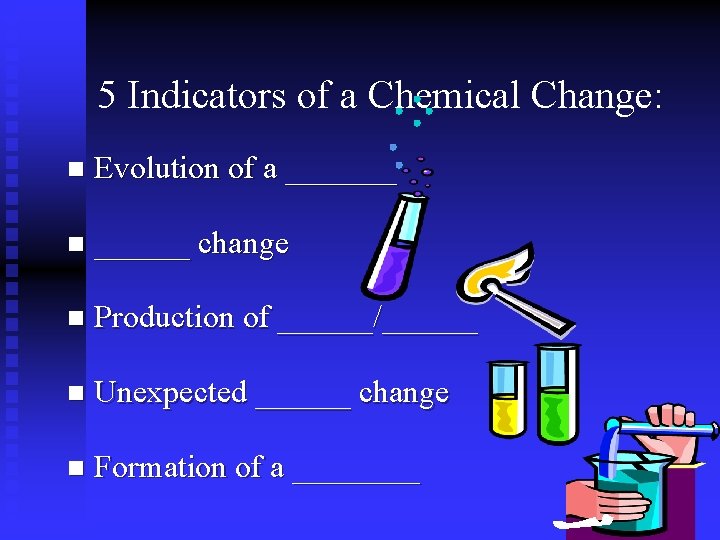
5 Indicators of a Chemical Change: n Evolution of a _______ n ______ change n Production of ______/______ n Unexpected ______ change n Formation of a ____
General Form of an Equation REACTANTS PRODUCTS Law of Conservation of Mass The mass of the reactants must be equal to the mass of the products.
Common Symbols in Equations n (s) - solid n (g) - gas n (l) - liquid n (aq) - aqueous solution n r - heat
Diatomic molecules The super 7 n Hydrogen n Nitrogen n Oxygen n Fluorine n Chlorine n Bromine n Iodine 7
3 Types of Chemical Equations: n Word Equation – describes rxn n Skeleton Equation-1 st step n Balanced Equation-final goal
Word Equation n Describes both reactants and products of a chemical reaction in sentence form. Ex: Solid magnesium reacts with aqueous hydrogen monochloride to produce hydrogen gas and aqueous magnesium chloride.
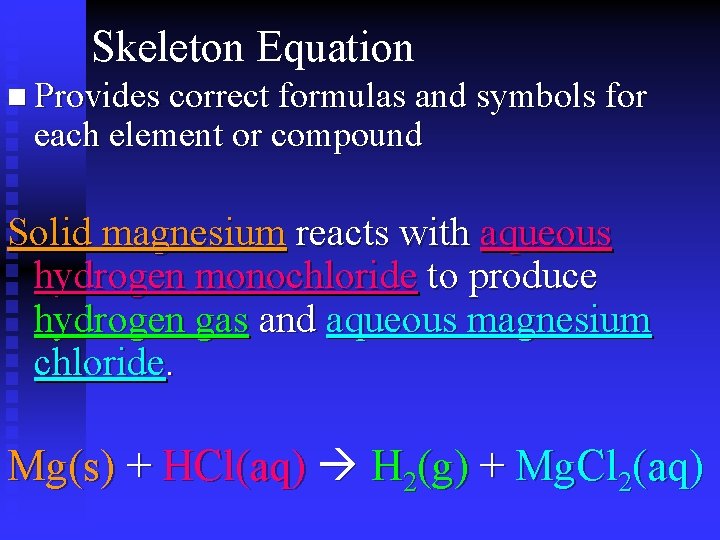
Skeleton Equation n Provides correct formulas and symbols for each element or compound Solid magnesium reacts with aqueous hydrogen monochloride to produce hydrogen gas and aqueous magnesium chloride. Mg(s) + HCl(aq) H 2(g) + Mg. Cl 2(aq)
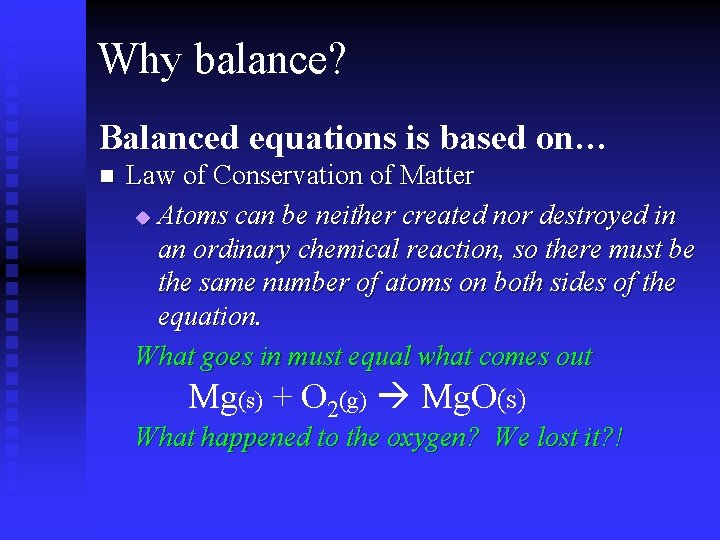
Why balance? Balanced equations is based on… n Law of Conservation of Matter u Atoms can be neither created nor destroyed in an ordinary chemical reaction, so there must be the same number of atoms on both sides of the equation. What goes in must equal what comes out Mg(s) + O 2(g) Mg. O(s) What happened to the oxygen? We lost it? !
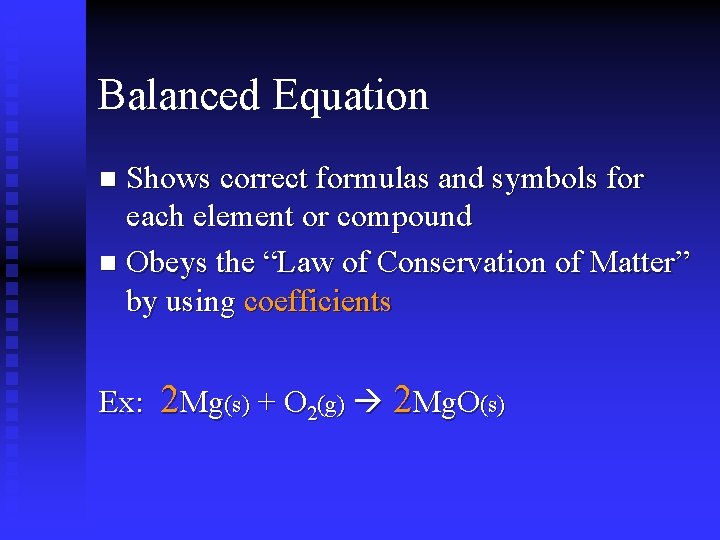
Balanced Equation Shows correct formulas and symbols for each element or compound n Obeys the “Law of Conservation of Matter” by using coefficients n Ex: 2 Mg(s) + O 2(g) 2 Mg. O(s)
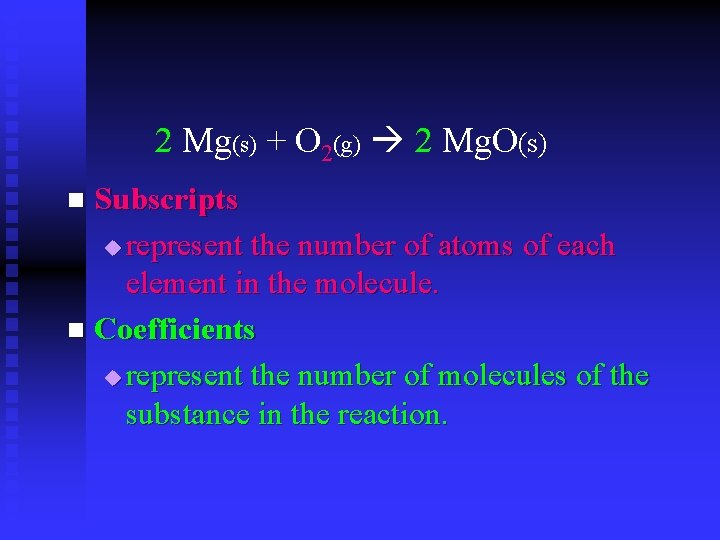
2 Mg(s) + O 2(g) 2 Mg. O(s) Subscripts u represent the number of atoms of each element in the molecule. n Coefficients u represent the number of molecules of the substance in the reaction. n
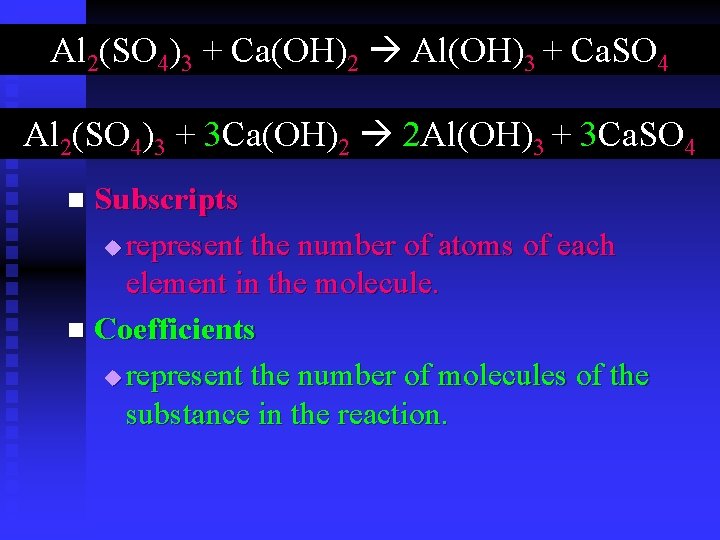
Al 2(SO 4)3 + Ca(OH)2 Al(OH)3 + Ca. SO 4 Al 2(SO 4)3 + 3 Ca(OH)2 2 Al(OH)3 + 3 Ca. SO 4 Subscripts u represent the number of atoms of each element in the molecule. n Coefficients u represent the number of molecules of the substance in the reaction. n
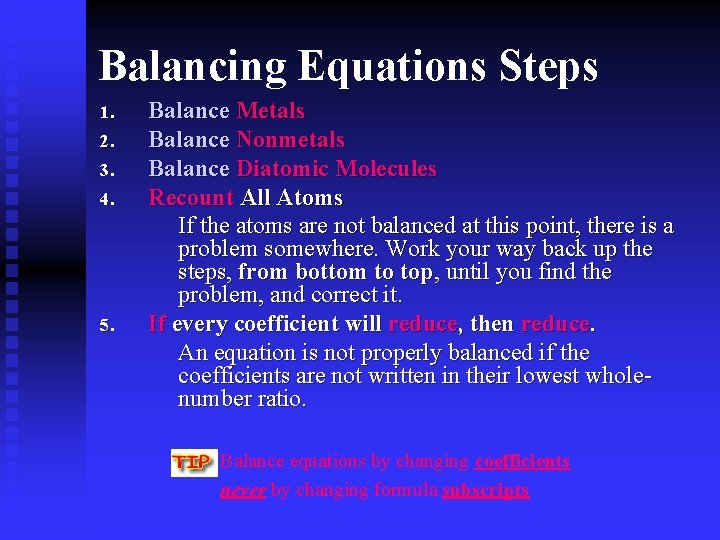
Balancing Equations Steps 1. 2. 3. 4. 5. Balance Metals Balance Nonmetals Balance Diatomic Molecules Recount All Atoms If the atoms are not balanced at this point, there is a problem somewhere. Work your way back up the steps, from bottom to top, until you find the problem, and correct it. If every coefficient will reduce, then reduce. An equation is not properly balanced if the coefficients are not written in their lowest wholenumber ratio. Balance equations by changing coefficients never by changing formula subscripts
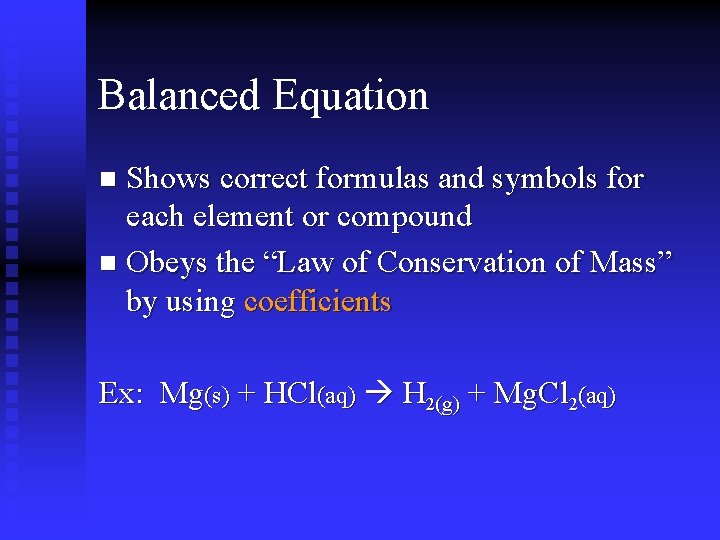
Balanced Equation Shows correct formulas and symbols for each element or compound n Obeys the “Law of Conservation of Mass” by using coefficients n Ex: Mg(s) + HCl(aq) H 2(g) + Mg. Cl 2(aq)
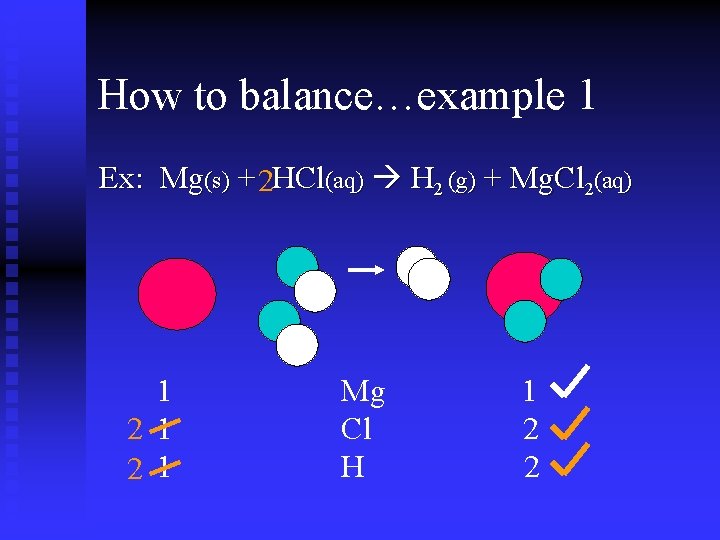
How to balance…example 1 Ex: Mg(s) + 2 HCl(aq) H 2 (g) + Mg. Cl 2(aq) 1 2 1 Mg Cl H 1 2 2
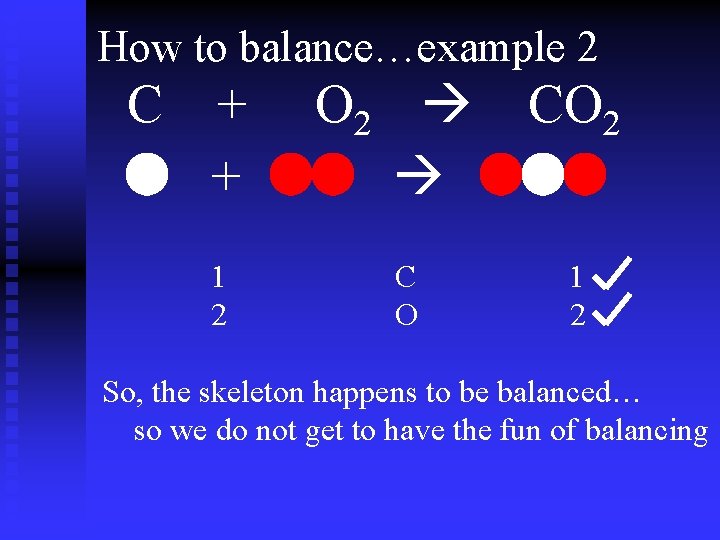
How to balance…example 2 C + + 1 2 O 2 C O CO 2 1 2 So, the skeleton happens to be balanced… so we do not get to have the fun of balancing
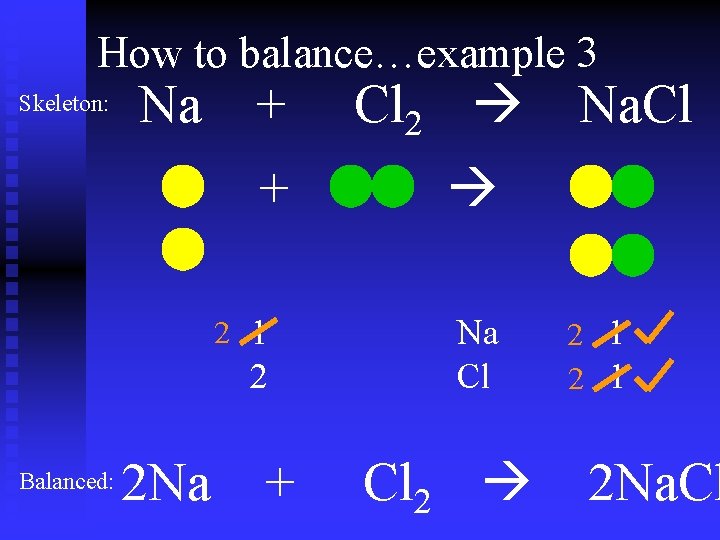
How to balance…example 3 Skeleton: Na + + 2 1 2 Balanced: 2 Na + Cl 2 Na. Cl Na Cl Cl 2 2 1 2 Na. Cl
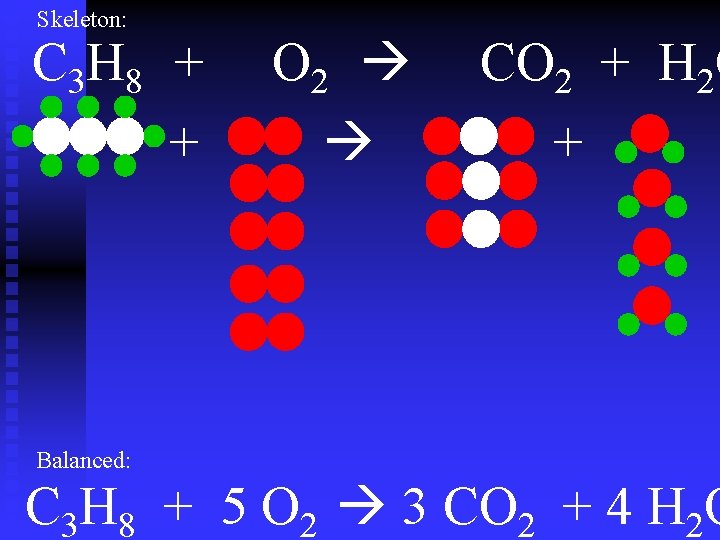
Skeleton: C 3 H 8 + + O 2 CO 2 + H 2 O + Balanced: C 3 H 8 + 5 O 2 3 CO 2 + 4 H 2 O
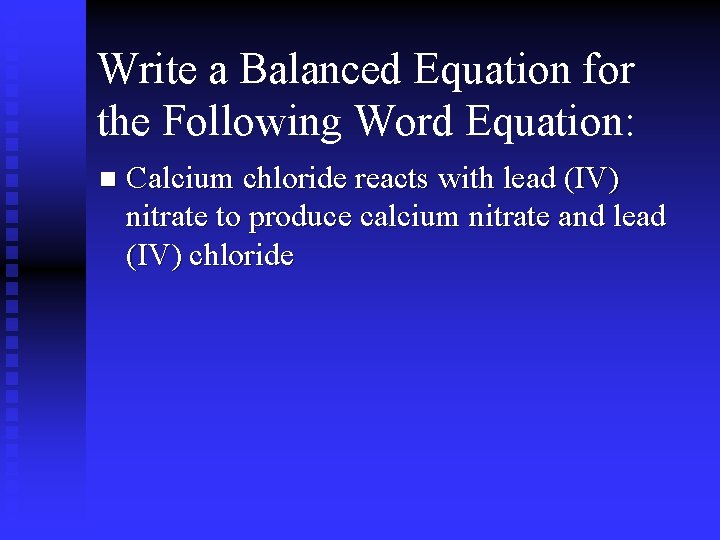
Write a Balanced Equation for the Following Word Equation: n Calcium chloride reacts with lead (IV) nitrate to produce calcium nitrate and lead (IV) chloride
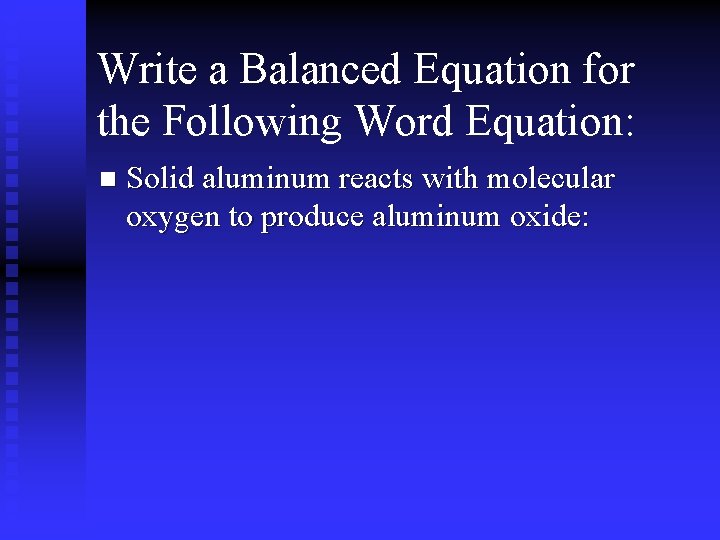
Write a Balanced Equation for the Following Word Equation: n Solid aluminum reacts with molecular oxygen to produce aluminum oxide:
Types of Chemical Reactions 8. 2
Chemical Reaction n a process in which substances change into other substances (changes identity) (deals with electrons)
Types of Chemical Reactions Synthesis Reactions n Decomposition Reactions n Single Replacement Reactions n Double Replacement Reactions n Combustion n Link to something useful. . . and comical
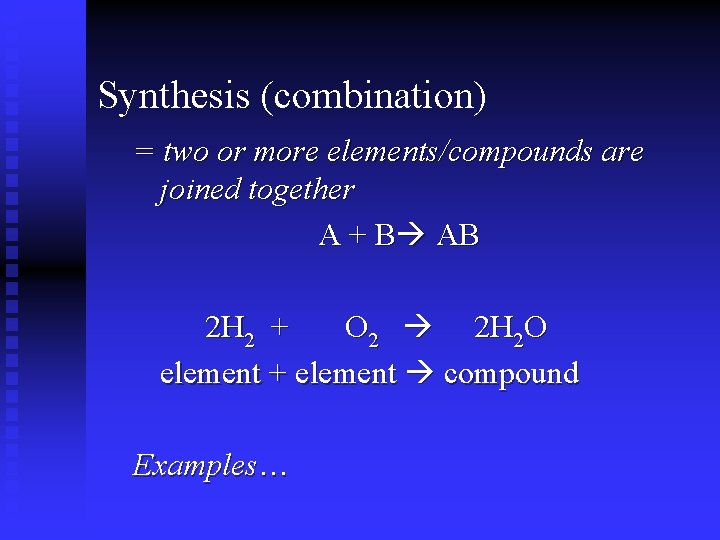
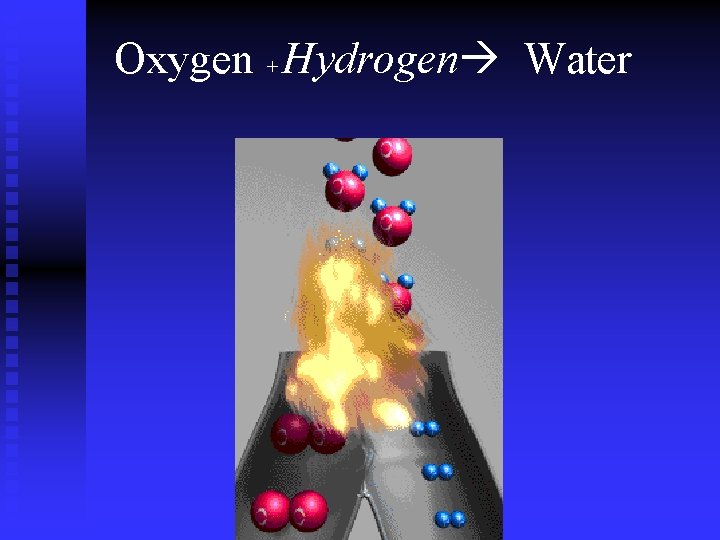
Synthesis (combination) = two or more elements/compounds are joined together A + B AB 2 H 2 + O 2 2 H 2 O element + element compound Examples…
Oxygen + Hydrogen Water
2 Na (s) + Cl 2 (g) 2 Na. Cl (s)
Decomposition = a compound breaks into parts AB A + B 2 H 2 O 2 H 2 + O 2 compound element + element Examples…
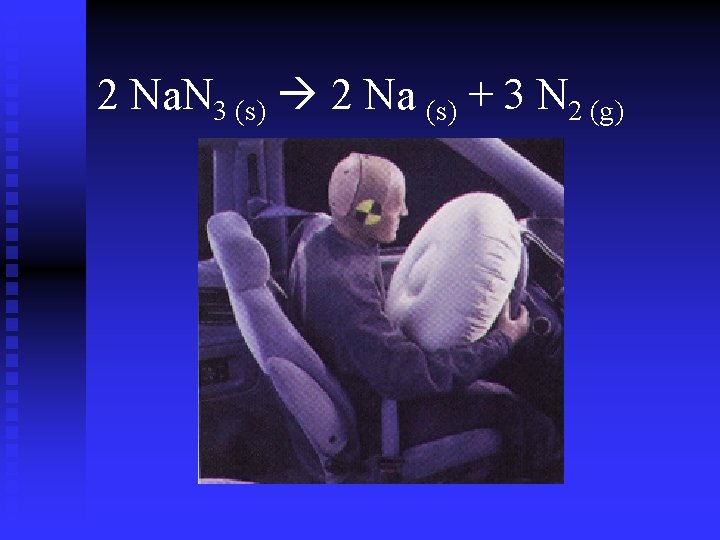
2 Na. N 3 (s) 2 Na (s) + 3 N 2 (g)
Sometimes too easy…
Click to watch an airbag deploy in slow motion
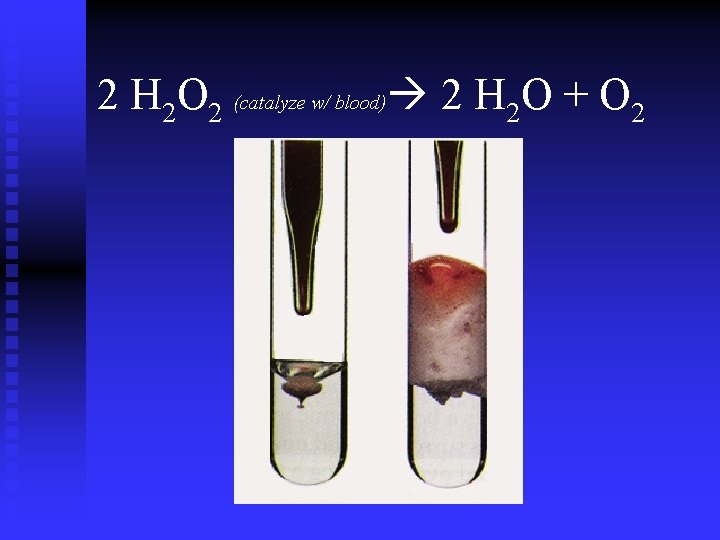
2 H 2 O 2 (catalyze w/ blood) 2 H 2 O + O 2
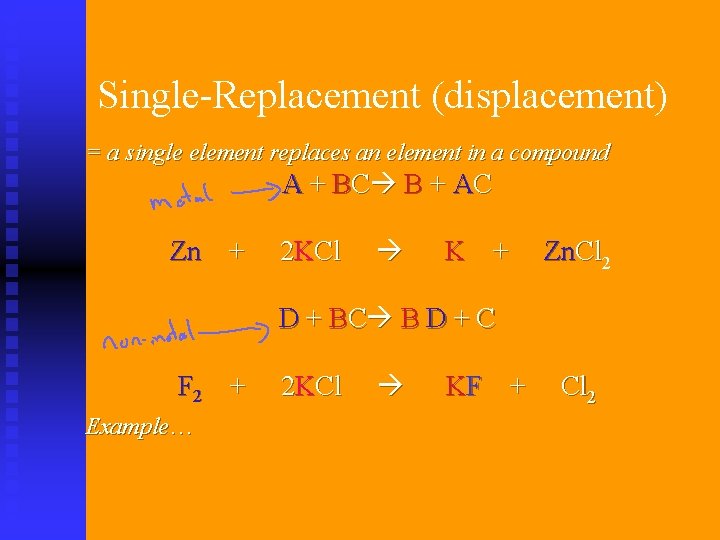
Single-Replacement (displacement) = a single element replaces an element in a compound A + B C B + AC Zn + 2 KCl K + Zn. Cl 2 D + BC B D + C F 2 + Example… 2 KCl KF + Cl 2
Ag. NO 3 (aq) + Cu (s) Cu(NO 3)2 + Ag(s)
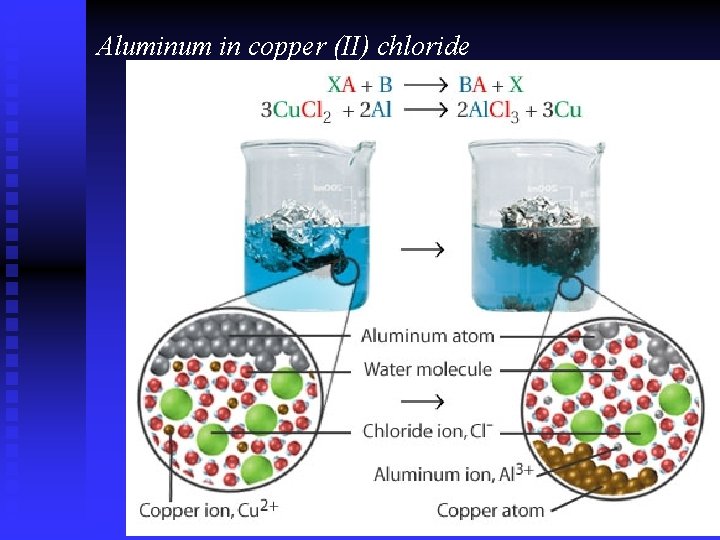
Aluminum in copper (II) chloride
Copper formation on iron nail
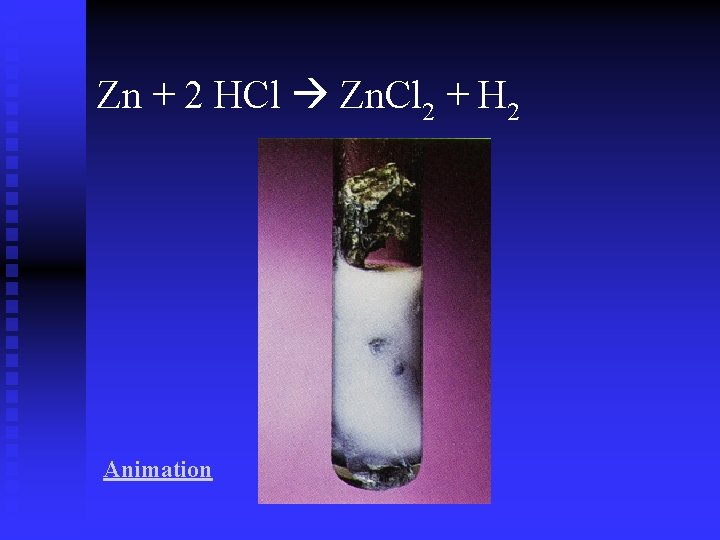
Zn + 2 HCl Zn. Cl 2 + H 2 Animation
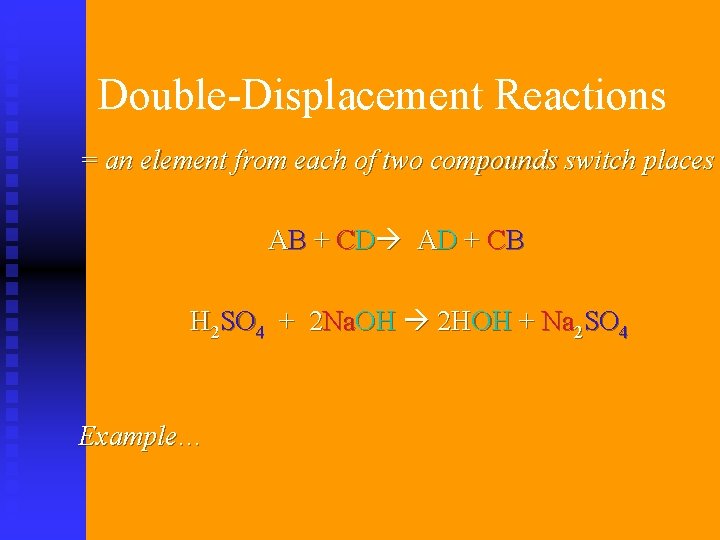
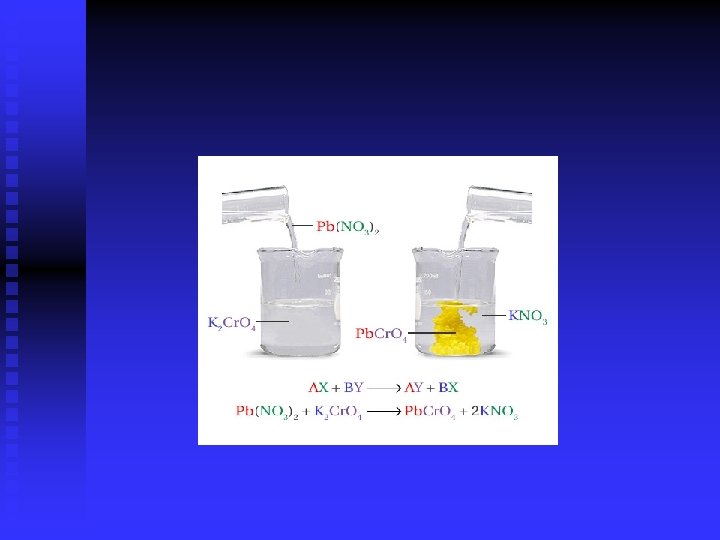
Double-Displacement Reactions = an element from each of two compounds switch places AB + C D AD + C B H 2 SO 4 + 2 Na. OH 2 HOH + Na 2 SO 4 Example…
Ag. NO 3(aq) + Na. OH(aq) Ag. OH (s) + Na. NO 3(aq)
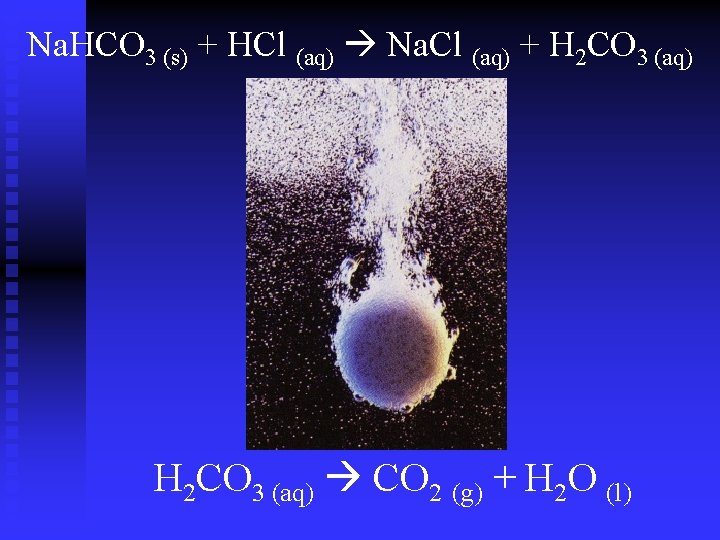
Na. HCO 3 (s) + HCl (aq) Na. Cl (aq) + H 2 CO 3 (aq) CO 2 (g) + H 2 O (l)
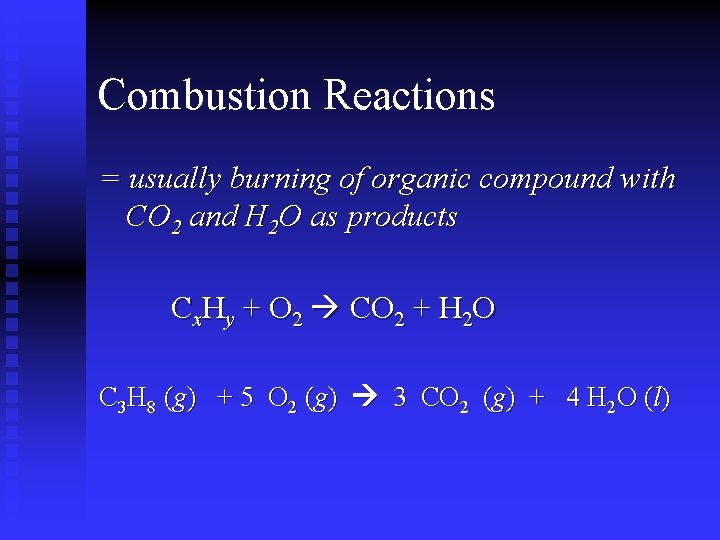
Combustion Reactions = usually burning of organic compound with CO 2 and H 2 O as products Cx. Hy + O 2 CO 2 + H 2 O C 3 H 8 (g) + 5 O 2 (g) 3 CO 2 (g) + 4 H 2 O (l)
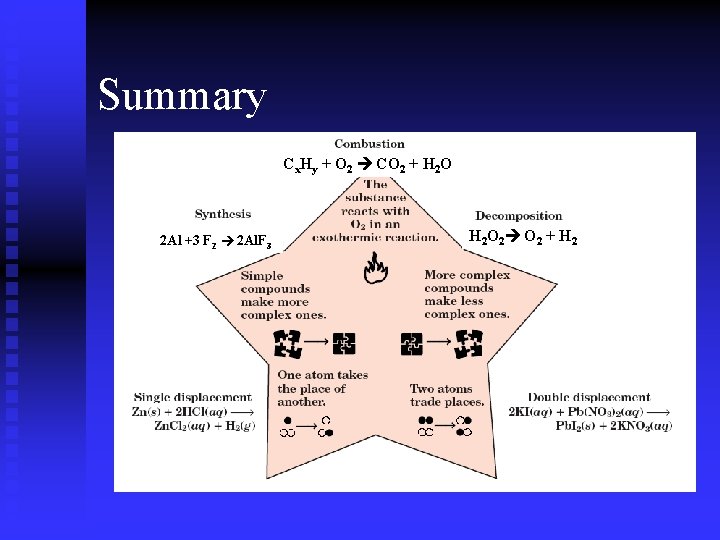
Summary Cx. Hy + O 2 CO 2 + H 2 O 2 Al +3 F 2 2 Al. F 3 H 2 O 2 + H 2