
chapter 8 projectile satellite motion Scientists at Arizona

- Slides: 42
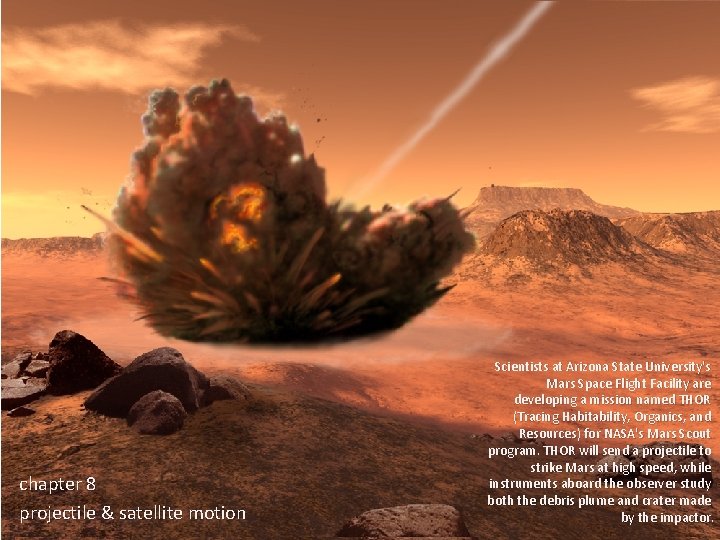
chapter 8 projectile & satellite motion Scientists at Arizona State University's Mars Space Flight Facility are developing a mission named THOR (Tracing Habitability, Organics, and Resources) for NASA's Mars Scout program. THOR will send a projectile to strike Mars at high speed, while instruments aboard the observer study both the debris plume and crater made by the impactor.
questions considered • What is a projectile? • Why is a projectile’s motion as it is? What if there was no g? What if there was no Rair? • Suppose I want maximum range—at which angle do I kick a ball? Maximum height? • What affect does Rair have on a projectile? • Is there a connection between the speed of a projectile and an Earth Satellite? How fast does something have to be moving to become an Earth satellite? • How is an elliptical orbit accomplished? How does a satellite in an elliptical orbit behave differently from one in a circular path? • Escape speed. Huh?
outline I. II. IV. V. VI. Projectile Motion A. Projectile Defined B. Examples C. Ch 2 reality check 1. Without g 2. With g D. Components 1. Horizontal 2. Vertical 3. Effective vs. Ineffective? 4. Examples Projectile Altitude & Range A. Angles& Velocities B. Q&A Affect of Air Drag Satellites Elliptical Orbits Escape Speed What is a projectile? Why is a projectile’s motion as it is? What if there was no g? What if there was no Rair? Suppose I want maximum range—at which angle do I kick a ball? Maximum height? What affect does Rair have on a projectile? Is there a connection between the speed of a projectile and an Earth Satellite? How fast does something have to be moving to become an Earth satellite? How is an elliptical orbit accomplished? How does a satellite in an elliptical orbit behave differently from one in a circular path?
Projectile Motion What exactly is a projectile? A projectile is any object which, once projected, continues in motion by its own inertia while under the influence of gravity.
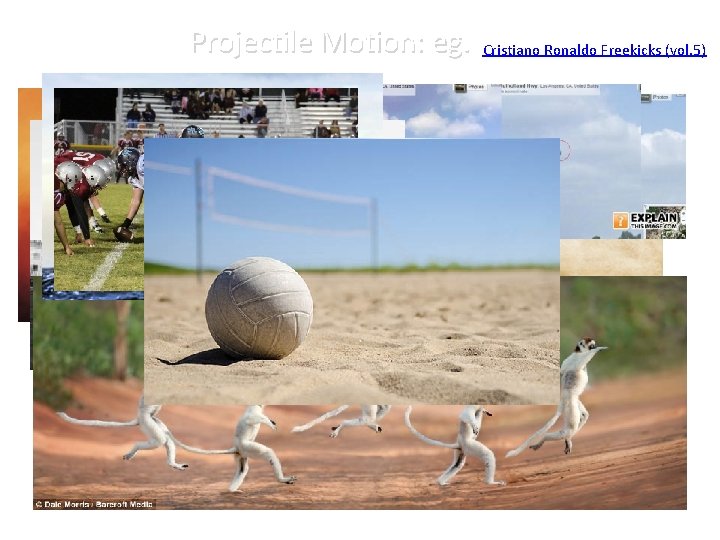
Projectile Motion: eg. Cristiano Ronaldo Freekicks (vol. 5)
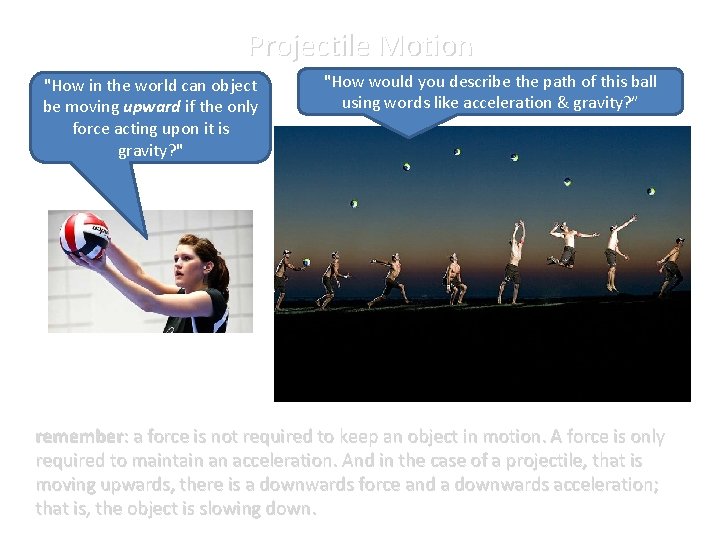
Projectile Motion "How in the world can object be moving upward if the only force acting upon it is gravity? " "How would you describe the path of this ball using words like acceleration & gravity? ” remember: a force is not required to keep an object in motion. A force is only required to maintain an acceleration. And in the case of a projectile, that is moving upwards, there is a downwards force and a downwards acceleration; that is, the object is slowing down.
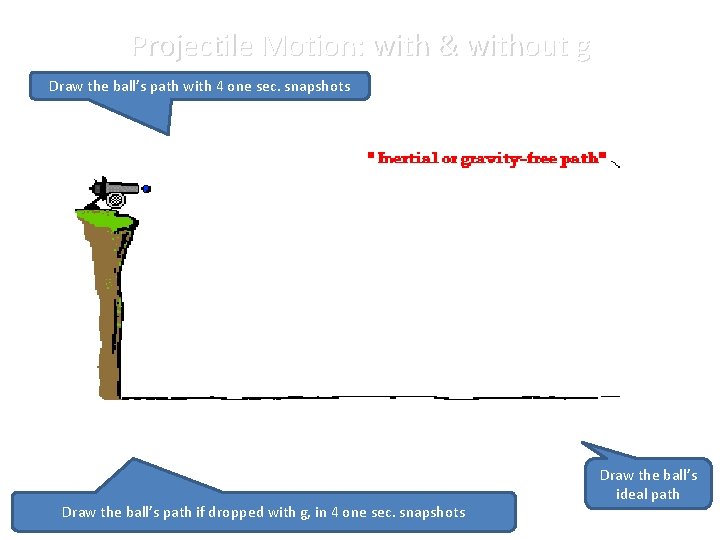
Projectile Motion: with & without g Draw the ball’s path with 4 one sec. snapshots Draw the ball’s path if dropped with g, in 4 one sec. snapshots Draw the ball’s ideal path
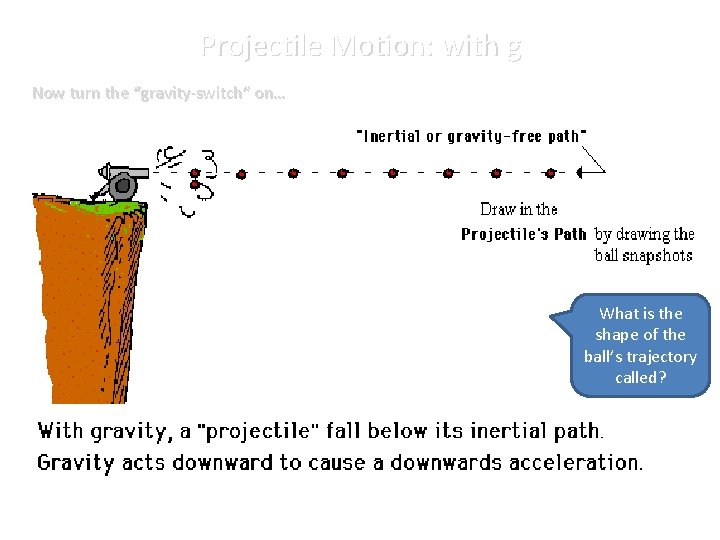
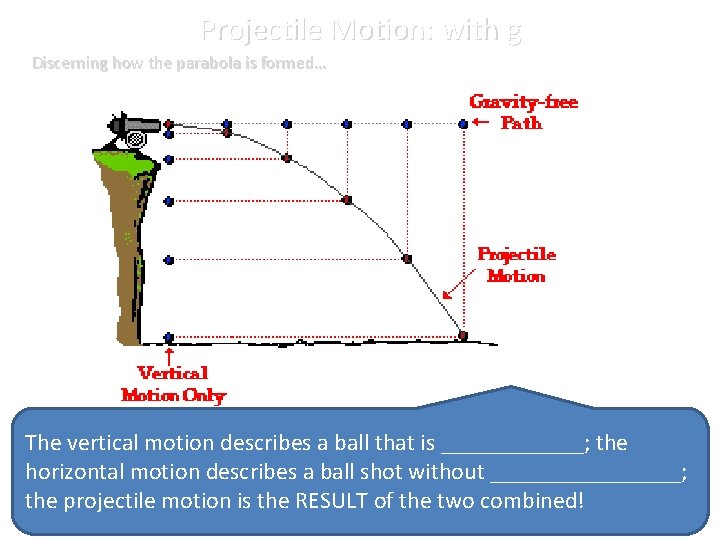
Projectile Motion: with g Now turn the “gravity-switch” on… What is the shape of the ball’s trajectory called?
Projectile Motion: with g Discerning how the parabola is formed… The vertical motion describes a ball that is ______; the horizontal motion describes a ball shot without ________; the projectile motion is the RESULT of the two combined!
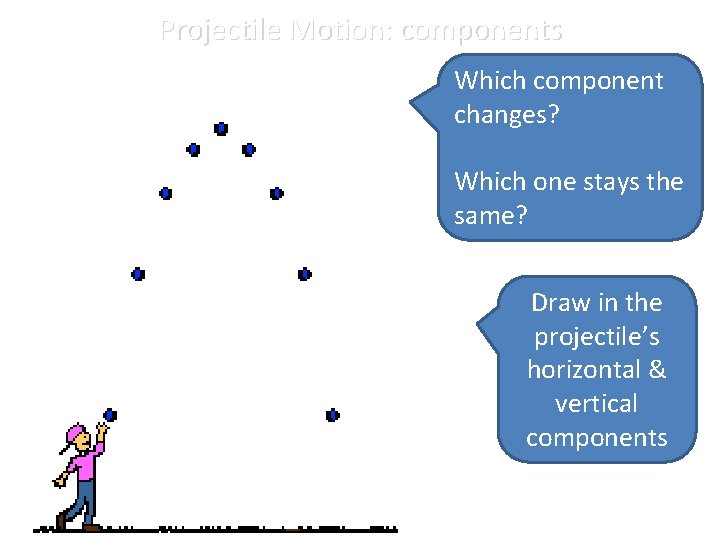
Projectile Motion: components Which component changes? Which one stays the same? Draw in the projectile’s horizontal & vertical components
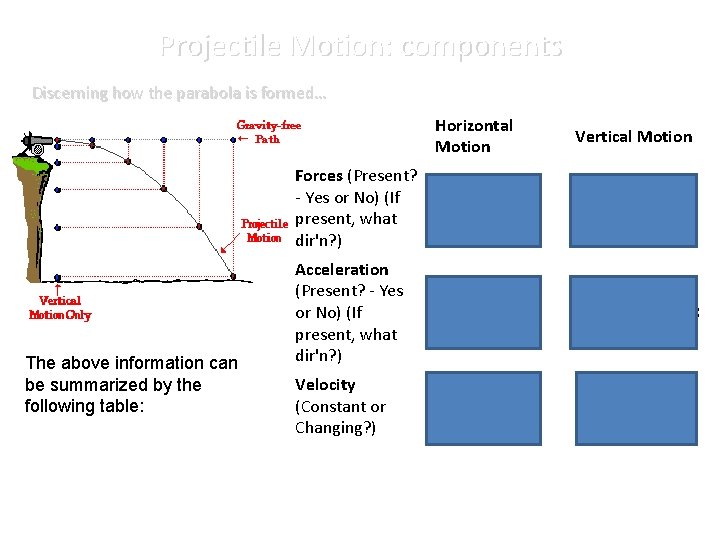
Projectile Motion: components Discerning how the parabola is formed… Forces (Present? - Yes or No) (If present, what dir'n? ) The above information can be summarized by the following table: Acceleration (Present? - Yes or No) (If present, what dir'n? ) Velocity (Constant or Changing? ) Horizontal Motion Vertical Motion No Yes The force of gravity acts downward No Yes "g" is downward at 9. 8 m/s/s Constant Changing (by 9. 8 m/s each second)
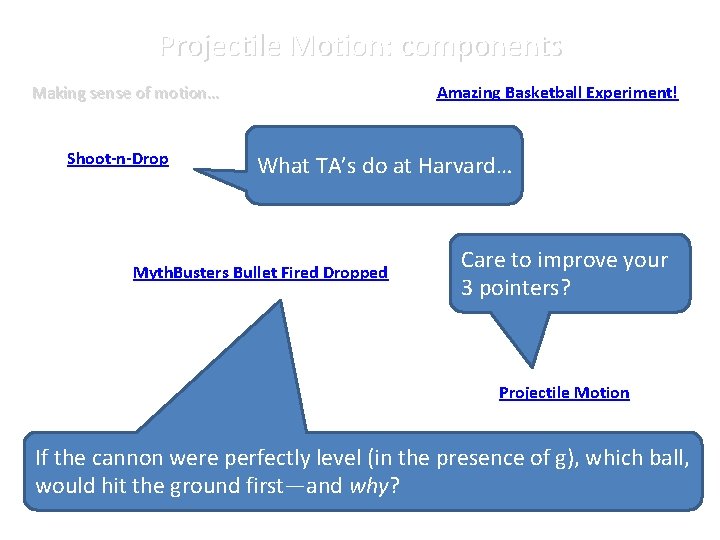
Projectile Motion: components Amazing Basketball Experiment! Making sense of motion… Shoot-n-Drop What TA’s do at Harvard… Myth. Busters Bullet Fired Dropped Care to improve your 3 pointers? Projectile Motion If the cannon were perfectly level (in the presence of g), which ball, would hit the ground first—and why?
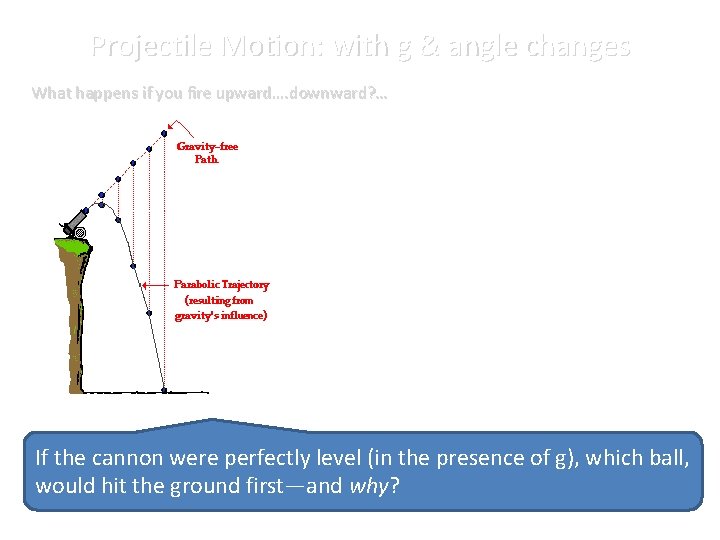
Projectile Motion: with g & angle changes What happens if you fire upward…. downward? … If the cannon were perfectly level (in the presence of g), which ball, would hit the ground first—and why?
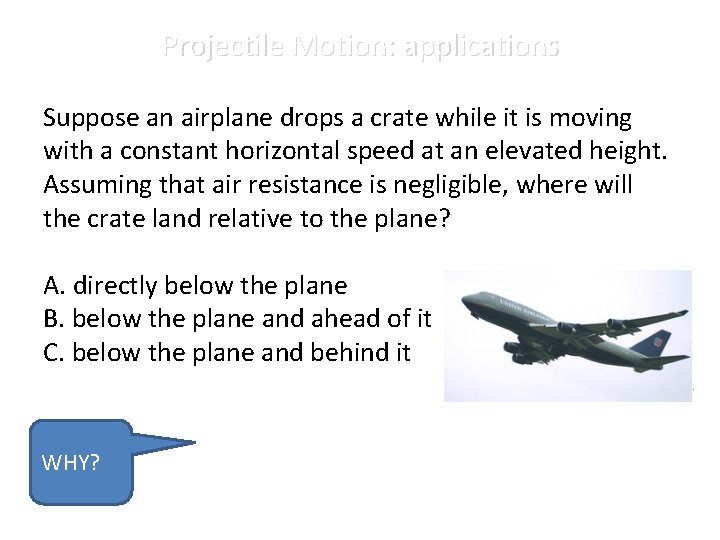
Projectile Motion: applications Suppose an airplane drops a crate while it is moving with a constant horizontal speed at an elevated height. Assuming that air resistance is negligible, where will the crate land relative to the plane? A. directly below the plane B. below the plane and ahead of it C. below the plane and behind it WHY?
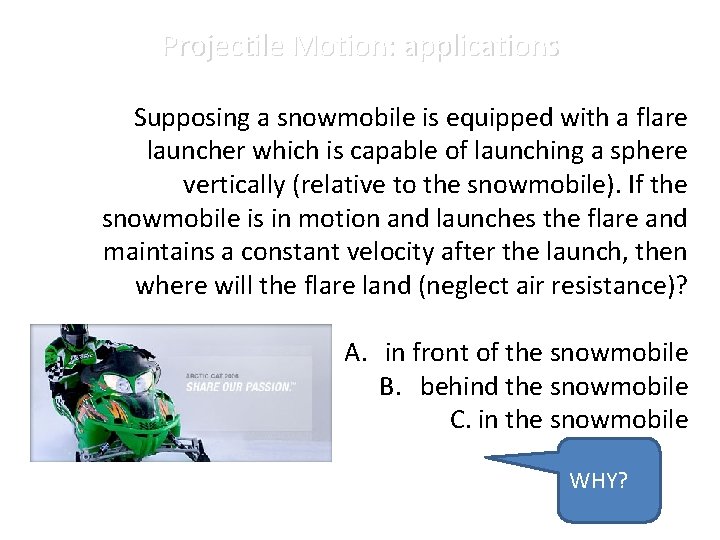
Projectile Motion: applications Supposing a snowmobile is equipped with a flare launcher which is capable of launching a sphere vertically (relative to the snowmobile). If the snowmobile is in motion and launches the flare and maintains a constant velocity after the launch, then where will the flare land (neglect air resistance)? A. in front of the snowmobile B. behind the snowmobile C. in the snowmobile WHY?
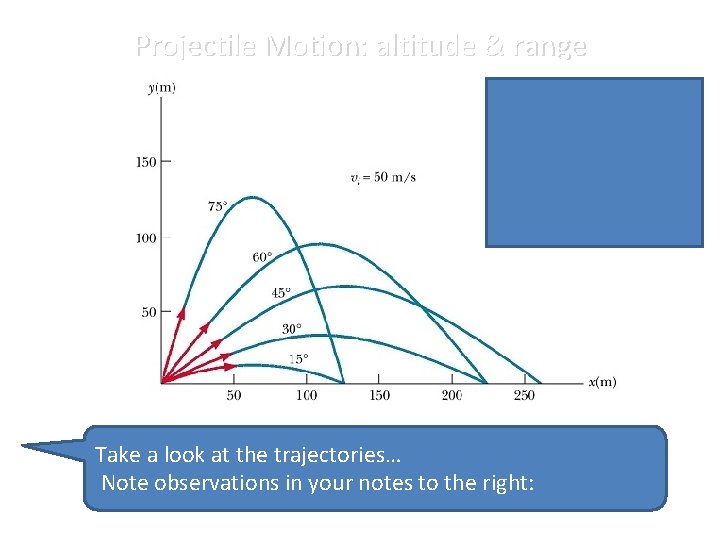
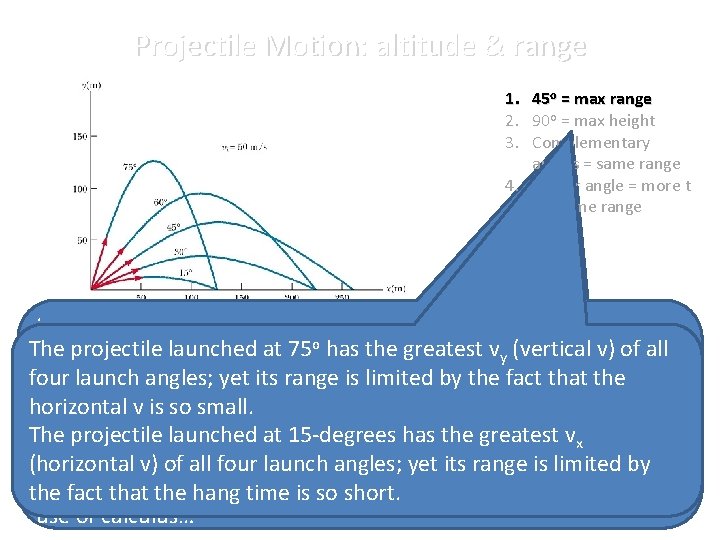
Projectile Motion: altitude & range 1. 45 o = max range 2. 90 o = max height 3. Complementary angles = same range 4. Higher angle = more t for same range Take a look at the trajectories… Note observations in your notes to the right:
Projectile Motion: altitude & range 1. 45 o = max range 2. 90 o = max height 3. Complementary angles = same range 4. Higher angle = more t for same range . o has the does Theprojectilelaunchedatat 75 45 -degree not vwin in either The greatest y (vertical v) of all category, the fact it is able to place strong showing four launchyet angles; yetthat its range is limited by athe fact that the in each category contributes to its ability to achieve the greatest horizontal v is so small. range. The projectile launched at 15 -degrees has the greatest vx More sophisticated arguments for whyyet theits 45 -degree launchby (horizontal v) of all four launch angles; range is limited angle the hang greatest the factyields that the timerange is so exist; short. yet since they involve the use of calculus…
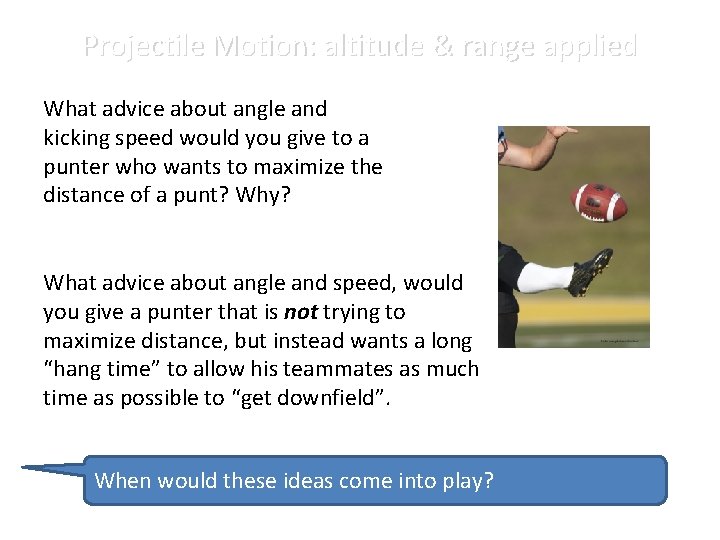
Projectile Motion: altitude & range applied What advice about angle and kicking speed would you give to a punter who wants to maximize the distance of a punt? Why? What advice about angle and speed, would you give a punter that is not trying to maximize distance, but instead wants a long “hang time” to allow his teammates as much time as possible to “get downfield”. When would these ideas come into play?
Projectile Motion: a cool vid Projectile Motion & Parabolas - Science of NFL Football “GO SCIENCE!”
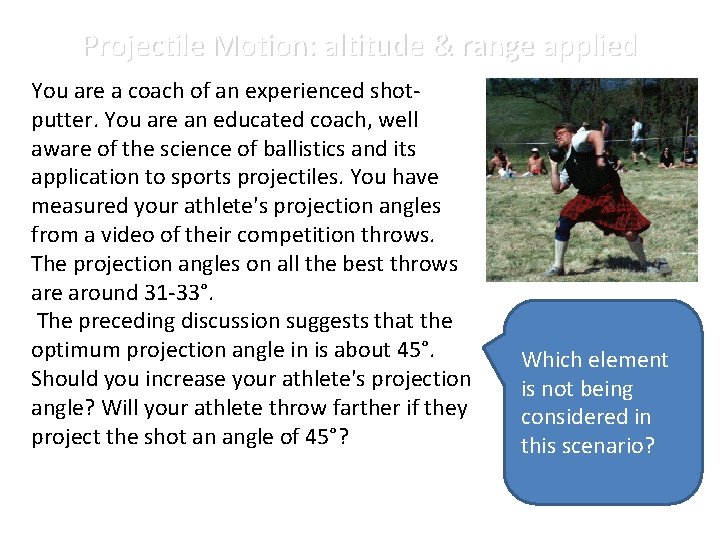
Projectile Motion: altitude & range applied You are a coach of an experienced shotputter. You are an educated coach, well aware of the science of ballistics and its application to sports projectiles. You have measured your athlete's projection angles from a video of their competition throws. The projection angles on all the best throws are around 31 -33°. The preceding discussion suggests that the optimum projection angle in is about 45°. Should you increase your athlete's projection angle? Will your athlete throw farther if they project the shot an angle of 45°? Which element is not being considered in this scenario?
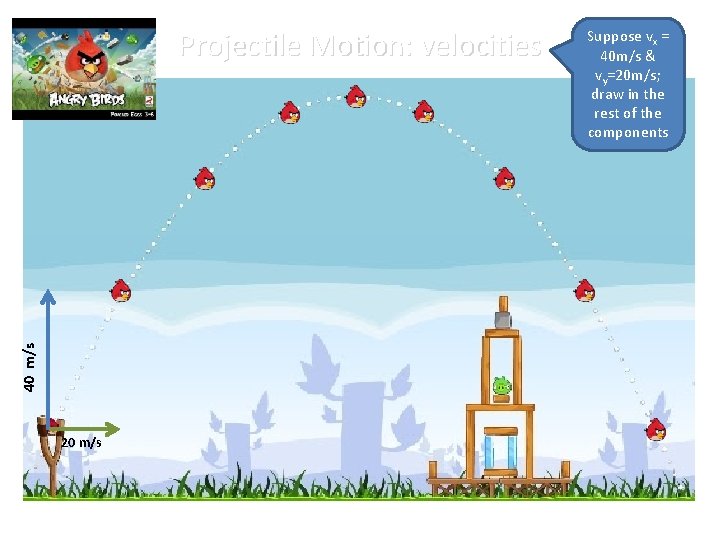
40 m/s Projectile Motion: velocities 20 m/s Suppose vx = 40 m/s & vy=20 m/s; draw in the rest of the components
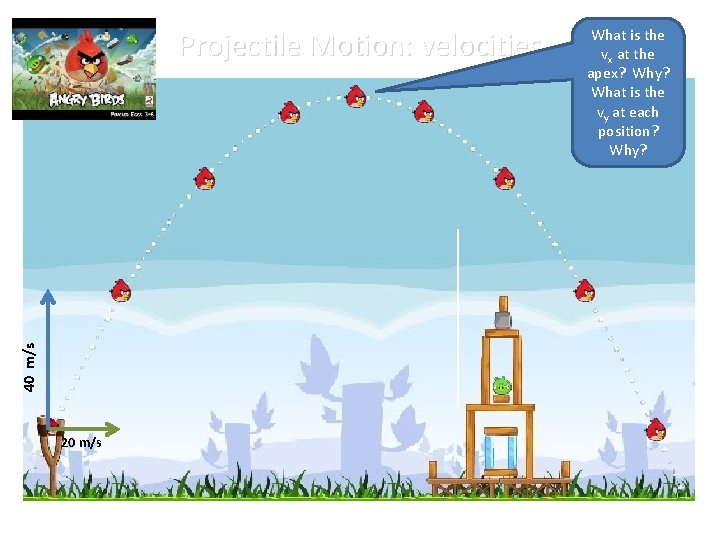
40 m/s Projectile Motion: velocities 20 m/s What is the vx at the apex? Why? What is the vy at each position? Why?
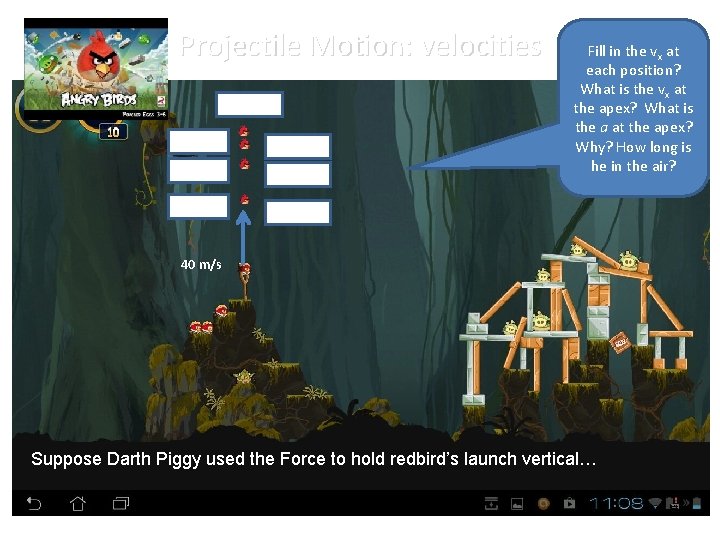
Projectile Motion: velocities Fill in the vx at each position? What is the vx at the apex? What is the a at the apex? Why? How long is he in the air? 40 m/s Suppose Darth Piggy used the Force to hold redbird’s launch vertical…
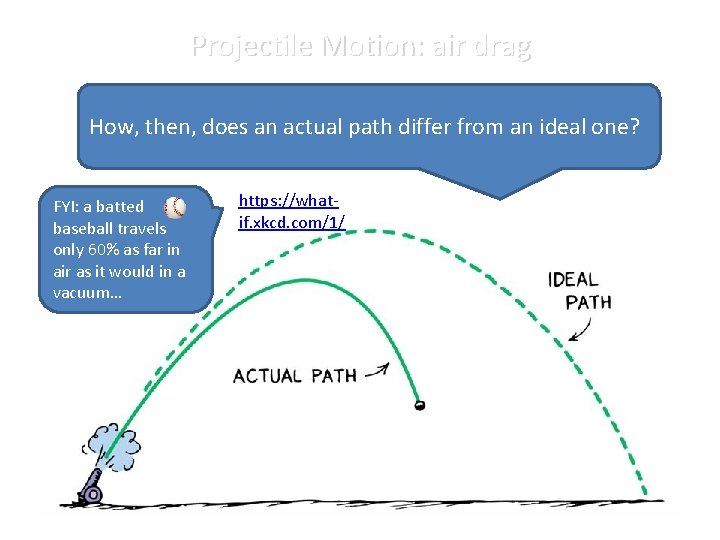
Projectile Motion: air drag How, then, does an actual path differ from an ideal one? FYI: a batted baseball travels only 60% as far in air as it would in a vacuum… https: //whatif. xkcd. com/1/
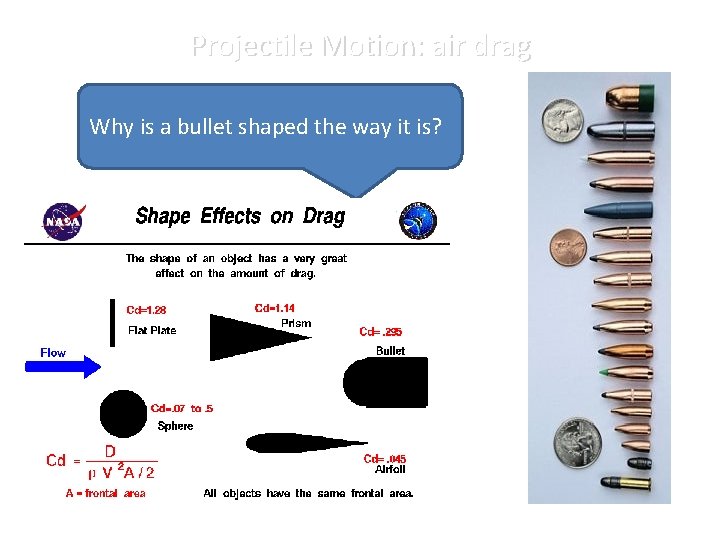
Projectile Motion: air drag Why is a bullet shaped the way it is?
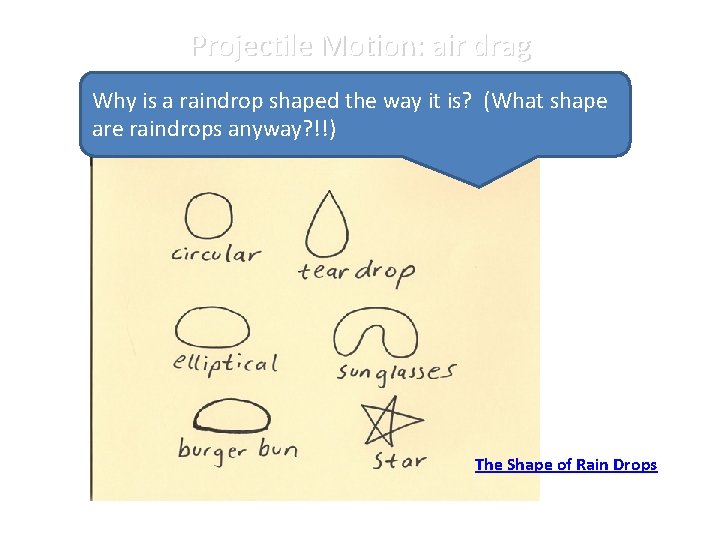
Projectile Motion: air drag Why is a raindrop shaped the way it is? (What shape are raindrops anyway? !!) The Shape of Rain Drops
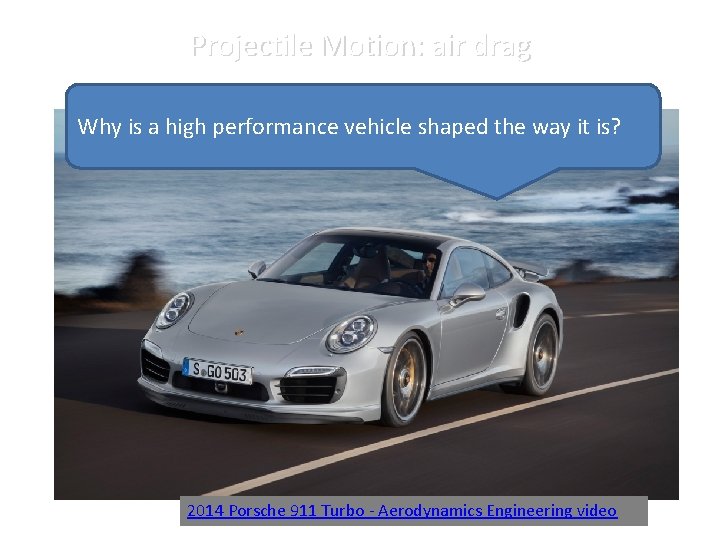
Projectile Motion: air drag Why is a high performance vehicle shaped the way it is? 2014 Porsche 911 Turbo - Aerodynamics Engineering video
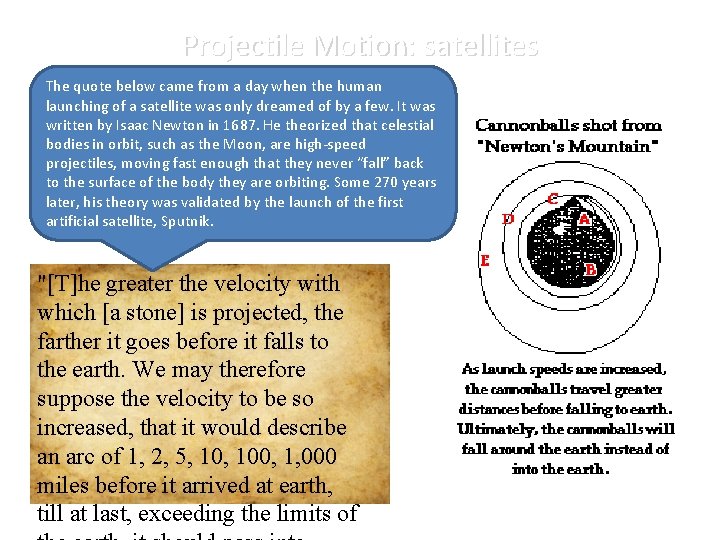
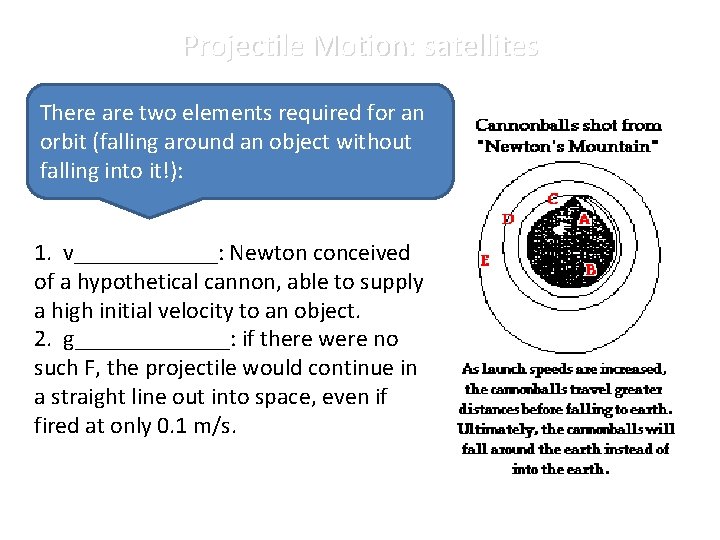
Projectile Motion: satellites The quote below came from a day when the human launching of a satellite was only dreamed of by a few. It was written by Isaac Newton in 1687. He theorized that celestial bodies in orbit, such as the Moon, are high-speed projectiles, moving fast enough that they never “fall” back to the surface of the body they are orbiting. Some 270 years later, his theory was validated by the launch of the first artificial satellite, Sputnik. "[T]he greater the velocity with which [a stone] is projected, the farther it goes before it falls to the earth. We may therefore suppose the velocity to be so increased, that it would describe an arc of 1, 2, 5, 100, 1, 000 miles before it arrived at earth, till at last, exceeding the limits of
Projectile Motion: satellites There are two elements required for an orbit (falling around an object without falling into it!): 1. v______: Newton conceived of a hypothetical cannon, able to supply a high initial velocity to an object. 2. g_______: if there were no such F, the projectile would continue in a straight line out into space, even if fired at only 0. 1 m/s.
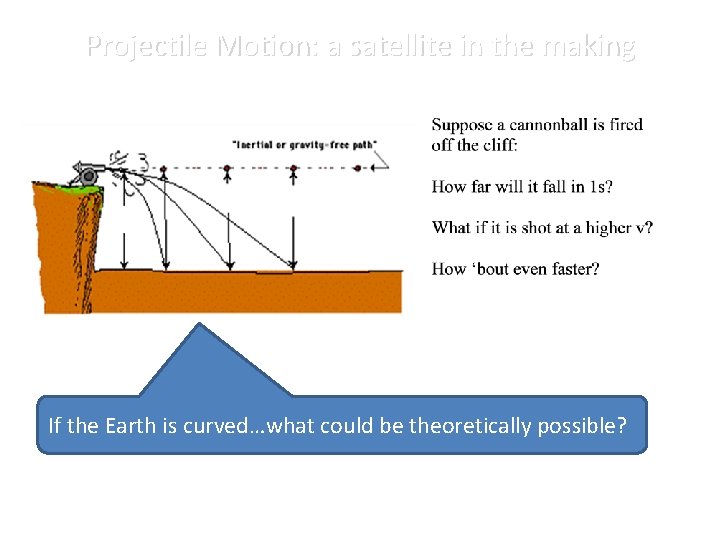
Projectile Motion: a satellite in the making If the Earth is curved…what could be theoretically possible?
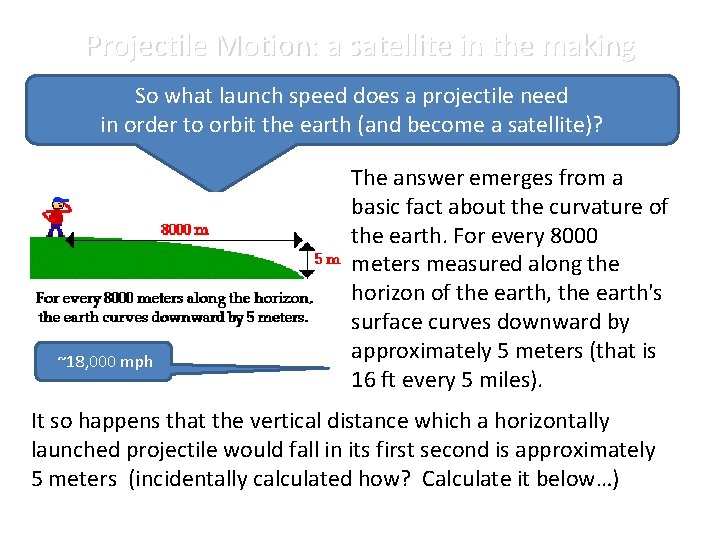
Projectile Motion: a satellite in the making So what launch speed does a projectile need in order to orbit the earth (and become a satellite)? ~18, 000 mph The answer emerges from a basic fact about the curvature of the earth. For every 8000 meters measured along the horizon of the earth, the earth's surface curves downward by approximately 5 meters (that is 16 ft every 5 miles). It so happens that the vertical distance which a horizontally launched projectile would fall in its first second is approximately 5 meters (incidentally calculated how? Calculate it below…)
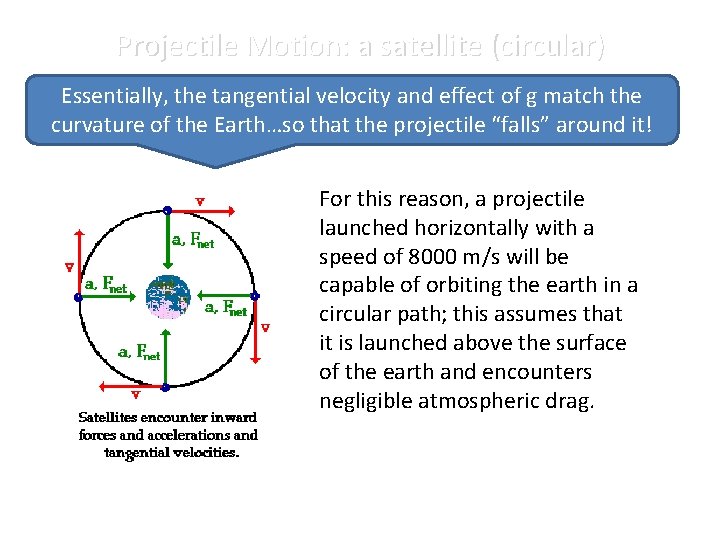
Projectile Motion: a satellite (circular) Essentially, the tangential velocity and effect of g match the curvature of the Earth…so that the projectile “falls” around it! For this reason, a projectile launched horizontally with a speed of 8000 m/s will be capable of orbiting the earth in a circular path; this assumes that it is launched above the surface of the earth and encounters negligible atmospheric drag.
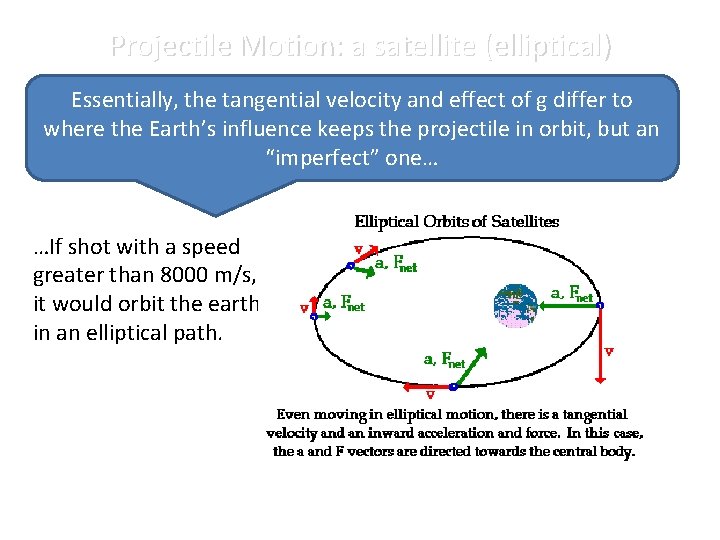
Projectile Motion: a satellite (elliptical) Essentially, the tangential velocity and effect of g differ to where the Earth’s influence keeps the projectile in orbit, but an “imperfect” one… …If shot with a speed greater than 8000 m/s, it would orbit the earth in an elliptical path.
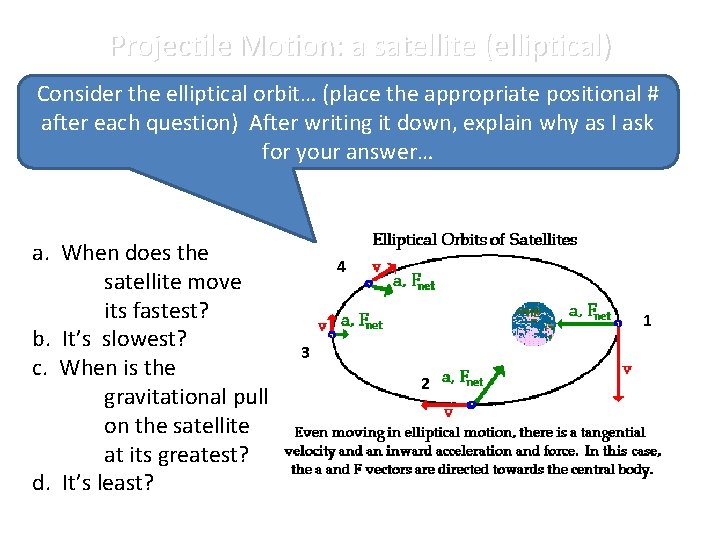
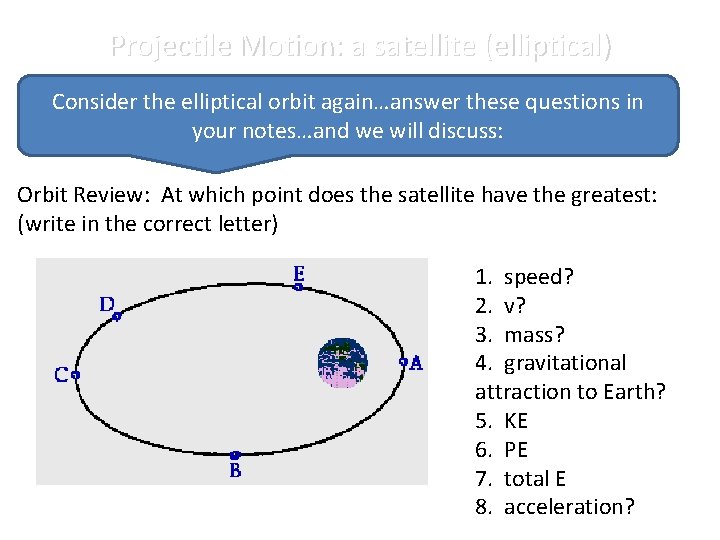
Projectile Motion: a satellite (elliptical) Consider the elliptical orbit… (place the appropriate positional # after each question) After writing it down, explain why as I ask for your answer… a. When does the satellite move its fastest? b. It’s slowest? c. When is the gravitational pull on the satellite at its greatest? d. It’s least? 4 1 3 2
Projectile Motion: a satellite (elliptical) Consider the ellipse geometrically? …What is it? An Ellipse! Hewitt-Drew-it! PHYSICS 50. Circular/Elliptical Orbit review
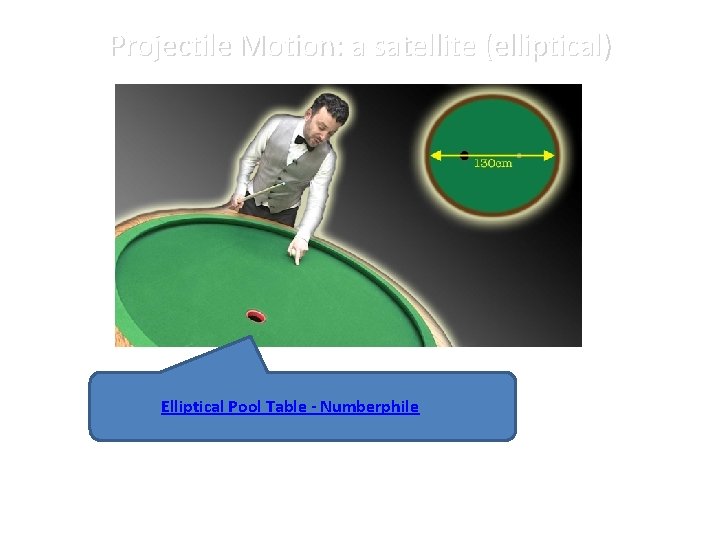
Projectile Motion: a satellite (elliptical) Elliptical Pool Table - Numberphile
Projectile Motion: a satellite (elliptical) Nature is filled with circles…why is it that we see far more ellipses than circles?
Projectile Motion: a satellite (elliptical) Consider the elliptical orbit again…answer these questions in your notes…and we will discuss: Orbit Review: At which point does the satellite have the greatest: (write in the correct letter) 1. speed? 2. v? 3. mass? 4. gravitational attraction to Earth? 5. KE 6. PE 7. total E 8. acceleration?
Projectile Motion: escape speed Consider the famous dictum… Is it true? How might one say this to achieve greater accuracy?
Projectile Motion: escape speed Well…let Dwight state it simply Use the Universal law of Gravitation to prove this…write how you could in your notes… If a ball must be shot at 8 km/s in order to become an Earth Satellite, one must be shot at a whopping 11. 2 km/s in order to “outrun” gravity and ‘escape’ the Earth… Remember: this does not mean that there is no gravitational influence from the Earth---merely that it can be overcome…
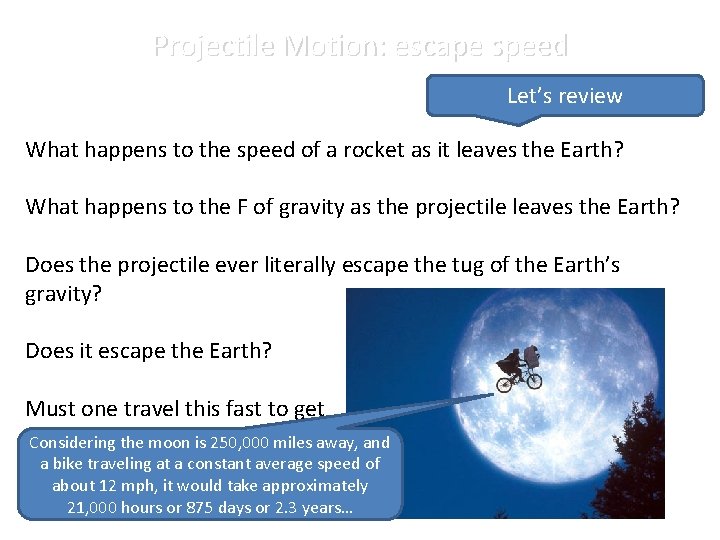
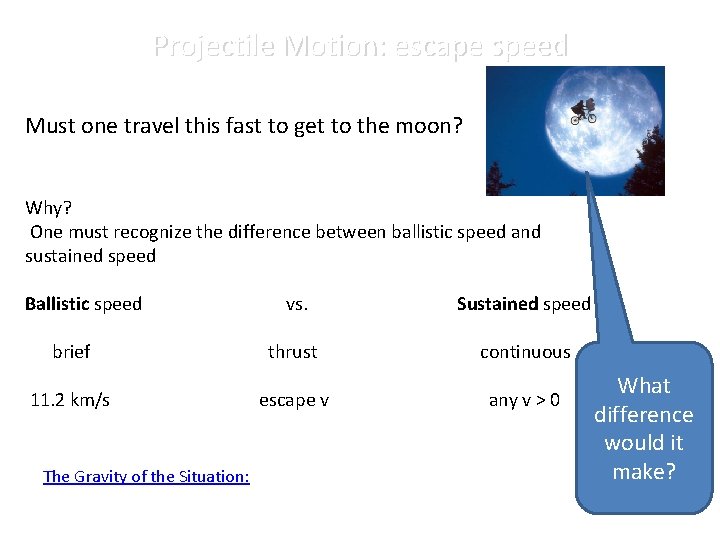
Projectile Motion: escape speed Let’s review What happens to the speed of a rocket as it leaves the Earth? What happens to the F of gravity as the projectile leaves the Earth? Does the projectile ever literally escape the tug of the Earth’s gravity? Does it escape the Earth? Must one travel this fast to get tothe moon? Considering moon is 250, 000 miles away, and a bike traveling at a constant average speed of about 12 mph, it would take approximately 21, 000 hours or 875 days or 2. 3 years…
Projectile Motion: escape speed Must one travel this fast to get to the moon? Why? One must recognize the difference between ballistic speed and sustained speed Ballistic speed vs. Sustained speed brief thrust continuous 11. 2 km/s escape v any v > 0 The Gravity of the Situation: What difference would it make?