
Chapter 8 Probability The Mathematics of Chance Lesson
Chapter 8: Probability: The Mathematics of Chance Lesson Plan n Probability Models and Rules For All Practical Purposes Mathematical Literacy in Today’s World, 7 th ed. n Discrete Probability Models n Equally Likely Outcomes n Continuous Probability Models n The Mean and Standard Deviation of a Probability Model n The Central Limit Theorem © 2006, W. H. Freeman and Company 1
Chapter 8: Probability: The Mathematics of Chance Probability Models and Rules n Probability Theory q q The mathematical description of randomness. Companies rely on profiting from known probabilities. n Examples: Casinos know every dollar bet will yield revenue; insurance companies base their premiums on known probabilities. Randomness – A phenomenon is said to be random if individual outcomes are uncertain but the long-term pattern of many individual outcomes is predictable. Probability – For a random phenomenon, the probability of any outcome is the proportion of times the outcome would occur in a very long series of repetitions. 2
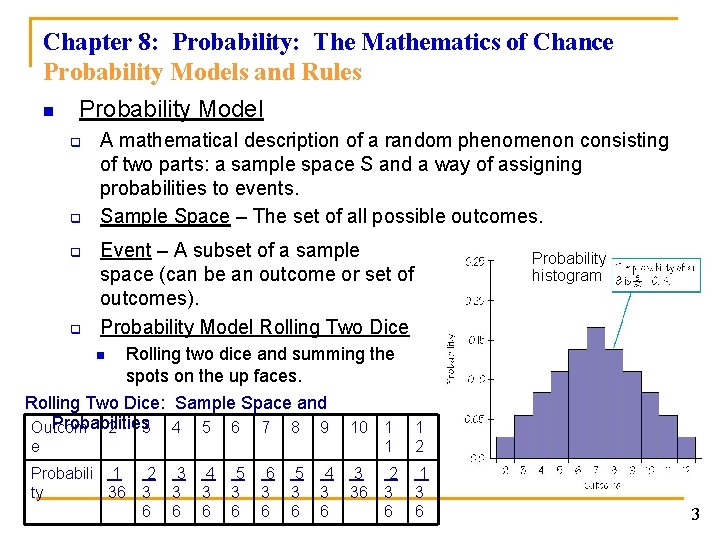
Chapter 8: Probability: The Mathematics of Chance Probability Models and Rules n Probability Model q q A mathematical description of a random phenomenon consisting of two parts: a sample space S and a way of assigning probabilities to events. Sample Space – The set of all possible outcomes. Event – A subset of a sample space (can be an outcome or set of outcomes). Probability Model Rolling Two Dice n Rolling two dice and summing the spots on the up faces. Rolling Two Dice: Sample Space and Probabilities Outcom 2 3 4 5 6 7 8 9 10 1 1 1 2 3 36 2 3 6 1 3 6 e Probabili 1 ty 36 Probability histogram 2 3 6 3 3 6 4 3 6 5 3 6 6 3 6 5 3 6 4 3 6 3
Chapter 8: Probability: The Mathematics of Chance Probability Models and Rules n Probability Rules 1. The probability P(A) of any event A satisfies 0 P(A) 1. n 2. If S is the sample space in a probability model, the P(S) = 1. n 3. All possible outcomes together must have probability of 1. Two events A and B are disjoint if they have no outcomes in common and so can never occur together. If A and B are disjoint, P(A or B) = P(A) + P(B) (addition rule for disjoint events). n 4. Any probability is a number between 0 and 1. If two events have no outcomes in common, the probability that one or the other occurs is the sum of their individual probabilities. The complement of any event A is the event that A does not occur, written as Ac. The complement rule: P(Ac) = 1 – P(A). n The probability that an event does not occur is 1 minus the probability that the event does occur. 4
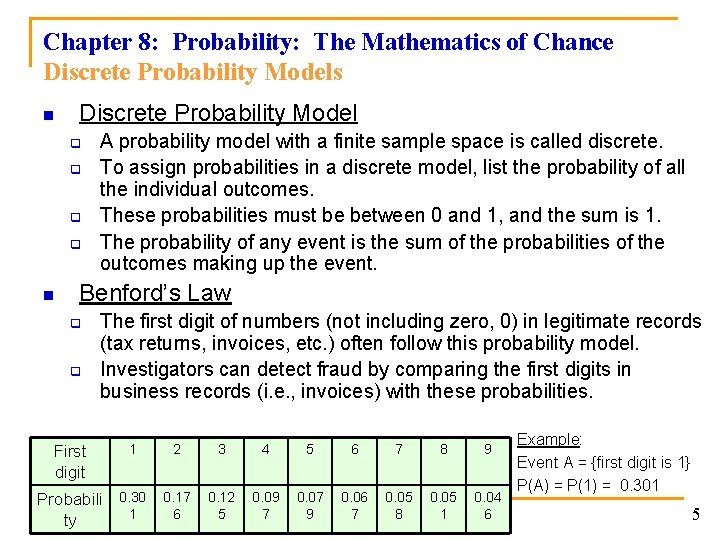
Chapter 8: Probability: The Mathematics of Chance Discrete Probability Models n Discrete Probability Model q q n A probability model with a finite sample space is called discrete. To assign probabilities in a discrete model, list the probability of all the individual outcomes. These probabilities must be between 0 and 1, and the sum is 1. The probability of any event is the sum of the probabilities of the outcomes making up the event. Benford’s Law q q First digit The first digit of numbers (not including zero, 0) in legitimate records (tax returns, invoices, etc. ) often follow this probability model. Investigators can detect fraud by comparing the first digits in business records (i. e. , invoices) with these probabilities. 1 Probabili 0. 30 1 ty 2 3 4 5 6 7 8 9 0. 17 6 0. 12 5 0. 09 7 0. 07 9 0. 06 7 0. 05 8 0. 05 1 0. 04 6 Example: Event A = {first digit is 1} P(A) = P(1) = 0. 301 5

Chapter 8: Probability: The Mathematics of Chance Equally Likely Outcomes n Equally Likely Outcomes q q If a random phenomenon has k possible outcomes, all equally likely, then each individual outcome has probability of 1/k. The probability of any event A is: P(A) = count of outcomes in A count of outcomes in S = count of outcomes in A k Example: Suppose you think the first digits are distributed “at random” among the digits 1 though 9; then the possible outcomes are equally likely. First digit 1 2 3 4 5 6 7 8 9 Probability 1/ 9 1/ 9 1/ 9 If business records are unlawfully produced by using (1 – 9) random digits, investigators can detect it. 6
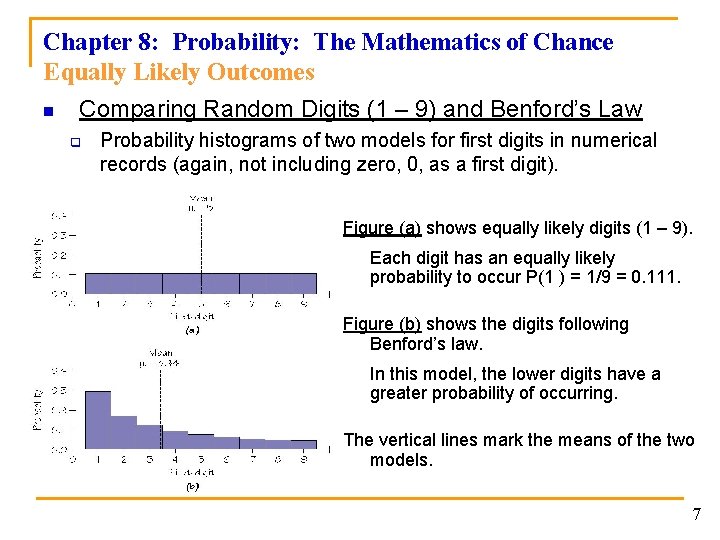
Chapter 8: Probability: The Mathematics of Chance Equally Likely Outcomes n Comparing Random Digits (1 – 9) and Benford’s Law q Probability histograms of two models for first digits in numerical records (again, not including zero, 0, as a first digit). Figure (a) shows equally likely digits (1 – 9). Each digit has an equally likely probability to occur P(1 ) = 1/9 = 0. 111. Figure (b) shows the digits following Benford’s law. In this model, the lower digits have a greater probability of occurring. The vertical lines mark the means of the two models. 7
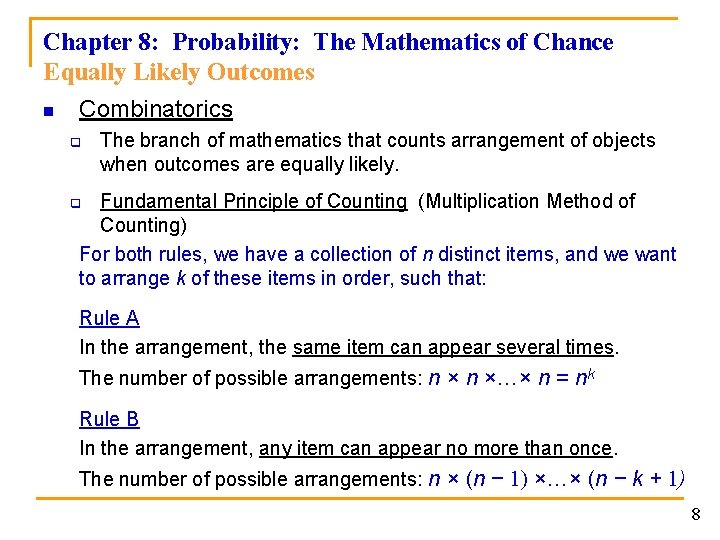
Chapter 8: Probability: The Mathematics of Chance Equally Likely Outcomes n Combinatorics q The branch of mathematics that counts arrangement of objects when outcomes are equally likely. Fundamental Principle of Counting (Multiplication Method of Counting) For both rules, we have a collection of n distinct items, and we want to arrange k of these items in order, such that: q Rule A In the arrangement, the same item can appear several times. The number of possible arrangements: n ×…× n = nk Rule B In the arrangement, any item can appear no more than once. The number of possible arrangements: n × (n − 1) ×…× (n − k + 1) 8
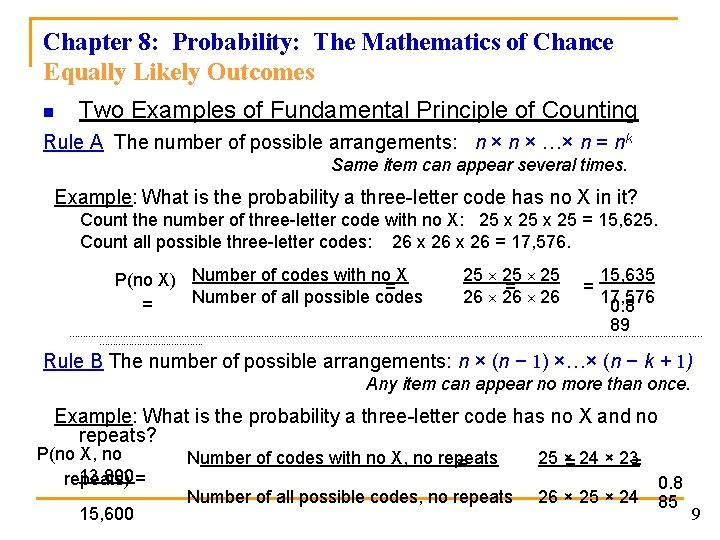
Chapter 8: Probability: The Mathematics of Chance Equally Likely Outcomes n Two Examples of Fundamental Principle of Counting Rule A The number of possible arrangements: n × …× n = nk Same item can appear several times. Example: What is the probability a three-letter code has no X in it? Count the number of three-letter code with no X: 25 x 25 = 15, 625. Count all possible three-letter codes: 26 x 26 = 17, 576. P(no X) Number of codes with no=X Number of all possible codes = 25 × 25 = 26 × 26 15, 635 17, 576 0. 8 89 -----------------------------------------------------------------------------------------------------------------------= -------------------- Rule B The number of possible arrangements: n × (n − 1) ×…× (n − k + 1) Any item can appear no more than once. Example: What is the probability a three-letter code has no X and no repeats? P(no X, no 13, 800 = repeats) 15, 600 Number of codes with no X, no repeats = 25 ×= 24 × 23= Number of all possible codes, no repeats 26 × 25 × 24 0. 8 85 9
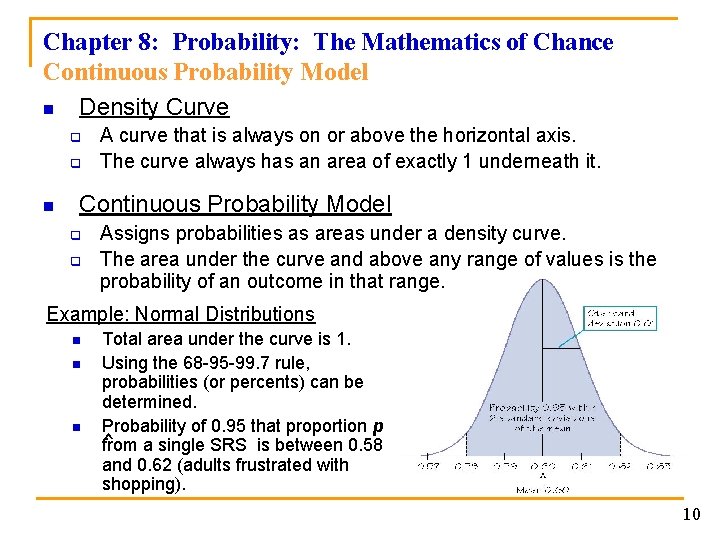
Chapter 8: Probability: The Mathematics of Chance Continuous Probability Model n Density Curve q q n A curve that is always on or above the horizontal axis. The curve always has an area of exactly 1 underneath it. Continuous Probability Model q q Assigns probabilities as areas under a density curve. The area under the curve and above any range of values is the probability of an outcome in that range. Example: Normal Distributions n n n Total area under the curve is 1. Using the 68 -95 -99. 7 rule, probabilities (or percents) can be determined. Probability of 0. 95 that proportion p ^ from a single SRS is between 0. 58 and 0. 62 (adults frustrated with shopping). 10
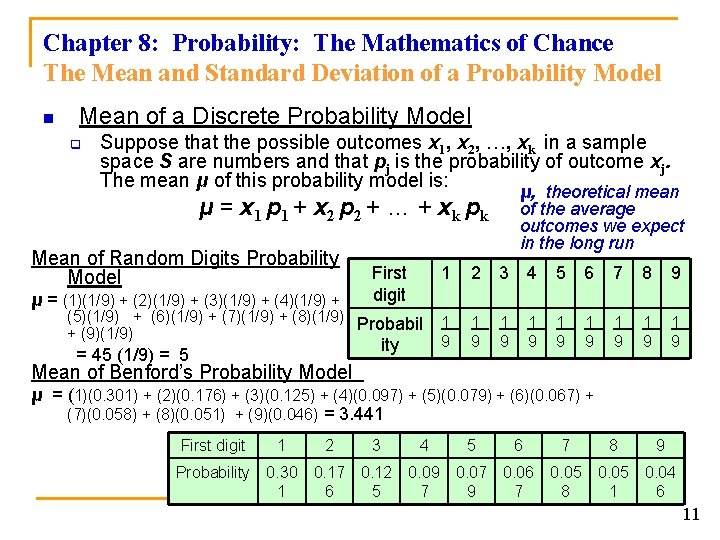
Chapter 8: Probability: The Mathematics of Chance The Mean and Standard Deviation of a Probability Model n Mean of a Discrete Probability Model q Suppose that the possible outcomes x 1, x 2, …, xk in a sample space S are numbers and that pj is the probability of outcome xj. The mean μ of this probability model is: μ, theoretical mean of the average outcomes we expect in the long run μ = x 1 p 1 + x 2 p 2 + … + xk p k Mean of Random Digits Probability Model μ = (1)(1/9) + (2)(1/9) + (3)(1/9) + (4)(1/9) + First digit (5)(1/9) + (6)(1/9) + (7)(1/9) + (8)(1/9) Probabil + (9)(1/9) ity = 45 (1/9) = 5 1 2 3 4 5 6 7 8 9 1 9 1 9 1 9 Mean of Benford’s Probability Model μ = (1)(0. 301) + (2)(0. 176) + (3)(0. 125) + (4)(0. 097) + (5)(0. 079) + (6)(0. 067) + (7)(0. 058) + (8)(0. 051) + (9)(0. 046) = 3. 441 First digit 1 Probability 0. 30 1 2 3 4 5 6 7 8 9 0. 17 6 0. 12 5 0. 09 7 0. 07 9 0. 06 7 0. 05 8 0. 05 1 0. 04 6 11
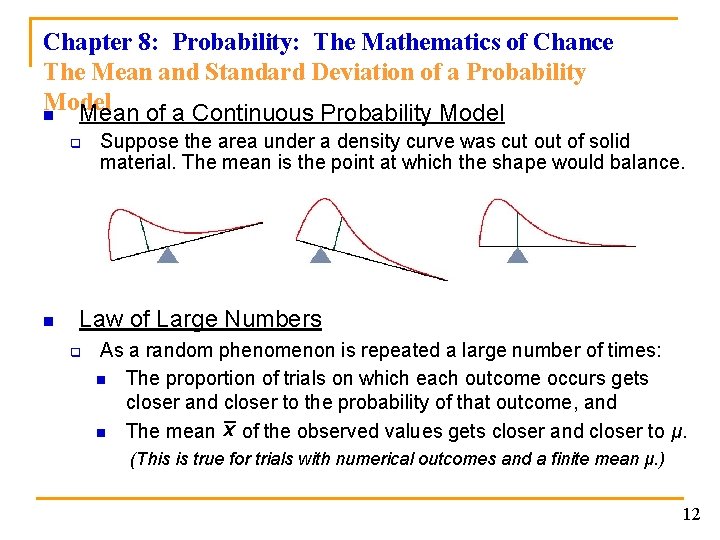
Chapter 8: Probability: The Mathematics of Chance The Mean and Standard Deviation of a Probability Model n Mean of a Continuous Probability Model q n Suppose the area under a density curve was cut of solid material. The mean is the point at which the shape would balance. Law of Large Numbers q As a random phenomenon is repeated a large number of times: n The proportion of trials on which each outcome occurs gets closer and closer to the probability of that outcome, and n The mean x ¯ of the observed values gets closer and closer to μ. (This is true for trials with numerical outcomes and a finite mean μ. ) 12
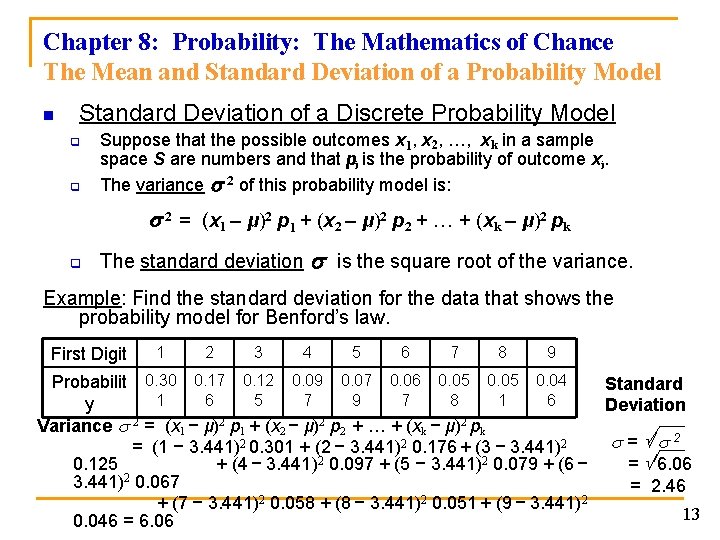
Chapter 8: Probability: The Mathematics of Chance The Mean and Standard Deviation of a Probability Model n Standard Deviation of a Discrete Probability Model q q Suppose that the possible outcomes x 1, x 2, …, xk in a sample space S are numbers and that pj is the probability of outcome xj. The variance 2 of this probability model is: 2 = (x 1 – μ)2 p 1 + (x 2 – μ)2 p 2 + … + (xk – μ)2 pk q The standard deviation is the square root of the variance. Example: Find the standard deviation for the data that shows the probability model for Benford’s law. First Digit 1 2 3 4 5 6 7 8 9 Probabilit 0. 30 0. 17 0. 12 0. 09 0. 07 0. 06 0. 05 0. 04 Standard 1 6 5 7 9 7 8 1 6 y Deviation Variance 2 = (x 1 − μ)2 p 1 + (x 2 − μ)2 p 2 + … + (xk − μ)2 pk = 2 = (1 − 3. 441)2 0. 301 + (2 − 3. 441)2 0. 176 + (3 − 3. 441)2 = 6. 06 0. 125 + (4 − 3. 441)2 0. 097 + (5 − 3. 441)2 0. 079 + (6 − 2 3. 441) 0. 067 = 2. 46 2 2 2 + (7 − 3. 441) 0. 058 + (8 − 3. 441) 0. 051 + (9 − 3. 441) 13 0. 046 = 6. 06
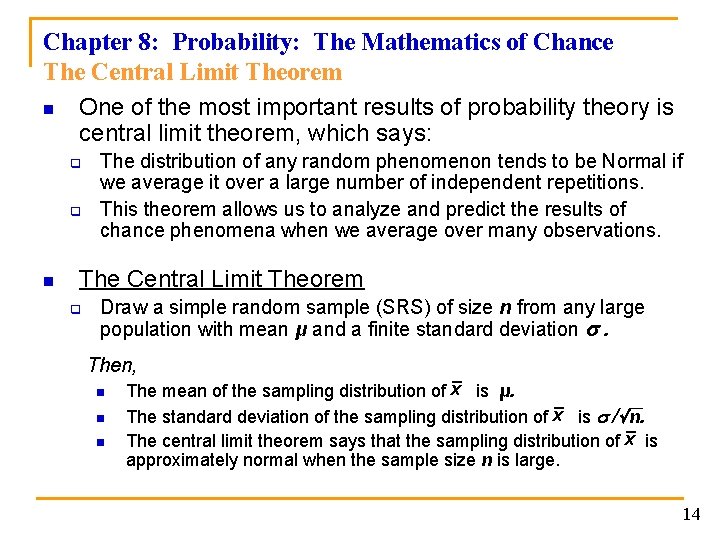
Chapter 8: Probability: The Mathematics of Chance The Central Limit Theorem n One of the most important results of probability theory is central limit theorem, which says: q q n The distribution of any random phenomenon tends to be Normal if we average it over a large number of independent repetitions. This theorem allows us to analyze and predict the results of chance phenomena when we average over many observations. The Central Limit Theorem q Draw a simple random sample (SRS) of size n from any large population with mean μ and a finite standard deviation . Then, n n n The mean of the sampling distribution of x ¯ is μ. The standard deviation of the sampling distribution of x ¯ is / n. The central limit theorem says that the sampling distribution of x ¯ is approximately normal when the sample size n is large. 14
- Slides: 14