
Chapter 8 Positive Letters and Messages Business Communication
Chapter 8 Positive Letters and Messages Business Communication: Process and Product, 6 e Mary Ellen Guffey Copyright © 2008 1
Applying the Writing Process § Identify your purpose. § Visualize the receiver. Prewriting § Predict the receiver’s reaction. Analyze Anticipate § Consider ways to adapt your message to achieve Adapt your goal. Mary Ellen Guffey, Business Communication: Process and Product, 6 e 2

Applying the Writing Process Writing Research Organize Compose § Collect information § Choose the most effective pattern of organization. § Compose the first draft. Mary Ellen Guffey, Business Communication: Process and Product, 6 e 3
Applying the Writing Process Revising Edit Proofread Evaluate § Revise for clarity and conciseness. § Proofread for correctness. § Decide whether this message will achieve its purpose. Mary Ellen Guffey, Business Communication: Process and Product, 6 e 4
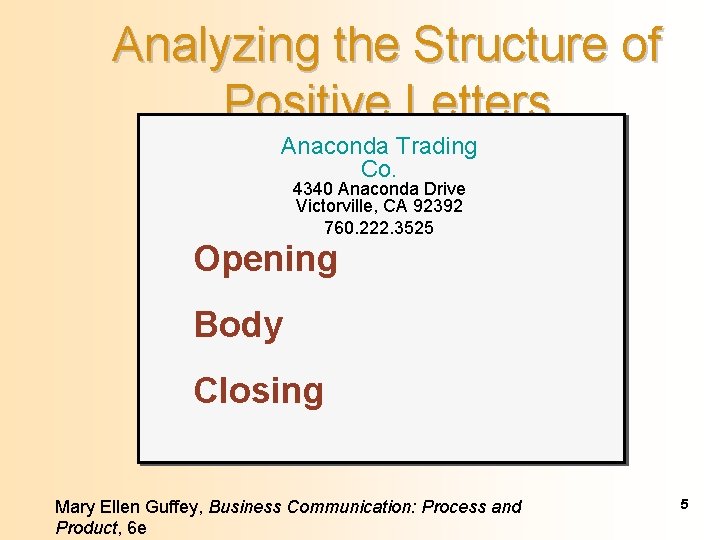
Analyzing the Structure of Positive Letters Anaconda Trading Co. 4340 Anaconda Drive Victorville, CA 92392 760. 222. 3525 Opening Body Closing Mary Ellen Guffey, Business Communication: Process and Product, 6 e 5
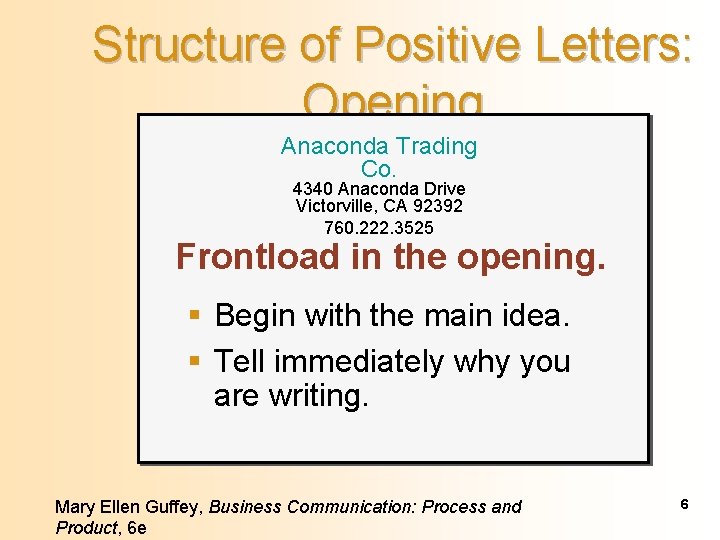
Structure of Positive Letters: Opening Anaconda Trading Co. 4340 Anaconda Drive Victorville, CA 92392 760. 222. 3525 Frontload in the opening. § Begin with the main idea. § Tell immediately why you are writing. Mary Ellen Guffey, Business Communication: Process and Product, 6 e 6
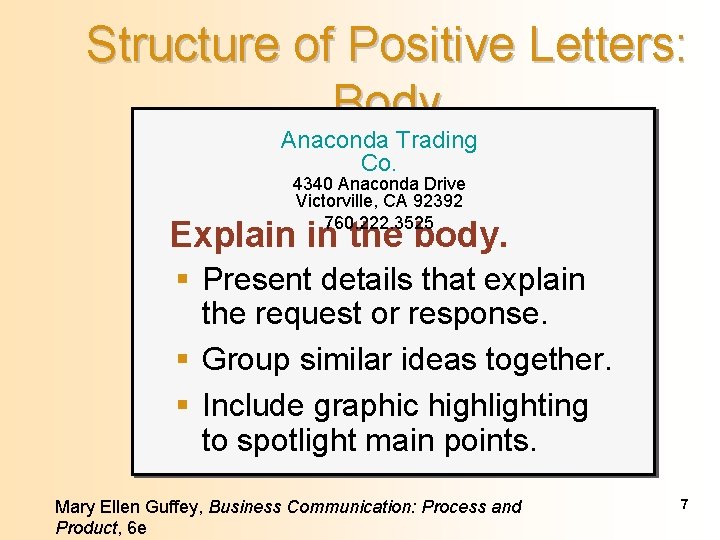
Structure of Positive Letters: Body Anaconda Trading Co. 4340 Anaconda Drive Victorville, CA 92392 760. 222. 3525 Explain in the body. § Present details that explain the request or response. § Group similar ideas together. § Include graphic highlighting to spotlight main points. Mary Ellen Guffey, Business Communication: Process and Product, 6 e 7
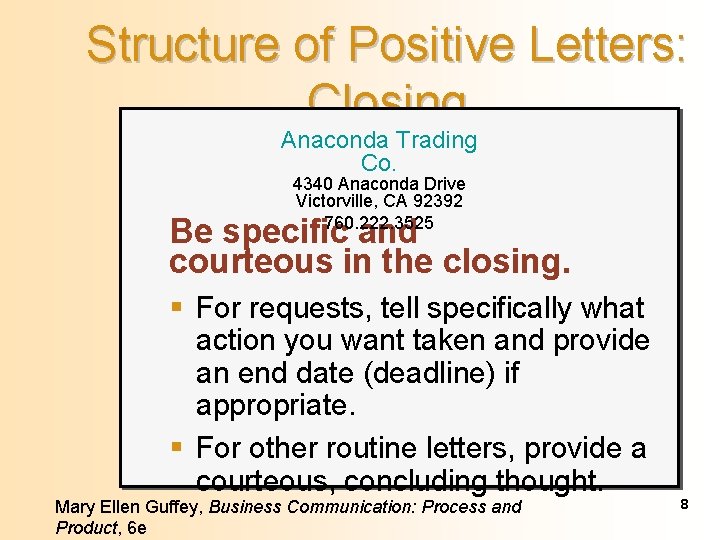
Structure of Positive Letters: Closing Anaconda Trading Co. 4340 Anaconda Drive Victorville, CA 92392 760. 222. 3525 Be specific and courteous in the closing. § For requests, tell specifically what action you want taken and provide an end date (deadline) if appropriate. § For other routine letters, provide a courteous, concluding thought. Mary Ellen Guffey, Business Communication: Process and Product, 6 e 8
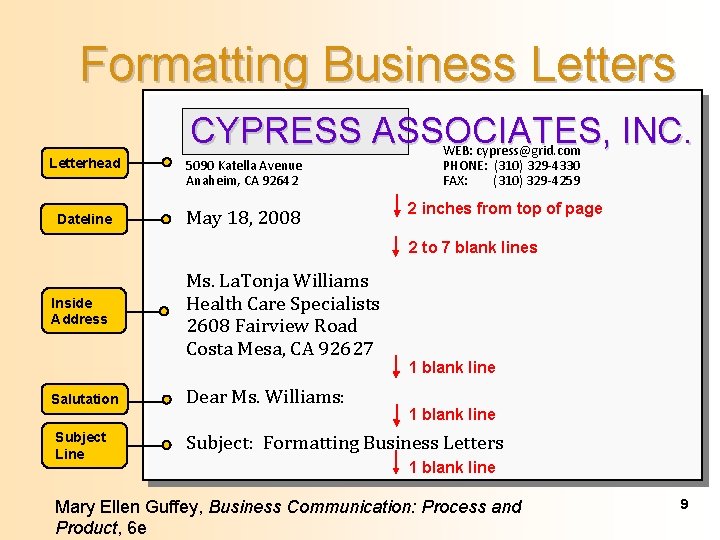
Formatting Business Letters CYPRESS ASSOCIATES, INC. Letterhead 5090 Katella Avenue Anaheim, CA 92642 Dateline May 18, 2008 WEB: cypress@grid. com PHONE: (310) 329 -4330 FAX: (310) 329 -4259 2 inches from top of page 2 to 7 blank lines Inside Address Salutation Subject Line Ms. La. Tonja Williams Health Care Specialists 2608 Fairview Road Costa Mesa, CA 92627 Dear Ms. Williams: 1 blank line Subject: Formatting Business Letters 1 blank line Mary Ellen Guffey, Business Communication: Process and Product, 6 e 9
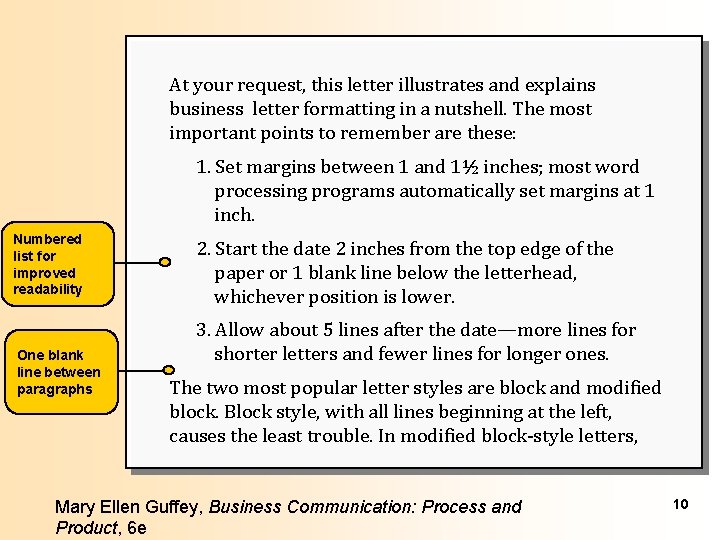
At your request, this letter illustrates and explains business letter formatting in a nutshell. The most important points to remember are these: 1. Set margins between 1 and 1½ inches; most word processing programs automatically set margins at 1 inch. Numbered list for improved readability One blank line between paragraphs 2. Start the date 2 inches from the top edge of the paper or 1 blank line below the letterhead, whichever position is lower. 3. Allow about 5 lines after the date—more lines for shorter letters and fewer lines for longer ones. The two most popular letter styles are block and modified block. Block style, with all lines beginning at the left, causes the least trouble. In modified block-style letters, Mary Ellen Guffey, Business Communication: Process and Product, 6 e 10
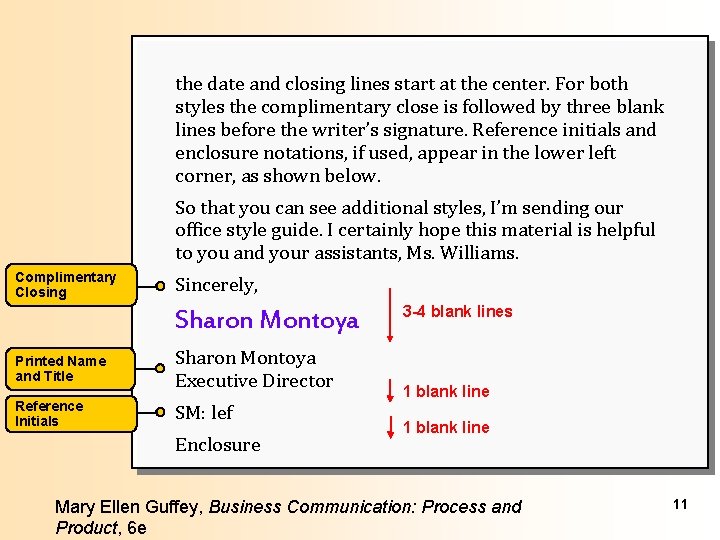
the date and closing lines start at the center. For both styles the complimentary close is followed by three blank lines before the writer’s signature. Reference initials and enclosure notations, if used, appear in the lower left corner, as shown below. So that you can see additional styles, I’m sending our office style guide. I certainly hope this material is helpful to you and your assistants, Ms. Williams. Complimentary Closing Sincerely, Sharon Montoya Printed Name and Title Sharon Montoya Executive Director Reference Initials SM: lef Enclosure 3 -4 blank lines 1 blank line Mary Ellen Guffey, Business Communication: Process and Product, 6 e 11
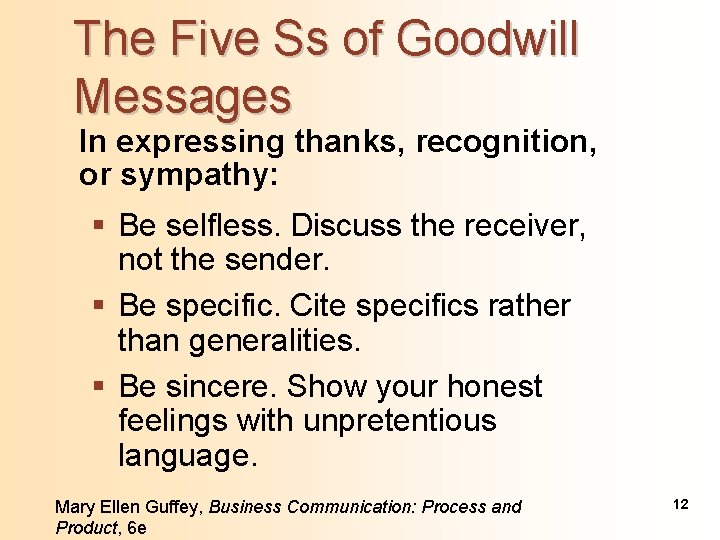
The Five Ss of Goodwill Messages In expressing thanks, recognition, or sympathy: § Be selfless. Discuss the receiver, not the sender. § Be specific. Cite specifics rather than generalities. § Be sincere. Show your honest feelings with unpretentious language. Mary Ellen Guffey, Business Communication: Process and Product, 6 e 12
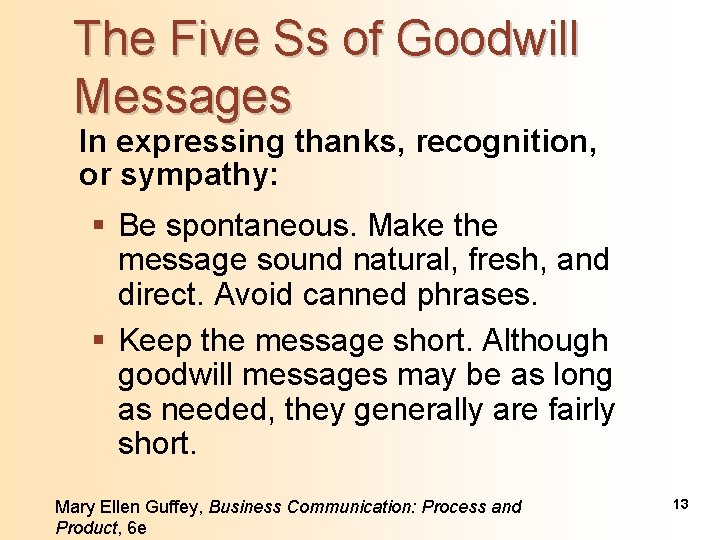
The Five Ss of Goodwill Messages In expressing thanks, recognition, or sympathy: § Be spontaneous. Make the message sound natural, fresh, and direct. Avoid canned phrases. § Keep the message short. Although goodwill messages may be as long as needed, they generally are fairly short. Mary Ellen Guffey, Business Communication: Process and Product, 6 e 13

Answering Congratulatory Messages § Send a brief note expressing your appreciation. § Tell how good the message made you feel. § Accept praise gracefully. Don’t make belittling statements (I’m not really that good. ) Mary Ellen Guffey, Business Communication: Process and Product, 6 e 14

End Mary Ellen Guffey, Business Communication: Process and Product, 6 e 15
- Slides: 15