
Chapter 8 Population Genetics Population genetics investigates genetic
- Slides: 52
Chapter 8 Population Genetics
Population genetics investigates genetic structure and genetic variation of population.
Population Mendelian population is a group of interbreeding individuals, who live in the same place and share a common set of genes (gene pool). 同一个物种生活在某一地区、能够相互 交配并能产生具有生殖能力后代的个体群, 该群体可利用孟德尔规律分析其传递规律, 故这样的群体称孟德尔式群体。
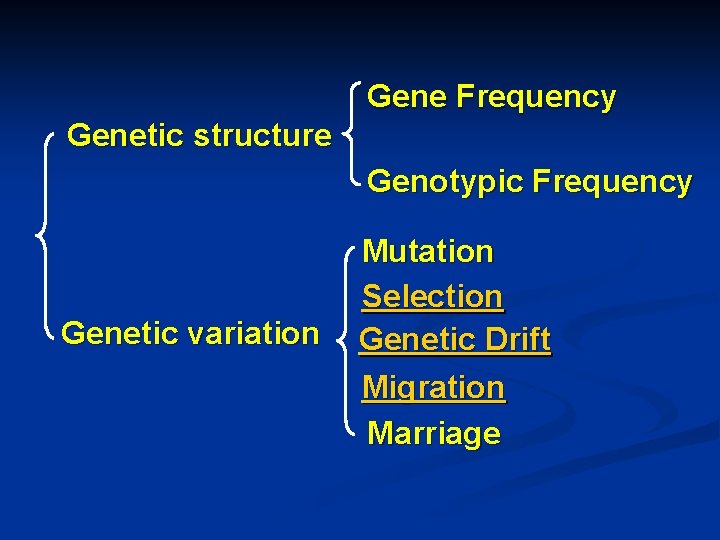
Gene Frequency Genetic structure Genotypic Frequency Genetic variation Mutation Selection Genetic Drift Migration Marriage
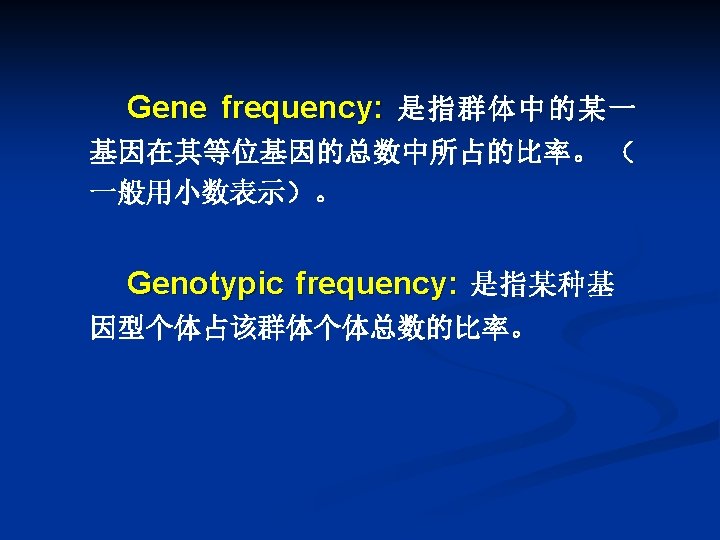
Gene Frequency & Genotypic Frequency
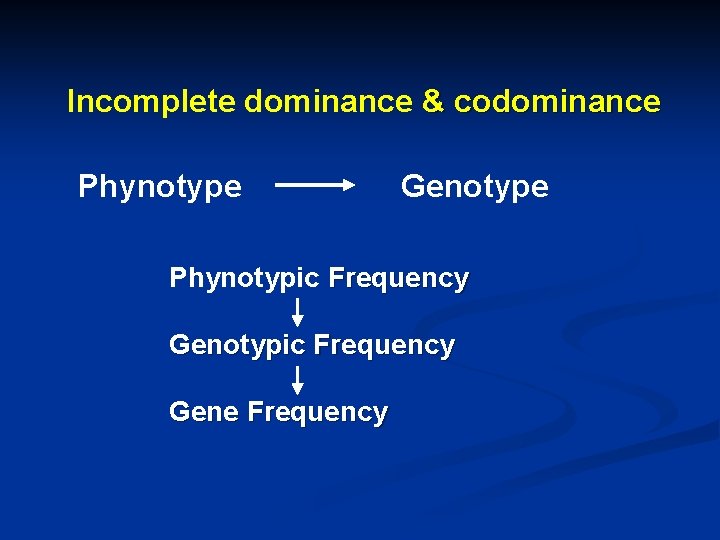
Incomplete dominance & codominance Phynotype Genotype Phynotypic Frequency Gene Frequency
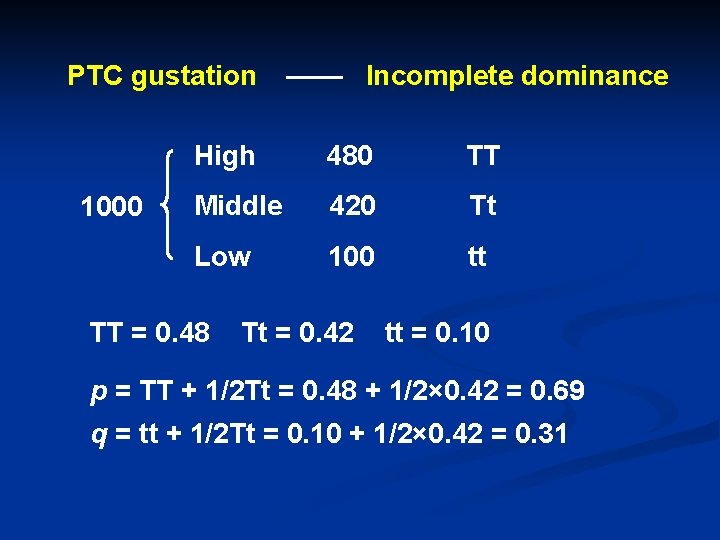
PTC gustation 1000 Incomplete dominance High 480 TT Middle 420 Tt Low 100 tt TT = 0. 48 Tt = 0. 42 tt = 0. 10 p = TT + 1/2 Tt = 0. 48 + 1/2× 0. 42 = 0. 69 q = tt + 1/2 Tt = 0. 10 + 1/2× 0. 42 = 0. 31
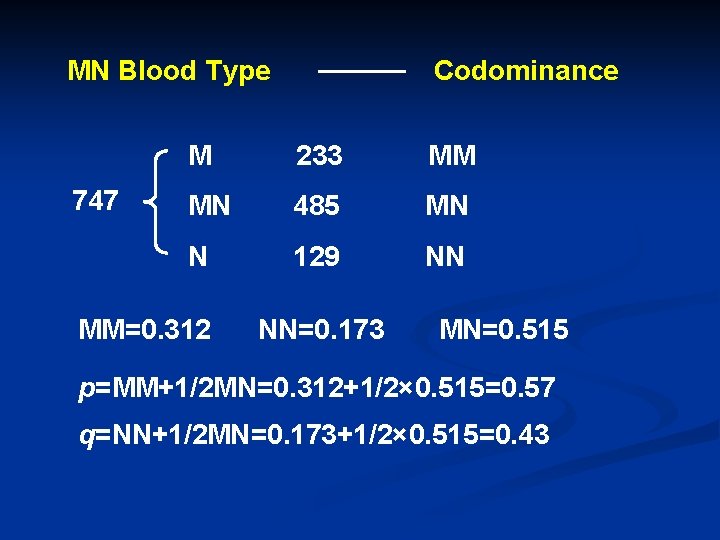
MN Blood Type 747 Codominance M 233 MM MN 485 MN N 129 NN MM=0. 312 NN=0. 173 MN=0. 515 p=MM+1/2 MN=0. 312+1/2× 0. 515=0. 57 q=NN+1/2 MN=0. 173+1/2× 0. 515=0. 43
Law of Genetic Equilibrium & Influential Factors
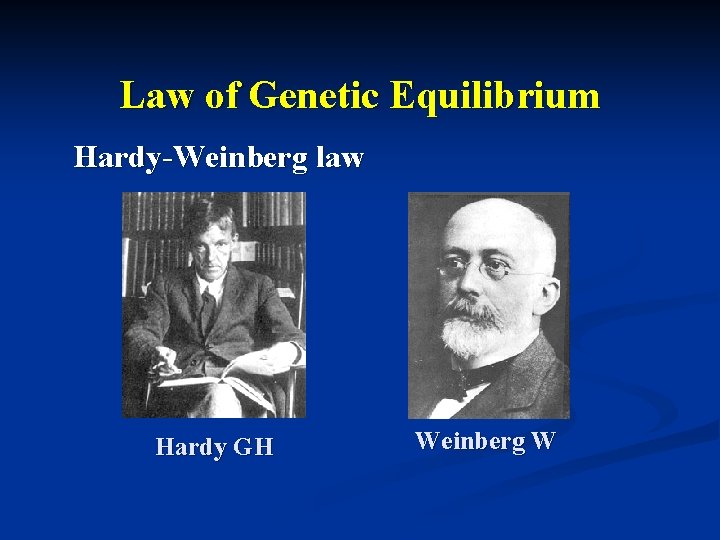
Law of Genetic Equilibrium Hardy-Weinberg law Hardy GH Weinberg W
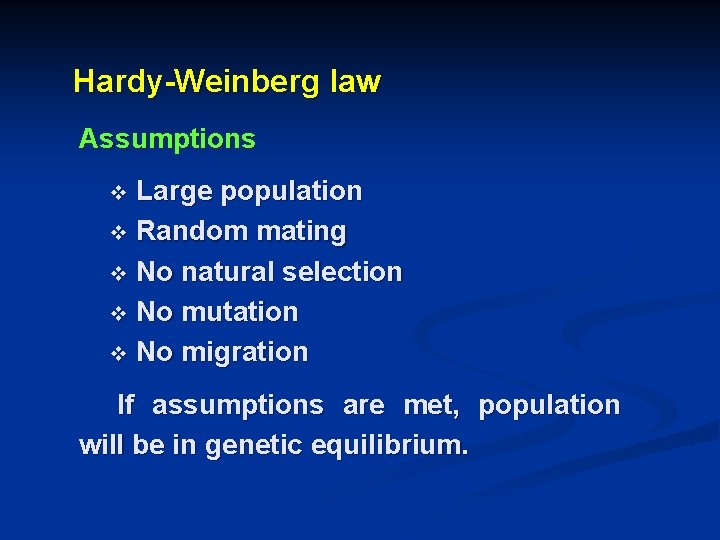
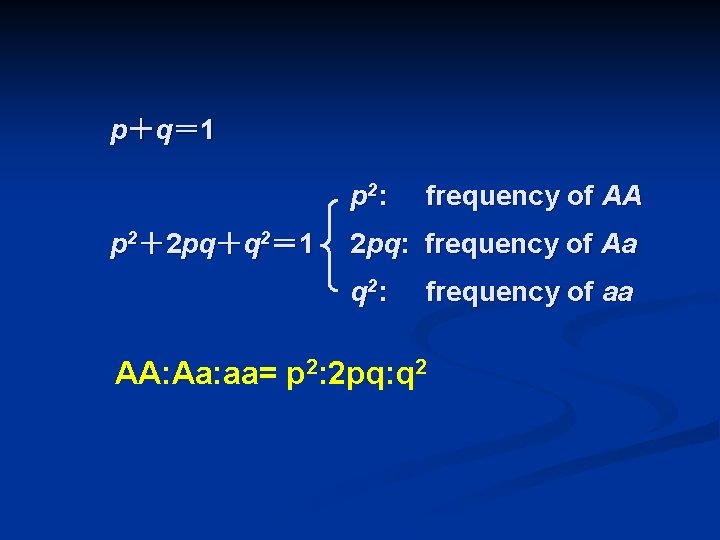
Hardy-Weinberg law Assumptions Large population v Random mating v No natural selection v No mutation v No migration v If assumptions are met, population will be in genetic equilibrium.
p+q= 1 p 2: p 2+2 pq+q 2= 1 frequency of AA 2 pq: frequency of Aa q 2: frequency of aa AA: Aa: aa= p 2: 2 pq: q 2
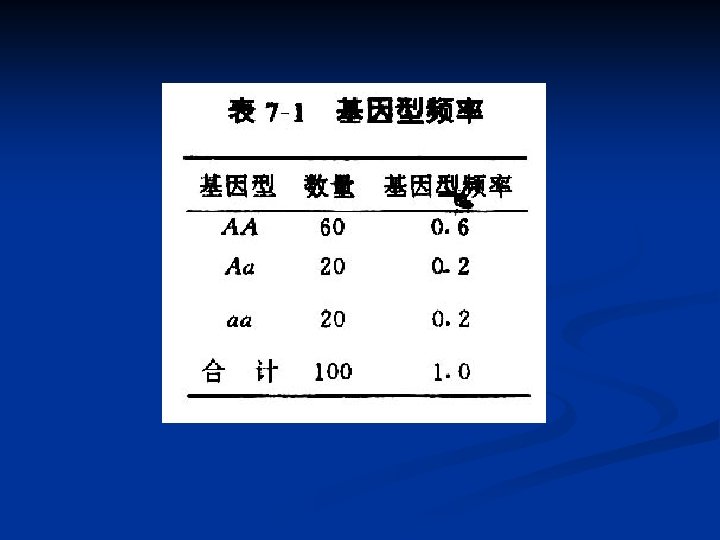
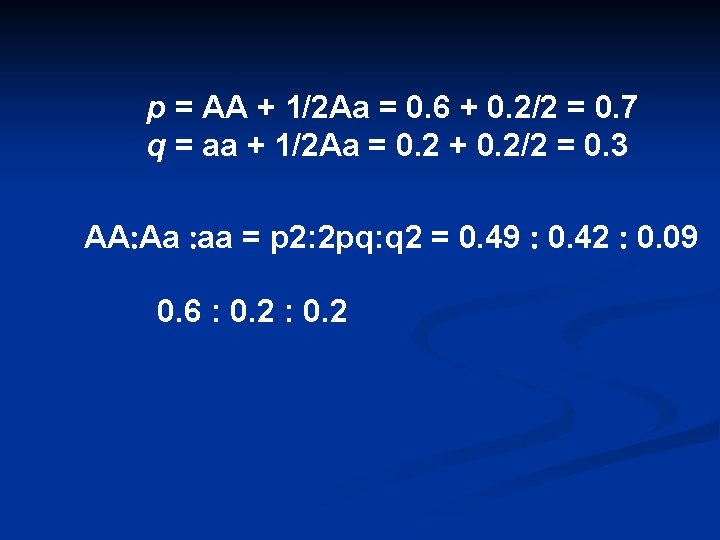
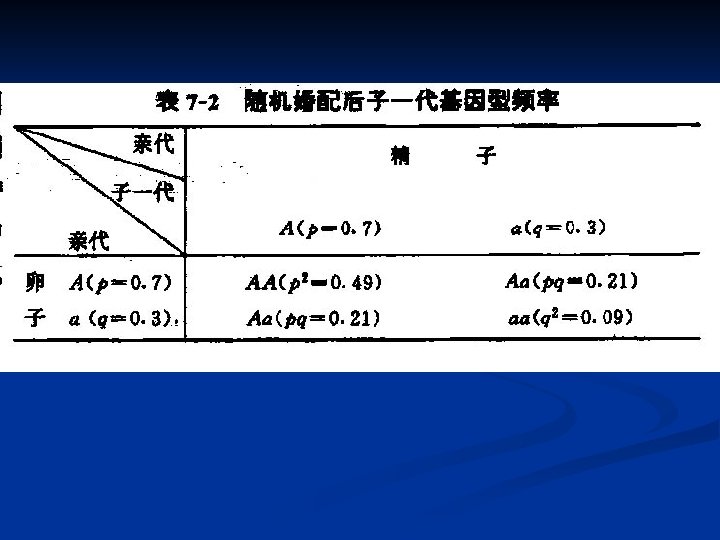
p = AA + 1/2 Aa = 0. 6 + 0. 2/2 = 0. 7 q = aa + 1/2 Aa = 0. 2 + 0. 2/2 = 0. 3 AA Aa aa = p 2: 2 pq: q 2 = 0. 49 0. 42 0. 09 0. 6 : 0. 2
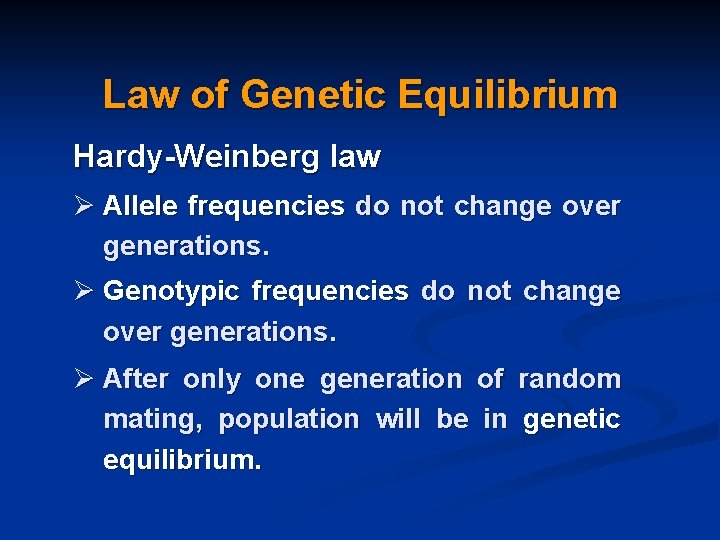
Law of Genetic Equilibrium Hardy-Weinberg law Ø Allele frequencies do not change over generations. Ø Genotypic frequencies do not change over generations. Ø After only one generation of random mating, population will be in genetic equilibrium.
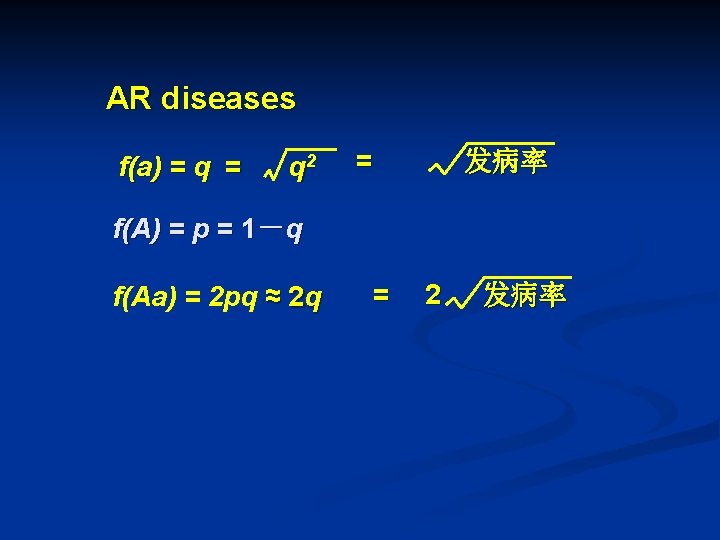
AR diseases f(a) = q 2 = 发病率 f(A) = p = 1-q f(Aa) = 2 pq ≈ 2 q = 2 发病率
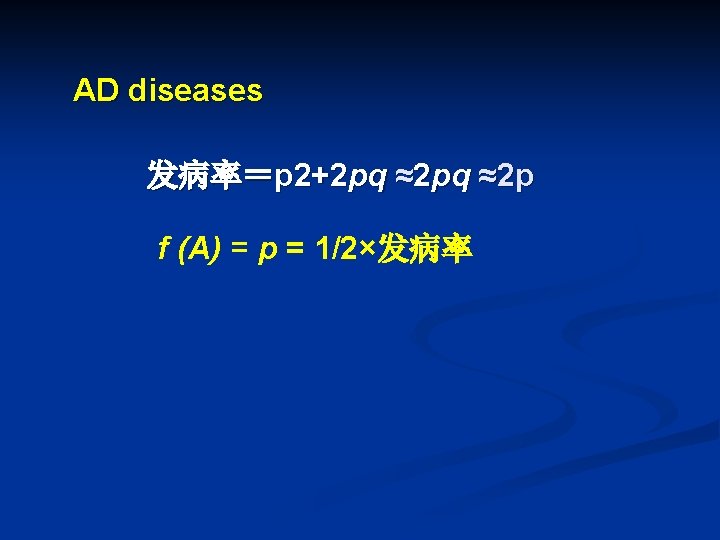
AD diseases 发病率=p 2+2 pq ≈2 p f (A) = p = 1/2×发病率
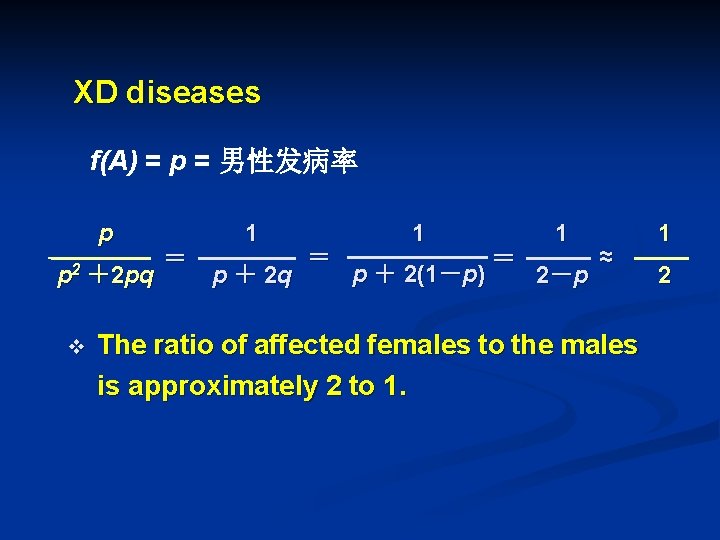
XD diseases f(A) = p = 男性发病率 p p 2 +2 pq v = 1 p + 2 q = 1 p + 2(1-p) = 1 2-p ≈ The ratio of affected females to the males is approximately 2 to 1. 1 2
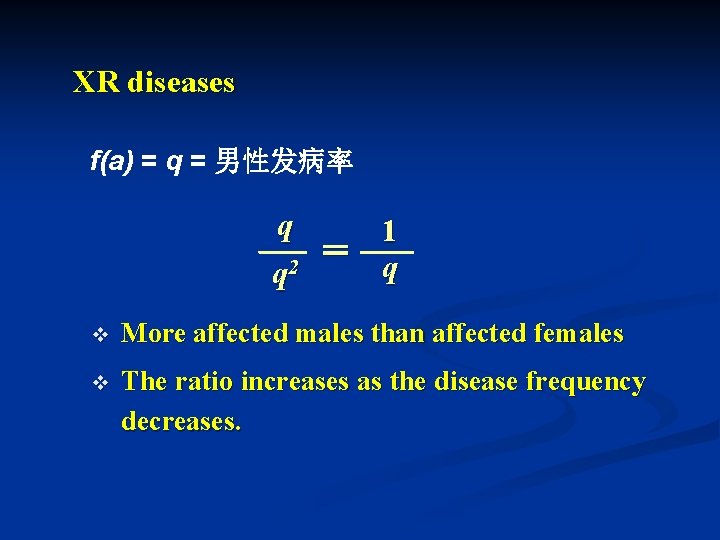
XR diseases f(a) = q = 男性发病率 q 1 = 2 q q v More affected males than affected females v The ratio increases as the disease frequency decreases.
Factors that Alter Genetic Equilibrium
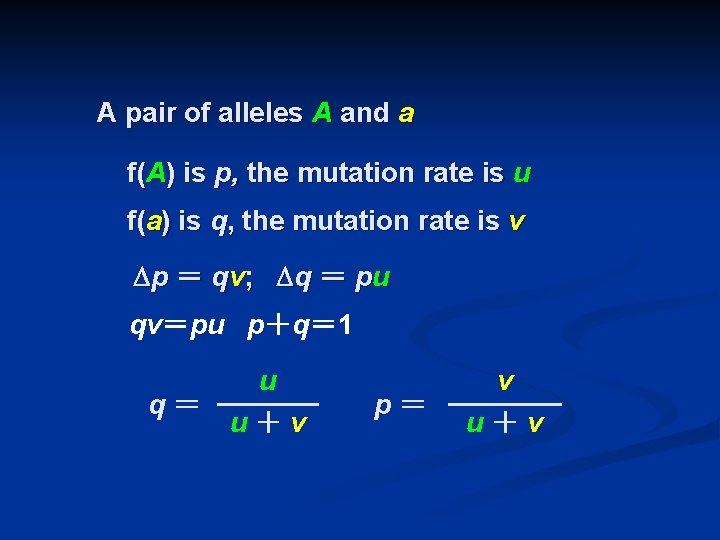
A pair of alleles A and a f(A) is p, the mutation rate is u f(a) is q, the mutation rate is v p = q v; q = p u qv=pu p+q= 1 q= u u+v p= v u+v
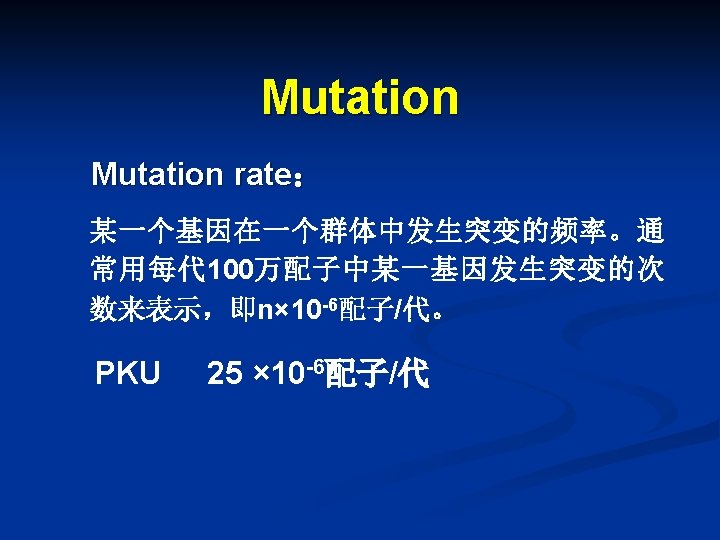
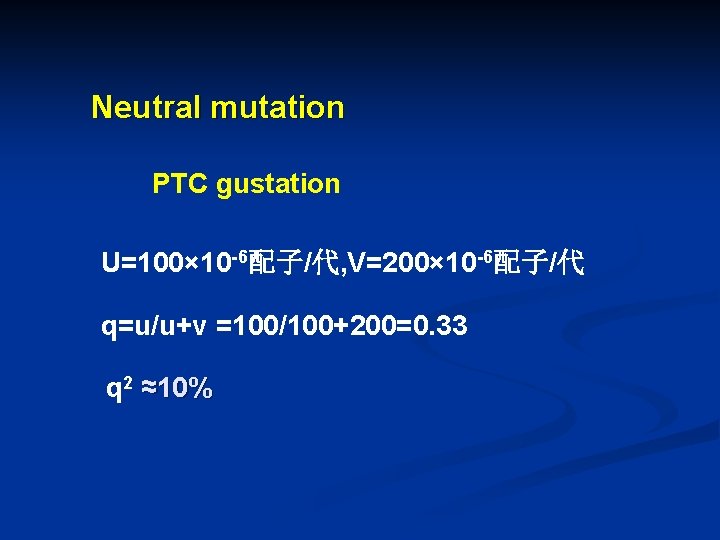
Neutral mutation PTC gustation U=100× 10 -6配子/代, V=200× 10 -6配子/代 q=u/u+v =100/100+200=0. 33 q 2 ≈10%
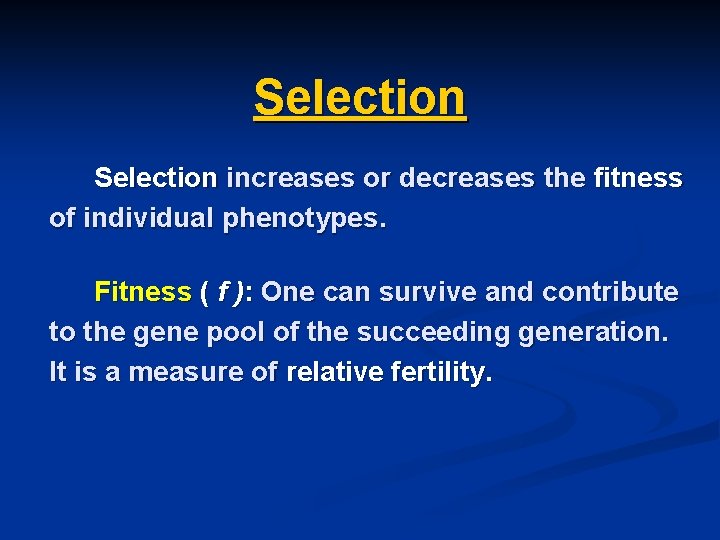
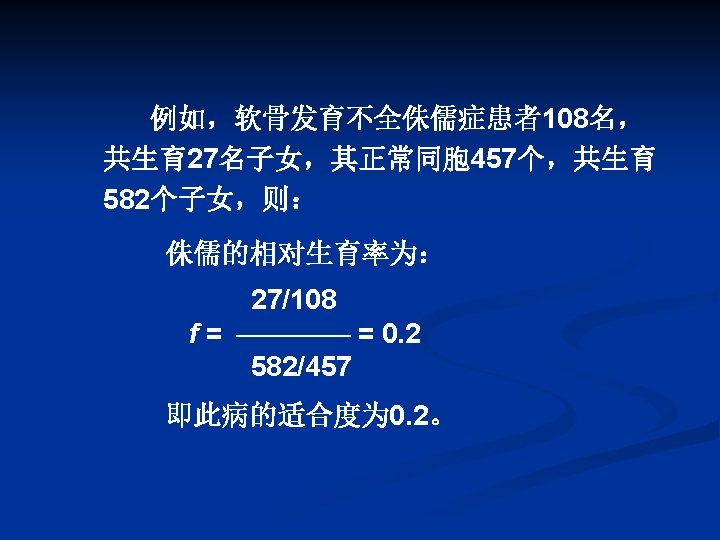
Selection increases or decreases the fitness of individual phenotypes. Fitness ( f ): One can survive and contribute to the gene pool of the succeeding generation. It is a measure of relative fertility.
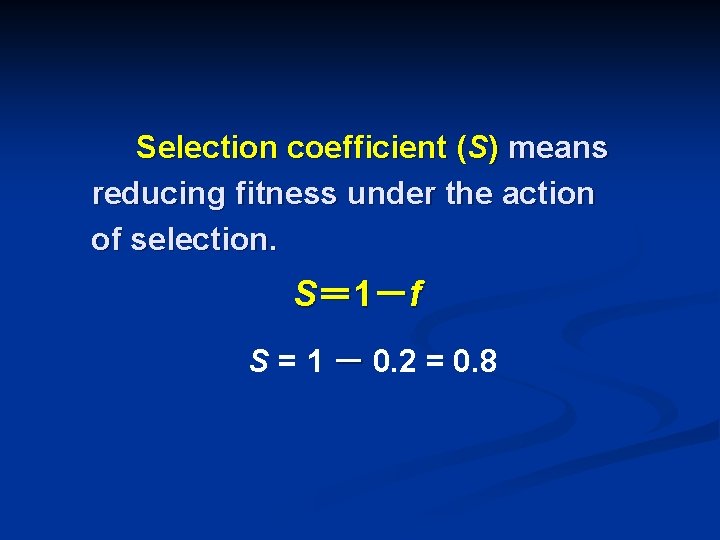
Selection coefficient (S) means reducing fitness under the action of selection. S= 1-f S = 1 - 0. 2 = 0. 8
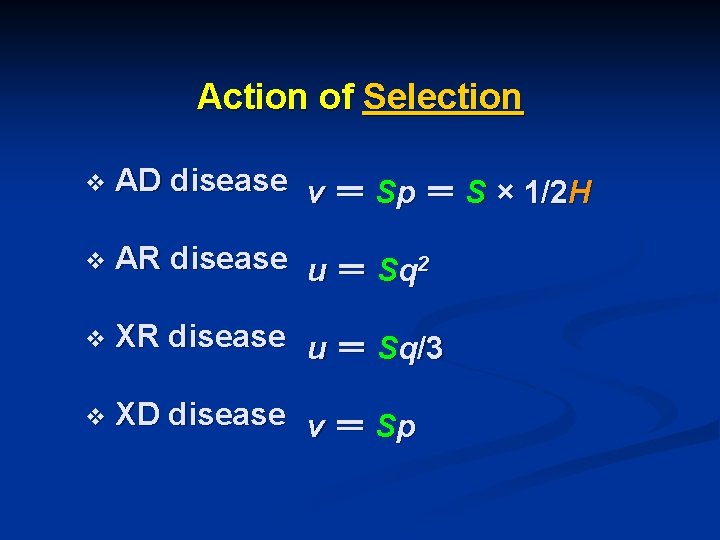
Action of Selection v AD disease v = Sp = S × 1/2 H v AR disease u = Sq 2 v XR disease u = Sq/3 v XD disease v = Sp
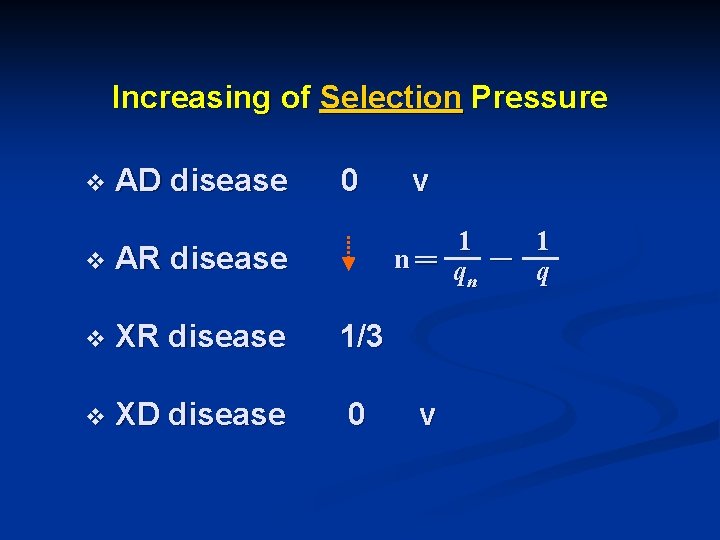
Increasing of Selection Pressure v AD disease 0 v 1 1 n= q - q n v AR disease v XR disease 1/3 v XD disease 0 v
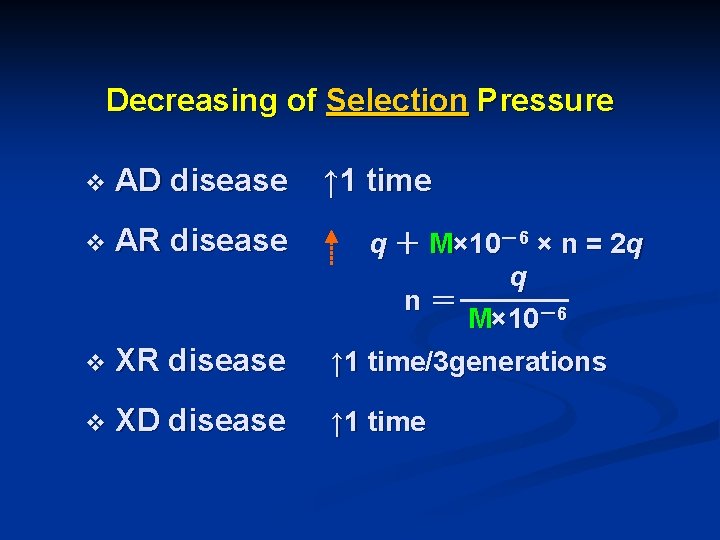
Decreasing of Selection Pressure v AD disease ↑ 1 time v AR disease v XR disease q + M× 10-6 × n = 2 q q n= M× 10-6 ↑ 1 time/3 generations v XD disease ↑ 1 time
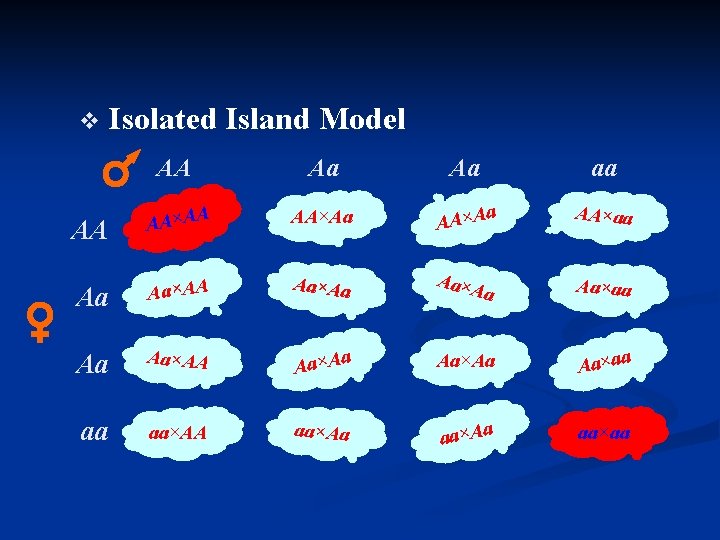
v Isolated Island Model AA Aa Aa aa AA A AA×Aa AA×A Aa Aa×AA Aa×Aa Aa Aa×AA aa aa×AA a AA×aa Aa×A a Aa×aa Aa×Aa Aa×aa aa×Aa aa×aa
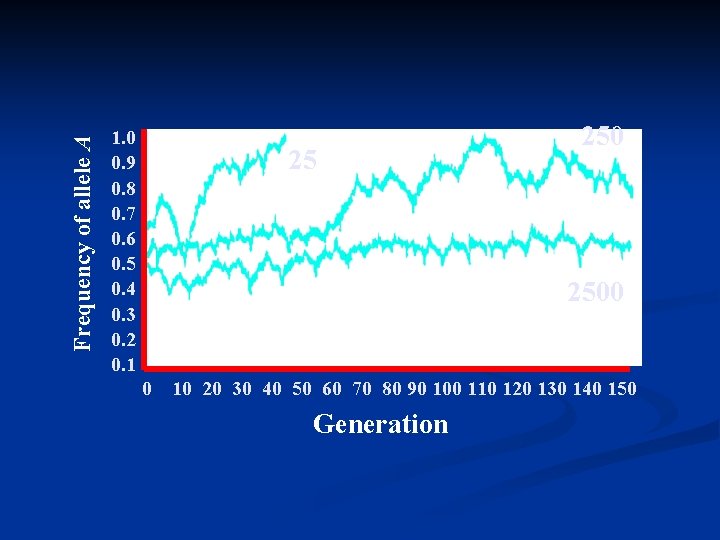
Frequency of allele A 1. 0 0. 9 0. 8 0. 7 0. 6 0. 5 0. 4 0. 3 0. 2 0. 1 25 2500 0 10 20 30 40 50 60 70 80 90 100 110 120 130 140 150 Generation
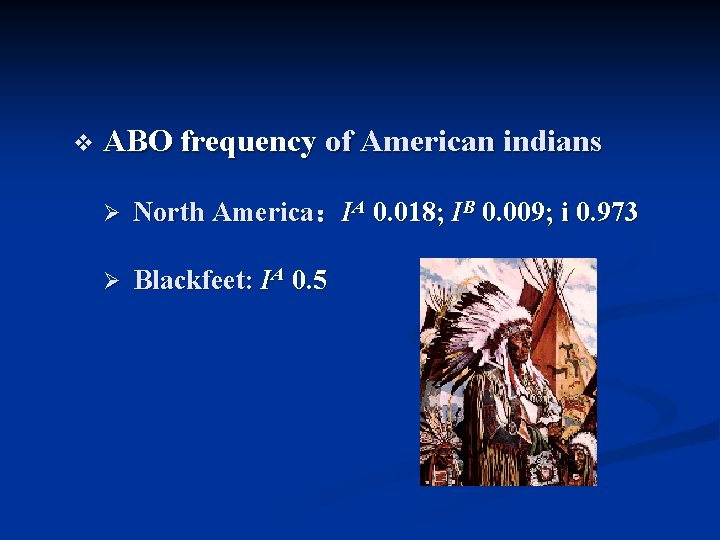
v ABO frequency of American indians Ø North America:IA 0. 018; IB 0. 009; i 0. 973 Ø Blackfeet: IA 0. 5
Founder effect A high frequency of a mutant gene in a population founded by a small ancestral group.
Migration v Migration pressure Ø The difference of allele frequency between two populations Ø Number of immigrators (gene)
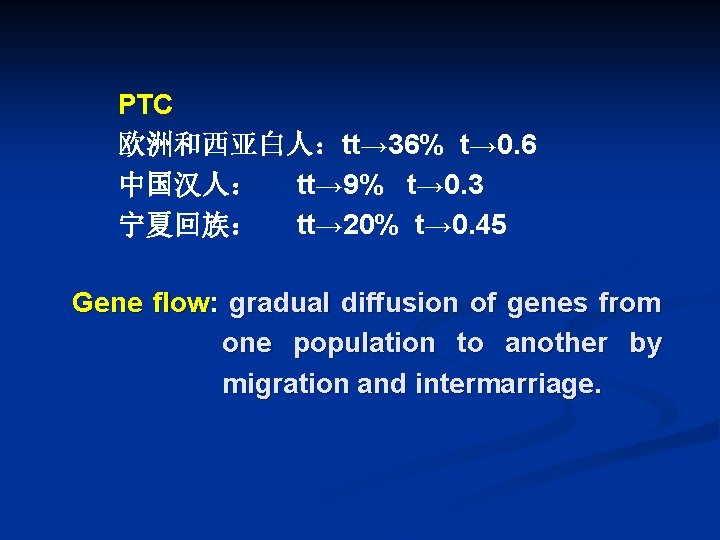
PTC 欧洲和西亚白人:tt→ 36% t→ 0. 6 中国汉人: tt→ 9% t→ 0. 3 宁夏回族: tt→ 20% t→ 0. 45 Gene flow: gradual diffusion of genes from one population to another by migration and intermarriage.
Factors that Alter Genetic Equilibrium v Mutation v Selection v Genetic Drift v Migration Consanguineous Marriage v
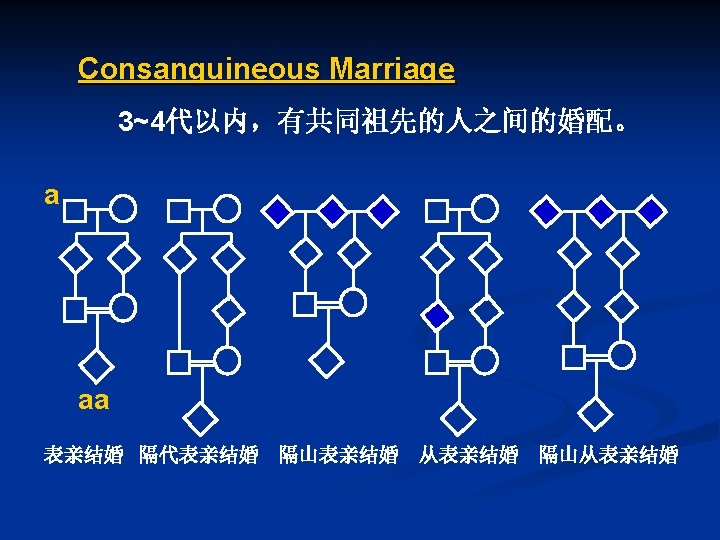
Inbreeding coefficient (F) The probability that an individual has a pair of alleles that are identical by descent from a common ancestor 是研究并推算由近亲婚配的两个个体经婚 后生育将从共同祖先得到的同一基因传递给 他们子女的概率。也就是说近亲婚配其子女 获得某一等位基因纯合子的概率。
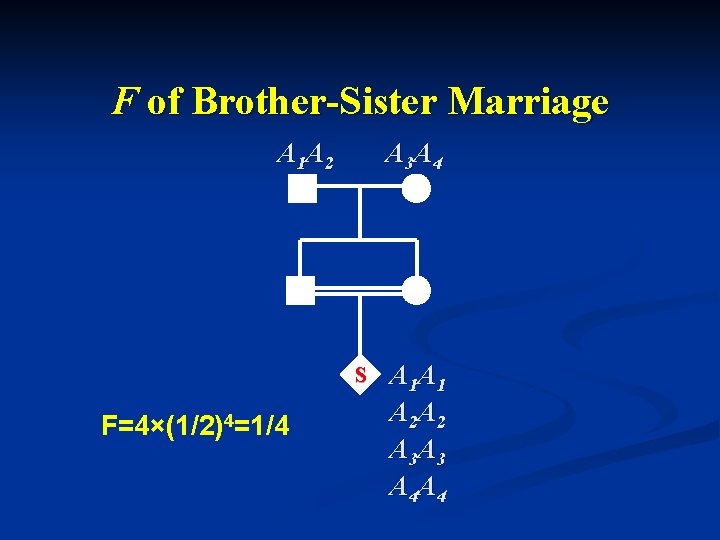
F of Brother-Sister Marriage A 1 A 2 A 3 A 4 S F=4×(1/2)4=1/4 A 1 A 1 A 2 A 2 A 3 A 3 A 4 A 4
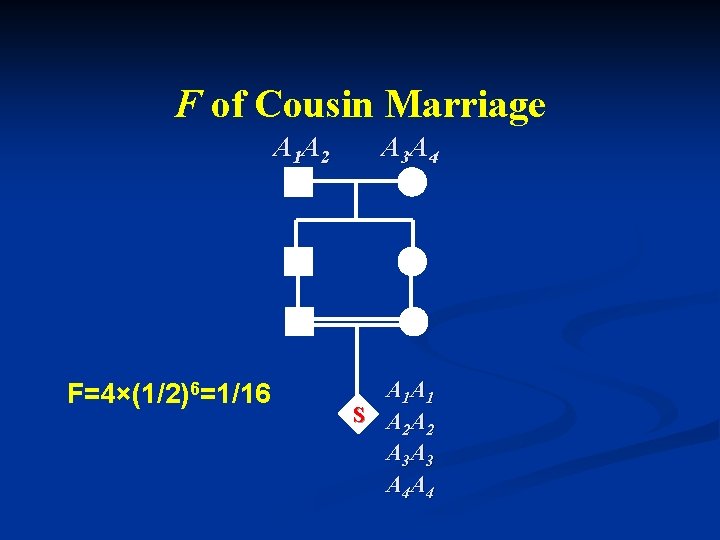
F of Cousin Marriage A 1 A 2 F=4×(1/2)6=1/16 A 3 A 4 A 1 A 1 S AA 2 2 A 3 A 3 A 4 A 4
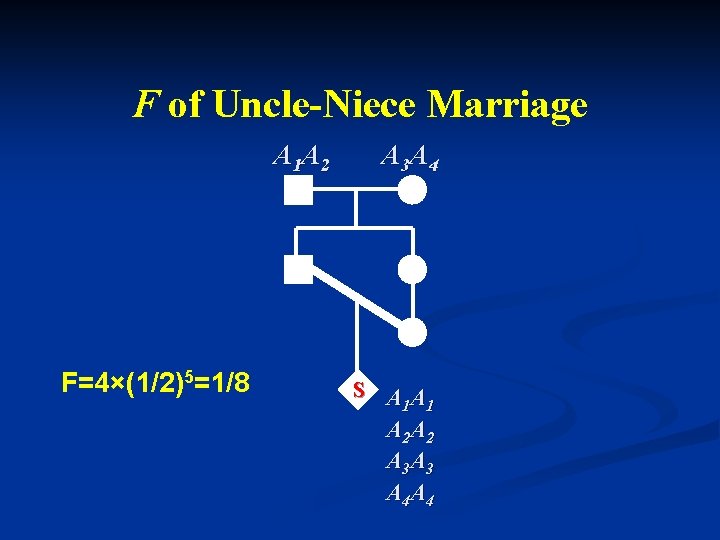
F of Uncle-Niece Marriage A 1 A 2 F=4×(1/2)5=1/8 A 3 A 4 S AA 1 1 A 2 A 2 A 3 A 3 A 4 A 4
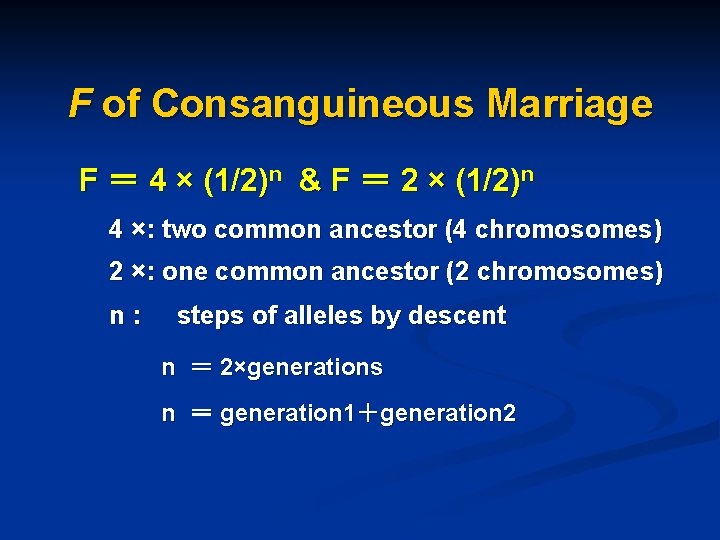
F of Consanguineous Marriage F = 4 × (1/2)n & F = 2 × (1/2)n 4 ×: two common ancestor (4 chromosomes) 2 ×: one common ancestor (2 chromosomes) n: steps of alleles by descent n = 2×generations n = generation 1+generation 2
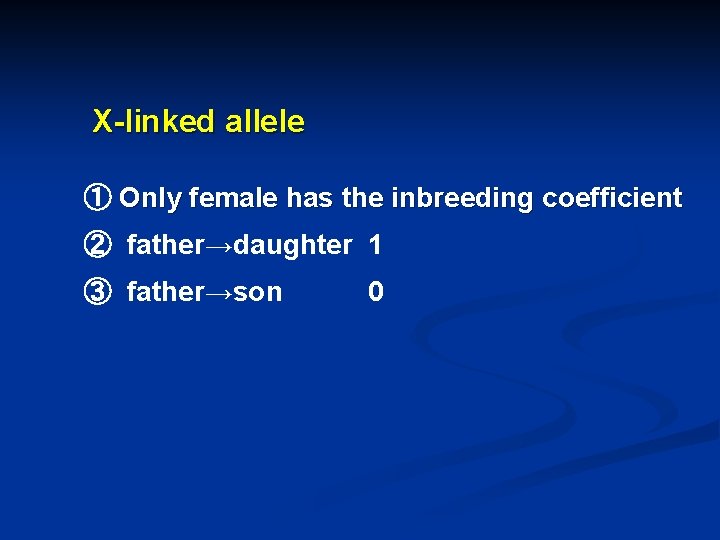
X-linked allele ① Only female has the inbreeding coefficient ② father→daughter 1 ③ father→son 0
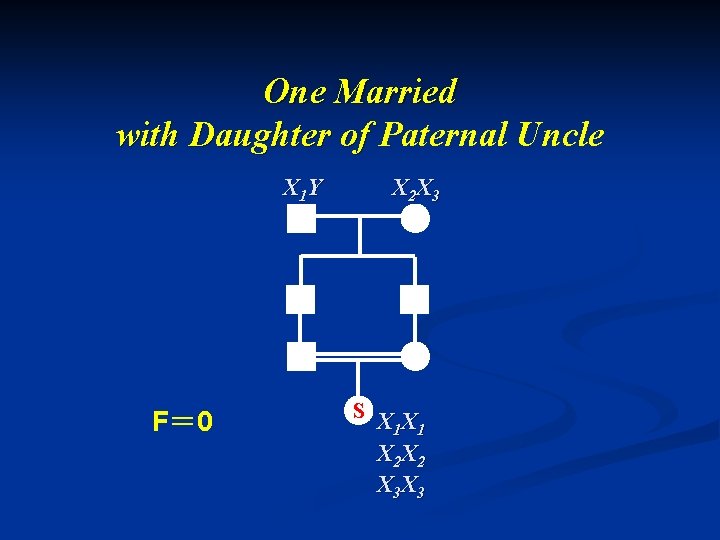
One Married with Daughter of Paternal Uncle X 1 Y F= 0 X 2 X 3 S XX 1 1 X 2 X 2 X 3 X 3
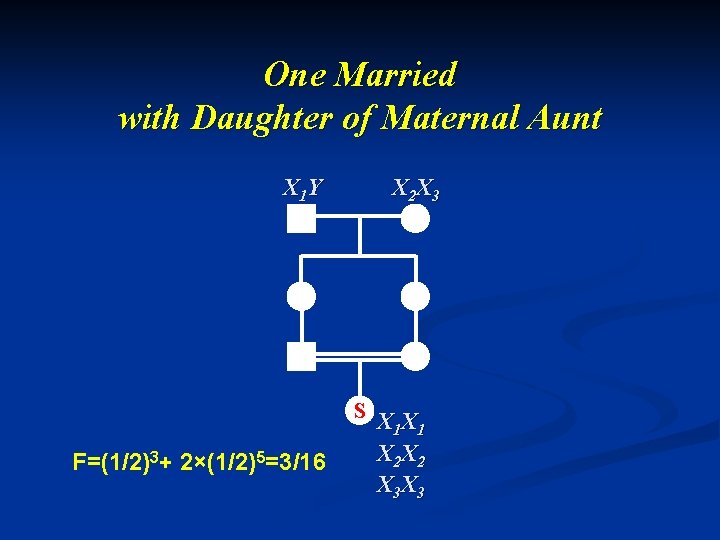
One Married with Daughter of Maternal Aunt X 1 Y X 2 X 3 S XX 1 1 F=(1/2)3+ 2×(1/2)5=3/16 X 2 X 2 X 3 X 3
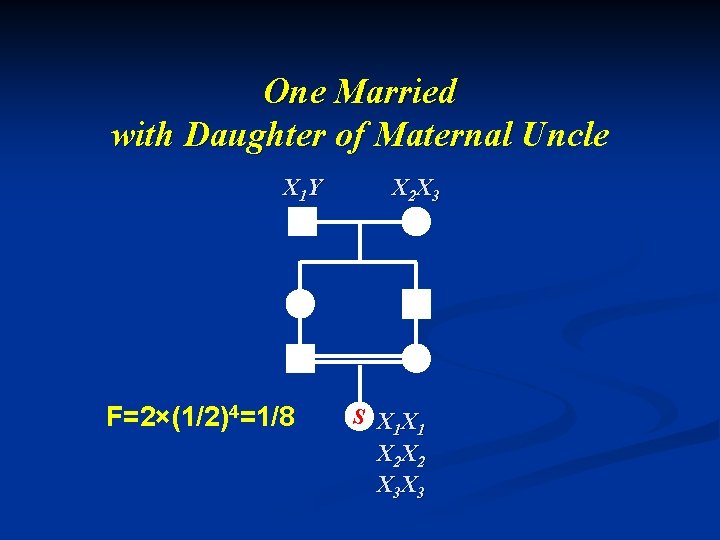
One Married with Daughter of Maternal Uncle X 1 Y F=2×(1/2)4=1/8 X 2 X 3 S X 1 X 1 X 2 X 2 X 3 X 3
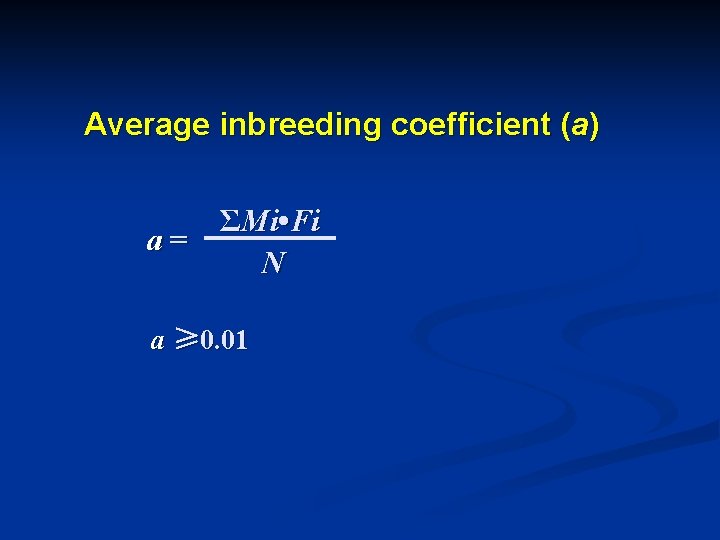
Average inbreeding coefficient (a) ΣMi • Fi a= N a ≥ 0. 01
Genetic Load v Mutation load v Segregation load