
Chapter 8 Photosynthesis 1 Photosynthesis is the process




- Slides: 61
Chapter 8 Photosynthesis
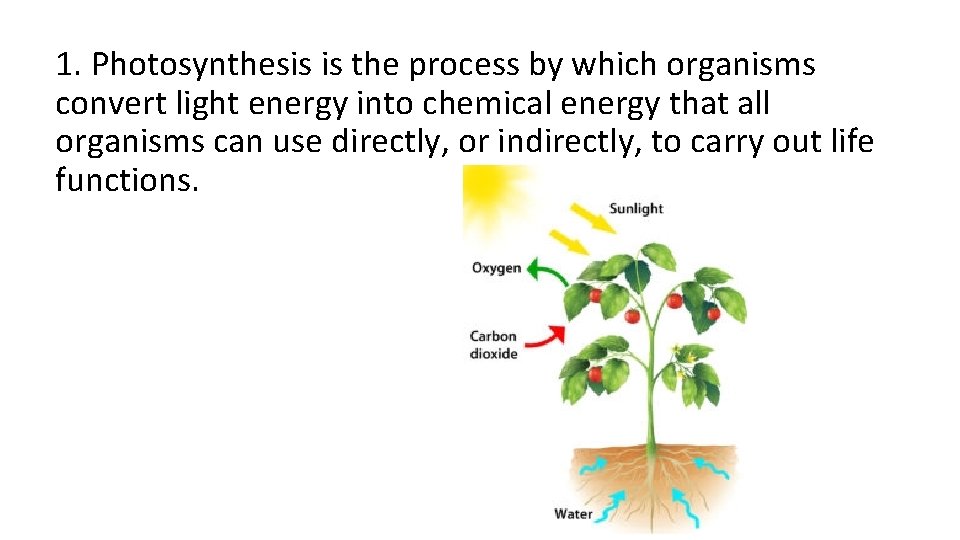
1. Photosynthesis is the process by which organisms convert light energy into chemical energy that all organisms can use directly, or indirectly, to carry out life functions.
8. 1 Energy and Life 2. adenosine triphosphate (ATP) (226) one of the most important compounds that cells use to store and release energy.
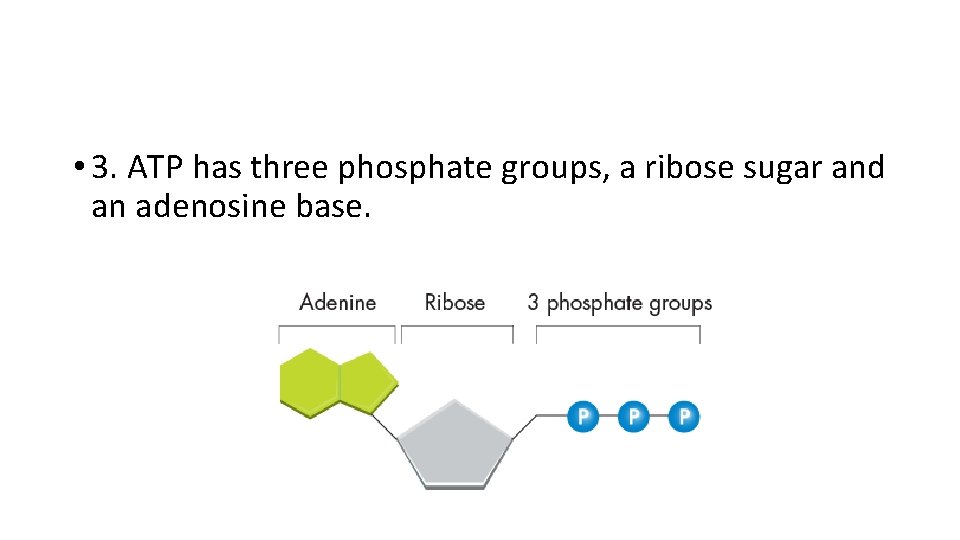
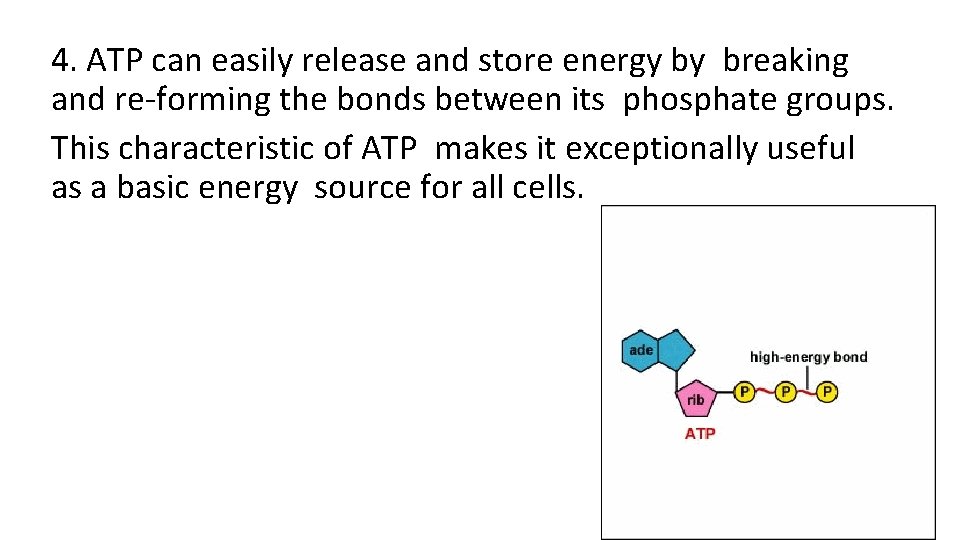
• 3. ATP has three phosphate groups, a ribose sugar and an adenosine base.
4. ATP can easily release and store energy by breaking and re-forming the bonds between its phosphate groups. This characteristic of ATP makes it exceptionally useful as a basic energy source for all cells.
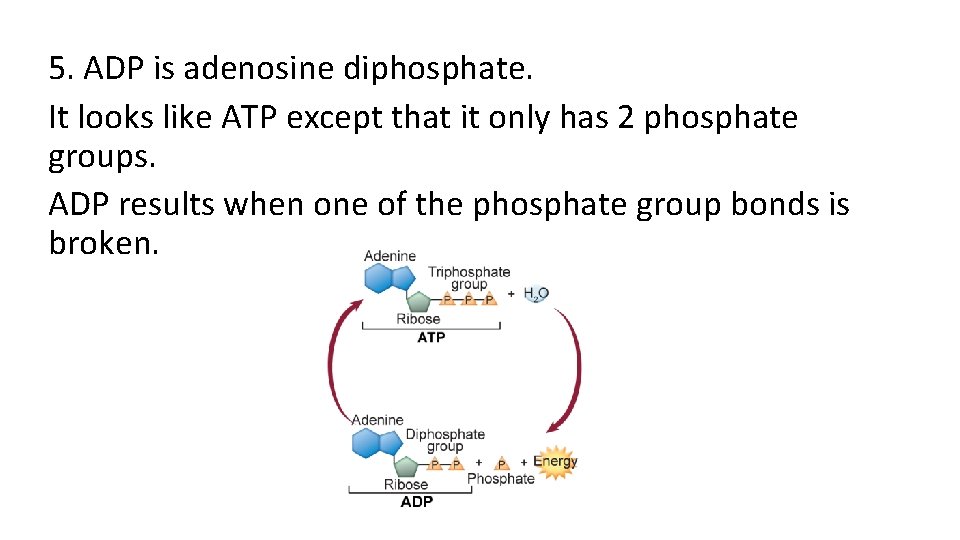
5. ADP is adenosine diphosphate. It looks like ATP except that it only has 2 phosphate groups. ADP results when one of the phosphate group bonds is broken.
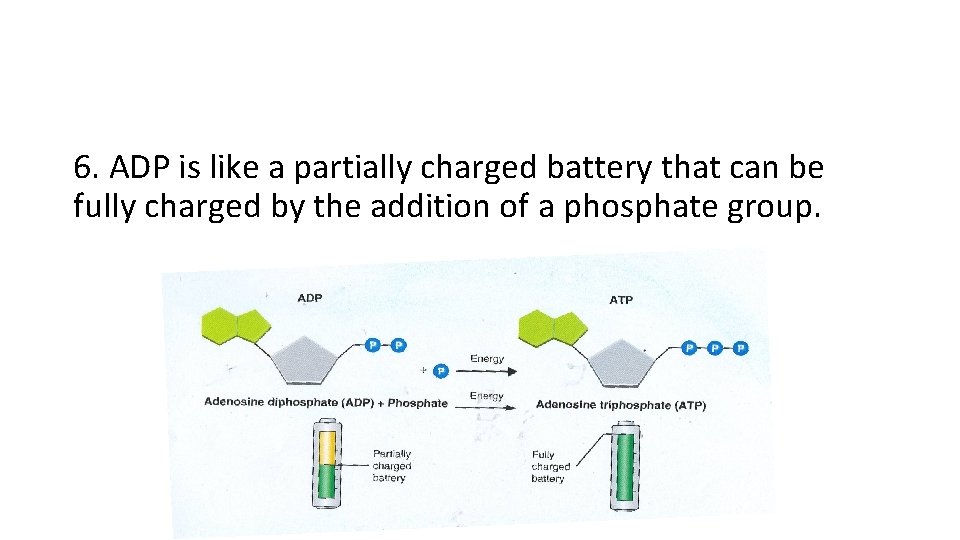
6. ADP is like a partially charged battery that can be fully charged by the addition of a phosphate group.
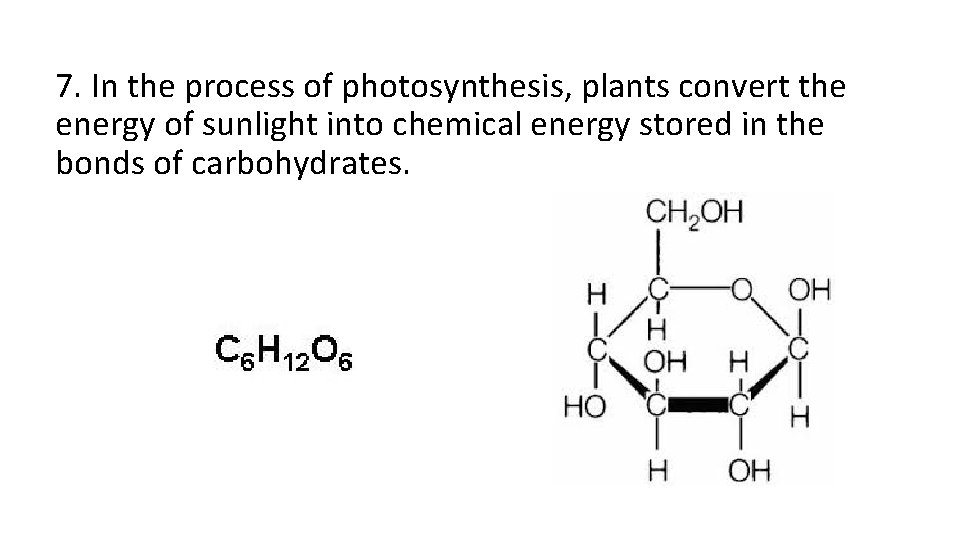
7. In the process of photosynthesis, plants convert the energy of sunlight into chemical energy stored in the bonds of carbohydrates.
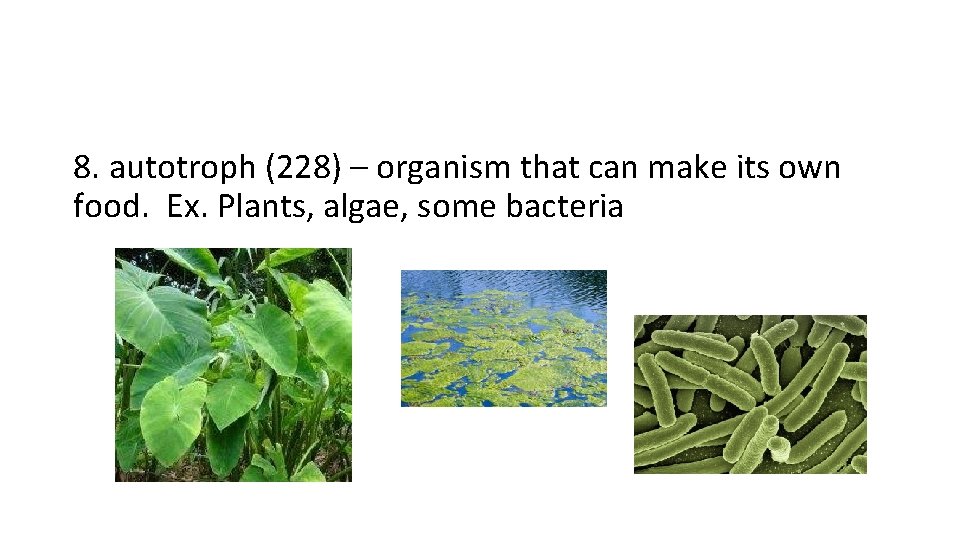
8. autotroph (228) – organism that can make its own food. Ex. Plants, algae, some bacteria
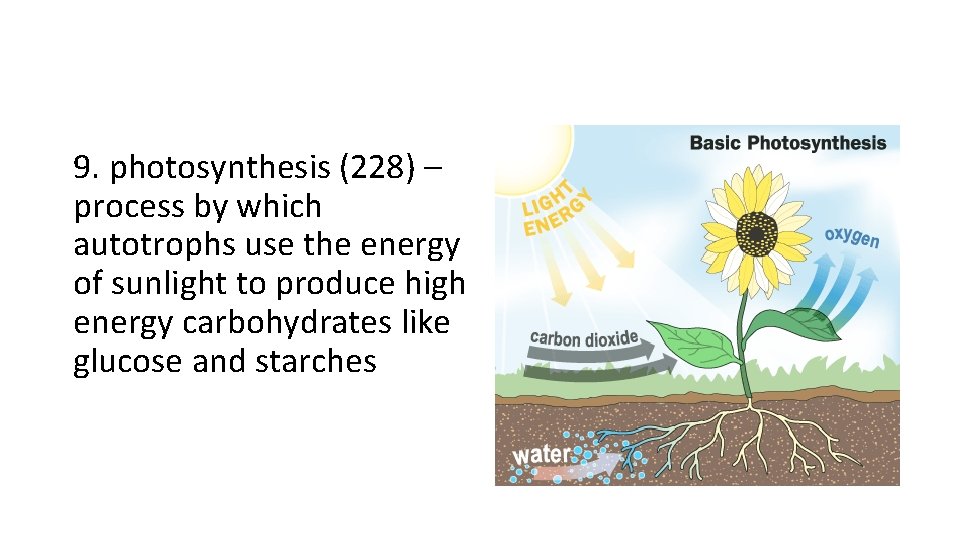
9. photosynthesis (228) – process by which autotrophs use the energy of sunlight to produce high energy carbohydrates like glucose and starches
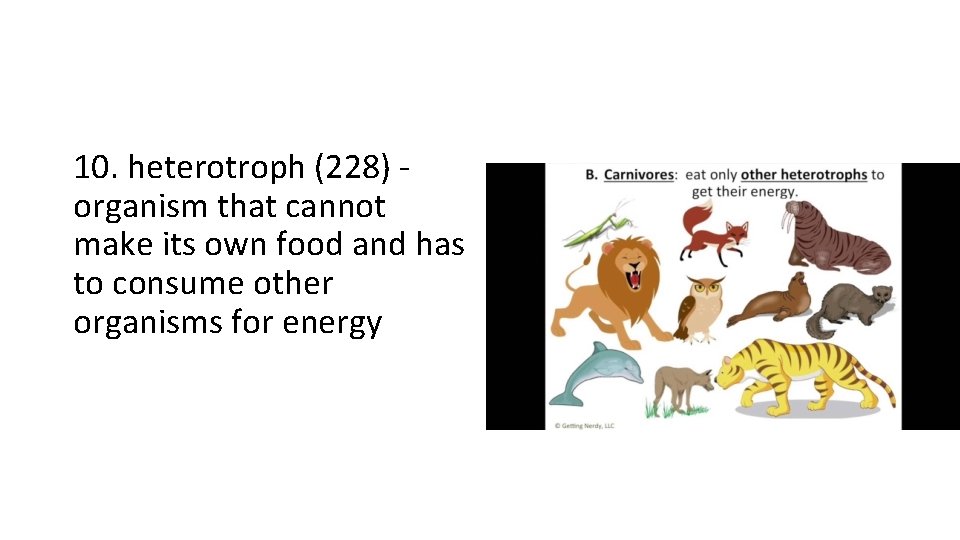
10. heterotroph (228) organism that cannot make its own food and has to consume other organisms for energy
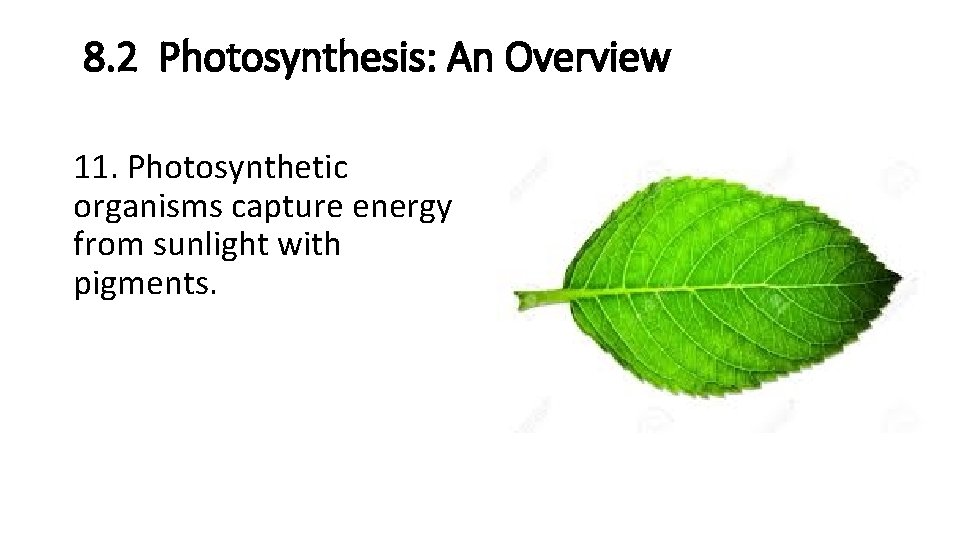
8. 2 Photosynthesis: An Overview 11. Photosynthetic organisms capture energy from sunlight with pigments.
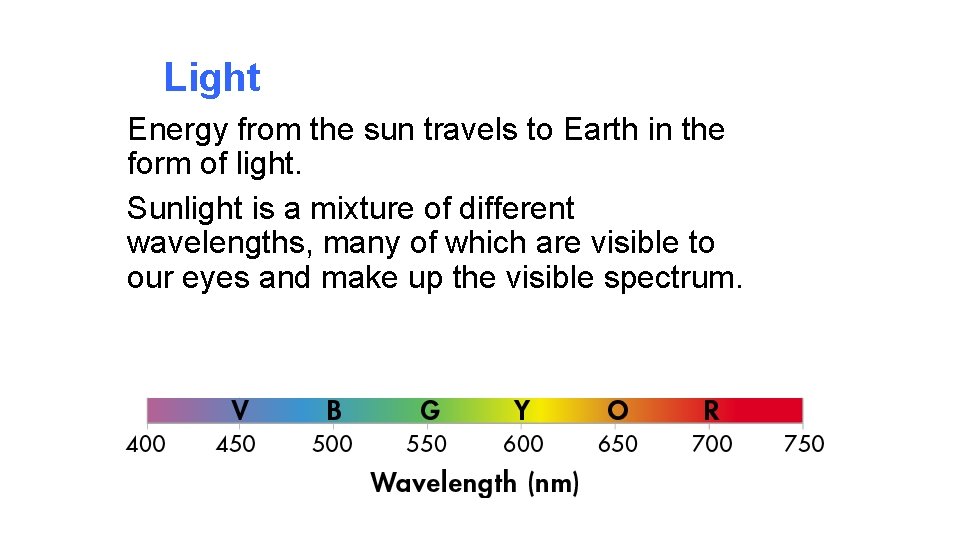
Light Energy from the sun travels to Earth in the form of light. Sunlight is a mixture of different wavelengths, many of which are visible to our eyes and make up the visible spectrum.
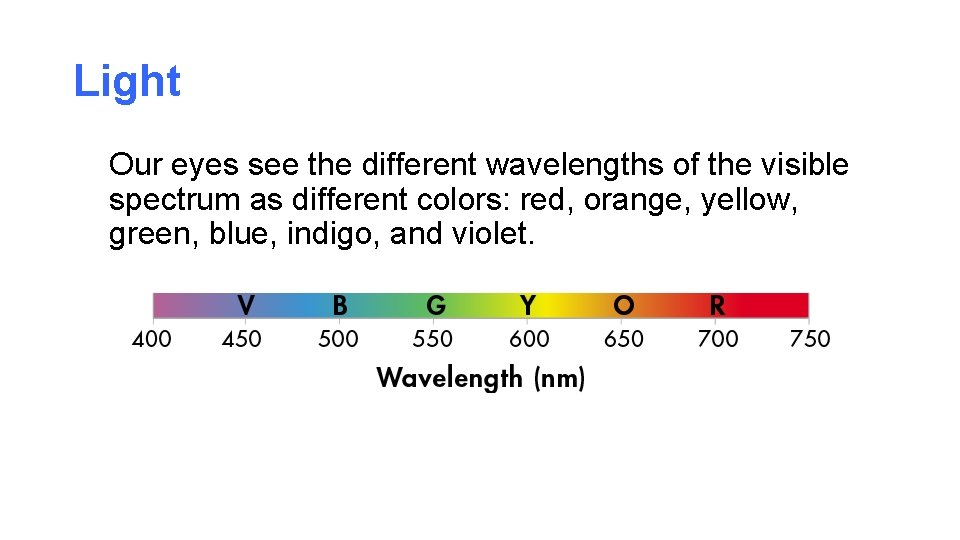
Light Our eyes see the different wavelengths of the visible spectrum as different colors: red, orange, yellow, green, blue, indigo, and violet.
Pigments Plants gather the sun’s energy with light-absorbing molecules called pigments. 12. pigment (230) – light absorbing molecules; found in plants
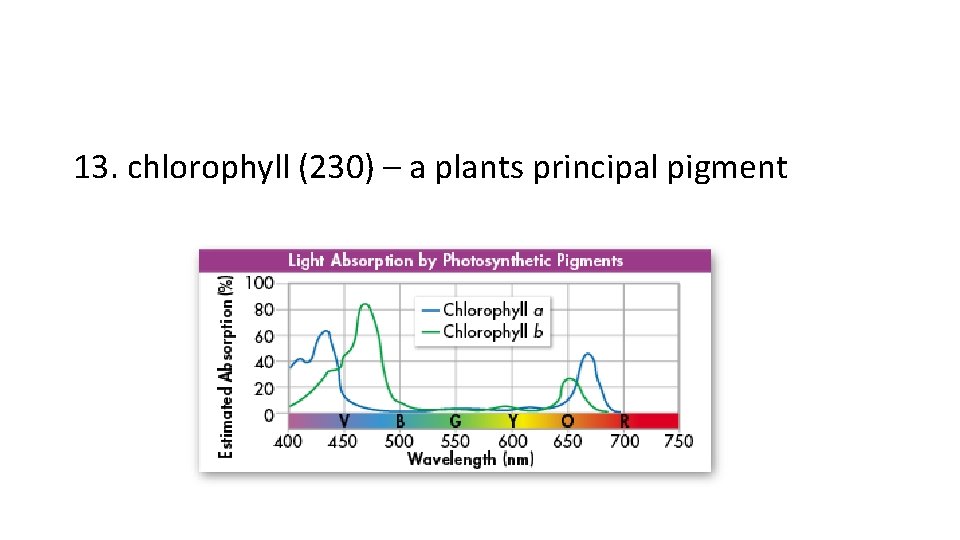
13. chlorophyll (230) – a plants principal pigment
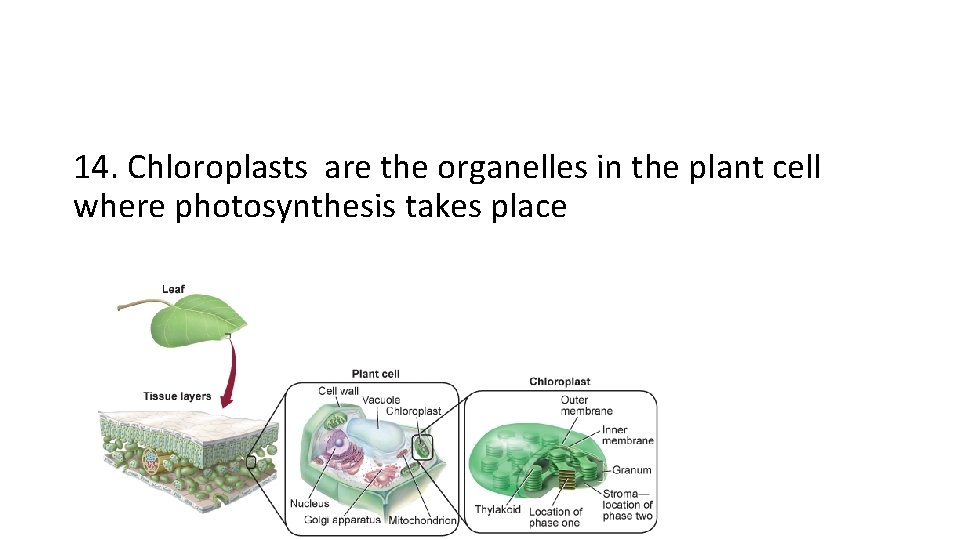
14. Chloroplasts are the organelles in the plant cell where photosynthesis takes place
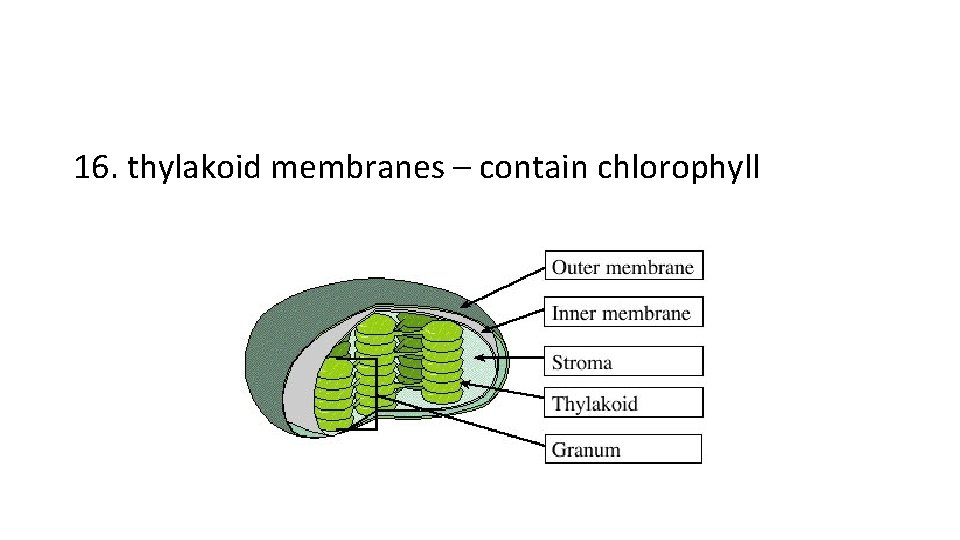
15. thylakoid (231)- sac like membranes in the chloroplast contain chlorophyll and are the exact location where photosynthesis occurs
16. thylakoid membranes – contain chlorophyll
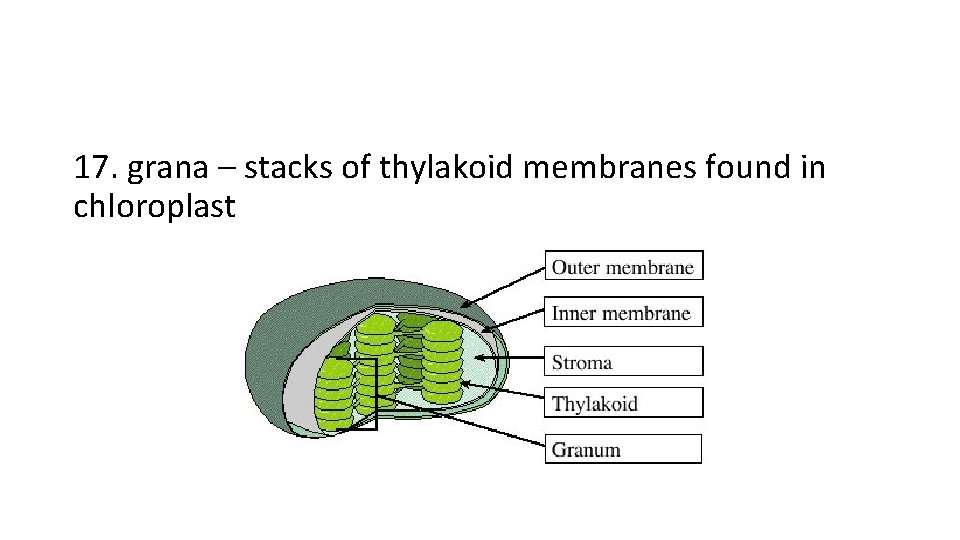
17. grana – stacks of thylakoid membranes found in chloroplast
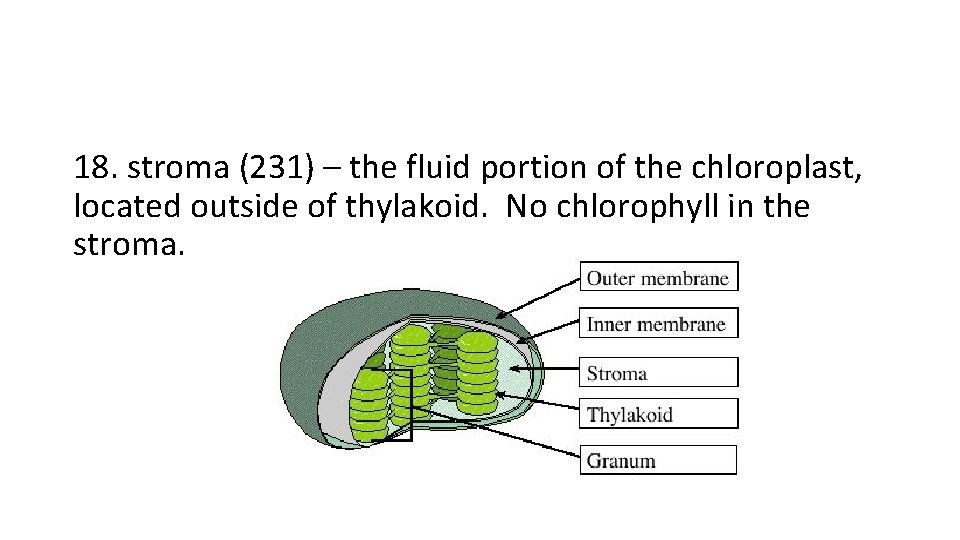
18. stroma (231) – the fluid portion of the chloroplast, located outside of thylakoid. No chlorophyll in the stroma.
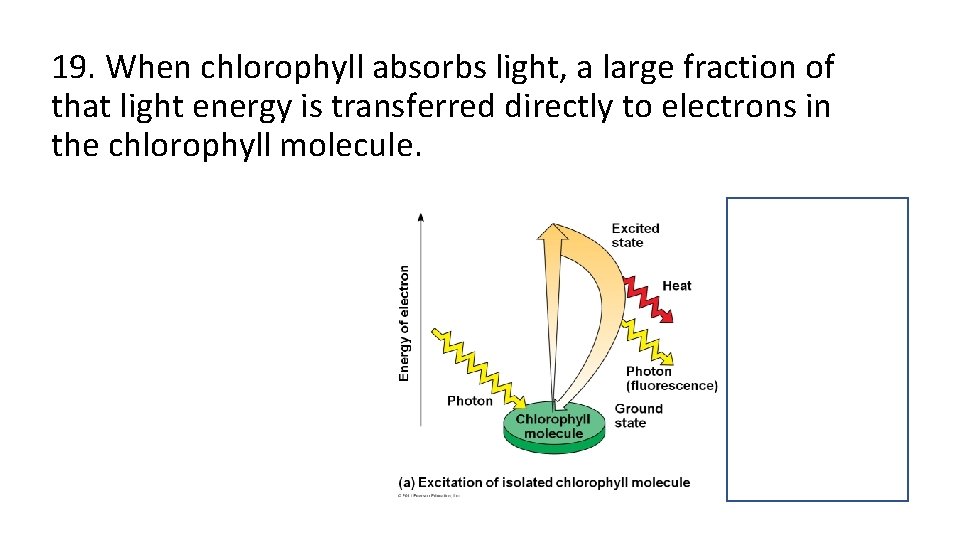
19. When chlorophyll absorbs light, a large fraction of that light energy is transferred directly to electrons in the chlorophyll molecule.
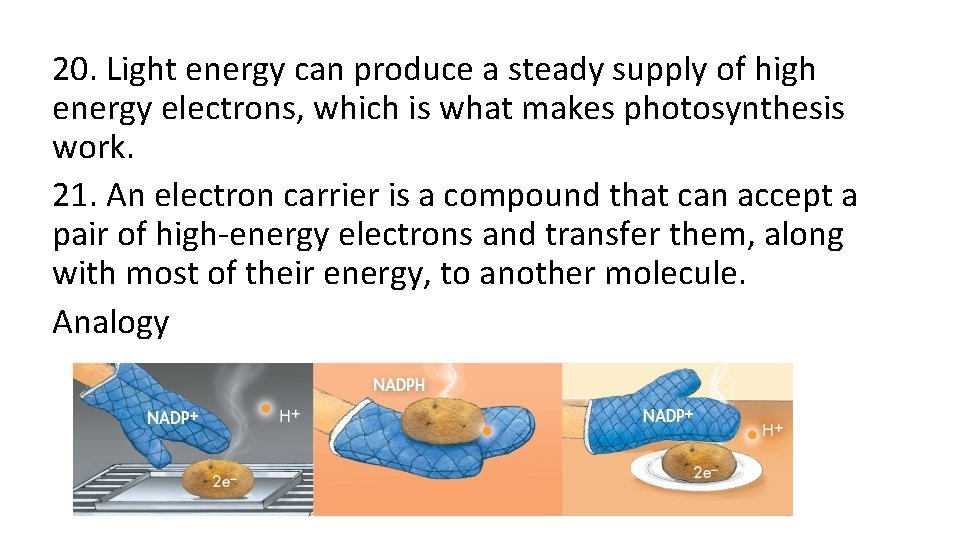
20. Light energy can produce a steady supply of high energy electrons, which is what makes photosynthesis work. 21. An electron carrier is a compound that can accept a pair of high-energy electrons and transfer them, along with most of their energy, to another molecule. Analogy
22. NADP+ (232) - is one of the electron carrier molecules. Its job is to accept and hold 2 high energy electrons along with a hydrogen ion.
23. NADPH- is what NADP+ is converted to when it accepts the electrons and hydrogen ion. Energy is now trapped in the new chemical bond between the hydrogen ion and NADP+. This energy can be carried to other areas in cell until the bond is broken and energy released.
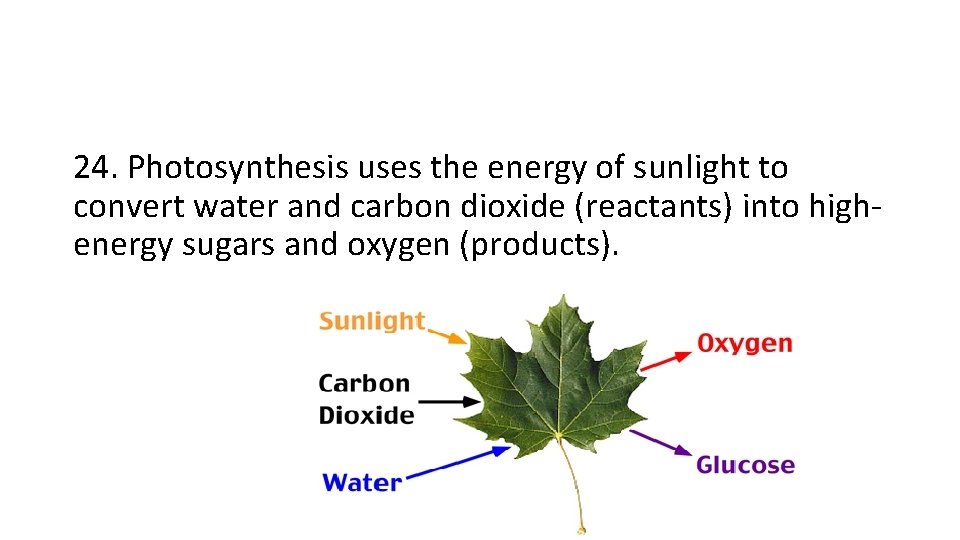
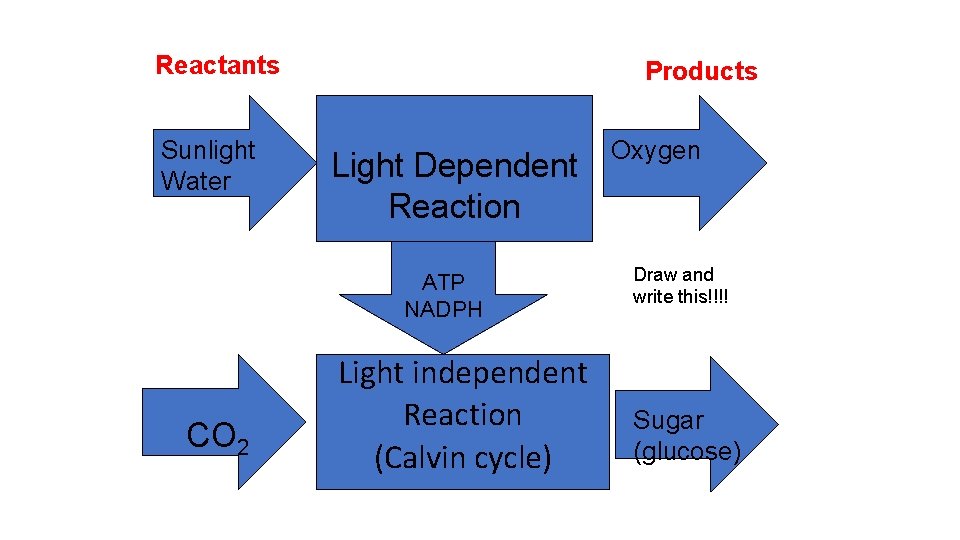
24. Photosynthesis uses the energy of sunlight to convert water and carbon dioxide (reactants) into highenergy sugars and oxygen (products).
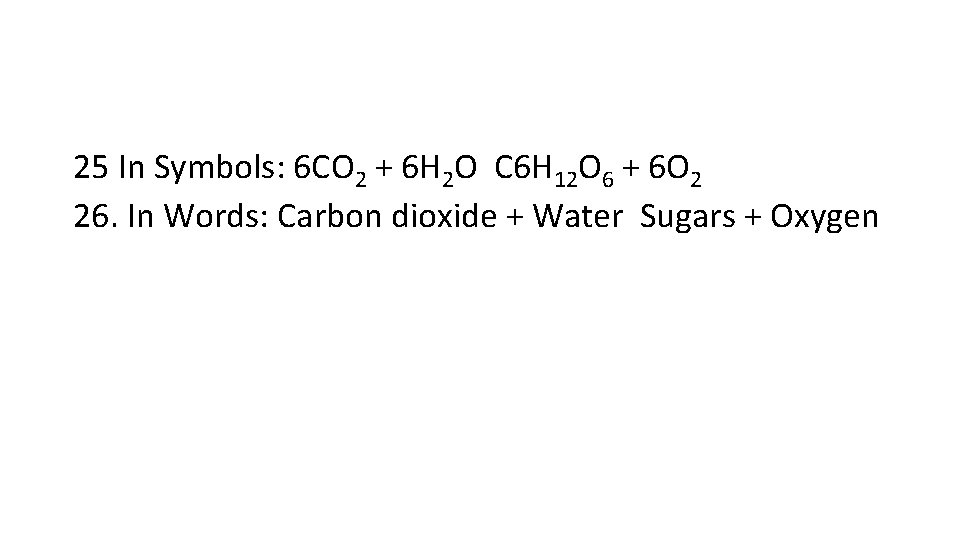
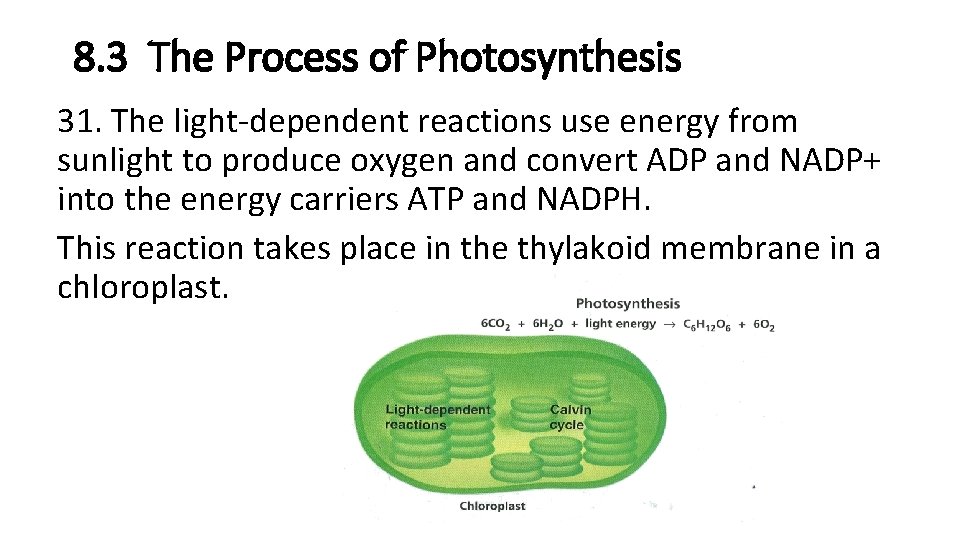
25 In Symbols: 6 CO 2 + 6 H 2 O C 6 H 12 O 6 + 6 O 2 26. In Words: Carbon dioxide + Water Sugars + Oxygen
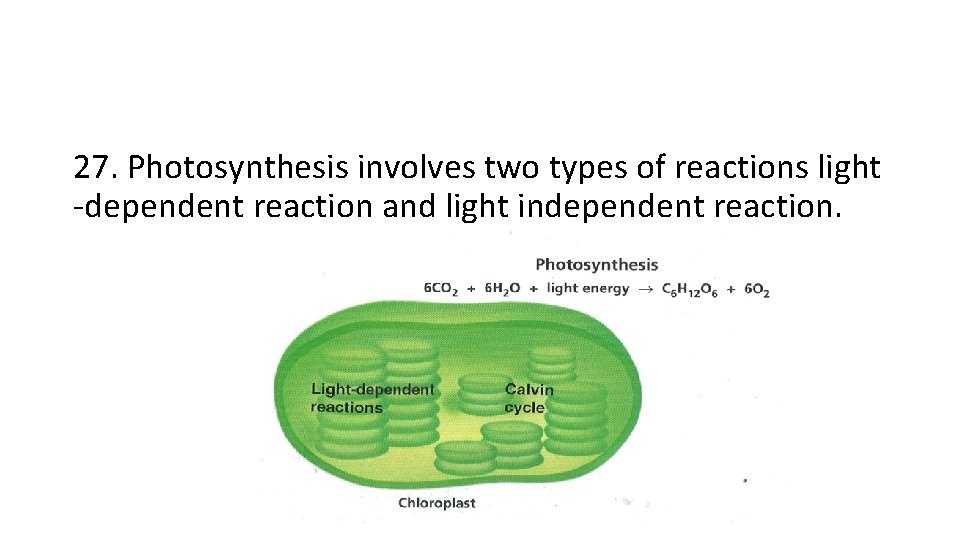
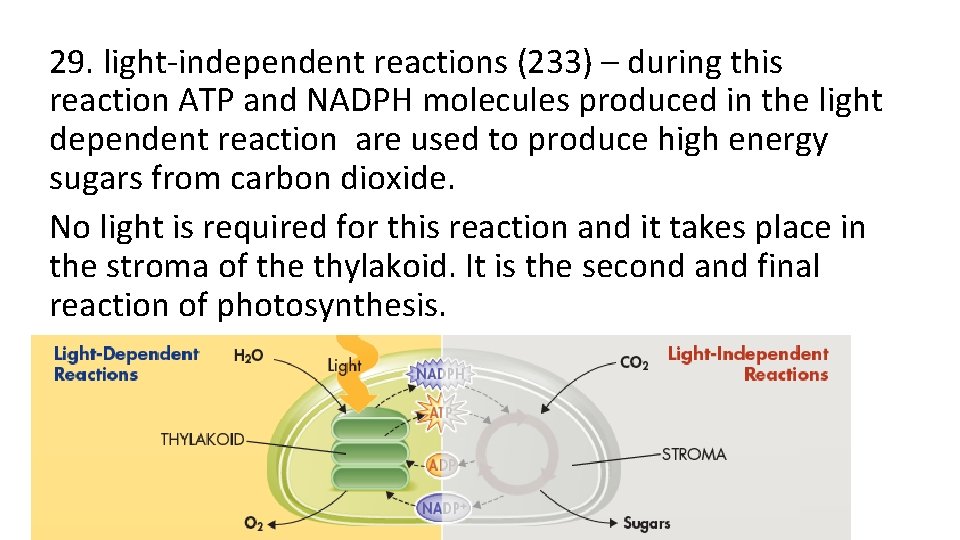
27. Photosynthesis involves two types of reactions light -dependent reaction and light independent reaction.
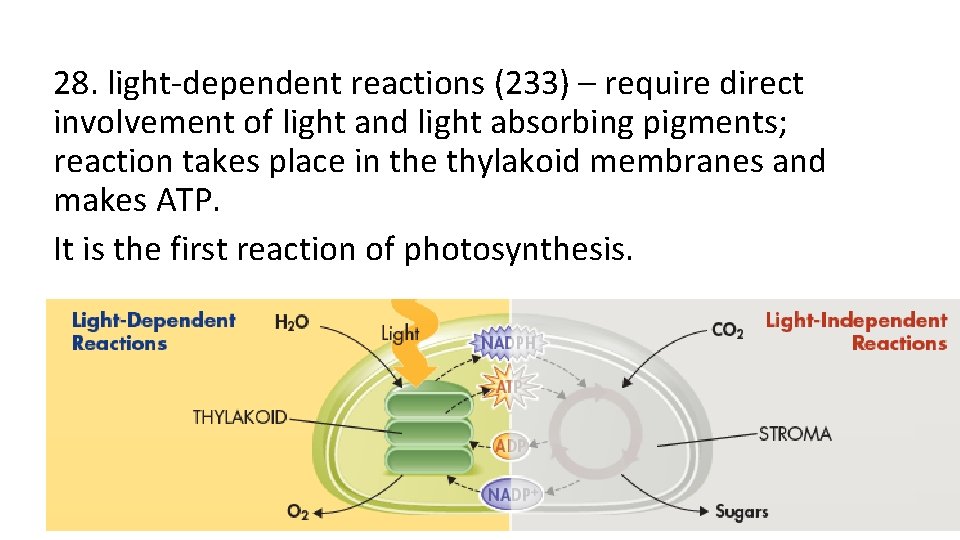
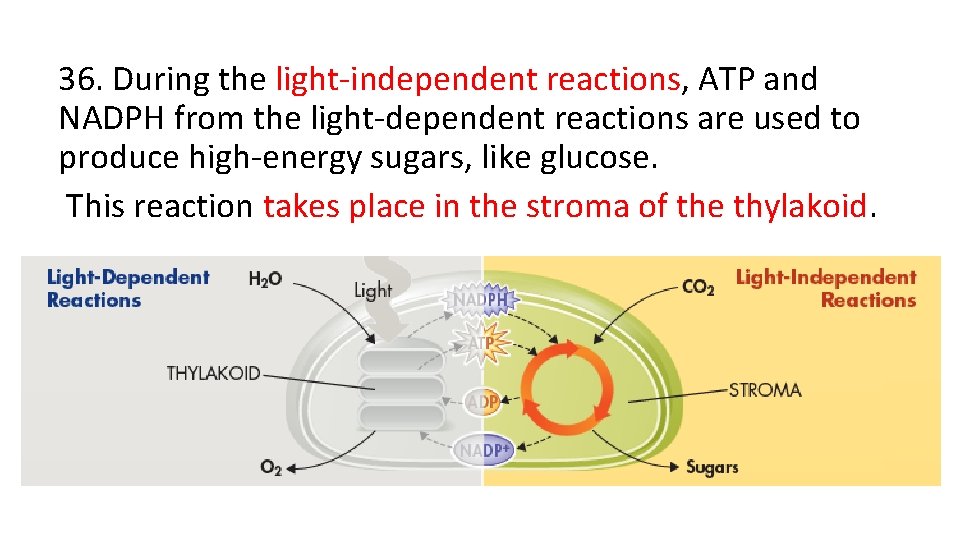
28. light-dependent reactions (233) – require direct involvement of light and light absorbing pigments; reaction takes place in the thylakoid membranes and makes ATP. It is the first reaction of photosynthesis.
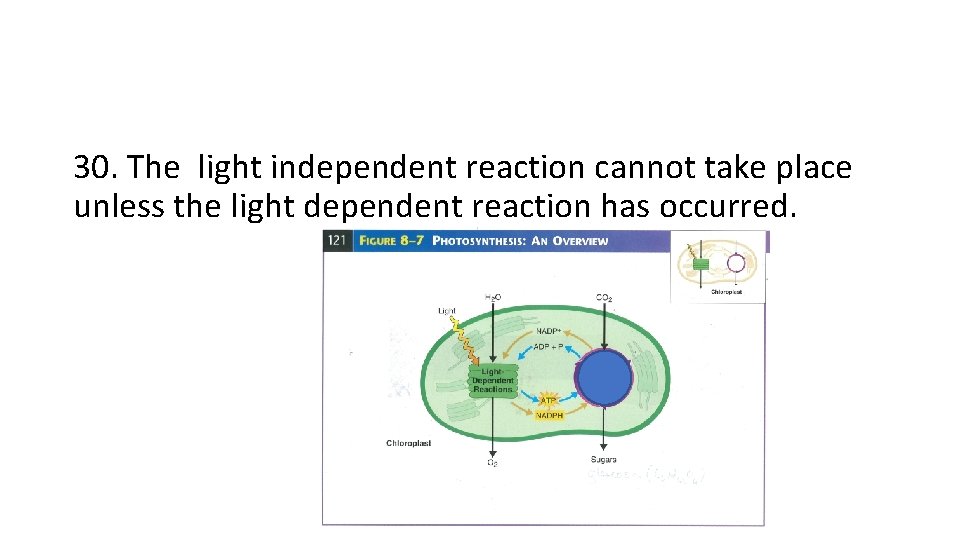
29. light-independent reactions (233) – during this reaction ATP and NADPH molecules produced in the light dependent reaction are used to produce high energy sugars from carbon dioxide. No light is required for this reaction and it takes place in the stroma of the thylakoid. It is the second and final reaction of photosynthesis.
30. The light independent reaction cannot take place unless the light dependent reaction has occurred.
Reactants Sunlight Water Products Light Dependent Reaction ATP NADPH CO 2 Light independent Reaction (Calvin cycle) Oxygen Draw and write this!!!! Sugar (glucose)
8. 3 The Process of Photosynthesis 31. The light-dependent reactions use energy from sunlight to produce oxygen and convert ADP and NADP+ into the energy carriers ATP and NADPH. This reaction takes place in the thylakoid membrane in a chloroplast.
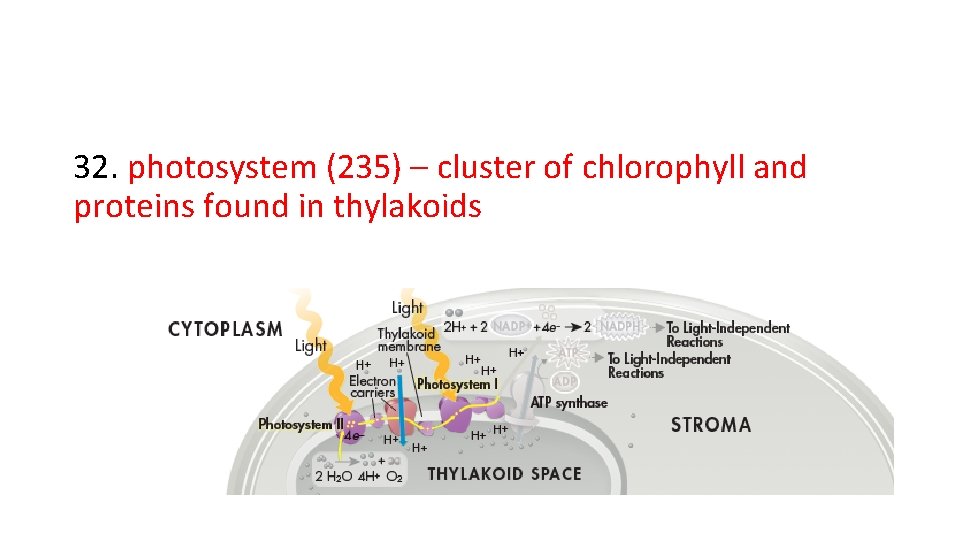
32. photosystem (235) – cluster of chlorophyll and proteins found in thylakoids
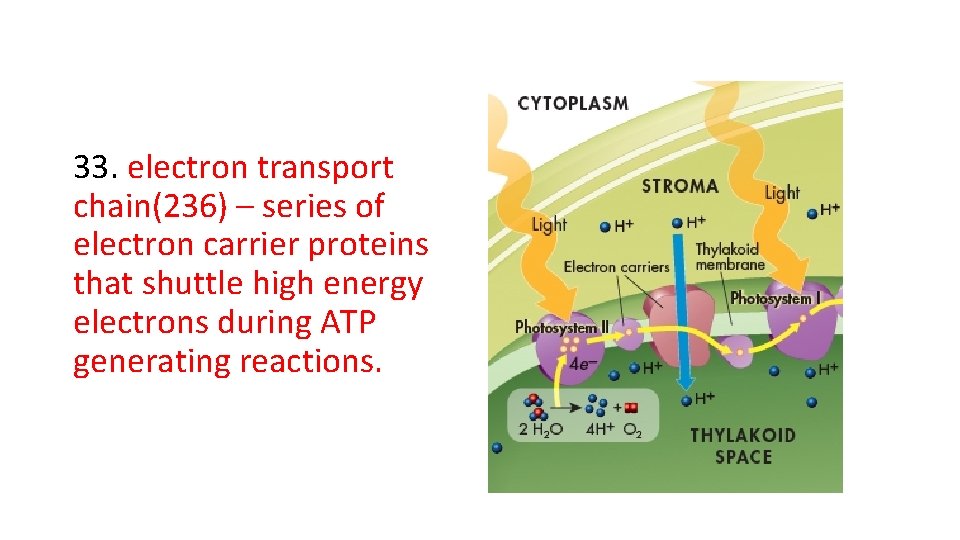
33. electron transport chain(236) – series of electron carrier proteins that shuttle high energy electrons during ATP generating reactions.
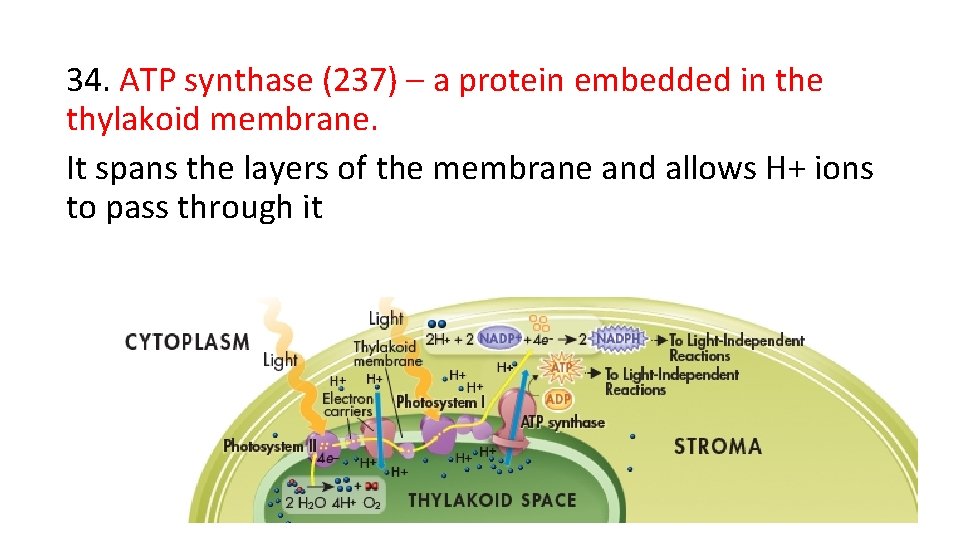
34. ATP synthase (237) – a protein embedded in the thylakoid membrane. It spans the layers of the membrane and allows H+ ions to pass through it
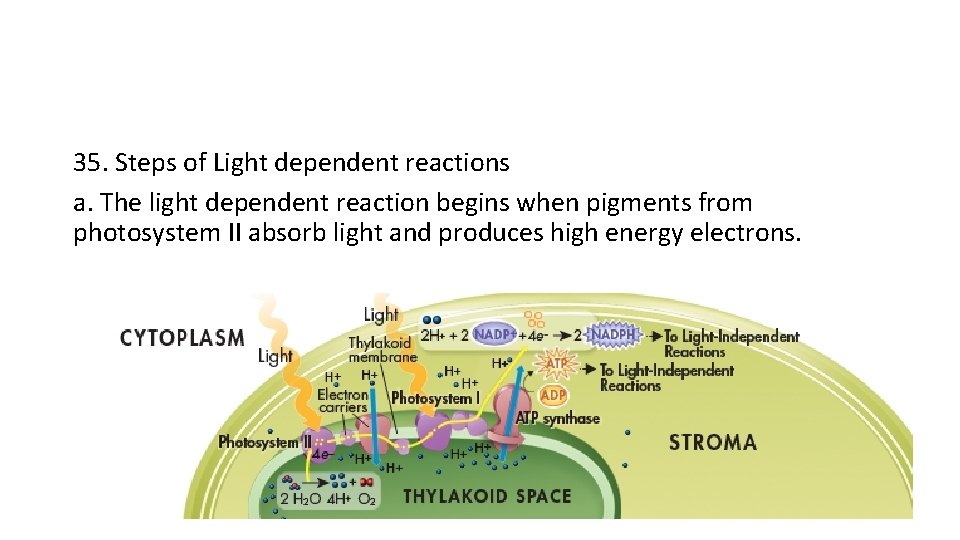
35. Steps of Light dependent reactions a. The light dependent reaction begins when pigments from photosystem II absorb light and produces high energy electrons.
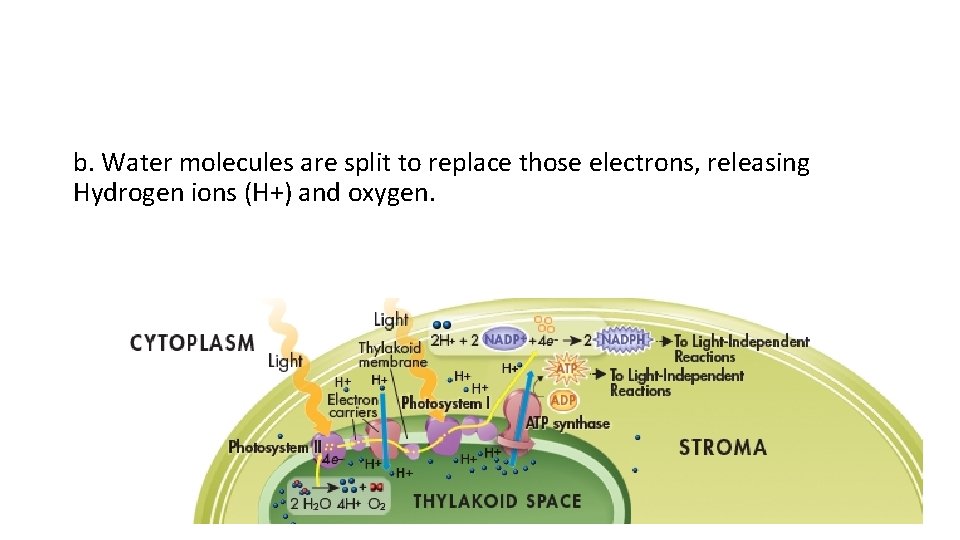
b. Water molecules are split to replace those electrons, releasing Hydrogen ions (H+) and oxygen.
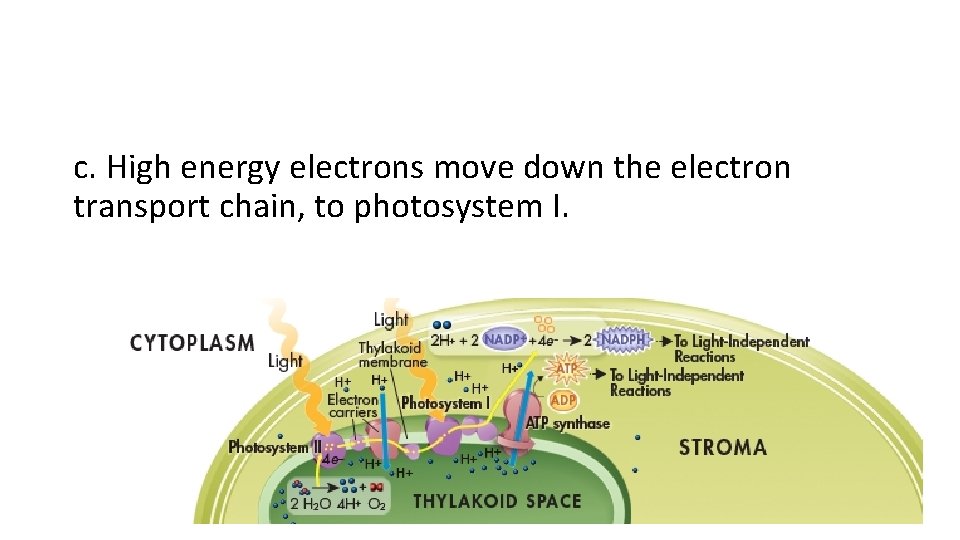
c. High energy electrons move down the electron transport chain, to photosystem I.
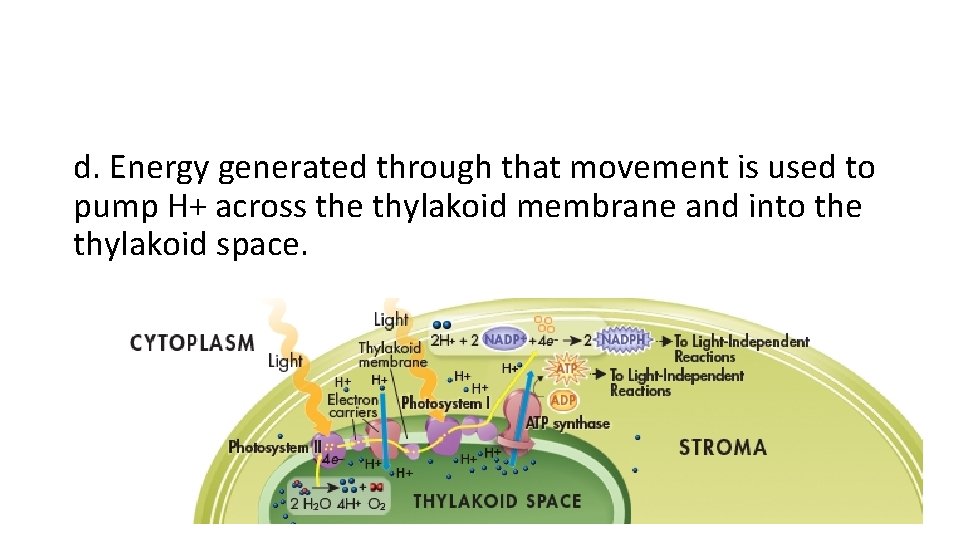
d. Energy generated through that movement is used to pump H+ across the thylakoid membrane and into the thylakoid space.
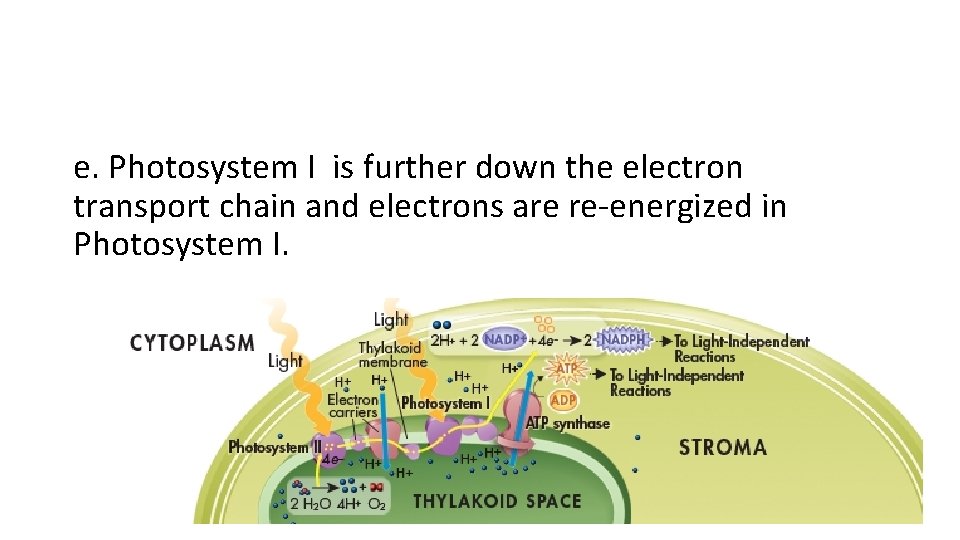
e. Photosystem I is further down the electron transport chain and electrons are re-energized in Photosystem I.
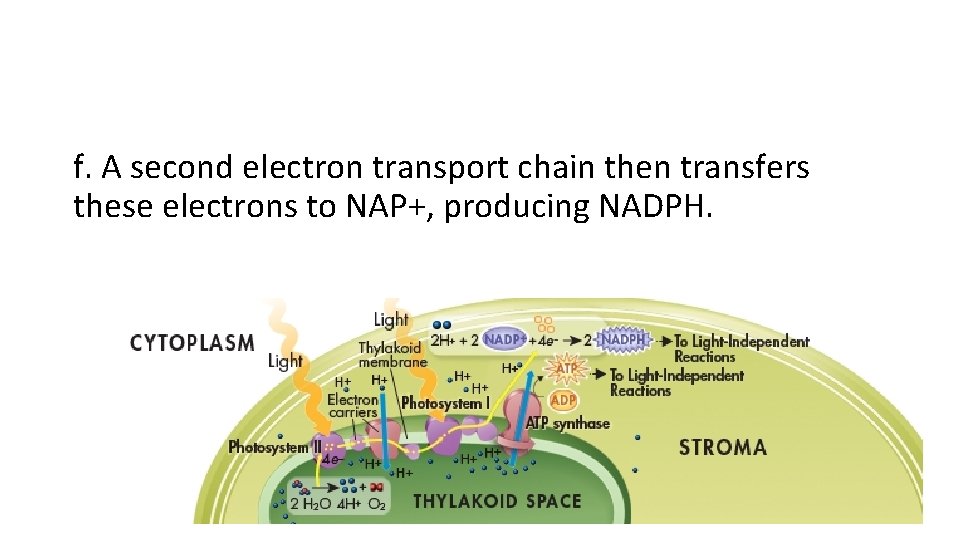
f. A second electron transport chain then transfers these electrons to NAP+, producing NADPH.
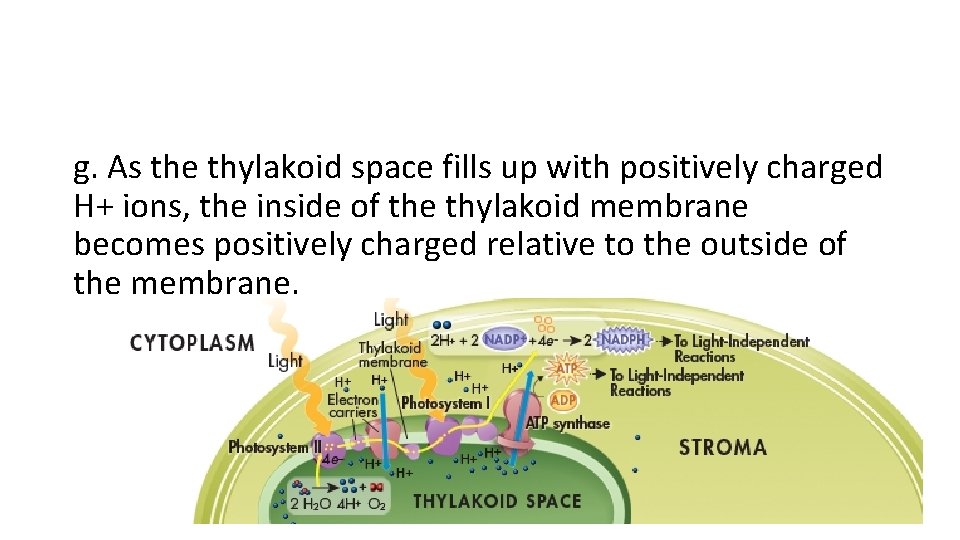
g. As the thylakoid space fills up with positively charged H+ ions, the inside of the thylakoid membrane becomes positively charged relative to the outside of the membrane.
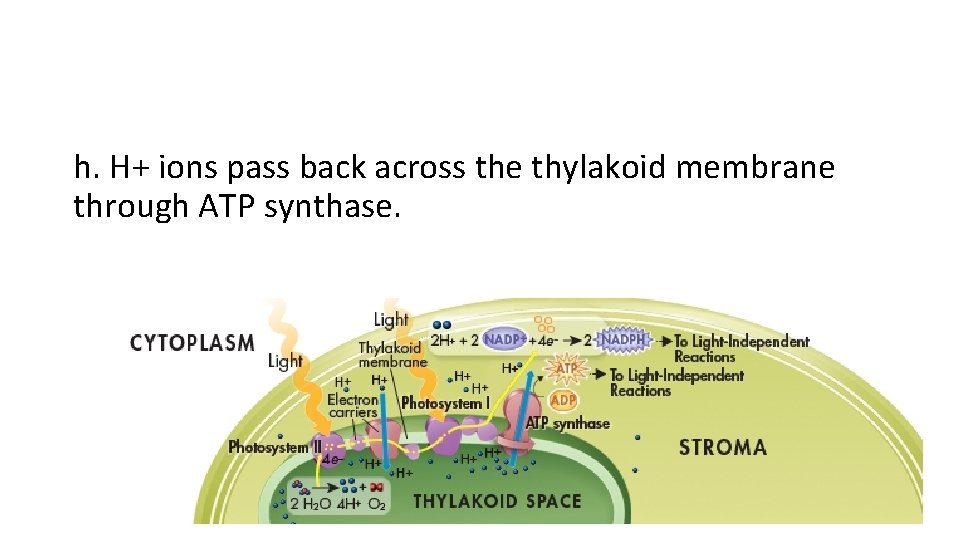
h. H+ ions pass back across the thylakoid membrane through ATP synthase.
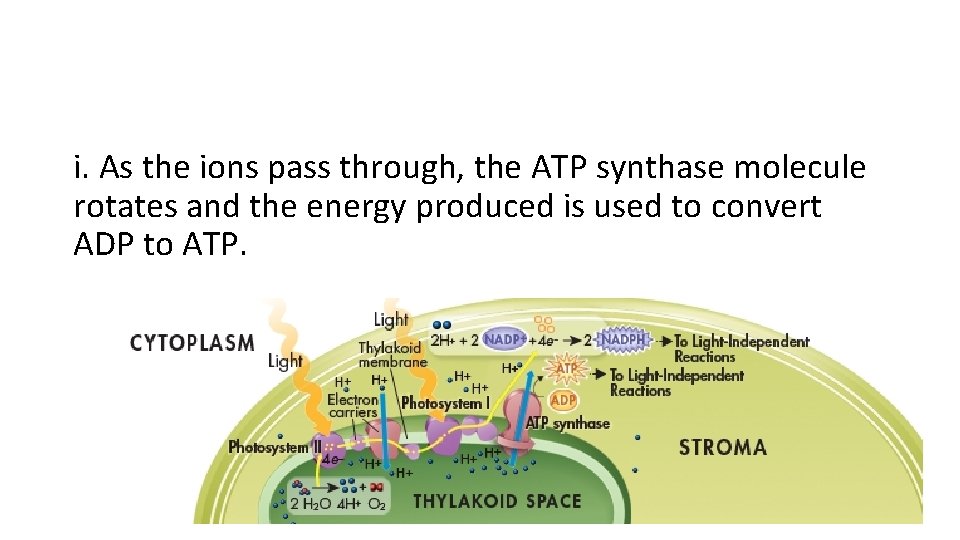
i. As the ions pass through, the ATP synthase molecule rotates and the energy produced is used to convert ADP to ATP.
36. During the light-independent reactions, ATP and NADPH from the light-dependent reactions are used to produce high-energy sugars, like glucose. This reaction takes place in the stroma of the thylakoid.
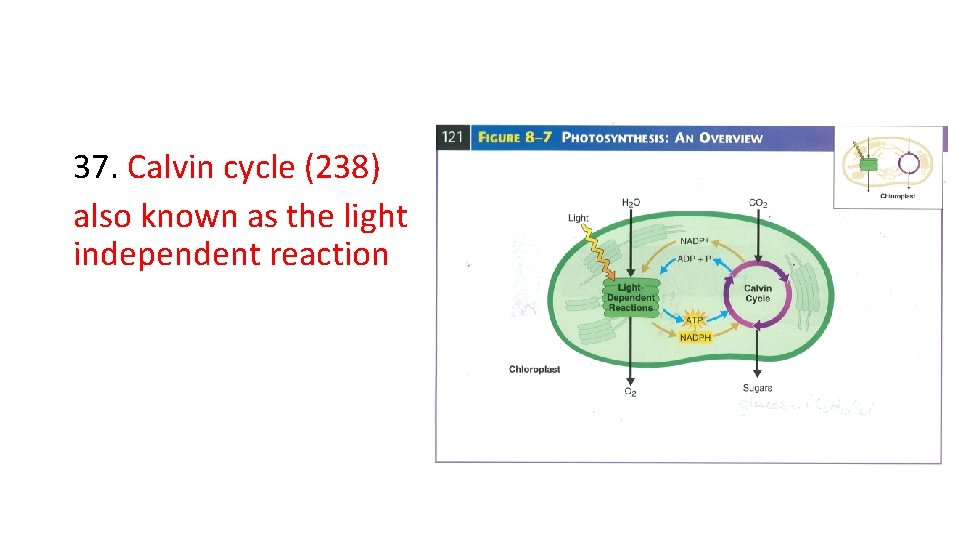
37. Calvin cycle (238) also known as the light independent reaction
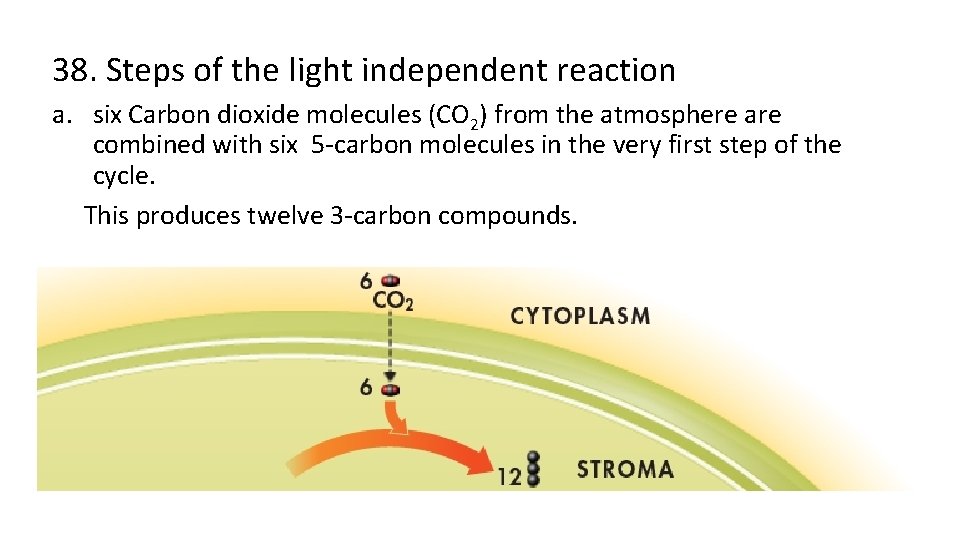
38. Steps of the light independent reaction a. six Carbon dioxide molecules (CO 2) from the atmosphere are combined with six 5 -carbon molecules in the very first step of the cycle. This produces twelve 3 -carbon compounds.
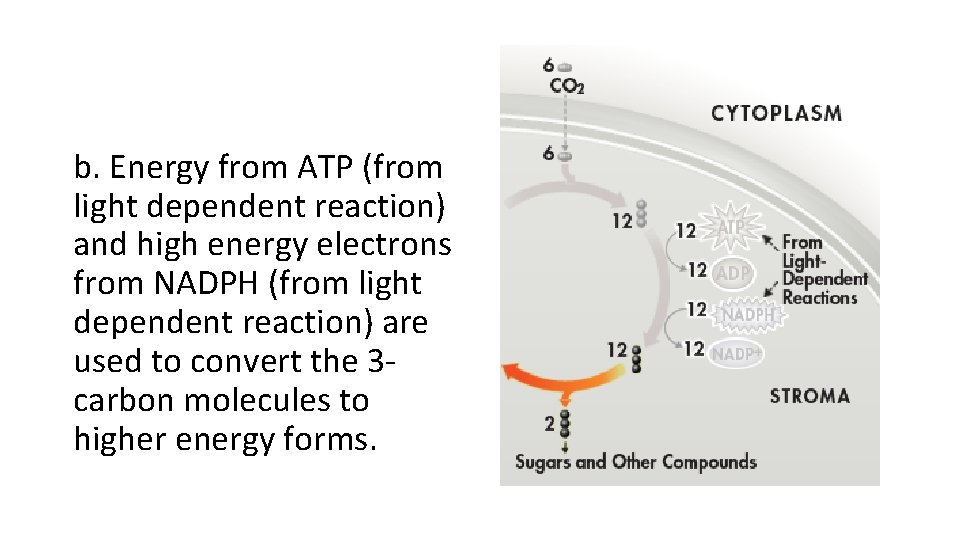
b. Energy from ATP (from light dependent reaction) and high energy electrons from NADPH (from light dependent reaction) are used to convert the 3 carbon molecules to higher energy forms.
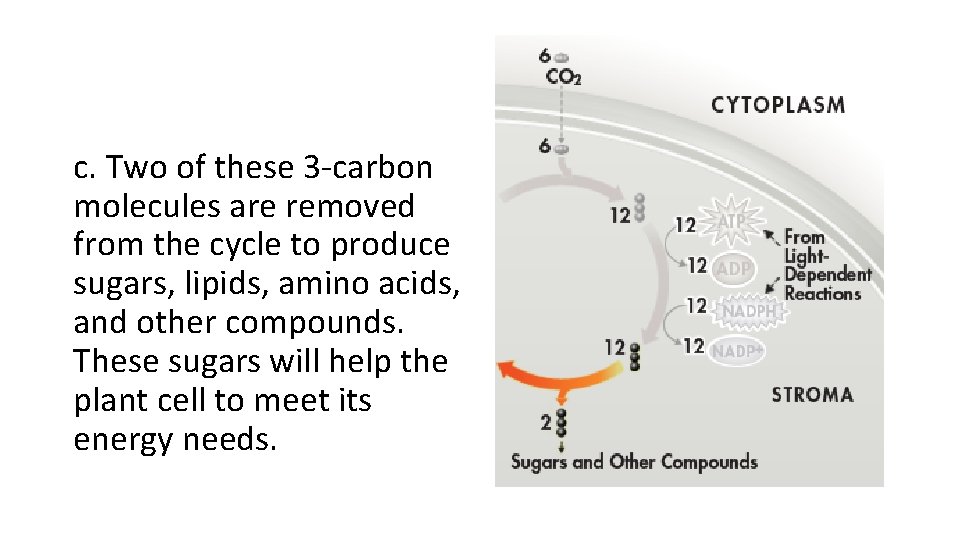
c. Two of these 3 -carbon molecules are removed from the cycle to produce sugars, lipids, amino acids, and other compounds. These sugars will help the plant cell to meet its energy needs.
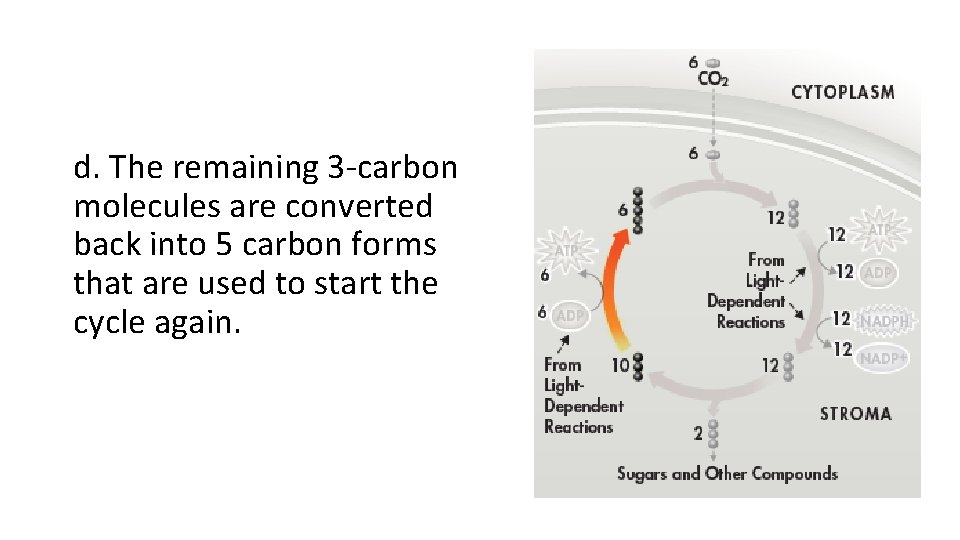
d. The remaining 3 -carbon molecules are converted back into 5 carbon forms that are used to start the cycle again.
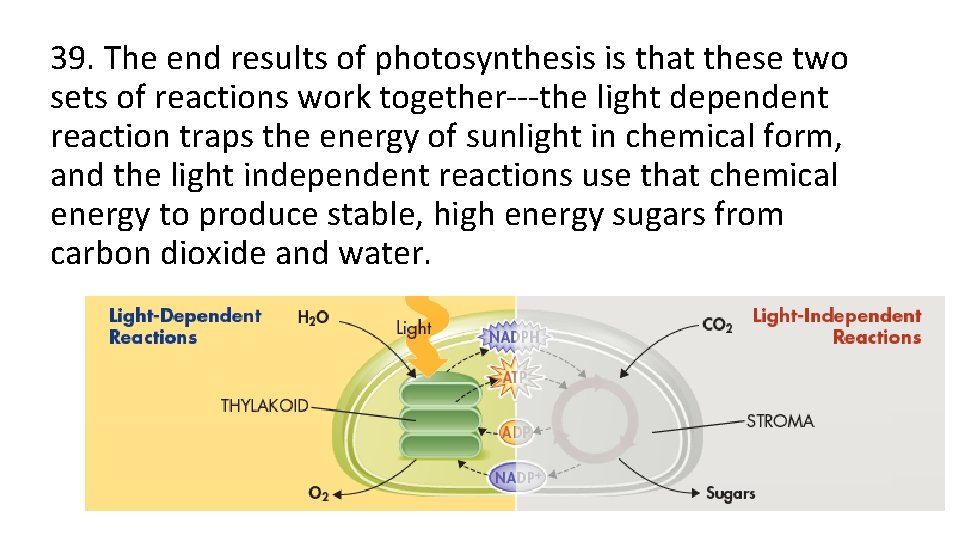
39. The end results of photosynthesis is that these two sets of reactions work together---the light dependent reaction traps the energy of sunlight in chemical form, and the light independent reactions use that chemical energy to produce stable, high energy sugars from carbon dioxide and water.
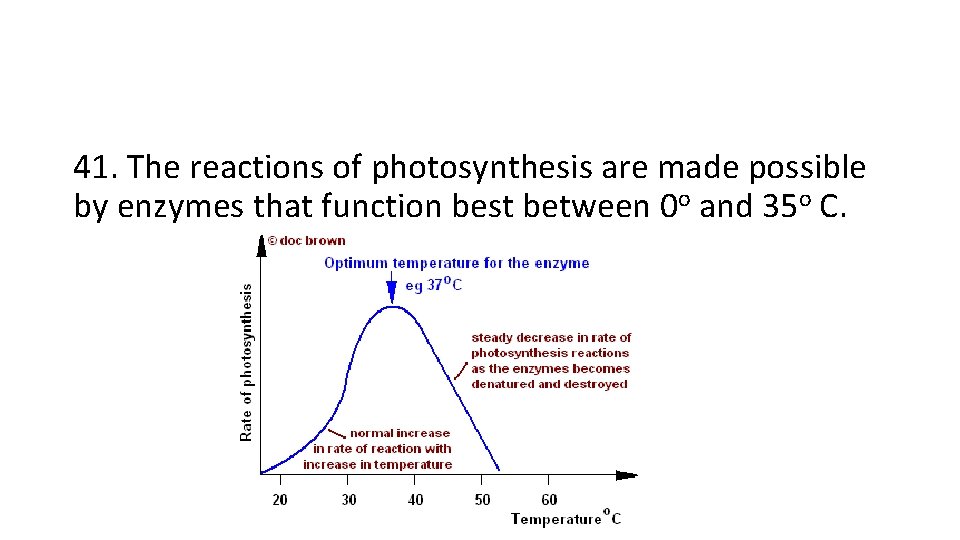
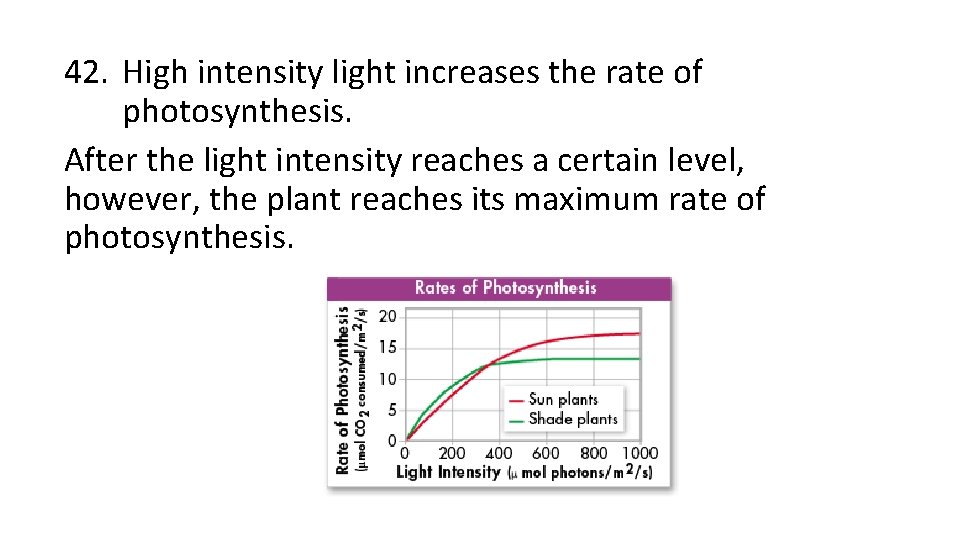
40. Among the most important factors that affect photosynthesis are temperature, light intensity, and the availability of water.
41. The reactions of photosynthesis are made possible by enzymes that function best between 0 o and 35 o C.
42. High intensity light increases the rate of photosynthesis. After the light intensity reaches a certain level, however, the plant reaches its maximum rate of photosynthesis.
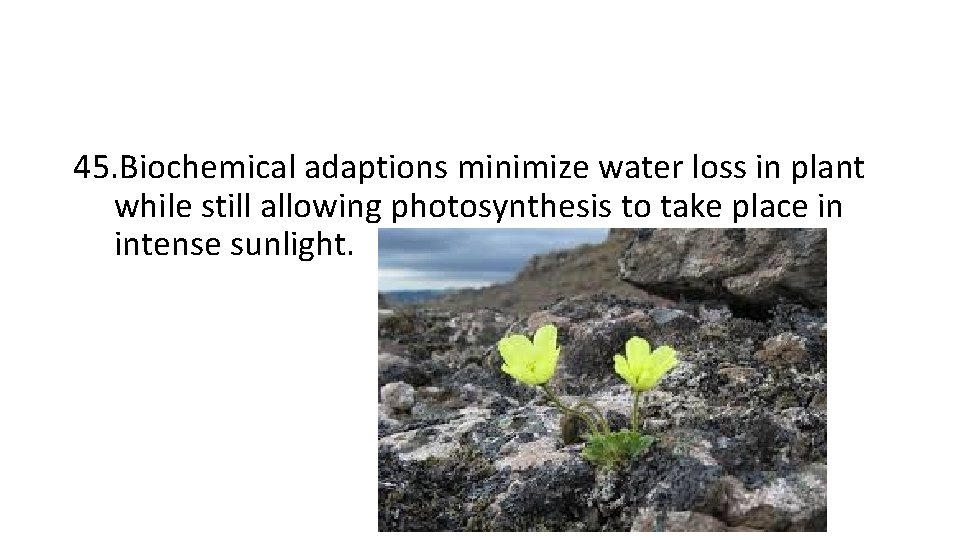
43. A shortage of water can slow or even stop photosynthesis. 44. Plants that live in dry conditions like the desert adapt to the environment by having waxy coatings on leaves to reduce water loss. Some have developed biochemical adaptations as well.
45. Biochemical adaptions minimize water loss in plant while still allowing photosynthesis to take place in intense sunlight.
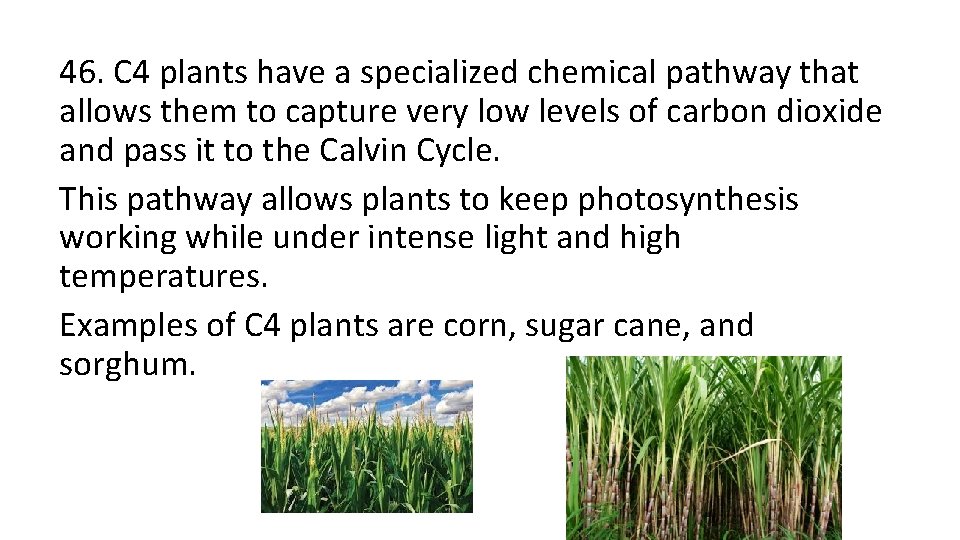
46. C 4 plants have a specialized chemical pathway that allows them to capture very low levels of carbon dioxide and pass it to the Calvin Cycle. This pathway allows plants to keep photosynthesis working while under intense light and high temperatures. Examples of C 4 plants are corn, sugar cane, and sorghum.
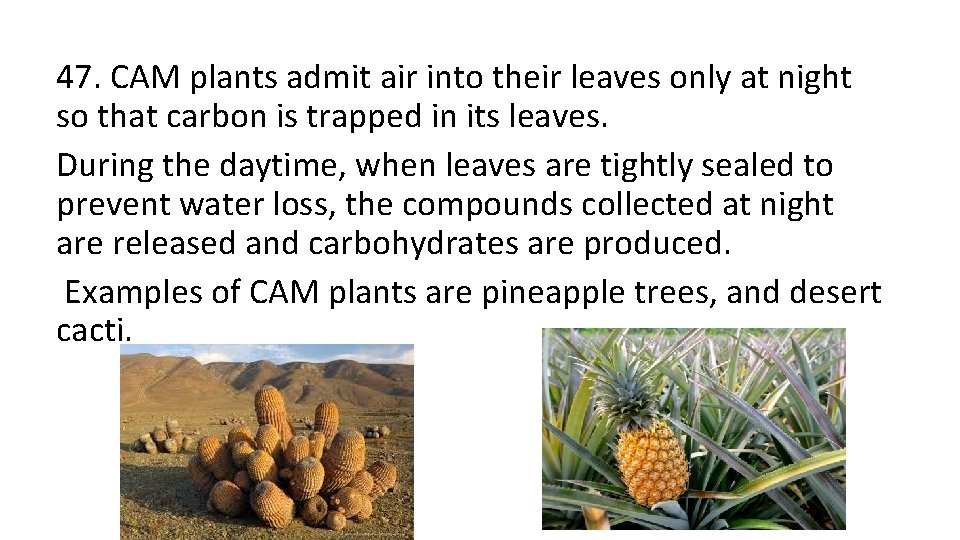
47. CAM plants admit air into their leaves only at night so that carbon is trapped in its leaves. During the daytime, when leaves are tightly sealed to prevent water loss, the compounds collected at night are released and carbohydrates are produced. Examples of CAM plants are pineapple trees, and desert cacti.