
CHAPTER 8 PERCEPTION 8 1 Consumer Behavior In
CHAPTER 8 PERCEPTION 8 -1
Consumer Behavior In The News… The death of advertising… or is it? Ø Fragmented media and uninterested consumers make for a tough advertising environment. Ø How will advertisers survive? Source: “Advertising Of, By, And For the People, ” Business Week, July 25, 2005, p. 63/4. 8 -2
Consumer Behavior In The News… The death of advertising… or is it? Ø How will advertisers survive? Ø New media (video games, cell phones) – yes! Ø Incentives for viewing ads – absolutely! Ø Letting consumers create ads – WHAT? Ø Converse sneakers solicited “ 60 -second films” Ø Films created by “brand fans” Ø Buzz increased web site traffic by 40%! Source: “Advertising Of, By, And For the People, ” Business Week, July 25, 2005, p. 63/4. 8 -3
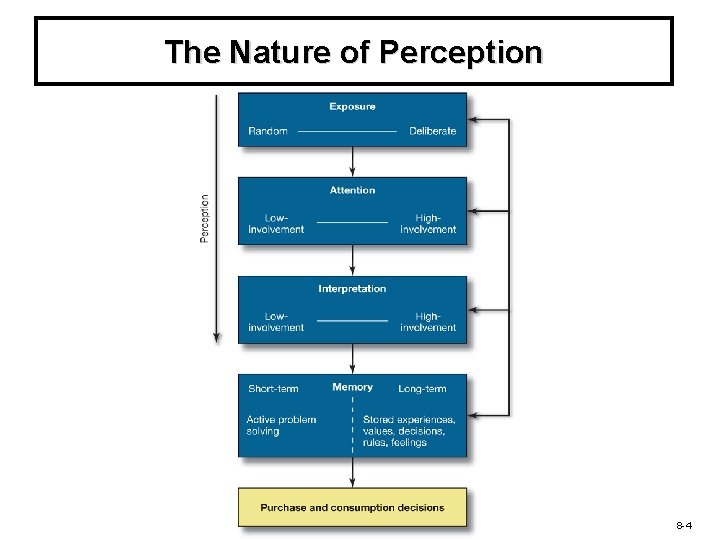
The Nature of Perception 8 -4
Exposure Types of Exposure 1. Selective Exposure • The highly selective nature of consumer exposure is a major concern for marketers, since failure to gain exposure results in lost communication and sales opportunities. 2. Voluntary Exposure • Although consumers often avoid commercials and other marketing stimuli, sometimes they actively seek them out for various reasons including purchase goals, entertainment, and information. 8 -5

Attention is determined by three factors: 1. Stimulus Factors • Are physical characteristics of the stimulus itself 2. Individual Factors • Are characteristics which distinguish one individual from another 3. Situational Factors • Include stimuli in the environment other than the focal stimulus and temporary characteristics of the individual that are induced by the environment 8 -6
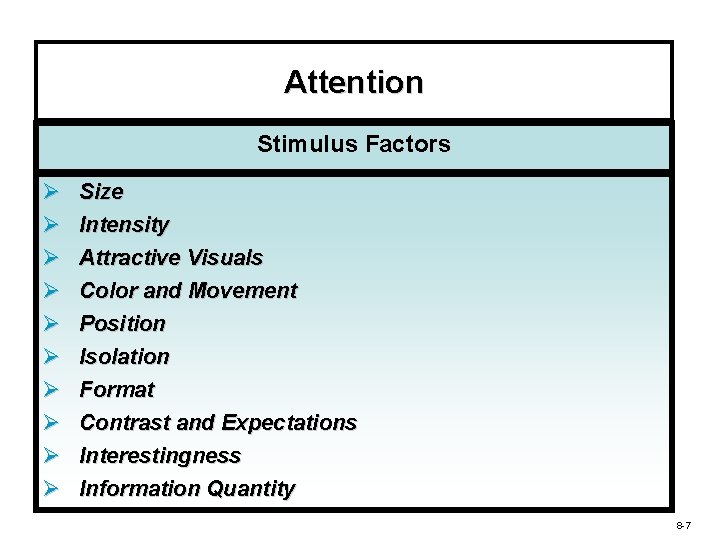
Attention Stimulus Factors Ø Ø Ø Ø Ø Size Intensity Attractive Visuals Color and Movement Position Isolation Format Contrast and Expectations Interestingness Information Quantity 8 -7
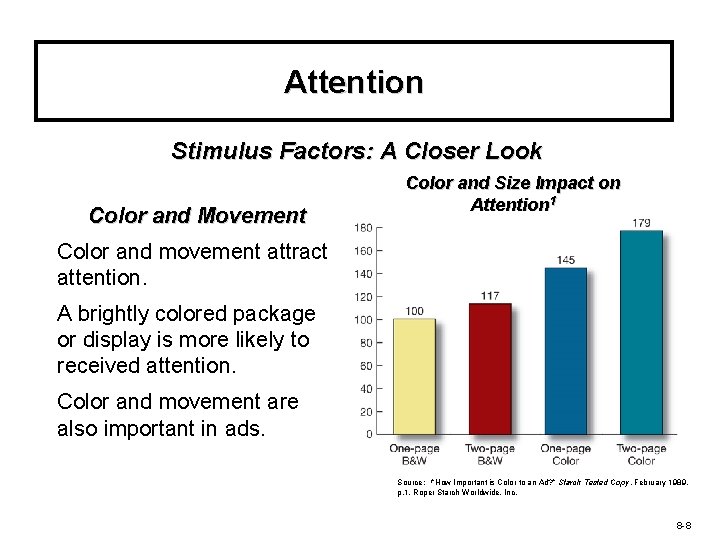
Attention Stimulus Factors: A Closer Look Color and Movement Color and Size Impact on Attention 1 Color and movement attract attention. A brightly colored package or display is more likely to received attention. Color and movement are also important in ads. Source: 1”How Important is Color to an Ad? ” Starch Tested Copy. February 1989, p. 1. Roper Starch Worldwide, Inc. 8 -8
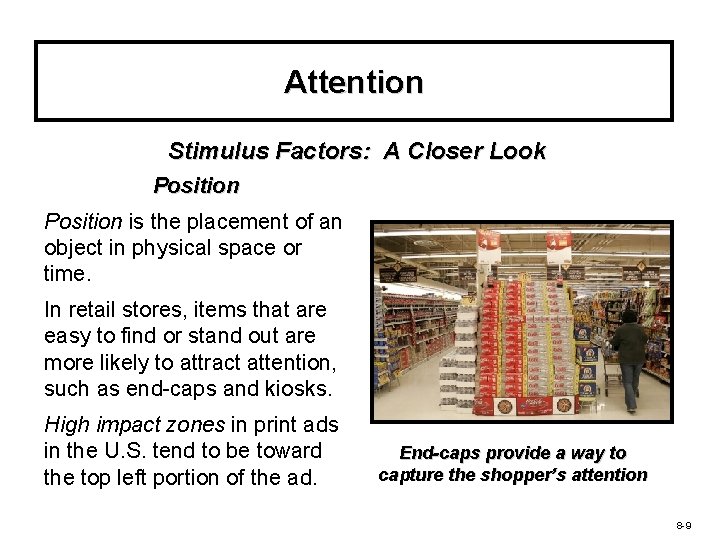
Attention Stimulus Factors: A Closer Look Position is the placement of an object in physical space or time. In retail stores, items that are easy to find or stand out are more likely to attract attention, such as end-caps and kiosks. High impact zones in print ads in the U. S. tend to be toward the top left portion of the ad. End-caps provide a way to capture the shopper’s attention 8 -9
Attention Stimulus Factors: A Closer Look Contrast and Expectations Consumers pay more attention to stimuli that contrast with their background. Expectations drive perceptions of contrast. Ads that differ from expectations for a product category often motivate more attention. Adaptation level theory suggests that if a stimulus doesn’t change over time we habituate to it and begin to notice it less. . 8 -10
Attention Individual Factors Ø Motivation Ø Ability 8 -11
Attention Situational Factors Ø Clutter Ø Program Involvement 8 -12
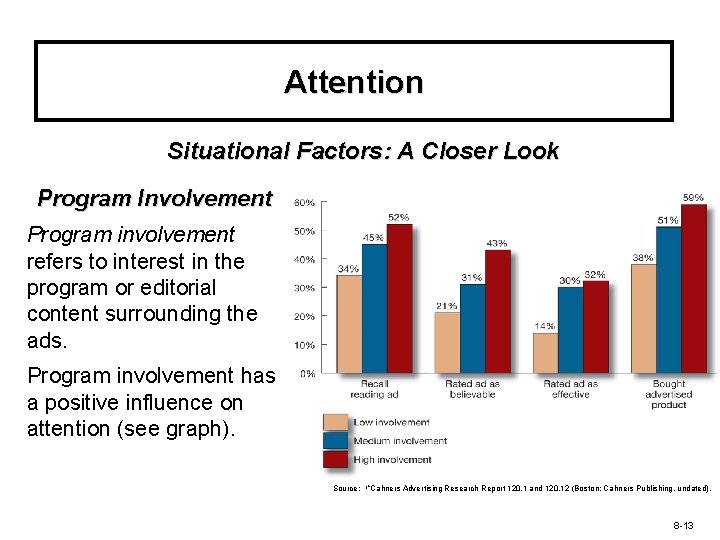
Attention Situational Factors: A Closer Look Program Involvement Program involvement refers to interest in the program or editorial content surrounding the ads. Program involvement has a positive influence on attention (see graph). Source: 1”Cahners Advertising Research Report 120. 1 and 120. 12 (Boston: Cahners Publishing, undated). 8 -13
Attention Nonfocused Attention Ø Hemispheric lateralization Ø Subliminal Stimuli 8 -14
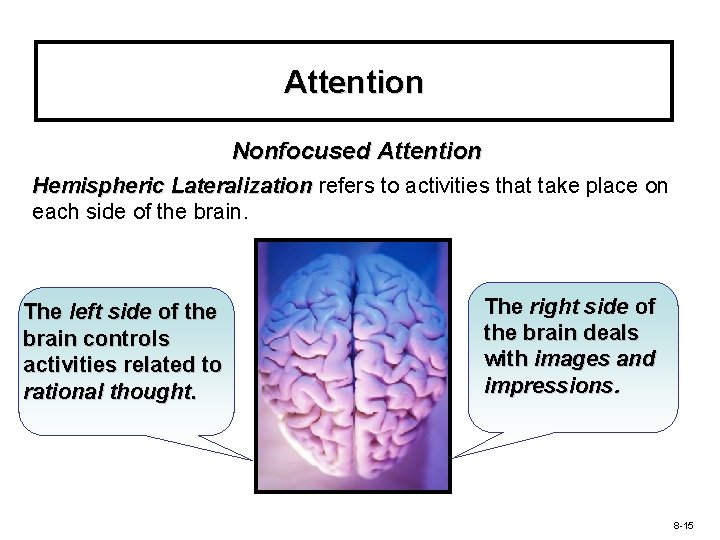
Attention Nonfocused Attention Hemispheric Lateralization refers to activities that take place on each side of the brain. The left side of the brain controls activities related to rational thought. The right side of the brain deals with images and impressions. 8 -15
Attention Nonfocused Attention Subliminal Stimuli A message presented so fast, softly or masked by other messages that one is not aware of seeing or hearing it is call a subliminal stimulus A subliminal ad “hides” key persuasive information within the ad by making it so weak that it is difficult or impossible for someone to physically detect. Subliminal advertising has been the focus of intense study and public concern. 8 -16
Interpretation Three aspects of interpretation: interpretation 1. It is generally a relative process rather than absolute, referred to as perceptual relativity 2. It tends to be subjective and open to a host of psychological biases. 3. It can be a cognitive “thinking” process or an affective “emotional” process. • Cognitive interpretation is a process whereby stimuli are placed into existing categories of meaning. • Affective interpretation is the emotional or feeling response triggered by a stimulus such as an ad. 8 -17
Interpretation is determined by three Characteristics : 1. Individual Characteristics 2. Situational Characteristics 3. Stimulus Characteristics 8 -18
Interpretation Individual Characteristics Ø Traits Ø Learning and Knowledge Ø Expectations 8 -19
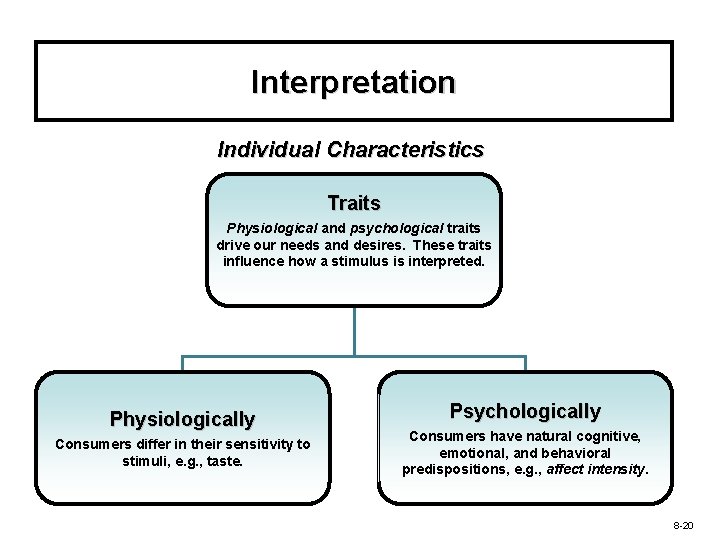
Interpretation Individual Characteristics Traits Physiological and psychological traits drive our needs and desires. These traits influence how a stimulus is interpreted. Physiologically Consumers differ in their sensitivity to stimuli, e. g. , taste. Psychologically Consumers have natural cognitive, emotional, and behavioral predispositions, e. g. , affect intensity. 8 -20
Interpretation Individual Characteristics Learning and Knowledge The meanings attached to such “natural” things as time, space, relationships, and colors are learned and vary widely across cultures. Consumers also learn about marketer-created stimuli like brands and promotions through their experiences with them. 8 -21
Interpretation Individual Characteristics Expectations Interpretations tend to be consistent with expectations, an effect referred to as the expectation bias. Consumers often evaluate the performance of a well-known brand as higher than that of an identical product with an unknown brand name. 8 -22
Interpretation Situational Characteristics Ø The situation provides a context within which the focal stimulus is interpreted. Ø The Contextual cues present in the situation play a role in consumer interpretation independent of the actual stimulus. 8 -23
Interpretation Stimulus Characteristics Ø Traits Ø Organization Ø Proximity Ø Closure Ø Figure-Ground Ø Changes Ø Ø Sensory Discrimination JND 8 -24
Applications in Consumer Behavior Stimulus Characteristics: A Closer Look Traits Rhetorical figures involve the use of incongruity or artful deviation in language use. Srixon uses rhetorical language to influence perception. Is Srixon LITERALLY “fire in the hole”? Courtesy Srixon Sports: Agency: Fitzgerald & Co. 8 -25
Interpretation Consumer Inferences Ø Quality Signals Ø Interpreting Images Ø Missing Information and Ethical Concerns 8 -26
Perception and Marketing Strategy Ø Retail Strategy Ø Brand Name and Logo Development • • • Linguistic Consideration Branding Strategies Logo Design and Typographics Ø Media Strategy Ø Advertisements Ø Package Design and Labeling 8 -27
- Slides: 27