
CHAPTER 8 OVERVOLTAGE PHENOMENON IN ELECTRICAL POWER SYSTEM
- Slides: 32
CHAPTER 8. OVERVOLTAGE PHENOMENON IN ELECTRICAL POWER SYSTEM 1. Sources and type of over voltages 2. Parameters and characteristics of Lightning strokes 3. Mathematical model for Lightning LIGHTNING 4. Traveling Wave on transmission Lines 5. Attenuation and Distortion of Traveling Waves 6. Reflection and transmission of waves at transition 7. Behavior of Rectangular Traveling Wave at Transition Points. 8. Over voltage due to Switching Surges 9. Power Frequency Over Voltage in Power System IR. SURYA HARDI 1
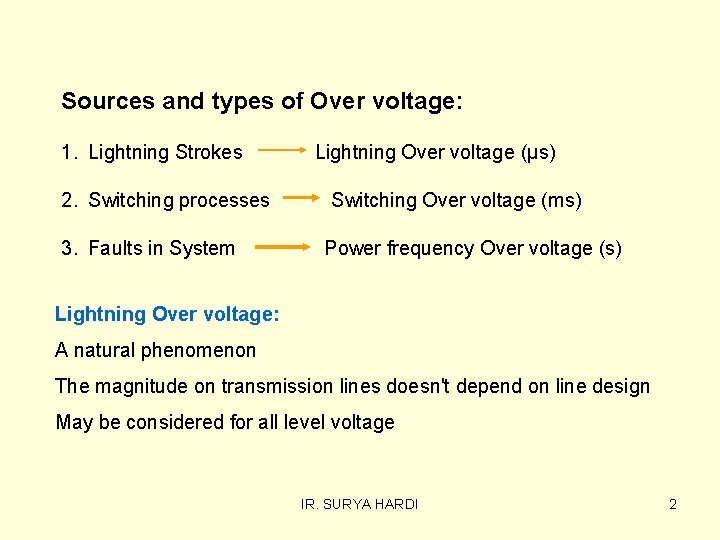
Sources and types of Over voltage: 1. Lightning Strokes 2. Switching processes 3. Faults in System Lightning Over voltage (μs) Switching Over voltage (ms) Power frequency Over voltage (s) Lightning Over voltage: A natural phenomenon The magnitude on transmission lines doesn't depend on line design May be considered for all level voltage IR. SURYA HARDI 2
Switching Over voltage: Switching processes with connection and disconnection of CB contacts. Proportional to operating voltage. Usually considered above 500 k. V Power frequency Over voltage: Fault in electrical power systems i. e: Phase to phase and phase to ground The magnitude depend on kind of fault and grounding system Can occur at all voltage level IR. SURYA HARDI 3
Parameters or characteristics of the lightning strokes • Amplitude of the current, create over voltage which damage equipment • The rate of rise, create electromagnetic induction on metal or inductive installation • Lightning current charge, can cause to melt metal and arching • Lightning current specification energy, can cause increasing temperature. two of last always is also called waveform of the lightning voltage and current. IR. SURYA HARDI 4
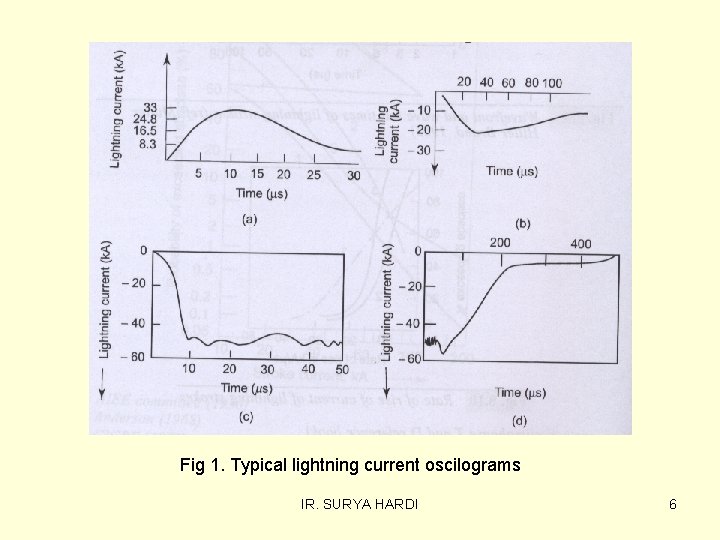
Lightning phenomenon is a peak discharge in which charge accumulated in the clouds discharges into neighboring cloud or to ground. The electrode separation, i. e cloud to cloud or cloud to ground is very large, perhaps 10 km or more. The lightning current oscilograms indicate initial high current portion which is characterized by short front time up to 10 μs. Lightning currents are usually measured either directly from high tower or buildings or from transmission tower legs. Measurements made by several investigators and comities indicated the large strokes of current > 100 k. A are possible. IR. SURYA HARDI 5
Fig 1. Typical lightning current oscilograms IR. SURYA HARDI 6
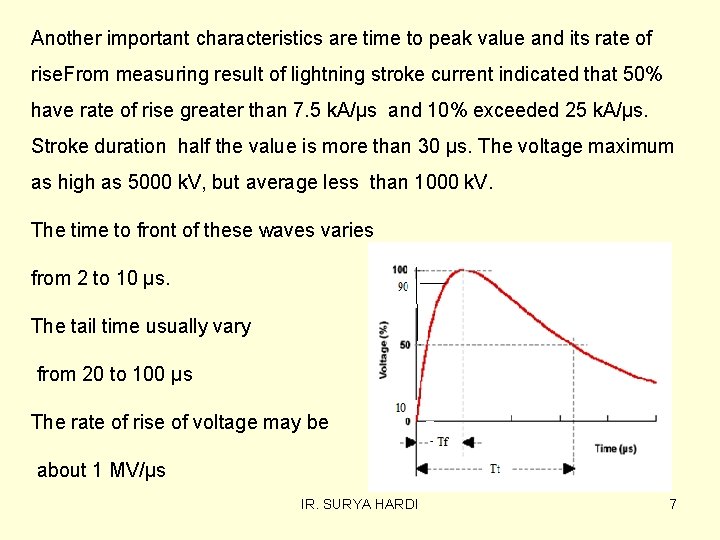
Another important characteristics are time to peak value and its rate of rise. From measuring result of lightning stroke current indicated that 50% have rate of rise greater than 7. 5 k. A/μs and 10% exceeded 25 k. A/μs. Stroke duration half the value is more than 30 μs. The voltage maximum as high as 5000 k. V, but average less than 1000 k. V. The time to front of these waves varies from 2 to 10 μs. The tail time usually vary from 20 to 100 μs The rate of rise of voltage may be about 1 MV/μs IR. SURYA HARDI 7
Lightning strokes on transmission line are classified into two groups: • The direct strokes, when a thunder cloud directly discharges on to a transmission line tower or line wire and result in most severe stroke. • The inducted strokes, caused by thunder cloud discharge on neighbor an object From transmission line. When a direct lightning stroke occurs on the a tower, the tower has to carry huge Impulse currents. If the tower footing resistance is high, the potential of the tower rises to a large value, steeply with respect to the line and consequently a flash over may take place along the insulator strings. This is known as back flash over. IR. SURYA HARDI 8
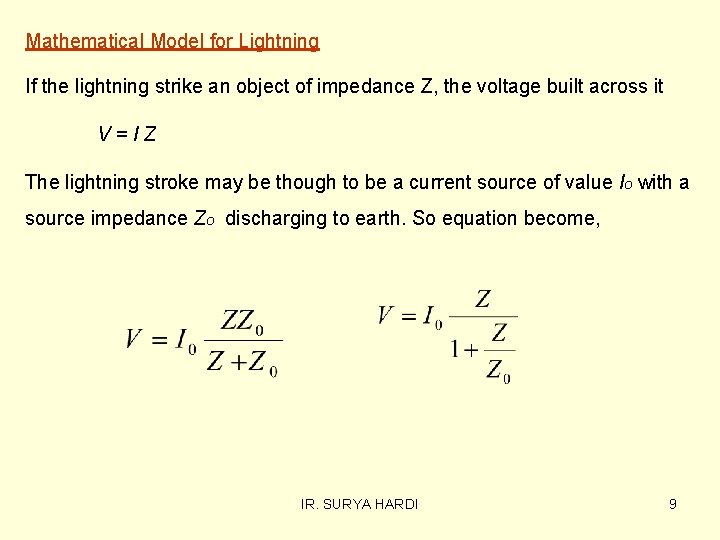
Mathematical Model for Lightning If the lightning strike an object of impedance Z, the voltage built across it V=IZ The lightning stroke may be though to be a current source of value Io with a source impedance Zo discharging to earth. So equation become, IR. SURYA HARDI 9
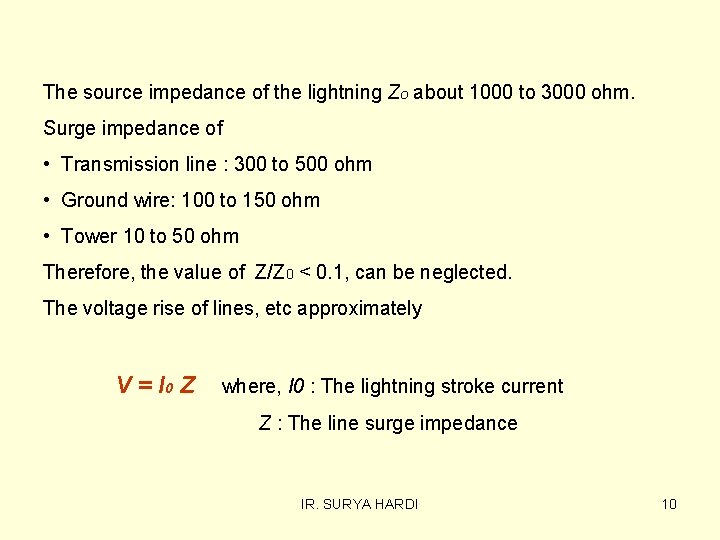
The source impedance of the lightning Zo about 1000 to 3000 ohm. Surge impedance of • Transmission line : 300 to 500 ohm • Ground wire: 100 to 150 ohm • Tower 10 to 50 ohm Therefore, the value of Z/Z 0 < 0. 1, can be neglected. The voltage rise of lines, etc approximately V = I 0 Z where, I 0 : The lightning stroke current Z : The line surge impedance IR. SURYA HARDI 10
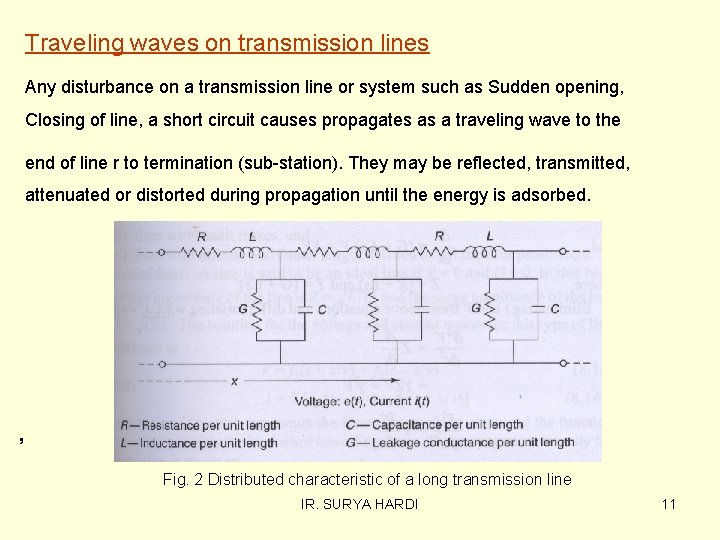
Traveling waves on transmission lines Any disturbance on a transmission line or system such as Sudden opening, Closing of line, a short circuit causes propagates as a traveling wave to the end of line r to termination (sub-station). They may be reflected, transmitted, attenuated or distorted during propagation until the energy is adsorbed. , Fig. 2 Distributed characteristic of a long transmission line IR. SURYA HARDI 11
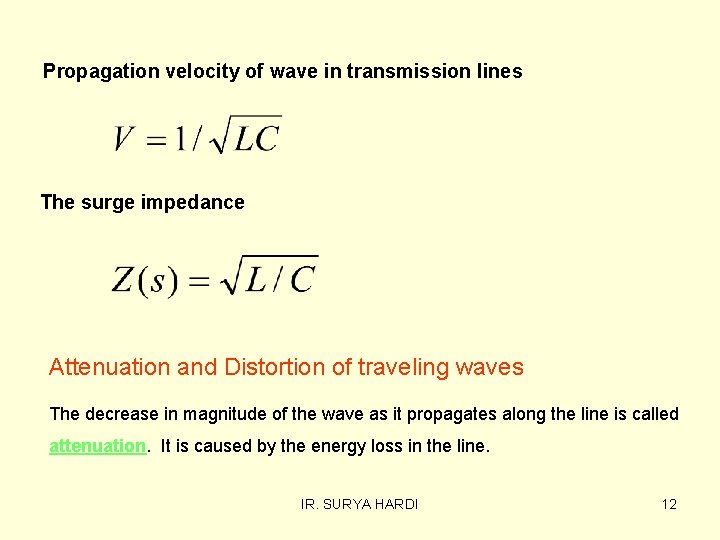
Propagation velocity of wave in transmission lines The surge impedance Attenuation and Distortion of traveling waves The decrease in magnitude of the wave as it propagates along the line is called attenuation. It is caused by the energy loss in the line. IR. SURYA HARDI 12
The change of waveform that occur is called distortion. The current and voltage wave forms become dissimilar even though they may be the same initially. It is caused by the inductance and capacitance in the line. The energy loss may be in the conductor resistance as modified by the skin effect, changes in the ground resistance, leakage resistance and non -uniform ground resistances etc. The changes in the inductance are due to the skin effect, the proximity effect, etc. The variation in the capacitance is due to capacitance change in the insulation nearest to the ground structures. Corona can influence attenuation and distortion in transmission line. IR. SURYA HARDI 13
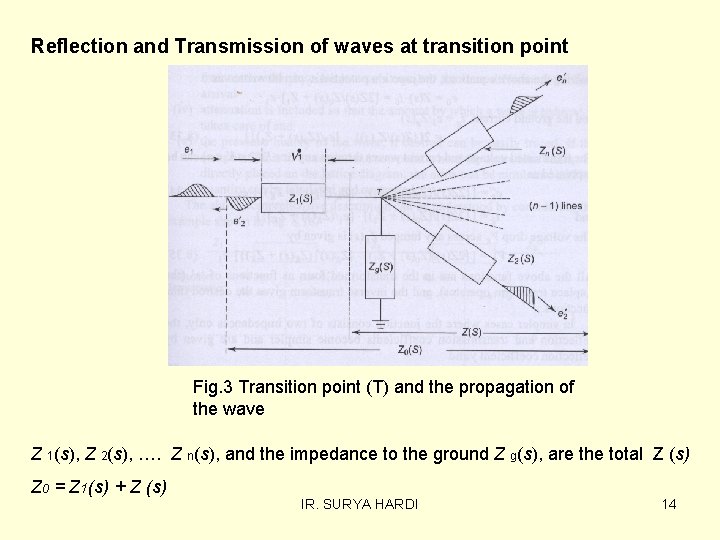
Reflection and Transmission of waves at transition point Fig. 3 Transition point (T) and the propagation of the wave Z 1(s), Z 2(s), …. Z n(s), and the impedance to the ground Z g(s), are the total Z (s) Z 0 = Z 1(s) + Z (s) IR. SURYA HARDI 14
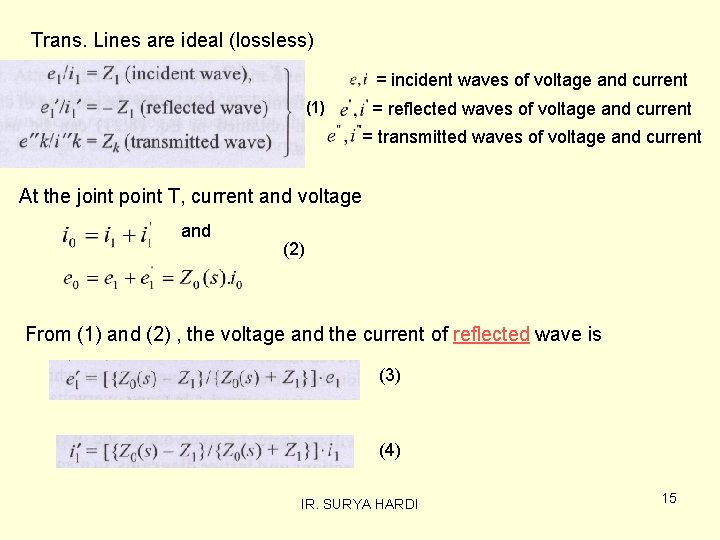
Trans. Lines are ideal (lossless) = incident waves of voltage and current (1) = reflected waves of voltage and current = transmitted waves of voltage and current At the joint point T, current and voltage and (2) From (1) and (2) , the voltage and the current of reflected wave is (3) (4) IR. SURYA HARDI 15
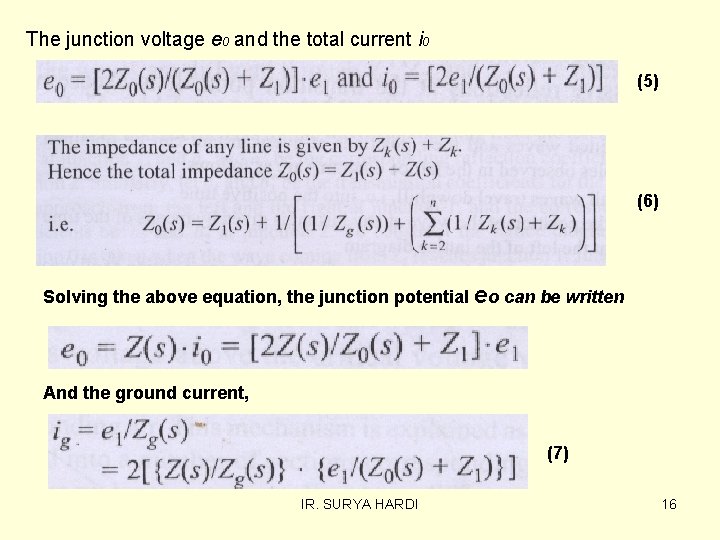
The junction voltage e 0 and the total current i 0 (5) (6) Solving the above equation, the junction potential eo can be written And the ground current, (7) IR. SURYA HARDI 16
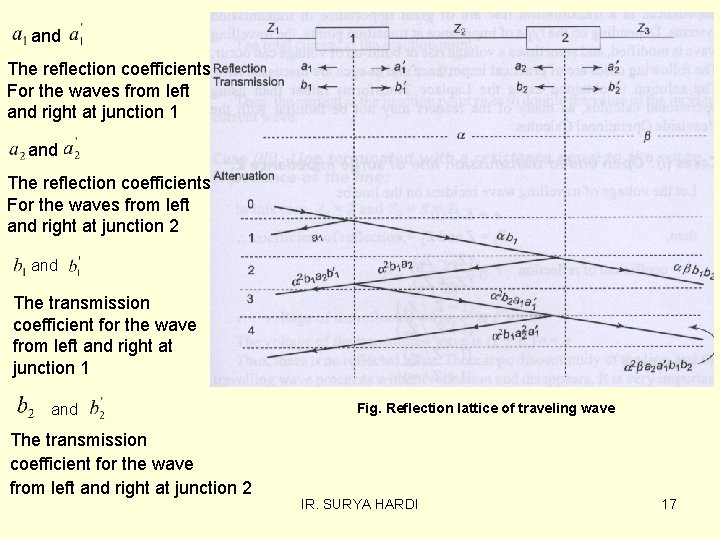
and The reflection coefficients For the waves from left and right at junction 1 and The reflection coefficients For the waves from left and right at junction 2 and The transmission coefficient for the wave from left and right at junction 1 and The transmission coefficient for the wave from left and right at junction 2 Fig. Reflection lattice of traveling wave IR. SURYA HARDI 17
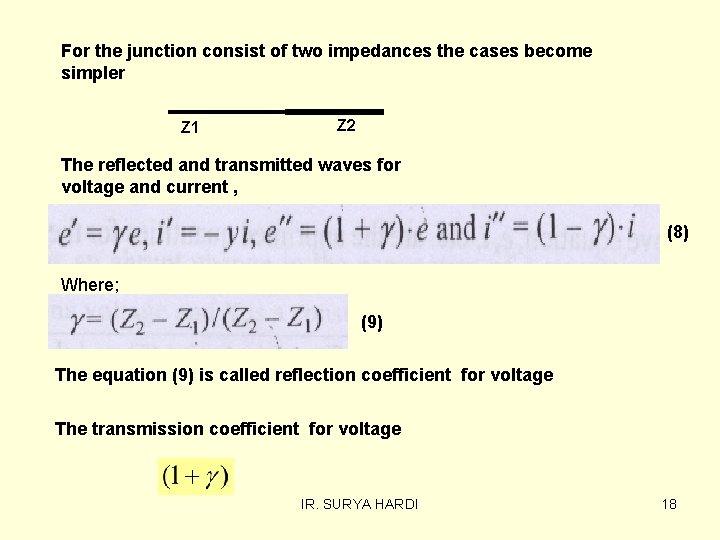
For the junction consist of two impedances the cases become simpler Z 1 Z 2 The reflected and transmitted waves for voltage and current , (8) Where; (9) The equation (9) is called reflection coefficient for voltage The transmission coefficient for voltage IR. SURYA HARDI 18
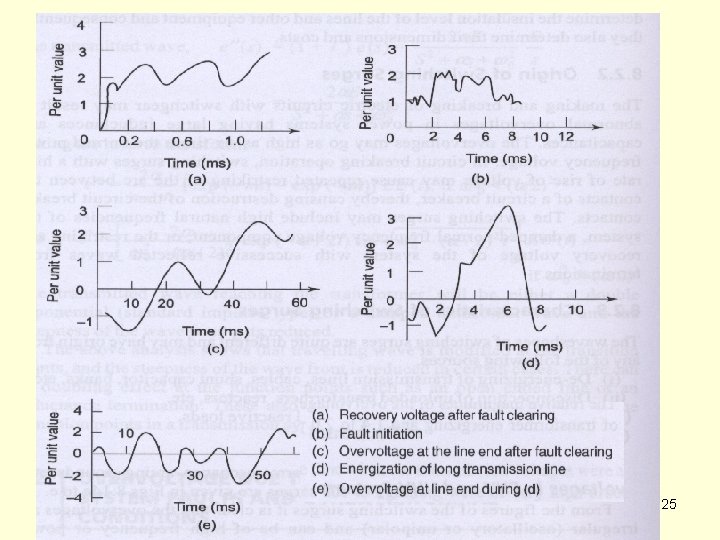
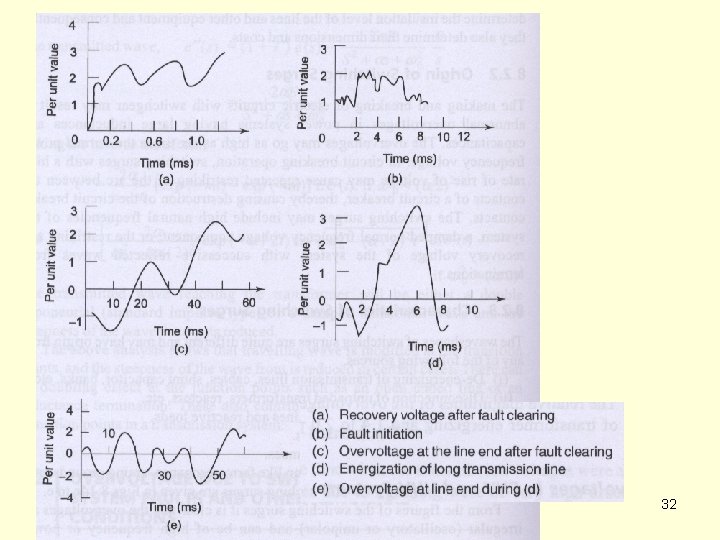
Switching Surge The making and breaking of electric circuits with switchgear may result In abnormal over voltage in power system having large inductance and capacitances. They may go as high as six time the normal power frequency voltage. IR. SURYA HARDI 19
Characteristics of switching surges; The switching surge waveform are quite different depend on sources namely, i). De energizing of transmission line, cables, shunt capacitor, etc ii). Disconnection of unloaded transformers, reactors iii) Energization or re-closing of lines and reactive loads iv) Sudden switching off of load v) Short circuits and fault clearance vi) Resonance phenomenon IR. SURYA HARDI 20
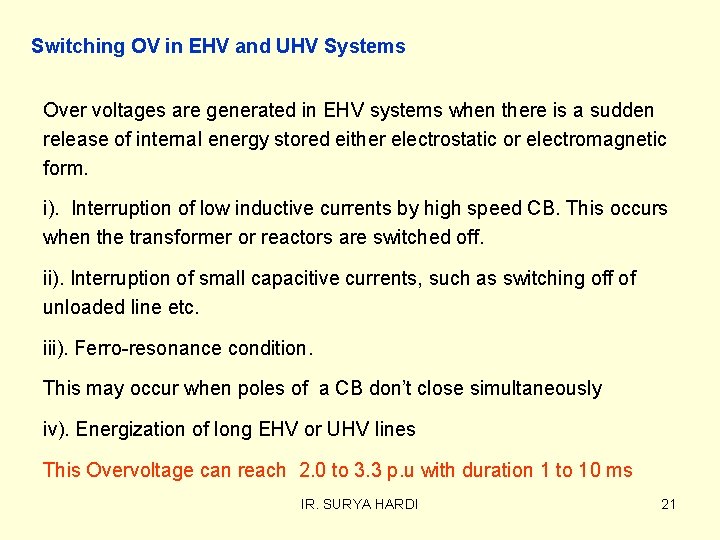
Switching OV in EHV and UHV Systems Over voltages are generated in EHV systems when there is a sudden release of internal energy stored either electrostatic or electromagnetic form. i). Interruption of low inductive currents by high speed CB. This occurs when the transformer or reactors are switched off. ii). Interruption of small capacitive currents, such as switching off of unloaded line etc. iii). Ferro-resonance condition. This may occur when poles of a CB don’t close simultaneously iv). Energization of long EHV or UHV lines This Overvoltage can reach 2. 0 to 3. 3 p. u with duration 1 to 10 ms IR. SURYA HARDI 21
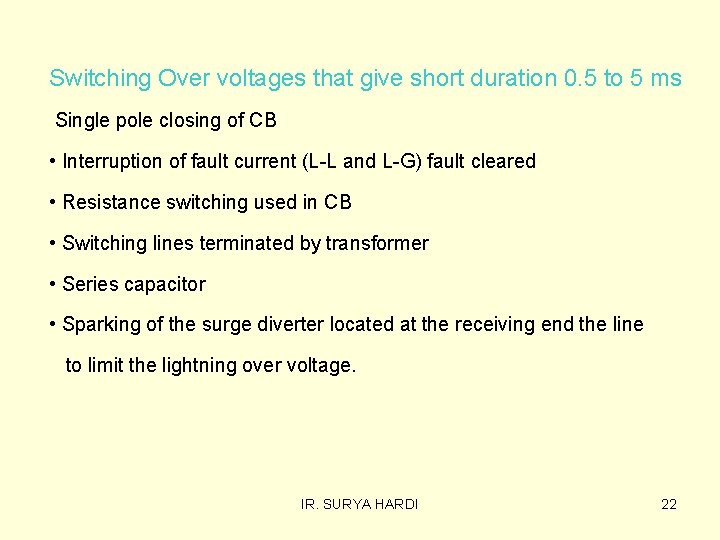
Switching Over voltages that give short duration 0. 5 to 5 ms Single pole closing of CB • Interruption of fault current (L-L and L-G) fault cleared • Resistance switching used in CB • Switching lines terminated by transformer • Series capacitor • Sparking of the surge diverter located at the receiving end the line to limit the lightning over voltage. IR. SURYA HARDI 22
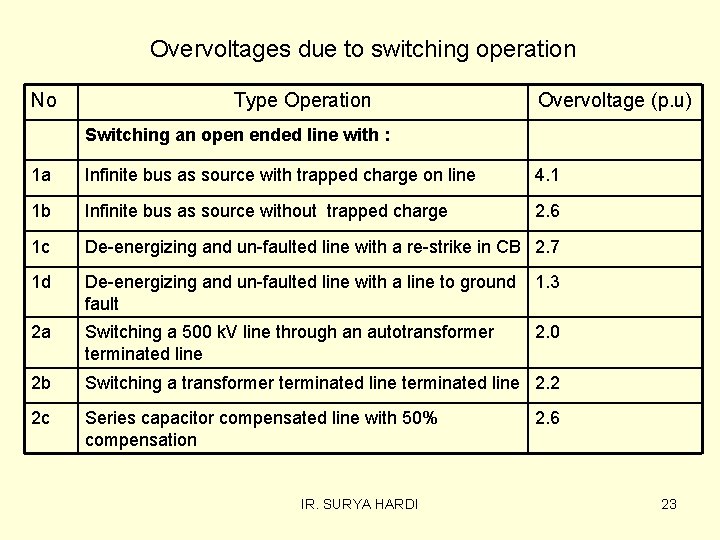
Overvoltages due to switching operation No Type Operation Overvoltage (p. u) Switching an open ended line with : 1 a Infinite bus as source with trapped charge on line 4. 1 1 b Infinite bus as source without trapped charge 2. 6 1 c De-energizing and un-faulted line with a re-strike in CB 2. 7 1 d De-energizing and un-faulted line with a line to ground fault 1. 3 2 a Switching a 500 k. V line through an autotransformer terminated line 2. 0 2 b Switching a transformer terminated line 2. 2 2 c Series capacitor compensated line with 50% compensation IR. SURYA HARDI 2. 6 23
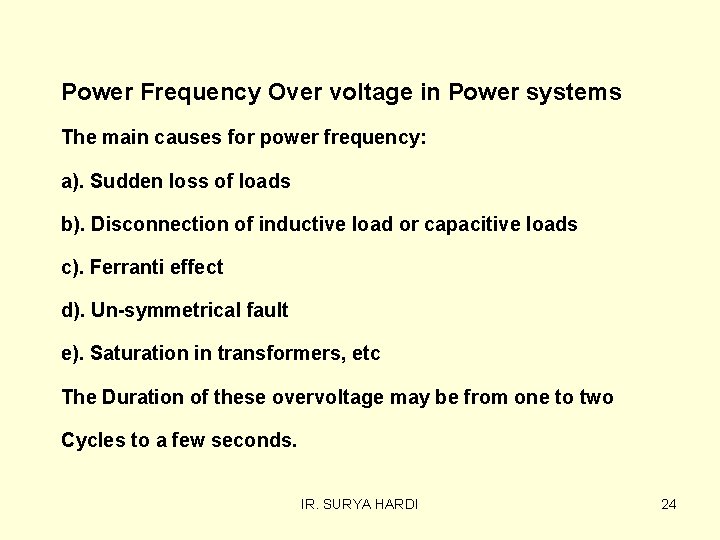
Power Frequency Over voltage in Power systems The main causes for power frequency: a). Sudden loss of loads b). Disconnection of inductive load or capacitive loads c). Ferranti effect d). Un-symmetrical fault e). Saturation in transformers, etc The Duration of these overvoltage may be from one to two Cycles to a few seconds. IR. SURYA HARDI 24
IR. SURYA HARDI 25
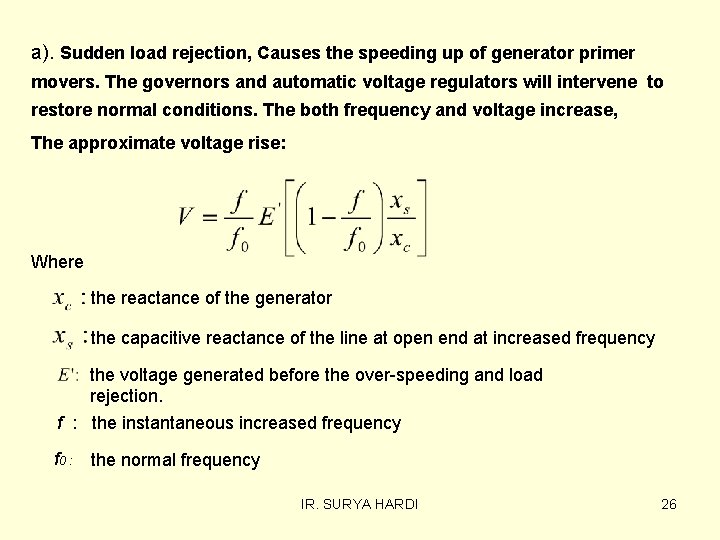
a). Sudden load rejection, Causes the speeding up of generator primer movers. The governors and automatic voltage regulators will intervene to restore normal conditions. The both frequency and voltage increase, The approximate voltage rise: Where the reactance of the generator the capacitive reactance of the line at open end at increased frequency the voltage generated before the over-speeding and load rejection. f : the instantaneous increased frequency f 0 : the normal frequency IR. SURYA HARDI 26
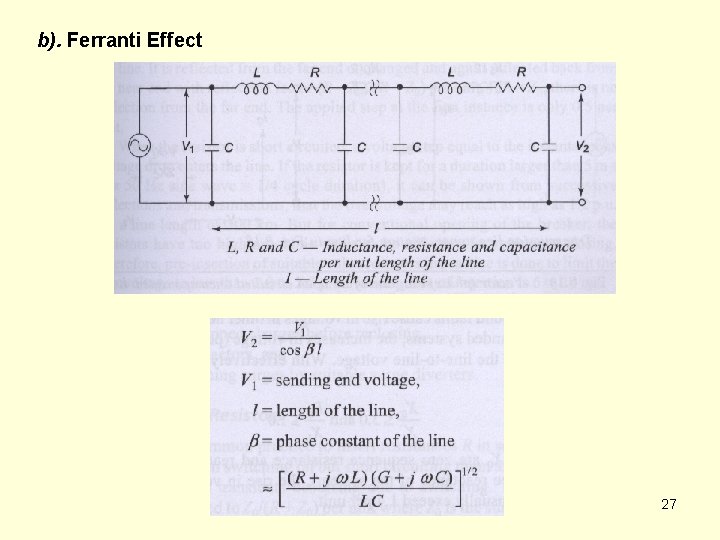
b). Ferranti Effect IR. SURYA HARDI 27
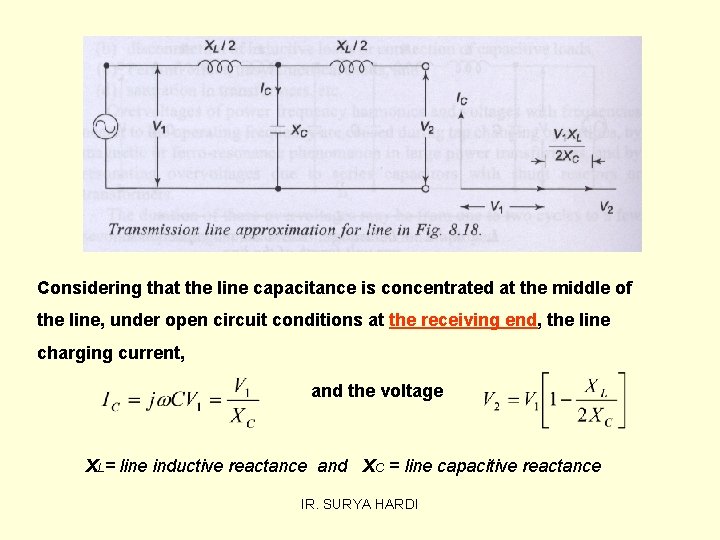
Considering that the line capacitance is concentrated at the middle of the line, under open circuit conditions at the receiving end, the line charging current, and the voltage XL= line inductive reactance and XC = line capacitive reactance IR. SURYA HARDI
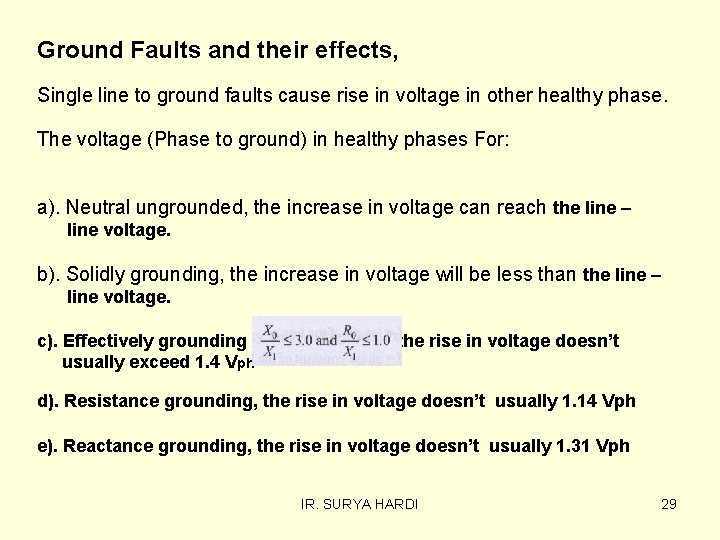
Ground Faults and their effects, Single line to ground faults cause rise in voltage in other healthy phase. The voltage (Phase to ground) in healthy phases For: a). Neutral ungrounded, the increase in voltage can reach the line – line voltage. b). Solidly grounding, the increase in voltage will be less than the line – line voltage. c). Effectively grounding usually exceed 1. 4 Vph the rise in voltage doesn’t d). Resistance grounding, the rise in voltage doesn’t usually 1. 14 Vph e). Reactance grounding, the rise in voltage doesn’t usually 1. 31 Vph IR. SURYA HARDI 29
Control of Over Voltages caused by Switching 1. Energization of transmission line in one or more steps by inserting resistances 2. Phase controlled closing of CB 3. Use of shunt reactor 4. Limiting switching surges by suitable surge diverter 5. Drainage of trapped charges before re-closing IR. SURYA HARDI 30
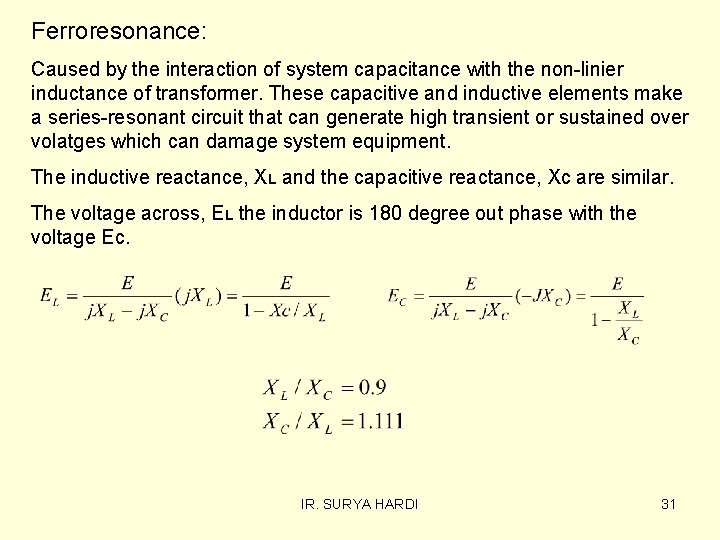
Ferroresonance: Caused by the interaction of system capacitance with the non-linier inductance of transformer. These capacitive and inductive elements make a series-resonant circuit that can generate high transient or sustained over volatges which can damage system equipment. The inductive reactance, XL and the capacitive reactance, Xc are similar. The voltage across, EL the inductor is 180 degree out phase with the voltage Ec. IR. SURYA HARDI 31
IR. SURYA HARDI 32