
Chapter 8 Overview Trademarks Patents Copyright Trade Secrets
- Slides: 12
Chapter 8 Overview • Trademarks • Patents • Copyright • Trade Secrets
Trademarks & Related Property � Trademark. ◦ Distinctive motto, mark or emblem. ◦ Stamped or affixed to a product. ◦ So that it can be identified in the market. 2
Trademarks & Related Property � Statutory Protection for Trademarks. ◦ Lanham Act of 1946 provides federal protection of manufacturers from loosing business to rivals that used confusingly similar brands and products. 3
Trademarks & Related Property �Trademark Registration. �Trademark Infringement. ◦ U. S. Patent and Trademark Office www. uspto. gov gives notice to 3 rd parties. ◦ A mark can be registered if in use or mark will be used within 6 months. ◦ Unintentional or intentional substantial copying of mark. 4
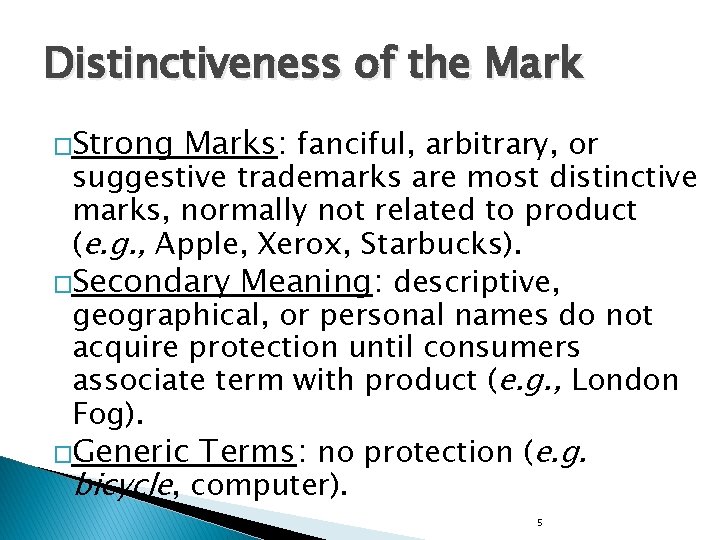
Distinctiveness of the Mark �Strong Marks: fanciful, arbitrary, or suggestive trademarks are most distinctive marks, normally not related to product (e. g. , Apple, Xerox, Starbucks). �Secondary Meaning: descriptive, geographical, or personal names do not acquire protection until consumers associate term with product (e. g. , London Fog). �Generic Terms: no protection (e. g. bicycle, computer). 5
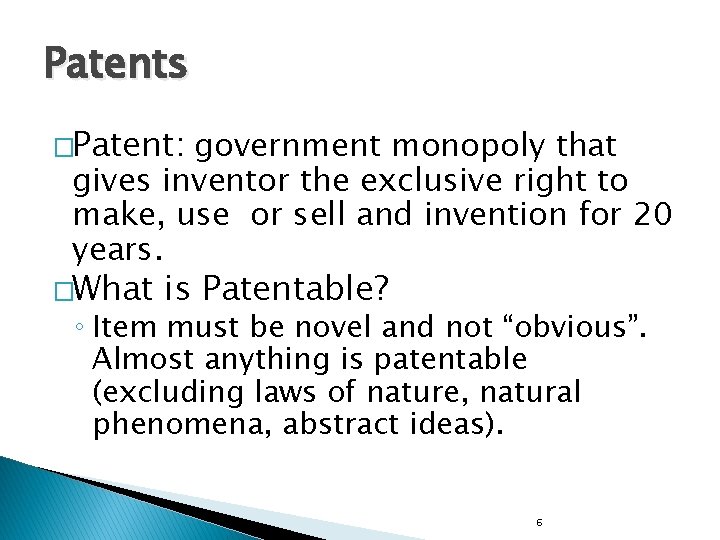
Patents �Patent: government monopoly that gives inventor the exclusive right to make, use or sell and invention for 20 years. �What is Patentable? ◦ Item must be novel and not “obvious”. Almost anything is patentable (excluding laws of nature, natural phenomena, abstract ideas). 6
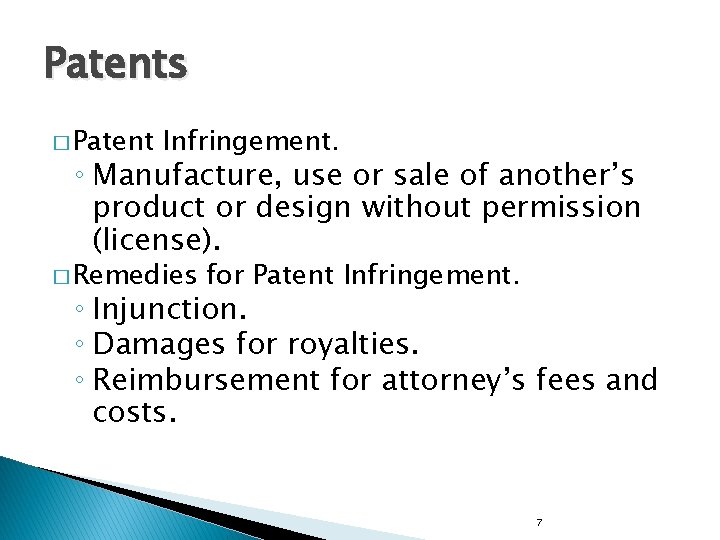
Patents � Patent Infringement. ◦ Manufacture, use or sale of another’s product or design without permission (license). � Remedies for Patent Infringement. ◦ Injunction. ◦ Damages for royalties. ◦ Reimbursement for attorney’s fees and costs. 7
Copyrights �Copyright is an intangible property right automatically granted by federal statute to the author for life plus 70 years. 8
Copyrights � What is Protected Expression? ◦ Work must be original and “fixed in a durable medium. ” Ideas are not protected, but the expression of an idea is. ◦ Mere compilation of facts is not protected. 9
Copyrights � Copyright Infringement. � Copyright Protection for Software. ◦ Form or expression is copied (does not have to be in its entirety). ◦ Penalties, damages and criminal action are possible. ◦ The “Fair Use” Exception: certain persons or organization can copy materials without penalty (e. g. , educational use, news, research). 10
Copyrights in Digital Information anytime a copyright work is downloaded and stored in RAM or hard drive without permission, there is infringement. � Digital media can easily be copied: � Copyright Act of 1976: ◦ Copy of a program into RAM is infringement. ◦ Revision or re-sale of freelance authors works can be infringement. 11
Trade Secrets �Trade secrets are confidential, not filed with the government. �Can be customer lists, formulas, pricing, etc. �Theft of trade secrets is now a federal crime under the Economic Espionage Act of 1996. �Cyberspace: employees can easily email information to competitors. 12