
Chapter 8 Organizational Strategy Effective Management by Williams
Chapter 8 Organizational Strategy Effective Management, by Williams South-Western College Publishing Copyright © 2002
What Would You Do? 2 Kodak’s Diversification Strategy 4 How can Kodak create a sustainable advantage over its competitors? 4 What are Kodak’s opportunities and threats? 4 What should their new strategy be? Effective Management, by Williams South-Western College Publishing Copyright © 2002
3 Learning Objectives Basics of Organizational Strategy After discussing this section, you should be able to: ¬ explain the components of sustainable competitive advantage and why it is important. describe the steps involved in the strategymaking process. Effective Management, by Williams South-Western College Publishing Copyright © 2002
Sustainable Competitive Advantage 4 4 Resources Tassets, capabilities, processes, information, & knowledge 4 Competitive advantage Tproviding greater customer value than competitors 4 Sustainable Competitive Advantage Twhen other firms cannot duplicate the value a firm is providing to customers Effective Management, by Williams South-Western College Publishing Copyright © 2002
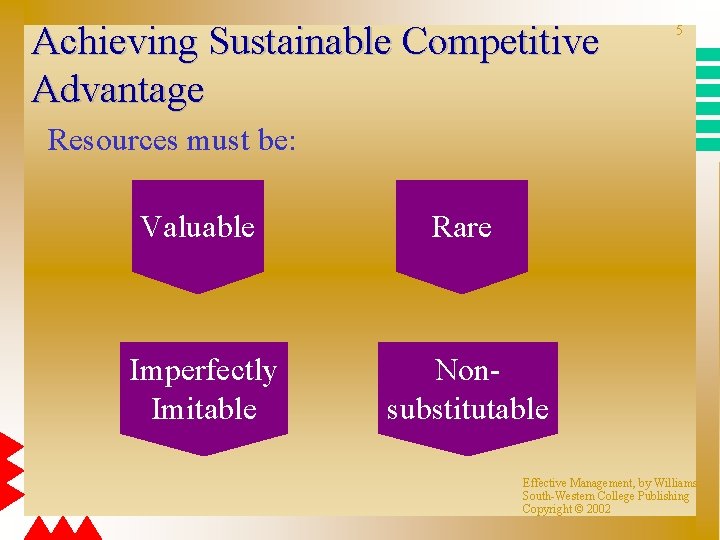
Achieving Sustainable Competitive Advantage 5 Resources must be: Valuable Rare Imperfectly Imitable Nonsubstitutable Effective Management, by Williams South-Western College Publishing Copyright © 2002
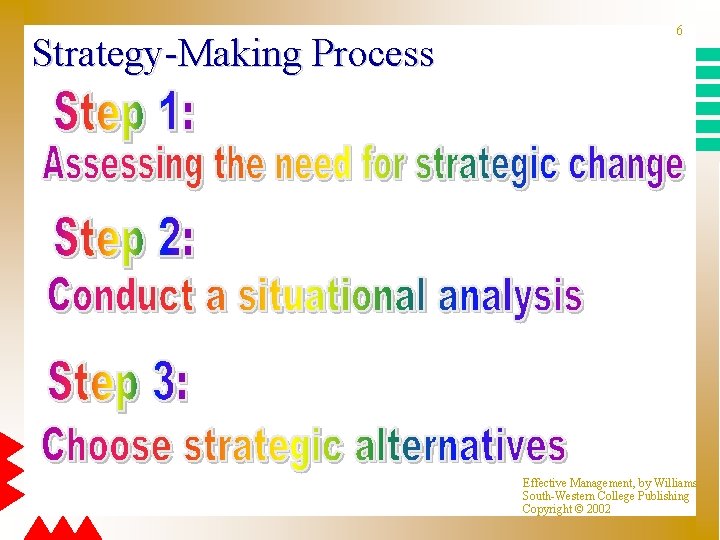
Strategy-Making Process 6 Effective Management, by Williams South-Western College Publishing Copyright © 2002
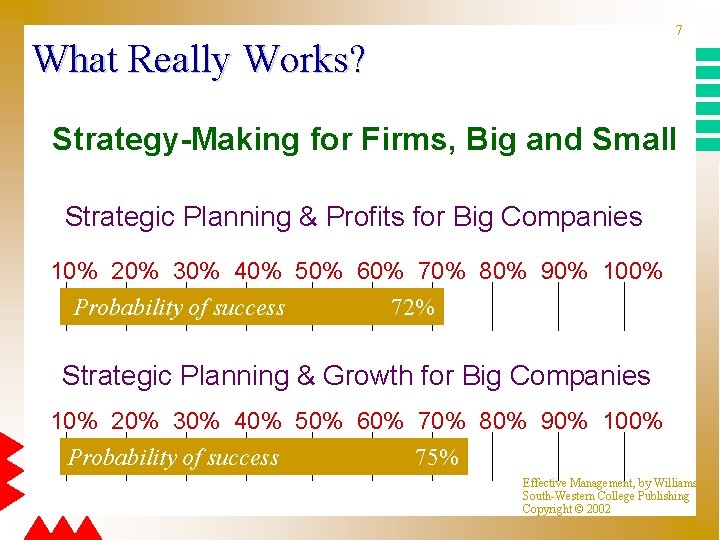
7 What Really Works? Strategy-Making for Firms, Big and Small Strategic Planning & Profits for Big Companies 10% 20% 30% 40% 50% 60% 70% 80% 90% 100% Probability of success 72% Strategic Planning & Growth for Big Companies 10% 20% 30% 40% 50% 60% 70% 80% 90% 100% Probability of success 75% Effective Management, by Williams South-Western College Publishing Copyright © 2002
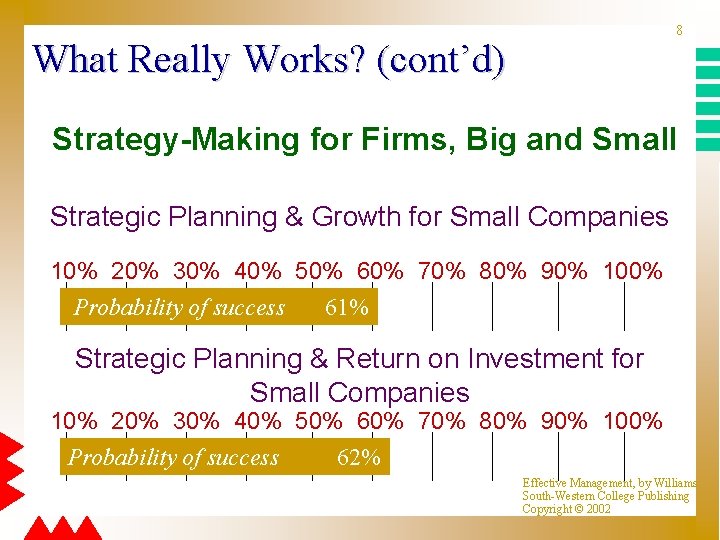
8 What Really Works? (cont’d) Strategy-Making for Firms, Big and Small Strategic Planning & Growth for Small Companies 10% 20% 30% 40% 50% 60% 70% 80% 90% 100% Probability of success 61% Strategic Planning & Return on Investment for Small Companies 10% 20% 30% 40% 50% 60% 70% 80% 90% 100% Probability of success 62% Effective Management, by Williams South-Western College Publishing Copyright © 2002
Assessing the Need for Strategic Change 9 4 Competitive Inertia Ta reluctance to change strategies or competitive practices that have been successful 4 Strategic Dissonance Tdiscrepancy between top management’s intended strategy and the actual strategy implemented by lower management Effective Management, by Williams South-Western College Publishing Copyright © 2002
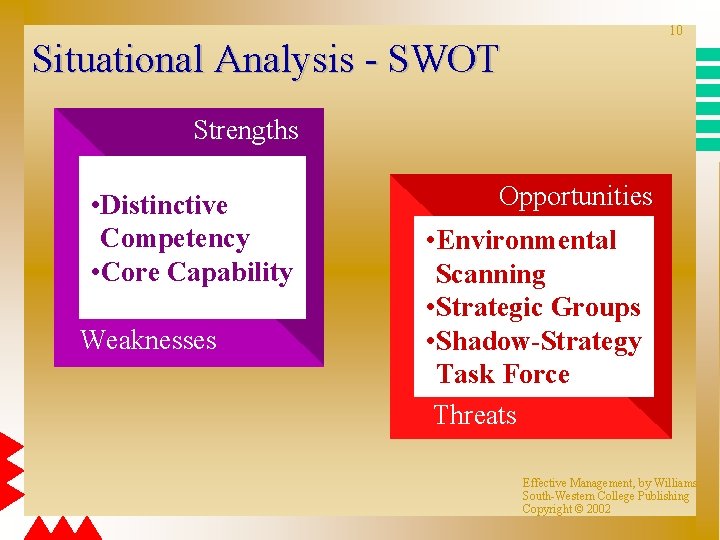
10 Situational Analysis - SWOT Strengths • Distinctive Competency • Core Capability Weaknesses Opportunities • Environmental Scanning • Strategic Groups • Shadow-Strategy Task Force Threats Effective Management, by Williams South-Western College Publishing Copyright © 2002
11 Strategic Groups 4 Core Firms Tcentral companies in a strategic group 4 Secondary Firms Tfirms that follow related, but somewhat different strategies than do core firms Effective Management, by Williams South-Western College Publishing Copyright © 2002
Choosing Strategic Alternatives 12 4 Risk-Avoiding Strategy Tprotect a competitive advantage 4 Risk-Seeking Strategy Tcreate a sustainable competitive advantage 4 Strategic Reference Points Ttargets used by managers to determine if the firm has a sustained competitive advantage Effective Management, by Williams South-Western College Publishing Copyright © 2002
Learning Objectives 13 Corporate-, Industry-, & Firm-Level Strategies After discussing this section, you should be able to: ®explain the different kinds of corporatelevel strategies. ¯describe the different kinds of industry-level strategies. °explain the components and strategies of firm-level competition. Effective Management, by Williams South-Western College Publishing Copyright © 2002
14 Corporate-Level Strategies Portfolio Strategy Grand Strategy Effective Management, by Williams South-Western College Publishing Copyright © 2002
15 Portfolio Strategy 4 Minimize risk by diversification 4 Acquisition Tthe company purchases another company 4 Unrelated diversification Tcreating or acquiring companies in completely unrelated businesses 4 BCG Matrix Effective Management, by Williams South-Western College Publishing Copyright © 2002
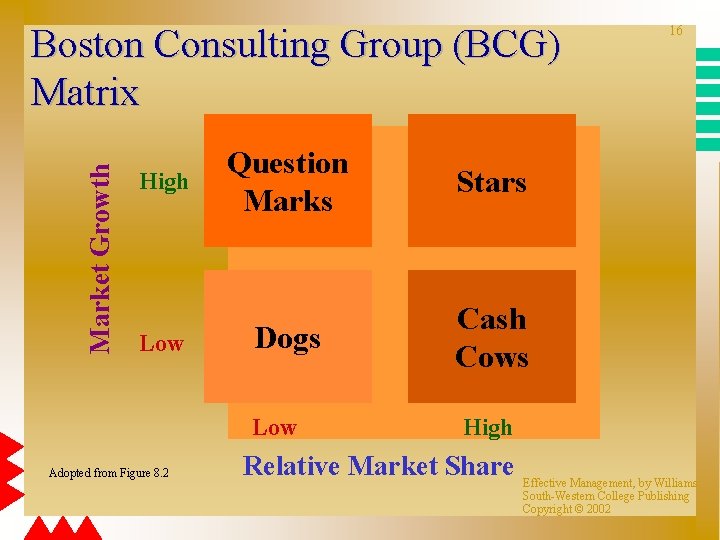
Market Growth Boston Consulting Group (BCG) Matrix High Low Question Marks Stars Dogs Cash Cows Low Adopted from Figure 8. 2 16 High Relative Market Share Effective Management, by Williams South-Western College Publishing Copyright © 2002
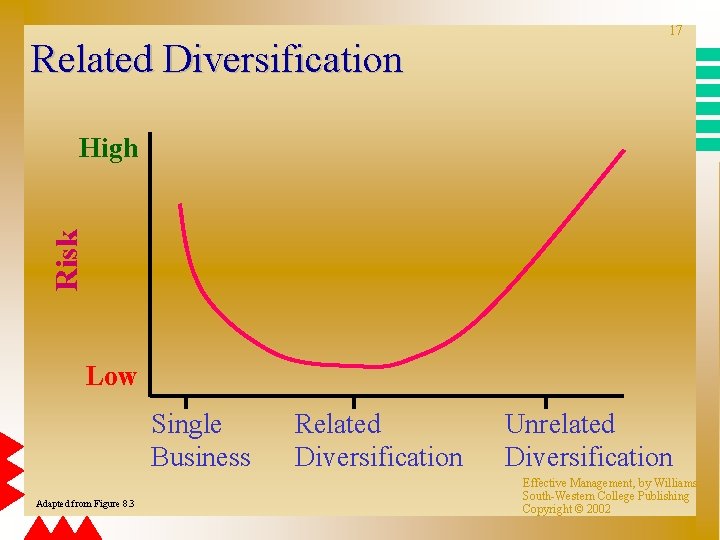
Related Diversification 17 Risk High Low Single Business Adapted from Figure 8. 3 Related Diversification Unrelated Diversification Effective Management, by Williams South-Western College Publishing Copyright © 2002
Grand Strategy 18 Effective Management, by Williams South-Western College Publishing Copyright © 2002
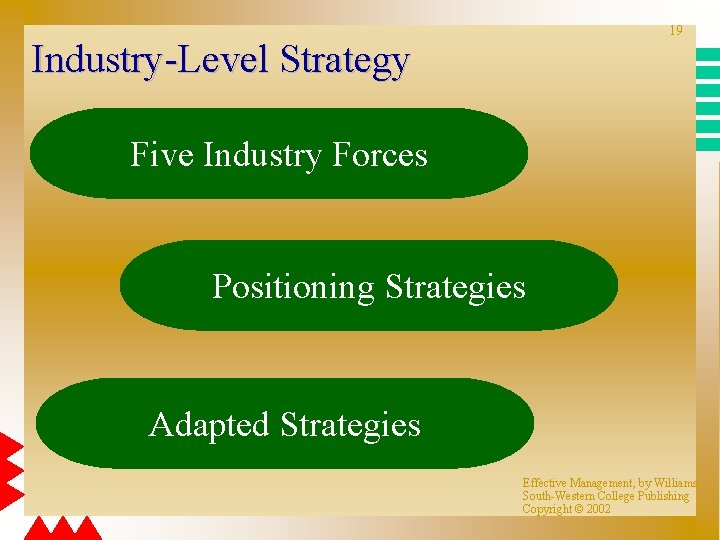
19 Industry-Level Strategy Five Industry Forces Positioning Strategies Adapted Strategies Effective Management, by Williams South-Western College Publishing Copyright © 2002
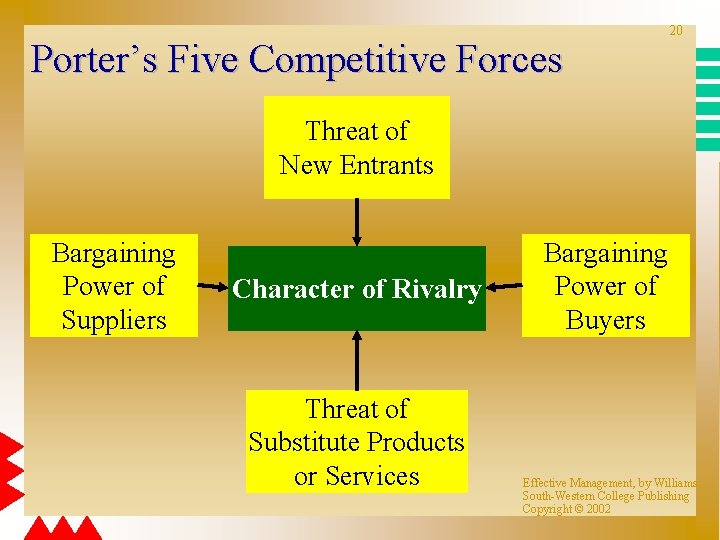
Porter’s Five Competitive Forces 20 Threat of New Entrants Bargaining Power of Suppliers Character of Rivalry Threat of Substitute Products or Services Bargaining Power of Buyers Effective Management, by Williams South-Western College Publishing Copyright © 2002
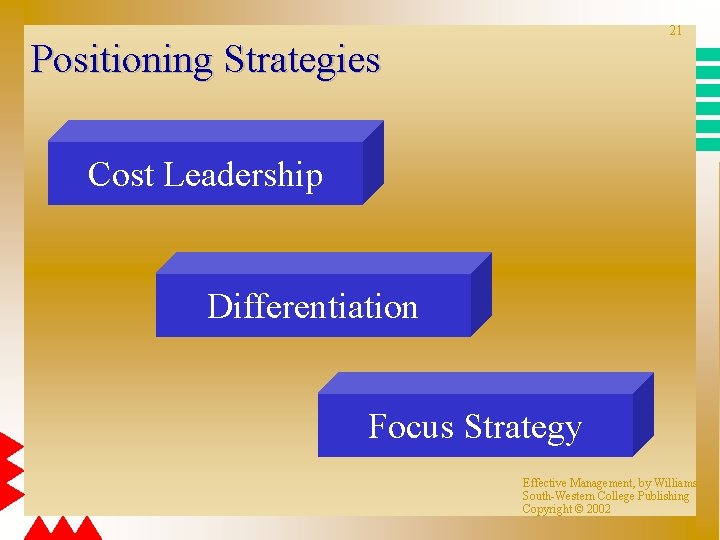
21 Positioning Strategies Cost Leadership Differentiation Focus Strategy Effective Management, by Williams South-Western College Publishing Copyright © 2002
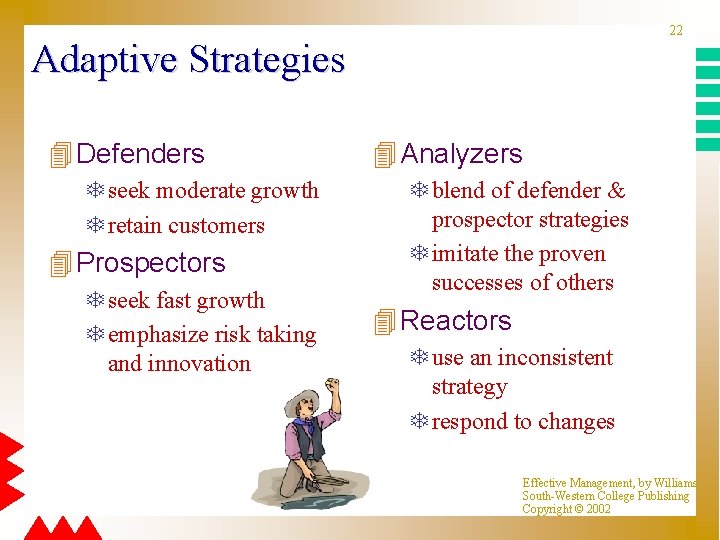
22 Adaptive Strategies 4 Defenders T seek moderate growth T retain customers 4 Prospectors T seek fast growth T emphasize risk taking and innovation 4 Analyzers T blend of defender & prospector strategies T imitate the proven successes of others 4 Reactors T use an inconsistent strategy T respond to changes Effective Management, by Williams South-Western College Publishing Copyright © 2002
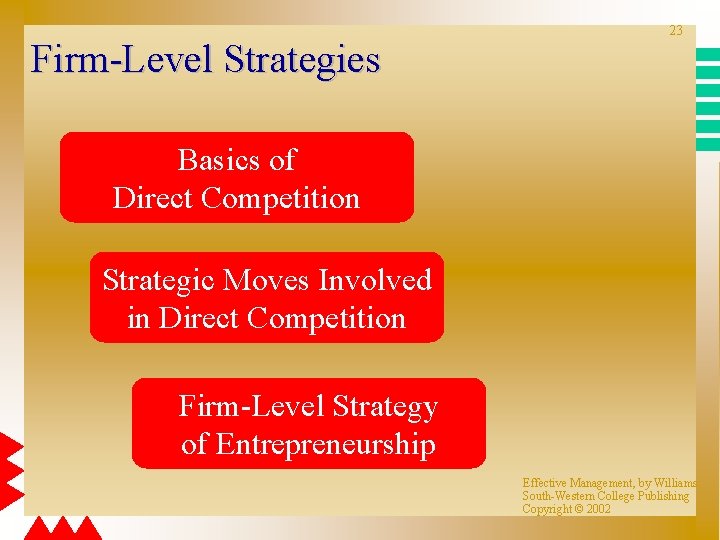
Firm-Level Strategies 23 Basics of Direct Competition Strategic Moves Involved in Direct Competition Firm-Level Strategy of Entrepreneurship Effective Management, by Williams South-Western College Publishing Copyright © 2002
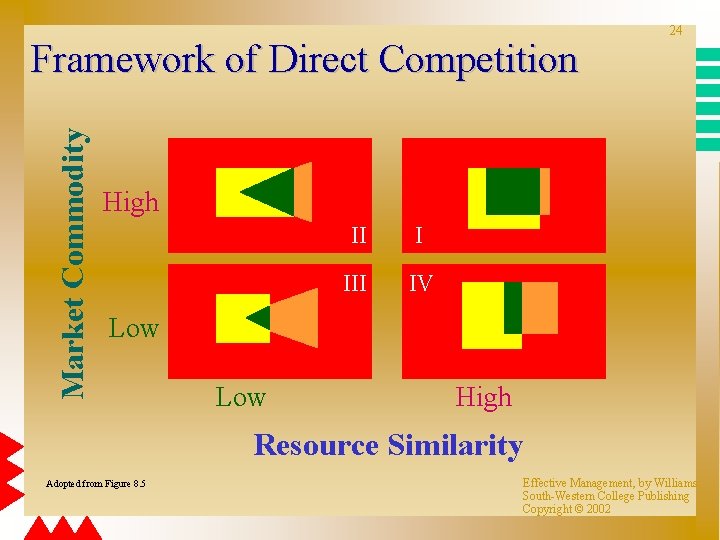
Market Commodity Framework of Direct Competition 24 High II I III IV Low High Resource Similarity Adopted from Figure 8. 5 Effective Management, by Williams South-Western College Publishing Copyright © 2002
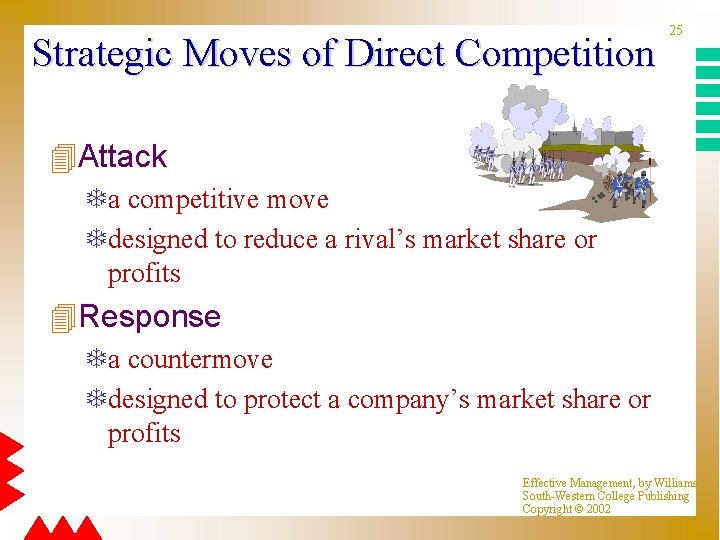
Strategic Moves of Direct Competition 25 4 Attack Ta competitive move Tdesigned to reduce a rival’s market share or profits 4 Response Ta countermove Tdesigned to protect a company’s market share or profits Effective Management, by Williams South-Western College Publishing Copyright © 2002
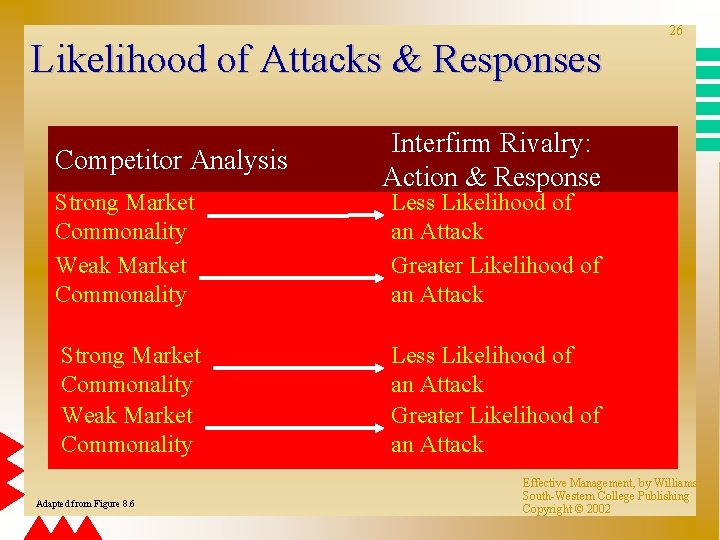
Likelihood of Attacks & Responses Competitor Analysis Strong Market Commonality Weak Market Commonality Adapted from Figure 8. 6 26 Interfirm Rivalry: Action & Response Less Likelihood of an Attack Greater Likelihood of an Attack Effective Management, by Williams South-Western College Publishing Copyright © 2002
27 Firm-Level Strategy 4 Entrepreneurship Tthe process of entering new or established markets Tuse new goods or services 4 Entrepreneurial Orientation Tset of processes, practices, and decision-making activities that lead to new entry Effective Management, by Williams South-Western College Publishing Copyright © 2002
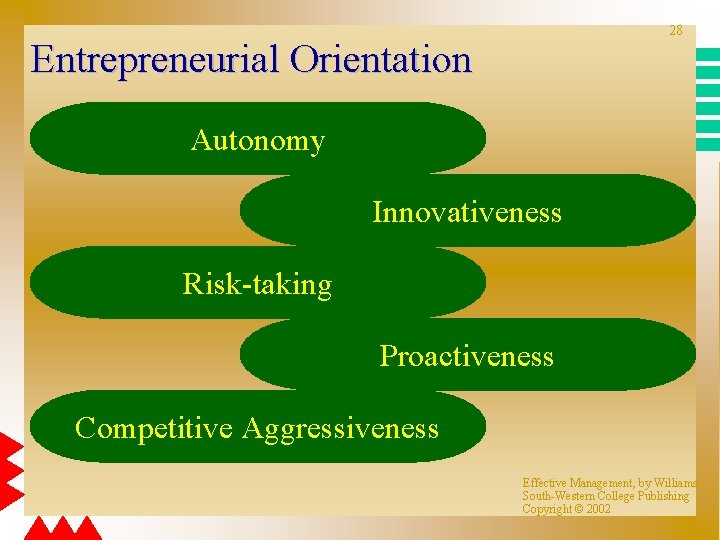
28 Entrepreneurial Orientation Autonomy Innovativeness Risk-taking Proactiveness Competitive Aggressiveness Effective Management, by Williams South-Western College Publishing Copyright © 2002
What Really Happened? 29 Kodak’s Strategy 4 Sustainable competitive advantage is not clearly evident 4 Investing in digital technology 4 Their business is imaging 4 From retrenchment to growth Effective Management, by Williams South-Western College Publishing Copyright © 2002
- Slides: 29