
Chapter 8 Options and Responses Options Potential choices


- Slides: 15
Chapter 8 � Options and Responses
Options � Potential choices in a driving situation › Based on a driver’s knowledge, experiences, and skills › Things to look for: Lines, colors, uncontrolled situations, and so forth
Comparisons � Determining � 1 st- your options Assess � 2 nd- Interpret � 3 rd- Evaluate � Lastly, you forecast the potential for hazards that may affect you
Questions to ask yourself � What if a vehicle slows or stops directly in front of me? � What if a traffic signals changes? � What if a vehicle moves into one of my blind spots? � What if I move into another vehicle’s blind spot? � What if a pedestrian enters the roadway?
Evaluate � Ask yourself these three questions to help make the best possible option › What is happening here? › What do I believe will happen next? › What can I do to increase the chance that nothing bad will happen to me?
Assumptions � Events you think or assume might happen › Ex: If you see the brake lights on the car ahead of you, you make an assumption that the car might stop
Choice � The selection between two or more possible options › Ex: selecting a route for travel, can be made before you start driving › Adjusting your speed › Ways to communicate with others
SMITH SYSTEM
AIM HIGH IN STEERING � Look FAR (12 -15 seconds) ahead into your target area
HOW OFTEN SHOULD YOU CHECK YOUR MIRRORS?
KEEP YOUR EYES MOVING �USE AN ORDERLY VISUAL SEARCH › Look far 12 -15 sec. zone › Look near 4 -6 second zone › Check mirrors and gauges › Repeat every 8 -10 seconds
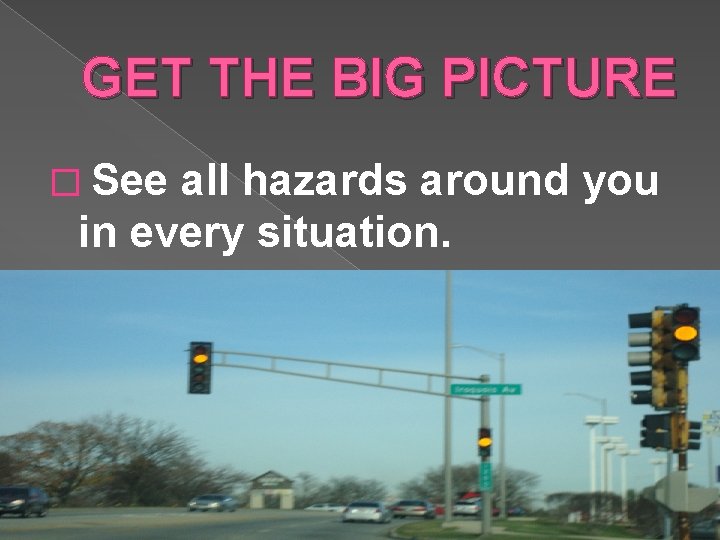
GET THE BIG PICTURE � See all hazards around you in every situation.
MAKE SURE OTHERS SEE YOU � Use lane position, Signals, zone control, and gestures to make sure you are seen by others.
LEAVE YOURSELF AN OUT � Keep as many open zones as possible � The only zone that you can truly control is your front zone. Make sure that you have AT LEAST a 2 -second following distance.