
Chapter 8 Nursing Care of Women with Complications
- Slides: 53
Chapter 8 Nursing Care of Women with Complications During Labor and Birth
Obstetric Procedures • Amniotomy – The artificial rupture of membranes • Physician or nurse mdwife • Nurses care for woman and fetus afterwards – Done to stimulate or enhance contractions or to permit internal fetal monitoring – Commits the woman to delivery – Stimulates prostaglandin secretion – stimulates labor – Complications d/t loss of amniotic fluid • Prolapse of the umbilical cord: Occurs if cord slips downward with gush of fluid • Infection • Abruptio placentae: uterus is overdistended with AF when membranes rupture and becomes smaller with dc of fluid – placenta no longer fits implantation site
Obstetric Procedures (cont. ) • Observe for complications post-amniotomy – FHR monitored for 1 minute after amniotomy – FHR outside normal range (110 -160 beats/min) suggests umbilical cord prolapse – Observe color, odor, amount, and character of amniotic fluid – Woman’s temperature 38°C (100. 4°F) or higher is suggestive of infection – Increase in FHR above 160 bpm may accompany woman’s temp increase – Green fluid may indicate that the fetus has passed a meconium stool – respiratory distress risk after birth
Induction or Augmentation of Labor • Induction is the initiation of labor before it begins naturally • Augmentation is the stimulation of contractions after they have begun naturally – Fetal maturity must be confirmed before labor by ultrasound amniotic fluid analysis to determine fetal lung maturity
Indications for Labor Induction • If continuing the preg is • Fetal problems such as hazardous for the woman slowed growth, or the fetus prolonged pregnancy, or incompatibility between • Gestational hypertension fetal and maternal blood • Ruptured membranes types without spontaneous onset • Placental insufficiency of labor • Fetal death • Infection within the uterus • Medical problems in the woman that worsen during pregnancy (diabetes, kidney/ pulmonary disease)
Contraindications to Labor Induction • Placenta previa • Active herpes infection in the birth • Umbilical cord canal prolapse • Abnormal size or • Abnormal fetal structure of the presentation mother’s pelvis • High station of the • Previous classic fetus (suggests: (vertical) cesarean preterm infant or small incision maternal pelvis)
Technique • Amniotomy • Oxytocin (Pitocin) – stimulate contractions • Pharmacological and nonpharmacological methods
Pharmacological Methods to Stimulate Contractions • Cervical ripening – Easier if cervix is soft, partially effaced/dilated – Oxytocic drugs have no effect on the cervix – Prostaglandin in a gel or vaginal insert is applied before labor induction to soften the cervix • SL, BR for 1 -2 hrs, V/S, FHR – Laminaria is an alternative to cervical ripening by swelling inside the cervix – Foley bulb inserted into cervix • Oxytocin induction and the augmentation of labor – Most commonly used method – Administered by RN – Used to initiate or stimulate contractions – Begins at a slow rate and increases depending on progression
Benefit of Augmentation • Usually requires less total oxytocin than induction • Uterus is more sensitive to the drug when labor has already begun
Nonpharmacological Methods to Stimulate Contractions • Walking – Stimulates contractions – Eases pressure of the fetus on the mother’s back – Adds gravity to the downward force of contraction • Upright positions (chair, squat, kneel) • Nipple stimulation of labor – Causes the pituitary gland to secrete natural oxytocin – Improves quality of contractions that have slowed or weakened
Complications of Oxytocin Induction and Augmentation of Labor • Most common is related to – Overstimulation of contractions • Fetal compromise – blood flow to placenta is reduced with excessive contractions • Uterine rupture • Water intoxication – Inhibits excretion of urine and promotes fluid retention • Oxytocin is dc or reduced, Primary IVF increased, Position change, Oxygen, FHR, notify HCP
Version • Method of changing fetal presentation, usually from breech to cephalic • Internal or External • Not indicated if any maternal or fetal reason why vaginal birth should not occur • Do not attempt with women who are at risk for uterine rupture or presenting fetal part is engaged in pelvis • Risk to fetus – may become entangled in umbilical cord
Episiotomy and Lacerations • Episiotomy: surgical enlargement of the vagina during birth • Laceration: uncontrolled tear of the tissues that result in a jagged wound
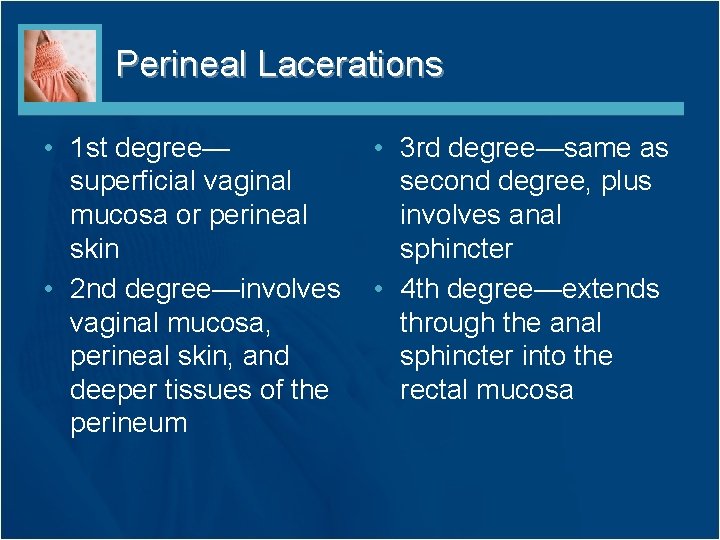
Perineal Lacerations • 1 st degree— superficial vaginal mucosa or perineal skin • 2 nd degree—involves vaginal mucosa, perineal skin, and deeper tissues of the perineum • 3 rd degree—same as second degree, plus involves anal sphincter • 4 th degree—extends through the anal sphincter into the rectal mucosa
Indications for an Episiotomy • Better control over where and how much the vaginal opening is enlarged • An opening with a clean edge rather than the ragged opening of a tear • Perineal massage and stretching exercises before labor may be an alternative to an episiotomy
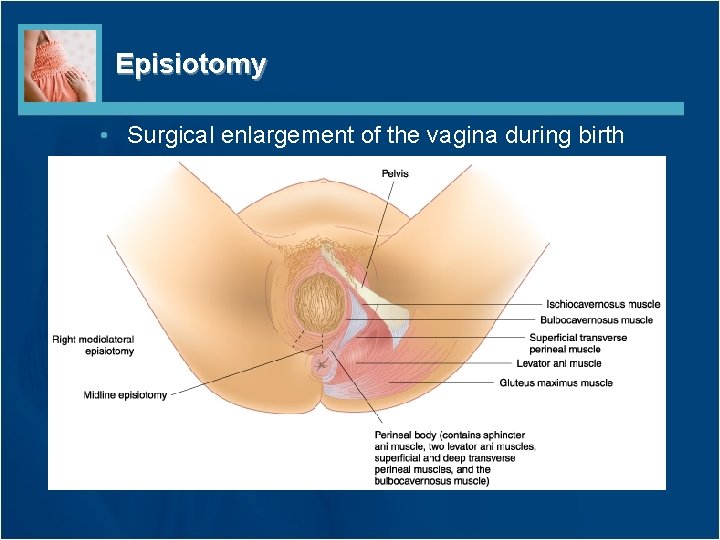
Episiotomy • Surgical enlargement of the vagina during birth
Episiotomy – Nursing Care • Primary risk: Infection • Cold packs should be applied to the perineum for at least the first 12 hrs – Reduces pain, bruising, edema • After 12 -24 hrs, sitz baths to increase blood circulation, enhance comfort and healing • Dermaplast
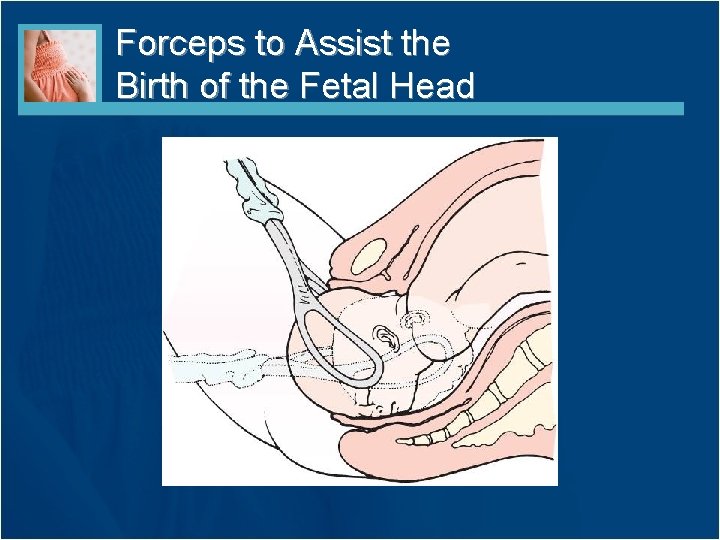
Forceps Extraction • Provides traction and rotation of the fetal head when the mother’s pushing efforts are insufficient to accomplish a safe delivery • Forceps may also help the physician extract the fetal head through the incision during a cesarean birth
Forceps to Assist the Birth of the Fetal Head
Vacuum Extraction Birth • Uses suction applied to the fetal head so the physician can assist the mother’s expulsive efforts • Used only with occiput presentation • Advantage: does not take up room in the mother’s pelvis, as forceps do
Forceps and Vacuum Extraction Births • Indications – Exhausted, unable to push effectively – Cardiac or pulmonary diseases – Cervix fully dilated, ROM, bladder empty, +2 station • Contraindications – Cannot substitute cesarean – More trauma than cesarean – fetus high in pelvis or large
Risks of Forceps or Vacuum Extraction • Trauma to maternal or fetal tissues • Mother may have a laceration or hematoma in her vagina • Infant may have bruising, facial or scalp lacerations or abrasions, cephalhematoma, or intracranial hemorrhage, damage to facial nerve • Check facial symmetry Nursing Tip: Reassure parents that these marks are temporary and usually resolve without treatment
Cesarean Birth • The surgical delivery of the fetus through incisions in the mother’s abdomen and uterus • Contraindications – Fetus is dead or too premature to survive – Mother has abnormal blood clotting
Indications for Cesarean Birth • Abnormal labor • Inability of the fetus to pass through the mother’s pelvis • Maternal conditions such as GH or DM • Active maternal herpes virus • Previous surgery on the uterus • Fetal compromise – Umbilical cord prolapse or abnormal presentations • Placenta previa or abruptio placentae
Risks of Cesarean Birth • Mother – Anesthesia – Respiratory complications – Hemorrhage – Blood clots – Injury to urinary tract – Delayed intestinal peristalsis – Infection • Neonate – Inadvertent preterm birth – Respiratory problems because of delayed absorption of lung fluid – Injury
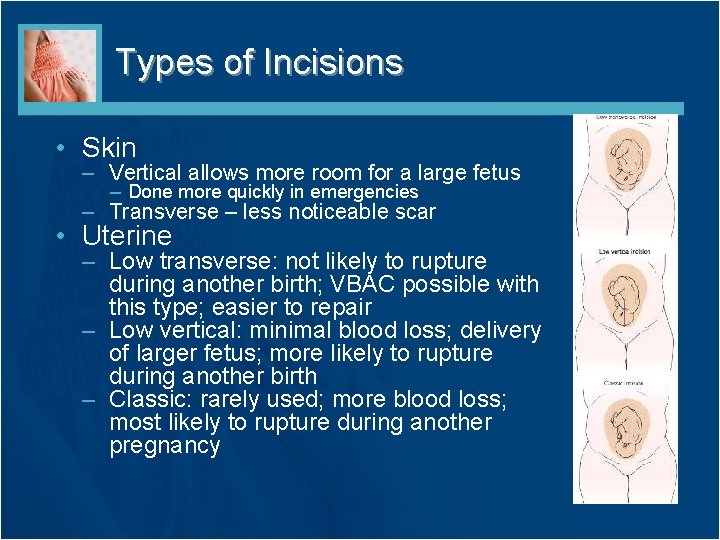
Types of Incisions • Skin – Vertical allows more room for a large fetus – Done more quickly in emergencies – Transverse – less noticeable scar • Uterine – Low transverse: not likely to rupture during another birth; VBAC possible with this type; easier to repair – Low vertical: minimal blood loss; delivery of larger fetus; more likely to rupture during another birth – Classic: rarely used; more blood loss; most likely to rupture during another pregnancy
Nursing Care in the Recovery Room • Vital signs to identify hemorrhage or shock • IV site and rate of solution flow • Fundus for firmness, height, and midline position • Dressing for drainage • Lochia for quantity, color, and presence of clots • Urine output from the indwelling catheter
Safety Alert • Although assessing the uterus after cesarean birth causes discomfort, it is important to do so regularly • The woman can have a relaxed uterus that causes excessive blood loss, regardless of how she delivered her child
Risk Factors for Dysfunctional Labor • Advanced maternal age • Obesity • Overdistention of uterus – Hydramnios or multifetal pregnancy • • • Abnormal presentation Cephalopelvic disproportion (CPD) Overstimulation of the uterus Maternal fatigue, dehydration, fear Lack of analgesic assistance
Problems with the Powers of Labor • Hypertonic – Increased tone • Hypotonic – Decreased tone – Less common than hypotonic – Most common – Too weak to be effective during active labor Differences pg. 186 Box 8 -1
Problems with Labor • Medical tx - mild sedation to allow rest • Nursing Care – Promote comfort measures that promote rest and relaxation • • Uncomfortable and frustrated Anxious over lack of progress Fatigued r/t pain Loose confidence
Ineffective Maternal Pushing • Woman may not understand which technique to use or fears tearing her perineal tissues • Epidural or subarachnoid blocks may depress or eliminate the natural urge to push • An exhausted woman may be unable to gather enough energy to push – Coach women about most effective techniques for pushing – Promote relaxation, relieve fatigue, change positions, increase hydration
Fetal Size • Macrosomia—large fetus; weighs more than 4000 g (8. 8 pounds) – May not fit through birth canal – Can contribute to hypotonic labor dysfunction • Shoulder dystocia – After delivery, mother and infant need to be assessed for injuries – Mother may have torn perineal tissue – More at risk for uterine atony and postpartum hemorrhage • Uterus does not contract well after birth – Infant may have fractured clavicle – Nurse may apply firm downward pressure to push shoulders toward the pelvic canal
Abnormal Presentations • Does not pass easily • Interferes with most efficient mechanisms of labor • Can cause cord compression between fetal head and mothers pelvis • Common cause is a fetus that remains in a persistent occiput posterior position • Labor may last longer • Woman may experience intense and poorly relieved back and leg pain bc occiput posterior position • May require forceps-assisted delivery
Nursing Care for Abnormal Fetal Presentation or Positions • Encourage woman to assume positions that favor fetal rotation and descent and reduce back pain – Sitting, kneeling, or standing while leaning forward – Rocking the pelvis back and forth while on hands and knees (encourages rotation) – Side-lying – Squatting (in second stage of labor) – Lunging by placing one foot in a chair with the foot and knee pointed to that side
Multifetal Pregnancy • May cause dysfunctional labor • Uterine overdistention contributes to poor contraction quality • Abnormal presentation or position of one or more fetuses interferes with labor mechanisms • Often one fetus is delivered as cephalic and the second as breech, unless a version is done
Multifetal Nursing Care • Monitor each fetus separately • Prepare equipment and medications for each fetus • Anesthesiologist and pediatrician is often present at birth d/t potential complications • One nurse should be available for each infant
Problems with the Pelvis and Soft Tissues • Bony pelvis – Gynecoid pelvis most favorable for vaginal birth • Soft tissue obstructions – Most common is a full bladder – Encourage urination every 1 -2 hours – Cath used if unable to urinate d/t anesthetics or large quantities of IV fluids
The Psyche • Most common factors that can prolong labor – – Lack of analgesic control of excessive pain Absence of a support person or coach Immobility and restriction to bed Lack of ability to carry out cultural traditions
Increased Anxiety • Causes hormones to be released – Epinephrine – Cortisol – Adrenocorticotropic • Reduces contractility of the smooth muscle
Precipitate Birth • A birth that is completed • Fetal oxygenation may be compromised in less than 3 hours • Birth injury may occur • Labor begins abruptly from rapid passage and intensifies quickly through the birth canal • Contractions may be • Injuries can include frequent and intense – Intracranial • May have uterine hemorrhage rupture, cervical – Nerve damage lacerations, or hematoma
Premature Rupture of Membranes (PROM) • Spontaneous rupture of membranes at term, more than 1 hour before labor contractions begin • Vaginal or cervical infection may cause PROM • Diagnosis confirmed by – Nitrazine paper test • Turns blue in the presence of amniotic fluid – Looking for a “ferning” pattern from vaginal fluid placed on a slide and viewed under the microscope
Patient Teaching for a Woman with Infection or in Preterm Labor • Report a temperature that is above 38° C (100. 4° F) • Avoid sexual intercourse or insertion of anything into vagina • Avoid orgasms, stimulates contractions • Avoid breast stimulation • Maintain any activity restrictions prescribed • Note any uterine contractions, reduced fetal activity, and other signs of infection • Record fetal kick counts daily and report fewer than 10 kicks in a 12 -hour period
Preterm Labor 20 -37 Weeks • Contractions that may be either uncomfortable or painless • Feeling that the fetus is “balling up” frequently • Menstrual-like cramps • Constant low backache • Pelvic pressure or a feeling that the fetus is pushing down • A change in vaginal discharge • Abdominal cramps with or without diarrhea • Pain or discomfort in the vulva or thighs • “Just feeling bad” or “coming down with something”
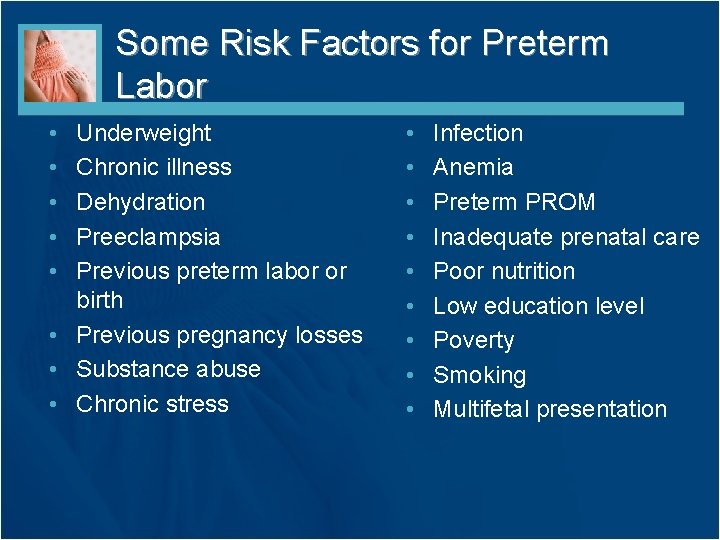
Some Risk Factors for Preterm Labor • • • Underweight Chronic illness Dehydration Preeclampsia Previous preterm labor or birth • Previous pregnancy losses • Substance abuse • Chronic stress • • • Infection Anemia Preterm PROM Inadequate prenatal care Poor nutrition Low education level Poverty Smoking Multifetal presentation
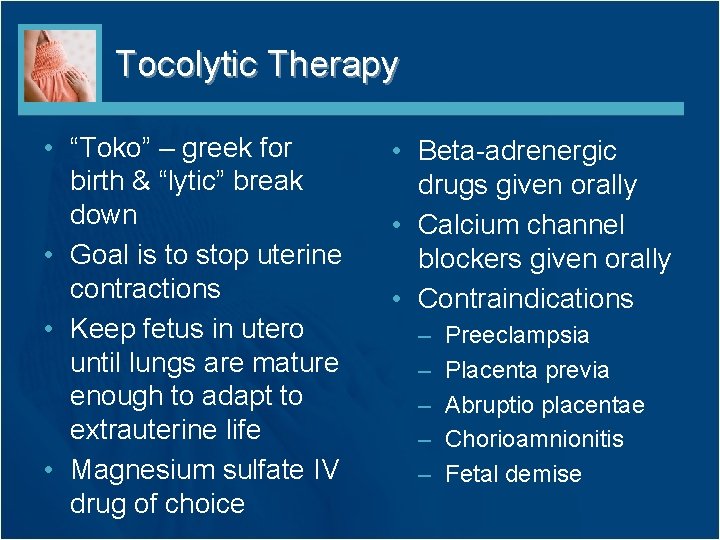
Tocolytic Therapy • “Toko” – greek for birth & “lytic” break down • Goal is to stop uterine contractions • Keep fetus in utero until lungs are mature enough to adapt to extrauterine life • Magnesium sulfate IV drug of choice • Beta-adrenergic drugs given orally • Calcium channel blockers given orally • Contraindications – – – Preeclampsia Placenta previa Abruptio placentae Chorioamnionitis Fetal demise
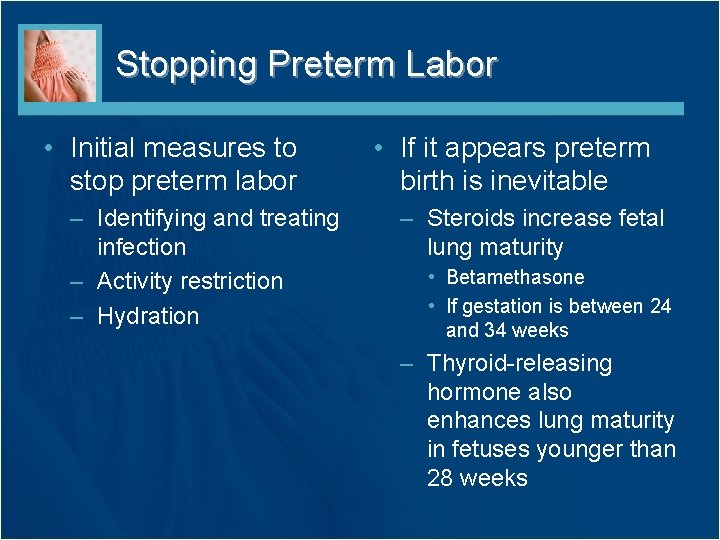
Stopping Preterm Labor • Initial measures to stop preterm labor – Identifying and treating infection – Activity restriction – Hydration • If it appears preterm birth is inevitable – Steroids increase fetal lung maturity • Betamethasone • If gestation is between 24 and 34 weeks – Thyroid-releasing hormone also enhances lung maturity in fetuses younger than 28 weeks
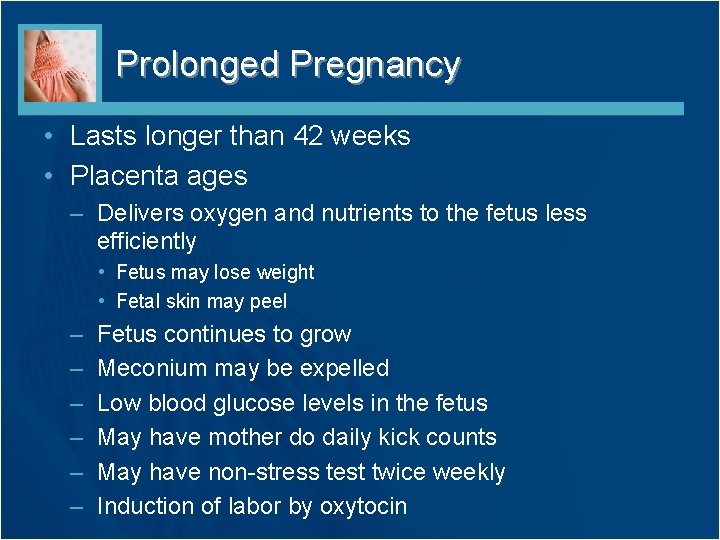
Prolonged Pregnancy • Lasts longer than 42 weeks • Placenta ages – Delivers oxygen and nutrients to the fetus less efficiently • Fetus may lose weight • Fetal skin may peel – – – Fetus continues to grow Meconium may be expelled Low blood glucose levels in the fetus May have mother do daily kick counts May have non-stress test twice weekly Induction of labor by oxytocin
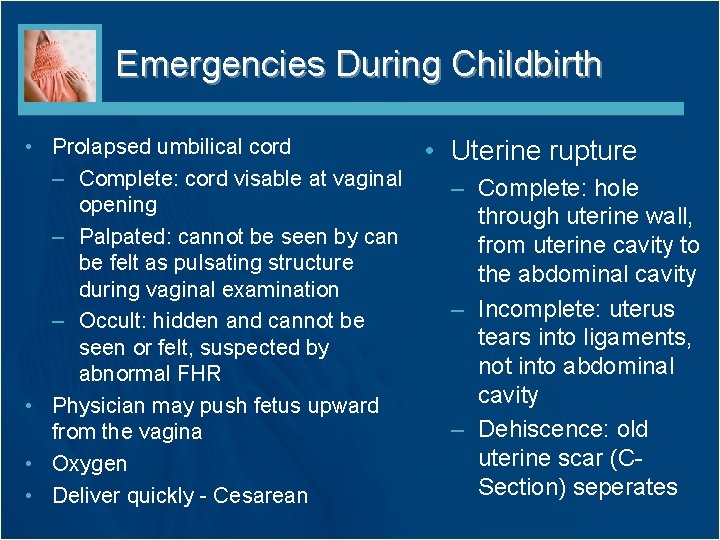
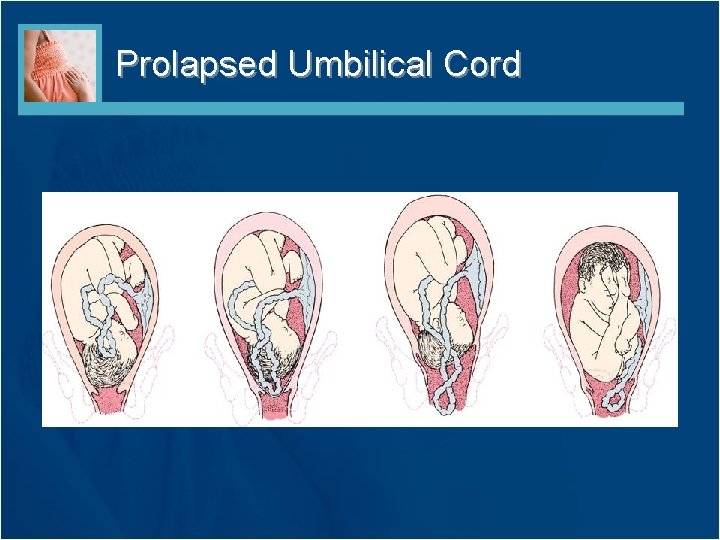
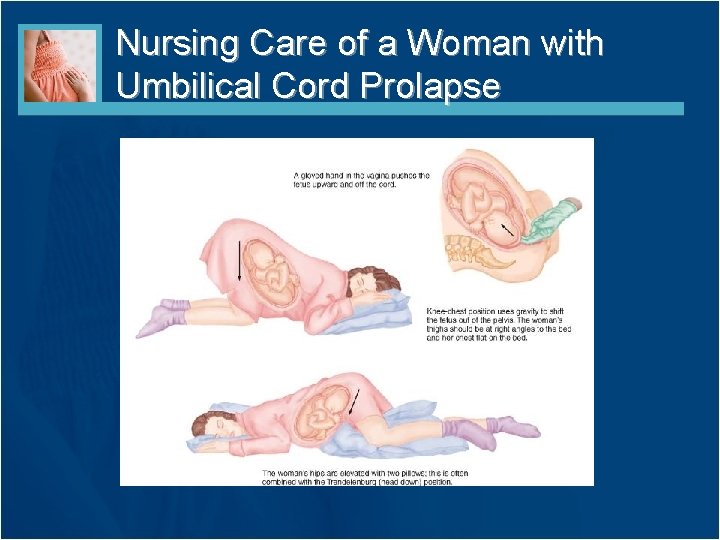
Emergencies During Childbirth • Prolapsed umbilical cord – Complete: cord visable at vaginal opening – Palpated: cannot be seen by can be felt as pulsating structure during vaginal examination – Occult: hidden and cannot be seen or felt, suspected by abnormal FHR • Physician may push fetus upward from the vagina • Oxygen • Deliver quickly - Cesarean • Uterine rupture – Complete: hole through uterine wall, from uterine cavity to the abdominal cavity – Incomplete: uterus tears into ligaments, not into abdominal cavity – Dehiscence: old uterine scar (CSection) seperates
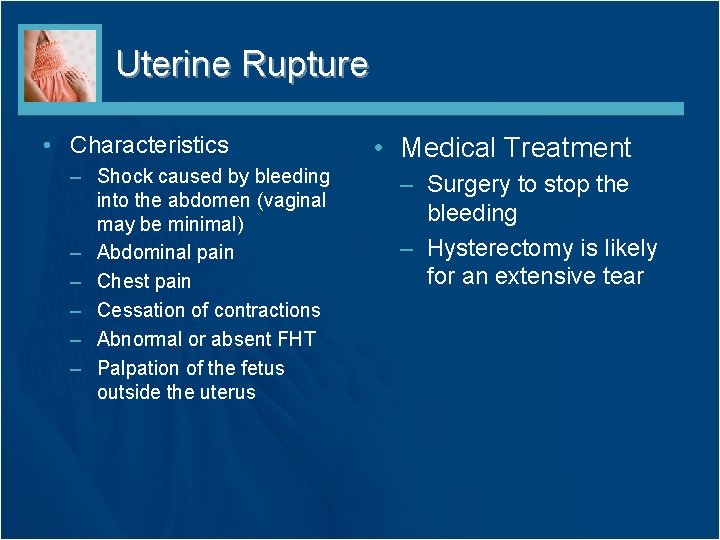
Uterine Rupture • Characteristics – Shock caused by bleeding into the abdomen (vaginal may be minimal) – Abdominal pain – Chest pain – Cessation of contractions – Abnormal or absent FHT – Palpation of the fetus outside the uterus • Medical Treatment – Surgery to stop the bleeding – Hysterectomy is likely for an extensive tear
Prolapsed Umbilical Cord
Nursing Care of a Woman with Umbilical Cord Prolapse
Elsevier items and derived items © 2011, 2007, 2006 by Saunders, an imprint of Elsevier Inc. 53