
Chapter 8 Nucleophilic Substitution 8 1 Functional Group
Chapter 8: Nucleophilic Substitution 8. 1: Functional Group Transformation By Nucleophilic Substitution Nucleophiles are Lewis bases (electron-pair donor) Nucleophiles are often negatively charged (more reactive) and used as their Li+, Na+, or K+ salt Nucelophiles react with alkyl halide (electrophile) to give substitution products. The carbon bearing the halogen (C–X) must be sp 3 hybridized alkenyl (vinyl) and aryl halides do not undergo nucleophilc substitution reactions 182
Reactions of an alkyl halide. . . with an alkoxide affords an ether . . . with an carboxylate anion affords an ester . . . with cyanide anion affords nitriles . . . with azide anion affords alkyl azides 183
8. 2: Relative Reactivity of Halide Leaving Groups The leaving group is usually displaced with a negative charge The best leaving groups are those with atoms or groups that can best stabilize a negative charge. Good leaving groups are the conjugate bases of strong acids H-X H+ + X- the lower the p. Ka of H-X, the stronger the acid. 184
Increasing reactivity in the nucleophilic substitution reactions LG: HO-, H 2 N-, RO- Relative Reactivity: p. Ka: F- Cl- Br- I- <<1 1 200 10, 000 30, 000 >15 3. 1 -3. 0 -5. 8 -10. 4 Charged Leaving Groups: conversion of a poor leaving group to a good one p. Ka of H 3 O+= -1. 7 185
![8. 3: The SN 2 Mechanism of Nucleophilic Substitution If [OH-] is doubled, then](http://slidetodoc.com/presentation_image/4d6f1083ef6871c7bff9316e7bdcfe2b/image-5.jpg "8. 3: The SN 2 Mechanism of Nucleophilic Substitution If [OH-] is doubled, then")
8. 3: The SN 2 Mechanism of Nucleophilic Substitution If [OH-] is doubled, then the reaction rate may be doubled If [CH 3 -Br] is doubled, then the reaction rate may be doubled The rate is linearly dependent on the concentration of two reactants is called a second-order reaction (bimolecular) For the disappearance of reactants: rate = k [CH 3 Br] [OH-] [CH 3 Br] = CH 3 Br concentration [OH-] = OH- concentration k= constant (rate constant) 186
The displacement of a leaving group in an SN 2 reaction has a defined stereochemistry (Walden Inversion) The rate of the SN 2 reaction is dependent upon the concentration of reactants; thus, the transition state for product formation must involve both reactants and explain the stereospecificity. 187
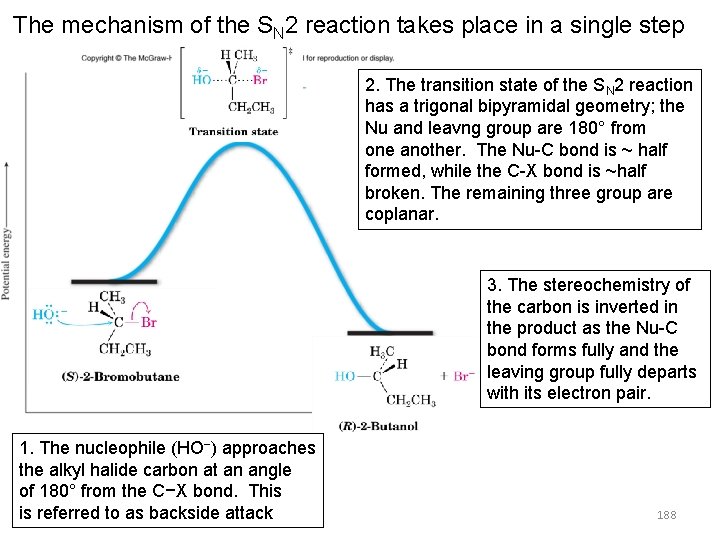
The mechanism of the SN 2 reaction takes place in a single step 2. The transition state of the SN 2 reaction has a trigonal bipyramidal geometry; the Nu and leavng group are 180° from one another. The Nu-C bond is ~ half formed, while the C-X bond is ~half broken. The remaining three group are coplanar. 3. The stereochemistry of the carbon is inverted in the product as the Nu-C bond forms fully and the leaving group fully departs with its electron pair. 1. The nucleophile (HO−) approaches the alkyl halide carbon at an angle of 180° from the C−X bond. This is referred to as backside attack 188
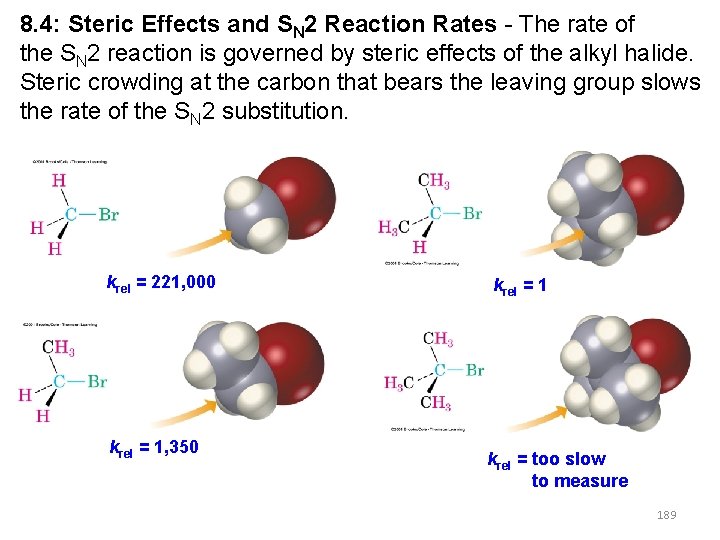
8. 4: Steric Effects and SN 2 Reaction Rates - The rate of the SN 2 reaction is governed by steric effects of the alkyl halide. Steric crowding at the carbon that bears the leaving group slows the rate of the SN 2 substitution. krel = 221, 000 krel = 1, 350 krel = 1 krel = too slow to measure 189
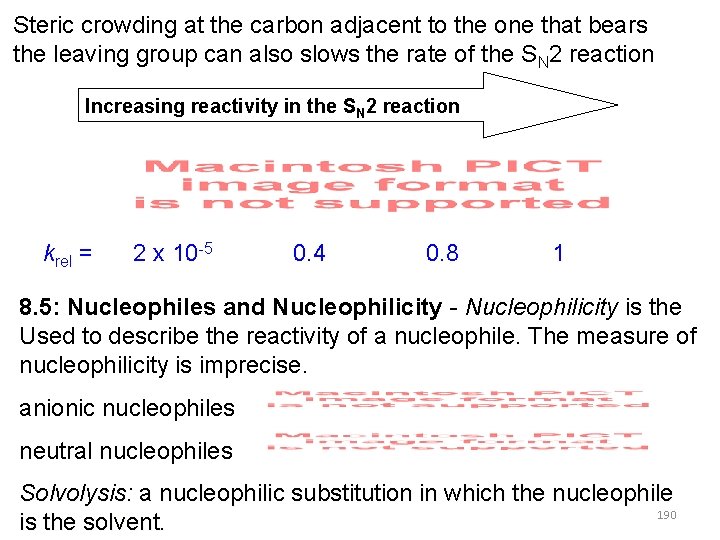
Steric crowding at the carbon adjacent to the one that bears the leaving group can also slows the rate of the SN 2 reaction Increasing reactivity in the SN 2 reaction krel = 2 x 10 -5 0. 4 0. 8 1 8. 5: Nucleophiles and Nucleophilicity - Nucleophilicity is the Used to describe the reactivity of a nucleophile. The measure of nucleophilicity is imprecise. anionic nucleophiles neutral nucleophiles Solvolysis: a nucleophilic substitution in which the nucleophile 190 is the solvent.
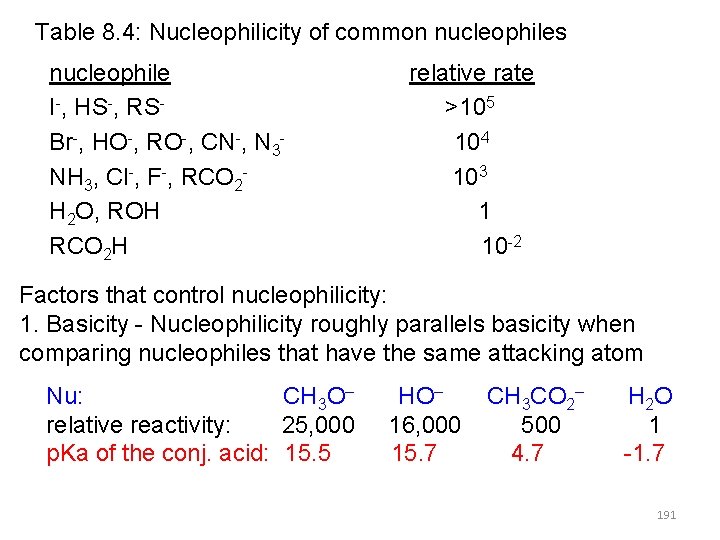
Table 8. 4: Nucleophilicity of common nucleophiles nucleophile I-, HS-, RSBr-, HO-, RO-, CN-, N 3 NH 3, Cl-, F-, RCO 2 H 2 O, ROH RCO 2 H relative rate >105 104 103 1 10 -2 Factors that control nucleophilicity: 1. Basicity - Nucleophilicity roughly parallels basicity when comparing nucleophiles that have the same attacking atom Nu: CH 3 O– relative reactivity: 25, 000 p. Ka of the conj. acid: 15. 5 HO– 16, 000 15. 7 CH 3 CO 2– 500 4. 7 H 2 O 1 -1. 7 191
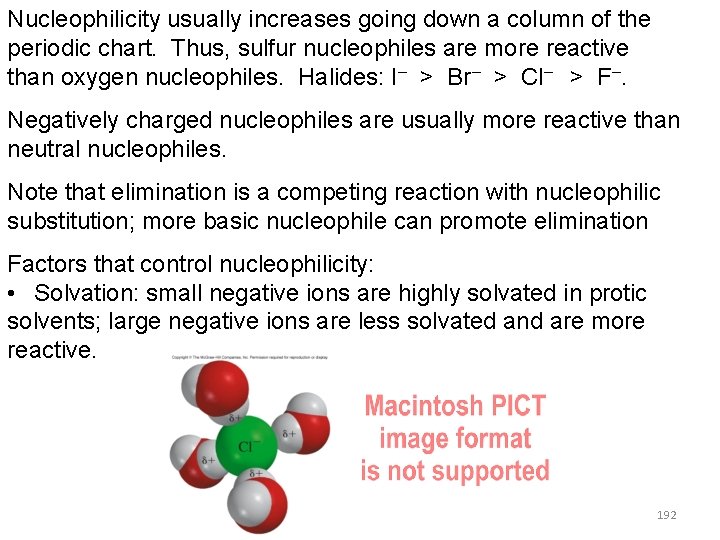
Nucleophilicity usually increases going down a column of the periodic chart. Thus, sulfur nucleophiles are more reactive than oxygen nucleophiles. Halides: I– > Br– > Cl– > F–. Negatively charged nucleophiles are usually more reactive than neutral nucleophiles. Note that elimination is a competing reaction with nucleophilic substitution; more basic nucleophile can promote elimination Factors that control nucleophilicity: • Solvation: small negative ions are highly solvated in protic solvents; large negative ions are less solvated and are more reactive. 192
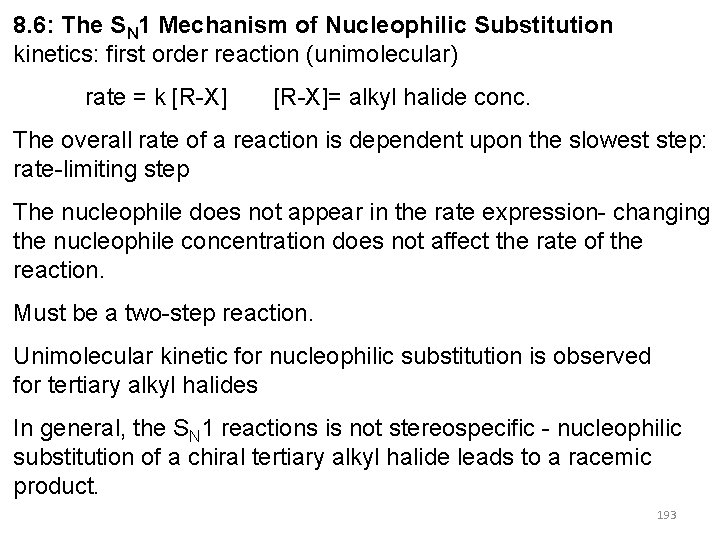
8. 6: The SN 1 Mechanism of Nucleophilic Substitution kinetics: first order reaction (unimolecular) rate = k [R-X]= alkyl halide conc. The overall rate of a reaction is dependent upon the slowest step: rate-limiting step The nucleophile does not appear in the rate expression- changing the nucleophile concentration does not affect the rate of the reaction. Must be a two-step reaction. Unimolecular kinetic for nucleophilic substitution is observed for tertiary alkyl halides In general, the SN 1 reactions is not stereospecific - nucleophilic substitution of a chiral tertiary alkyl halide leads to a racemic product. 193
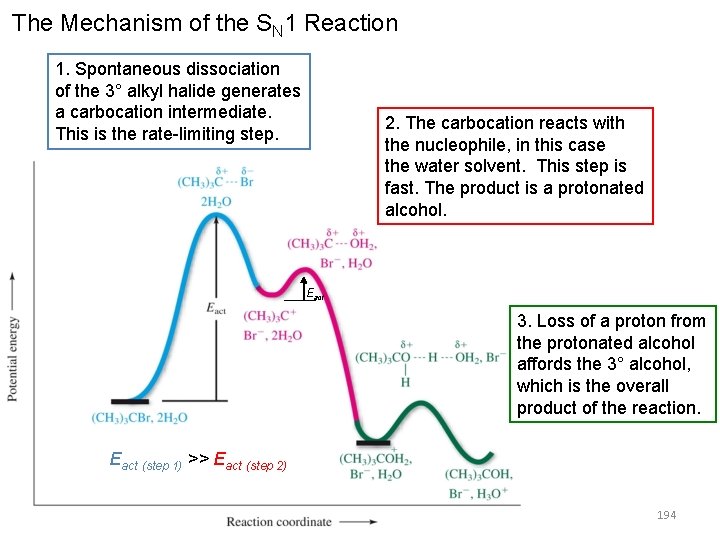
The Mechanism of the SN 1 Reaction 1. Spontaneous dissociation of the 3° alkyl halide generates a carbocation intermediate. This is the rate-limiting step. 2. The carbocation reacts with the nucleophile, in this case the water solvent. This step is fast. The product is a protonated alcohol. Eact 3. Loss of a proton from the protonated alcohol affords the 3° alcohol, which is the overall product of the reaction. Eact (step 1) >> Eact (step 2) 194
8. 7: Carbocation Stability and SN 1 Reaction Rates Formation of the carbocation intermediate is rate-limiting. Thus, carbocation stability greatly influences the reactivity. The order of reactivity of the alkyl halide in the SN 1 reaction exactly parallels the carbocation stability Krel 2. 5 x 10⁶ 1 8. 8: Stereochemistry of SN 1 Reactions - is actually a complicated issue. For the purpose of Chem 220 a, sect. 1 the stereochemistry of the SN 1 reaction results in racemization. A single enantiomer of a 3° alkyl halide will undergo SN 1 substitution to give a racemic product (both possible stereoisomers at the carbon that bore the halide of the reactant). 195
Carbocation is achiral Both stereoisomeric outcomes result 8. 9: Carbocation Rearrangements in SN 1 Reactions - Since carbocations are intermediates in SN 1 reactions, products resulting from carbocation rearrangements are possible 196
8. 10: Effect of Solvent on the Rate of Nucleophilic Substitution - In general, polar solvents increase the rate of the SN 1 reaction. Solvent polarity is measured by dielectric constant ( ) = water 80 formic acid 58 DMSO DMF 47 38 non-polar solvent: hexanes acetonitrile methanol 37 33 acetic acid 6 197
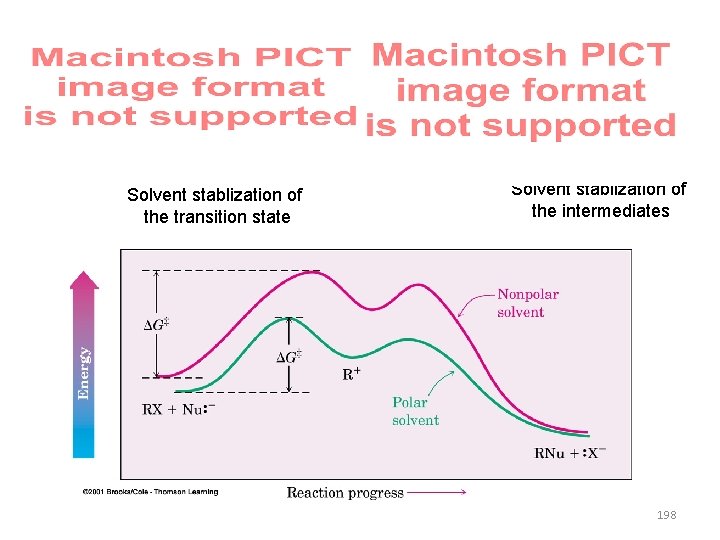
Solvent stablization of the transition state Solvent stablization of the intermediates 198
In general, polar aprotic solvents increase the rate of the SN 2 reaction. Aprotic solvents do not have an acidic proton. CH 3 CH 2 CH 2 Br + N 3– Solvent: CH 3 OH relative reativity: 1 CH 3 CH 2 CH 2 Br + Br– H 2 O 7 DMSO 1, 300 DMF 2, 800 CH 3 CN 5, 000 8. 11: Substitution and Elimination as Competing Reactions Nucleophiles are Lewis bases. They can also promote elimination reactions of alkyl halides rather than substitution 199
Elimination is a competitive reaction with nucleophilic substitution. SN 2 vs E 2 For primary alkyl halides SN 2 is favored with most nucleophiles E 2 is favored with “bulky” bases (t-butoxide) t-butoxide is too bulky to undergo SN 2 200
Secondary halides: E 2 is competitive with SN 2 and often gives a mixture of substitution and elimination products SN 2 is favored with nucleophiles that are weak bases cyanide ion, azide ion, thiolate ion, halide ion Tertiary Halides: E 2 elimination occurs with strong bases such as HO–, RO–, H 2 N– (strongly basic conditions) E 1 elimination occurs with heat and weak bases such as H 2 O or ROH. (neutral conditions) The E 1 elimination product is often a minor product with the major product arising from SN 1 reaction. SN 2 reactions does not occur with 3° halides 201
8. 12: Nucleophilic Substitution of Alkyl Sulfonates Good leaving groups are the conjugate bases of strong acids Leaving group F– H 2 O Cl– Br– I– conjugate acid HF H 3 O + HCl HBr HI p. Ka 3. 5 -1. 7 -7 -9 -10 -2. 8 Sulfonates are excellent leaving groups. p-toluenesulfonate ester (tosylate): converts an alcohol into a leaving group; abbreviated as Ts or Tos 202

203
8. 13: Looking Back: Reactions of Alcohols with Hydrogen Halides 3° alcohols proceed by an SN 1 mechanism- racemization occurs through an achiral 3° carbocation 2° alcohols proceed by both an SN 1 and SN 2 mechanismpartial scrambling of stereochemistry We will assume that 2° centers proceed by an SN 2 mechanism 204
- Slides: 23