
Chapter 8 Network Security Chapter goals r Understand
![Symmetric key crypto: DES: Data Encryption Standard r US encryption standard [NIST 1993] r](https://slidetodoc.com/presentation_image_h/75ca5ce75951f76d0391935e0fa30f87/image-17.jpg "Symmetric key crypto: DES: Data Encryption Standard r US encryption standard [NIST 1993] r")
- Slides: 29
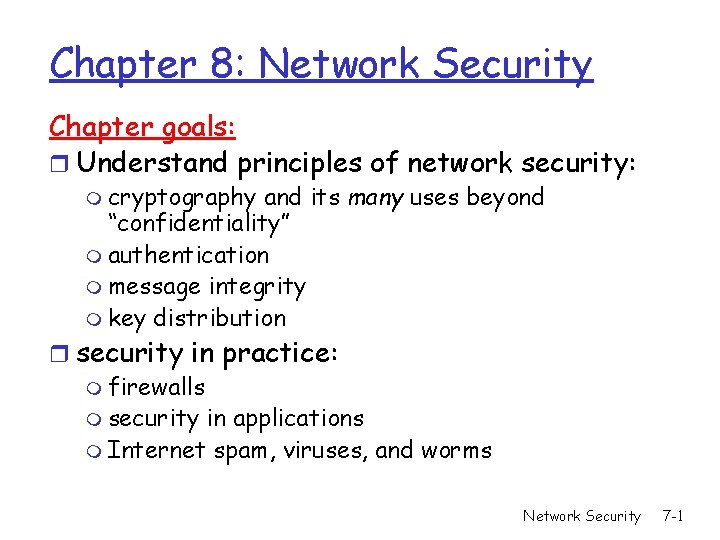
Chapter 8: Network Security Chapter goals: r Understand principles of network security: m cryptography and its many uses beyond “confidentiality” m authentication m message integrity m key distribution r security in practice: m firewalls m security in applications m Internet spam, viruses, and worms Network Security 7 -1
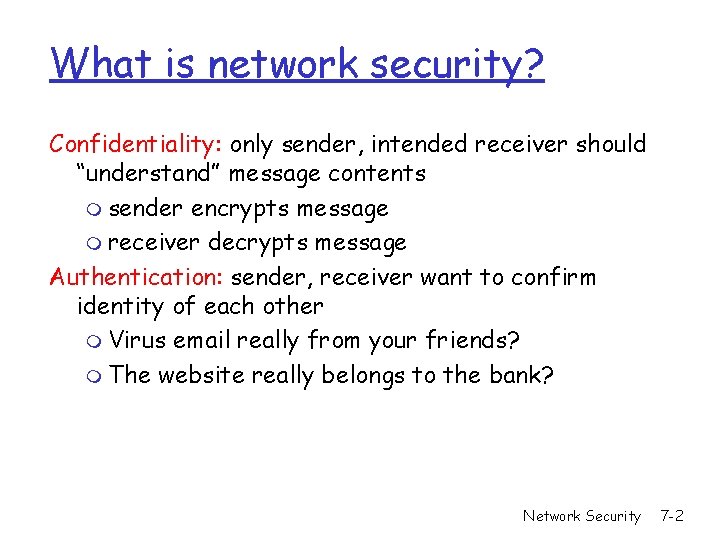
What is network security? Confidentiality: only sender, intended receiver should “understand” message contents m sender encrypts message m receiver decrypts message Authentication: sender, receiver want to confirm identity of each other m Virus email really from your friends? m The website really belongs to the bank? Network Security 7 -2
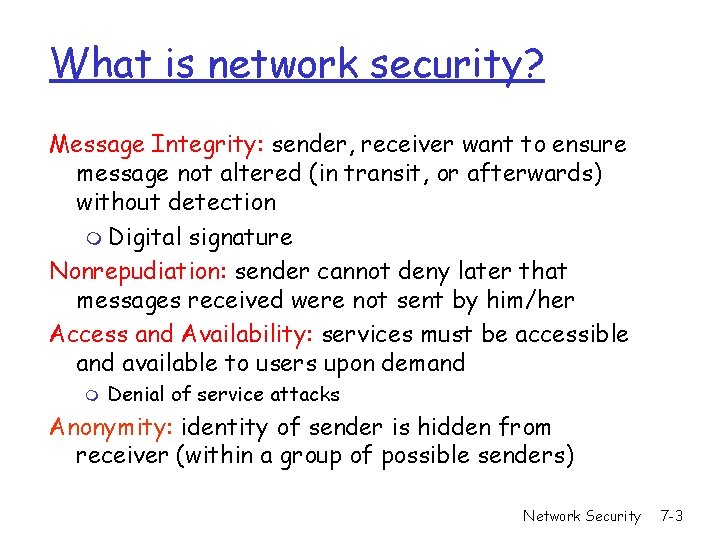
What is network security? Message Integrity: sender, receiver want to ensure message not altered (in transit, or afterwards) without detection m Digital signature Nonrepudiation: sender cannot deny later that messages received were not sent by him/her Access and Availability: services must be accessible and available to users upon demand m Denial of service attacks Anonymity: identity of sender is hidden from receiver (within a group of possible senders) Network Security 7 -3
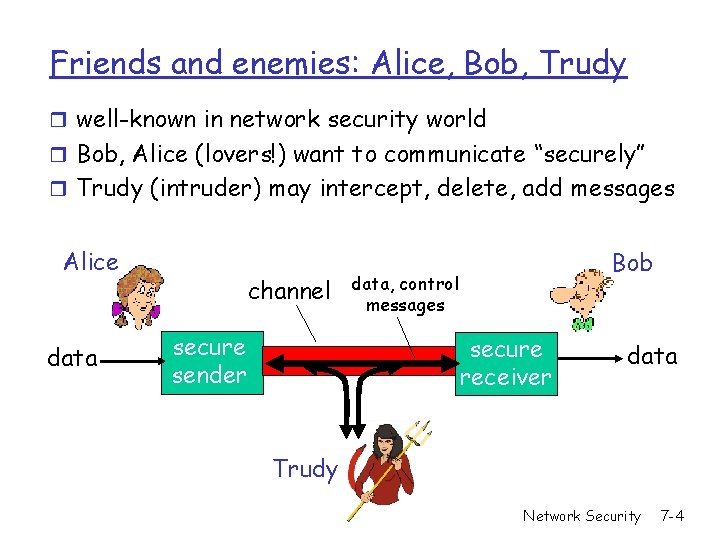
Friends and enemies: Alice, Bob, Trudy r well-known in network security world r Bob, Alice (lovers!) want to communicate “securely” r Trudy (intruder) may intercept, delete, add messages Alice data channel secure sender Bob data, control messages secure receiver data Trudy Network Security 7 -4
Who might Bob, Alice be? r Web client/server (e. g. , on-line purchases) r DNS servers r routers exchanging routing table updates r Two computers in peer-to-peer networks r Wireless laptop and wireless access point r Cell phone and cell tower r Cell phone and bluetooth earphone r RFID tag and reader r. . . . Network Security 7 -5
There are bad guys (and girls) out there! Q: What can a “bad guy” do? A: a lot! m eavesdrop: intercept messages m actively insert messages into connection m impersonation: can fake (spoof) source address in packet (or any field in packet) m hijacking: “take over” ongoing connection by removing sender or receiver, inserting himself in place m denial of service: prevent service from being used by others (e. g. , by overloading resources) more on this later …… Network Security 7 -6
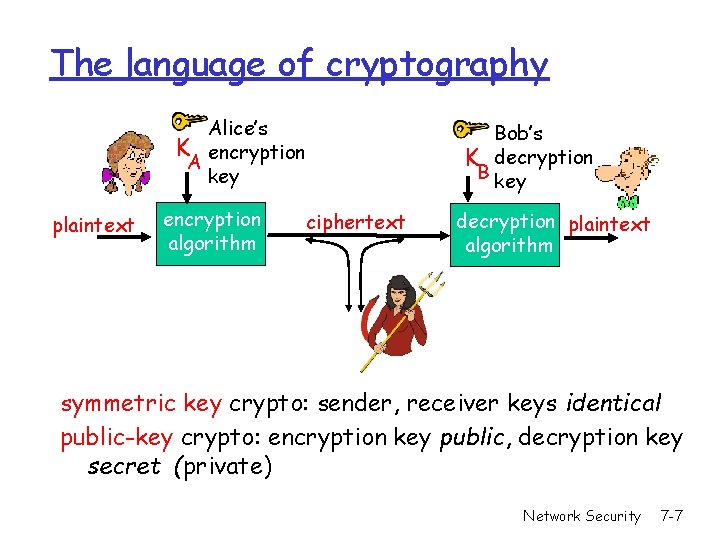
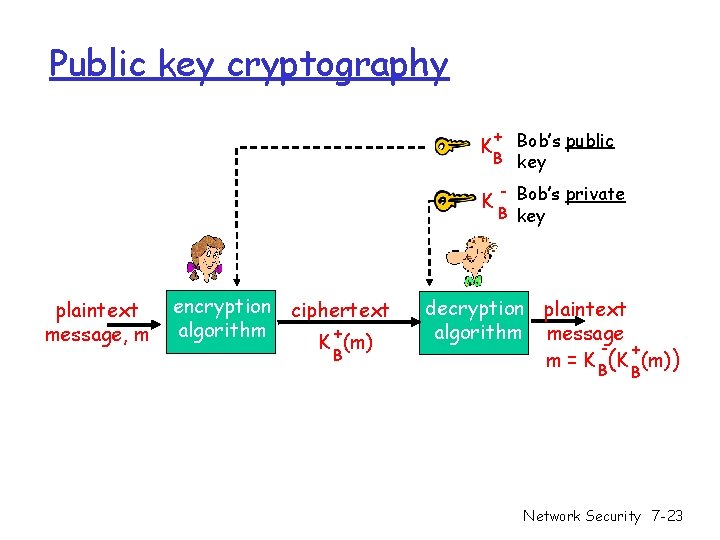
The language of cryptography Alice’s K encryption A key plaintext encryption algorithm Bob’s K decryption B key ciphertext decryption plaintext algorithm symmetric key crypto: sender, receiver keys identical public-key crypto: encryption key public, decryption key secret (private) Network Security 7 -7
Classical Cryptography r Transposition Cipher r Substitution Cipher m Simple substitution cipher (Caesar cipher) m Vigenere cipher m One-time pad Network Security 7 -8
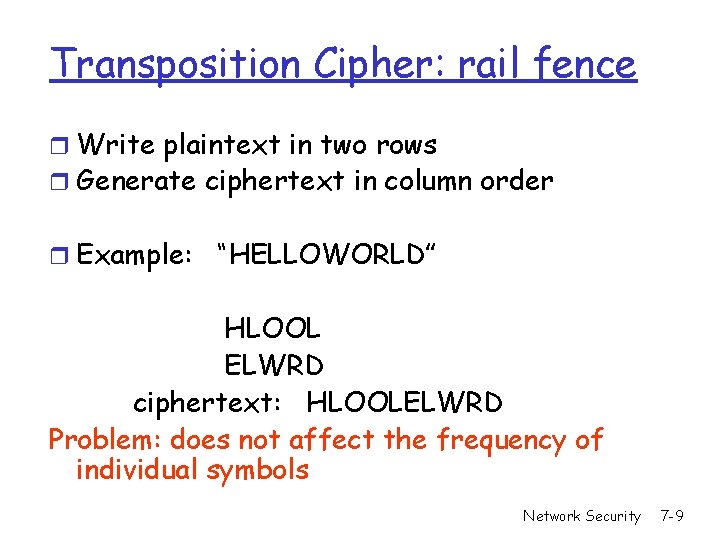
Transposition Cipher: rail fence r Write plaintext in two rows r Generate ciphertext in column order r Example: “HELLOWORLD” HLOOL ELWRD ciphertext: HLOOLELWRD Problem: does not affect the frequency of individual symbols Network Security 7 -9
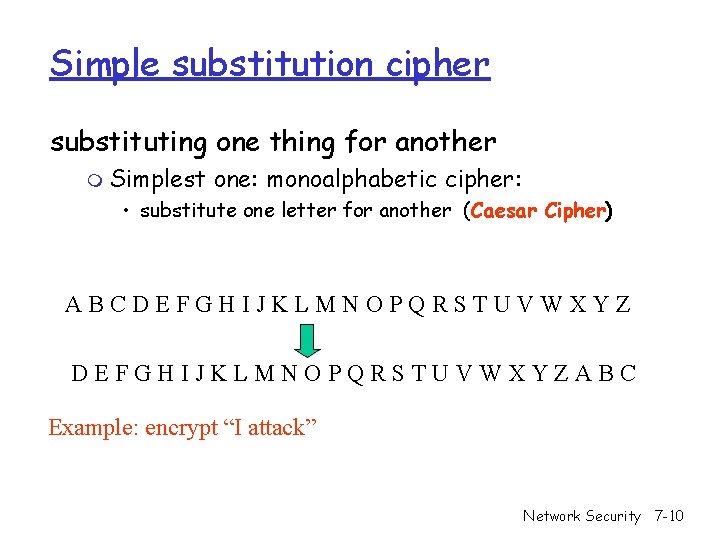
Simple substitution cipher substituting one thing for another m Simplest one: monoalphabetic cipher: • substitute one letter for another (Caesar Cipher) ABCDEFGHIJKLMNOPQRSTUVWXYZABC Example: encrypt “I attack” Network Security 7 -10
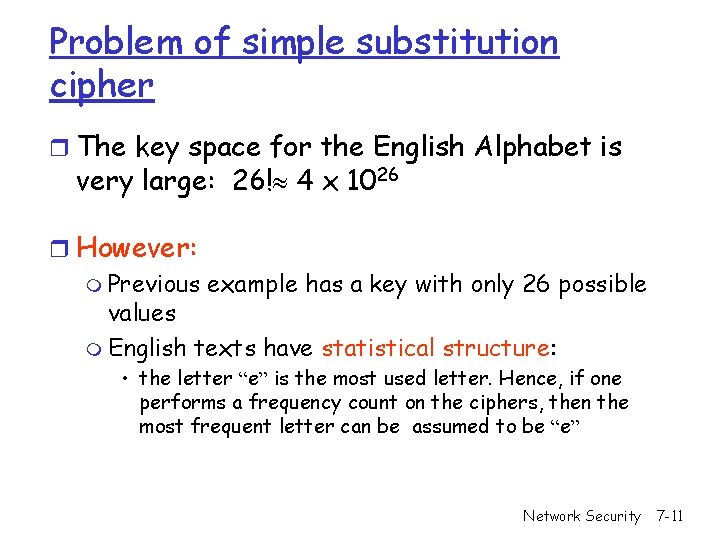
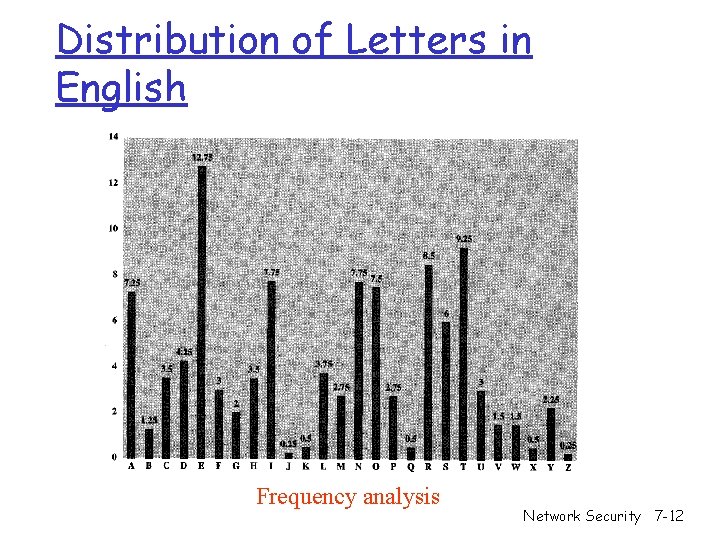
Problem of simple substitution cipher r The key space for the English Alphabet is very large: 26! 4 x 1026 r However: m Previous example has a key with only 26 possible values m English texts have statistical structure: • the letter “e” is the most used letter. Hence, if one performs a frequency count on the ciphers, then the most frequent letter can be assumed to be “e” Network Security 7 -11
Distribution of Letters in English Frequency analysis Network Security 7 -12
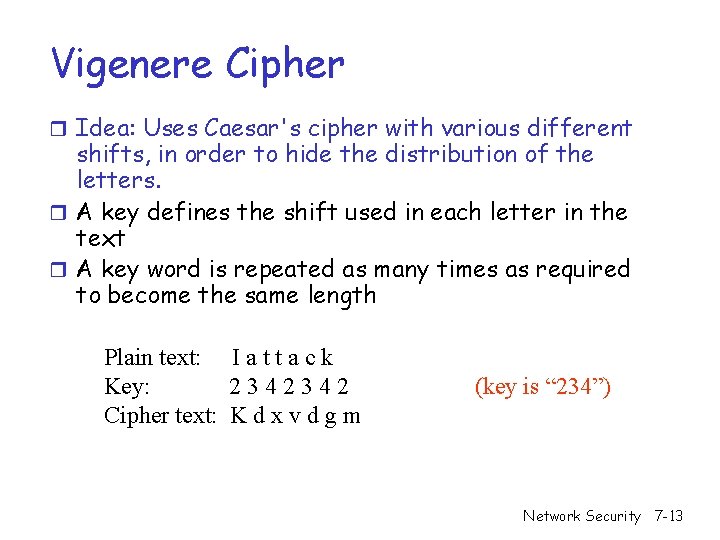
Vigenere Cipher r Idea: Uses Caesar's cipher with various different shifts, in order to hide the distribution of the letters. r A key defines the shift used in each letter in the text r A key word is repeated as many times as required to become the same length Plain text: I a t t a c k Key: 2342342 Cipher text: K d x v d g m (key is “ 234”) Network Security 7 -13
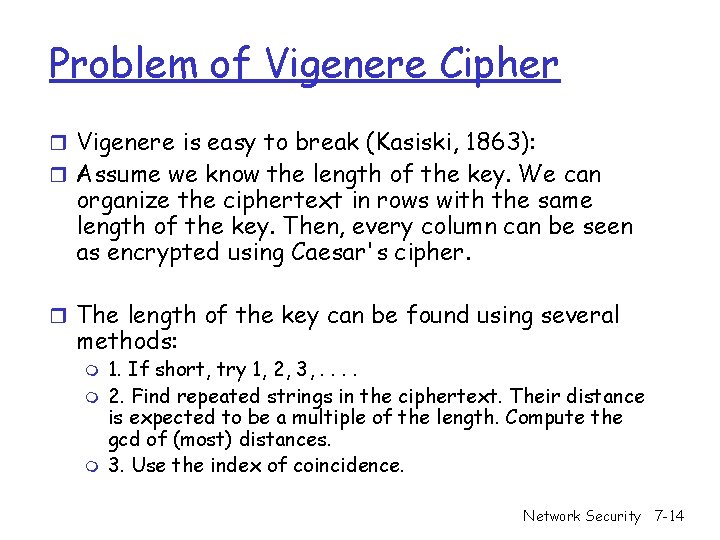
Problem of Vigenere Cipher r Vigenere is easy to break (Kasiski, 1863): r Assume we know the length of the key. We can organize the ciphertext in rows with the same length of the key. Then, every column can be seen as encrypted using Caesar's cipher. r The length of the key can be found using several methods: m m m 1. If short, try 1, 2, 3, . . 2. Find repeated strings in the ciphertext. Their distance is expected to be a multiple of the length. Compute the gcd of (most) distances. 3. Use the index of coincidence. Network Security 7 -14
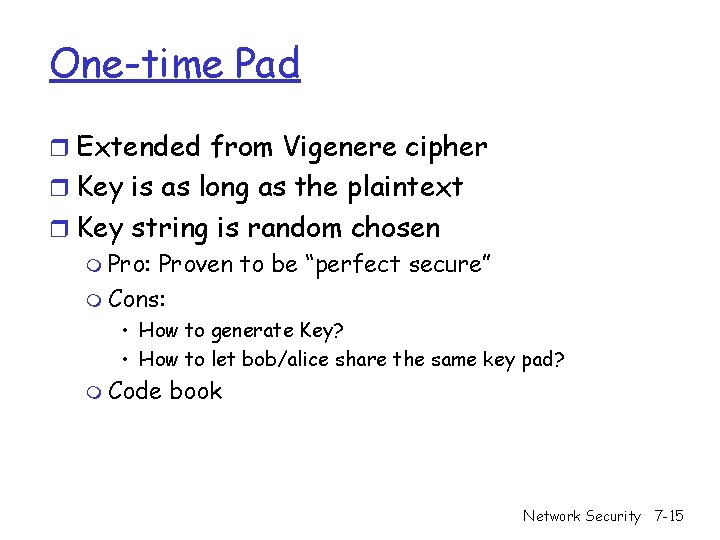
One-time Pad r Extended from Vigenere cipher r Key is as long as the plaintext r Key string is random chosen m Pro: Proven to be “perfect secure” m Cons: • How to generate Key? • How to let bob/alice share the same key pad? m Code book Network Security 7 -15
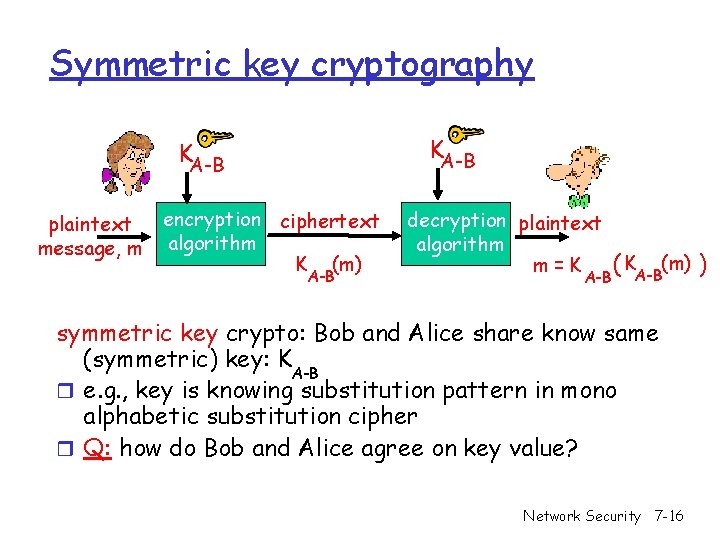
Symmetric key cryptography KA-B plaintext message, m encryption ciphertext algorithm K (m) A-B decryption plaintext algorithm m=K A-B ( KA-B(m) ) symmetric key crypto: Bob and Alice share know same (symmetric) key: K A-B r e. g. , key is knowing substitution pattern in mono alphabetic substitution cipher r Q: how do Bob and Alice agree on key value? Network Security 7 -16
Symmetric key crypto: DES: Data Encryption Standard r US encryption standard [NIST 1993] r 56 -bit symmetric key, 64 -bit plaintext input r How secure is DES? m DES Challenge: 56 -bit-key-encrypted phrase (“Strong cryptography makes the world a safer place”) decrypted (brute force) in 4 months m no known “backdoor” decryption approach r making DES more secure (3 DES): m use three keys sequentially on each datum m use cipher-block chaining Network Security 7 -17
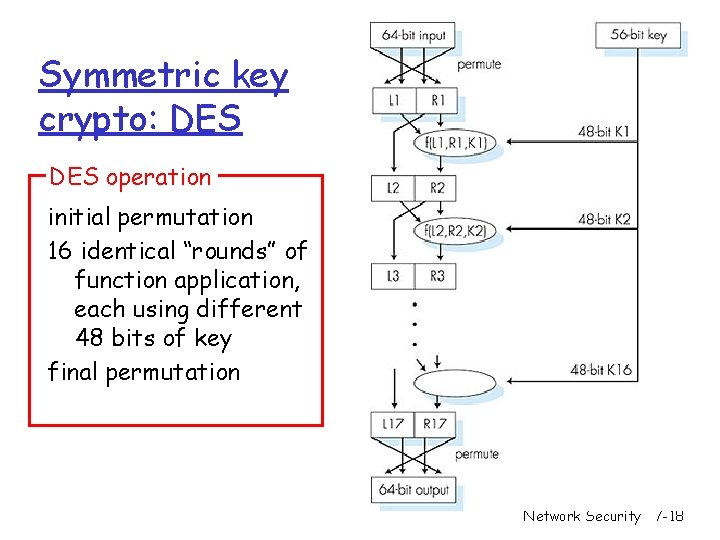
Symmetric key crypto: DES operation initial permutation 16 identical “rounds” of function application, each using different 48 bits of key final permutation Network Security 7 -18
AES: Advanced Encryption Standard r new (Nov. 2001) symmetric-key NIST standard, replacing DES r processes data in 128 bit blocks r 128, 192, or 256 bit keys r brute force decryption (try each key) taking 1 sec on DES, takes 149 trillion years for AES Network Security 7 -19
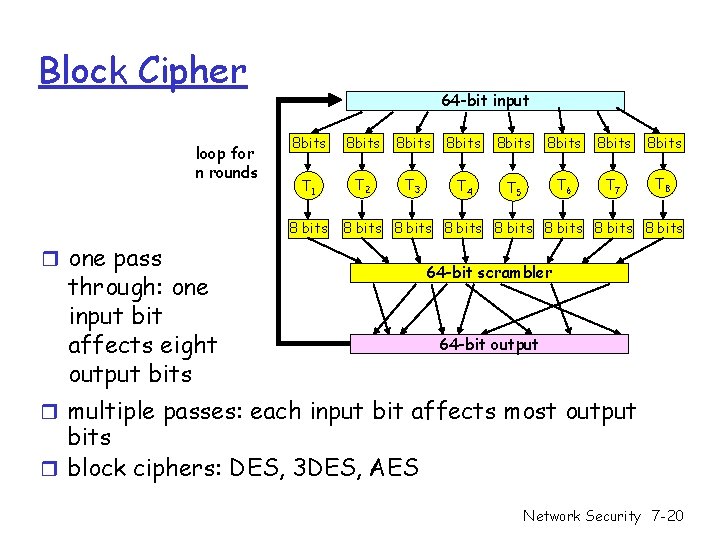
Block Cipher loop for n rounds 64 -bit input 8 bits 8 bits T 1 T 2 T 3 T 4 T 5 T 6 T 7 T 8 8 bits 8 bits r one pass through: one input bit affects eight output bits 64 -bit scrambler 64 -bit output r multiple passes: each input bit affects most output bits r block ciphers: DES, 3 DES, AES Network Security 7 -20
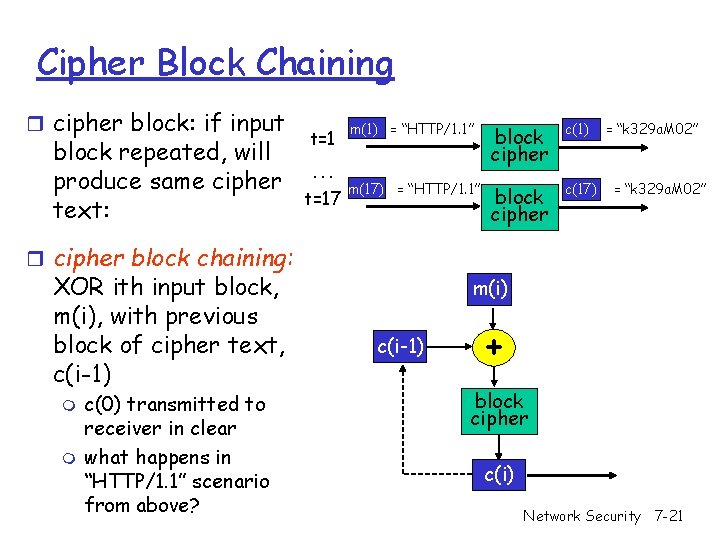
Cipher Block Chaining r cipher block: if input block repeated, will produce same cipher text: t=1 … t=17 m(1) = “HTTP/1. 1” block cipher c(1) m(17) = “HTTP/1. 1” block cipher c(17) = “k 329 a. M 02” r cipher block chaining: XOR ith input block, m(i), with previous block of cipher text, c(i-1) m m c(0) transmitted to receiver in clear what happens in “HTTP/1. 1” scenario from above? m(i) c(i-1) + block cipher c(i) Network Security 7 -21
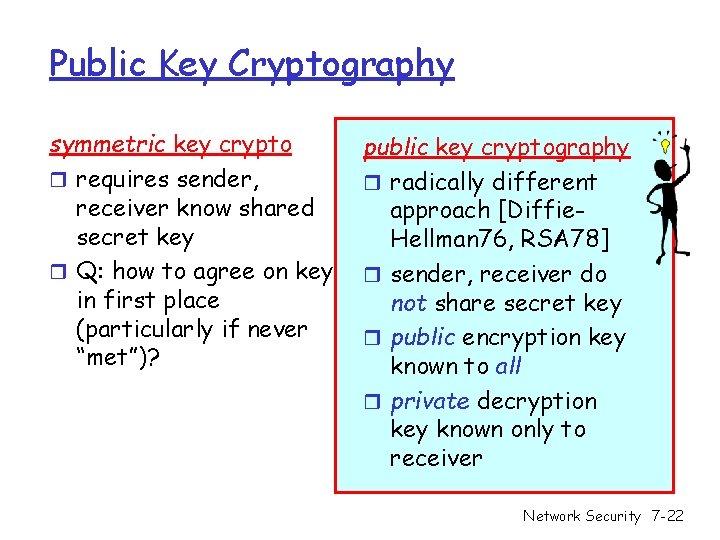
Public Key Cryptography symmetric key crypto r requires sender, receiver know shared secret key r Q: how to agree on key in first place (particularly if never “met”)? public key cryptography r radically different approach [Diffie. Hellman 76, RSA 78] r sender, receiver do not share secret key r public encryption key known to all r private decryption key known only to receiver Network Security 7 -22
Public key cryptography + Bob’s public B key K K plaintext message, m encryption ciphertext algorithm + K (m) B - Bob’s private B key decryption plaintext algorithm message + m = K B(K (m)) B Network Security 7 -23
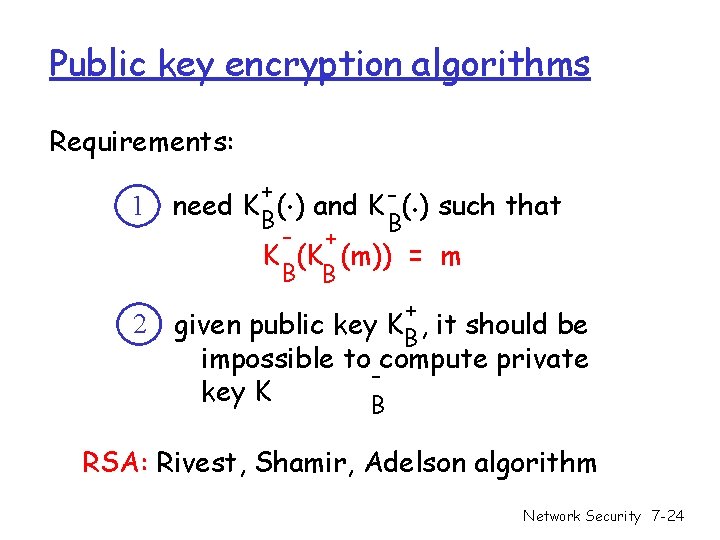
Public key encryption algorithms Requirements: 1 2 . . + need K B( ) and K - ( ) such that B - + K (K (m)) = m B B + given public key KB , it should be impossible to compute private key K B RSA: Rivest, Shamir, Adelson algorithm Network Security 7 -24
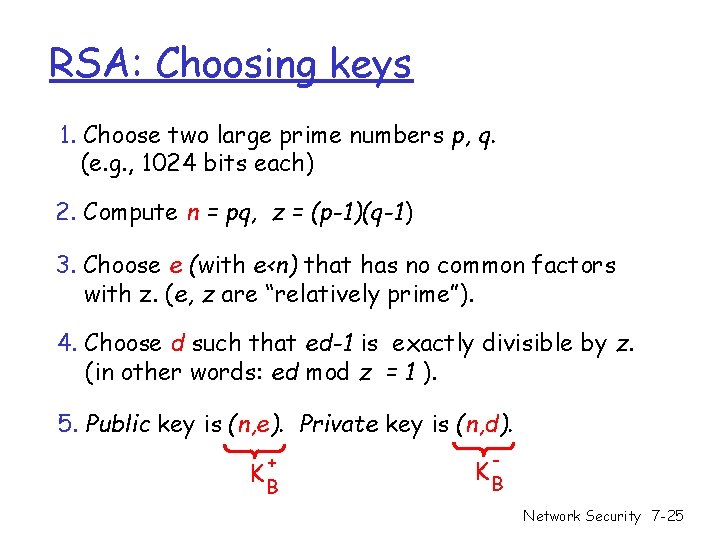
RSA: Choosing keys 1. Choose two large prime numbers p, q. (e. g. , 1024 bits each) 2. Compute n = pq, z = (p-1)(q-1) 3. Choose e (with e<n) that has no common factors with z. (e, z are “relatively prime”). 4. Choose d such that ed-1 is exactly divisible by z. (in other words: ed mod z = 1 ). 5. Public key is (n, e). Private key is (n, d). + KB - KB Network Security 7 -25
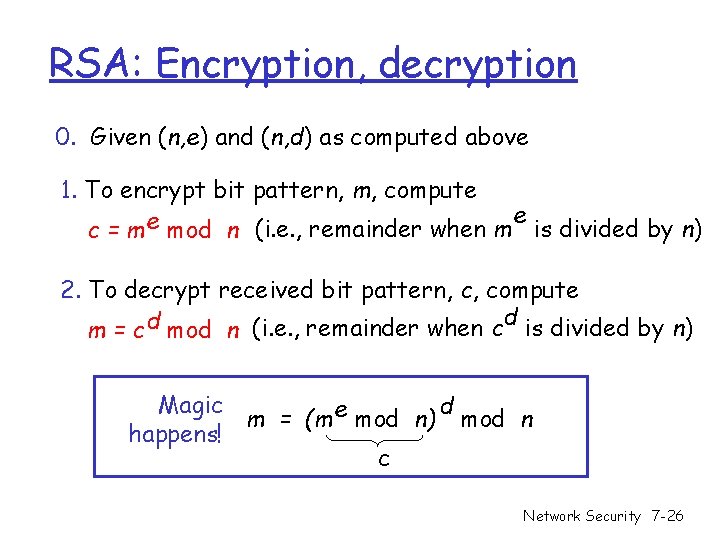
RSA: Encryption, decryption 0. Given (n, e) and (n, d) as computed above 1. To encrypt bit pattern, m, compute e e c = m mod n (i. e. , remainder when m is divided by n) 2. To decrypt received bit pattern, c, compute d m = c d mod n (i. e. , remainder when c is divided by n) Magic d m = (m e mod n) mod n happens! c Network Security 7 -26
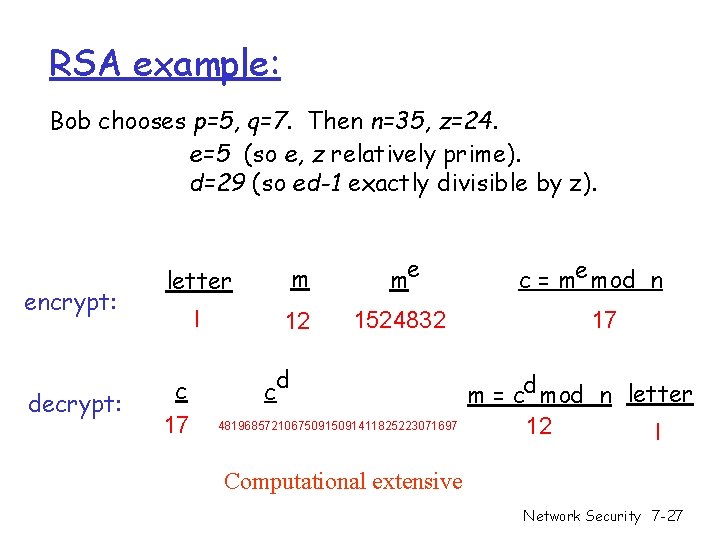
RSA example: Bob chooses p=5, q=7. Then n=35, z=24. e=5 (so e, z relatively prime). d=29 (so ed-1 exactly divisible by z). encrypt: decrypt: letter m me l 12 1524832 c 17 d c 48196857210675091411825223071697 c = me mod n 17 m = cd mod n letter 12 l Computational extensive Network Security 7 -27
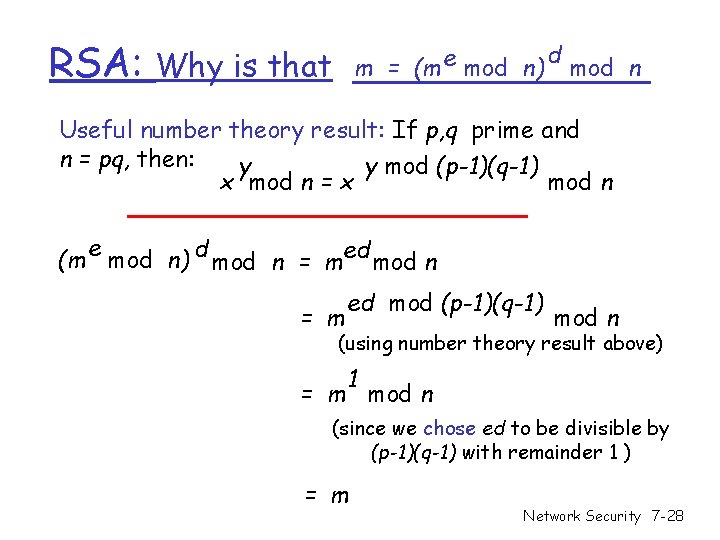
RSA: m = (m e mod n) Why is that d mod n Useful number theory result: If p, q prime and n = pq, then: y y mod (p-1)(q-1) x mod n = x mod n e (m mod n) d mod n = med mod n = m ed mod (p-1)(q-1) mod n (using number theory result above) 1 = m mod n (since we chose ed to be divisible by (p-1)(q-1) with remainder 1 ) = m Network Security 7 -28
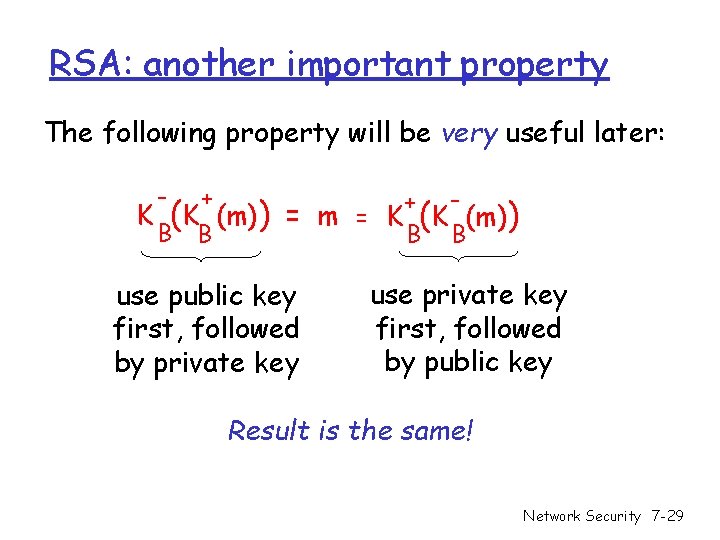
RSA: another important property The following property will be very useful later: - + B B K (K (m)) + = m = K (K (m)) B B use public key first, followed by private key use private key first, followed by public key Result is the same! Network Security 7 -29