
Chapter 8 Net Present Value and Other Investment




- Slides: 42
Chapter 8 Net Present Value and Other Investment Criteria 0 Mc. Graw-Hill/Irwin Copyright © 2008 by The Mc. Graw-Hill Companies, Inc. All rights reserved.
1 -1 8 -1 Key Concepts and Skills • Understand the payback rule and its shortcomings • Understand accounting rates of return and their problems • Understand the internal rate of return and its strengths and weaknesses • Understand the net present value rule and why it is the best decision criteria 1
1 -2 8 -2 Chapter Outline • • • Net Present Value The Payback Rule The Average Accounting Return The Internal Rate of Return The Profitability Index The Practice of Capital Budgeting 2
1 -3 8 -3 Good Decision Criteria • We need to ask ourselves the following questions when evaluating decision criteria – Does the decision rule adjust for the time value of money? – Does the decision rule adjust for risk? – Does the decision rule provide information on whether we are creating value for the firm? 3
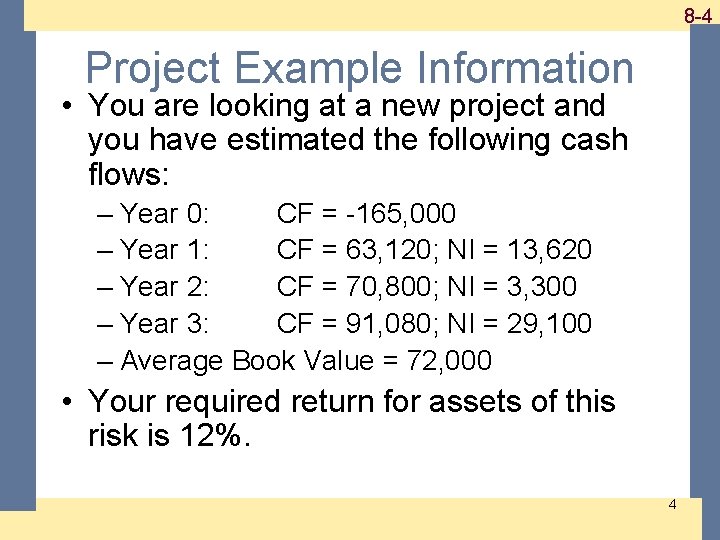
1 -4 8 -4 Project Example Information • You are looking at a new project and you have estimated the following cash flows: – Year 0: CF = -165, 000 – Year 1: CF = 63, 120; NI = 13, 620 – Year 2: CF = 70, 800; NI = 3, 300 – Year 3: CF = 91, 080; NI = 29, 100 – Average Book Value = 72, 000 • Your required return for assets of this risk is 12%. 4
1 -5 8 -5 Net Present Value • The difference between the market value of a project and its cost • How much value is created from undertaking an investment? – The first step is to estimate the expected future cash flows. – The second step is to estimate the required return for projects of this risk level. – The third step is to find the present value of the cash flows and subtract the initial investment. 5
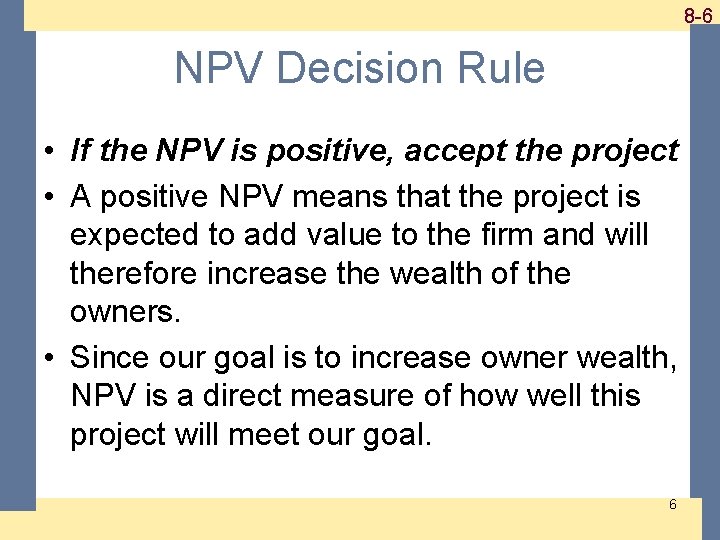
1 -6 8 -6 NPV Decision Rule • If the NPV is positive, accept the project • A positive NPV means that the project is expected to add value to the firm and will therefore increase the wealth of the owners. • Since our goal is to increase owner wealth, NPV is a direct measure of how well this project will meet our goal. 6
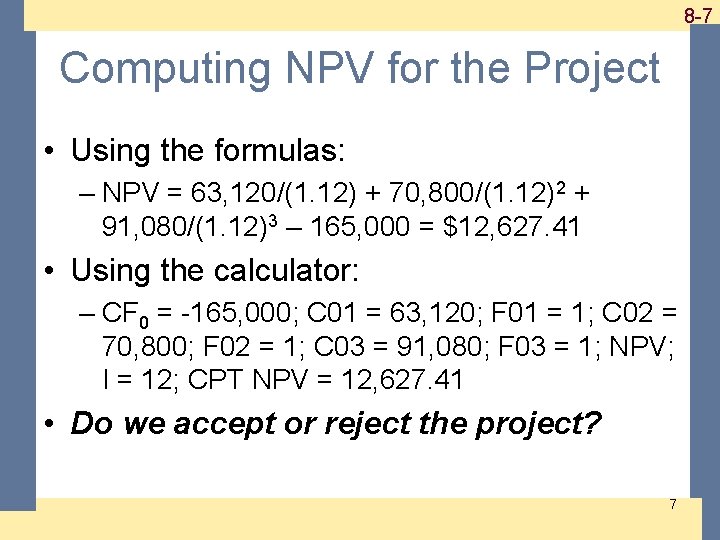
1 -7 8 -7 Computing NPV for the Project • Using the formulas: – NPV = 63, 120/(1. 12) + 70, 800/(1. 12)2 + 91, 080/(1. 12)3 – 165, 000 = $12, 627. 41 • Using the calculator: – CF 0 = -165, 000; C 01 = 63, 120; F 01 = 1; C 02 = 70, 800; F 02 = 1; C 03 = 91, 080; F 03 = 1; NPV; I = 12; CPT NPV = 12, 627. 41 • Do we accept or reject the project? 7
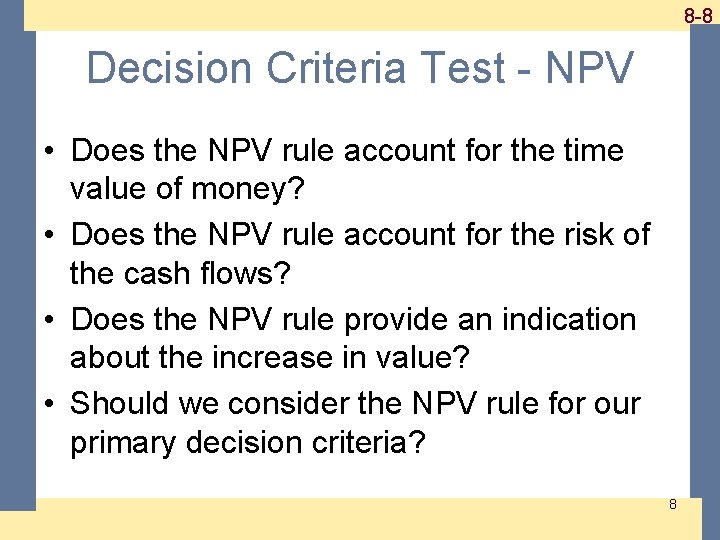
1 -8 8 -8 Decision Criteria Test - NPV • Does the NPV rule account for the time value of money? • Does the NPV rule account for the risk of the cash flows? • Does the NPV rule provide an indication about the increase in value? • Should we consider the NPV rule for our primary decision criteria? 8
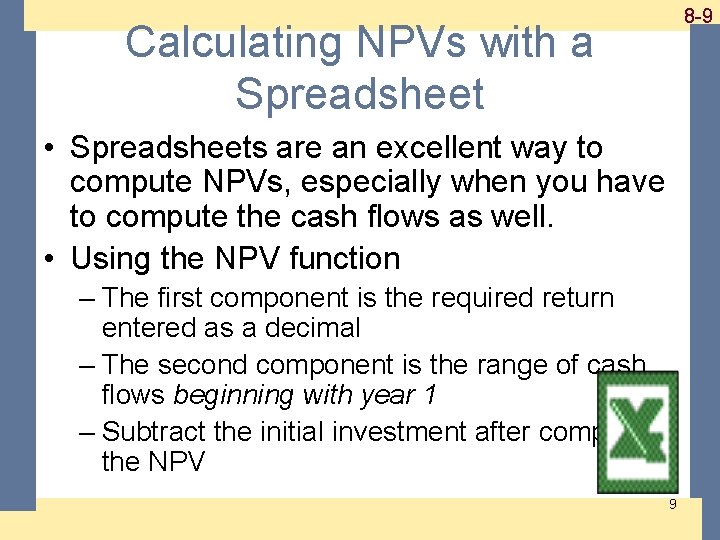
Calculating NPVs with a Spreadsheet 1 -9 8 -9 • Spreadsheets are an excellent way to compute NPVs, especially when you have to compute the cash flows as well. • Using the NPV function – The first component is the required return entered as a decimal – The second component is the range of cash flows beginning with year 1 – Subtract the initial investment after computing the NPV 9
1 -10 8 -10 Payback Period • How long does it take to get the initial cost back in a nominal sense? • Computation – Estimate the cash flows – Subtract the future cash flows from the initial cost until the initial investment has been recovered • Decision Rule – Accept if the payback period is less than some preset limit 10
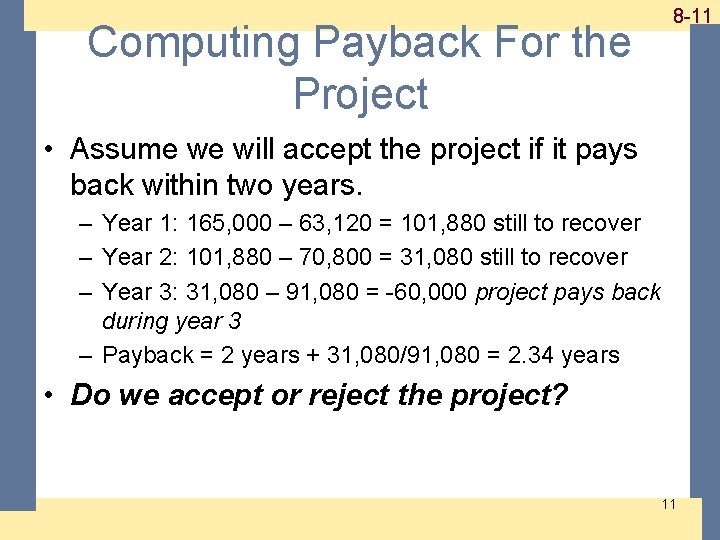
Computing Payback For the Project 1 -11 8 -11 • Assume we will accept the project if it pays back within two years. – Year 1: 165, 000 – 63, 120 = 101, 880 still to recover – Year 2: 101, 880 – 70, 800 = 31, 080 still to recover – Year 3: 31, 080 – 91, 080 = -60, 000 project pays back during year 3 – Payback = 2 years + 31, 080/91, 080 = 2. 34 years • Do we accept or reject the project? 11
1 -12 8 -12 Decision Criteria Test - Payback • Does the payback rule account for the time value of money? • Does the payback rule account for the risk of the cash flows? • Does the payback rule provide an indication about the increase in value? • Should we consider the payback rule for our primary decision criteria? 12
1 -13 8 -13 Advantages and Disadvantages of Payback • Advantages – Easy to understand – Adjusts for uncertainty of later cash flows – Biased towards liquidity • Disadvantages – Ignores the time value of money – Requires an arbitrary cutoff point – Ignores cash flows beyond the cutoff date – Biased against longterm projects, such as research and development, and new projects 13
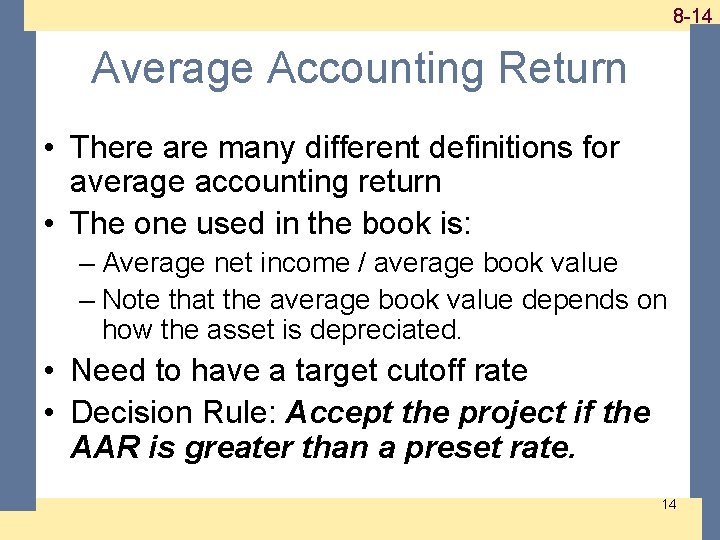
1 -14 8 -14 Average Accounting Return • There are many different definitions for average accounting return • The one used in the book is: – Average net income / average book value – Note that the average book value depends on how the asset is depreciated. • Need to have a target cutoff rate • Decision Rule: Accept the project if the AAR is greater than a preset rate. 14
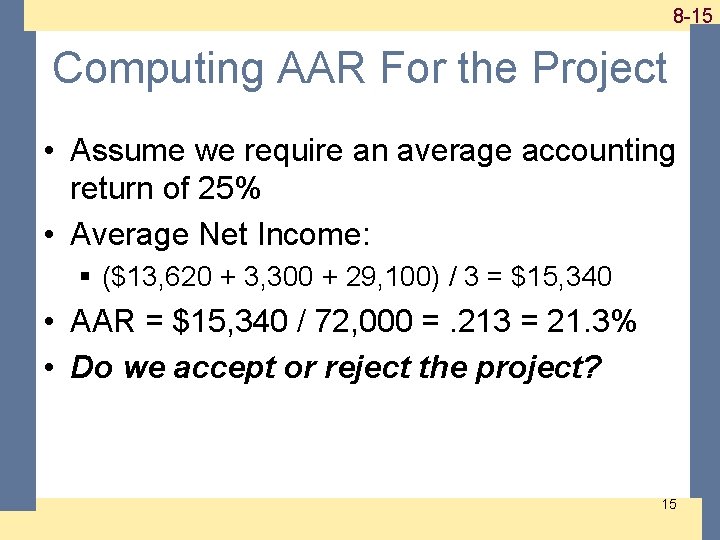
1 -15 8 -15 Computing AAR For the Project • Assume we require an average accounting return of 25% • Average Net Income: § ($13, 620 + 3, 300 + 29, 100) / 3 = $15, 340 • AAR = $15, 340 / 72, 000 =. 213 = 21. 3% • Do we accept or reject the project? 15
1 -16 8 -16 Decision Criteria Test - AAR • Does the AAR rule account for the time value of money? • Does the AAR rule account for the risk of the cash flows? • Does the AAR rule provide an indication about the increase in value? • Should we consider the AAR rule for our primary decision criteria? 16
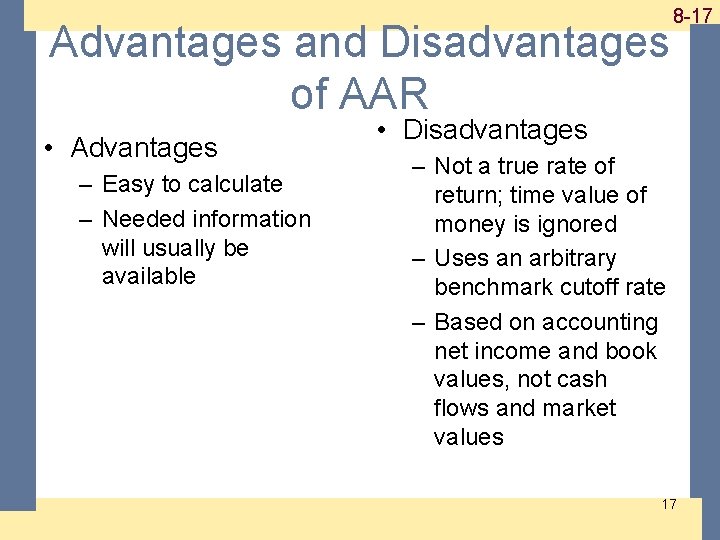
1 -17 8 -17 Advantages and Disadvantages of AAR • Advantages – Easy to calculate – Needed information will usually be available • Disadvantages – Not a true rate of return; time value of money is ignored – Uses an arbitrary benchmark cutoff rate – Based on accounting net income and book values, not cash flows and market values 17
1 -18 8 -18 Internal Rate of Return • This is the most important alternative to NPV • It is often used in practice and is intuitively appealing • It is based entirely on the estimated cash flows and is independent of interest rates found elsewhere 18
IRR – Definition and Decision Rule 1 -19 8 -19 • Definition: IRR is the return that makes the NPV = 0 • Decision Rule: Accept the project if the IRR is greater than the required return 19
1 -20 8 -20 Computing IRR For the Project • If you do not have a financial calculator, then this becomes a trial-and-error process • Calculator § Enter the cash flows as you did with NPV § Press IRR and then CPT § IRR = 16. 13% > 12% required return • Do we accept or reject the project? 20
1 -21 8 -21 NPV Profile For the Project IRR = 16. 13% 21
1 -22 8 -22 Decision Criteria Test - IRR • Does the IRR rule account for the time value of money? • Does the IRR rule account for the risk of the cash flows? • Does the IRR rule provide an indication about the increase in value? • Should we consider the IRR rule for our primary decision criteria? 22
1 -23 8 -23 Advantages of IRR • Knowing a return is intuitively appealing • It is a simple way to communicate the value of a project to someone who doesn’t know all the estimation details • If the IRR is high enough, you may not need to estimate a required return, which is often a difficult task 23
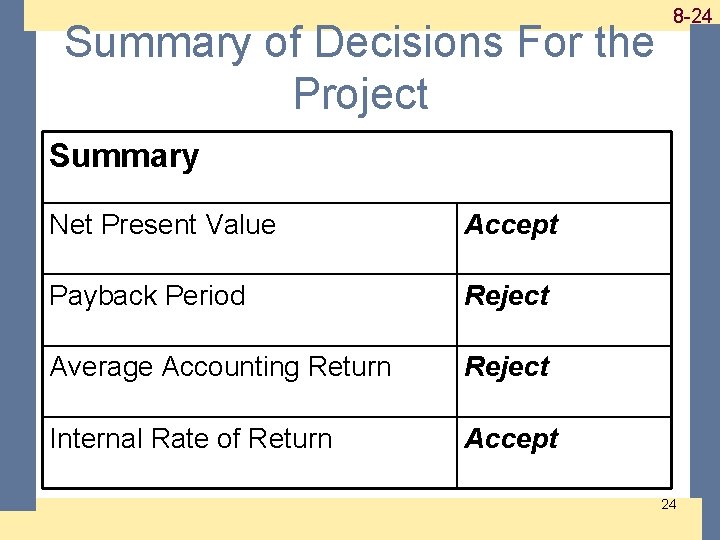
1 -24 8 -24 Summary of Decisions For the Project Summary Net Present Value Accept Payback Period Reject Average Accounting Return Reject Internal Rate of Return Accept 24
Calculating IRRs With a Spreadsheet 1 -25 8 -25 • You start with the cash flows the same as you did for the NPV • You use the IRR function – You first enter your range of cash flows, beginning with the initial cash flow – You can enter a guess, but it is not necessary – The default format is a whole percent – you will normally want to increase the decimal places to at least two 25
1 -26 8 -26 NPV vs. IRR • NPV and IRR will generally give us the same decision • Exceptions – Nonconventional cash flows – cash flow signs change more than once – Mutually exclusive projects • Initial investments are substantially different • Timing of cash flows is substantially different 26
1 -27 8 -27 IRR and Nonconventional Cash Flows • When the cash flows change signs more than once, there is more than one IRR • When you solve for IRR, you are solving for the root of an equation and when you cross the x-axis more than once, there will be more than one return that solves the equation • If you have more than one IRR, which one do you use to make your decision? 27
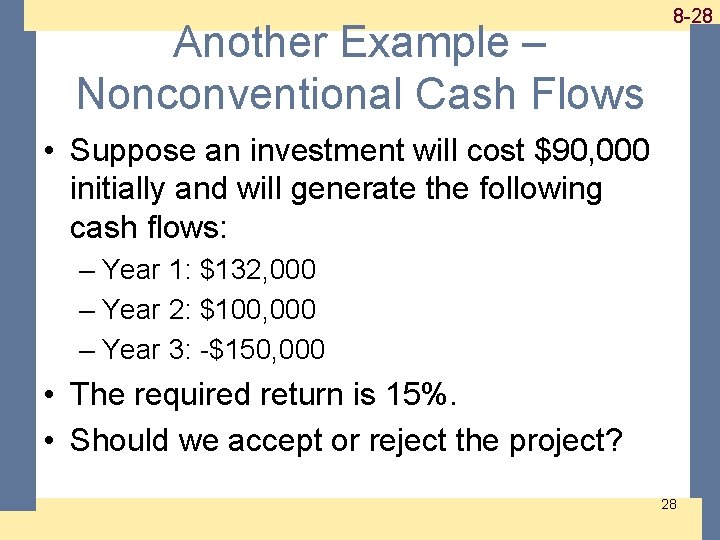
Another Example – Nonconventional Cash Flows 1 -28 8 -28 • Suppose an investment will cost $90, 000 initially and will generate the following cash flows: – Year 1: $132, 000 – Year 2: $100, 000 – Year 3: -$150, 000 • The required return is 15%. • Should we accept or reject the project? 28
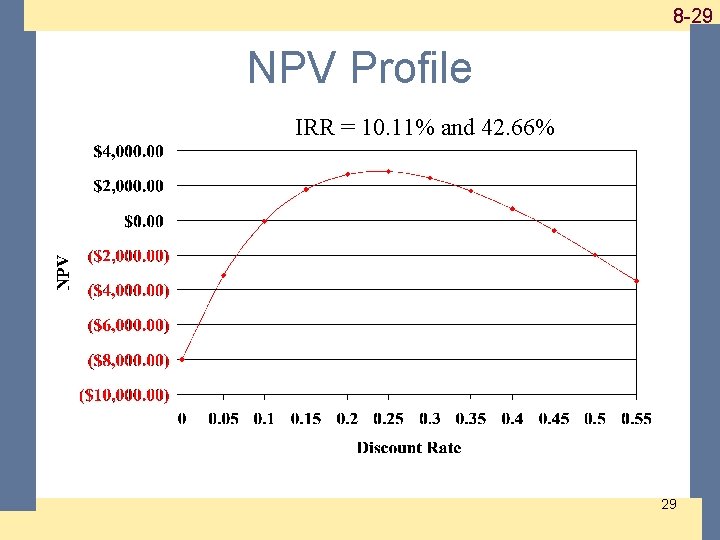
1 -29 8 -29 NPV Profile IRR = 10. 11% and 42. 66% 29
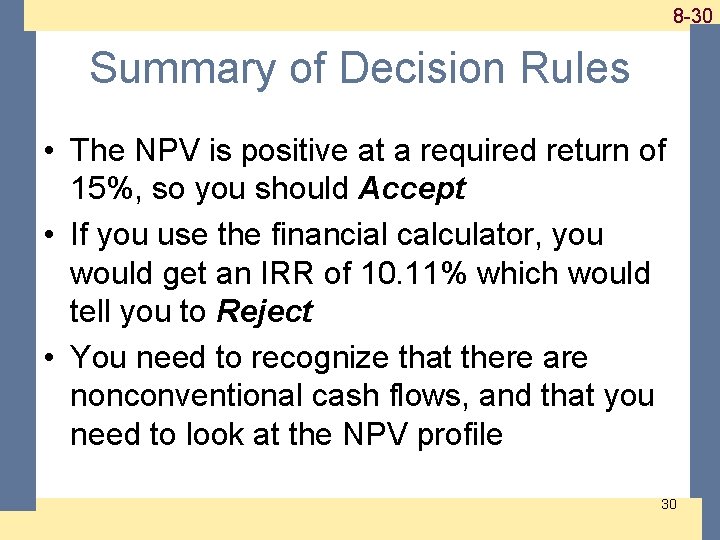
1 -30 8 -30 Summary of Decision Rules • The NPV is positive at a required return of 15%, so you should Accept • If you use the financial calculator, you would get an IRR of 10. 11% which would tell you to Reject • You need to recognize that there are nonconventional cash flows, and that you need to look at the NPV profile 30
IRR and Mutually Exclusive Projects 1 -31 8 -31 • Mutually exclusive projects – If you choose one, you can’t choose the other – Example: You can choose to attend graduate school next year at either Harvard or Stanford, but not both • Intuitively, you would use the following decision rules: – NPV – choose the project with the higher NPV – IRR – choose the project with the higher IRR 31
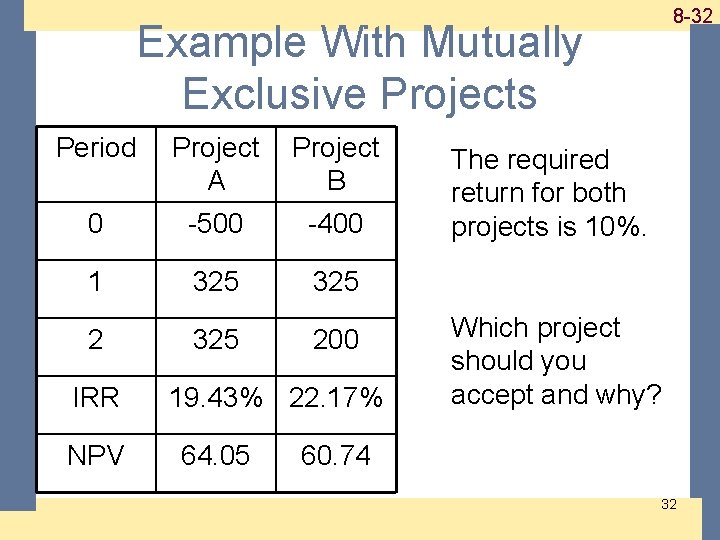
Example With Mutually Exclusive Projects Period Project A Project B 0 -500 -400 1 325 200 IRR NPV 19. 43% 22. 17% 64. 05 1 -32 8 -32 The required return for both projects is 10%. Which project should you accept and why? 60. 74 32
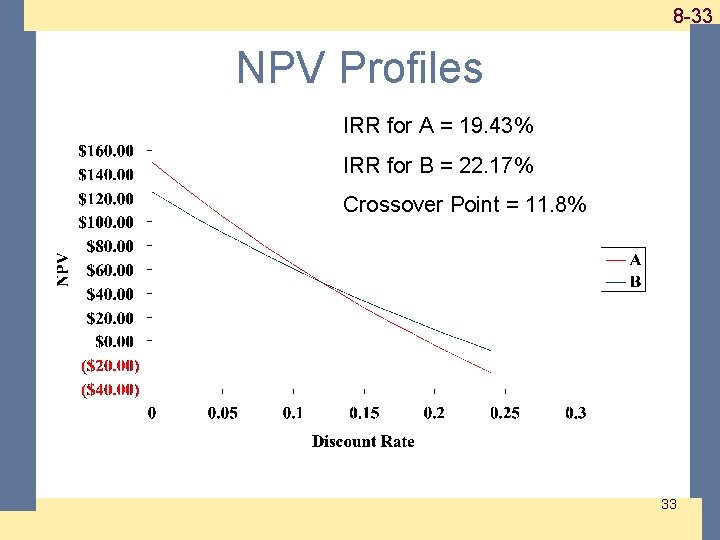
1 -33 8 -33 NPV Profiles IRR for A = 19. 43% IRR for B = 22. 17% Crossover Point = 11. 8% 33
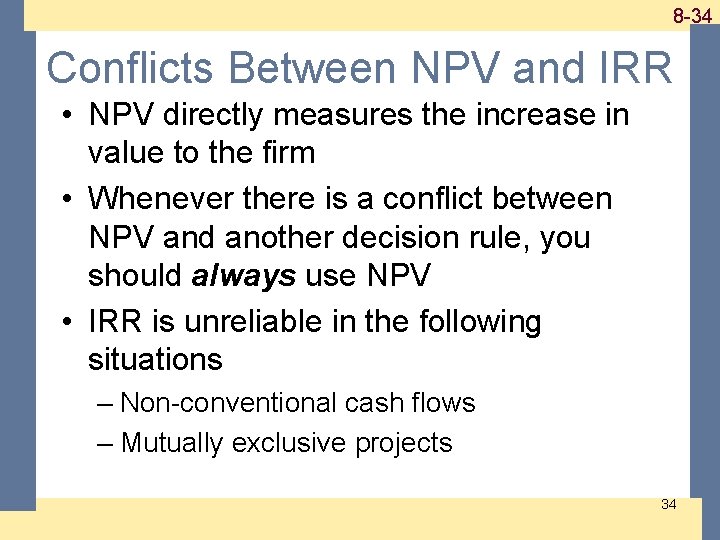
1 -34 8 -34 Conflicts Between NPV and IRR • NPV directly measures the increase in value to the firm • Whenever there is a conflict between NPV and another decision rule, you should always use NPV • IRR is unreliable in the following situations – Non-conventional cash flows – Mutually exclusive projects 34
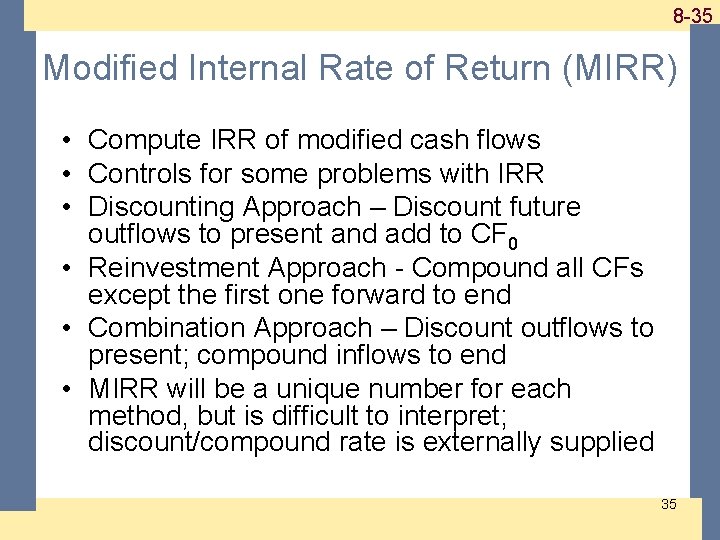
1 -35 8 -35 Modified Internal Rate of Return (MIRR) • Compute IRR of modified cash flows • Controls for some problems with IRR • Discounting Approach – Discount future outflows to present and add to CF 0 • Reinvestment Approach - Compound all CFs except the first one forward to end • Combination Approach – Discount outflows to present; compound inflows to end • MIRR will be a unique number for each method, but is difficult to interpret; discount/compound rate is externally supplied 35
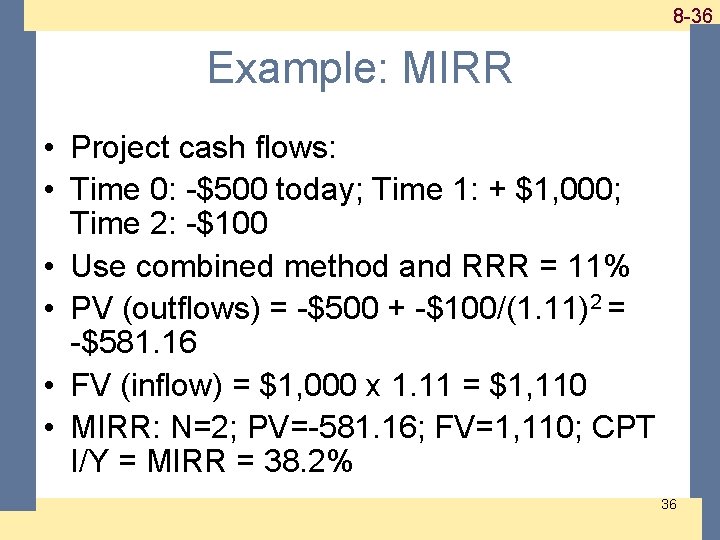
1 -36 8 -36 Example: MIRR • Project cash flows: • Time 0: -$500 today; Time 1: + $1, 000; Time 2: -$100 • Use combined method and RRR = 11% • PV (outflows) = -$500 + -$100/(1. 11)2 = -$581. 16 • FV (inflow) = $1, 000 x 1. 11 = $1, 110 • MIRR: N=2; PV=-581. 16; FV=1, 110; CPT I/Y = MIRR = 38. 2% 36
1 -37 8 -37 Profitability Index • Measures the benefit per unit cost, based on the time value of money • A profitability index of 1. 1 implies that for every $1 of investment, we receive $1. 10 worth of benefits, so we create an additional $0. 10 in value • This measure can be very useful in situations in which we have limited capital 37
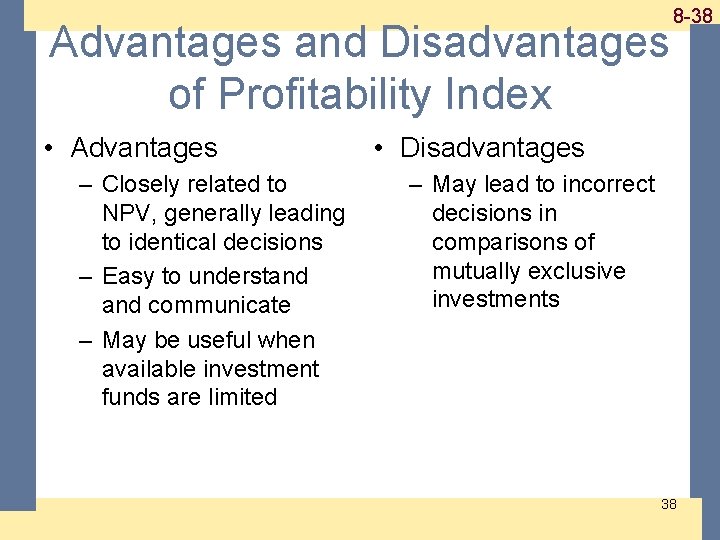
1 -38 8 -38 Advantages and Disadvantages of Profitability Index • Advantages – Closely related to NPV, generally leading to identical decisions – Easy to understand communicate – May be useful when available investment funds are limited • Disadvantages – May lead to incorrect decisions in comparisons of mutually exclusive investments 38
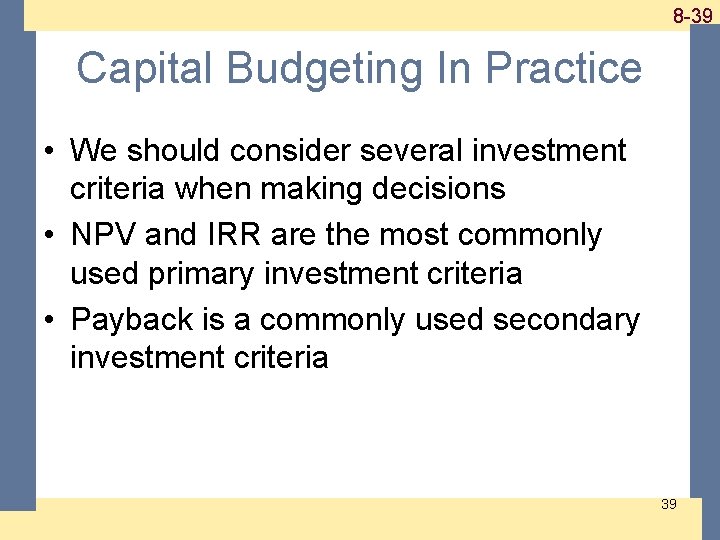
1 -39 8 -39 Capital Budgeting In Practice • We should consider several investment criteria when making decisions • NPV and IRR are the most commonly used primary investment criteria • Payback is a commonly used secondary investment criteria 39
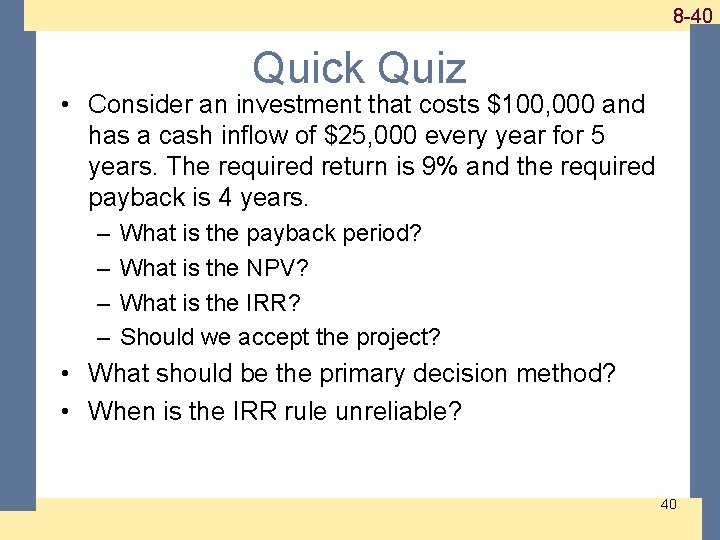
1 -40 8 -40 Quick Quiz • Consider an investment that costs $100, 000 and has a cash inflow of $25, 000 every year for 5 years. The required return is 9% and the required payback is 4 years. – – What is the payback period? What is the NPV? What is the IRR? Should we accept the project? • What should be the primary decision method? • When is the IRR rule unreliable? 40
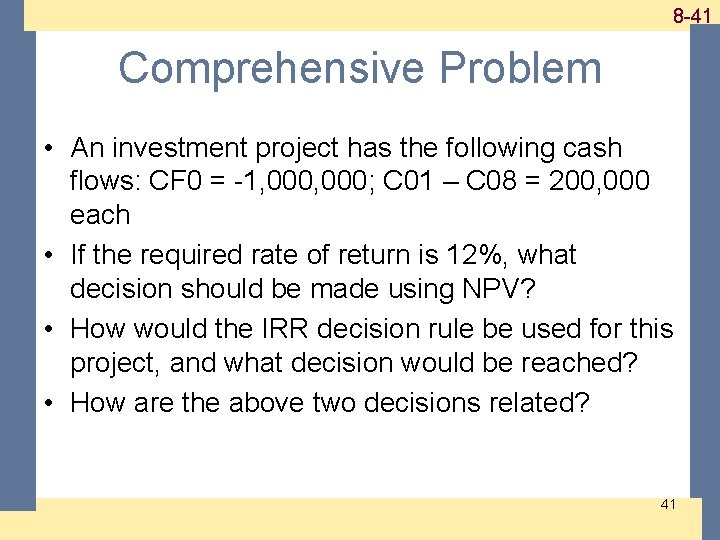
1 -41 8 -41 Comprehensive Problem • An investment project has the following cash flows: CF 0 = -1, 000; C 01 – C 08 = 200, 000 each • If the required rate of return is 12%, what decision should be made using NPV? • How would the IRR decision rule be used for this project, and what decision would be reached? • How are the above two decisions related? 41