
Chapter 8 Negative Messages Chapter 8 Highlights q
- Slides: 56
Chapter 8: Negative Messages Chapter 8
Highlights q. Plan for resolving business problems q. Four components of a bad news message q. Direct and indirect patterns q. Buffer, reasons, cushion, close q. Announcing bad news to customers and
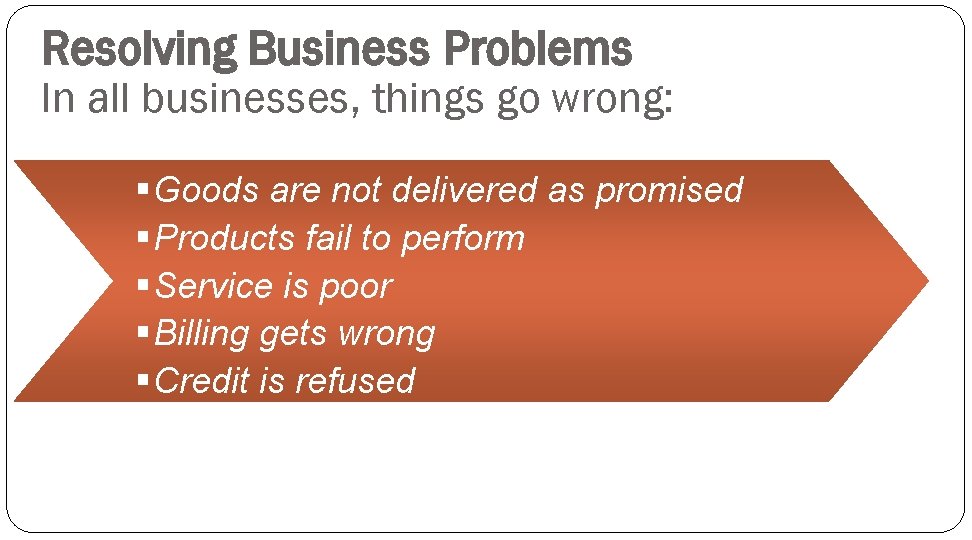
Resolving Business Problems In all businesses, things go wrong: § Goods are not delivered as promised § Products fail to perform § Service is poor § Billing gets wrong § Credit is refused
Delivering negative information is never enjoyable. Bad news disappoints, irritates, or angersreceivers. Some helpful guidelines can minimize negative reactions. Chapter 9 - 4 Copyright © 2013 Pearson Education, Inc. publishing as Prentice Hall
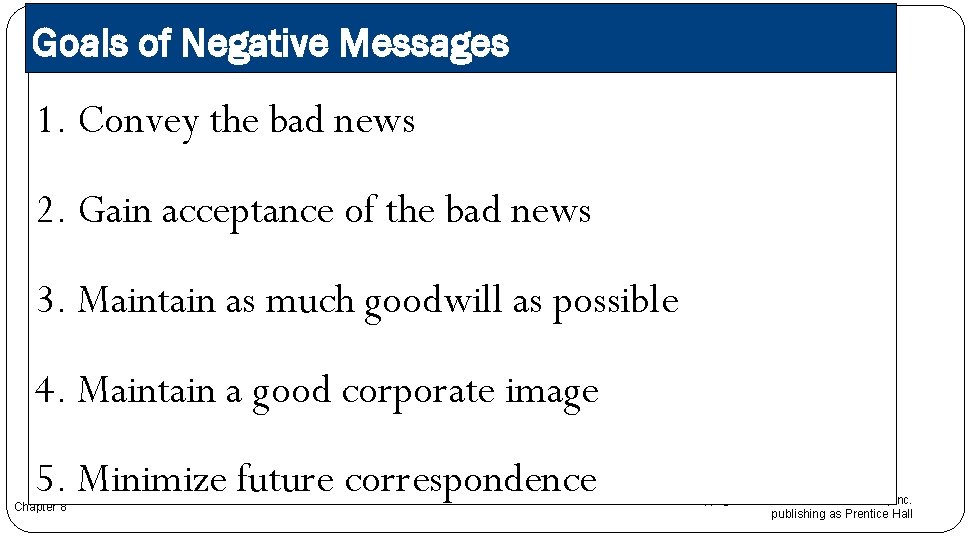
Goals of Negative Messages 1. Convey the bad news 2. Gain acceptance of the bad news 3. Maintain as much goodwill as possible 4. Maintain a good corporate image 5. Minimize future correspondence Chapter 8 Copyright © 2013 Pearson Education, Inc. publishing as Prentice Hall
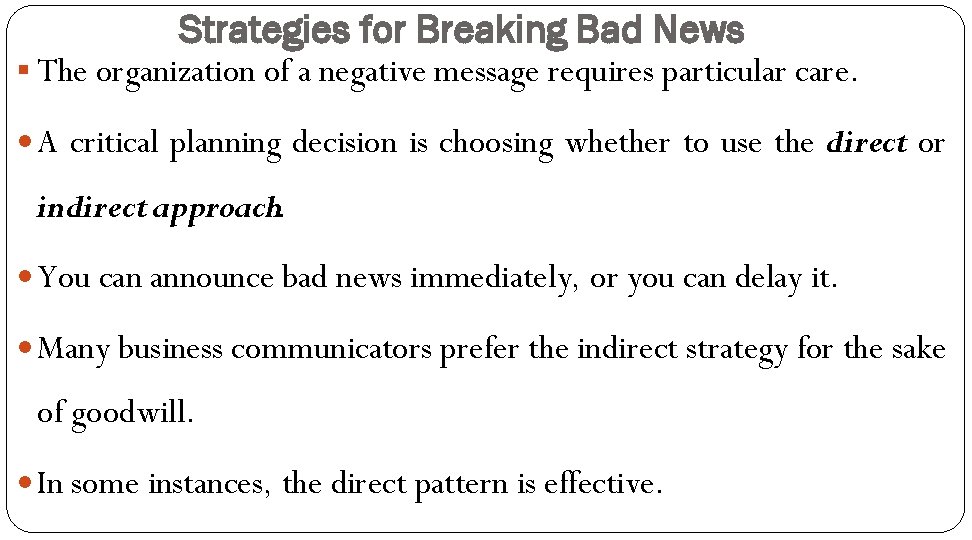
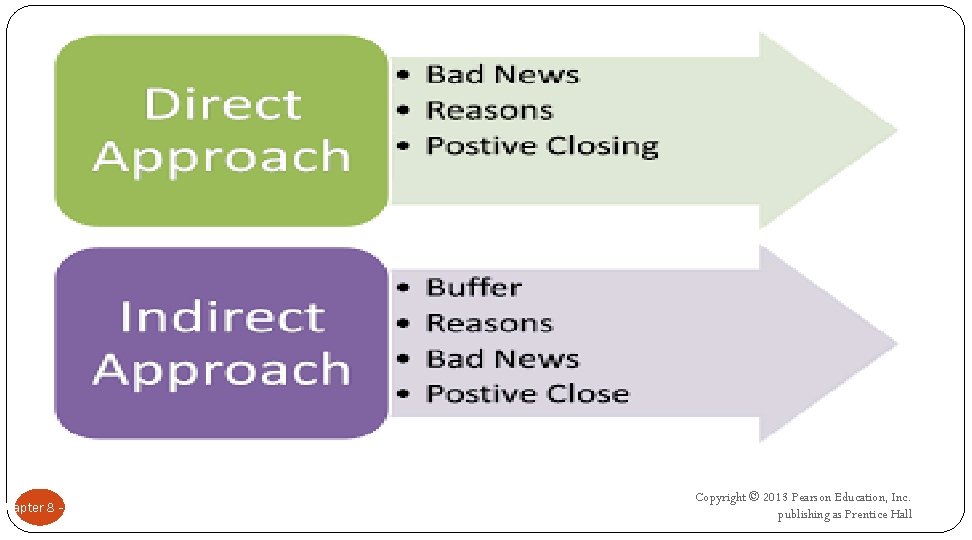
Strategies for Breaking Bad News § The organization of a negative message requires particular care. A critical planning decision is choosing whether to use the direct or indirect approach. You can announce bad news immediately, or you can delay it. Many business communicators prefer the indirect strategy for the sake of goodwill. In some instances, the direct pattern is effective.
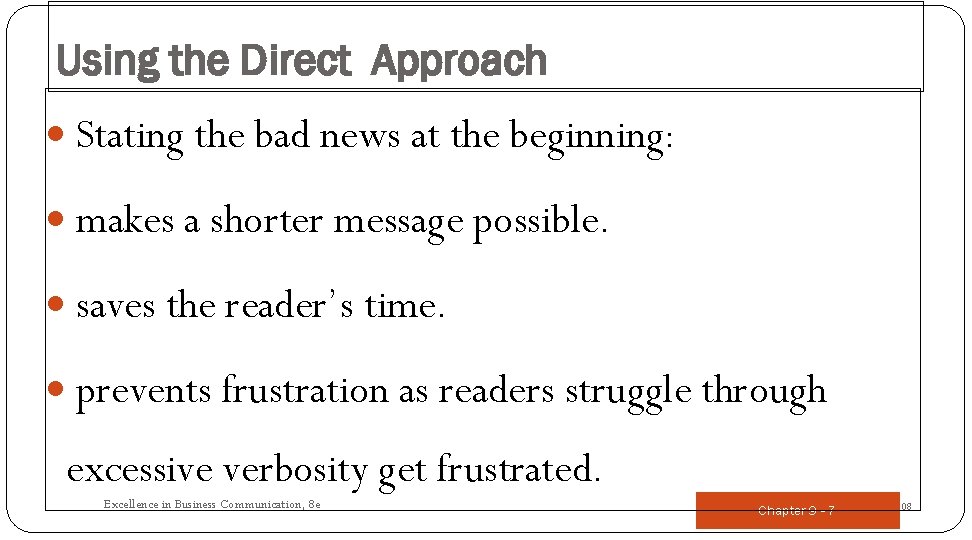
Using the Direct Approach Stating the bad news at the beginning: makes a shorter message possible. saves the reader’s time. prevents frustration as readers struggle through excessive verbosity get frustrated. Excellence in Business Communication, 8 e Hall, 2008 Chapter 9©- Prentice 7
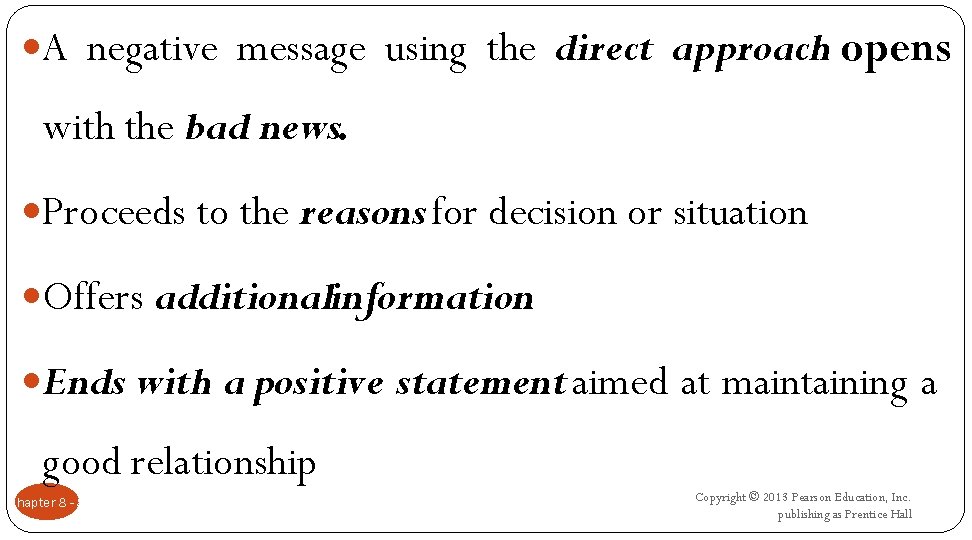
A negative message using the direct approach opens with the bad news. Proceeds to the reasons for decision or situation Offers additionalinformation Ends with a positive statement aimed at maintaining a good relationship Chapter 8 - 8 Copyright © 2013 Pearson Education, Inc. publishing as Prentice Hall
Ask yourself a few questions to decide the approach: Do you need to get the reader’s attention immediately üEmergency; someone has ignored repeated messages Do the organization and the receiver preferdirectness or a directstyle of communication? Chapter 8 - 9 Copyright © 2013 Pearson Education, Inc. publishing as Prentice Hall
How important is news to readers? üMinor or routine scenarios; emotional investment; considerable consequences; expected or unexpected Will the bad news come as shock or damage? ü understand they are to receive bad news; insignificant, small increase in cost; personally affect the receiver Chapter 8 - 10 Copyright © 2013 Pearson Education, Inc. publishing as Prentice Hall
Will the receiver overlook the bad news? üCrush of mail today---skim messages; rate increases, changes in service, new policy requirements require boldness Is firmness necessary? üDetermination and strength --- the last in a series of collection letters that seek payment of overdue accounts Chapter 8 - 11 Copyright © 2013 Pearson Education, Inc. publishing as Prentice Hall
Both approaches are neither universal nor inviolate. Every business transaction is distinct: § mixed: good and bad; goodwill and persuasion. Use your skills and confidence to evaluate the situation. Vary the patterns depending on your desired goals. Chapter 8 - Copyright © 2013 Pearson Education, Inc. publishing as Prentice Hall
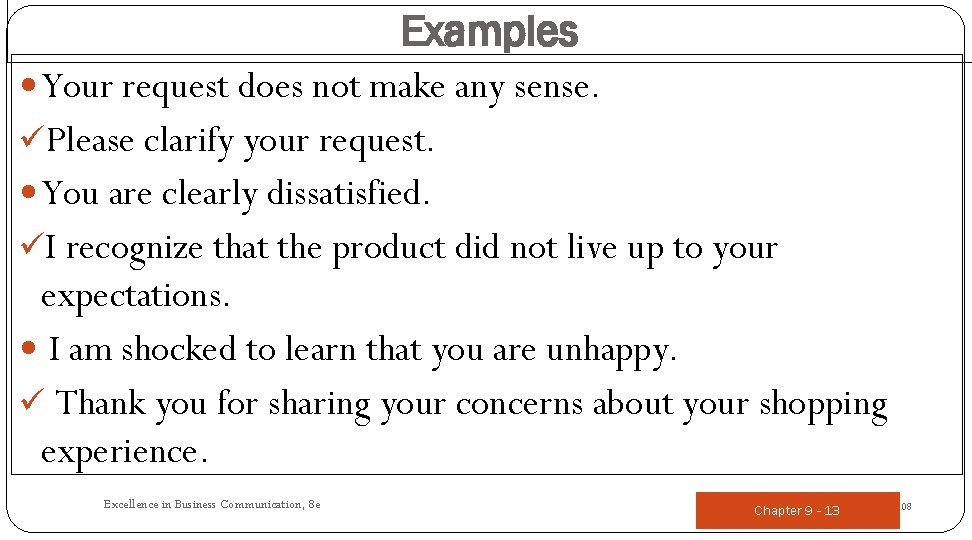
Examples Your request does not make any sense. üPlease clarify your request. You are clearly dissatisfied. üI recognize that the product did not live up to your expectations. I am shocked to learn that you are unhappy. ü Thank you for sharing your concerns about your shopping experience. Excellence in Business Communication, 8 e Prentice Hall, 2008 Chapter 9©- 13
Chapter 8 - 14 Copyright © 2013 Pearson Education, Inc. publishing as Prentice Hall
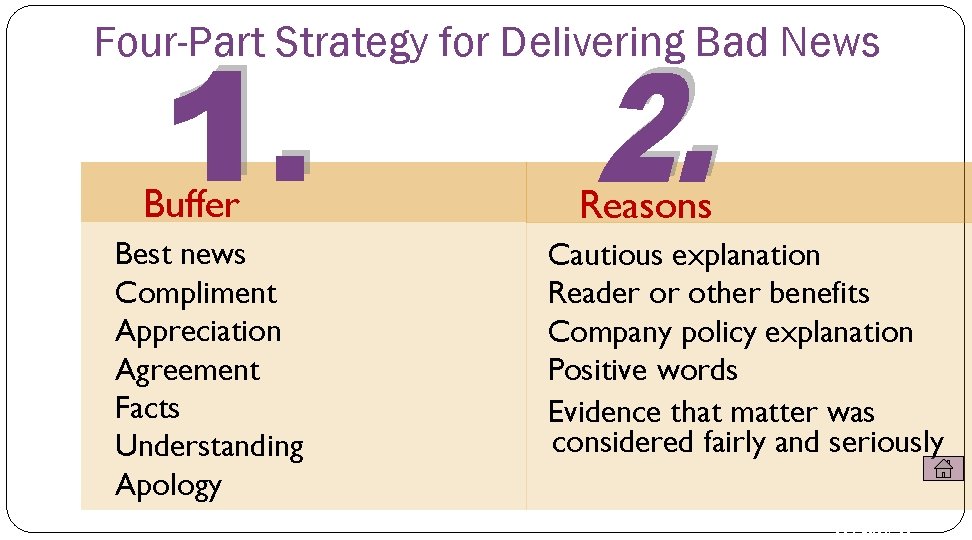
Four-Part Strategy for Delivering Bad News Buffer Best news Compliment Appreciation Agreement Facts Understanding Apology Ch. 10, Slide 15 Reasons Cautious explanation Reader or other benefits Company policy explanation Positive words Evidence that matter was considered fairly and seriously Mary Ellen Guffey, Business Communication: Process and Product, 6 e
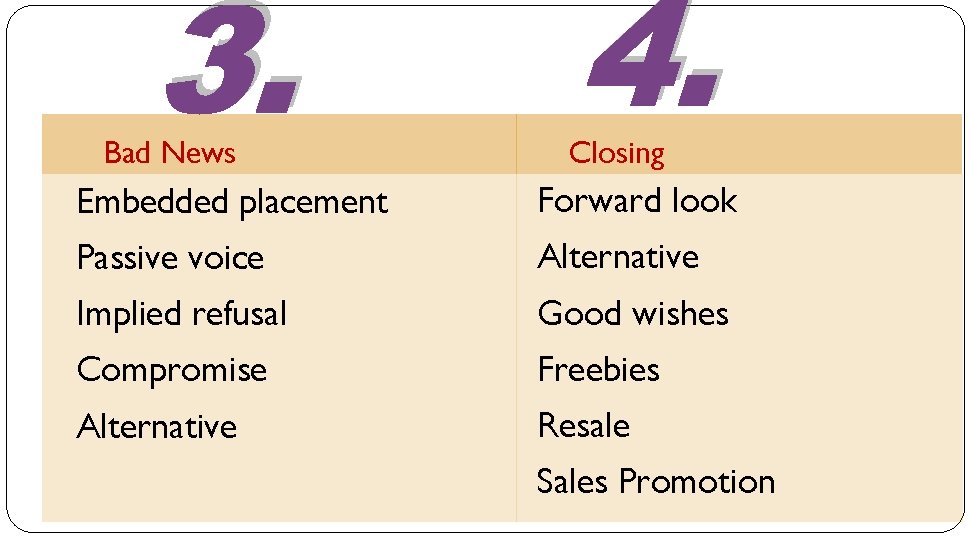
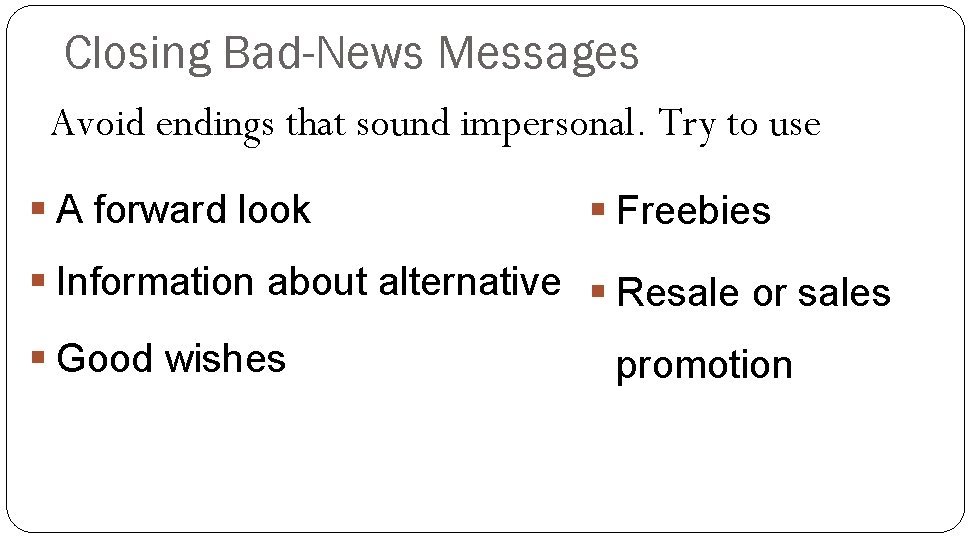
Bad News Closing Embedded placement Forward look Passive voice Alternative Implied refusal Good wishes Compromise Freebies Alternative Ch. 10, Slide 16 Resale Mary Ellen Guffey, Business Communication: Process and Product, 6 e Sales Promotion
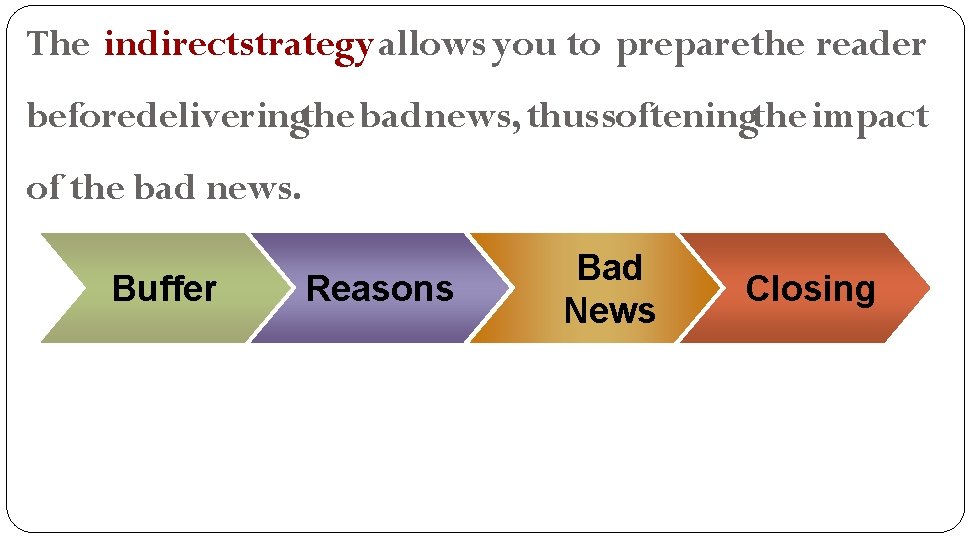
The indirectstrategy allows you to preparethe reader beforedeliveringthe bad news, thus softeningthe impact of the bad news. Buffer Reasons Bad News Closing
A buffer is the device to reduce shock or pain. It is a neutral, noncontroversial statement. It is a relevant statement but doesn’t convey the bad news. It makes the reader continue reading. Chapter 8 - 18 Copyright © 2013 Pearson Education, Inc. publishing as Prentice Hall
1. Buffering the Opening A buffer does not convey a false impression that good news follows. It provides a natural transition to the explanation that follows. Here are some possibilities for buffers: Chapter 8 Copyright © 2013 Pearson Education, Inc. publishing as Prentice Hall
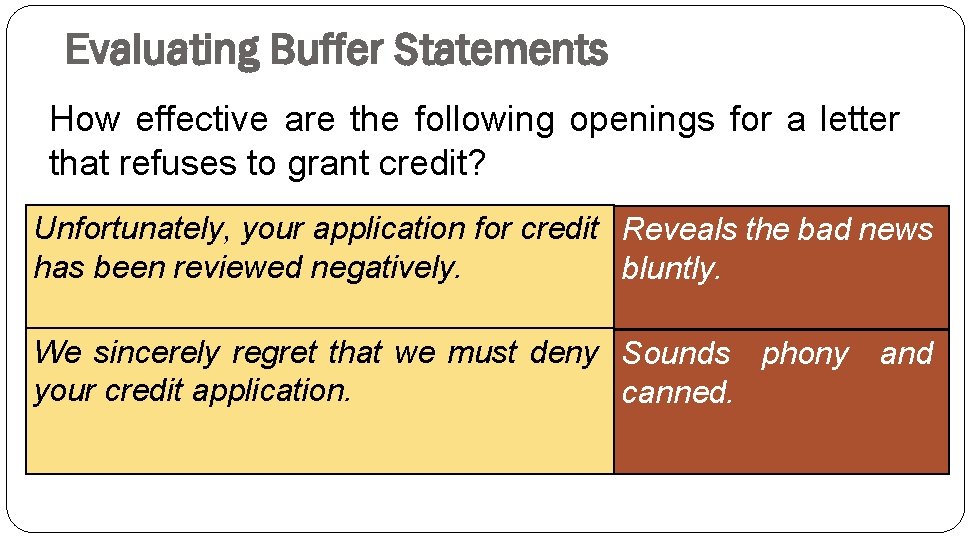
Evaluating Buffer Statements How effective are the following openings for a letter that refuses to grant credit? Unfortunately, your application for credit Reveals the bad news has been reviewed negatively. bluntly. Quick Check We sincerely regret that we must deny Sounds your credit application. canned. phony and
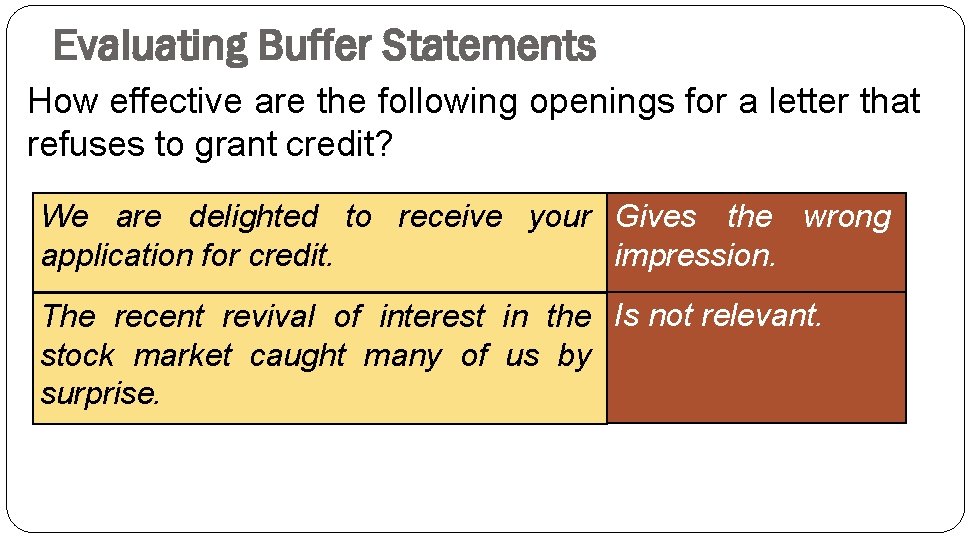
Evaluating Buffer Statements How effective are the following openings for a letter that refuses to grant credit? We are delighted to receive your Gives the wrong application for credit. impression. The recent revival of interest in the Is not relevant. stock market caught many of us by surprise.
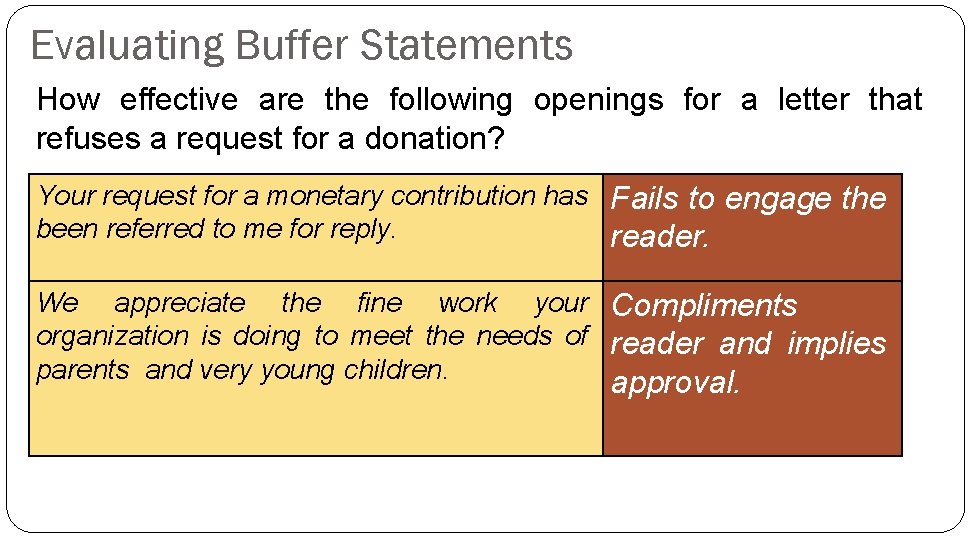
Evaluating Buffer Statements How effective are the following openings for a letter that refuses a request for a donation? Your request for a monetary contribution has Fails to engage the been referred to me for reply. reader. We appreciate the fine work your Compliments organization is doing to meet the needs of reader and implies parents and very young children. approval.
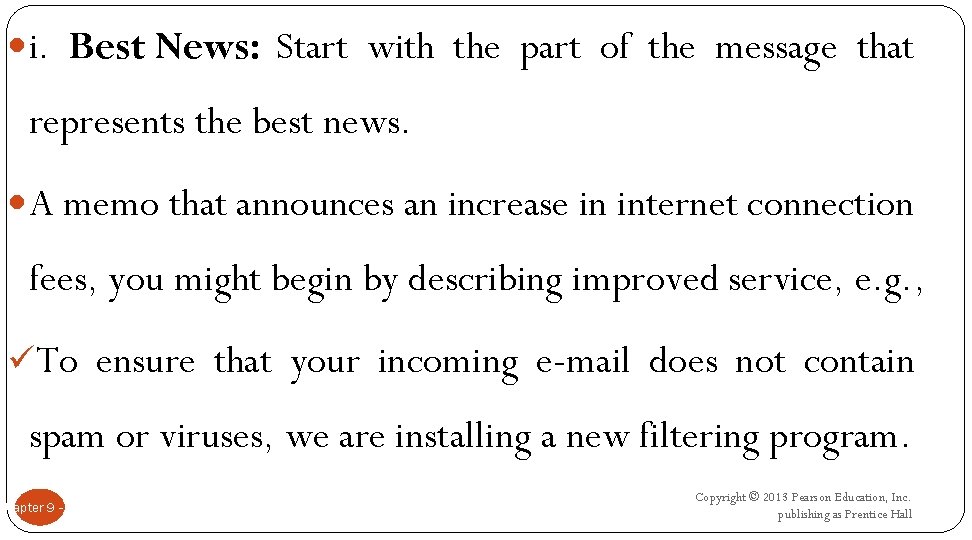
i. Best News: Start with the part of the message that represents the best news. A memo that announces an increase in internet connection fees, you might begin by describing improved service, e. g. , üTo ensure that your incoming e-mail does not contain spam or viruses, we are installing a new filtering program. Chapter 9 - 23 Copyright © 2013 Pearson Education, Inc. publishing as Prentice Hall
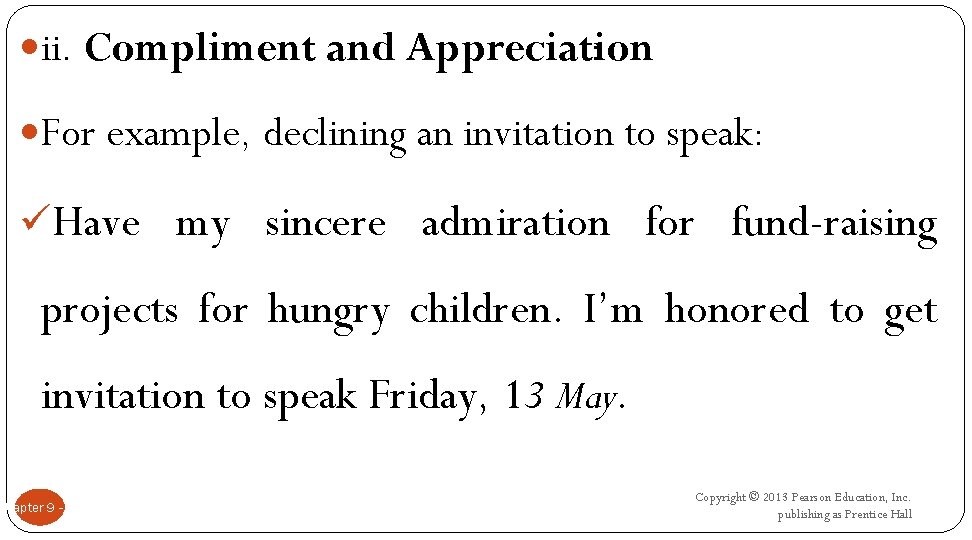
ii. Compliment and Appreciation : For example, declining an invitation to speak: üHave my sincere admiration for fund-raising projects for hungry children. I’m honored to get invitation to speak Friday, 13 May. Chapter 9 - 24 Copyright © 2013 Pearson Education, Inc. publishing as Prentice Hall
iii. Agreement: A letter that rejects a loan application might read: üWe both realize how much the export business has been affected by the relevant strength of the dollar in the past two years. Chapter 9 - 25 Copyright © 2013 Pearson Education, Inc. publishing as Prentice Hall
iv. Fact: for example, in a memo announcing cutbacks in the hours of the employees’ cafeteria, you might say: During the past two years the number of employees eating breakfast in our cafeteria has dropped from 40 percent to 20 percent. Chapter 9 - 26 Copyright © 2013 Pearson Education, Inc. publishing as Prentice Hall
v. Understanding : Show that you care about the reader. For example, in announcing a product defect, you might say: We believe that you expect superior performance from all the products you purchase from us. That’s why we’re writing personally about printer cartridges…. Chapter 9 - 27 Copyright © 2013 Pearson Education, Inc. publishing as Prentice Hall
vi. Apology : For example, a manufacturer of super premium ice cream might respond: We’re genuinely sorry that you were disappointed in the price of the ice cream you recently purchased at one of our scoop shops. Your opinion is important…. Chapter 9 - 28 Copyright © 2013 Pearson Education, Inc. publishing as Prentice Hall
2. Presenting the Reasons Providing an explanation reduces feelings of ill will. It improves the chances that the reader will accept the bad news. i. Being cautious in explaining. In refusing a speaking engagement, tell why the date is impossible: üOn January 15 we have a board of directors meeting that I must attend. Chapter 9 - 29 Copyright © 2013 Pearson Education, Inc. publishing as Prentice Hall
ii. Citing reader or others’ benefits. Although we would like to consider your application, we prefer to fill the positions from within. To improve our services to you, we’re increasing internet fees. Chapter 9 - 30 Copyright © 2013 Pearson Education, Inc. publishing as Prentice Hall
iii. Explaining company policy. üWe prefer to promote from within because it rewards the loyalty of our employees. üIn addition, we’ve found that people familiar with our organization make the quickest contribution to our team effort. Chapter 9 - 31 Copyright © 2013 Pearson Education, Inc. publishing as Prentice Hall
iv. Choosing positive words. Avoid the following expressions that might cause the reader to tune out: üClaim, error, failure, fault, impossible, regret, misunderstood, mistaken, unwilling, never, etc. Chapter 9 - 32 Copyright © 2013 Pearson Education, Inc. publishing as Prentice Hall
v. Showingthat the matterwas treatedseriouslyand fairly. Thus, consumers are more accepting of bad news. Avoid blaming others within your organization. Chapter 9 - 33 Copyright © 2013 Pearson Education, Inc. publishing as Prentice Hall
To reveal the bad news with sensitivity, learn these Seven Techniques for Deemphasizing Bad News.
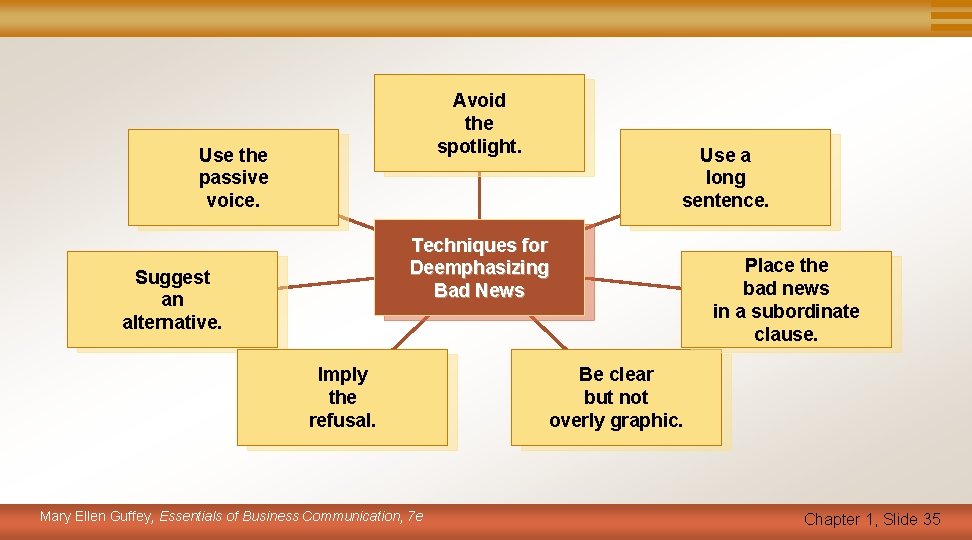
Avoid the spotlight. Use the passive voice. Use a long sentence. Techniques for Deemphasizing Bad News Suggest an alternative. Imply the refusal. Mary Ellen Guffey, Essentials of Business Communication, 7 e Place the bad news in a subordinate clause. Be clear but not overly graphic. Chapter 1, Slide 35
3. Cushioning the Bad News i. Positioning the bad news. Sandwich the bad news between other sentences. The reader’s eye lingers on start or end. üAlthough another candidate was hired, we appreciate your interest in our organization and wish you every success in your job search. Chapter 8 - 36 Copyright © 2013 Pearson Education, Inc. publishing as Prentice Hall
3. Cushioning the Bad News ii. Using the Passive Voice. The active voice focuses attention on a person; the passive voice highlights the action. üCash refunds are not given because …. Chapter 8 - 37 Copyright © 2013 Pearson Education, Inc. publishing as Prentice Hall
3. Cushioning the Bad News iii. Accentuating the positive. Rather than We will no longer allow credit card purchases, try a more positive appeal: üWe are now selling gasoline at discount cash prizes. Chapter 8 - 38 Copyright © 2013 Pearson Education, Inc. publishing as Prentice Hall
3. Cushioning the Bad News iv. Suggesting an alternative. üAlthough private tours of the grounds are not given, we do open the house and its gardens for one charitable event in the fall. Chapter 9 - 39 Copyright © 2013 Pearson Education, Inc. publishing as Prentice Hall
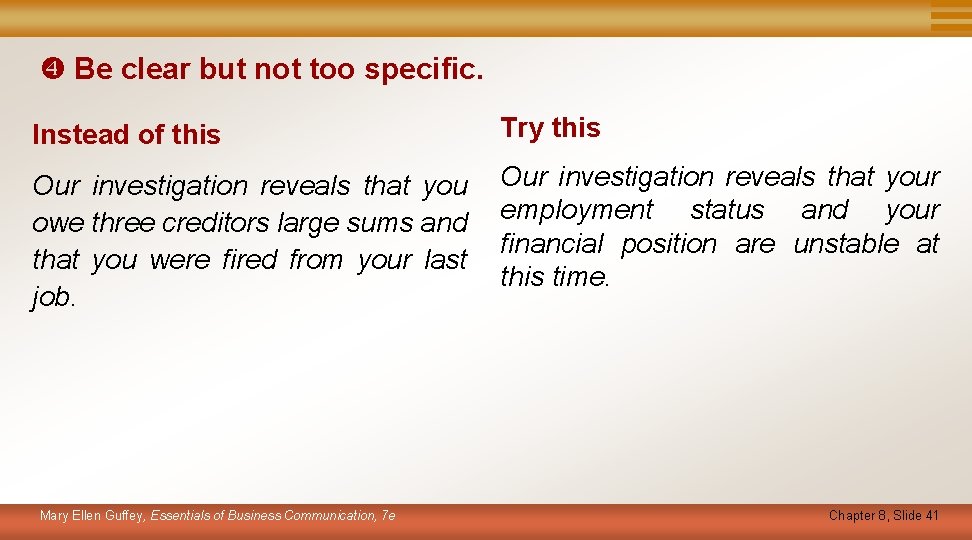
u Avoid the spotlight. Put the bad news in the middle of a paragraph halfway through the message. v Use a long sentence. Don’t put the bad news in a short, simple sentence. w Place the bad news in a subordinate clause. Although we have no position for an individual with your qualifications at this time, we are pleased that you thought of us when you started your job search. Mary Ellen Guffey, Essentials of Business Communication, 7 e Chapter 8, Slide 40
x Be clear but not too specific. Instead of this Try this Our investigation reveals that you owe three creditors large sums and that you were fired from your last job. Our investigation reveals that your employment status and your financial position are unstable at this time. Mary Ellen Guffey, Essentials of Business Communication, 7 e Chapter 8, Slide 41
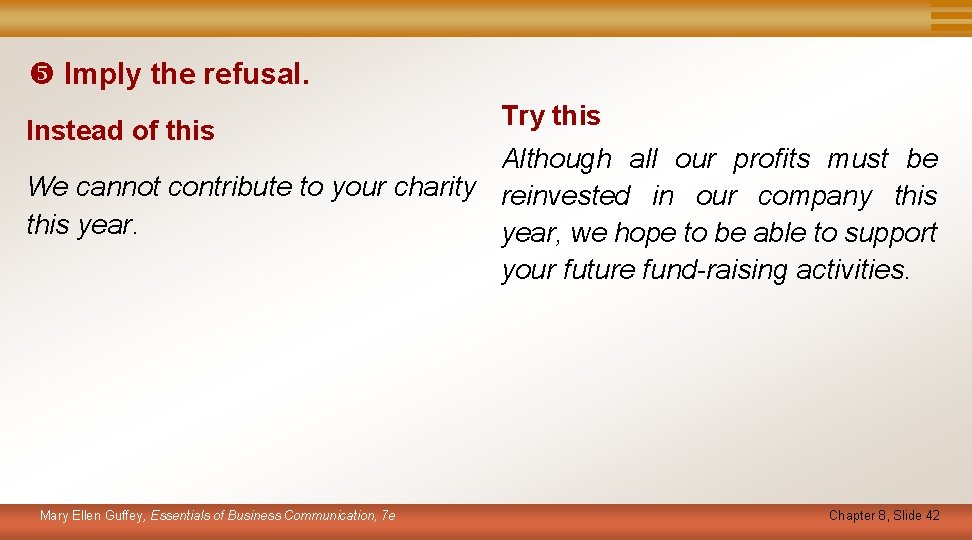
y Imply the refusal. Instead of this Try this Although all our profits must be We cannot contribute to your charity reinvested in our company this year, we hope to be able to support your future fund-raising activities. Mary Ellen Guffey, Essentials of Business Communication, 7 e Chapter 8, Slide 42
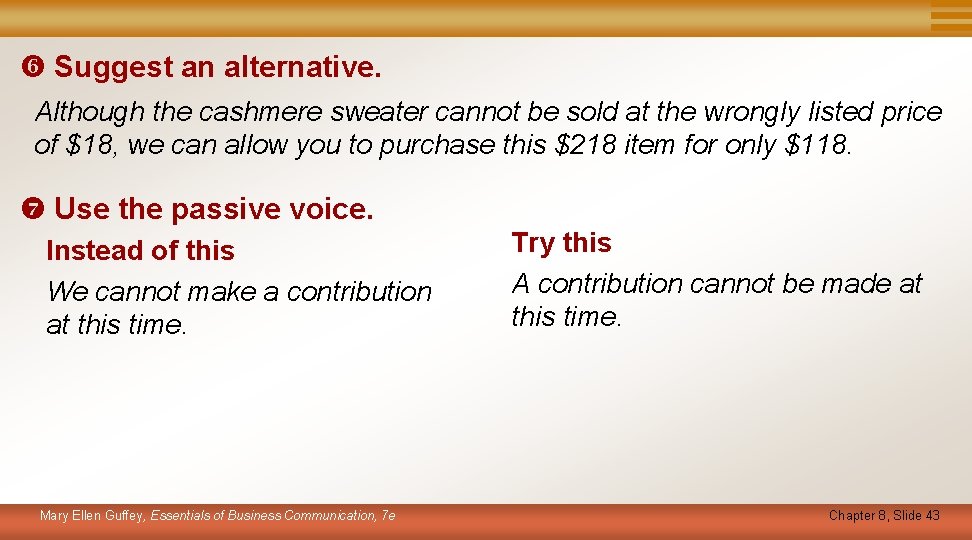
z Suggest an alternative. Although the cashmere sweater cannot be sold at the wrongly listed price of $18, we can allow you to purchase this $218 item for only $118. { Use the passive voice. Instead of this We cannot make a contribution at this time. Mary Ellen Guffey, Essentials of Business Communication, 7 e Try this A contribution cannot be made at this time. Chapter 8, Slide 43
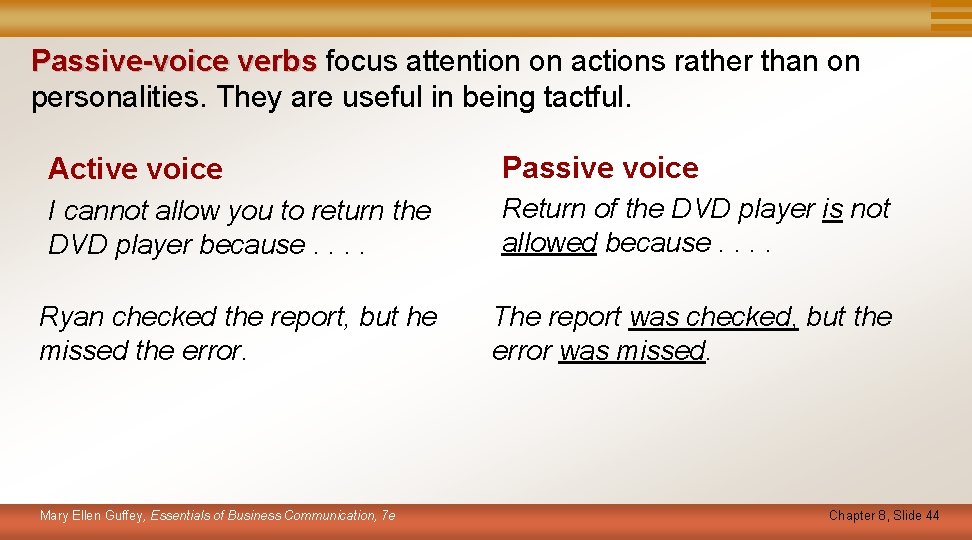
Passive-voice verbs focus attention on actions rather than on personalities. They are useful in being tactful. Active voice Passive voice I cannot allow you to return the DVD player because. . Return of the DVD player is not allowed because. . Ryan checked the report, but he missed the error. The report was checked, but the error was missed. Mary Ellen Guffey, Essentials of Business Communication, 7 e Chapter 8, Slide 44
Closing Bad-News Messages Avoid endings that sound impersonal. Try to use § A forward look § Freebies § Information about alternative § Resale or sales § Good wishes promotion
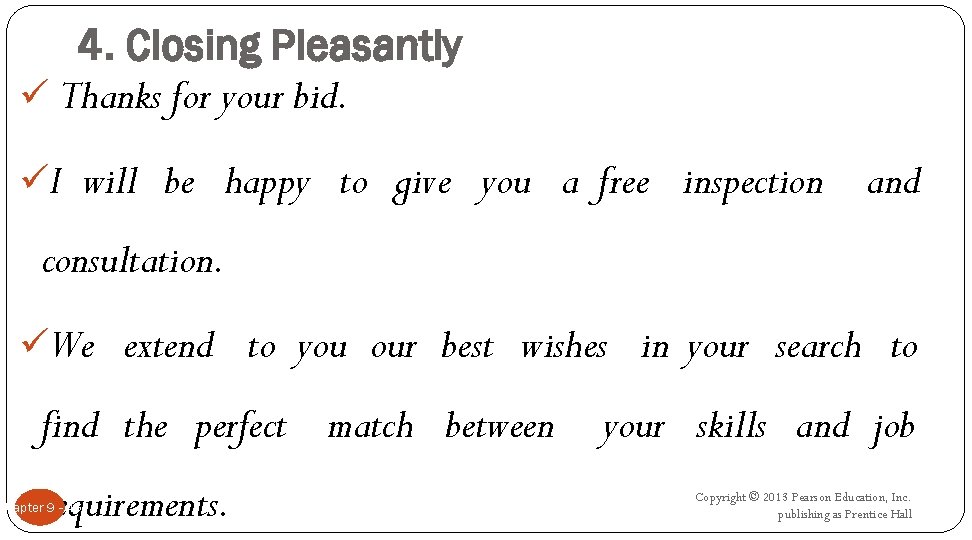
4. Closing Pleasantly ü Thanks for your bid. üI will be happy to give you a free inspection and consultation. üWe extend to you our best wishes in your search to find the perfect match between requirements. Chapter 9 - 46 your skills and job Copyright © 2013 Pearson Education, Inc. publishing as Prentice Hall
Model Refusal Letters Click icon to view memo refusing an internal request before revision. Click icon to view revised memo. Mary Ellen Guffey, Essentials of Business Communication, 7 e Chapter 8, Slide 47
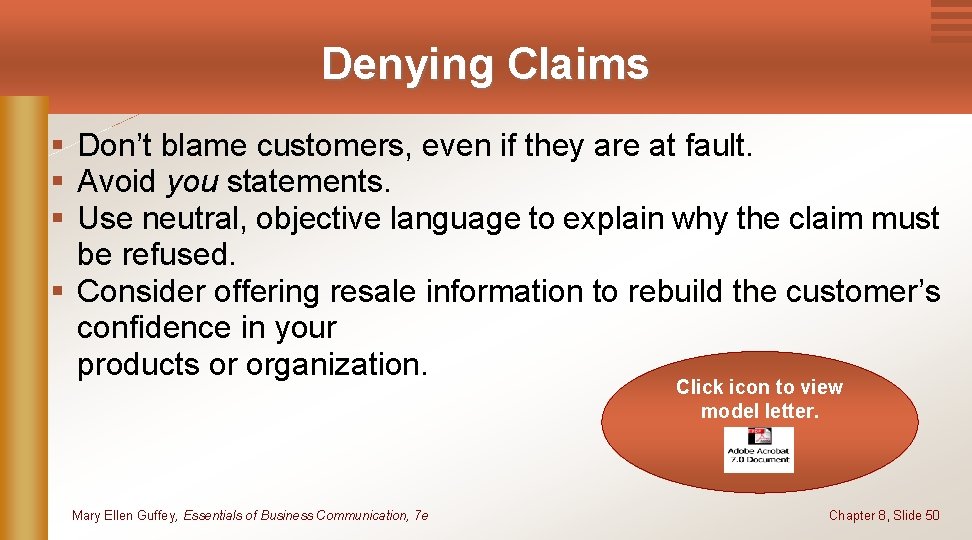
Denying Claims § Don’t blame customers, even if they are at fault. § Avoid you statements. § Use neutral, objective language to explain why the claim must be refused. § Consider offering resale information to rebuild the customer’s confidence in your products or organization. Click icon to view model letter. Mary Ellen Guffey, Essentials of Business Communication, 7 e Chapter 8, Slide 50
§ Provide information about an alternative, if one exists. § If appropriate, describe what will happen next. § Look forward positively. Click icon to view before-revision letter announcing bad news to employees. Mary Ellen Guffey, Essentials of Business Communication, 7 e Click icon to view after-revision letter. Chapter 8, Slide 51
Ethics and the Indirect Strategy You may worry that the indirect strategy is unethical or manipulative because the writer deliberately delays the main idea. But consider the alternative. Breaking bad news bluntly can cause pain. Excellence in Business Communication, 8 e Prentice Hall, 2008 Chapter 8©- 52
Ethics and the Indirect Strategy By delaying bad news, you soften the blow somewhat. Your motives are not to deceive the reader, or to hide the news. The key lies in the motives of the sender. For example, Victoria’s Secret Excellence in Business Communication, 8 e Chapter© 8 Prentice Hall, 2008
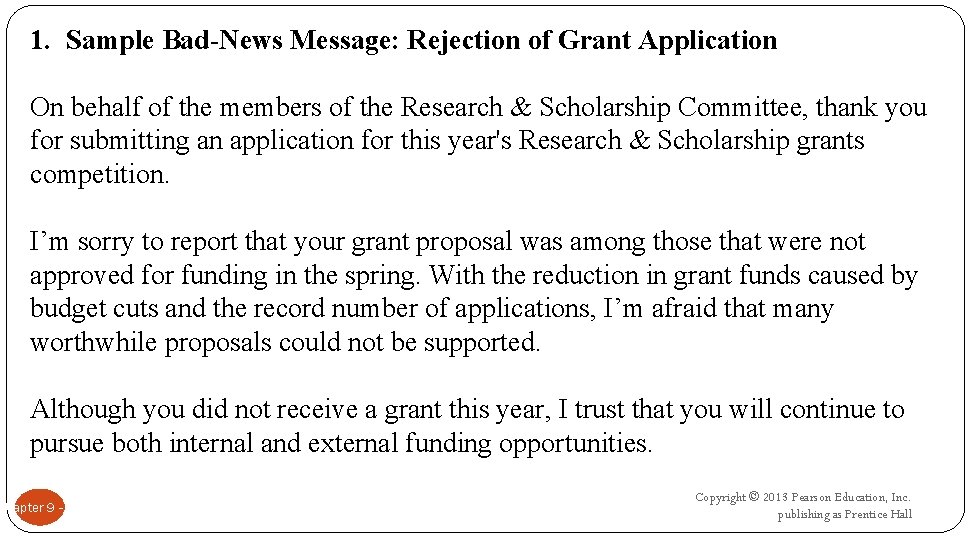
1. Sample Bad-News Message: Rejection of Grant Application On behalf of the members of the Research & Scholarship Committee, thank you for submitting an application for this year's Research & Scholarship grants competition. I’m sorry to report that your grant proposal was among those that were not approved for funding in the spring. With the reduction in grant funds caused by budget cuts and the record number of applications, I’m afraid that many worthwhile proposals could not be supported. Although you did not receive a grant this year, I trust that you will continue to pursue both internal and external funding opportunities. Chapter 9 - 54 Copyright © 2013 Pearson Education, Inc. publishing as Prentice Hall
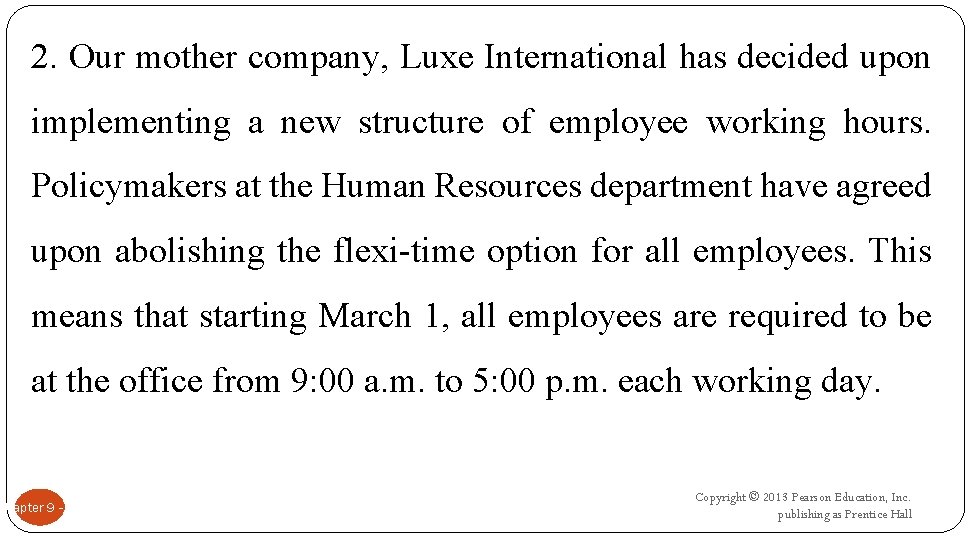
2. Our mother company, Luxe International has decided upon implementing a new structure of employee working hours. Policymakers at the Human Resources department have agreed upon abolishing the flexi-time option for all employees. This means that starting March 1, all employees are required to be at the office from 9: 00 a. m. to 5: 00 p. m. each working day. Chapter 9 - 55 Copyright © 2013 Pearson Education, Inc. publishing as Prentice Hall
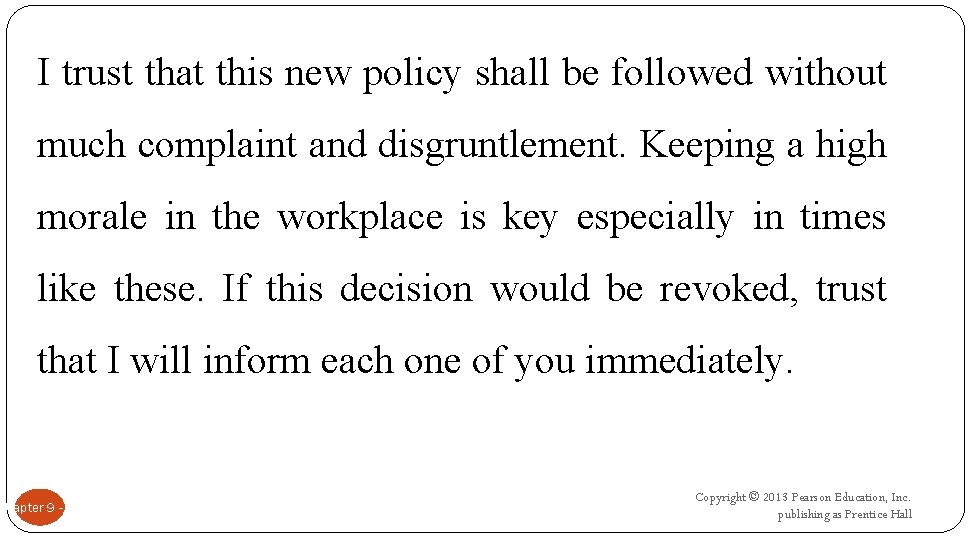
I trust that this new policy shall be followed without much complaint and disgruntlement. Keeping a high morale in the workplace is key especially in times like these. If this decision would be revoked, trust that I will inform each one of you immediately. Chapter 9 - 56 Copyright © 2013 Pearson Education, Inc. publishing as Prentice Hall
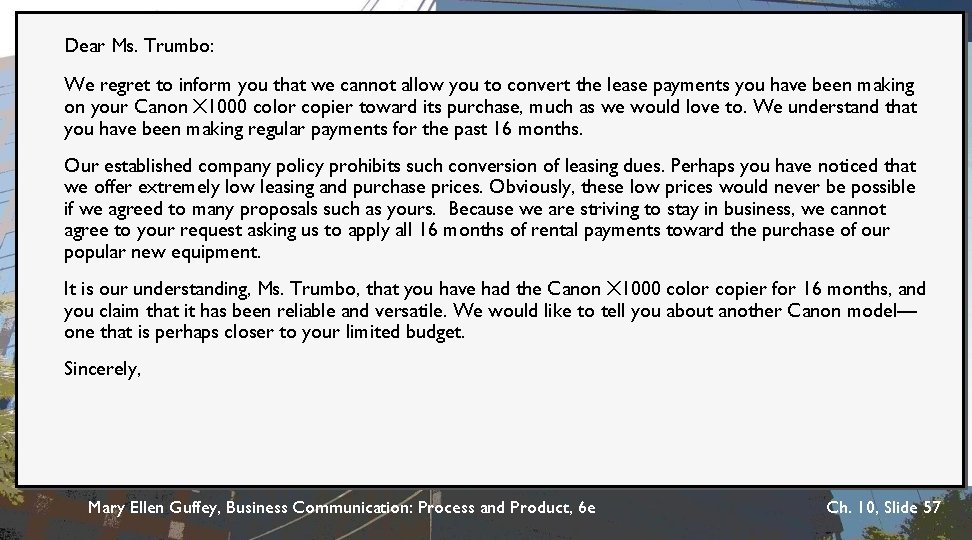
Dear Ms. Trumbo: “Before”—Ineffective Customer Request Refusal We regret to inform you that we cannot allow you to convert the lease payments you have been making on your Canon X 1000 color copier toward its purchase, much as we would love to. We understand that you have been making regular payments for the past 16 months. Our established company policy prohibits such conversion of leasing dues. Perhaps you have noticed that we offer extremely low leasing and purchase prices. Obviously, these low prices would never be possible if we agreed to many proposals such as yours. Because we are striving to stay in business, we cannot agree to your request asking us to apply all 16 months of rental payments toward the purchase of our popular new equipment. It is our understanding, Ms. Trumbo, that you have had the Canon X 1000 color copier for 16 months, and you claim that it has been reliable and versatile. We would like to tell you about another Canon model— one that is perhaps closer to your limited budget. Sincerely, Mary Ellen Guffey, Business Communication: Process and Product, 6 e Ch. 10, Slide 57
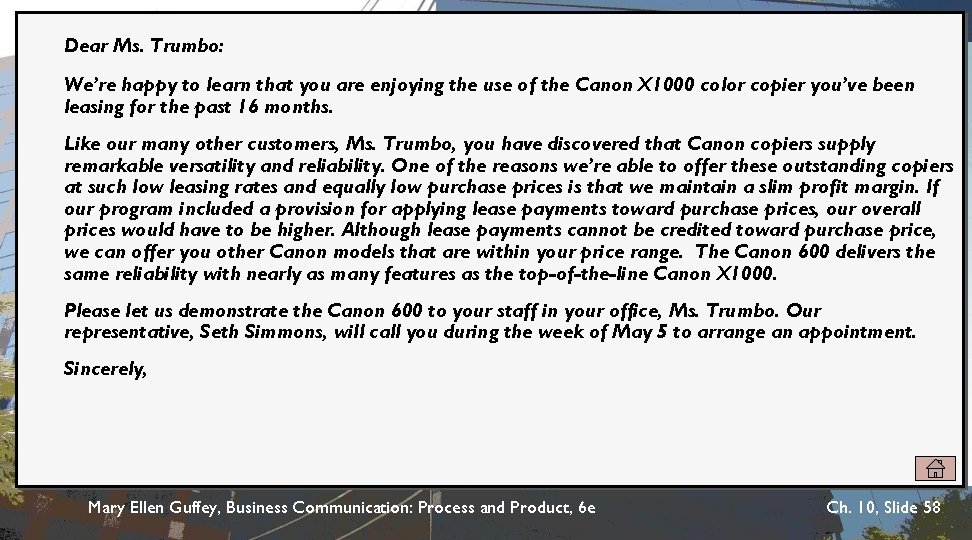
Dear Ms. Trumbo: We’re happy to learn that you are enjoying the use of the Canon X 1000 color copier you’ve been leasing for the past 16 months. “After”—Improved Refusal of Request Like our many other customers, Ms. Trumbo, you have discovered that Canon copiers supply remarkable versatility and reliability. One of the reasons we’re able to offer these outstanding copiers at such low leasing rates and equally low purchase prices is that we maintain a slim profit margin. If our program included a provision for applying lease payments toward purchase prices, our overall prices would have to be higher. Although lease payments cannot be credited toward purchase price, we can offer you other Canon models that are within your price range. The Canon 600 delivers the same reliability with nearly as many features as the top-of-the-line Canon X 1000. Please let us demonstrate the Canon 600 to your staff in your office, Ms. Trumbo. Our representative, Seth Simmons, will call you during the week of May 5 to arrange an appointment. Sincerely, Mary Ellen Guffey, Business Communication: Process and Product, 6 e Ch. 10, Slide 58