
Chapter 8 Muscular System 8 1 Copyright The
- Slides: 31
Chapter 8 Muscular System 8 -1
Copyright The Mc. Graw-Hill Companies, Inc. Permission required for reproduction or display. Recap: -The three types of muscle in the body are skeletal, smooth, and cardiac muscle. 8 -2
Copyright The Mc. Graw-Hill Companies, Inc. Permission required for reproduction or display. Structure of a Skeletal Muscle Each muscle is an organ comprised of -skeletal muscle tissue -connective tissues -nervous tissue -blood 8 -3
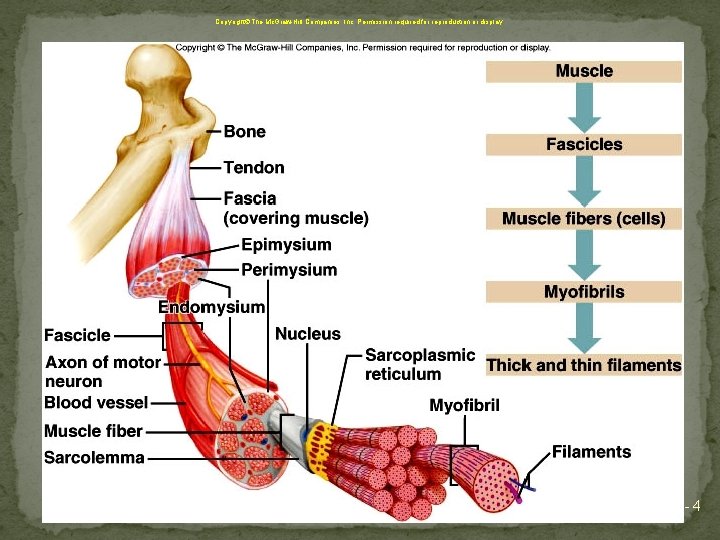
Copyright The Mc. Graw-Hill Companies, Inc. Permission required for reproduction or display. 8 -4
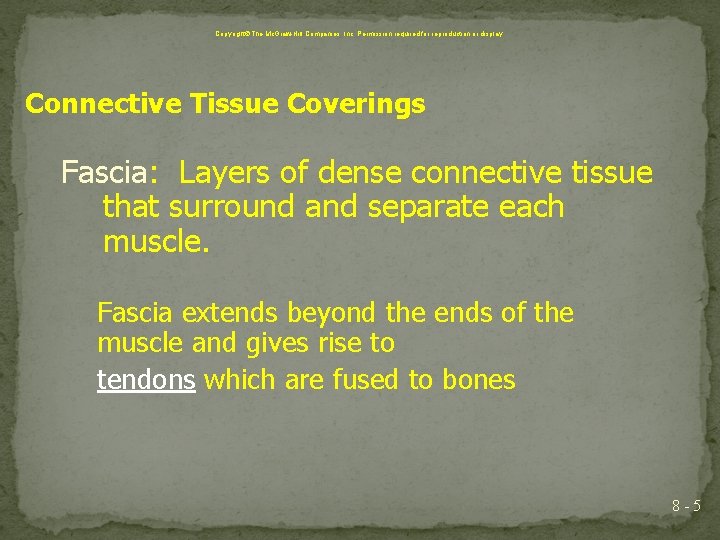
Copyright The Mc. Graw-Hill Companies, Inc. Permission required for reproduction or display. Connective Tissue Coverings Fascia: Layers of dense connective tissue that surround and separate each muscle. Fascia extends beyond the ends of the muscle and gives rise to tendons which are fused to bones 8 -5
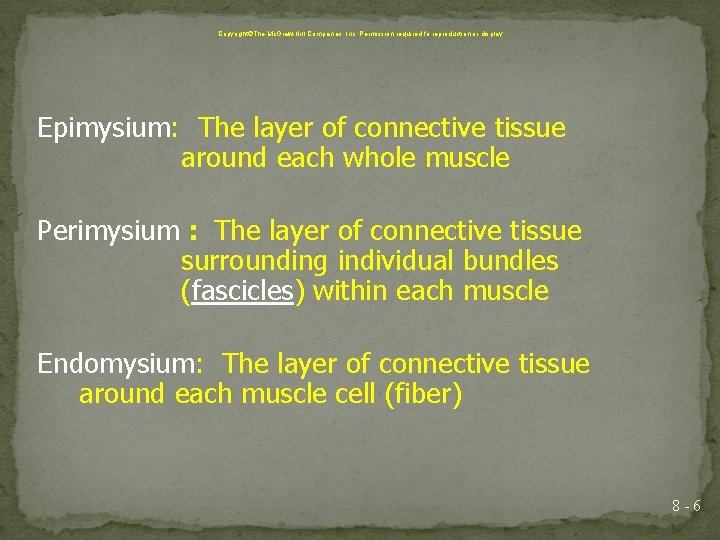
Copyright The Mc. Graw-Hill Companies, Inc. Permission required fo reproduction or display Epimysium: The layer of connective tissue around each whole muscle Perimysium : The layer of connective tissue surrounding individual bundles (fascicles) within each muscle Endomysium: The layer of connective tissue around each muscle cell (fiber) 8 -6
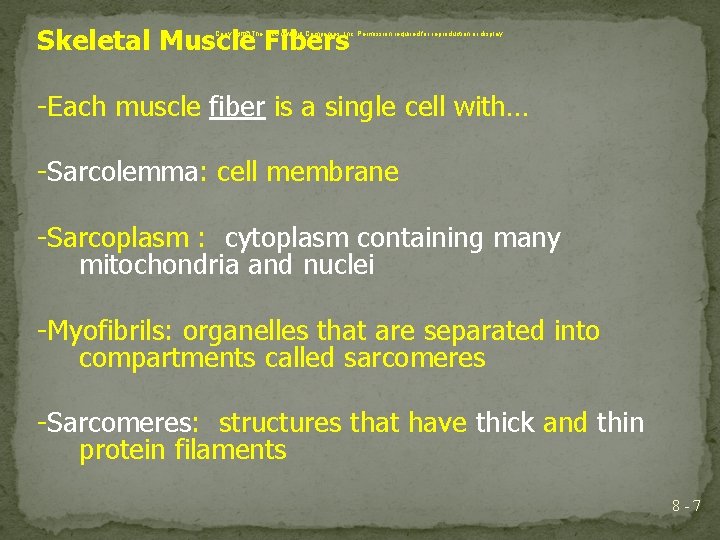
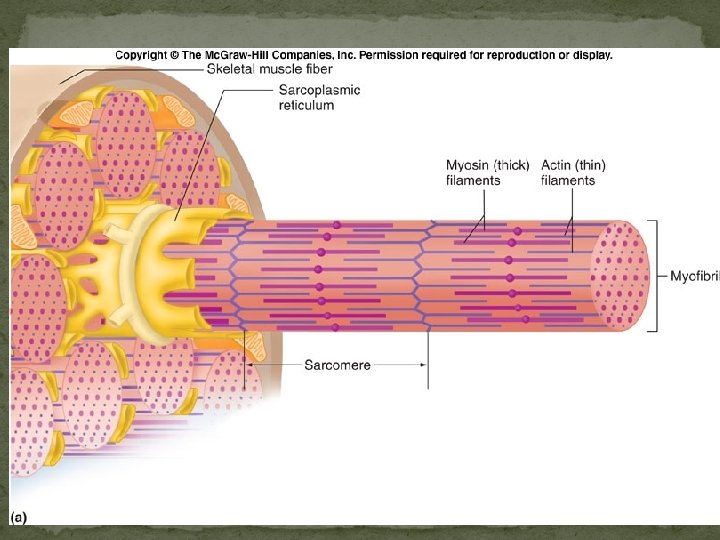
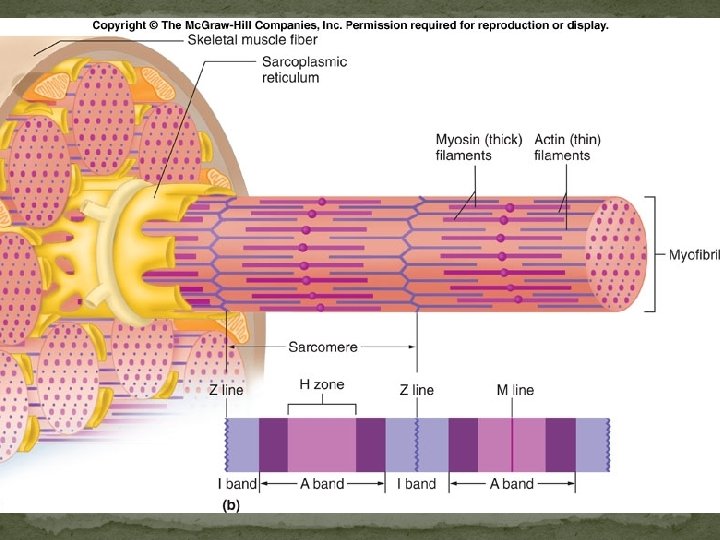
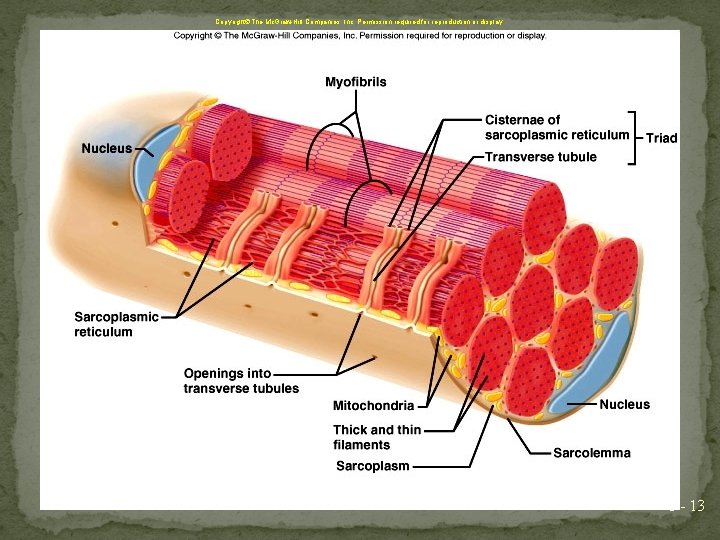
Skeletal Muscle Fibers Copyright The Mc. Graw-Hill Companies, Inc. Permission required for reproduction or display. -Each muscle fiber is a single cell with… -Sarcolemma: cell membrane -Sarcoplasm : cytoplasm containing many mitochondria and nuclei -Myofibrils: organelles that are separated into compartments called sarcomeres -Sarcomeres: structures that have thick and thin protein filaments 8 -7
8 -8
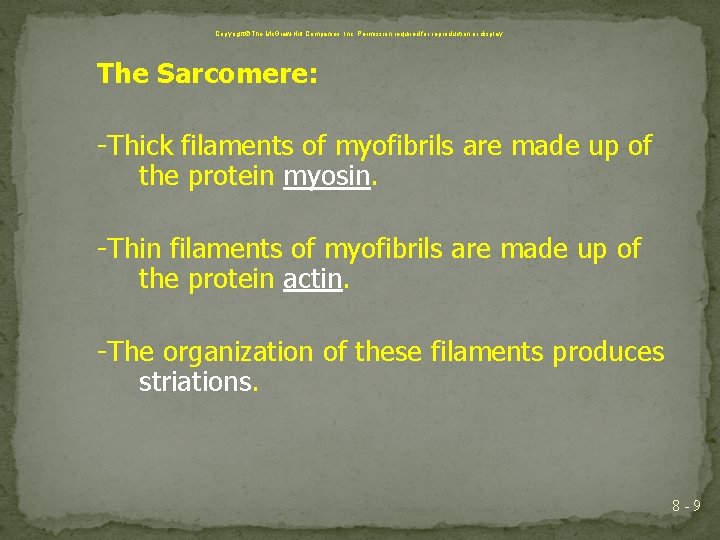
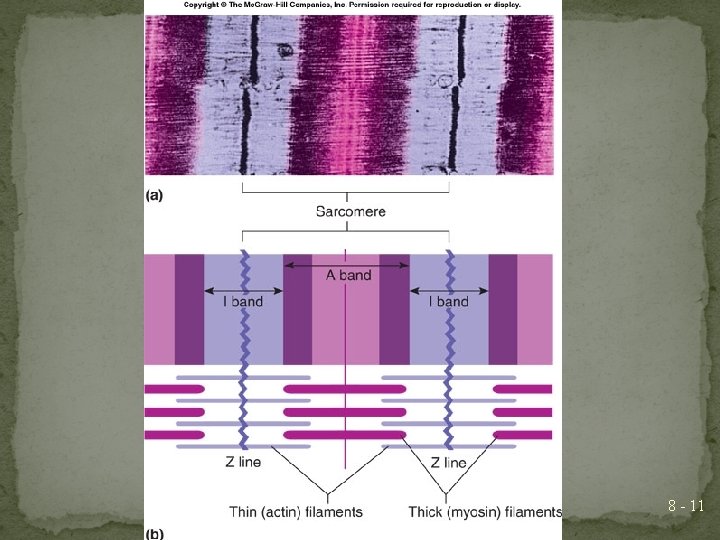
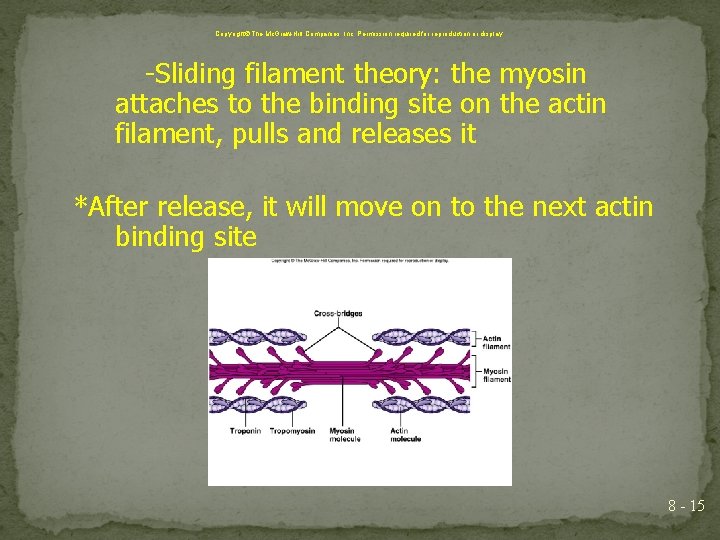
Copyright The Mc. Graw-Hill Companies, Inc. Permission required for reproduction or display. The Sarcomere: -Thick filaments of myofibrils are made up of the protein myosin. -Thin filaments of myofibrils are made up of the protein actin. -The organization of these filaments produces striations. 8 -9
8 - 10
8 - 11
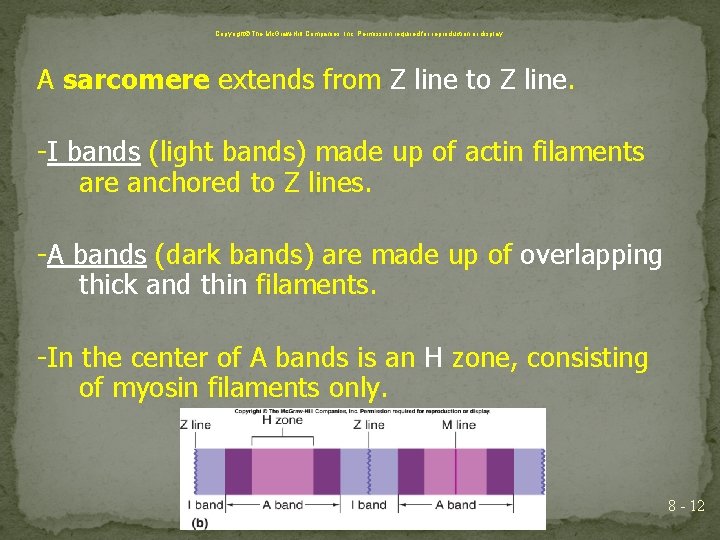
Copyright The Mc. Graw-Hill Companies, Inc. Permission required for reproduction or display. A sarcomere extends from Z line to Z line. -I bands (light bands) made up of actin filaments are anchored to Z lines. -A bands (dark bands) are made up of overlapping thick and thin filaments. -In the center of A bands is an H zone, consisting of myosin filaments only. 8 - 12
Copyright The Mc. Graw-Hill Companies, Inc. Permission required for reproduction or display. 8 - 13
Copyright The Mc. Graw-Hill Companies, Inc. Permission required for reproduction or display. Skeletal Muscle Contraction Muscle contraction involves several components that result in -the shortening of sarcomeres -the pulling of the muscle against its attachments. 8 - 14
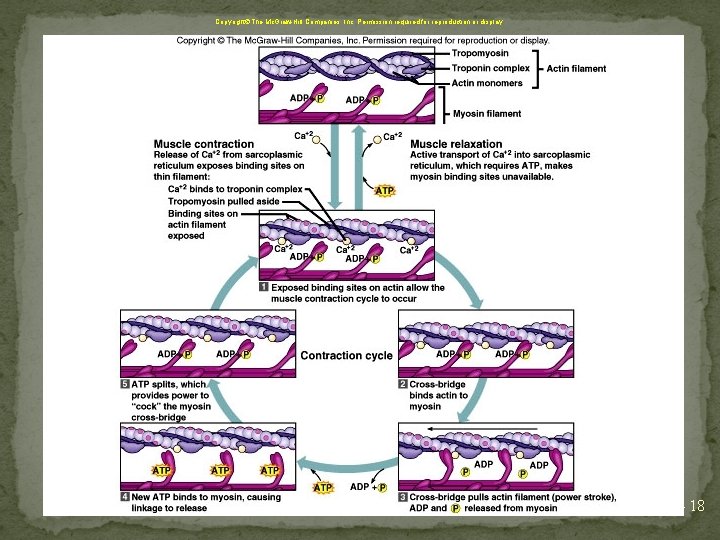
Copyright The Mc. Graw-Hill Companies, Inc. Permission required for reproduction or display. -Sliding filament theory: the myosin attaches to the binding site on the actin filament, pulls and releases it *After release, it will move on to the next actin binding site 8 - 15
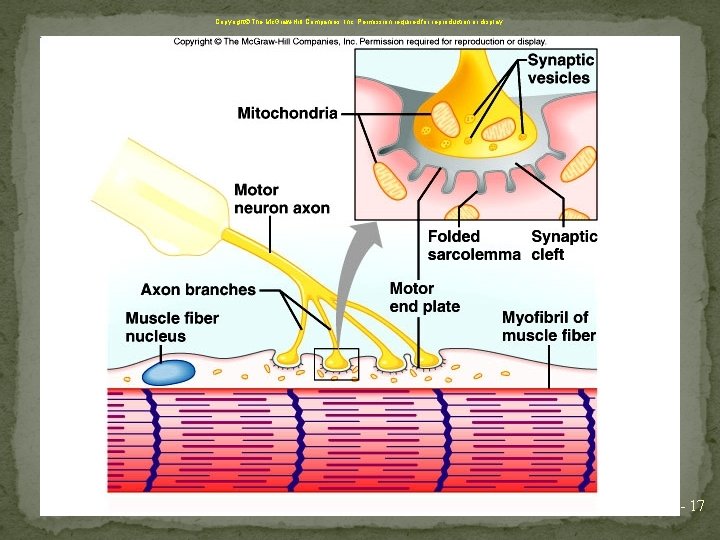
Copyright The Mc. Graw-Hill Companies, Inc. Permission required for reproduction or display. Stimulus for Contraction 1. The motor neuron releases acetylcholine (signalled from brain) *Signals muscle to contract 2. Calcium is released 3. Myosin is able to bind to actin and the fiber contracts (sarcomeres shorten) How does this stop? 8 - 16
Copyright The Mc. Graw-Hill Companies, Inc. Permission required for reproduction or display. 8 - 17
Copyright The Mc. Graw-Hill Companies, Inc. Permission required for reproduction or display. 8 - 18
Copyright The Mc. Graw-Hill Companies, Inc. Permission required for reproduction or display. Energy Sources for Contraction 1. Energy for contraction comes from ATP. 8 - 19
Copyright The Mc. Graw-Hill Companies, Inc. Permission required for reproduction or display. Muscle Fatigue -Muscle Fatigue: A muscle loses its ability to contract during strenuous exercise -Usually arises from the accumulation of lactic acid (lowered p. H) in the muscle. -As a result, no muscle response to stimulation 8 - 20
Copyright The Mc. Graw-Hill Companies, Inc. Permission required for reproduction or display. Muscle Cramp Muscle cramp: sustained involuntary contraction *Changes in fluid around cell *Uncontrolled stimulation of muscle (dehydration…) 8 - 21
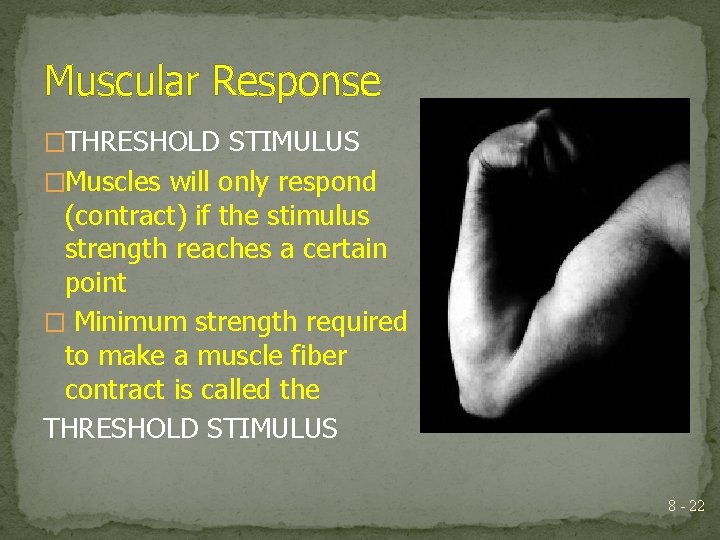
Muscular Response �THRESHOLD STIMULUS �Muscles will only respond (contract) if the stimulus strength reaches a certain point � Minimum strength required to make a muscle fiber contract is called the THRESHOLD STIMULUS 8 - 22
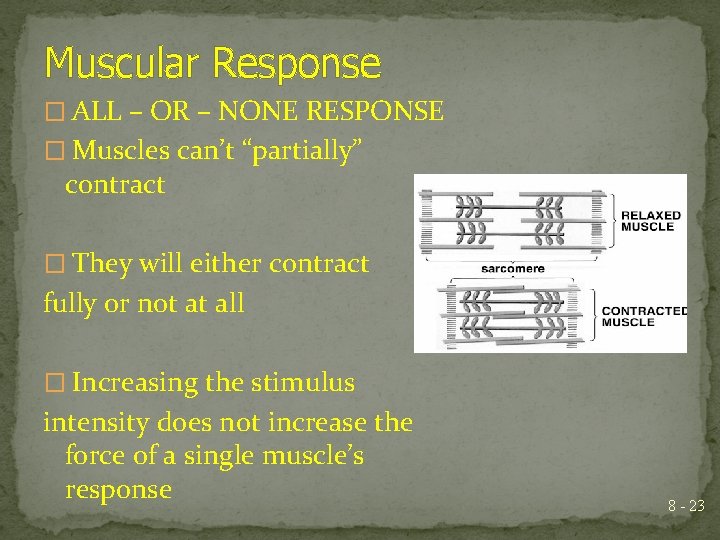
Muscular Response � ALL – OR – NONE RESPONSE � Muscles can’t “partially” contract � They will either contract fully or not at all � Increasing the stimulus intensity does not increase the force of a single muscle’s response 8 - 23
Twitches �Twitch: period of contraction and relaxation of a single muscle fiber �Movements result from multiple muscle fibers contracting together �Fast Twitch: weight lifting, sprints, �Slow Twitch: low intensity, long distance run, swimming 8 - 24
Copyright The Mc. Graw-Hill Companies, Inc. Permission required for reproduction or display. “Nervous” Twitches Skeletal muscle contracts involuntarily Can be caused by: *Muscle fatigue/strain *Stress/anxiety *Medication *Caffeine 8 - 25
Sustained Contractions � MUSCLE TONE –Even at “rest” a muscle is contracting � Important in maintaining posture � When a person collapses, muscle tone has been lost 8 - 26
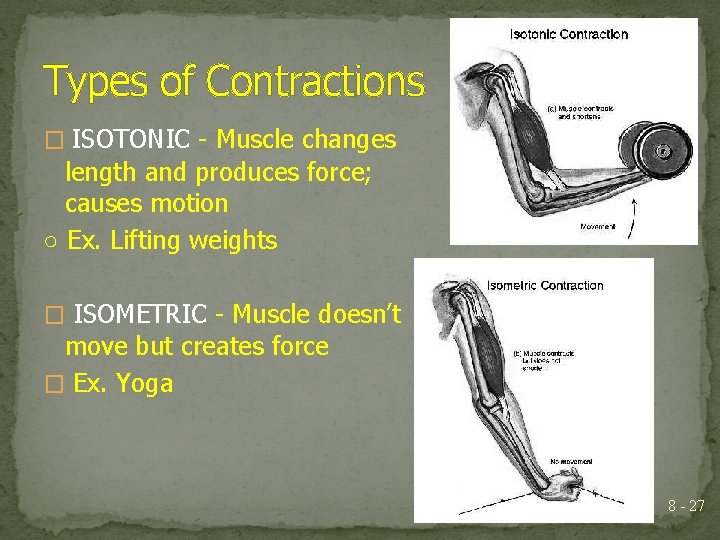
Types of Contractions � ISOTONIC - Muscle changes length and produces force; causes motion ○ Ex. Lifting weights � ISOMETRIC - Muscle doesn’t move but creates force � Ex. Yoga 8 - 27
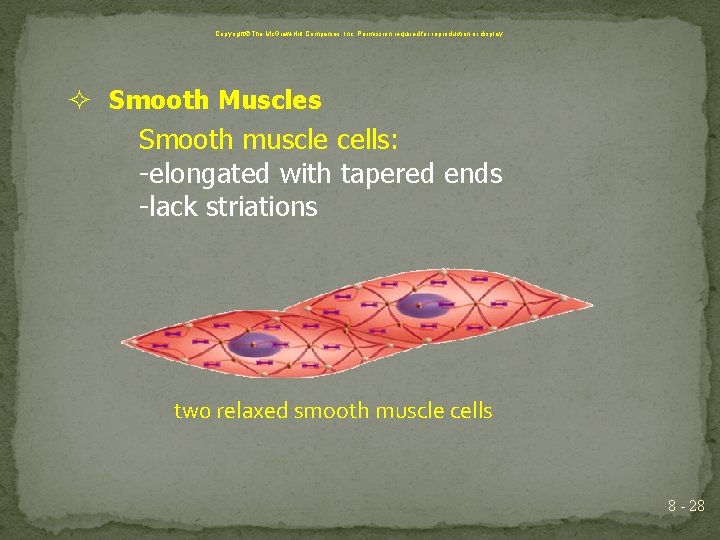
Copyright The Mc. Graw-Hill Companies, Inc. Permission required for reproduction or display. Smooth Muscles Smooth muscle cells: -elongated with tapered ends -lack striations tw 0 relaxed smooth muscle cells 8 - 28
Copyright The Mc. Graw-Hill Companies, Inc. Permission required for reproduction or display. Types of Smooth Muscle Multiunit �Blood vessels �Iris of the eye �Individual fibers Visceral �Walls of hollow organs �Sheets �Self-stimulating and rhythmic �Peristalsis in tubes and hollow organs 8 - 29
Copyright The Mc. Graw-Hill Companies, Inc. Permission required for reproduction or display. Smooth Muscle Contraction -Slower to contract and relax than skeletal muscle -Can contract longer using the same amount of ATP (sustainable contractions) 8 - 30
Copyright The Mc. Graw-Hill Companies, Inc. Permission required for reproduction or display. Cardiac Muscle - has structures that supply extra calcium, and can thus contract for longer periods - intercalated disks: join cells and transmit impulses throughout the heart - self-exciting and rhythmic - the whole heart contracts as a unit 8 - 31