
Chapter 8 Multiple Regression for Time Series Chapter


- Slides: 46
Chapter 8 Multiple Regression for Time Series
Chapter 8: Multiple Regression for Time Series 8. 1 Graphical Analysis and Preliminary Model Development 8. 2 The Multiple Regression Model 8. 3 Testing the Overall Model 8. 4 Testing Individual Coefficients 8. 5 Checking the Assumptions 8. 6 Forecasting with Multiple Regression 8. 7 Principles of Regression © 2017 Wessex Press, Inc. Principles of Business Forecasting 2 e (Ord, Fildes, Kourentzes) • Chapter 8: Multiple Regression for Time Series 2
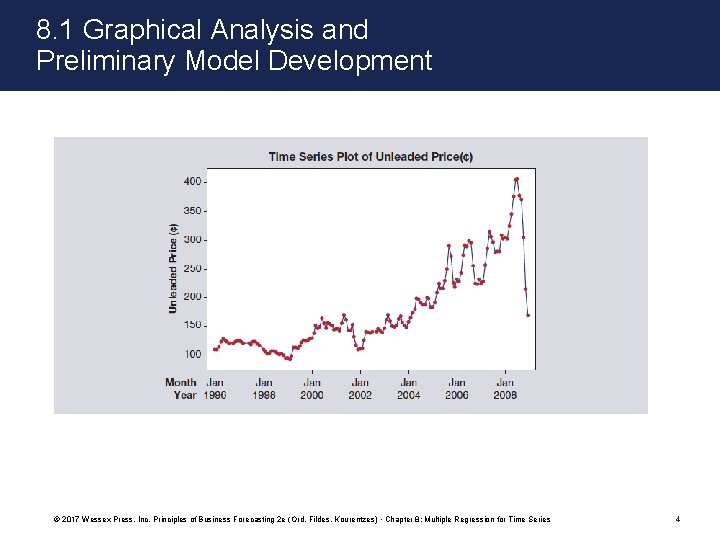
8. 1 Graphical Analysis and Preliminary Model Development • Suppose we are interested in the level of gas prices as a function of various explanatory variables. • Observe Gas Prices (=Yt) over n time periods, t = 1, 2, …, n Step 1: DDD, a time plot of Y against time Step 2: produce a scatter plot of Y against each explanatory variable Xj –For step 2, identify possible variables: • • Personal Disposable Income Unemployment S&P 500 Index Price of crude oil Question: What other variables would be of potential interest? © 2017 Wessex Press, Inc. Principles of Business Forecasting 2 e (Ord, Fildes, Kourentzes) • Chapter 8: Multiple Regression for Time Series 3
8. 1 Graphical Analysis and Preliminary Model Development © 2017 Wessex Press, Inc. Principles of Business Forecasting 2 e (Ord, Fildes, Kourentzes) • Chapter 8: Multiple Regression for Time Series 4
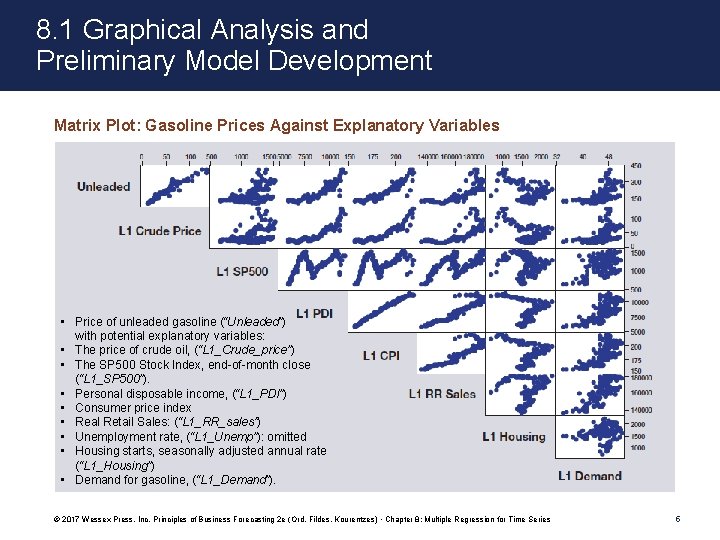
8. 1 Graphical Analysis and Preliminary Model Development Matrix Plot: Gasoline Prices Against Explanatory Variables • Price of unleaded gasoline (“Unleaded”) with potential explanatory variables: • The price of crude oil, (“L 1_Crude_price”) • The SP 500 Stock Index, end-of-month close (“L 1_SP 500”). • Personal disposable income, (“L 1_PDI”) • Consumer price index • Real Retail Sales: (“L 1_RR_sales”) • Unemployment rate, (“L 1_Unemp”): omitted • Housing starts, seasonally adjusted annual rate (“L 1_Housing”) • Demand for gasoline, (“L 1_Demand”). © 2017 Wessex Press, Inc. Principles of Business Forecasting 2 e (Ord, Fildes, Kourentzes) • Chapter 8: Multiple Regression for Time Series 5
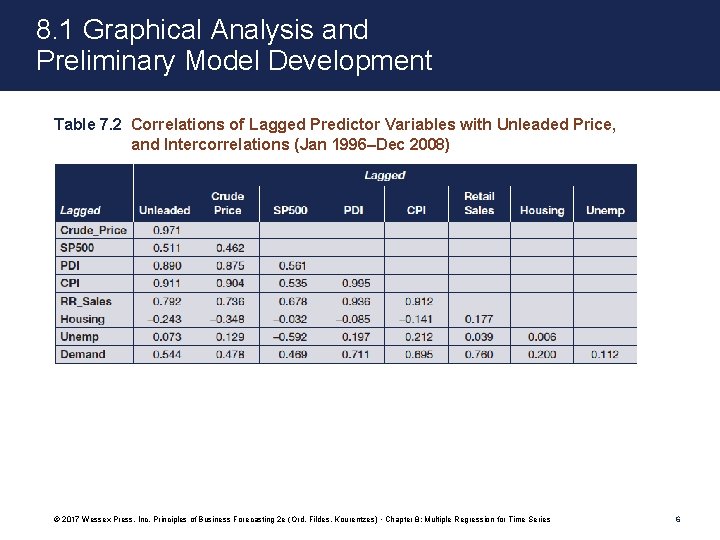
8. 1 Graphical Analysis and Preliminary Model Development Table 7. 2 Correlations of Lagged Predictor Variables with Unleaded Price, and Intercorrelations (Jan 1996–Dec 2008) © 2017 Wessex Press, Inc. Principles of Business Forecasting 2 e (Ord, Fildes, Kourentzes) • Chapter 8: Multiple Regression for Time Series 6
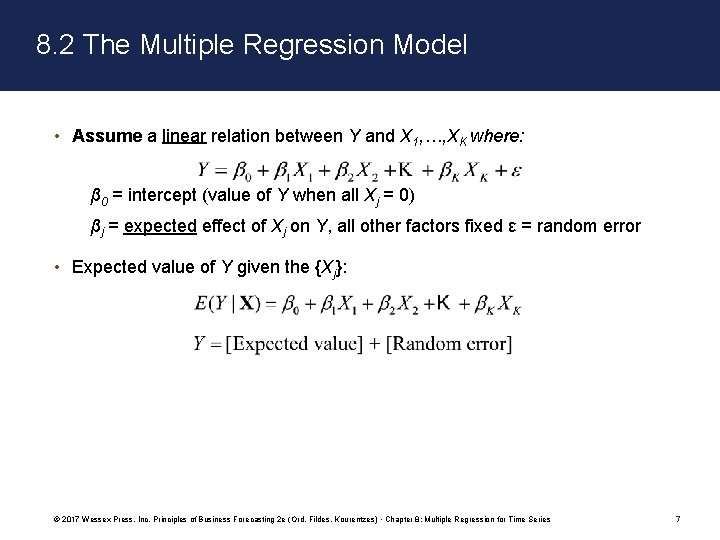
8. 2 The Multiple Regression Model • Assume a linear relation between Y and X 1, …, XK where: β 0 = intercept (value of Y when all Xj = 0) βj = expected effect of Xj on Y, all other factors fixed ε = random error • Expected value of Y given the {Xj}: © 2017 Wessex Press, Inc. Principles of Business Forecasting 2 e (Ord, Fildes, Kourentzes) • Chapter 8: Multiple Regression for Time Series 7
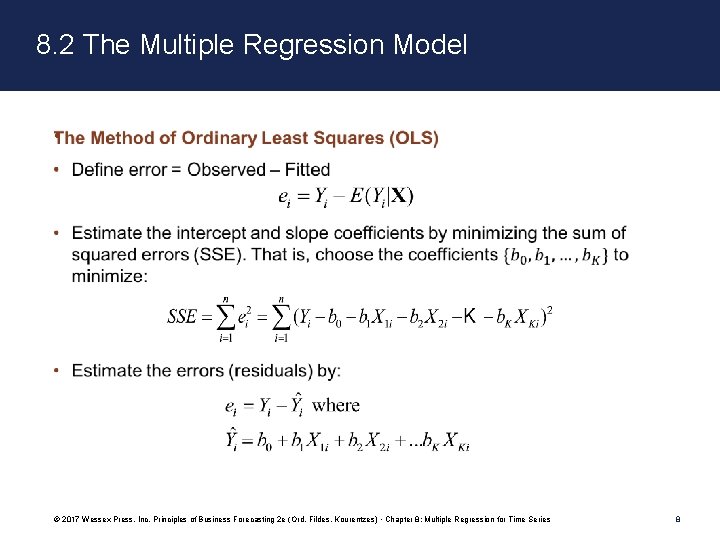
8. 2 The Multiple Regression Model • © 2017 Wessex Press, Inc. Principles of Business Forecasting 2 e (Ord, Fildes, Kourentzes) • Chapter 8: Multiple Regression for Time Series 8
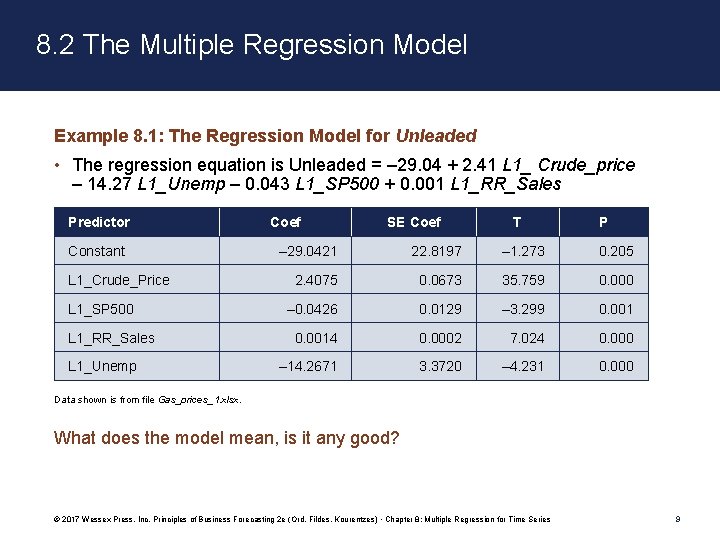
8. 2 The Multiple Regression Model Example 8. 1: The Regression Model for Unleaded • The regression equation is Unleaded = – 29. 04 + 2. 41 L 1_ Crude_price – 14. 27 L 1_Unemp – 0. 043 L 1_SP 500 + 0. 001 L 1_RR_Sales Predictor Constant L 1_Crude_Price L 1_SP 500 L 1_RR_Sales L 1_Unemp Coef SE Coef T P – 29. 0421 22. 8197 – 1. 273 0. 205 2. 4075 0. 0673 35. 759 0. 000 – 0. 0426 0. 0129 – 3. 299 0. 0014 0. 0002 7. 024 0. 000 – 14. 2671 3. 3720 – 4. 231 0. 000 Data shown is from file Gas_prices_1. xlsx. What does the model mean, is it any good? © 2017 Wessex Press, Inc. Principles of Business Forecasting 2 e (Ord, Fildes, Kourentzes) • Chapter 8: Multiple Regression for Time Series 9
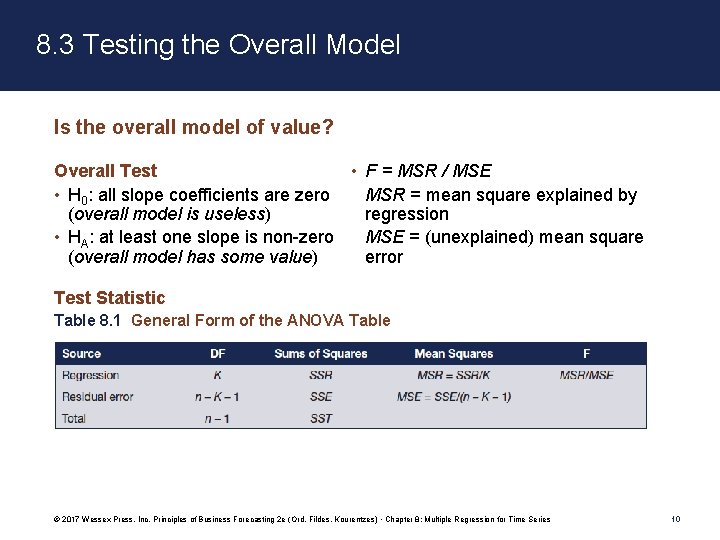
8. 3 Testing the Overall Model Is the overall model of value? • F = MSR / MSE Overall Test • H 0: all slope coefficients are zero MSR = mean square explained by (overall model is useless) regression • HA: at least one slope is non-zero MSE = (unexplained) mean square (overall model has some value) error Test Statistic Table 8. 1 General Form of the ANOVA Table © 2017 Wessex Press, Inc. Principles of Business Forecasting 2 e (Ord, Fildes, Kourentzes) • Chapter 8: Multiple Regression for Time Series 10
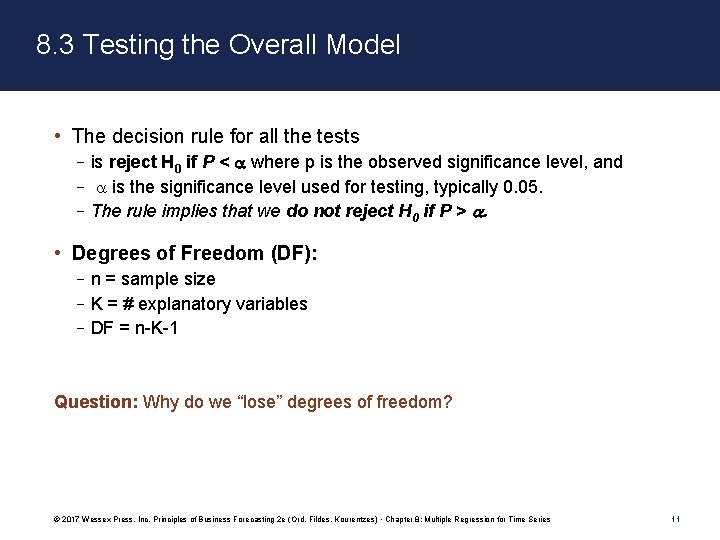
8. 3 Testing the Overall Model • The decision rule for all the tests –is reject H 0 if P < where p is the observed significance level, and – is the significance level used for testing, typically 0. 05. –The rule implies that we do not reject H 0 if P > . • Degrees of Freedom (DF): –n = sample size –K = # explanatory variables –DF = n-K-1 Question: Why do we “lose” degrees of freedom? © 2017 Wessex Press, Inc. Principles of Business Forecasting 2 e (Ord, Fildes, Kourentzes) • Chapter 8: Multiple Regression for Time Series 11
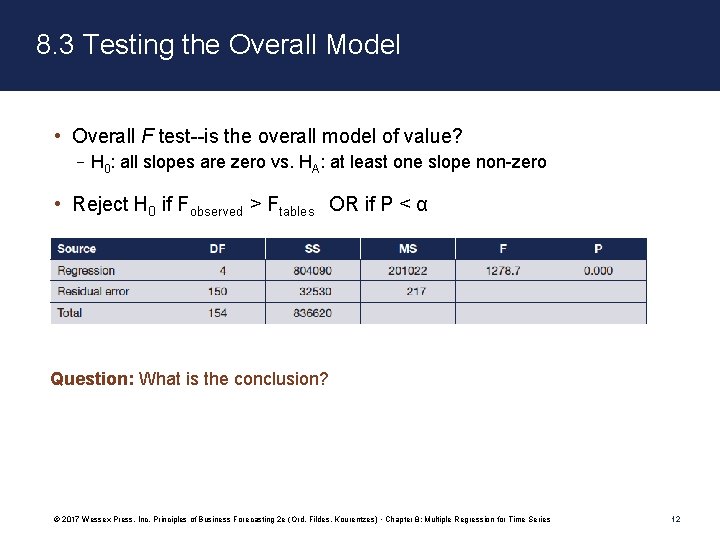
8. 3 Testing the Overall Model • Overall F test--is the overall model of value? –H 0: all slopes are zero vs. HA: at least one slope non-zero • Reject H 0 if Fobserved > Ftables OR if P < α Question: What is the conclusion? © 2017 Wessex Press, Inc. Principles of Business Forecasting 2 e (Ord, Fildes, Kourentzes) • Chapter 8: Multiple Regression for Time Series 12
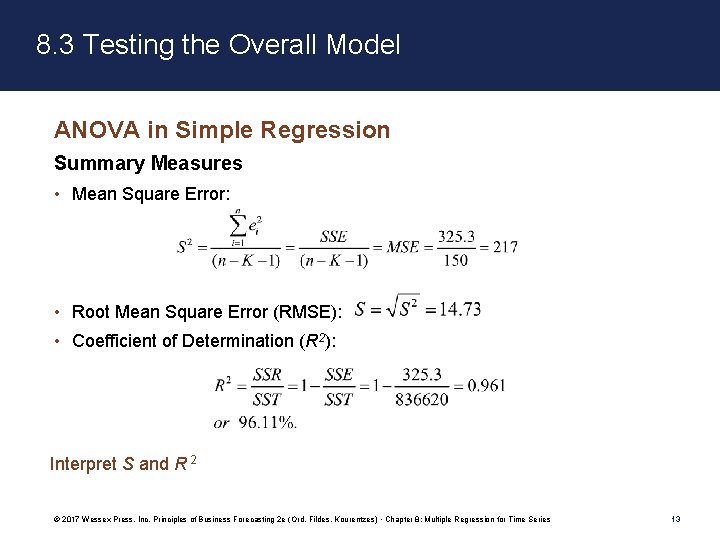
8. 3 Testing the Overall Model ANOVA in Simple Regression Summary Measures • Mean Square Error: • Root Mean Square Error (RMSE): • Coefficient of Determination (R 2): Interpret S and R 2 © 2017 Wessex Press, Inc. Principles of Business Forecasting 2 e (Ord, Fildes, Kourentzes) • Chapter 8: Multiple Regression for Time Series 13
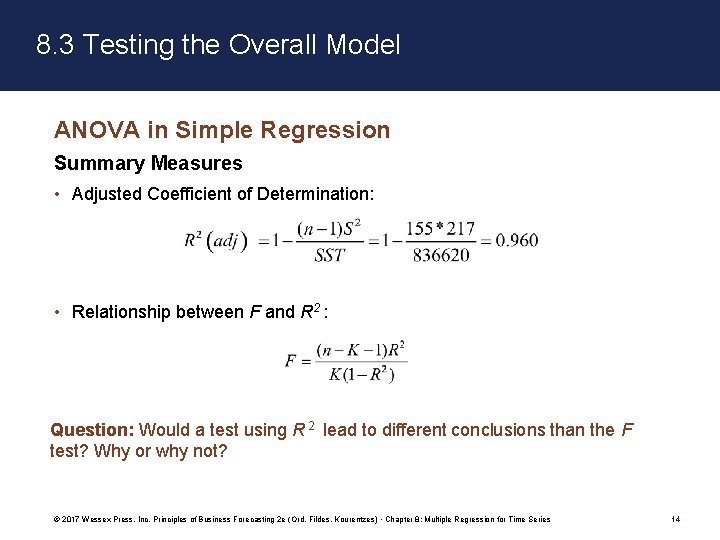
8. 3 Testing the Overall Model ANOVA in Simple Regression Summary Measures • Adjusted Coefficient of Determination: • Relationship between F and R 2 : Question: Would a test using R 2 lead to different conclusions than the F test? Why or why not? © 2017 Wessex Press, Inc. Principles of Business Forecasting 2 e (Ord, Fildes, Kourentzes) • Chapter 8: Multiple Regression for Time Series 14
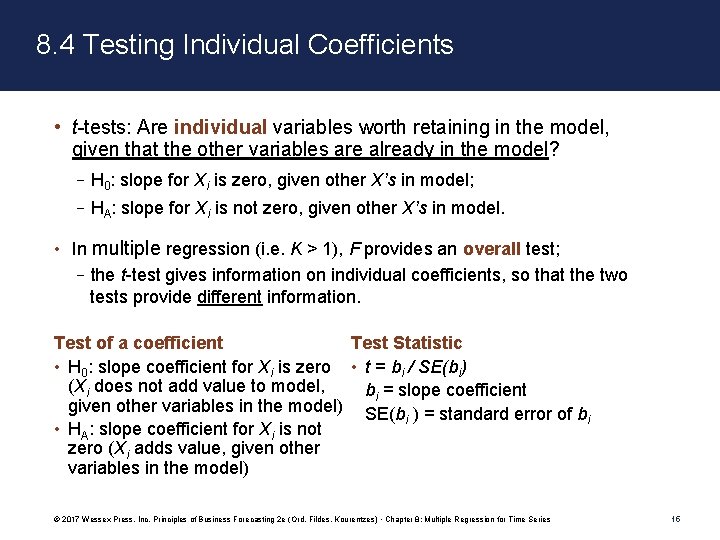
8. 4 Testing Individual Coefficients • t-tests: Are individual variables worth retaining in the model, given that the other variables are already in the model? –H 0: slope for Xi is zero, given other X’s in model; –HA: slope for Xi is not zero, given other X’s in model. • In multiple regression (i. e. K > 1), F provides an overall test; –the t-test gives information on individual coefficients, so that the two tests provide different information. Test Statistic Test of a coefficient • H 0: slope coefficient for Xi is zero • t = bi / SE(bi) (Xi does not add value to model, bi = slope coefficient given other variables in the model) SE(b ) = standard error of b i i • HA: slope coefficient for Xi is not zero (Xi adds value, given other variables in the model) © 2017 Wessex Press, Inc. Principles of Business Forecasting 2 e (Ord, Fildes, Kourentzes) • Chapter 8: Multiple Regression for Time Series 15
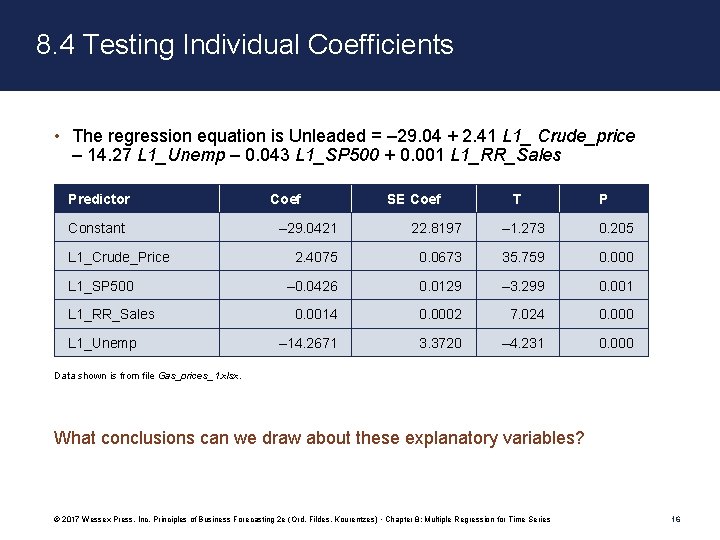
8. 4 Testing Individual Coefficients • The regression equation is Unleaded = – 29. 04 + 2. 41 L 1_ Crude_price – 14. 27 L 1_Unemp – 0. 043 L 1_SP 500 + 0. 001 L 1_RR_Sales Predictor Constant L 1_Crude_Price L 1_SP 500 L 1_RR_Sales L 1_Unemp Coef SE Coef T P – 29. 0421 22. 8197 – 1. 273 0. 205 2. 4075 0. 0673 35. 759 0. 000 – 0. 0426 0. 0129 – 3. 299 0. 0014 0. 0002 7. 024 0. 000 – 14. 2671 3. 3720 – 4. 231 0. 000 Data shown is from file Gas_prices_1. xlsx. What conclusions can we draw about these explanatory variables? © 2017 Wessex Press, Inc. Principles of Business Forecasting 2 e (Ord, Fildes, Kourentzes) • Chapter 8: Multiple Regression for Time Series 16
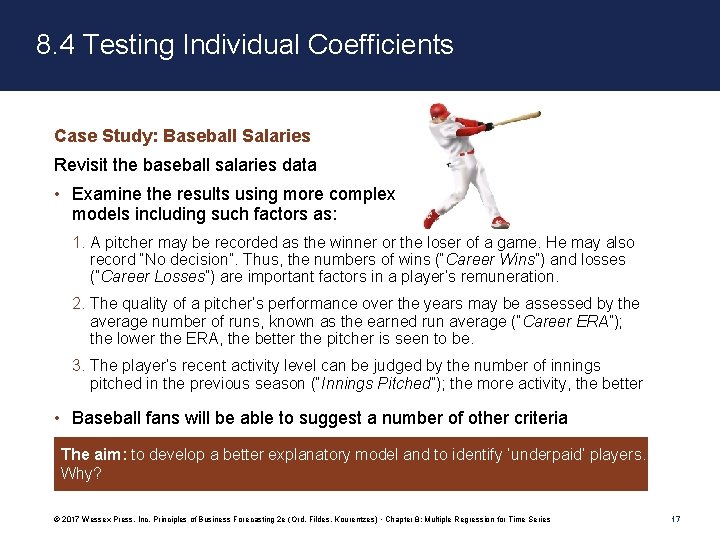
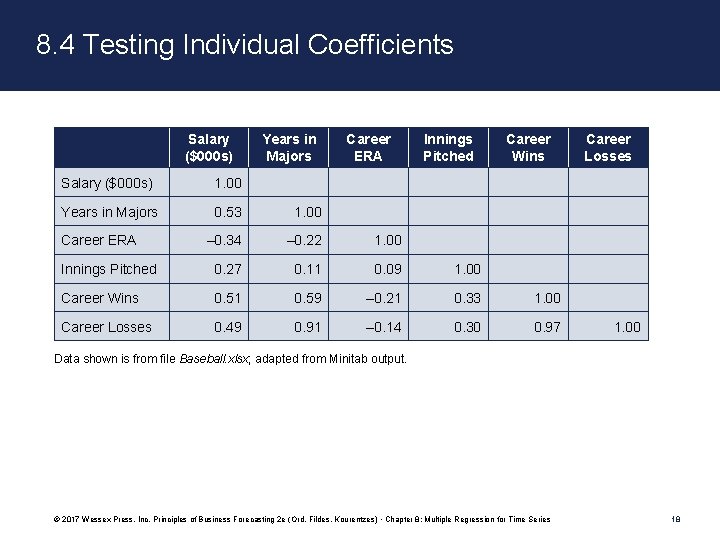
8. 4 Testing Individual Coefficients Case Study: Baseball Salaries Revisit the baseball salaries data • Examine the results using more complex models including such factors as: 1. A pitcher may be recorded as the winner or the loser of a game. He may also record “No decision”. Thus, the numbers of wins (“Career Wins”) and losses (“Career Losses”) are important factors in a player’s remuneration. 2. The quality of a pitcher’s performance over the years may be assessed by the average number of runs, known as the earned run average (“Career ERA”); the lower the ERA, the better the pitcher is seen to be. 3. The player’s recent activity level can be judged by the number of innings pitched in the previous season (“Innings Pitched”); the more activity, the better • Baseball fans will be able to suggest a number of other criteria The aim: to develop a better explanatory model and to identify ‘underpaid’ players. Why? © 2017 Wessex Press, Inc. Principles of Business Forecasting 2 e (Ord, Fildes, Kourentzes) • Chapter 8: Multiple Regression for Time Series 17
8. 4 Testing Individual Coefficients Salary ($000 s) Years in Majors Career ERA Innings Pitched Career Wins Salary ($000 s) 1. 00 Years in Majors 0. 53 1. 00 – 0. 34 – 0. 22 1. 00 Innings Pitched 0. 27 0. 11 0. 09 1. 00 Career Wins 0. 51 0. 59 – 0. 21 0. 33 1. 00 Career Losses 0. 49 0. 91 – 0. 14 0. 30 0. 97 Career ERA Career Losses 1. 00 Data shown is from file Baseball. xlsx; adapted from Minitab output. © 2017 Wessex Press, Inc. Principles of Business Forecasting 2 e (Ord, Fildes, Kourentzes) • Chapter 8: Multiple Regression for Time Series 18
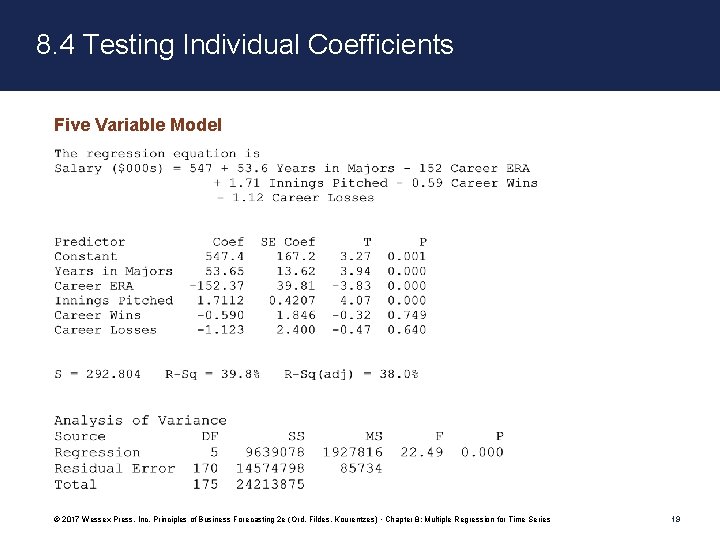
8. 4 Testing Individual Coefficients Five Variable Model © 2017 Wessex Press, Inc. Principles of Business Forecasting 2 e (Ord, Fildes, Kourentzes) • Chapter 8: Multiple Regression for Time Series 19
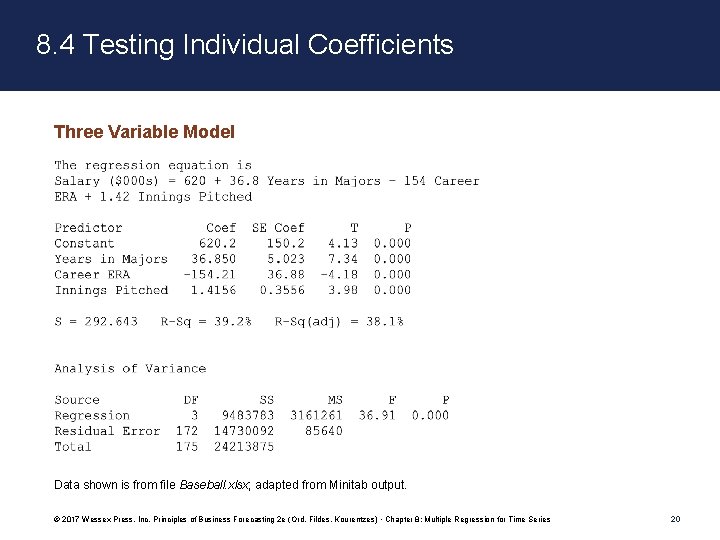
8. 4 Testing Individual Coefficients Three Variable Model Data shown is from file Baseball. xlsx; adapted from Minitab output. © 2017 Wessex Press, Inc. Principles of Business Forecasting 2 e (Ord, Fildes, Kourentzes) • Chapter 8: Multiple Regression for Time Series 20
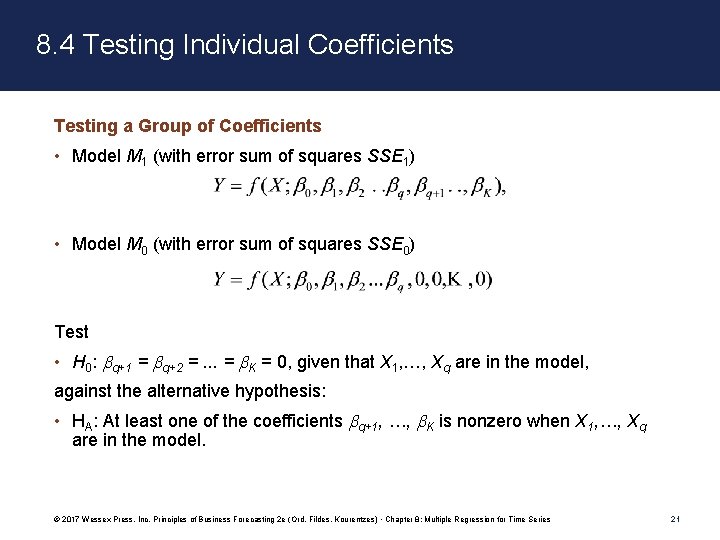
8. 4 Testing Individual Coefficients Testing a Group of Coefficients • Model M 1 (with error sum of squares SSE 1) • Model M 0 (with error sum of squares SSE 0) Test • H 0: q+1 = q+2 =. . . = K = 0, given that X 1, …, Xq are in the model, against the alternative hypothesis: • HA: At least one of the coefficients q+1, …, K is nonzero when X 1, …, Xq are in the model. © 2017 Wessex Press, Inc. Principles of Business Forecasting 2 e (Ord, Fildes, Kourentzes) • Chapter 8: Multiple Regression for Time Series 21
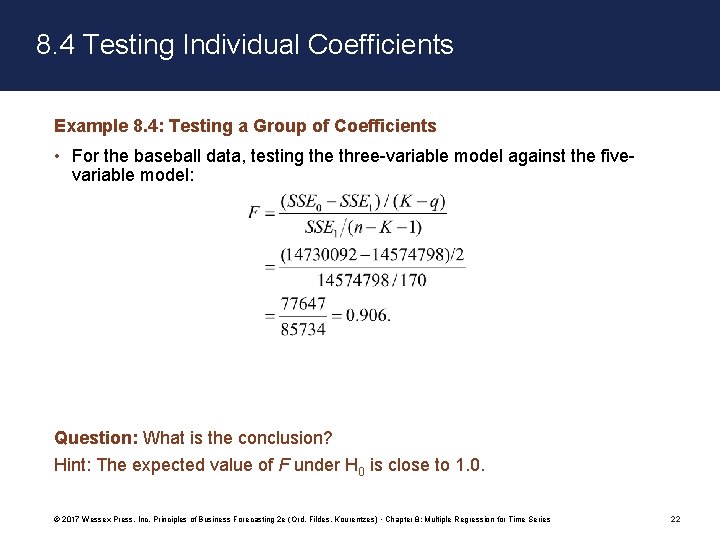
8. 4 Testing Individual Coefficients Example 8. 4: Testing a Group of Coefficients • For the baseball data, testing the three-variable model against the fivevariable model: Question: What is the conclusion? Hint: The expected value of F under H 0 is close to 1. 0. © 2017 Wessex Press, Inc. Principles of Business Forecasting 2 e (Ord, Fildes, Kourentzes) • Chapter 8: Multiple Regression for Time Series 22
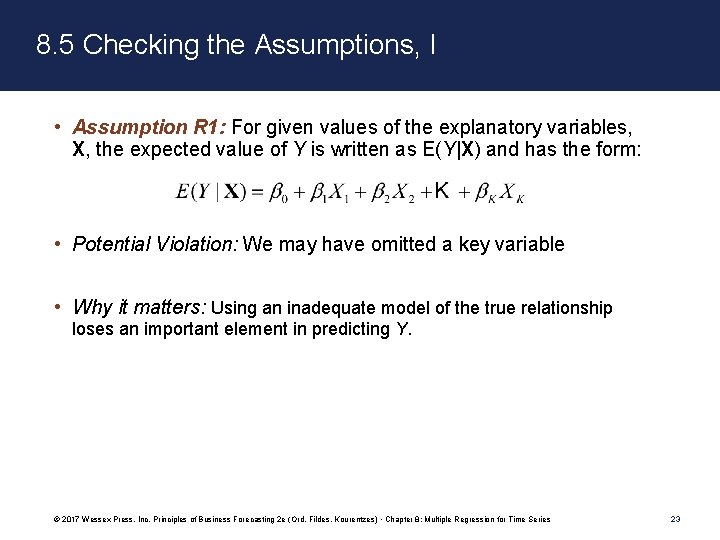
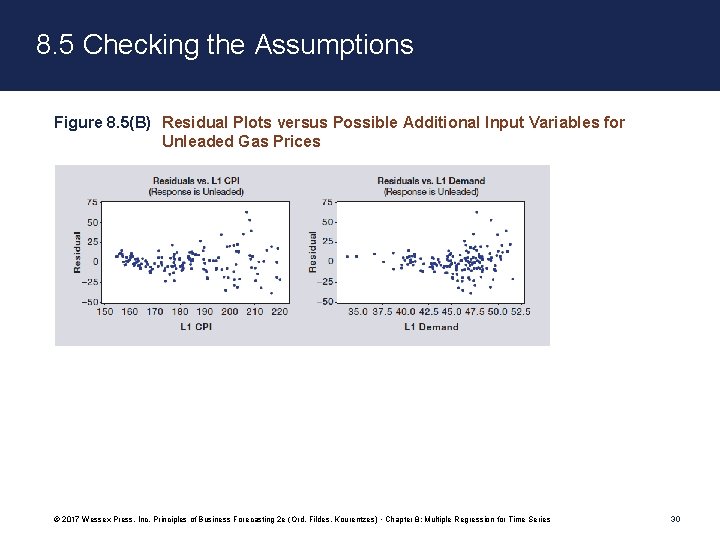
8. 5 Checking the Assumptions, I • Assumption R 1: For given values of the explanatory variables, X, the expected value of Y is written as E(Y|X) and has the form: • Potential Violation: We may have omitted a key variable • Why it matters: Using an inadequate model of the true relationship loses an important element in predicting Y. © 2017 Wessex Press, Inc. Principles of Business Forecasting 2 e (Ord, Fildes, Kourentzes) • Chapter 8: Multiple Regression for Time Series 23
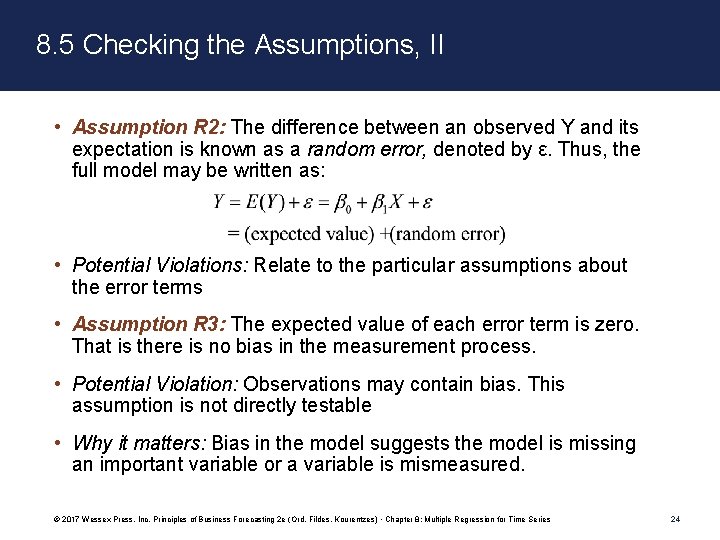
8. 5 Checking the Assumptions, II • Assumption R 2: The difference between an observed Y and its expectation is known as a random error, denoted by ε. Thus, the full model may be written as: • Potential Violations: Relate to the particular assumptions about the error terms • Assumption R 3: The expected value of each error term is zero. That is there is no bias in the measurement process. • Potential Violation: Observations may contain bias. This assumption is not directly testable • Why it matters: Bias in the model suggests the model is missing an important variable or a variable is mismeasured. © 2017 Wessex Press, Inc. Principles of Business Forecasting 2 e (Ord, Fildes, Kourentzes) • Chapter 8: Multiple Regression for Time Series 24
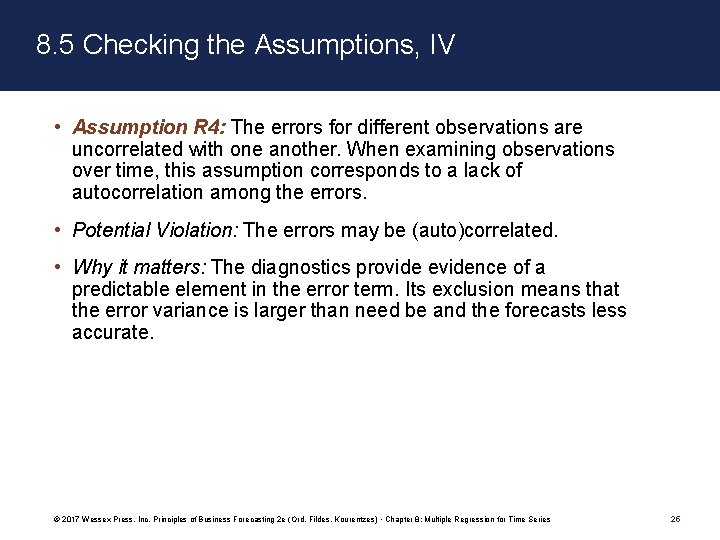
8. 5 Checking the Assumptions, IV • Assumption R 4: The errors for different observations are uncorrelated with one another. When examining observations over time, this assumption corresponds to a lack of autocorrelation among the errors. • Potential Violation: The errors may be (auto)correlated. • Why it matters: The diagnostics provide evidence of a predictable element in the error term. Its exclusion means that the error variance is larger than need be and the forecasts less accurate. © 2017 Wessex Press, Inc. Principles of Business Forecasting 2 e (Ord, Fildes, Kourentzes) • Chapter 8: Multiple Regression for Time Series 25
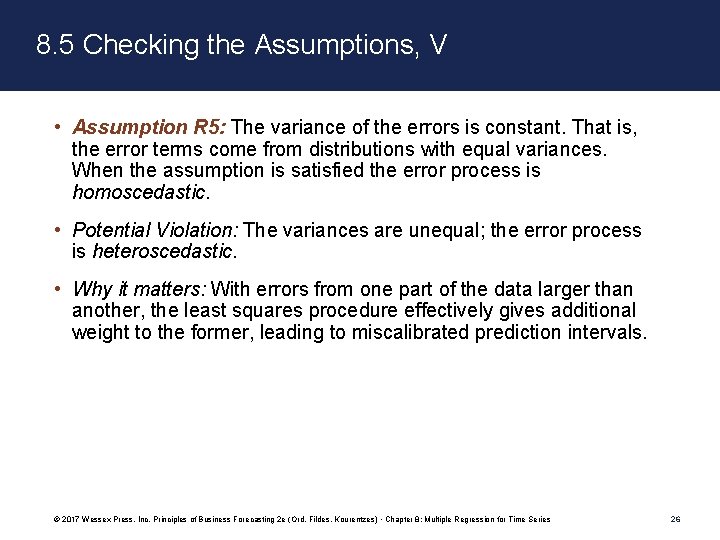
8. 5 Checking the Assumptions, V • Assumption R 5: The variance of the errors is constant. That is, the error terms come from distributions with equal variances. When the assumption is satisfied the error process is homoscedastic. • Potential Violation: The variances are unequal; the error process is heteroscedastic. • Why it matters: With errors from one part of the data larger than another, the least squares procedure effectively gives additional weight to the former, leading to miscalibrated prediction intervals. © 2017 Wessex Press, Inc. Principles of Business Forecasting 2 e (Ord, Fildes, Kourentzes) • Chapter 8: Multiple Regression for Time Series 26
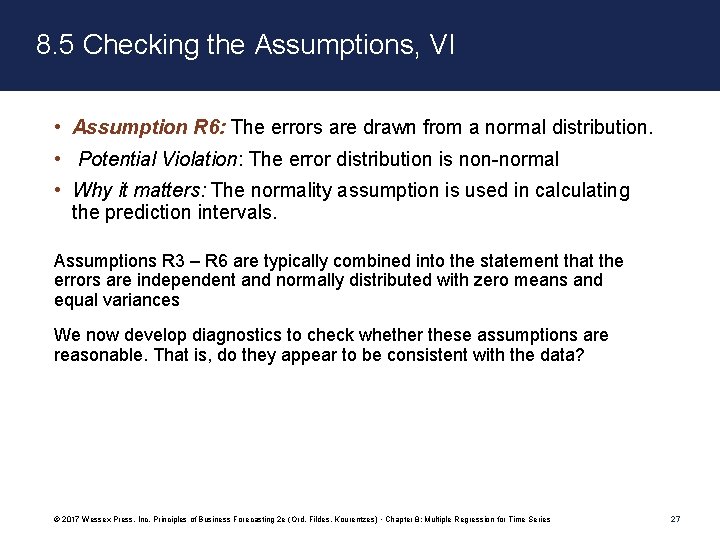
8. 5 Checking the Assumptions, VI • Assumption R 6: The errors are drawn from a normal distribution. • Potential Violation: The error distribution is non-normal • Why it matters: The normality assumption is used in calculating the prediction intervals. Assumptions R 3 – R 6 are typically combined into the statement that the errors are independent and normally distributed with zero means and equal variances We now develop diagnostics to check whether these assumptions are reasonable. That is, do they appear to be consistent with the data? © 2017 Wessex Press, Inc. Principles of Business Forecasting 2 e (Ord, Fildes, Kourentzes) • Chapter 8: Multiple Regression for Time Series 27
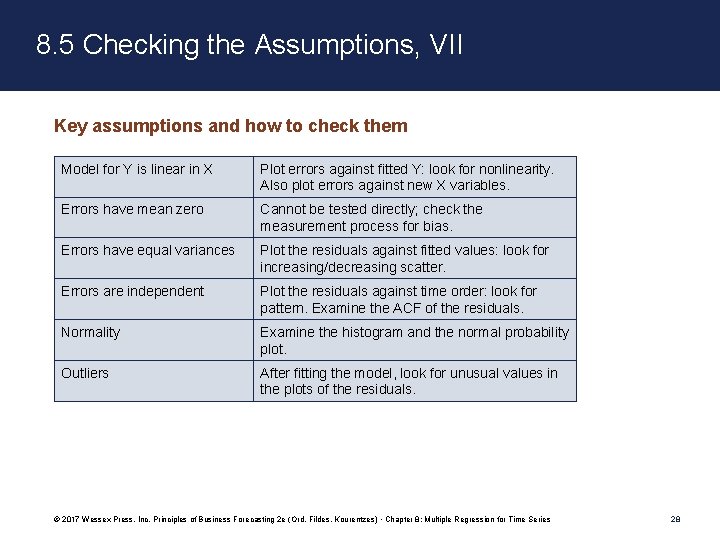
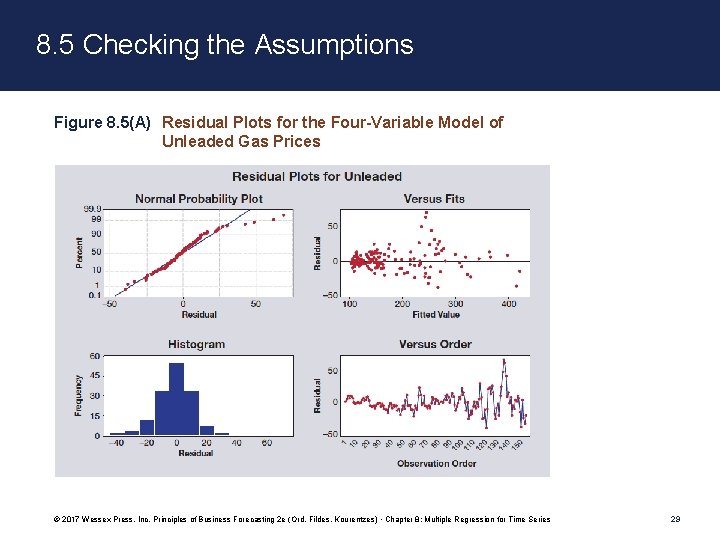
8. 5 Checking the Assumptions, VII Key assumptions and how to check them Model for Y is linear in X Plot errors against fitted Y: look for nonlinearity. Also plot errors against new X variables. Errors have mean zero Cannot be tested directly; check the measurement process for bias. Errors have equal variances Plot the residuals against fitted values: look for increasing/decreasing scatter. Errors are independent Plot the residuals against time order: look for pattern. Examine the ACF of the residuals. Normality Examine the histogram and the normal probability plot. Outliers After fitting the model, look for unusual values in the plots of the residuals. © 2017 Wessex Press, Inc. Principles of Business Forecasting 2 e (Ord, Fildes, Kourentzes) • Chapter 8: Multiple Regression for Time Series 28
8. 5 Checking the Assumptions Figure 8. 5(A) Residual Plots for the Four-Variable Model of Unleaded Gas Prices © 2017 Wessex Press, Inc. Principles of Business Forecasting 2 e (Ord, Fildes, Kourentzes) • Chapter 8: Multiple Regression for Time Series 29
8. 5 Checking the Assumptions Figure 8. 5(B) Residual Plots versus Possible Additional Input Variables for Unleaded Gas Prices © 2017 Wessex Press, Inc. Principles of Business Forecasting 2 e (Ord, Fildes, Kourentzes) • Chapter 8: Multiple Regression for Time Series 30
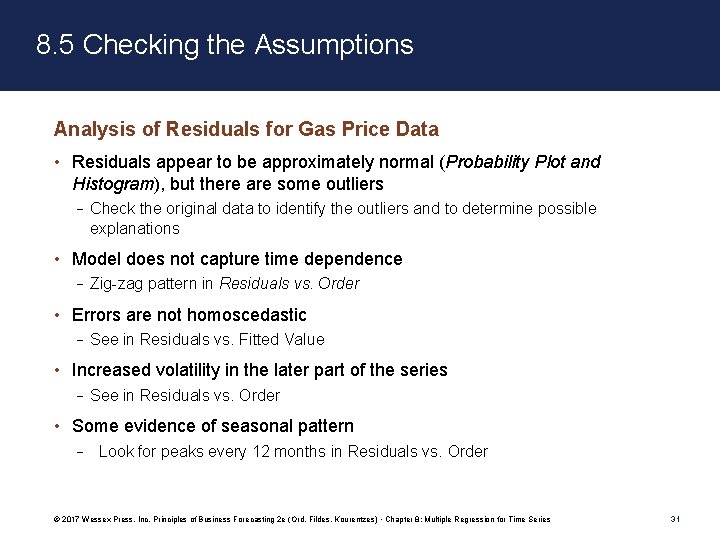
8. 5 Checking the Assumptions Analysis of Residuals for Gas Price Data • Residuals appear to be approximately normal (Probability Plot and Histogram), but there are some outliers – Check the original data to identify the outliers and to determine possible explanations • Model does not capture time dependence – Zig-zag pattern in Residuals vs. Order • Errors are not homoscedastic – See in Residuals vs. Fitted Value • Increased volatility in the later part of the series – See in Residuals vs. Order • Some evidence of seasonal pattern – Look for peaks every 12 months in Residuals vs. Order © 2017 Wessex Press, Inc. Principles of Business Forecasting 2 e (Ord, Fildes, Kourentzes) • Chapter 8: Multiple Regression for Time Series 31
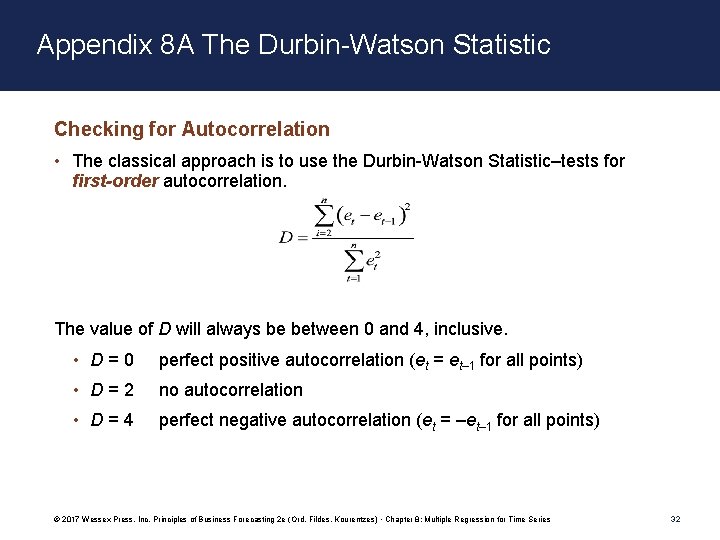
Appendix 8 A The Durbin-Watson Statistic Checking for Autocorrelation • The classical approach is to use the Durbin-Watson Statistic–tests for first-order autocorrelation. The value of D will always be between 0 and 4, inclusive. • D=0 perfect positive autocorrelation (et = et– 1 for all points) • D=2 no autocorrelation • D=4 perfect negative autocorrelation (et = –et– 1 for all points) © 2017 Wessex Press, Inc. Principles of Business Forecasting 2 e (Ord, Fildes, Kourentzes) • Chapter 8: Multiple Regression for Time Series 32
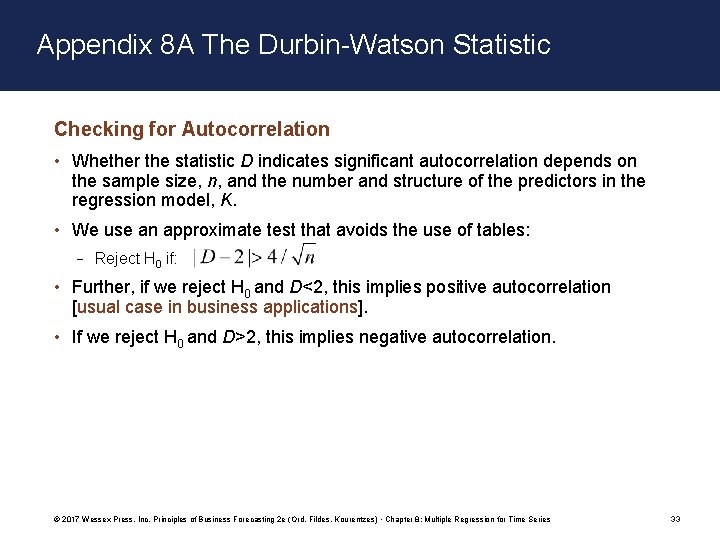
Appendix 8 A The Durbin-Watson Statistic Checking for Autocorrelation • Whether the statistic D indicates significant autocorrelation depends on the sample size, n, and the number and structure of the predictors in the regression model, K. • We use an approximate test that avoids the use of tables: – Reject H 0 if: • Further, if we reject H 0 and D<2, this implies positive autocorrelation [usual case in business applications]. • If we reject H 0 and D>2, this implies negative autocorrelation. © 2017 Wessex Press, Inc. Principles of Business Forecasting 2 e (Ord, Fildes, Kourentzes) • Chapter 8: Multiple Regression for Time Series 33
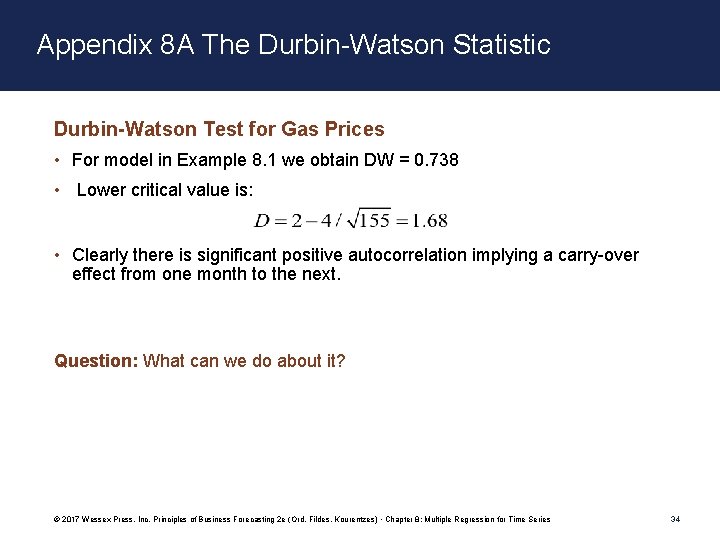
Appendix 8 A The Durbin-Watson Statistic Durbin-Watson Test for Gas Prices • For model in Example 8. 1 we obtain DW = 0. 738 • Lower critical value is: • Clearly there is significant positive autocorrelation implying a carry-over effect from one month to the next. Question: What can we do about it? © 2017 Wessex Press, Inc. Principles of Business Forecasting 2 e (Ord, Fildes, Kourentzes) • Chapter 8: Multiple Regression for Time Series 34
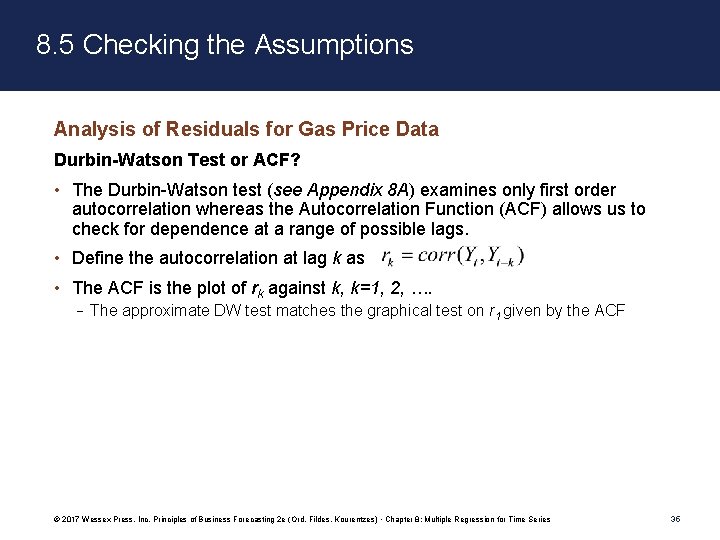
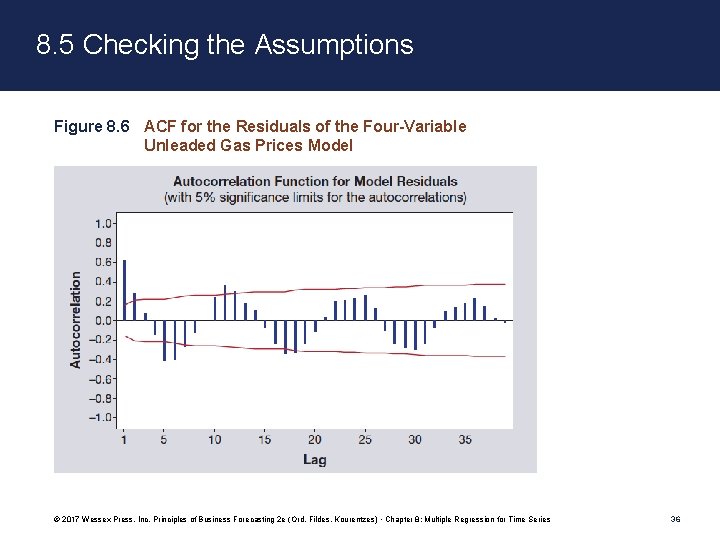
8. 5 Checking the Assumptions Analysis of Residuals for Gas Price Data Durbin-Watson Test or ACF? • The Durbin-Watson test (see Appendix 8 A) examines only first order autocorrelation whereas the Autocorrelation Function (ACF) allows us to check for dependence at a range of possible lags. • Define the autocorrelation at lag k as • The ACF is the plot of rk against k, k=1, 2, …. – The approximate DW test matches the graphical test on r 1 given by the ACF © 2017 Wessex Press, Inc. Principles of Business Forecasting 2 e (Ord, Fildes, Kourentzes) • Chapter 8: Multiple Regression for Time Series 35
8. 5 Checking the Assumptions Figure 8. 6 ACF for the Residuals of the Four-Variable Unleaded Gas Prices Model © 2017 Wessex Press, Inc. Principles of Business Forecasting 2 e (Ord, Fildes, Kourentzes) • Chapter 8: Multiple Regression for Time Series 36
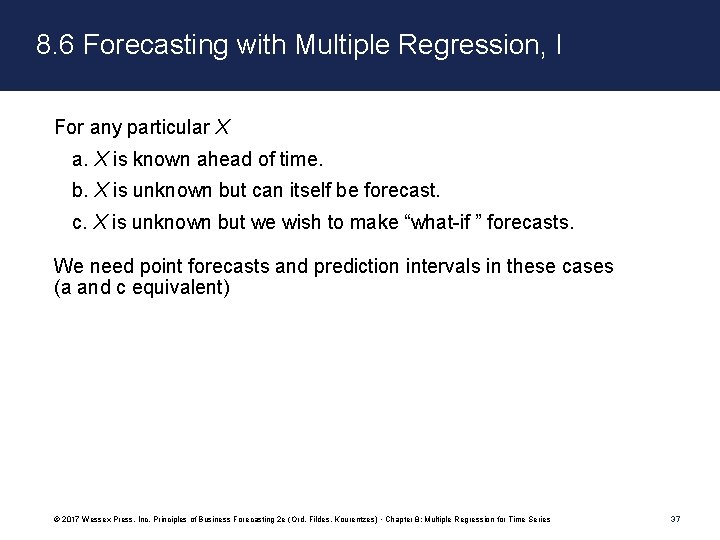
8. 6 Forecasting with Multiple Regression, I For any particular X a. X is known ahead of time. b. X is unknown but can itself be forecast. c. X is unknown but we wish to make “what-if ” forecasts. We need point forecasts and prediction intervals in these cases (a and c equivalent) © 2017 Wessex Press, Inc. Principles of Business Forecasting 2 e (Ord, Fildes, Kourentzes) • Chapter 8: Multiple Regression for Time Series 37
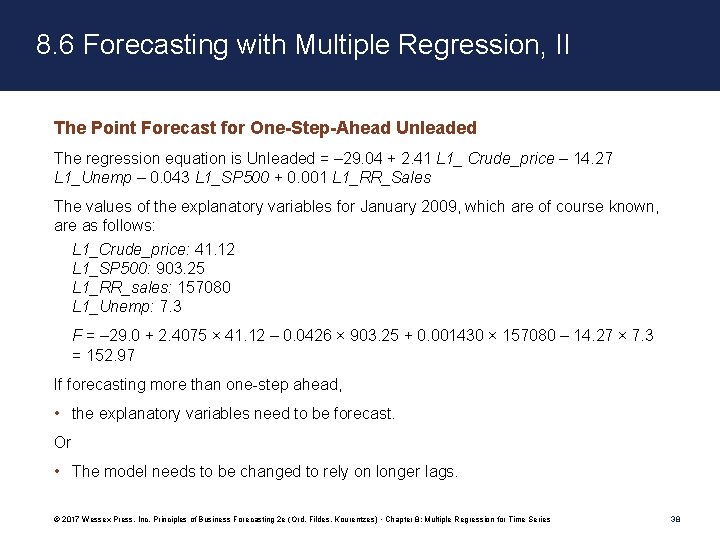
8. 6 Forecasting with Multiple Regression, II The Point Forecast for One-Step-Ahead Unleaded The regression equation is Unleaded = – 29. 04 + 2. 41 L 1_ Crude_price – 14. 27 L 1_Unemp – 0. 043 L 1_SP 500 + 0. 001 L 1_RR_Sales The values of the explanatory variables for January 2009, which are of course known, are as follows: L 1_Crude_price: 41. 12 L 1_SP 500: 903. 25 L 1_RR_sales: 157080 L 1_Unemp: 7. 3 F = – 29. 0 + 2. 4075 × 41. 12 – 0. 0426 × 903. 25 + 0. 001430 × 157080 – 14. 27 × 7. 3 = 152. 97 If forecasting more than one-step ahead, • the explanatory variables need to be forecast. Or • The model needs to be changed to rely on longer lags. © 2017 Wessex Press, Inc. Principles of Business Forecasting 2 e (Ord, Fildes, Kourentzes) • Chapter 8: Multiple Regression for Time Series 38
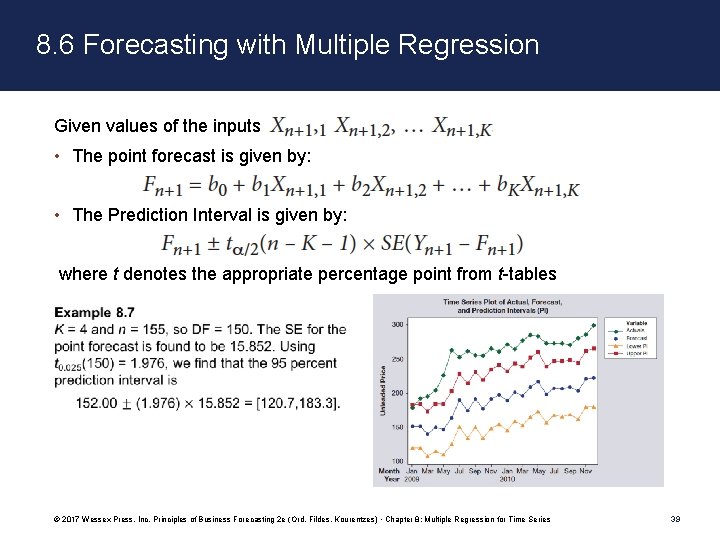
8. 6 Forecasting with Multiple Regression Given values of the inputs • The point forecast is given by: • The Prediction Interval is given by: where t denotes the appropriate percentage point from t-tables © 2017 Wessex Press, Inc. Principles of Business Forecasting 2 e (Ord, Fildes, Kourentzes) • Chapter 8: Multiple Regression for Time Series 39
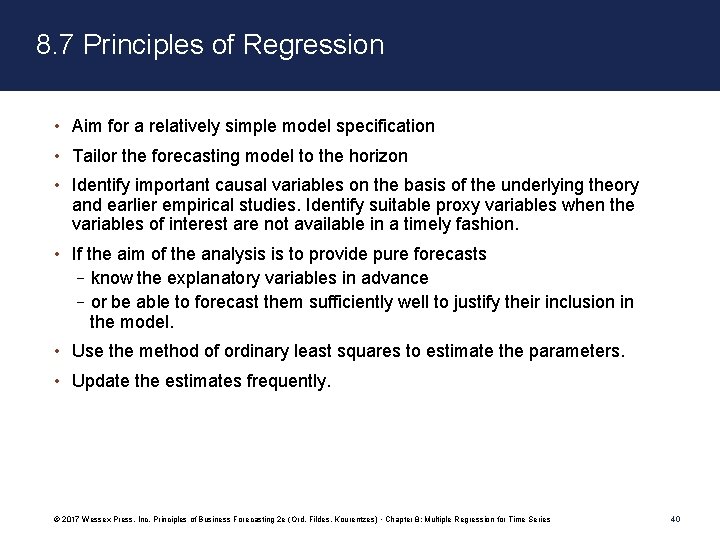
8. 7 Principles of Regression • Aim for a relatively simple model specification • Tailor the forecasting model to the horizon • Identify important causal variables on the basis of the underlying theory and earlier empirical studies. Identify suitable proxy variables when the variables of interest are not available in a timely fashion. • If the aim of the analysis is to provide pure forecasts –know the explanatory variables in advance –or be able to forecast them sufficiently well to justify their inclusion in the model. • Use the method of ordinary least squares to estimate the parameters. • Update the estimates frequently. © 2017 Wessex Press, Inc. Principles of Business Forecasting 2 e (Ord, Fildes, Kourentzes) • Chapter 8: Multiple Regression for Time Series 40
Take-Aways • Start the modeling process by careful consideration of available theory and previous empirical studies • Carry out a full preliminary analysis of the data to look for associations and for unusual observations • Test both the overall model and the individual components • Examine the validity of the underlying assumptions • Make sure that the model is “sensible” with respect to the signs and magnitudes of the slope coefficients • Use a hold-out sample to evaluate forecasting performance. © 2017 Wessex Press, Inc. Principles of Business Forecasting 2 e (Ord, Fildes, Kourentzes) • Chapter 8: Multiple Regression for Time Series 41
Minicase 8. 1 The Volatility of Google Stock Volatility is a measure of the uncertainty of the return realized on an asset. Applied to financial markets, the volatility of a stock price is a measure of how uncertain we are of future stock price movements. As volatility increases, the possibility that the stock price will appreciate or depreciate significantly also increases. The volatility measure has widespread implications, particularly for stock option valuation and also for volatility indices (VIX), portfolio management, and hedging strategies. Since its initial public offering, Google, Inc. (GOOG: NASDAQ), stock has become one of the most sought-after and popular investment opportunities. The search engine giant’s stock price has fluctuated from an IPO price of $85/share, to a high of $741/share (adjusted close, Nov. 27, 2007), down to a low 2009 closing price of $345/share (adjusted close, Feb. 25, 2009 The following potential explanatory variables were identified: • STDEV: the volatility measure for Google stock • VOLUME: amount of trading in Google shares • P/E: the price-to-earnings ratio of Google stock + various macro variables The aim of the project is to develop a multiple regression model to forecast the volatility of Google’s stock price over the next three months. © 2017 Wessex Press, Inc. Principles of Business Forecasting 2 e (Ord, Fildes, Kourentzes) • Chapter 8: Multiple Regression for Time Series 42
Minicase 8. 2 Forecasting for Natural Gas Consumption This minicase comes in two forms so that the effects of different time periods upon the modeling process can be examined. The intent of this project is to develop a model to forecast natural gas consumption for Washington, DC, metropolitan area. The level of natural gas consumption is influenced by a variety of factors, including local weather, the state of the national and the local economies, the purchasing power of the dollar (because at least some of the natural gas is imported), and the prices for other commodities. Some possible variables are: Quarterly data • GASCONS: consumption of natural gas, AVETEMP: average temperature, GDP: annualized percentage change, UNEMP: percentage unemployment, GAS_PRICE: price of natural gas, OIL_PRICE: price of crude oil, RESERVES: reserves of natural gas, DISTRIB: natural gas production distributed Monthly data • GASCONS: consumption of natural gas, AVETEMP: average temperature, GDP: annualized percentage change, UNEMP: percentage unemployment, GAS_PRICE: price of natural gas, OIL_PRICE: price of crude oil, RESERVES: reserves of natural gas, PRODN: natural gas production distributed © 2017 Wessex Press, Inc. Principles of Business Forecasting 2 e (Ord, Fildes, Kourentzes) • Chapter 8: Multiple Regression for Time Series 43
Minicase 8. 3 U. S. Retail & Food Service Sales The purpose of this project is to forecast how U. S. retail and food sales will fare over the coming months. The variables considered include personal income and savings, consumer sentiment, and various macroeconomic variables. Because manufacturing costs and levels of activity are clearly important, these factors are also included. Considered in the analysis as well were three seasonal factors associated, respectively, with the Easter, Thanksgiving, and Christmas holidays. The data set includes monthly figures for the period January 2000– December 2008 for possible explanatory variables, e. g. • RSALES: U. S. retail and food service sales ($millions) • CONSENT: University of Michigan Index of U. S. Consumer Sentiment • PRICE_OIL: spot price of oil ($/barrel) • IND_PROD: Index of U. S. Industrial Production + other variables including indicator variables for holiday periods © 2017 Wessex Press, Inc. Principles of Business Forecasting 2 e (Ord, Fildes, Kourentzes) • Chapter 8: Multiple Regression for Time Series 44
Minicase 8. 4 U. S. Automobile Sales Automobiles are regarded as essential to the American way of life, but people tend to delay replacing an older vehicle when economic conditions deteriorate. Economic stress can be measured in a variety of ways including unemployment levels and declining consumer sentiment. Aside from unusual economic conditions the general state of the economy is reflected in such measures as the level of consumer expenditure, the price level and the performance of the stock market. The demand for new automobiles is also affected by the price of gasoline and the level of interest rates for auto loans. continues © 2017 Wessex Press, Inc. Principles of Business Forecasting 2 e (Ord, Fildes, Kourentzes) • Chapter 8: Multiple Regression for Time Series 45
Minicase 8. 4 U. S. Automobile Sales Monthly data are available for the period January 2000–December 2011 on the following variables. • • • • AUTO_SALES: Seasonally adjusted annual rate (millions) CRUDE: Price of crude oil ($/barrel) CPI: Consumer Price Index CONSUMPTION: Personal consumer expenditures UNEMP: Number of people unemployed (thousands) UNEMP_PC: Unemployment level (percentage) UNEMP_DUR: Mean length of time unemployed CON_SENT: Consumer sentiment S&P 500: S&P 500 Index LIBOR: One month LIBOR (London Inter-Bank Offered Rate) interest rate TREASURY_3: Interest rate on 3 -yr U. S. Treasury bonds TREASURY_10: Interest rate on 10 -year U. S. Treasury bonds RECESSION: Timing of the Great Recession, as defined by the NBER Develop a model for Auto_Sales to forecast two years ahead. © 2017 Wessex Press, Inc. Principles of Business Forecasting 2 e (Ord, Fildes, Kourentzes) • Chapter 8: Multiple Regression for Time Series 46