
Chapter 8 Movement across the Cell Membrane AP

Chapter 8. Movement across the Cell Membrane AP Biology 2005 -2006
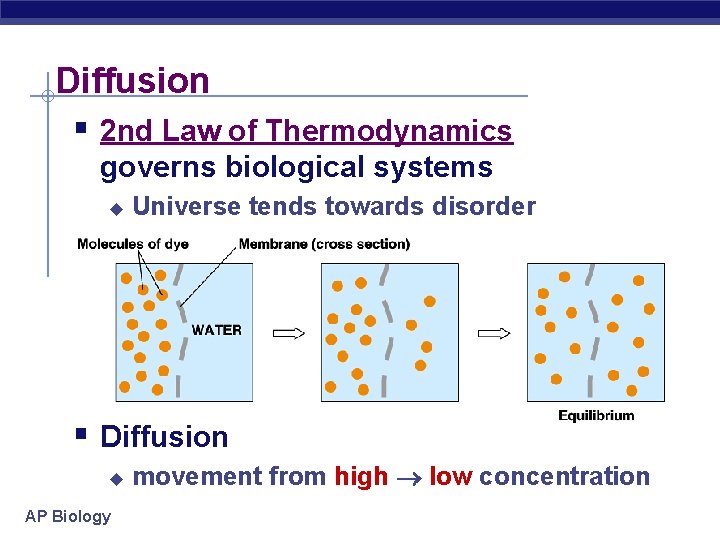
Diffusion § 2 nd Law of Thermodynamics governs biological systems u Universe tends towards disorder § Diffusion u AP Biology movement from high low concentration

Diffusion of 2 solutes § Each substance diffuses down its own concentration gradient, independent of concentration gradients of other substances AP Biology
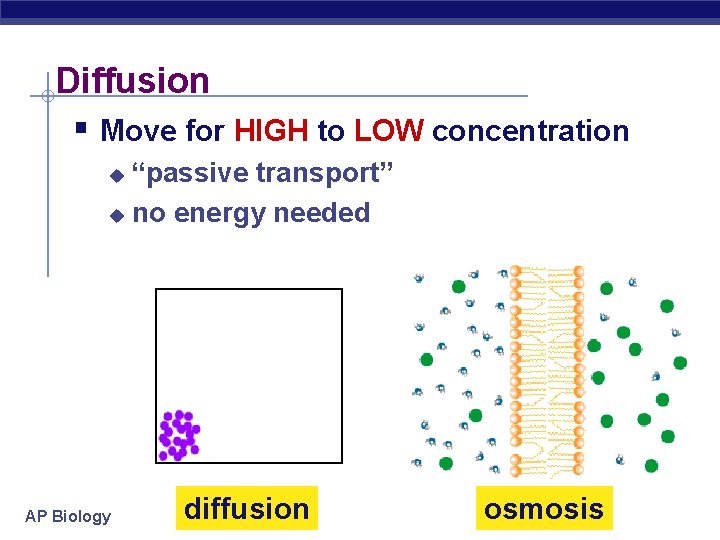
Diffusion § Move for HIGH to LOW concentration “passive transport” u no energy needed u AP Biology diffusion osmosis
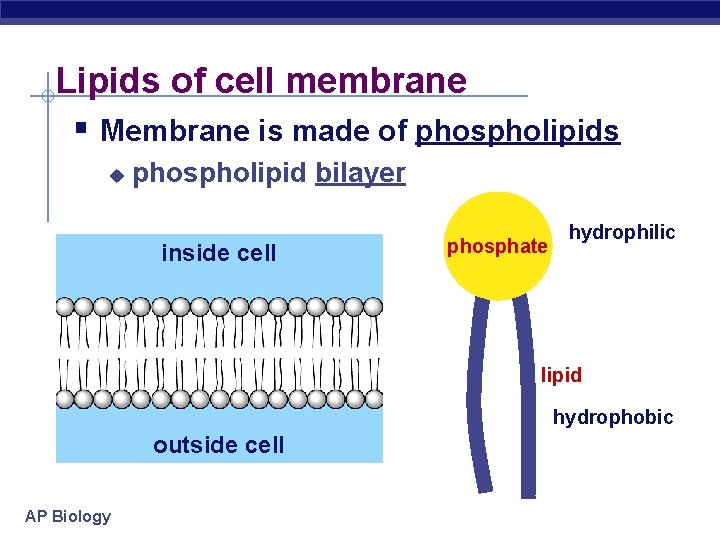
Lipids of cell membrane § Membrane is made of phospholipids u phospholipid bilayer inside cell phosphate hydrophilic lipid hydrophobic outside cell AP Biology
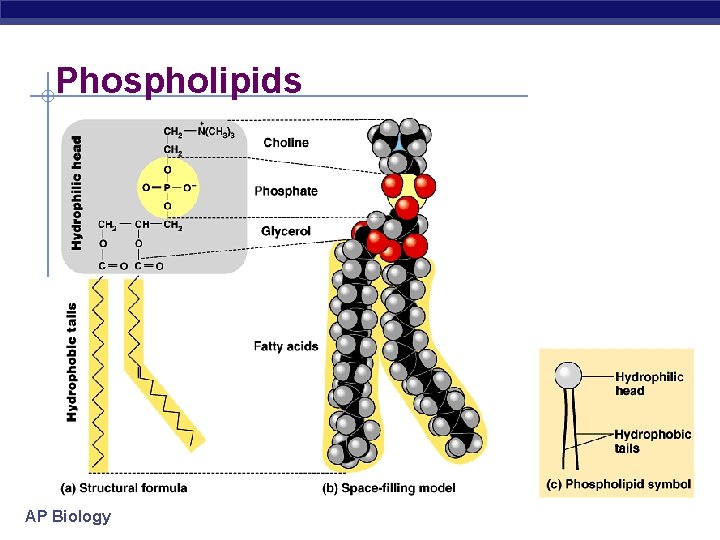
Phospholipids AP Biology
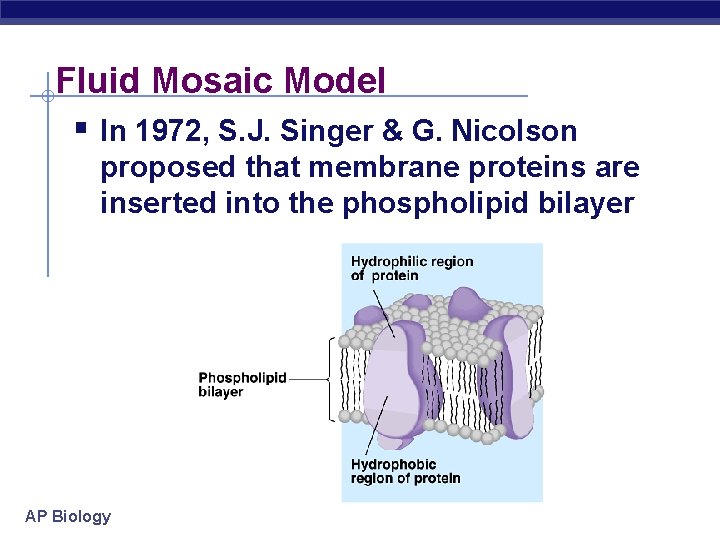
Fluid Mosaic Model § In 1972, S. J. Singer & G. Nicolson proposed that membrane proteins are inserted into the phospholipid bilayer AP Biology
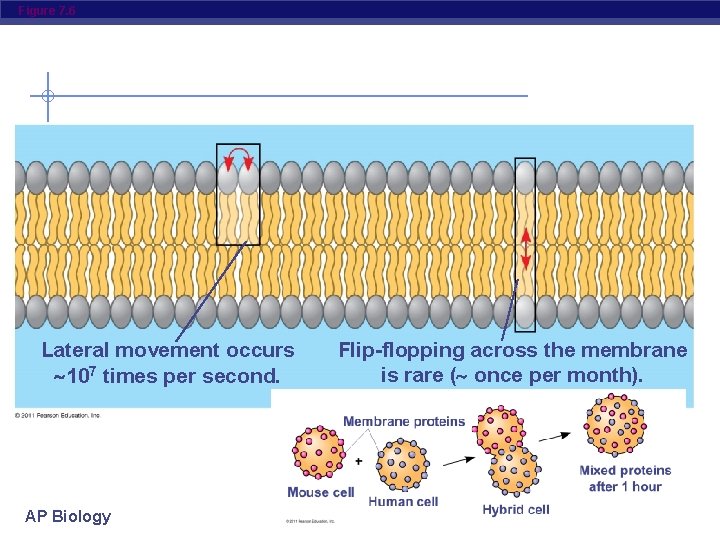
Figure 7. 6 Lateral movement occurs 107 times per second. AP Biology Flip-flopping across the membrane is rare ( once per month).
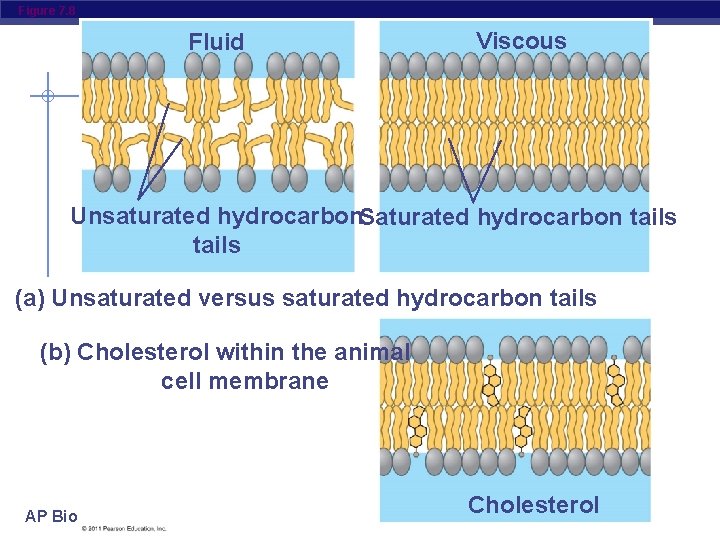
Figure 7. 8 Fluid Viscous Unsaturated hydrocarbon. Saturated hydrocarbon tails (a) Unsaturated versus saturated hydrocarbon tails (b) Cholesterol within the animal cell membrane AP Biology Cholesterol
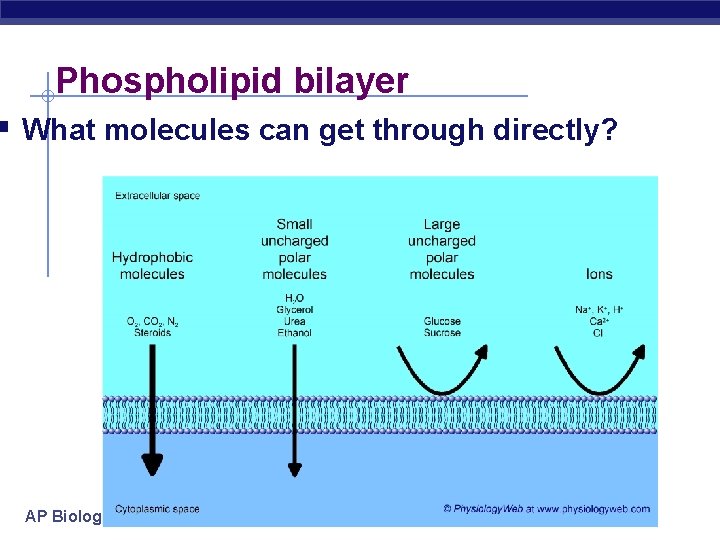
Phospholipid bilayer § What molecules can get through directly? AP Biology
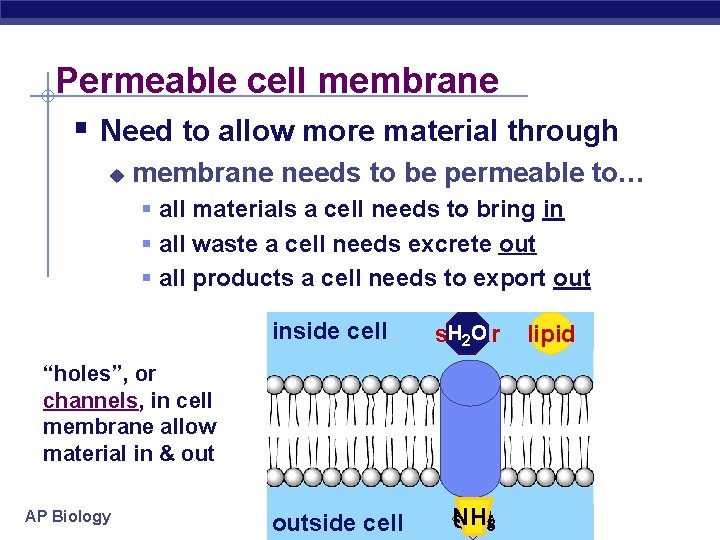
Permeable cell membrane § Need to allow more material through u membrane needs to be permeable to… § all materials a cell needs to bring in § all waste a cell needs excrete out § all products a cell needs to export out inside cell Haa sugar 2 O “holes”, or channels, in cell membrane allow material in & out AP Biology outside cell NH salt 3 lipid
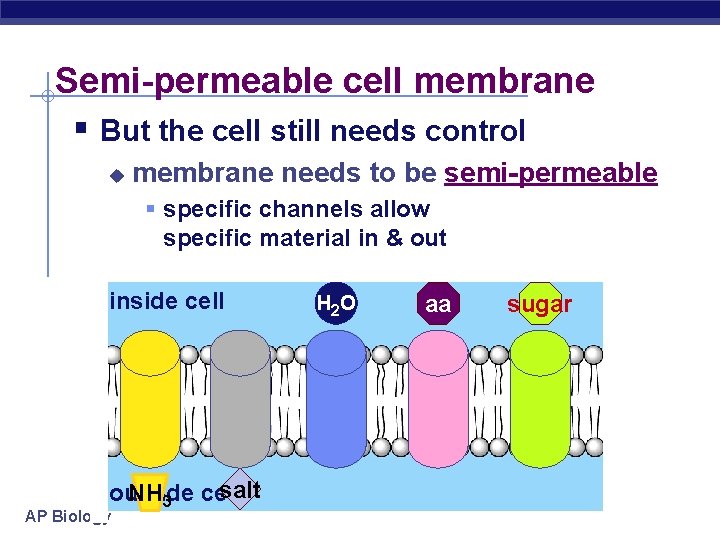
Semi-permeable cell membrane § But the cell still needs control u membrane needs to be semi-permeable § specific channels allow specific material in & out inside cell salt outside NH 3 cell AP Biology H 2 O aa sugar
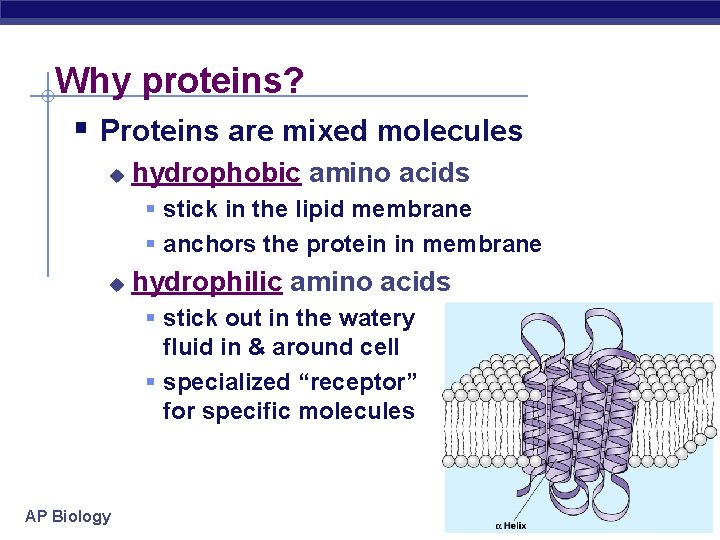
Why proteins? § Proteins are mixed molecules u hydrophobic amino acids § stick in the lipid membrane § anchors the protein in membrane u hydrophilic amino acids § stick out in the watery fluid in & around cell § specialized “receptor” for specific molecules AP Biology 2005 -2006
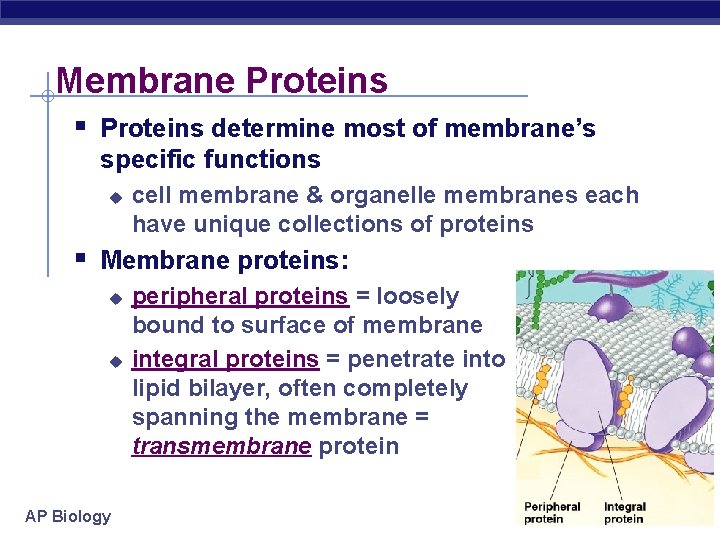
Membrane Proteins § Proteins determine most of membrane’s specific functions u cell membrane & organelle membranes each have unique collections of proteins § Membrane proteins: u u AP Biology peripheral proteins = loosely bound to surface of membrane integral proteins = penetrate into lipid bilayer, often completely spanning the membrane = transmembrane protein 2005 -2006
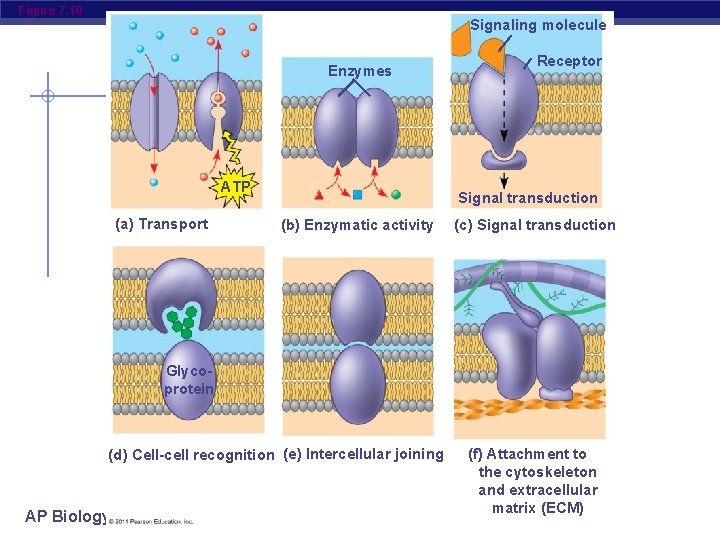
Figure 7. 10 Signaling molecule Enzymes ATP (a) Transport Receptor Signal transduction (b) Enzymatic activity (c) Signal transduction Glycoprotein (d) Cell-cell recognition (e) Intercellular joining AP Biology (f) Attachment to the cytoskeleton and extracellular matrix (ECM)
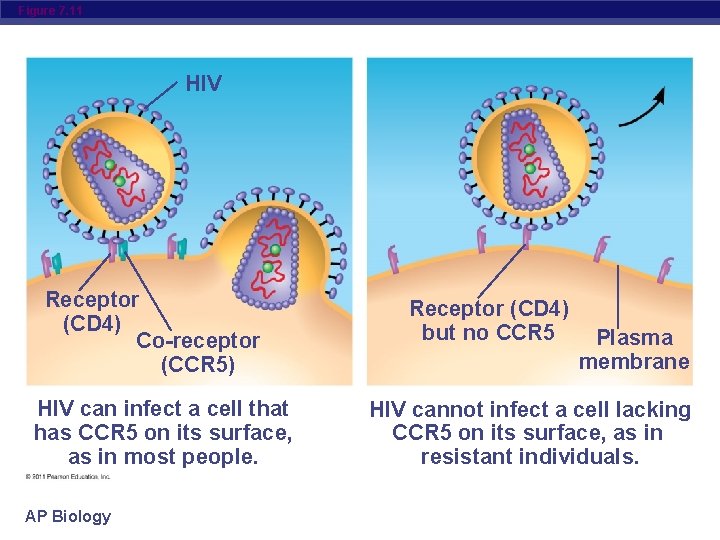
Figure 7. 11 HIV Receptor (CD 4) Co-receptor (CCR 5) HIV can infect a cell that has CCR 5 on its surface, as in most people. AP Biology Receptor (CD 4) but no CCR 5 Plasma membrane HIV cannot infect a cell lacking CCR 5 on its surface, as in resistant individuals.
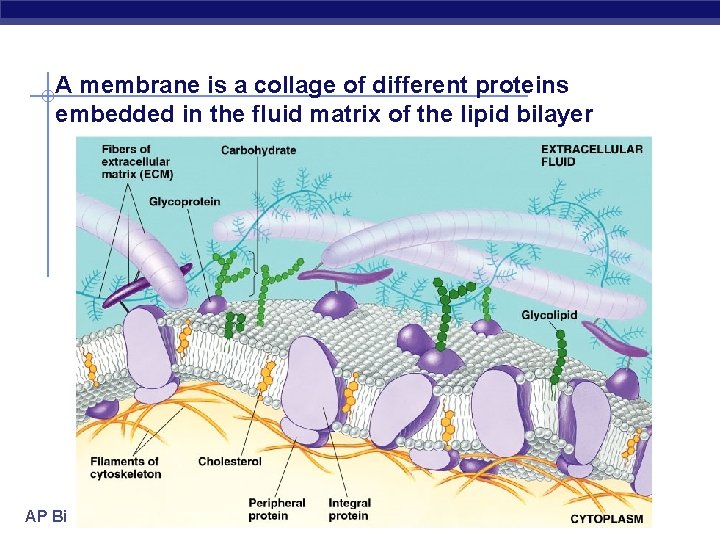
A membrane is a collage of different proteins embedded in the fluid matrix of the lipid bilayer AP Biology 2005 -2006
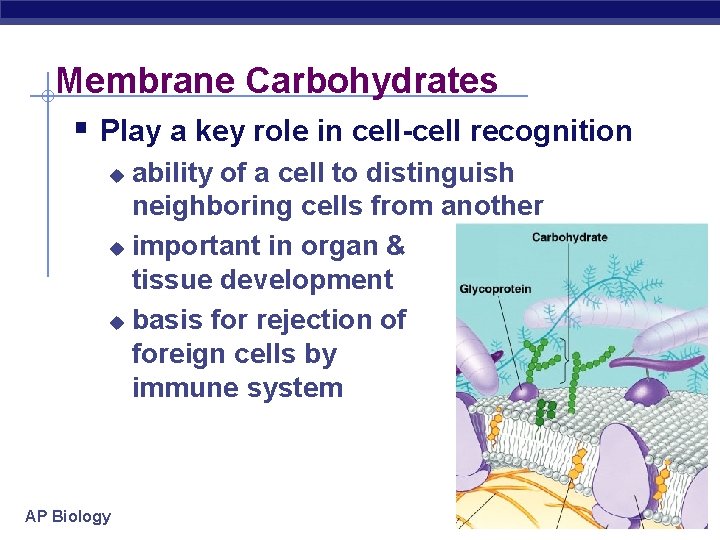
Membrane Carbohydrates § Play a key role in cell-cell recognition ability of a cell to distinguish neighboring cells from another u important in organ & tissue development u basis for rejection of foreign cells by immune system u AP Biology 2005 -2006
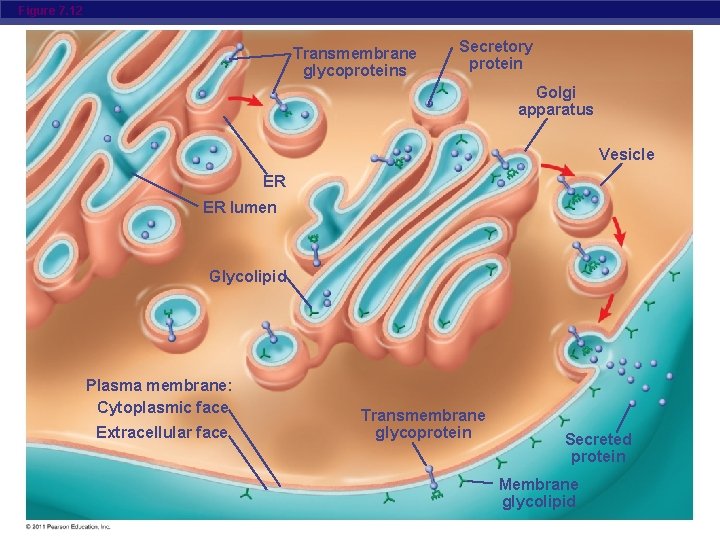
Figure 7. 12 Transmembrane glycoproteins Secretory protein Golgi apparatus Vesicle ER ER lumen Glycolipid Plasma membrane: Cytoplasmic face Extracellular face AP Biology Transmembrane glycoprotein Secreted protein Membrane glycolipid
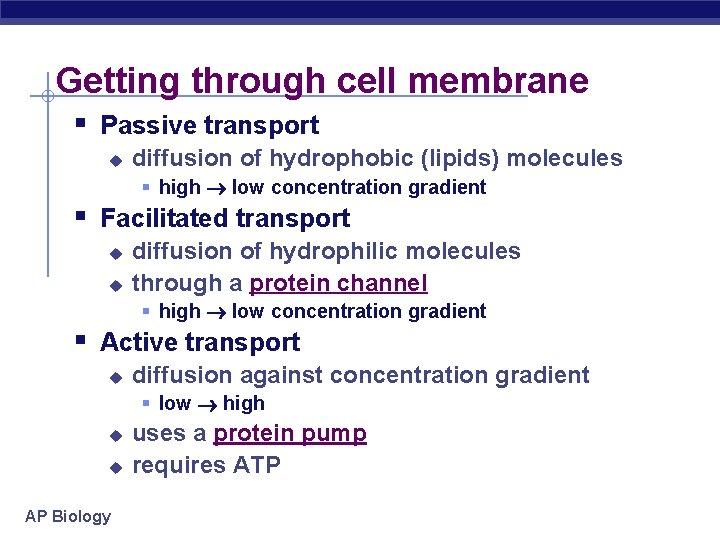
Getting through cell membrane § Passive transport u diffusion of hydrophobic (lipids) molecules § high low concentration gradient § Facilitated transport u u diffusion of hydrophilic molecules through a protein channel § high low concentration gradient § Active transport u diffusion against concentration gradient § low high u u AP Biology uses a protein pump requires ATP
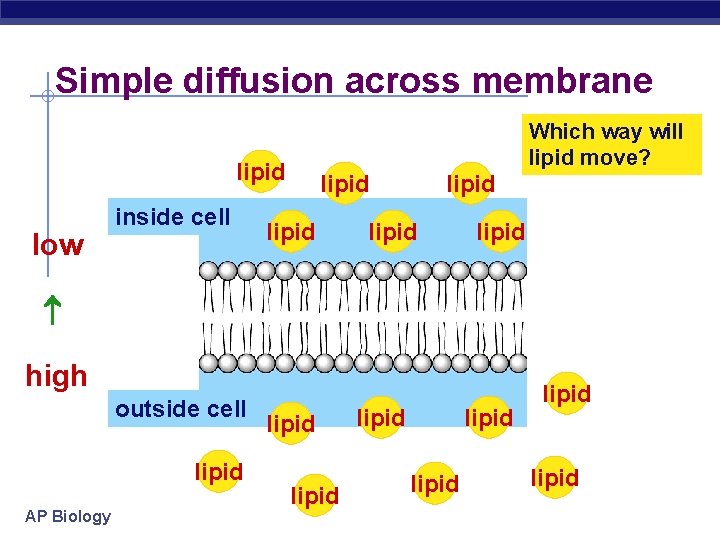
Simple diffusion across membrane Which way will lipid move? lipid low inside cell lipid lipid high outside cell lipid AP Biology lipid lipid
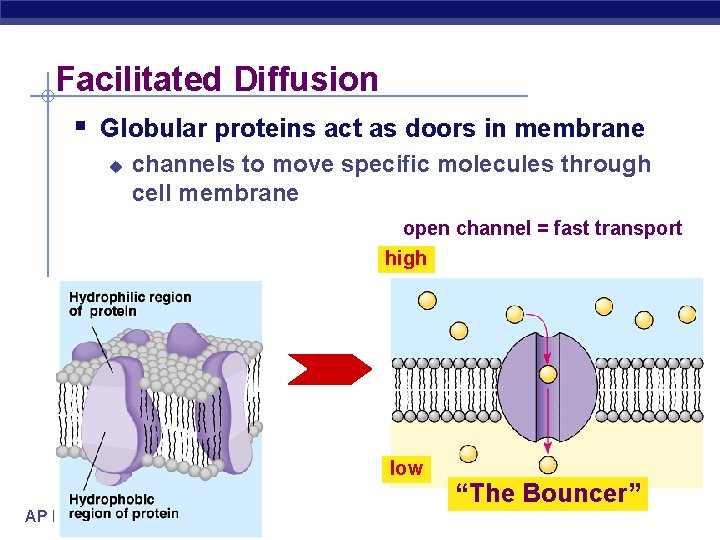
Facilitated Diffusion § Globular proteins act as doors in membrane u channels to move specific molecules through cell membrane open channel = fast transport high low AP Biology “The Bouncer”
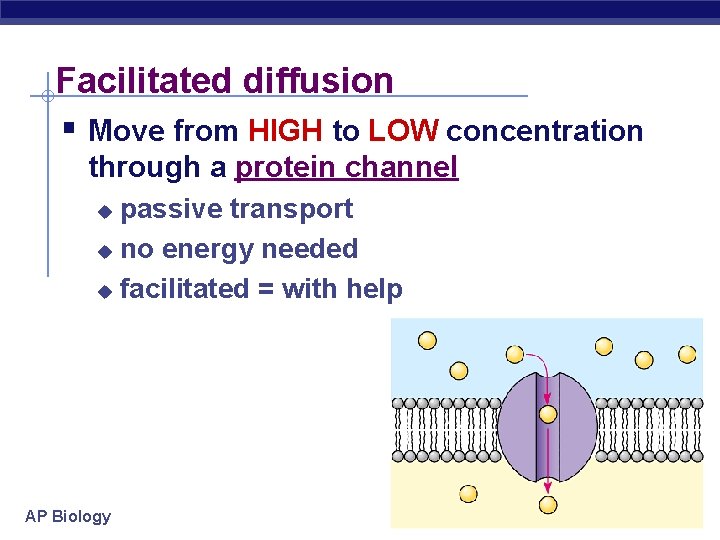
Facilitated diffusion § Move from HIGH to LOW concentration through a protein channel passive transport u no energy needed u facilitated = with help u AP Biology 2005 -2006
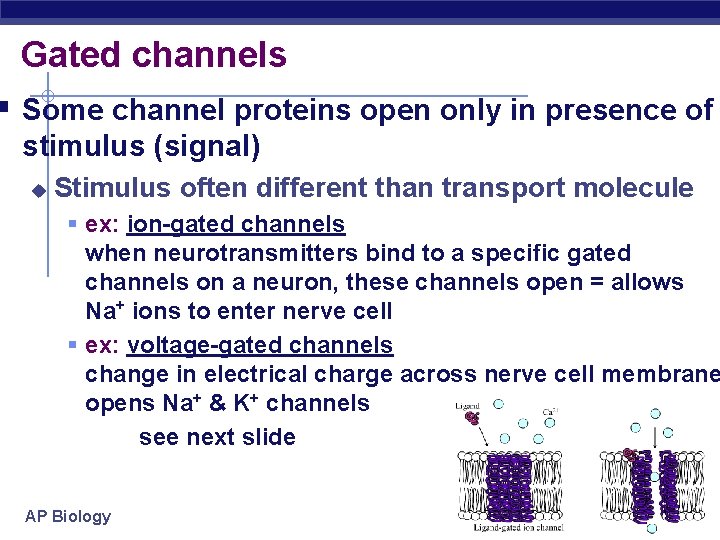
Gated channels § Some channel proteins open only in presence of stimulus (signal) u Stimulus often different than transport molecule § ex: ion-gated channels when neurotransmitters bind to a specific gated channels on a neuron, these channels open = allows Na+ ions to enter nerve cell § ex: voltage-gated channels change in electrical charge across nerve cell membrane opens Na+ & K+ channels see next slide AP Biology
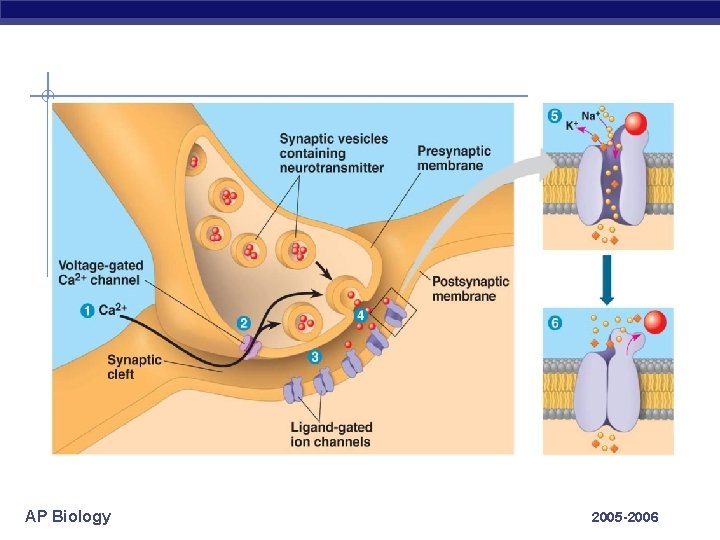
AP Biology 2005 -2006
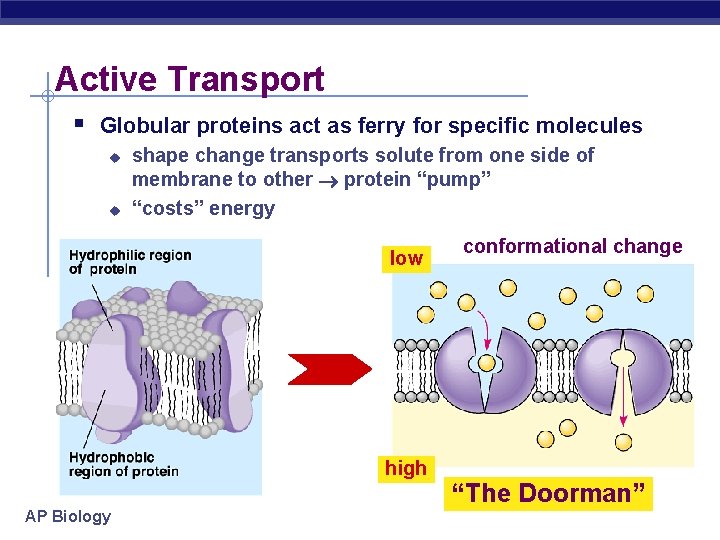
Active Transport § Globular proteins act as ferry for specific molecules u u shape change transports solute from one side of membrane to other protein “pump” “costs” energy low high AP Biology conformational change “The Doorman”
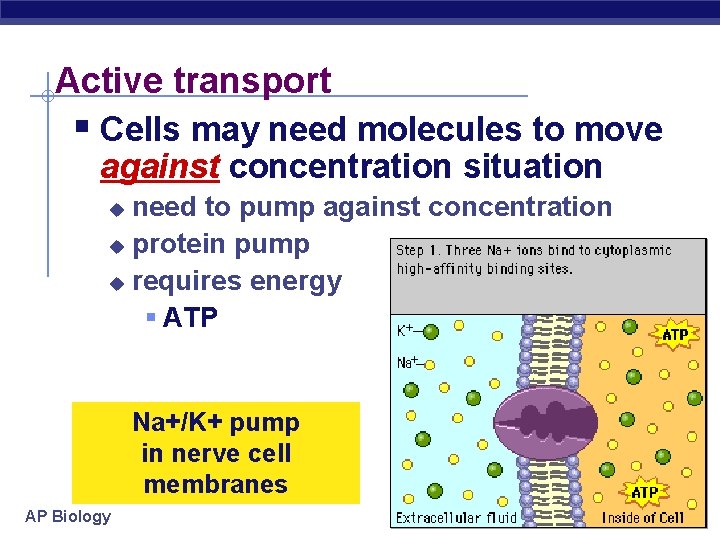
Active transport § Cells may need molecules to move against concentration situation need to pump against concentration u protein pump u requires energy § ATP u Na+/K+ pump in nerve cell membranes AP Biology 2005 -2006
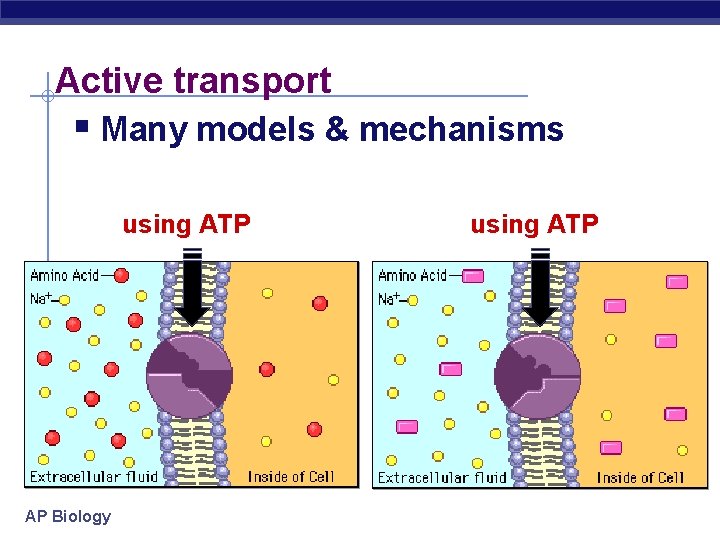
Active transport § Many models & mechanisms using ATP AP Biology using ATP
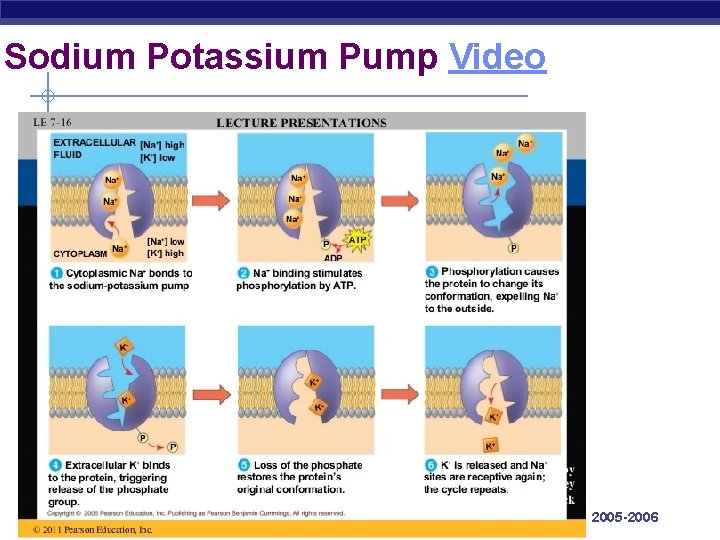
Sodium Potassium Pump Video AP Biology 2005 -2006
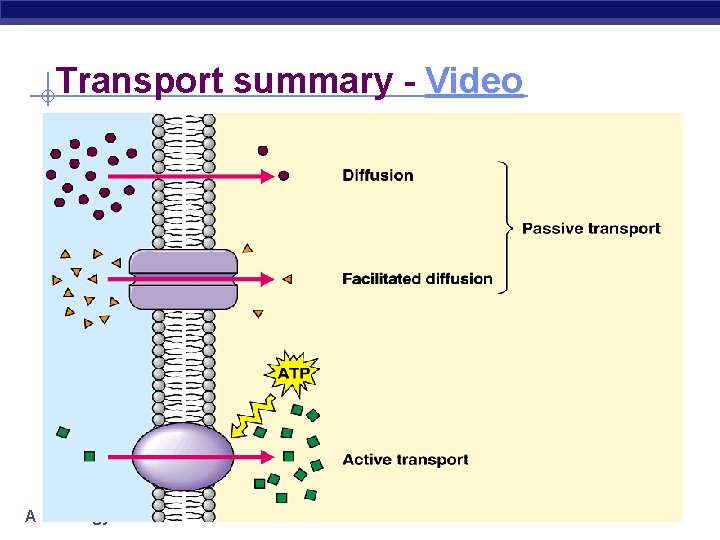
Transport summary - Video AP Biology 2005 -2006
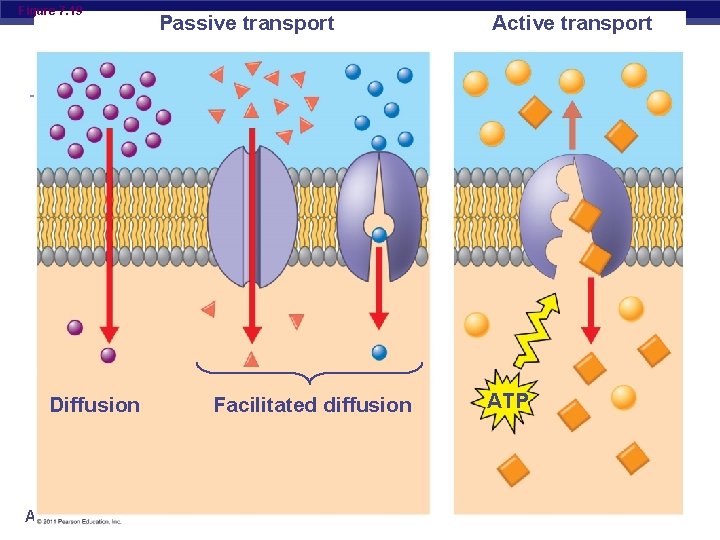
Figure 7. 19 Diffusion AP Biology Passive transport Facilitated diffusion Active transport ATP
Cotransport: Coupled Transport by a Membrane Protein § Cotransport occurs when active transport § of a solute indirectly drives transport of other solutes Plants commonly use the gradient of hydrogen ions generated by proton pumps to drive active transport of nutrients into the cell AP Biology © 2011 Pearson Education, Inc.
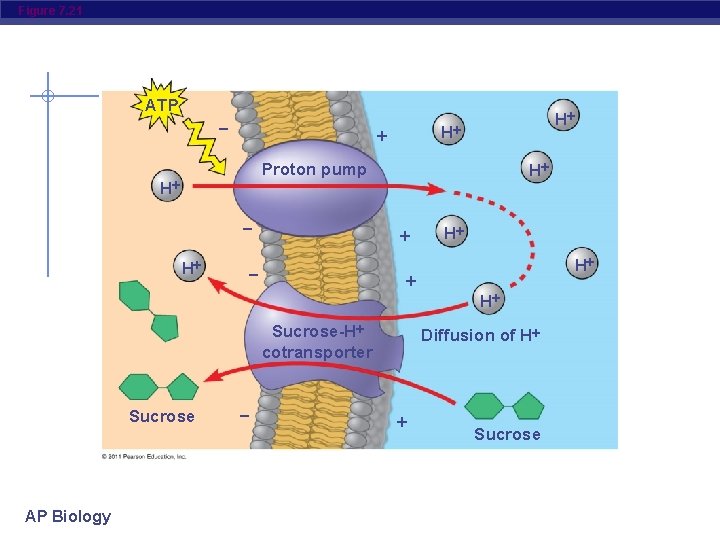
Figure 7. 21 ATP H H Proton pump H H H H H Sucrose-H cotransporter Sucrose AP Biology Diffusion of H Sucrose
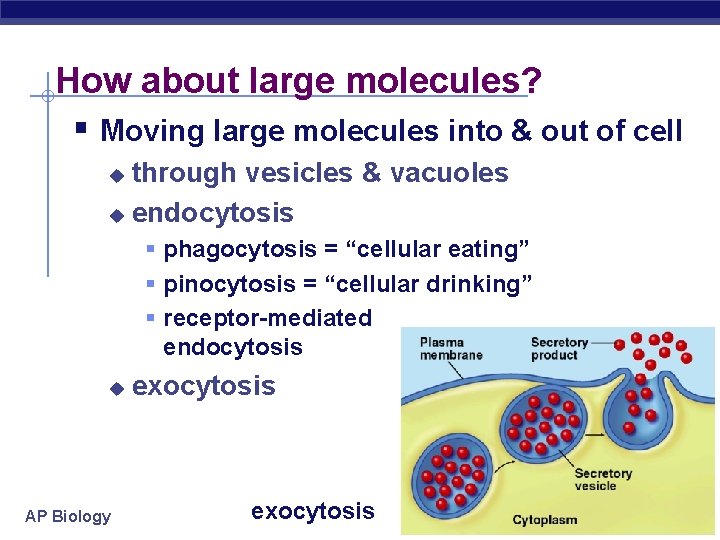
How about large molecules? § Moving large molecules into & out of cell through vesicles & vacuoles u endocytosis u § phagocytosis = “cellular eating” § pinocytosis = “cellular drinking” § receptor-mediated endocytosis u AP Biology exocytosis 2005 -2006
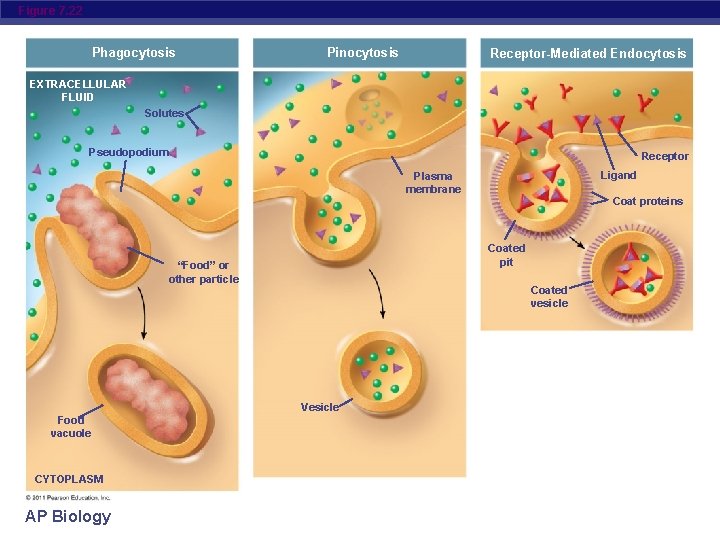
Figure 7. 22 Phagocytosis Pinocytosis Receptor-Mediated Endocytosis EXTRACELLULAR FLUID Solutes Pseudopodium Receptor Ligand Plasma membrane Coated pit “Food” or other particle Coated vesicle Vesicle Food vacuole CYTOPLASM AP Biology Coat proteins
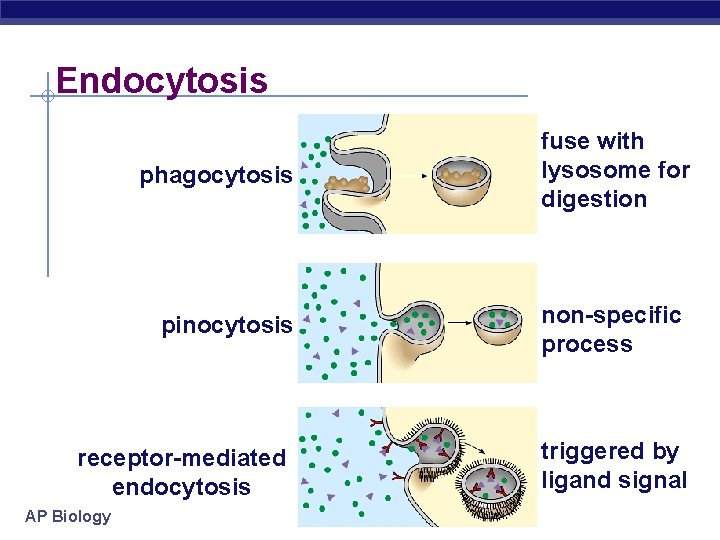
Endocytosis phagocytosis pinocytosis receptor-mediated endocytosis AP Biology fuse with lysosome for digestion non-specific process triggered by ligand signal
The Special Case of Water Movement of water across the cell membrane AP Biology 2005 -2006
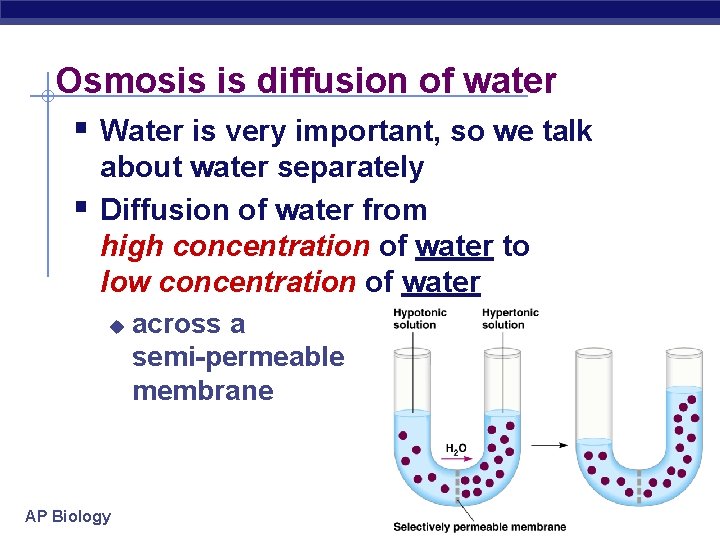
Osmosis is diffusion of water § Water is very important, so we talk § about water separately Diffusion of water from high concentration of water to low concentration of water u AP Biology across a semi-permeable membrane 2005 -2006
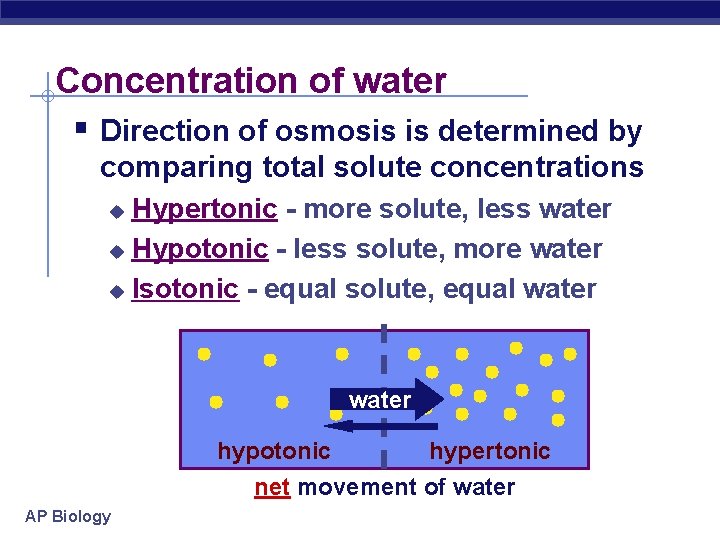
Concentration of water § Direction of osmosis is determined by comparing total solute concentrations Hypertonic - more solute, less water u Hypotonic - less solute, more water u Isotonic - equal solute, equal water u water hypotonic hypertonic net movement of water AP Biology
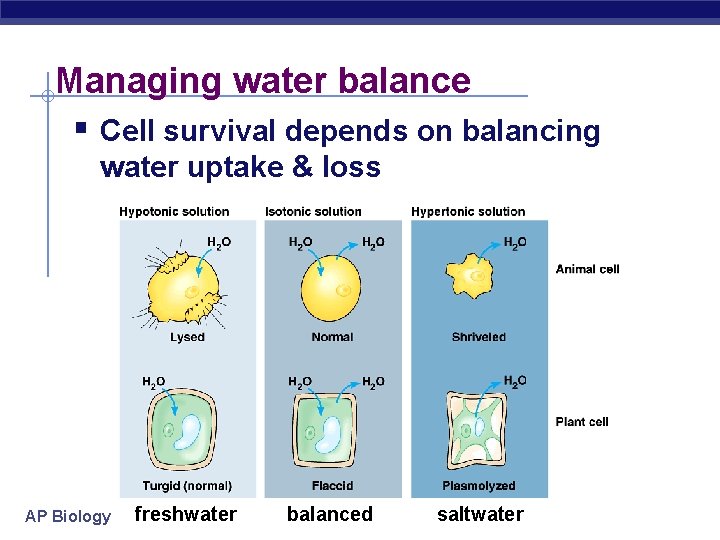
Managing water balance § Cell survival depends on balancing water uptake & loss AP Biology freshwater balanced saltwater

Managing water balance § Isotonic u AP Biology animal cell immersed in isotonic solution § blood cells in blood § no net movement of water across plasma membrane § water flows across membrane, at same rate in both directions § volume of cell is stable
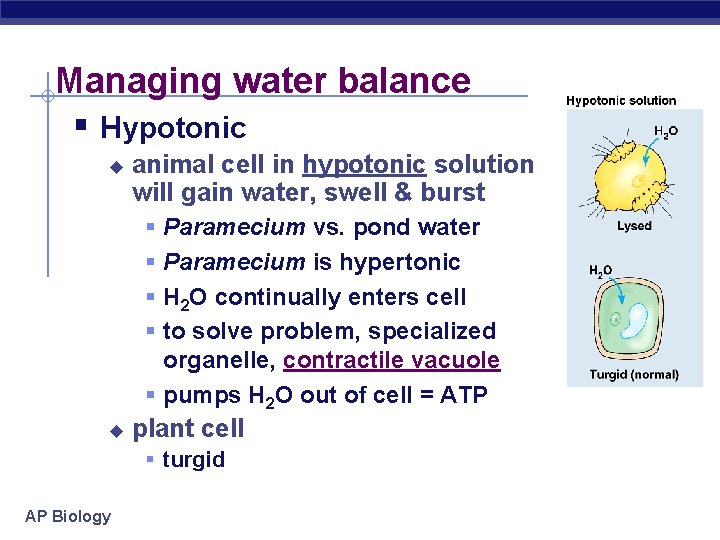
Managing water balance § Hypotonic u animal cell in hypotonic solution will gain water, swell & burst Paramecium vs. pond water Paramecium is hypertonic H 2 O continually enters cell to solve problem, specialized organelle, contractile vacuole § pumps H 2 O out of cell = ATP § § u plant cell § turgid AP Biology
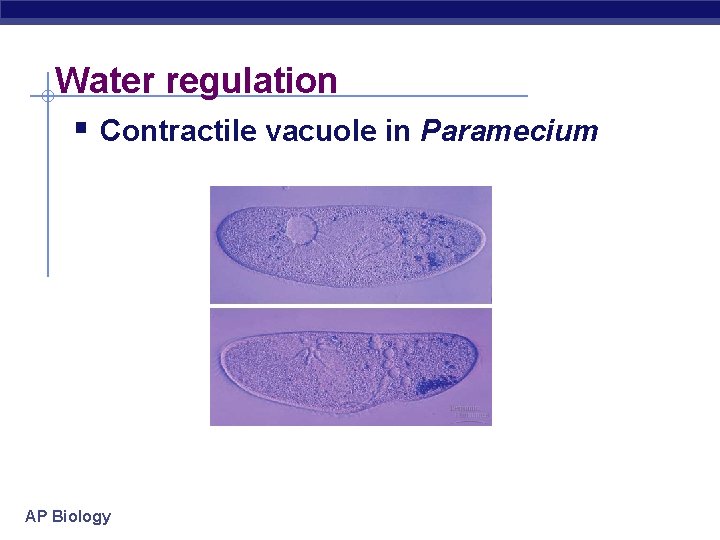
Water regulation § Contractile vacuole in Paramecium AP Biology
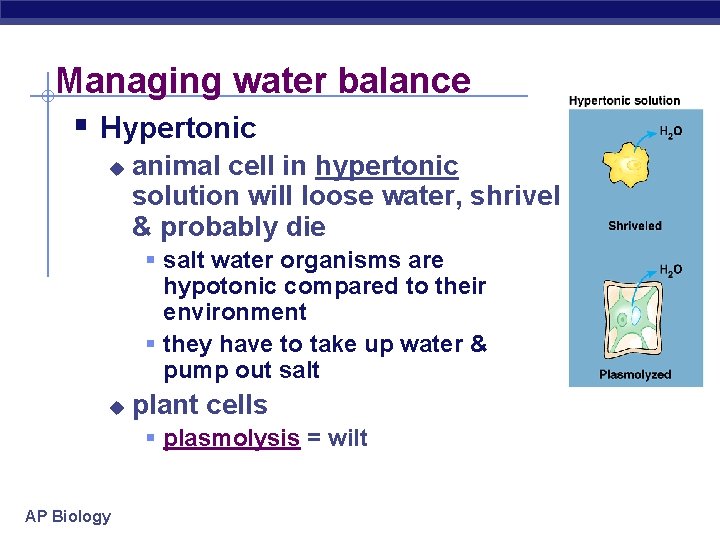
Managing water balance § Hypertonic u animal cell in hypertonic solution will loose water, shrivel & probably die § salt water organisms are hypotonic compared to their environment § they have to take up water & pump out salt u plant cells § plasmolysis = wilt AP Biology

Figure 7. 15 (a) Animal cell Hypotonic solution H 2 O (b) Plant cell Isotonic solution H 2 O Lysed Normal H 2 OCell wall H 2 O Turgid (normal) Flaccid Osmosis AP Biology H 2 O Hypertonic solution H 2 O Shriveled H 2 O Plasmolyzed
Water Balance of Cells Without Walls § Tonicity is the ability of a surrounding § § § solution to cause a cell to gain or lose water Isotonic solution: Solute concentration is the same as that inside the cell; no net water movement across the plasma membrane Hypertonic solution: Solute concentration is greater than that inside the cell; cell loses water Hypotonic solution: Solute concentration is less than that inside the cell; cell gains water AP Biology © 2011 Pearson Education, Inc.
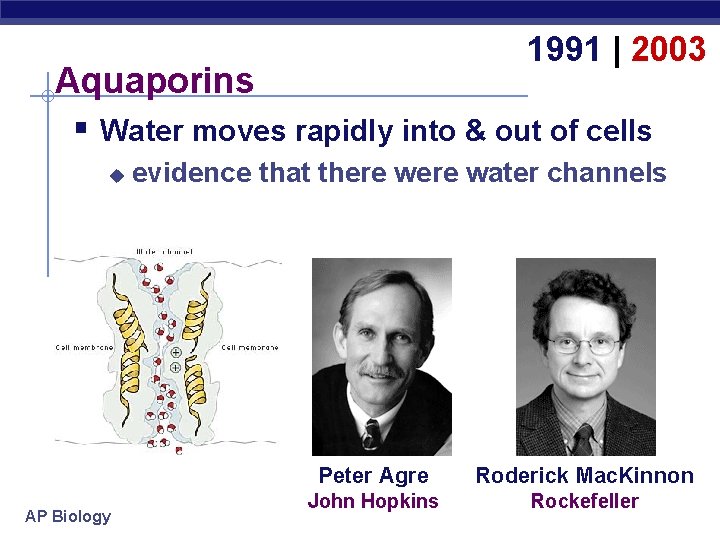
1991 | 2003 Aquaporins § Water moves rapidly into & out of cells u AP Biology evidence that there water channels Peter Agre Roderick Mac. Kinnon John Hopkins Rockefeller
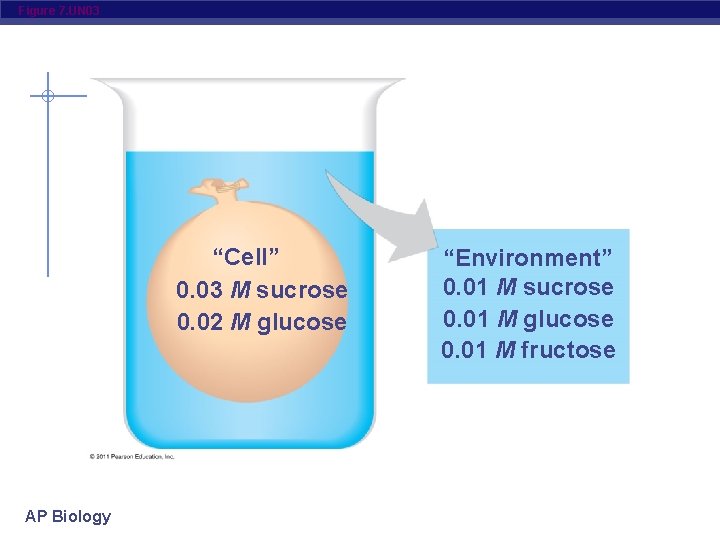
Figure 7. UN 03 “Cell” 0. 03 M sucrose 0. 02 M glucose AP Biology “Environment” 0. 01 M sucrose 0. 01 M glucose 0. 01 M fructose
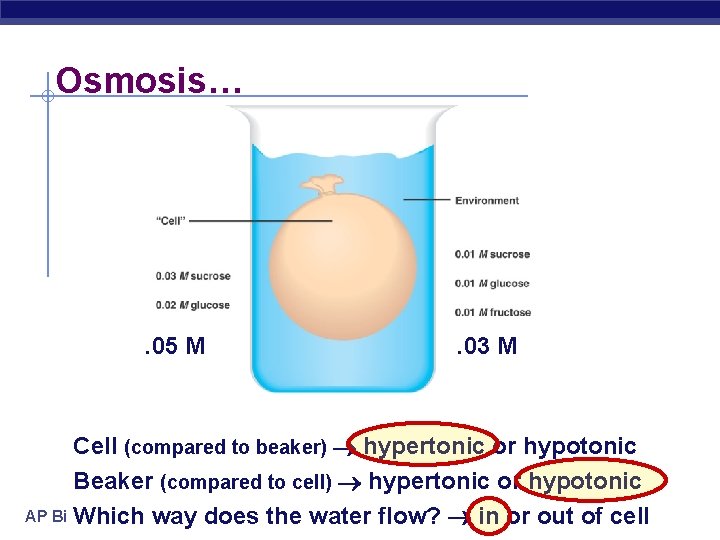
Osmosis… . 05 M . 03 M Cell (compared to beaker) hypertonic or hypotonic Beaker (compared to cell) hypertonic or hypotonic AP Biology Which way does the water flow? in or out of 2005 -2006 cell
- Slides: 49