
CHAPTER 8 MOTIVATION LEARNING AND REWARDS REINFORCEMENT THEORY
- Slides: 19
CHAPTER 8: MOTIVATION: LEARNING AND REWARDS
REINFORCEMENT THEORY • Based on the law of effect • Past actions leading to positive outcomes tend to be repeated, • whereas past actions that led to negative outcomes will diminish. • Led to the development of operant conditioning • https: //www. youtube. com/watch? v=qy_m. IEnnl. F 4 Scandura, Essentials of Organizational Behavior. © 2016, SAGE Publications. 2
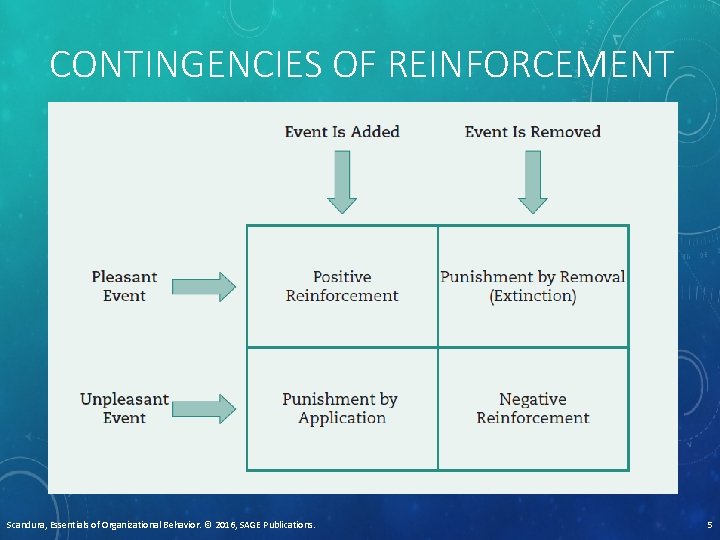
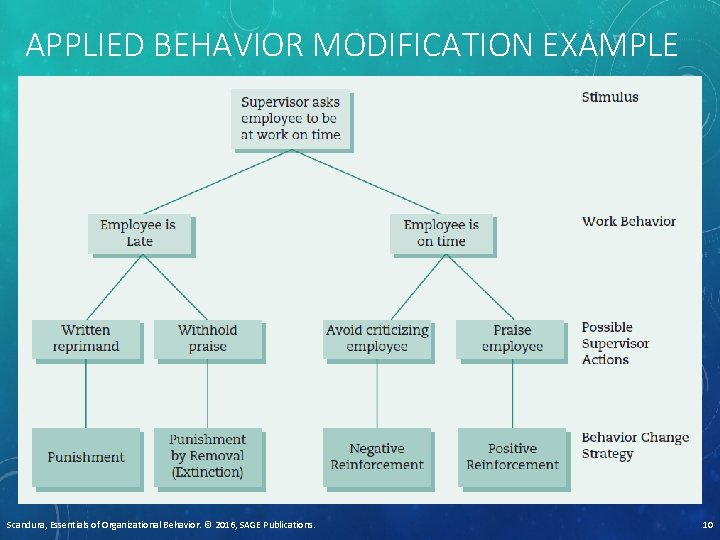
REINFORCERS • The two kinds of reinforcement that increase behavior: • Positive reinforcement • Negative reinforcement Scandura, Essentials of Organizational Behavior. © 2016, SAGE Publications. 3
PUNISHMENT The presentation of an adverse event causes a decrease in the behavior it follows; there are two kinds of punishment: 1. Punishment by application 2. Punishment by removal (also called extinction) Scandura, Essentials of Organizational Behavior. © 2016, SAGE Publications. 4
CONTINGENCIES OF REINFORCEMENT Scandura, Essentials of Organizational Behavior. © 2016, SAGE Publications. 5
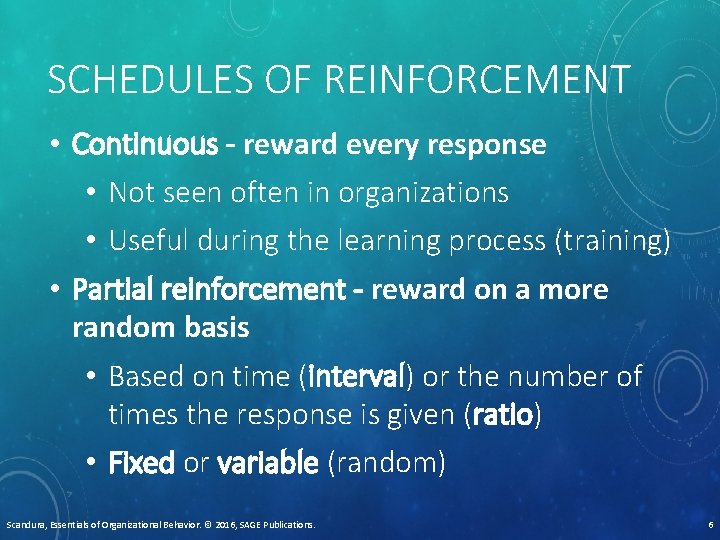
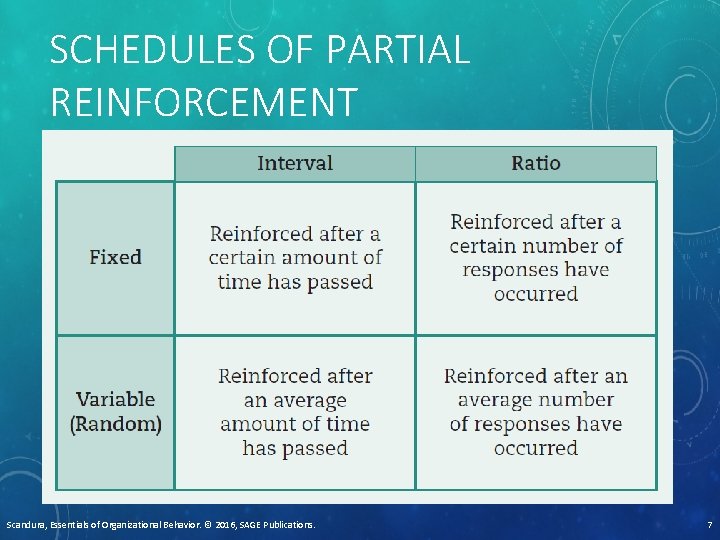
SCHEDULES OF REINFORCEMENT • Continuous - reward every response • Not seen often in organizations • Useful during the learning process (training) • Partial reinforcement - reward on a more random basis • Based on time (interval) or the number of times the response is given (ratio) • Fixed or variable (random) Scandura, Essentials of Organizational Behavior. © 2016, SAGE Publications. 6
SCHEDULES OF PARTIAL REINFORCEMENT Scandura, Essentials of Organizational Behavior. © 2016, SAGE Publications. 7
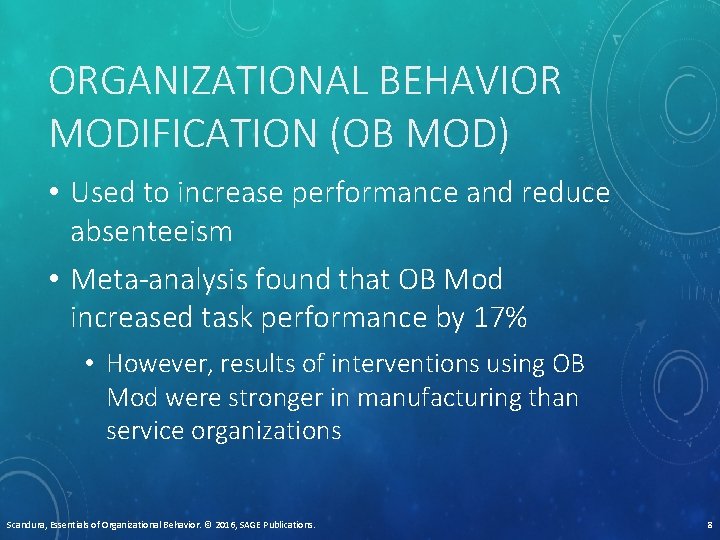
ORGANIZATIONAL BEHAVIOR MODIFICATION (OB MOD) • Used to increase performance and reduce absenteeism • Meta-analysis found that OB Mod increased task performance by 17% • However, results of interventions using OB Mod were stronger in manufacturing than service organizations Scandura, Essentials of Organizational Behavior. © 2016, SAGE Publications. 8
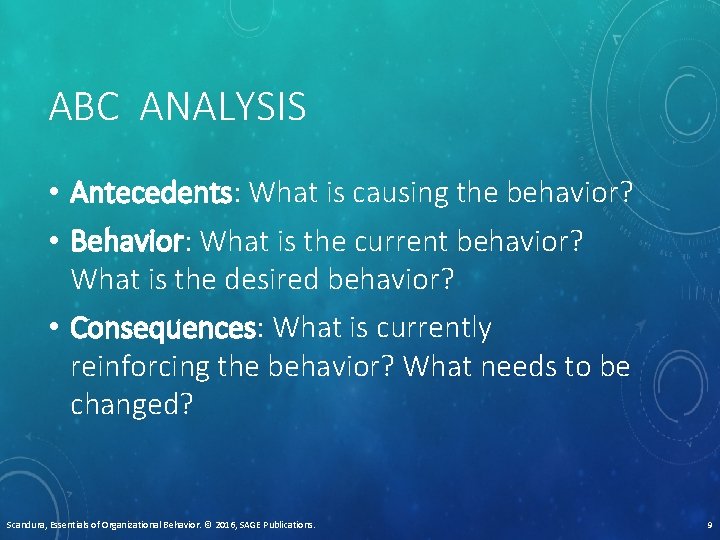
ABC ANALYSIS • Antecedents: What is causing the behavior? • Behavior: What is the current behavior? What is the desired behavior? • Consequences: What is currently reinforcing the behavior? What needs to be changed? Scandura, Essentials of Organizational Behavior. © 2016, SAGE Publications. 9
APPLIED BEHAVIOR MODIFICATION EXAMPLE Scandura, Essentials of Organizational Behavior. © 2016, SAGE Publications. 10
SOCIAL LEARNING THEORY • Extends operant conditioning • People can learn from watching other people succeed or fail. • Known as observational learning (or modeling) Scandura, Essentials of Organizational Behavior. © 2016, SAGE Publications. 11
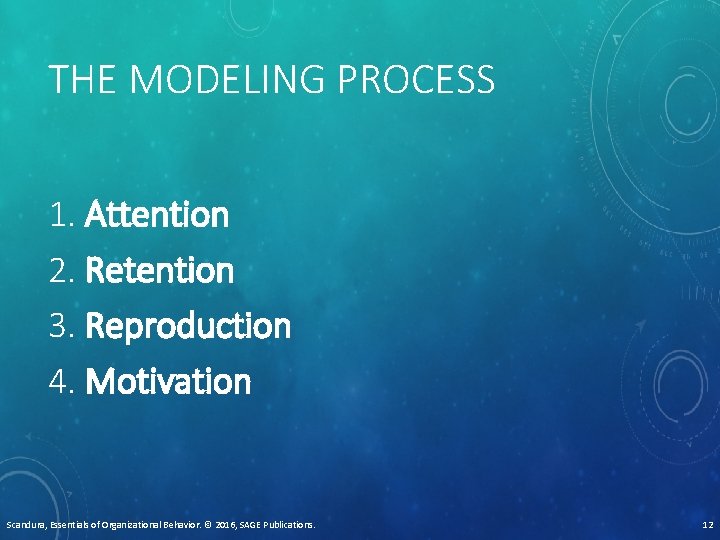
THE MODELING PROCESS 1. Attention 2. Retention 3. Reproduction 4. Motivation Scandura, Essentials of Organizational Behavior. © 2016, SAGE Publications. 12
INTRINSIC VS. EXTRINSIC REWARDS • Intrinsic motivation • Gain satisfaction from the task itself • Extrinsic motivation • Performance outcome expectancies • Satisfaction comes from the extrinsic reward (e. g. , money) Scandura, Essentials of Organizational Behavior. © 2016, SAGE Publications. 13
RELATIONSHIP BETWEEN INTRINSIC AND EXTRINSIC REWARDS • Extrinsics in service of intrinsics • Motivation–work cycle match • https: //www. youtube. com/watch? v=h 86 g-Xg. UCA 8 Scandura, Essentials of Organizational Behavior. © 2016, SAGE Publications. 14
WHAT MONEY CAN AND CANNOT DO • Hospital study: pay level practices and pay structures combined to affect: • Resource efficiency, patient care outcomes, and financial performance • On the other hand, tying pay directly to performance can have dysfunctional or even unethical consequences. Scandura, Essentials of Organizational Behavior. © 2016, SAGE Publications. 15
PAY DISPERSION • When employees receive different levels of rewards for individual efforts • Can cause jealously among employees and/or harm team performance • If pay dispersion creates pay inequity due to discrimination, it may result in litigation under the Equal Pay Act. Scandura, Essentials of Organizational Behavior. © 2016, SAGE Publications. 16
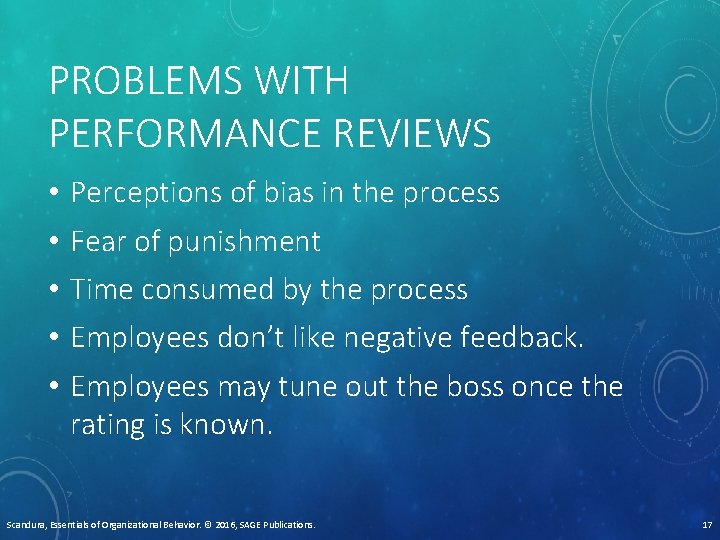
PROBLEMS WITH PERFORMANCE REVIEWS • • • Perceptions of bias in the process Fear of punishment Time consumed by the process Employees don’t like negative feedback. Employees may tune out the boss once the rating is known. Scandura, Essentials of Organizational Behavior. © 2016, SAGE Publications. 17
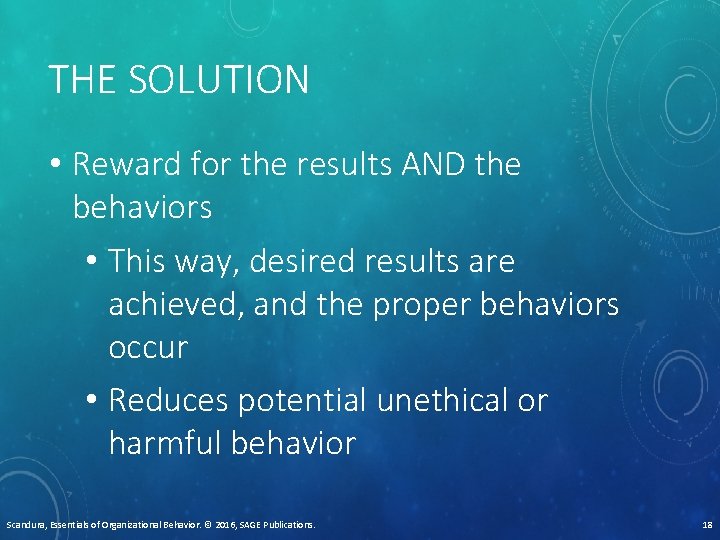
THE SOLUTION • Reward for the results AND the behaviors • This way, desired results are achieved, and the proper behaviors occur • Reduces potential unethical or harmful behavior Scandura, Essentials of Organizational Behavior. © 2016, SAGE Publications. 18
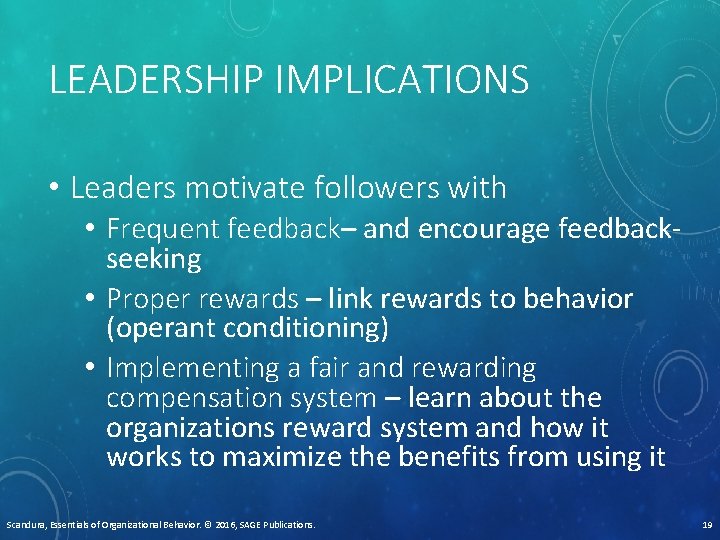
LEADERSHIP IMPLICATIONS • Leaders motivate followers with • Frequent feedback– and encourage feedbackseeking • Proper rewards – link rewards to behavior (operant conditioning) • Implementing a fair and rewarding compensation system – learn about the organizations reward system and how it works to maximize the benefits from using it Scandura, Essentials of Organizational Behavior. © 2016, SAGE Publications. 19