
Chapter 8 Mobile Computing and Commerce LEARNING OBJECTIVES
Chapter 8 Mobile Computing and Commerce
LEARNING OBJECTIVES 1. Discuss the value-added attributes, benefits, and fundamental drivers of m-commerce. 2. Describe the mobile computing environment that supports m-commerce (devices, software, services). 3. Describe the four major types of wireless telecommunications networks. 4. Discuss m-commerce applications in finance. Copyright © 2011 Pearson Education, Inc. Publishing as Prentice Hall 8 -1
LEARNING OBJECTIVES 5. Describe m-commerce applications in shopping, advertising, and provision of content. 6. Discuss the application of m-commerce within organizations and across the supply chain. 7. Describe consumer and personal applications of mcommerce. 8. Understand the technologies and potential application of location-based m-commerce. 9. Describe the major inhibitors and barriers of mcommerce. Copyright © 2011 Pearson Education, Inc. Publishing as Prentice Hall 8 -2
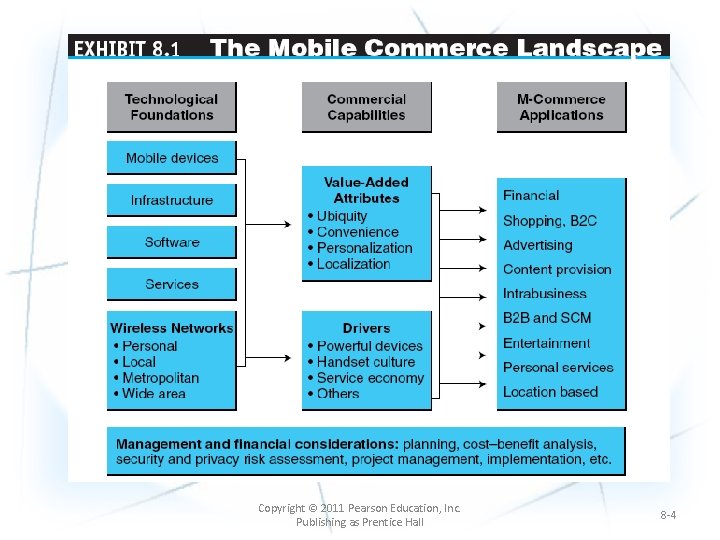
MOBILE COMMERCE: ATTRIBUTES, BENEFITS, AND DRIVERS • mobile commerce (m-commerce or m-business) Any business activity conducted over a wireless telecommunications network or from mobile devices. Copyright © 2011 Pearson Education, Inc. Publishing as Prentice Hall 8 -3
Copyright © 2011 Pearson Education, Inc. Publishing as Prentice Hall 8 -4
MOBILE COMMERCE: ATTRIBUTES, BENEFITS, AND DRIVERS • ATTRIBUTES OF M-COMMERCE – Ubiquity – Convenience – Interactivity – Personalization – Localization Copyright © 2011 Pearson Education, Inc. Publishing as Prentice Hall 8 -5
MOBILE COMMERCE: ATTRIBUTES, BENEFITS, AND DRIVERS • DRIVERS OF M-COMMERCE – Widespread availability of more powerful mobile devices – The handset culture – The service economy – Vendor’s push – The mobile workforce – Increased mobility – Improved price/performance – Improving bandwidth Copyright © 2011 Pearson Education, Inc. Publishing as Prentice Hall 8 -6
COMPONENTS, TECHNICAL INFRASTRUCTURE, AND SERVICES OF MOBILE COMPUTING • wireless mobile computing (mobile computing) Computing that connects a mobile device to a network or another computing device, anytime, anywhere. Copyright © 2011 Pearson Education, Inc. Publishing as Prentice Hall 8 -7
COMPONENTS, TECHNICAL INFRASTRUCTURE, AND SERVICES OF MOBILE COMPUTING • MOBILE DEVICES – personal digital assistant (PDA) A stand-alone handheld computer principally used for personal information management. – smart phone A mobile phone with PC-like capabilities. Copyright © 2011 Pearson Education, Inc. Publishing as Prentice Hall 8 -8
COMPONENTS, TECHNICAL INFRASTRUCTURE, AND SERVICES OF MOBILE COMPUTING • MOBILE COMPUTING SOFTWARE AND SERVICES – Messaging Services • short message service (SMS) A service that supports the sending and receiving of short text messages on mobile phones. • multimedia messaging service (MMS) The emerging generation of wireless messaging; MMS is able to deliver rich media. Copyright © 2011 Pearson Education, Inc. Publishing as Prentice Hall 8 -9
COMPONENTS, TECHNICAL INFRASTRUCTURE, AND SERVICES OF MOBILE COMPUTING – Location-Based Services – Voice-Support Services – interactive voice response (IVR) A voice system that enables users to request and receive information and to enter and change data through a telephone to a computerized system. – voice portal A Web site with an audio interface that can be accessed through a telephone call. Copyright © 2011 Pearson Education, Inc. Publishing as Prentice Hall 8 -10

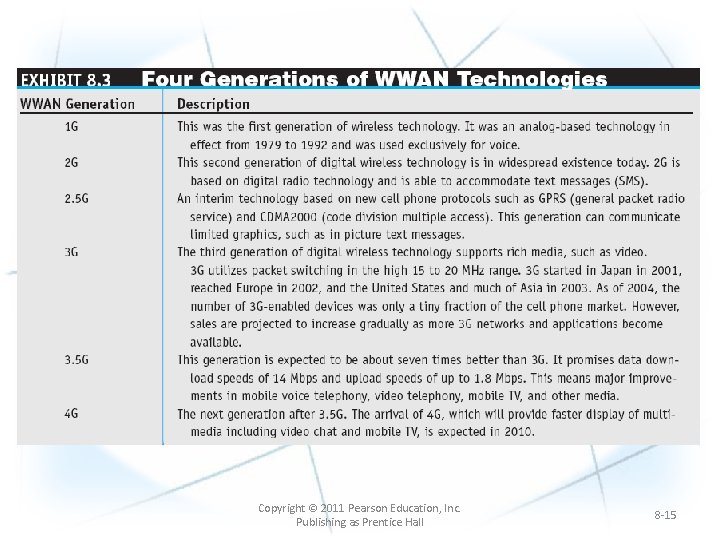
COMPONENTS, TECHNICAL INFRASTRUCTURE, AND SERVICES OF MOBILE COMPUTING • WIRELESS TELECOMMUNICATIONS NETWORKS – personal area network (PAN) A wireless telecommunications network for deviceto-device connections within a very short range. • Bluetooth A set of telecommunications standards that enables wireless devices to communicate with each other over short distances. Copyright © 2011 Pearson Education, Inc. Publishing as Prentice Hall 8 -11
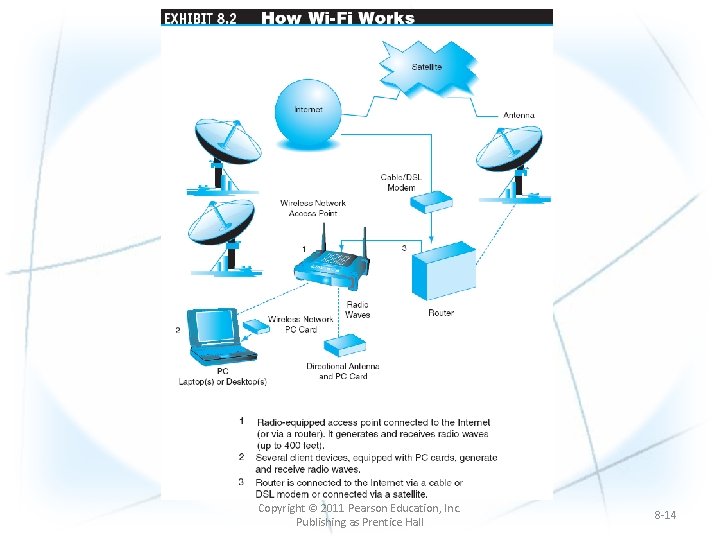
COMPONENTS, TECHNICAL INFRASTRUCTURE, AND SERVICES OF MOBILE COMPUTING – wireless local area network (WLAN) A telecommunications network that enables users to make short-range wireless connections to the Internet or another network. • Wi-Fi (wireless fidelity) The common name used to describe the IEEE 802. 11 standard used on most WLANs. – Municipal Wi-Fi networks Copyright © 2011 Pearson Education, Inc. Publishing as Prentice Hall 8 -12
COMPONENTS, TECHNICAL INFRASTRUCTURE, AND SERVICES OF MOBILE COMPUTING – Wi. Max A wireless standard (IEEE 802. 16) for making broadband network connections over a mediumsize area such as a city. – wireless wide area network (WWAN) A telecommunications network that offers wireless coverage over a large geographical area, typically over a cellular phone network. Copyright © 2011 Pearson Education, Inc. Publishing as Prentice Hall 8 -13
Copyright © 2011 Pearson Education, Inc. Publishing as Prentice Hall 8 -14
Copyright © 2011 Pearson Education, Inc. Publishing as Prentice Hall 8 -15
MOBILE FINANCIAL APPLICATIONS • MOBILE BANKING • MOBILE PAYMENTS – Mobile Proximity Payments – Mobile Remote Payments – microfinance Refers to the provision of financial services to poor or low-income clients, including consumers and the self-employed. Copyright © 2011 Pearson Education, Inc. Publishing as Prentice Hall 8 -16
MOBILE MARKETING AND ADVERTISING • MOBILE MARKETING CAMPAIGNS – Four classes of online campaigns: 1. 2. 3. 4. Information Entertainment Raffles Coupons Copyright © 2011 Pearson Education, Inc. Publishing as Prentice Hall 8 -17
MOBILE MARKETING AND ADVERTISING – The major objectives of these classes fell into one of six categories: 1. Building brand awareness 2. Changing brand image 3. Promoting sales 4. Enhancing brand loyalty 5. Building customer databases 6. Stimulating mobile word of mouth Copyright © 2011 Pearson Education, Inc. Publishing as Prentice Hall 8 -18
MOBILE MARKETING AND ADVERTISING • MOBILE MARKETING GUIDELINES – Notice – Choice and consent – Customization and constraint – Security – Enforcement and accountability Copyright © 2011 Pearson Education, Inc. Publishing as Prentice Hall 8 -19
MOBILE WORKFORCE SOLUTIONS • mobile worker Any employee who is away from his or her primary work space at least 10 hours a week or 25 percent of the time. Copyright © 2011 Pearson Education, Inc. Publishing as Prentice Hall 8 -20
MOBILE WORKFORCE SOLUTIONS – Benefits of Mobile Workforce Support • Provides mobile workers with real-time access to enterprise data and applications • Reduces time required in the field to process orders or to service customer requests • Automates existing paper and pen processes and workflows • Ensures that processes are completed in a uniform fashion with minimal data entry errors or data loss Copyright © 2011 Pearson Education, Inc. Publishing as Prentice Hall 8 -21
MOBILE WORKFORCE SOLUTIONS – Mobile workers can be divided into three segments: • Mobile professionals (senior executives and consultants) • Mobile field force (field sales and service technicians) • Mobile specialty workers (delivery personnel and construction workers) Copyright © 2011 Pearson Education, Inc. Publishing as Prentice Hall 8 -22
MOBILE WORKFORCE SOLUTIONS – Some of the solutions that are widely used by the three segments include: • • Mobile office applications Sales force automation (SFA) Field force automation (FFA) Mobile CRM (e-CRM) Copyright © 2011 Pearson Education, Inc. Publishing as Prentice Hall 8 -23
MOBILE WORKFORCE SOLUTIONS – Challenges of Mobile Workforce Support • • • Network coverage gaps and interruptions Internetwork roaming Mobile network and application performance Device and network management Bandwidth management Copyright © 2011 Pearson Education, Inc. Publishing as Prentice Hall 8 -24
MOBILE ENTERTAINMENT • mobile entertainment Any type of leisure activity that utilizes wireless telecommunication networks, interacts with service providers, and incurs a cost upon usage. Copyright © 2011 Pearson Education, Inc. Publishing as Prentice Hall 8 -25
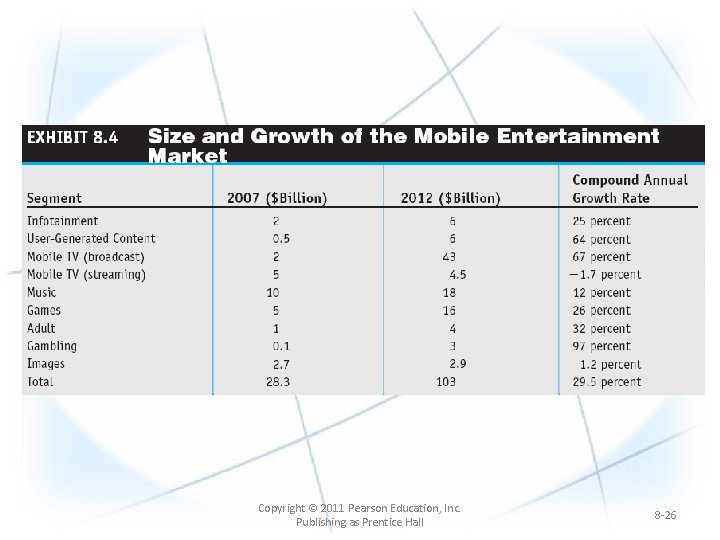
Copyright © 2011 Pearson Education, Inc. Publishing as Prentice Hall 8 -26

MOBILE ENTERTAINMENT • MOBILE MUSIC AND VIDEO • MOBILE GAMES – Technology – Number of players – Genre • MOBILE GAMBLING Copyright © 2011 Pearson Education, Inc. Publishing as Prentice Hall 8 -27
LOCATION-BASED MOBILE COMMERCE • location-based m-commerce (l-commerce) Delivery of m-commerce transactions to individuals in a specific location, at a specific time. Copyright © 2011 Pearson Education, Inc. Publishing as Prentice Hall 8 -28

LOCATION-BASED MOBILE COMMERCE • The services provided through location-based m-commerce focus on five key factors: 1. 2. 3. 4. 5. Location Navigation Tracking Mapping Timing Copyright © 2011 Pearson Education, Inc. Publishing as Prentice Hall 8 -29
LOCATION-BASED MOBILE COMMERCE • L-COMMERCE INFRASTRUCTURE – Mobile devices – Communication network – Positioning component – Service or application provider – Data or content provider Copyright © 2011 Pearson Education, Inc. Publishing as Prentice Hall 8 -30
LOCATION-BASED MOBILE COMMERCE – Positioning Component • network-based positioning Relies on base stations to find the location of a mobile device sending a signal or sensed by the network. • terminal-based positioning Calculating the location of a mobile device from signals sent by the device to base stations. Copyright © 2011 Pearson Education, Inc. Publishing as Prentice Hall 8 -31
LOCATION-BASED MOBILE COMMERCE • global positioning system (GPS) A worldwide satellite-based tracking system that enables users to determine their position anywhere on Earth. • real-time location system (RTLS) Systems used to track and identify the location of objects in real time. Copyright © 2011 Pearson Education, Inc. Publishing as Prentice Hall 8 -32
LOCATION-BASED MOBILE COMMERCE – Location-Based Data • • • Locating Navigating Searching Identifying Event checking – Geographical information system (GIS) A computer system capable of integrating, storing, editing, analyzing, sharing, and displaying geographically referenced (spatial) information. Copyright © 2011 Pearson Education, Inc. Publishing as Prentice Hall 8 -33

Copyright © 2011 Pearson Education, Inc. Publishing as Prentice Hall 8 -34
LOCATION-BASED MOBILE COMMERCE • BARRIERS TO LOCATION-BASED M-COMMERCE – Lack of GPS in mobile phones – Accuracy of devices – The cost-benefit justification – Limited network bandwidth – Invasion of privacy Copyright © 2011 Pearson Education, Inc. Publishing as Prentice Hall 8 -35

SECURITY AND OTHER IMPLEMENTATION ISSUES IN MOBILE COMMERCE • M-COMMERCE SECURITY ISSUES – The basic security goals of confidentiality, authentication, authorization, and integrity are just as important for m-commerce as they are for e-commerce but are more difficult to ensure – An appropriate level of security must be maintained on several networks, both wireless and wired. • ETHICAL, LEGAL, AND HEALTH ISSUES IN MCOMMERCE Copyright © 2011 Pearson Education, Inc. Publishing as Prentice Hall 8 -36
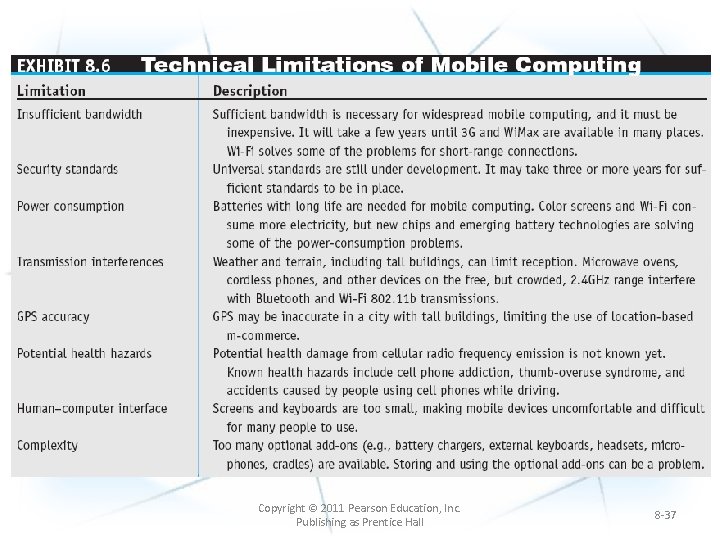
Copyright © 2011 Pearson Education, Inc. Publishing as Prentice Hall 8 -37
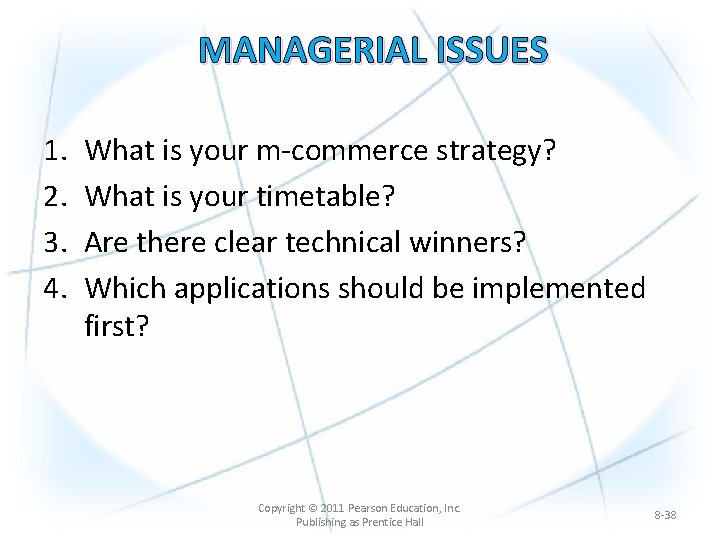
MANAGERIAL ISSUES 1. 2. 3. 4. What is your m-commerce strategy? What is your timetable? Are there clear technical winners? Which applications should be implemented first? Copyright © 2011 Pearson Education, Inc. Publishing as Prentice Hall 8 -38
- Slides: 39